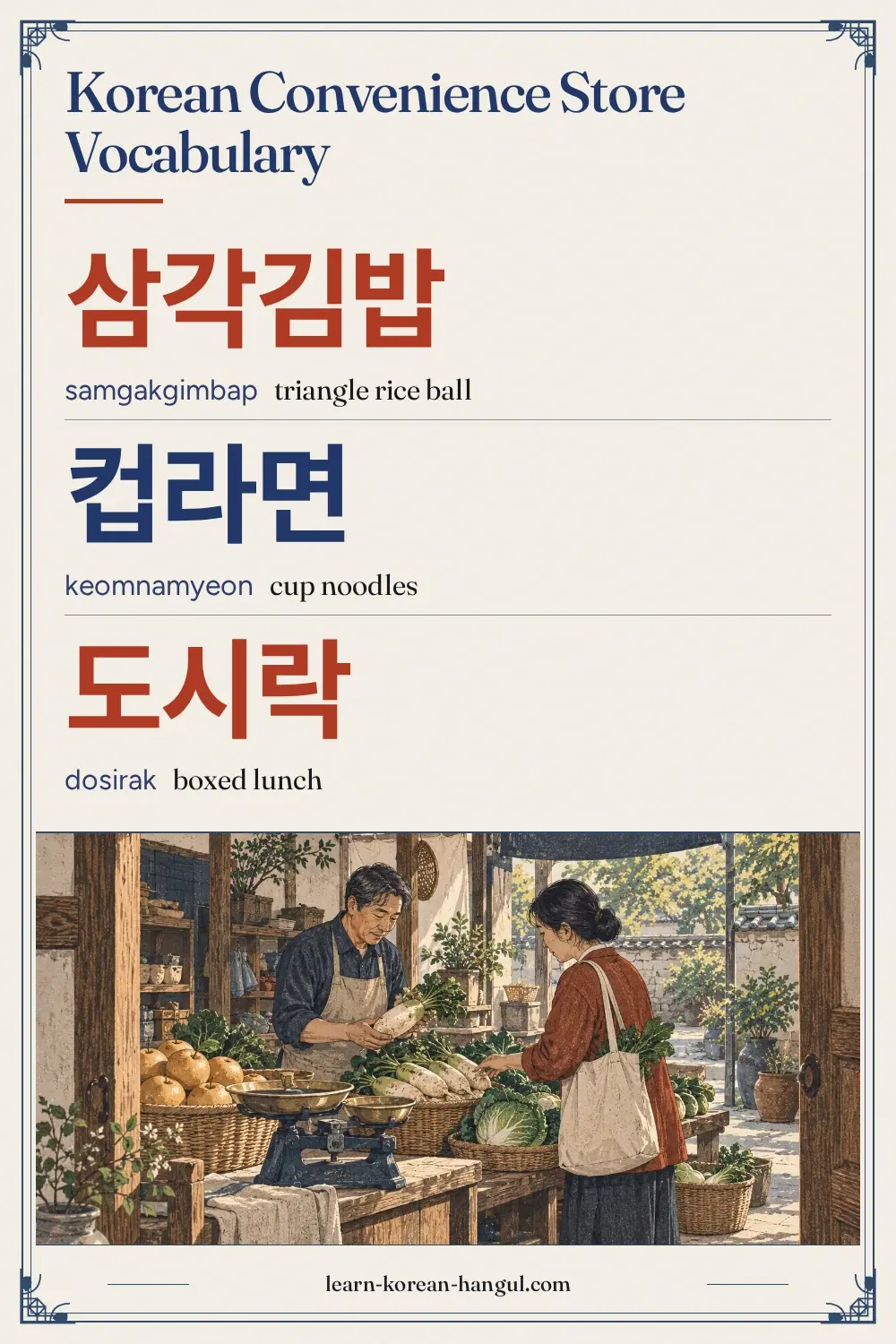
Korean Convenience Store Vocabulary at a Glance
This list has 35 words in five groups of seven. It follows a visit: you go in, pick up a snack or a meal, ask for it to be heated, use a service, check the deal and pay. It belongs to Shopping and pairs with Korean Supermarket Vocabulary for a full grocery shop. Every word has an example sentence, so the page doubles as a ready deck.
| Group | Words | Use |
|---|---|---|
| Products and snacks | 7 | Naming everyday items on the shelf |
| Ready meals and drinks | 7 | Ordering a quick meal and a drink |
| Services | 7 | Parcels, transit cards, cash and heating |
| Deals (1+1, 2+1) | 7 | Reading promotion stickers |
| Payment and receipts | 7 | Opening hours, paying and change |
Most words are nouns. A few, such as 충전 and 결제, turn into verbs with 하다. The next section tells you which to learn first.
Which Convenience Store Words Should You Learn First?
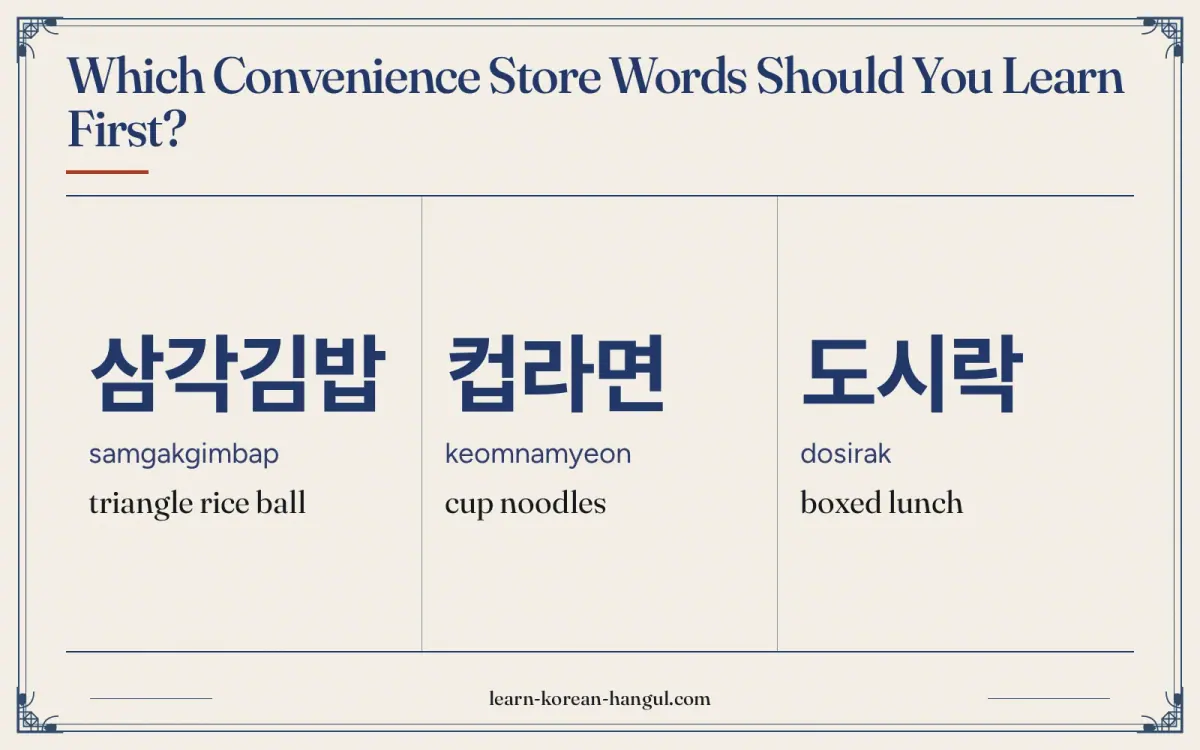
Learn 삼각김밥 (triangle rice ball), 컵라면 (cup noodles), 데워 주세요 (please heat it), 카드 (card) and 봉투 (bag, taught on the Shopping list) first. With these five you can pick a meal, have it heated and pay. After that, add 택배 and 충전, the two services that visitors use most.
- Words to say. 삼각김밥, 컵라면, 데워 주세요, 카드, 포장해 주세요. These go straight into requests.
- Words to recognise. 원 플러스 원, 투 플러스 원, 행사, 품절, 신상품. These appear on stickers and shelf tags.
- Words to understand when spoken. 결제, 거스름돈, 데워 드릴까요. The clerk says them, and you only need to react.
Two habits help. First, many convenience stores let you heat food yourself, so you can often answer a heating question with a simple yes and walk to the microwave. Second, the big chains print their brand names in the Latin alphabet, but 편의점 is the word Koreans use in speech and the one to type into a map app.
Word · 8
- 1
삼각김밥
samgakgimbap
triangle rice ball
- 2
컵라면
keomnamyeon
cup noodles
- 3
도시락
dosirak
boxed lunch
- 4
김밥
gimbap
gimbap (rolled rice with fillings)
- 5
캔 커피
kaen keopi
canned coffee
- 6
택배
taekbae
parcel delivery
- 7
전자레인지
jeonjareinji
microwave oven
- 8
현금 인출기
hyeongeum inchulgi
cash machine (ATM)
Products and Snacks
A Korean convenience store, called a 편의점, is a small shop that sells snacks, drinks, simple goods and quick meals, and most of them stay open late. The first seven words name the things on the shelves that you pick up without asking anyone. Several are loanwords, so your English will help you read the labels.
| No. | Hangul | Revised Romanization | Meaning and note | Example sentence | Audio assetId |
|---|---|---|---|---|---|
| 1 | 편의점 | pyeonuijeom | convenience store. 편의 means convenience and 점 means shop. Said [펴늬점] or, more often, [펴니점], with the 의 sounding like 이. | 편의점에 가요. (I go to the convenience store.) | au-pg-vocabulary-daily-life-shopping-convenience-store-1; example: au-pg-vocabulary-daily-life-shopping-convenience-store-36 |
| 2 | 과자 | gwaja | snack; chips and cookies. The general word for packaged snacks. A whole shelf bay is labelled 과자. | 과자를 사요. (I buy snacks.) | au-pg-vocabulary-daily-life-shopping-convenience-store-2; example: au-pg-vocabulary-daily-life-shopping-convenience-store-37 |
| 3 | 초콜릿 | chokollit | chocolate. A loanword with a doubled l sound in the middle. Also spelled 초콜렛 in casual writing, but 초콜릿 is the standard. | 초콜릿을 좋아해요. (I like chocolate.) | au-pg-vocabulary-daily-life-shopping-convenience-store-3; example: au-pg-vocabulary-daily-life-shopping-convenience-store-38 |
| 4 | 아이스크림 | aiseukeurim | ice cream. A loanword. Convenience stores keep it in a freezer near the door. | 아이스크림 하나 주세요. (One ice cream, please.) | au-pg-vocabulary-daily-life-shopping-convenience-store-4; example: au-pg-vocabulary-daily-life-shopping-convenience-store-39 |
| 5 | 껌 | kkeom | chewing gum. A tense ㄲ at the start. Say it tight, without a puff of air. | 껌 있어요? (Do you have gum?) | au-pg-vocabulary-daily-life-shopping-convenience-store-5; example: au-pg-vocabulary-daily-life-shopping-convenience-store-40 |
| 6 | 건전지 | geonjeonji | battery (dry cell). Used for remote controls and clocks. The phone battery is 배터리, a different word. | 건전지가 필요해요. (I need a battery.) | au-pg-vocabulary-daily-life-shopping-convenience-store-6; example: au-pg-vocabulary-daily-life-shopping-convenience-store-41 |
| 7 | 우산 | usan | umbrella. A cheap umbrella is one of the quick purchases shoppers make when rain starts. | 비가 와서 우산을 사요. (It is raining, so I buy an umbrella.) | au-pg-vocabulary-daily-life-shopping-convenience-store-7; example: au-pg-vocabulary-daily-life-shopping-convenience-store-42 |
Example Sentences
The sentences use two frames. The first is item + 을/를 사요 (I buy item), as in 과자를 사요. The second is item + 주세요 (please give me item), as in 아이스크림 하나 주세요. The particle 을 follows a noun ending in a consonant and 를 follows a noun ending in a vowel, so it is 과자를 but 껌을. The second frame needs no particle at all in speech. Say each sentence aloud after the audio clip, and swap the noun to make new ones.
How Do You Say Ready Meals and Drinks in Korean?
Ready meals are what draw people into a Korean convenience store at lunchtime. The names are compounds of words you already meet in food vocabulary, so each one can be read in parts. A triangle rice ball, for example, is simply the word for triangle plus the word for gimbap.
| No. | Hangul | Revised Romanization | Meaning and note | Example sentence | Audio assetId |
|---|---|---|---|---|---|
| 8 | 삼각김밥 | samgakgimbap | triangle rice ball. 삼각 means triangle. Said [삼각낌밥], with a tense [ㄲ]. The wrapper keeps the seaweed dry until you pull the tab. | 삼각김밥을 먹어요. (I eat a triangle rice ball.) | au-pg-vocabulary-daily-life-shopping-convenience-store-8; example: au-pg-vocabulary-daily-life-shopping-convenience-store-43 |
| 9 | 컵라면 | keomnamyeon | cup noodles. 컵 (cup) + 라면 (ramyeon). Said [컴나면]; the romanization follows the sound. | 컵라면에 물을 부어요. (I pour water onto the cup noodles.) | au-pg-vocabulary-daily-life-shopping-convenience-store-9; example: au-pg-vocabulary-daily-life-shopping-convenience-store-44 |
| 10 | 도시락 | dosirak | boxed lunch. A ready-made meal in a plastic box, with rice and side dishes. | 도시락을 데워 먹어요. (I heat up a boxed lunch and eat it.) | au-pg-vocabulary-daily-life-shopping-convenience-store-10; example: au-pg-vocabulary-daily-life-shopping-convenience-store-45 |
| 11 | 샌드위치 | saendeuwichi | sandwich. A loanword. Packaged sandwiches sit in the chilled case. | 샌드위치와 우유를 사요. (I buy a sandwich and milk.) | au-pg-vocabulary-daily-life-shopping-convenience-store-11; example: au-pg-vocabulary-daily-life-shopping-convenience-store-46 |
| 12 | 김밥 | gimbap | gimbap (rolled rice with fillings). Counted in rolls with 줄. 김밥 한 줄 is one whole roll. | 김밥 한 줄 주세요. (One roll of gimbap, please.) | au-pg-vocabulary-daily-life-shopping-convenience-store-12; example: au-pg-vocabulary-daily-life-shopping-convenience-store-47 |
| 13 | 생수 | saengsu | bottled water. 생 means raw or fresh and 수 means water. The usual word for water in a bottle. | 생수 한 병 주세요. (One bottle of water, please.) | au-pg-vocabulary-daily-life-shopping-convenience-store-13; example: au-pg-vocabulary-daily-life-shopping-convenience-store-48 |
| 14 | 캔 커피 | kaen keopi | canned coffee. 캔 (can) + 커피 (coffee). A chilled can near the till is a common drink. | 캔 커피를 마셔요. (I drink canned coffee.) | au-pg-vocabulary-daily-life-shopping-convenience-store-14; example: au-pg-vocabulary-daily-life-shopping-convenience-store-49 |
How Do You Ask a Convenience Store to Heat Your Food?
The verb is 데우다 (to heat). The request is 데워 주세요, and the staff offer is 데워 드릴까요? (shall I heat it for you?). In many stores you can also heat the food yourself in a 전자레인지, a microwave, so a simple point and a question may be enough. A typical exchange at the counter looks like this.
| Speaker | Korean | English |
|---|---|---|
| Customer | 삼각김밥 하나랑 컵라면 하나 주세요. | One triangle rice ball and one cup noodles, please. |
| Staff | 데워 드릴까요? | Shall I heat it? |
| Customer | 네, 데워 주세요. | Yes, please heat it. |
| Staff | 봉투 필요하세요? | Do you need a bag? |
| Customer | 아니요, 괜찮아요. | No, that is fine. |
| Staff | 결제는 어떻게 하세요? | How will you pay? |
| Customer | 카드로 할게요. | I will pay by card. |
The particle 랑 means "and" in speech, so 삼각김밥 하나랑 컵라면 하나 is "one rice ball and one cup noodles". The ending 로 in 카드로 marks the tool or method, here the way you pay.
Services
A Korean convenience store does more than sell food. You can send a parcel, top up a transit card, withdraw cash and pay a bill in the same visit. The service words are mostly Sino-Korean nouns, and each one takes 하다 or a simple verb to make a request.
| No. | Hangul | Revised Romanization | Meaning and note | Example sentence | Audio assetId |
|---|---|---|---|---|---|
| 15 | 택배 | taekbae | parcel delivery. Said [택빼]. A courier parcel, and the service of sending one. | 택배를 보내요. (I send a parcel.) | au-pg-vocabulary-daily-life-shopping-convenience-store-15; example: au-pg-vocabulary-daily-life-shopping-convenience-store-50 |
| 16 | 교통카드 | gyotongkadeu | transit card. 교통 means traffic or transport. The card pays for buses and subways. | 교통카드를 사요. (I buy a transit card.) | au-pg-vocabulary-daily-life-shopping-convenience-store-16; example: au-pg-vocabulary-daily-life-shopping-convenience-store-51 |
| 17 | 충전 | chungjeon | charging; top-up. Used for both a phone charge and adding money to a transit card. | 교통카드를 충전해 주세요. (Please top up my transit card.) | au-pg-vocabulary-daily-life-shopping-convenience-store-17; example: au-pg-vocabulary-daily-life-shopping-convenience-store-52 |
| 18 | 현금 인출기 | hyeongeum inchulgi | cash machine (ATM). 현금 is cash and 인출 is withdrawal. 기 means machine. | 편의점에 현금 인출기가 있어요. (There is an ATM in the convenience store.) | au-pg-vocabulary-daily-life-shopping-convenience-store-18; example: au-pg-vocabulary-daily-life-shopping-convenience-store-53 |
| 19 | 공과금 | gonggwageum | utility bills. Water, gas and electricity bills are all 공과금. | 공과금을 내요. (I pay the utility bills.) | au-pg-vocabulary-daily-life-shopping-convenience-store-19; example: au-pg-vocabulary-daily-life-shopping-convenience-store-54 |
| 20 | 전자레인지 | jeonjareinji | microwave oven. 전자 (electronic) + 레인지 (from English "range"). Often shortened to 렌지 in casual speech. | 전자레인지는 저쪽에 있어요. (The microwave is over there.) | au-pg-vocabulary-daily-life-shopping-convenience-store-20; example: au-pg-vocabulary-daily-life-shopping-convenience-store-55 |
| 21 | 데워 주세요 | dewo juseyo | please heat it up. The request form of 데우다. Learn it as one phrase. See the exchange above. | 이거 데워 주세요. (Please heat this up.) | au-pg-vocabulary-daily-life-shopping-convenience-store-21; example: au-pg-vocabulary-daily-life-shopping-convenience-store-56 |
The service words follow a pattern. A noun such as 충전 or 택배 becomes a request when you add 해 주세요 or 보내요. 충전해 주세요 means "please top it up", and 택배를 보내요 means "I send a parcel". Because 충전 is also the word for charging a phone, the context tells you which meaning is intended: with 교통카드 it means a transit-card top-up. If you need a full service explained, the ordering phrases show how Korean requests with 주세요 work in a shop.
How Do You Say Deals (1+1, 2+1) in Korean?
Deals are a large part of why people buy at convenience stores. A sticker on the shelf shows 1+1 or 2+1, and some products come with a free gift taped to them. The vocabulary is a mix of loanwords and short Sino-Korean nouns, and it also tells you when a product has run out.
| No. | Hangul | Revised Romanization | Meaning and note | Example sentence | Audio assetId |
|---|---|---|---|---|---|
| 22 | 원 플러스 원 | won peulleoseu won | 1+1 (buy one, get one). Written 1+1. You pay for one and take two. | 이 음료는 원 플러스 원이에요. (This drink is buy one, get one.) | au-pg-vocabulary-daily-life-shopping-convenience-store-22; example: au-pg-vocabulary-daily-life-shopping-convenience-store-57 |
| 23 | 투 플러스 원 | tu peulleoseu won | 2+1 (buy two, get one). Written 2+1. You pay for two and take three. | 투 플러스 원 행사예요. (It is a 2+1 promotion.) | au-pg-vocabulary-daily-life-shopping-convenience-store-23; example: au-pg-vocabulary-daily-life-shopping-convenience-store-58 |
| 24 | 증정 | jeungjeong | free gift; giveaway. A gift given with a purchase. 증정품 is the gift item. | 증정품이 있어요. (There is a free gift.) | au-pg-vocabulary-daily-life-shopping-convenience-store-24; example: au-pg-vocabulary-daily-life-shopping-convenience-store-59 |
| 25 | 덤 | deom | bonus extra. An extra thing given free, a classic shopping word in Korean. | 덤으로 하나 더 줘요. (They give one more as a bonus.) | au-pg-vocabulary-daily-life-shopping-convenience-store-25; example: au-pg-vocabulary-daily-life-shopping-convenience-store-60 |
| 26 | 행사 | haengsa | promotion; event. 행사 상품 is a promotional product, often marked on the shelf tag. | 이번 주 행사 상품이에요. (It is this week's promotional item.) | au-pg-vocabulary-daily-life-shopping-convenience-store-26; example: au-pg-vocabulary-daily-life-shopping-convenience-store-61 |
| 27 | 신상품 | sinsangpum | new product. 신 means new and 상품 means product. Shelves often tag new items. | 신상품이 나왔어요. (A new product has come out.) | au-pg-vocabulary-daily-life-shopping-convenience-store-27; example: au-pg-vocabulary-daily-life-shopping-convenience-store-62 |
| 28 | 품절 | pumjeol | sold out. A sign or an app message. The shop has none left. | 이 상품은 품절이에요. (This product is sold out.) | au-pg-vocabulary-daily-life-shopping-convenience-store-28; example: au-pg-vocabulary-daily-life-shopping-convenience-store-63 |
Deal stickers are read in English, said with Korean sounds. When you read 1+1, say 원 플러스 원, and for 2+1 say 투 플러스 원. These are not the Korean number words 일 or 이, which you would use for counting. The word 덤 is native Korean and warm in tone. A shopkeeper at a market is more likely to offer a 덤 than a chain store, but you will hear it for small free extras everywhere. For how to count the items you take home, see the food and drink counters.
Payment and Receipts
The last group covers the opening hours and the payment step. Many convenience stores in Korea stay open all day and night, so hours are part of the vocabulary. Paying uses a small set of words that you will say at every visit.
| No. | Hangul | Revised Romanization | Meaning and note | Example sentence | Audio assetId |
|---|---|---|---|---|---|
| 29 | 24시간 | isipsa sigan | 24 hours; open all day. Read as 이십사 시간. A sign on the door shows the store never closes. | 편의점은 24시간 문을 열어요. (The convenience store is open 24 hours.) | au-pg-vocabulary-daily-life-shopping-convenience-store-29; example: au-pg-vocabulary-daily-life-shopping-convenience-store-64 |
| 30 | 심야 | simya | late night. Said [시먀]. 심야 시간 means the late-night hours. | 심야에는 사람이 적어요. (There are few people late at night.) | au-pg-vocabulary-daily-life-shopping-convenience-store-30; example: au-pg-vocabulary-daily-life-shopping-convenience-store-65 |
| 31 | 결제 | gyeolje | payment (by card or app). Said [결쩨]. The cashier says 결제는 어떻게 하세요? | 카드로 결제해요. (I pay by card.) | au-pg-vocabulary-daily-life-shopping-convenience-store-31; example: au-pg-vocabulary-daily-life-shopping-convenience-store-66 |
| 32 | 현금 | hyeongeum | cash. The opposite of 카드 at the till. 현금 영수증 is a cash receipt for tax purposes. | 현금으로 계산해요. (I pay in cash.) | au-pg-vocabulary-daily-life-shopping-convenience-store-32; example: au-pg-vocabulary-daily-life-shopping-convenience-store-67 |
| 33 | 카드 | kadeu | card. A loanword. It covers credit and debit cards. | 카드도 돼요? (Is a card OK?) | au-pg-vocabulary-daily-life-shopping-convenience-store-33; example: au-pg-vocabulary-daily-life-shopping-convenience-store-68 |
| 34 | 거스름돈 | geoseureumdon | change (money back). 거스름 means giving back and 돈 means money. | 거스름돈 받으세요. (Please take your change.) | au-pg-vocabulary-daily-life-shopping-convenience-store-34; example: au-pg-vocabulary-daily-life-shopping-convenience-store-69 |
| 35 | 포장 | pojang | packing; takeaway wrapping. 포장해 주세요 asks the shop to pack or wrap the item. | 포장해 주세요. (Please pack it up.) | au-pg-vocabulary-daily-life-shopping-convenience-store-35; example: au-pg-vocabulary-daily-life-shopping-convenience-store-70 |
How Do You Pronounce These Words?
Several convenience store words change sound when you say them. Standard pronunciation follows the National Institute of Korean Language (국립국어원) rules, and the romanization follows the Revised Romanization of Korean, which records some sound changes, such as nasalization, and leaves out others, such as tensing.
| Spelling | Sounds like | What changes |
|---|---|---|
| 컵라면 | [컴나면] | ㅂ followed by ㄹ: the ㄹ becomes [ㄴ], then ㅂ becomes [ㅁ]. |
| 삼각김밥 | [삼각낌밥] | After a final ㄱ, the ㄱ of 김 becomes tense [ㄲ]. |
| 택배 | [택빼] | After a final ㄱ, the ㅂ becomes tense [ㅃ]. |
| 결제 | [결쩨] | In Sino-Korean words ㅈ after ㄹ becomes tense [ㅉ]. |
| 편의점 | [펴늬점] or [펴니점] | the ㄴ moves to the next syllable, and 의 after a consonant-initial syllable may be said [이]. |
The tense sounds are the hard part. A tense consonant is said with a tight throat and no puff of air, so 껌 and 택배 sound sharper than the English equivalents. Say the word, then compare your version with the audio.
Audio and Slow Playback
Every headword and every example sentence has its own audio. The five clips below replay the trickiest words slowly. Play one, repeat it aloud, then play it again and compare.
What Mistakes Do Learners Make with Convenience Store Words?
These five mistakes come up often at the convenience store counter.
- Saying 라면 when you mean cup noodles. 라면 is the instant noodle in general, often in a bag. 컵라면 is the one in a cup you eat in the store. Ask for the right one by its full name.
- Reading 1+1 as 일 더하기 일. That is how you read maths. On a deal sticker, say 원 플러스 원.
- Using 충전 for a purchase. 충전 means to charge or top up. To add value to a transit card, say 교통카드를 충전해 주세요. To buy a new card, say 교통카드를 사요.
- Using a service noun on its own. 택배 alone is the parcel service. To ask for it, say 택배 보내 주세요 or 택배 부탁해요.
- Mixing up 현금 and 현금 인출기. 현금 is cash and 현금 인출기 is the machine that gives it. Say the machine if you are looking for an ATM.
Practice: Flashcards and Worksheet
Study in three steps. First, run the flashcard deck in recognition mode until you know each of the 35 words. Second, switch to listening mode and answer from the audio alone. Third, take the quiz. The deck covers all 35 words with audio, and your progress stays in your browser. The vocabulary flashcard decks page lists the other decks.
Practice · 75
- 01편의점
Show answer
headword 1: convenience store
- 02편의점에 가요.
Show answer
example sentence for 편의점: I go to the convenience store.
- 03과자
Show answer
headword 2: snack; chips and cookies
- 04과자를 사요.
Show answer
example sentence for 과자: I buy snacks.
- 05초콜릿
Show answer
headword 3: chocolate
- 06초콜릿을 좋아해요.
Show answer
example sentence for 초콜릿: I like chocolate.
- 07아이스크림
Show answer
headword 4: ice cream
- 08아이스크림 하나 주세요.
Show answer
example sentence for 아이스크림: One ice cream, please.
- 09껌
Show answer
headword 5: chewing gum
- 10껌 있어요?
Show answer
example sentence for 껌: Do you have gum?
- 11건전지
Show answer
headword 6: battery (dry cell)
- 12건전지가 필요해요.
Show answer
example sentence for 건전지: I need a battery.
- 13우산
Show answer
headword 7: umbrella
- 14비가 와서 우산을 사요.
Show answer
example sentence for 우산: It is raining, so I buy an umbrella.
- 15삼각김밥
Show answer
headword 8: triangle rice ball
- 16삼각김밥을 먹어요.
Show answer
example sentence for 삼각김밥: I eat a triangle rice ball.
- 17컵라면
Show answer
headword 9: cup noodles
- 18컵라면에 물을 부어요.
Show answer
example sentence for 컵라면: I pour water onto the cup noodles.
- 19도시락
Show answer
headword 10: boxed lunch
- 20도시락을 데워 먹어요.
Show answer
example sentence for 도시락: I heat up a boxed lunch and eat it.
- 21샌드위치
Show answer
headword 11: sandwich
- 22샌드위치와 우유를 사요.
Show answer
example sentence for 샌드위치: I buy a sandwich and milk.
- 23김밥
Show answer
headword 12: gimbap (rolled rice with fillings)
- 24김밥 한 줄 주세요.
Show answer
example sentence for 김밥: One roll of gimbap, please.
- 25생수
Show answer
headword 13: bottled water
- 26생수 한 병 주세요.
Show answer
example sentence for 생수: One bottle of water, please.
- 27캔 커피
Show answer
headword 14: canned coffee
- 28캔 커피를 마셔요.
Show answer
example sentence for 캔 커피: I drink canned coffee.
- 29택배
Show answer
headword 15: parcel delivery
- 30택배를 보내요.
Show answer
example sentence for 택배: I send a parcel.
- 31교통카드
Show answer
headword 16: transit card
- 32교통카드를 사요.
Show answer
example sentence for 교통카드: I buy a transit card.
- 33충전
Show answer
headword 17: charging; top-up
- 34교통카드를 충전해 주세요.
Show answer
example sentence for 충전: Please top up my transit card.
- 35현금 인출기
Show answer
headword 18: cash machine (ATM)
- 36편의점에 현금 인출기가 있어요.
Show answer
example sentence for 현금 인출기: There is an ATM in the convenience store.
- 37공과금
Show answer
headword 19: utility bills
- 38공과금을 내요.
Show answer
example sentence for 공과금: I pay the utility bills.
- 39전자레인지
Show answer
headword 20: microwave oven
- 40전자레인지는 저쪽에 있어요.
Show answer
example sentence for 전자레인지: The microwave is over there.
- 41데워 주세요
Show answer
headword 21: please heat it up
- 42이거 데워 주세요.
Show answer
example sentence for 데워 주세요: Please heat this up.
- 43원 플러스 원
Show answer
headword 22: 1+1 (buy one, get one)
- 44이 음료는 원 플러스 원이에요.
Show answer
example sentence for 원 플러스 원: This drink is buy one, get one.
- 45투 플러스 원
Show answer
headword 23: 2+1 (buy two, get one)
- 46투 플러스 원 행사예요.
Show answer
example sentence for 투 플러스 원: It is a 2+1 promotion.
- 47증정
Show answer
headword 24: free gift; giveaway
- 48증정품이 있어요.
Show answer
example sentence for 증정: There is a free gift.
- 49덤
Show answer
headword 25: bonus extra
- 50덤으로 하나 더 줘요.
Show answer
example sentence for 덤: They give one more as a bonus.
- 51행사
Show answer
headword 26: promotion; event
- 52이번 주 행사 상품이에요.
Show answer
example sentence for 행사: It is this week's promotional item.
- 53신상품
Show answer
headword 27: new product
- 54신상품이 나왔어요.
Show answer
example sentence for 신상품: A new product has come out.
- 55품절
Show answer
headword 28: sold out
- 56이 상품은 품절이에요.
Show answer
example sentence for 품절: This product is sold out.
- 5724시간
Show answer
headword 29: 24 hours; open all day
- 58편의점은 24시간 문을 열어요.
Show answer
example sentence for 24시간: The convenience store is open 24 hours.
- 59심야
Show answer
headword 30: late night
- 60심야에는 사람이 적어요.
Show answer
example sentence for 심야: There are few people late at night.
- 61결제
Show answer
headword 31: payment (by card or app)
- 62카드로 결제해요.
Show answer
example sentence for 결제: I pay by card.
- 63현금
Show answer
headword 32: cash
- 64현금으로 계산해요.
Show answer
example sentence for 현금: I pay in cash.
- 65카드
Show answer
headword 33: card
- 66카드도 돼요?
Show answer
example sentence for 카드: Is a card OK?
- 67거스름돈
Show answer
headword 34: change (money back)
- 68거스름돈 받으세요.
Show answer
example sentence for 거스름돈: Please take your change.
- 69포장
Show answer
headword 35: packing; takeaway wrapping
- 70포장해 주세요.
Show answer
example sentence for 포장: Please pack it up.
- 71삼각김밥
Show answer
slow playback of headword 8: triangle rice ball
- 72컵라면
Show answer
slow playback of headword 9: cup noodles
- 73택배
Show answer
slow playback of headword 15: parcel delivery
- 74편의점
Show answer
slow playback of headword 1: convenience store
- 75결제
Show answer
slow playback of headword 31: payment (by card or app)
Practice · 5
What does 삼각김밥 (samgakgimbap) mean?
Show answer
triangle rice ball
삼각김밥 means triangle rice ball. Example: 삼각김밥을 먹어요. (I eat a triangle rice ball.)
What does 컵라면 (keomnamyeon) mean?
Show answer
cup noodles
컵라면 means cup noodles. Example: 컵라면에 물을 부어요. (I pour water onto the cup noodles.)
What does 택배 (taekbae) mean?
Show answer
parcel delivery
택배 means parcel delivery. Example: 택배를 보내요. (I send a parcel.)
What does 투 플러스 원 (tu peulleoseu won) mean?
Show answer
2+1 (buy two, get one)
투 플러스 원 means 2+1 (buy two, get one). Example: 투 플러스 원 행사예요. (It is a 2+1 promotion.)
What does 결제 (gyeolje) mean?
Show answer
payment (by card or app)
결제 means payment (by card or app). Example: 카드로 결제해요. (I pay by card.)
Korean Convenience Store Vocabulary Worksheet (PDF)
A printable worksheet for these words (word list, matching, writing practice, fill-in-the-blank exercises and answer key) is available in A4 and US Letter from the download card on this page. For practice, copy the 35 words by hand and write the meaning next to each. Writing the scripted exchange from the services section by heart is a good test of the whole page.
Where to Go Next
After this page, continue with Korean Traditional Market Vocabulary, where prices are spoken and bargaining is possible, or go back to Korean Supermarket Vocabulary. For the single query on its own, see convenience store in korean. To move up a level, return to Shopping.
Frequently Asked Questions
How Do You Say Triangle Rice Ball in Korean?
A triangle rice ball is 삼각김밥 (samgakgimbap). 삼각 means triangle and 김밥 means gimbap. It is said [삼각낌밥], because after the final ㄱ of 각 the next ㄱ always becomes tense. Ask for one with 삼각김밥 하나 주세요 (one triangle rice ball, please). Convenience stores usually sell several flavours side by side.
How Do You Pronounce 컵라면 (keomnamyeon)?
Say keom-na-myeon, written [컴나면]. The ㅂ at the end of 컵 meets the ㄹ at the start of 라, so ㄹ becomes [ㄴ] and ㅂ becomes [ㅁ]. The spelling stays 컵라면, but the sound is [컴나면]. Press the audio button on this page for the normal and slow versions.
How Many Convenience Store Words Should I Learn First?
Five first: 삼각김밥, 컵라면, 데워 주세요, 카드 and 봉투. At five new words a day, the whole list of 35 takes seven days plus review. Add the services 택배 and 충전 next, since they cover the most common non-food visits.
Where Can I Practise Convenience Store Words with Flashcards?
Use the vocabulary flashcard decks. The deck for this page holds all 35 words with Hangul, romanization and audio, and it offers recognition and listening modes. Your progress stays in your browser, so return daily and review the cards you missed.
Is the Romanization on This Page Official?
It follows the Revised Romanization of Korean, which South Korea adopted on 7 July 2000 and whose rules the National Institute of Korean Language (국립국어원) publishes. It is a learning aid and does not mark every sound change, so rely on the Hangul and the audio.
Is There a Printable Worksheet for Convenience Store Words?
A printable worksheet for these words (word list, matching, writing practice, fill-in-the-blank exercises and answer key) is available in A4 and US Letter from the download card on this page. For practice, copy the tables on this page by hand or use the flashcard deck, which carries the same 35 words.