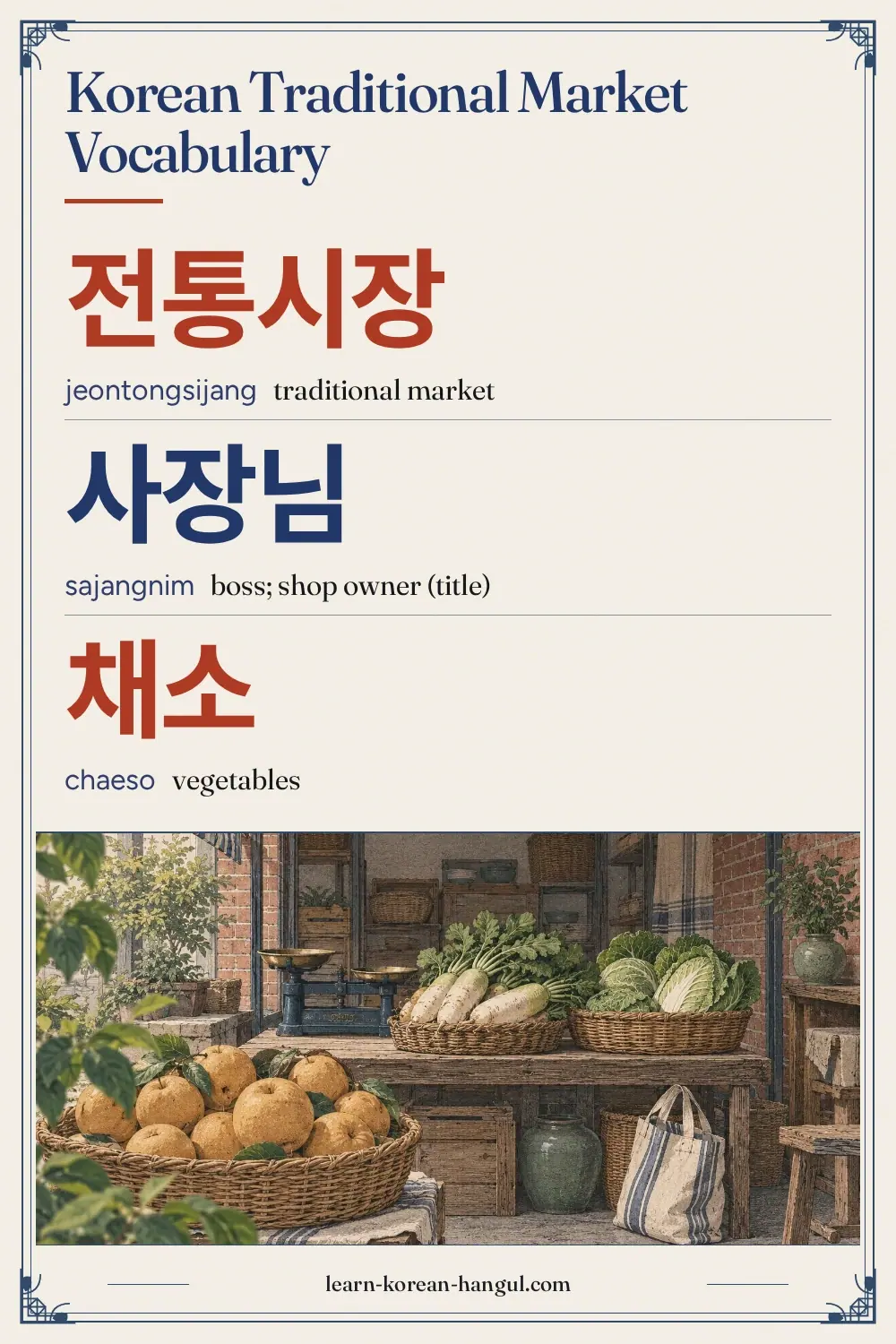
Korean Traditional Market Vocabulary at a Glance
A trip to a market has a clear order, and the list follows it. You greet the seller, look at what is for sale, ask the price, buy a snack on the way, and tell the seller how much you want. That is why the groups run from people and places, to goods, to bargaining and prices, to street snacks, and last to weights and amounts. The page sits inside Shopping and next to the Korean Convenience Store Vocabulary page, which covers the shop with fixed prices.
| Group | Words | Use |
|---|---|---|
| People and places | 6 | Naming the market and the people in it |
| Goods | 6 | Naming what stalls sell |
| Bargaining and prices | 6 | Asking prices, bargaining and paying |
| Street snacks | 6 | Ordering food from stalls |
| Weights and amounts | 6 | Saying how much you want |
Nearly all the words are nouns. Two kinds behave differently: 깎다 is a verb that every bargainer needs, and 근, 봉지, 줌, 상자 and 바구니 are measure words that follow a native number, as in 한 봉지 (one bag). The next section ranks the words by how soon you will need them.
Which Traditional Market Words Should You Learn First?
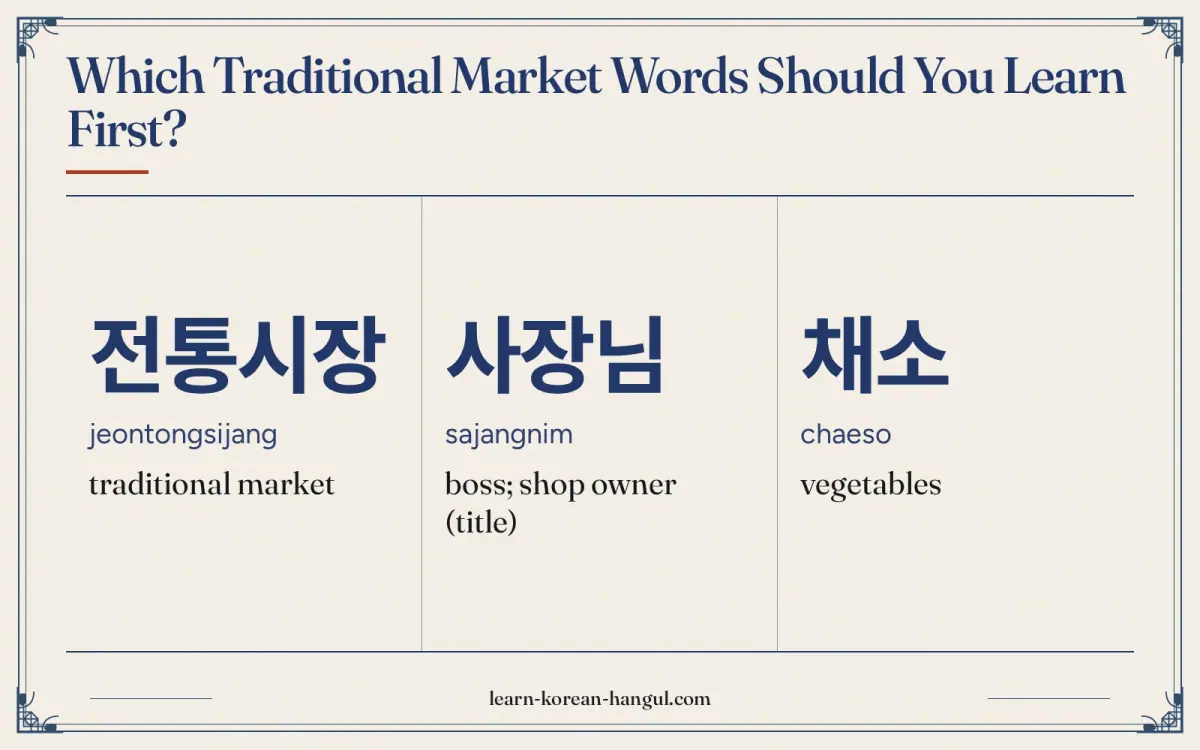
Learn 시장 (market), 사장님 (boss; a polite title for a seller), 이모 (aunt; a friendly title for a woman who runs a food stall), 가격 (price) and 주세요 patterns with 봉지 (bag) first. With those you can get a seller's attention, ask for something and say how much you want.
- Words to say. 사장님, 이모, 떡볶이, 순대, 호떡, 봉지, 한 줌. These are what you call out and order.
- Words to recognise. 가격, 현금, 거스름돈, 무게. You hear these during payment.
- Words to understand when spoken. 덤 and 깎다. The seller may offer a 덤, a small free extra, and you may hear about 깎다, lowering the price.
At five new words a day, the list takes six days plus review. Start with the first two groups, because you need them in the first minute at a stall.
The price question is the one you will use most. Ask 이거 얼마예요? (How much is this?) and listen for a number. The page on 얼마 and how much explains the question word, and Money and Prices teaches how to say the answer. The scene below puts eight of the 30 words on one market lane.
Word · 8
- 1
전통시장
jeontongsijang
traditional market
- 2
사장님
sajangnim
boss; shop owner (title)
- 3
채소
chaeso
vegetables
- 4
생선
saengseon
fish (as food)
- 5
떡볶이
tteokbokki
tteokbokki (spicy stir-fried rice cakes)
- 6
봉지
bongji
bag (of food); plastic bag
- 7
바구니
baguni
basket
- 8
무게
muge
weight
How Do You Talk to People at a Traditional Market?
Titles matter more than names at a market. Sellers are rarely addressed by name, so you use a role word. 사장님 (sajangnim) literally means company president, but customers use it for the owner of any shop or stall, whether the seller is a man or a woman. 이모 (imo) literally means maternal aunt, and customers use it warmly for women who run food stalls and small restaurants. Many learners notice that this sounds like a family word. It is. Korean often borrows family words to make a stranger feel close, and you will hear the same habit in taxis, cafes and small restaurants.
The choice depends on the stall. At a vegetable or clothes stall, 사장님 is the safe choice. At a snack stall, 이모 is common, but 사장님 is always polite. Avoid pointing at someone and saying 아줌마 (middle-aged woman) because it can sound rude when it is aimed at a person.
Sellers call customers 손님 (sonnim), the customer or guest, and you will hear it when a seller calls out to people walking past. If you reply with a clear item and quantity, the exchange is fast. The next sections give you the nouns for both.
People and Places
The first group covers the place and the three people you meet. 시장 is a market of any kind, and 전통시장 adds the idea of a long-established market with many small stalls. 상인 is the plain word for a merchant, while 사장님 and 이모 are the titles used to address one.
| No. | Hangul | Revised Romanization | Meaning and note | Example sentence | Audio assetId |
|---|---|---|---|---|---|
| 1 | 시장 | sijang | market. The general word for a market. A different word with the same spelling, 시장 (市長), means mayor; context decides. | 시장에 가요. (I go to the market.) | au-pg-vocabulary-daily-life-shopping-traditional-market-1; example: au-pg-vocabulary-daily-life-shopping-traditional-market-31 |
| 2 | 전통시장 | jeontongsijang | traditional market. 전통 means tradition and 시장 means market. A market of many small stalls rather than one large store. | 전통시장은 재미있어요. (The traditional market is fun.) | au-pg-vocabulary-daily-life-shopping-traditional-market-2; example: au-pg-vocabulary-daily-life-shopping-traditional-market-32 |
| 3 | 상인 | sangin | merchant; seller. A neutral word, mostly used when you talk about sellers, not when you talk to them. | 상인이 친절해요. (The merchant is kind.) | au-pg-vocabulary-daily-life-shopping-traditional-market-3; example: au-pg-vocabulary-daily-life-shopping-traditional-market-33 |
| 4 | 사장님 | sajangnim | boss; shop owner (title). A polite title for the owner of a shop. Use it when speaking to a seller. | 사장님, 이거 얼마예요? (Boss, how much is this?) | au-pg-vocabulary-daily-life-shopping-traditional-market-4; example: au-pg-vocabulary-daily-life-shopping-traditional-market-34 |
| 5 | 이모 | imo | aunt (maternal); friendly title for a woman stallholder. Literally mother's sister. A warm way to call a woman who runs a food stall. | 이모, 이거 주세요. (Auntie, give me this please.) | au-pg-vocabulary-daily-life-shopping-traditional-market-5; example: au-pg-vocabulary-daily-life-shopping-traditional-market-35 |
| 6 | 손님 | sonnim | customer; guest. The seller's word for you. 님 is a respectful suffix. | 손님이 많아요. (There are many customers.) | au-pg-vocabulary-daily-life-shopping-traditional-market-6; example: au-pg-vocabulary-daily-life-shopping-traditional-market-36 |
Two different words share the spelling 시장: the market and the mayor. They come from different Chinese characters, so Korean readers rely on context, and nobody will confuse them at a market stall.
When you address a seller, put the title first and the request second: 사장님, 이거 주세요. The pattern is title + comma + request, and it sounds natural and polite.
Once you can address a seller, the next step is to name what is on the stall.
Goods at the Market
Markets are known for fresh produce and traditional foods. 채소, 과일 and 생선 are the three big categories, and 나물, 젓갈 and 떡 are three foods that you will see in almost every traditional market. Each one also appears on a Korean dinner table, so you may already know the taste.
| No. | Hangul | Revised Romanization | Meaning and note | Example sentence | Audio assetId |
|---|---|---|---|---|---|
| 7 | 채소 | chaeso | vegetables. Sino-Korean word. Often used with 과일: 채소와 과일. | 채소를 사요. (I buy vegetables.) | au-pg-vocabulary-daily-life-shopping-traditional-market-7; example: au-pg-vocabulary-daily-life-shopping-traditional-market-37 |
| 8 | 과일 | gwail | fruit. Said [과일]. Pronounced as written. | 과일이 싱싱해요. (The fruit is fresh.) | au-pg-vocabulary-daily-life-shopping-traditional-market-8; example: au-pg-vocabulary-daily-life-shopping-traditional-market-38 |
| 9 | 생선 | saengseon | fish (as food). Fish you buy to eat. A live fish is usually 물고기. Fish are counted with the counter 마리. | 생선 한 마리 주세요. (One fish, please.) | au-pg-vocabulary-daily-life-shopping-traditional-market-9; example: au-pg-vocabulary-daily-life-shopping-traditional-market-39 |
| 10 | 나물 | namul | seasoned greens; wild or cultivated greens. Greens that are blanched and seasoned by hand. A staple side dish at markets. | 나물을 무쳐요. (I season the greens.) | au-pg-vocabulary-daily-life-shopping-traditional-market-10; example: au-pg-vocabulary-daily-life-shopping-traditional-market-40 |
| 11 | 젓갈 | jeotgal | salted fermented seafood. Said [젇깔]. Used to make kimchi and as a side dish. Very salty. | 젓갈은 짜요. (Jeotgal is salty.) | au-pg-vocabulary-daily-life-shopping-traditional-market-11; example: au-pg-vocabulary-daily-life-shopping-traditional-market-41 |
| 12 | 떡 | tteok | rice cake. Chewy cakes made from rice flour. The word 떡 is also the first syllable of 떡볶이 and 호떡. | 떡을 먹어요. (I eat rice cake.) | au-pg-vocabulary-daily-life-shopping-traditional-market-12; example: au-pg-vocabulary-daily-life-shopping-traditional-market-42 |
Look at how the verb changes with the food. You buy (사다) vegetables, eat (먹다) rice cake and season (무치다) greens with your hands. A short list of such pairs is worth keeping: 사요, 먹어요 and 무쳐요 are all polite present forms.
The counter 마리 counts animals, including fish, so one fish is 한 마리 and two fish are 두 마리. The page on counting people and animals explains the counter in detail.
You know the goods, so the next question is the price.
Bargaining and Prices
The third group is about money. 가격 is the plain word for price, 흥정 is bargaining, and 깎다 is the verb that you use to ask for a lower price. 덤 is a small free extra. 현금 and 거스름돈 finish the exchange: you pay in cash, and the seller gives you change.
| No. | Hangul | Revised Romanization | Meaning and note | Example sentence | Audio assetId |
|---|---|---|---|---|---|
| 13 | 가격 | gagyeok | price. Sino-Korean word. At a stall you more often ask 얼마예요? than say 가격. | 가격이 싸요. (The price is cheap.) | au-pg-vocabulary-daily-life-shopping-traditional-market-13; example: au-pg-vocabulary-daily-life-shopping-traditional-market-43 |
| 14 | 흥정 | heungjeong | bargaining; haggling. The noun for bargaining. Add 하다 to make a verb. | 흥정을 해요. (I bargain.) | au-pg-vocabulary-daily-life-shopping-traditional-market-14; example: au-pg-vocabulary-daily-life-shopping-traditional-market-44 |
| 15 | 깎다 | kkakda | to haggle down; to cut a price. Said [깍따]. The dictionary form is 깎다; the same verb also means to peel or to cut hair. | 조금만 깎아 주세요. (Please lower it a little.) | au-pg-vocabulary-daily-life-shopping-traditional-market-15; example: au-pg-vocabulary-daily-life-shopping-traditional-market-45 |
| 16 | 덤 | deom | a free extra; a bonus. A small extra the seller adds, such as one more piece of fruit. Native word. | 덤으로 주세요. (Please give it as a bonus.) | au-pg-vocabulary-daily-life-shopping-traditional-market-16; example: au-pg-vocabulary-daily-life-shopping-traditional-market-46 |
| 17 | 현금 | hyeongeum | cash. Sino-Korean word. 현금으로 means in cash. | 현금으로 내요. (I pay in cash.) | au-pg-vocabulary-daily-life-shopping-traditional-market-17; example: au-pg-vocabulary-daily-life-shopping-traditional-market-47 |
| 18 | 거스름돈 | geoseureumdon | change (money returned). Said [거스름똔]. 거스름 means giving back and 돈 means money. | 거스름돈 여기 있어요. (Here is your change.) | au-pg-vocabulary-daily-life-shopping-traditional-market-18; example: au-pg-vocabulary-daily-life-shopping-traditional-market-48 |
Bargaining in a traditional market is softer than many visitors expect. A stall may have a fixed price, and a polite request for a small discount or a 덤 can be more natural than a hard counter-offer. Practice varies by stall and by season, so watch what others do before you ask.
The sentence 조금만 깎아 주세요 has three useful parts. 조금만 means just a little, 깎아 is the verb in its -아/어 form, and 주세요 turns it into a polite request. You can swap the verb to make other requests, such as 봉지에 담아 주세요 (please put it in a bag).
You now have the words for paying. The most popular part of a market visit comes next, the snacks.
Street Snacks
Many traditional markets have a row of food stalls. The six foods in this group are the ones you find on most menu boards. They are all nouns that you can say alone with 주세요 to order, so they are easy first words to try aloud.
| No. | Hangul | Revised Romanization | Meaning and note | Example sentence | Audio assetId |
|---|---|---|---|---|---|
| 19 | 떡볶이 | tteokbokki | tteokbokki (spicy stir-fried rice cakes). Said [떡뽀끼]. The official romanization is tteokbokki, and other spellings, such as tteokpokki, appear on menus. | 떡볶이 주세요. (Tteokbokki, please.) | au-pg-vocabulary-daily-life-shopping-traditional-market-19; example: au-pg-vocabulary-daily-life-shopping-traditional-market-49 |
| 20 | 순대 | sundae | sundae (Korean stuffed sausage). A sausage stuffed with noodles and other fillings. Not the ice-cream sundae. | 순대 한 접시 주세요. (One plate of sundae, please.) | au-pg-vocabulary-daily-life-shopping-traditional-market-20; example: au-pg-vocabulary-daily-life-shopping-traditional-market-50 |
| 21 | 어묵 | eomuk | fish cake. The standard word. Many people also say 오뎅 informally. | 어묵 국물이 따뜻해요. (The fish cake broth is warm.) | au-pg-vocabulary-daily-life-shopping-traditional-market-21; example: au-pg-vocabulary-daily-life-shopping-traditional-market-51 |
| 22 | 호떡 | hotteok | hotteok (sweet filled pancake). A pancake filled with sugar, nuts or seeds, fried on a griddle. | 호떡이 달아요. (The hotteok is sweet.) | au-pg-vocabulary-daily-life-shopping-traditional-market-22; example: au-pg-vocabulary-daily-life-shopping-traditional-market-52 |
| 23 | 튀김 | twigim | fried food; tempura-style fritters. Vegetables, squid or noodles in batter, deep-fried. From the verb 튀기다, to deep-fry. | 튀김이 바삭해요. (The fried food is crunchy.) | au-pg-vocabulary-daily-life-shopping-traditional-market-23; example: au-pg-vocabulary-daily-life-shopping-traditional-market-53 |
| 24 | 전 | jeon | savoury pancake. A fried pancake made with egg and batter. The same syllable also means before or whole. | 전을 부쳐요. (I fry a pancake.) | au-pg-vocabulary-daily-life-shopping-traditional-market-24; example: au-pg-vocabulary-daily-life-shopping-traditional-market-54 |
A plate of food is usually ordered with a counter: 한 접시 (one plate) or 일 인분 (one portion). With 주세요 the order is complete. The page on tteokbokki in Korean gives more on the best-known item. The foods 호떡 and 떡 share a syllable, but 호떡 is a pancake made from a wheat-based dough, not a rice cake.
The last thing you need is the way to say how much you want.
Weights and Amounts
At a market, you buy by the bag, the handful or the box, not only by the item. These six words are measure words, and they follow a native Korean number: 한 봉지 (one bag), 두 상자 (two boxes). 무게 is the word for weight, and you hear it when the seller puts something on the scale.
| No. | Hangul | Revised Romanization | Meaning and note | Example sentence | Audio assetId |
|---|---|---|---|---|---|
| 25 | 근 | geun | geun (traditional unit of weight). A traditional weight unit still used in speech for meat and produce. The exact grams depend on the goods. | 고기 한 근 주세요. (One geun of meat, please.) | au-pg-vocabulary-daily-life-shopping-traditional-market-25; example: au-pg-vocabulary-daily-life-shopping-traditional-market-55 |
| 26 | 봉지 | bongji | bag (of food); plastic bag. The word for a bag of loose goods. 한 봉지 is one bag. | 봉지에 담아 주세요. (Please put it in a bag.) | au-pg-vocabulary-daily-life-shopping-traditional-market-26; example: au-pg-vocabulary-daily-life-shopping-traditional-market-56 |
| 27 | 줌 | jum | a handful. How much fits in one hand. Often used for herbs and small greens. | 한 줌만 주세요. (Just one handful, please.) | au-pg-vocabulary-daily-life-shopping-traditional-market-27; example: au-pg-vocabulary-daily-life-shopping-traditional-market-57 |
| 28 | 상자 | sangja | box. A cardboard or wooden box. Fruit is often sold by the box. | 사과 한 상자 주세요. (One box of apples, please.) | au-pg-vocabulary-daily-life-shopping-traditional-market-28; example: au-pg-vocabulary-daily-life-shopping-traditional-market-58 |
| 29 | 바구니 | baguni | basket. The container the seller may use. Also the shopping basket in a store. | 바구니가 가득 찼어요. (The basket is full.) | au-pg-vocabulary-daily-life-shopping-traditional-market-29; example: au-pg-vocabulary-daily-life-shopping-traditional-market-59 |
| 30 | 무게 | muge | weight. Said as written. The verb for weighing something is 달다. | 무게를 달아요. (I weigh it.) | au-pg-vocabulary-daily-life-shopping-traditional-market-30; example: au-pg-vocabulary-daily-life-shopping-traditional-market-60 |
Units give the market its character, but they are also where mistakes happen. A 근 is not the same weight for all goods. Traditionally, a 근 of meat is about 600 grams, and a 근 of fruit and vegetables is about 400 grams. Since shops are expected to sell by metric weight, many sellers now say kilograms or grams instead, so ask 몇 그램이에요? (How many grams is it?) if you are unsure.
The verb 달다 appears twice in this list in different senses. 무게를 달아요 uses it as to weigh, and 호떡이 달아요 uses it as to be sweet. Both forms are 달아요, and only context tells you which one you heard.
How Do You Buy Something at a Market Stall?
A purchase at a market follows one pattern: item + number + measure word + 주세요. Say what you want first, then how much, then the polite ending. The chart shows the pattern with words from this page.
| Pattern | Example | Meaning |
|---|---|---|
| Item + 주세요 | 떡볶이 주세요. | Tteokbokki, please. |
| Item + 한 + measure word + 주세요 | 사과 한 상자 주세요. | One box of apples, please. |
| Item + 한 + 줌 + 주세요 | 나물 한 줌 주세요. | One handful of greens, please. |
| 깎아 주세요 | 조금만 깎아 주세요. | Please lower it a little. |
| 담아 주세요 | 봉지에 담아 주세요. | Please put it in a bag. |
Here is a short conversation that uses the pattern from start to finish.
- 손님: 사장님, 이거 얼마예요? (Boss, how much is this?)
- 상인: 한 봉지에 오천 원이에요. (It is 5,000 won a bag.)
- 손님: 조금만 깎아 주세요. (Please lower it a little.)
- 상인: 그럼 사천오백 원 주세요. (Then give me 4,500 won.)
- 손님: 네, 현금으로 내요. (Yes, I pay in cash.)
Read the dialogue twice, once as the customer and once as the seller. For more ready-made lines, see the shopping phrases page.
How Do You Pronounce These Words?
Market words contain several sound changes, because many end in a consonant that changes before the next sound. Standard pronunciation follows the National Institute of Korean Language (국립국어원) rules. The romanization follows the Revised Romanization of Korean, which writes tense letters such as kk and tt but does not show tensing caused by a neighbouring sound.
| Spelling | Sounds like | What changes |
|---|---|---|
| 떡볶이 | [떡뽀끼] | The final ㄱ of 떡 makes the ㅂ of 볶 tense, and the final ㄲ of 볶 moves across to the vowel of 이 as [끼]. |
| 젓갈 | [젇깔] | A final ㅅ is said as ㄷ, and it makes the next ㄱ tense. |
| 깎다 | [깍따] | The final ㄲ is said as ㄱ, and it makes the next ㄷ tense. |
| 거스름돈 | [거스름똔] | The ㄷ in 돈 is said tense in this compound. |
| 호떡 | [호떡] | ㄸ is already tense; say it with a tight throat and no breath. |
| 손님 | [손님] | Said as written: the final ㄴ and the next ㄴ join into one long n, with no pause. |
| 전통시장 | [전통시장] | Said as written. After ㅇ the ㅅ is not tensed in this word. |
The tense sounds in 떡볶이, 젓갈 and 깎다 are the ones learners most often miss. Say the tense sound with a tight throat and no puff of breath. The page on tensification explains why a stop sound makes the next consonant tense.
Audio and Slow Playback
Every word and every example sentence has its own clip. The five clips below replay the trickiest words slowly. Play one, repeat it aloud, then play it again and compare.
What Mistakes Do Learners Make with Traditional Market Words?
These five mistakes cause most of the confusion at a market stall.
- Calling a seller by name. Sellers are addressed by role. Use 사장님 or 이모, not a first name.
- Using 아줌마 to call a seller. The word means a middle-aged woman and can sound blunt when you call someone with it. 이모 or 사장님 is warmer.
- Forgetting the measure word. Say 사과 한 상자, not 사과 하나 상자. The number goes before the measure word, and 하나 shortens to 한.
- Expecting every stall to bargain. Some stalls have fixed prices. Ask for a 덤 or a small discount politely, and accept a no.
- Mixing the two 달다. 무게를 달아요 means I weigh it, and 호떡이 달아요 means the hotteok is sweet. The spelling and the form are identical.
Learning the titles and the measure words removes most of the risk.
Practice: Flashcards and Worksheet
Study in three steps. First, run the flashcard deck in recognition mode until you recognise each of the 30 words. Second, switch to listening mode. Third, take the quiz. The deck covers all 30 words with audio, and your progress stays in your browser. The vocabulary flashcard decks page lists the other decks.
Practice · 65
- 01시장
Show answer
headword 1: market
- 02전통시장
Show answer
headword 2: traditional market
- 03상인
Show answer
headword 3: merchant; seller
- 04사장님
Show answer
headword 4: boss; shop owner (title)
- 05이모
Show answer
headword 5: aunt (maternal); friendly title for a woman stallholder
- 06손님
Show answer
headword 6: customer; guest
- 07채소
Show answer
headword 7: vegetables
- 08과일
Show answer
headword 8: fruit
- 09생선
Show answer
headword 9: fish (as food)
- 10나물
Show answer
headword 10: seasoned greens; wild or cultivated greens
- 11젓갈
Show answer
headword 11: salted fermented seafood
- 12떡
Show answer
headword 12: rice cake
- 13가격
Show answer
headword 13: price
- 14흥정
Show answer
headword 14: bargaining; haggling
- 15깎다
Show answer
headword 15: to haggle down; to cut a price
- 16덤
Show answer
headword 16: a free extra; a bonus
- 17현금
Show answer
headword 17: cash
- 18거스름돈
Show answer
headword 18: change (money returned)
- 19떡볶이
Show answer
headword 19: tteokbokki (spicy stir-fried rice cakes)
- 20순대
Show answer
headword 20: sundae (Korean stuffed sausage)
- 21어묵
Show answer
headword 21: fish cake
- 22호떡
Show answer
headword 22: hotteok (sweet filled pancake)
- 23튀김
Show answer
headword 23: fried food; tempura-style fritters
- 24전
Show answer
headword 24: savoury pancake
- 25근
Show answer
headword 25: geun (traditional unit of weight)
- 26봉지
Show answer
headword 26: bag (of food); plastic bag
- 27줌
Show answer
headword 27: a handful
- 28상자
Show answer
headword 28: box
- 29바구니
Show answer
headword 29: basket
- 30무게
Show answer
headword 30: weight
- 31시장에 가요.
Show answer
example sentence for headword 1
- 32전통시장은 재미있어요.
Show answer
example sentence for headword 2
- 33상인이 친절해요.
Show answer
example sentence for headword 3
- 34사장님, 이거 얼마예요?
Show answer
example sentence for headword 4
- 35이모, 이거 주세요.
Show answer
example sentence for headword 5
- 36손님이 많아요.
Show answer
example sentence for headword 6
- 37채소를 사요.
Show answer
example sentence for headword 7
- 38과일이 싱싱해요.
Show answer
example sentence for headword 8
- 39생선 한 마리 주세요.
Show answer
example sentence for headword 9
- 40나물을 무쳐요.
Show answer
example sentence for headword 10
- 41젓갈은 짜요.
Show answer
example sentence for headword 11
- 42떡을 먹어요.
Show answer
example sentence for headword 12
- 43가격이 싸요.
Show answer
example sentence for headword 13
- 44흥정을 해요.
Show answer
example sentence for headword 14
- 45조금만 깎아 주세요.
Show answer
example sentence for headword 15
- 46덤으로 주세요.
Show answer
example sentence for headword 16
- 47현금으로 내요.
Show answer
example sentence for headword 17
- 48거스름돈 여기 있어요.
Show answer
example sentence for headword 18
- 49떡볶이 주세요.
Show answer
example sentence for headword 19
- 50순대 한 접시 주세요.
Show answer
example sentence for headword 20
- 51어묵 국물이 따뜻해요.
Show answer
example sentence for headword 21
- 52호떡이 달아요.
Show answer
example sentence for headword 22
- 53튀김이 바삭해요.
Show answer
example sentence for headword 23
- 54전을 부쳐요.
Show answer
example sentence for headword 24
- 55고기 한 근 주세요.
Show answer
example sentence for headword 25
- 56봉지에 담아 주세요.
Show answer
example sentence for headword 26
- 57한 줌만 주세요.
Show answer
example sentence for headword 27
- 58사과 한 상자 주세요.
Show answer
example sentence for headword 28
- 59바구니가 가득 찼어요.
Show answer
example sentence for headword 29
- 60무게를 달아요.
Show answer
example sentence for headword 30
- 61떡볶이
Show answer
slow playback of headword 19: tteokbokki (spicy stir-fried rice cakes)
- 62젓갈
Show answer
slow playback of headword 11: salted fermented seafood
- 63깎다
Show answer
slow playback of headword 15: to haggle down; to cut a price
- 64거스름돈
Show answer
slow playback of headword 18: change (money returned)
- 65봉지
Show answer
slow playback of headword 26: bag (of food); plastic bag
Practice · 5
What does 상인 (sangin) mean?
Show answer
merchant; seller
상인 means merchant; seller. Example: 상인이 친절해요. (The merchant is kind.)
What does 나물 (namul) mean?
Show answer
seasoned greens; wild or cultivated greens
나물 means seasoned greens; wild or cultivated greens. Example: 나물을 무쳐요. (I season the greens.)
What does 깎다 (kkakda) mean?
Show answer
to haggle down; to cut a price
깎다 means to haggle down; to cut a price. Example: 조금만 깎아 주세요. (Please lower it a little.)
What does 떡볶이 (tteokbokki) mean?
Show answer
tteokbokki (spicy stir-fried rice cakes)
떡볶이 means tteokbokki (spicy stir-fried rice cakes). Example: 떡볶이 주세요. (Tteokbokki, please.)
What does 근 (geun) mean?
Show answer
geun (traditional unit of weight)
근 means geun (traditional unit of weight). Example: 고기 한 근 주세요. (One geun of meat, please.)
Korean Traditional Market Vocabulary Worksheet (PDF)
A printable worksheet for these words (word list, matching, writing practice, fill-in-the-blank exercises and answer key) is available in A4 and US Letter from the download card on this page. For practice, copy the 30 words by hand and write the meaning beside each one. Then write two sentences of your own, such as 시장에서 과일을 사요 (I buy fruit at the market).
Where to Go Next
After this page, continue with Korean Convenience Store Vocabulary, or go back up to Shopping. For the single word, see traditional market in Korean. To practise the lines you need, open the shopping phrases.
Frequently Asked Questions
How Do You Say Traditional Market in Korean?
A traditional market is 전통시장 (jeontongsijang). The plain word for a market is 시장 (sijang), and you say 시장에 가요 for I go to the market. For the single-word lookup with a pronunciation guide, see the page on traditional market in Korean.
What Do You Call a Seller at a Korean Market?
Use a title, not a name. 사장님 (sajangnim) is the safe, polite choice for any seller, and 이모 (imo), literally aunt, is a warm title for a woman who runs a food stall. The plain word for a merchant is 상인 (sangin), but it is used about sellers rather than to them.
How Do You Ask for a Lower Price in Korean?
Say 조금만 깎아 주세요 (jogeumman kkakka juseyo), which means please lower it a little. 깎다 is the verb for cutting a price, and 주세요 turns it into a polite request. A 덤, a small free extra, is another polite thing to ask for.
How Do You Pronounce 떡볶이 (tteokbokki)?
Say tteok-ppo-kki, as in [떡뽀끼]. The ㄸ, the ㅃ and the ㄲ are all tense sounds, said with a tight throat and no puff of breath. The official romanization is tteokbokki, and other spellings, such as tteokpokki, appear on menus. Press the audio button on this page for the normal and slow versions.
Is the Romanization on This Page Official?
It follows the Revised Romanization of Korean, which South Korea adopted on 7 July 2000 and whose rules the National Institute of Korean Language (국립국어원) publishes. It is a learning aid and does not show every sound change, so rely on the Hangul and the audio.
Is There a Printable Worksheet for Traditional Market Words?
A printable worksheet for these words (word list, matching, writing practice, fill-in-the-blank exercises and answer key) is available in A4 and US Letter from the download card on this page. For practice, copy the tables on this page by hand or use the flashcard deck, which carries the same 30 words.