Key facts
Korean Supermarket Vocabulary at a Glance
This list has 35 words in five groups of seven. It follows a shopping trip: you walk through the sections, collect a basket, check the package and the label, and finish with the membership and delivery questions at the register. It belongs to Shopping, next to the convenience store and the traditional market. Every word has an example sentence, so the page doubles as a ready deck.
| Group | Words | Use |
|---|---|---|
| Sections of the store | 7 | Reading aisle signs and finding food |
| Basket and checkout | 7 | Carrying, paying and answering the bag question |
| Packaging and weights | 7 | Counting and weighing groceries |
| Sale labels | 7 | Reading dates, discounts and prices |
| Membership and points | 7 | Points, coupons and delivery |
The words are nearly all nouns. A few, such as 계산 and 적립, become verbs when you add 하다, which is why they appear in sentences as 계산해 주세요 and 적립해요. The next section picks the words to learn first.
Which Supermarket Words Should You Learn First?
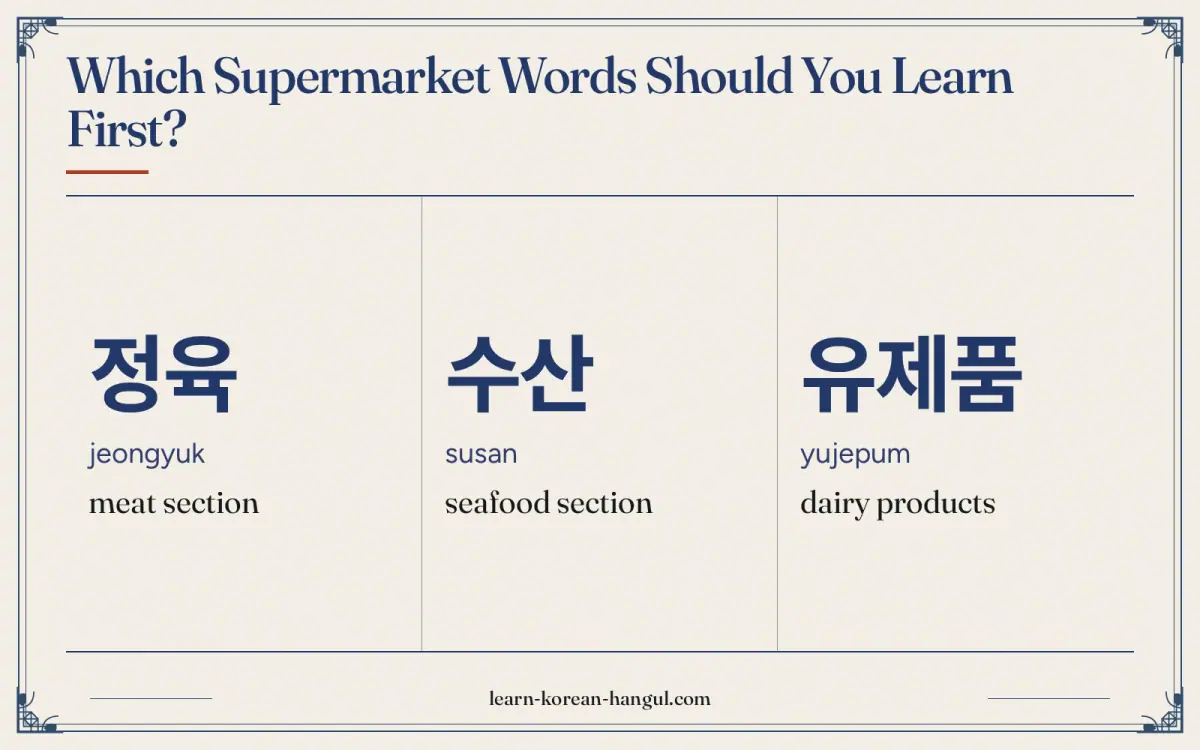
Learn 과일 (fruit), 채소 (vegetables), 계산대 (checkout), 봉투 (bag) and 유통기한 (sell-by date) first. The first two let you find food, the next two let you pay and answer the cashier, and the last one keeps you safe. After those five, add the sign words 정육 and 수산, because they are not obvious from English.
- Words to read. 정육, 수산, 유제품, 냉동식품, 유통기한, 소비기한. These appear on signs and labels, so you need to recognise them, not say them.
- Words to say. 영수증, 봉투, 계산, 장바구니. You use these at the register, usually in short requests.
- Words to understand when spoken. 회원, 포인트, 적립, 쿠폰. The cashier says these quickly, often as a single question before you pay.
Two habits are worth knowing. Koreans usually call a large supermarket a 마트, from the English "mart", and a small neighbourhood store a 슈퍼. Both words are everyday speech, while 슈퍼마켓 is the full form you meet in writing. Also, the exact words on signs vary between chains, so treat this list as the common core, not a rule that every store follows.
Word · 8
- 1
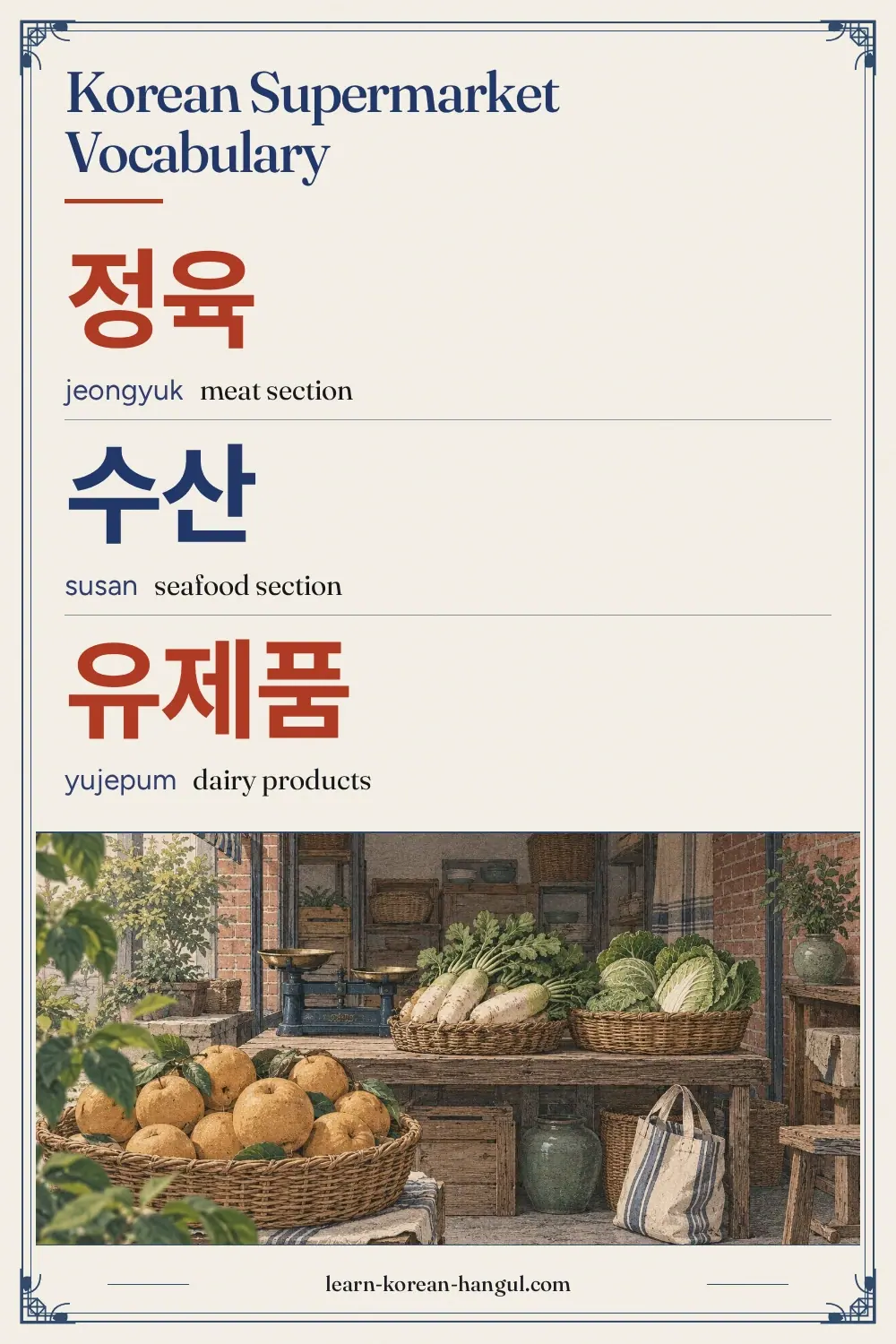
정육
jeongyuk
meat section
- 2
수산
susan
seafood section
- 3
유제품
yujepum
dairy products
- 4
카트
kateu
shopping cart
- 5
계산대
gyesandae
checkout counter
- 6
봉투
bongtu
bag (paper or plastic)
- 7
팩
paek
pack; tray
- 8
유통기한
yutonggihan
sell-by date
Sections of the Store
Korean supermarkets hang a sign over each area, and the sign is usually one short noun. Some signs are plain everyday words, such as 과일 and 채소. Others are short Sino-Korean sign words that you rarely say in conversation, such as 정육 for the meat counter. Learn these seven and you can find any part of the shop without asking.
| No. | Hangul | Revised Romanization | Meaning and note | Example sentence | Audio assetId |
|---|---|---|---|---|---|
| 1 | 슈퍼마켓 | syupeomaket | supermarket. 슈퍼 (syupeo) is the usual short form. A larger store is often called a 마트. | 슈퍼에 가요. (I go to the supermarket.) | au-pg-vocabulary-daily-life-shopping-supermarket-1; example: au-pg-vocabulary-daily-life-shopping-supermarket-36 |
| 2 | 정육 | jeongyuk | meat section. Literally "refined meat". It is the sign over the butcher counter, not an everyday word for meat. | 정육 코너는 저쪽이에요. (The meat section is over there.) | au-pg-vocabulary-daily-life-shopping-supermarket-2; example: au-pg-vocabulary-daily-life-shopping-supermarket-37 |
| 3 | 수산 | susan | seafood section. It means fisheries. 수산물 is the full word for seafood products. | 수산 코너에서 생선을 사요. (I buy fish at the seafood section.) | au-pg-vocabulary-daily-life-shopping-supermarket-3; example: au-pg-vocabulary-daily-life-shopping-supermarket-38 |
| 4 | 과일 | gwail | fruit. The everyday word, used on signs and in speech alike. | 과일은 입구 쪽에 있어요. (The fruit is near the entrance.) | au-pg-vocabulary-daily-life-shopping-supermarket-4; example: au-pg-vocabulary-daily-life-shopping-supermarket-39 |
| 5 | 채소 | chaeso | vegetables. The standard word on signs. 야채 is a common everyday variant. | 채소를 씻어요. (I wash the vegetables.) | au-pg-vocabulary-daily-life-shopping-supermarket-5; example: au-pg-vocabulary-daily-life-shopping-supermarket-40 |
| 6 | 유제품 | yujepum | dairy products. 유 means milk, 제품 means product. Milk, cheese and yogurt all sit here. | 우유와 치즈는 유제품이에요. (Milk and cheese are dairy products.) | au-pg-vocabulary-daily-life-shopping-supermarket-6; example: au-pg-vocabulary-daily-life-shopping-supermarket-41 |
| 7 | 냉동식품 | naengdongsikpum | frozen food. 냉동 means freezing and 식품 means food product. Look for it near the freezers. | 냉동식품은 어디에 있어요? (Where is the frozen food?) | au-pg-vocabulary-daily-life-shopping-supermarket-7; example: au-pg-vocabulary-daily-life-shopping-supermarket-42 |
Example Sentences
The examples above use three simple frames. The first is place + 에 가요 (I go to place), as in 슈퍼에 가요. The second is item + 은/는 + place + 에 있어요 (the item is at the place), as in 과일은 입구 쪽에 있어요. The third is place + 에서 + item + 을/를 사요 (I buy item at place), as in 수산 코너에서 생선을 사요. The particle 에서 marks where an action happens, and 에 marks a destination or where something is. The location particles page explains the difference. Say each sentence aloud after its audio clip, and swap in other sections to build new ones.
Once you know the layout, you need the words for carrying and paying.
How Do You Say Basket and Checkout in Korean?
At the front of a Korean mart you pick up a 카트 or a 장바구니, and at the end you pay at a 계산대. The cashier then asks the one question every shopper hears: whether you need a bag. These seven words cover that whole path from the entrance to the exit.
| No. | Hangul | Revised Romanization | Meaning and note | Example sentence | Audio assetId |
|---|---|---|---|---|---|
| 8 | 장바구니 | jangbaguni | shopping basket; reusable shopping bag. 장 means market and 바구니 means basket. Many shoppers bring their own. | 장바구니에 우유를 넣어요. (I put milk in the basket.) | au-pg-vocabulary-daily-life-shopping-supermarket-8; example: au-pg-vocabulary-daily-life-shopping-supermarket-43 |
| 9 | 카트 | kateu | shopping cart. A loanword from English "cart". 카트 is the word on the sign at the cart bay. | 카트를 밀어요. (I push the cart.) | au-pg-vocabulary-daily-life-shopping-supermarket-9; example: au-pg-vocabulary-daily-life-shopping-supermarket-44 |
| 10 | 계산대 | gyesandae | checkout counter. 계산 is calculation or payment and 대 is a stand or counter. Said [계산대] or [게산대]. | 계산대는 저기예요. (The checkout is over there.) | au-pg-vocabulary-daily-life-shopping-supermarket-10; example: au-pg-vocabulary-daily-life-shopping-supermarket-45 |
| 11 | 계산 | gyesan | payment; the bill. 계산하다 means to pay or to add up. 계산해 주세요 is a polite request to ring things up. | 계산해 주세요. (Please ring it up for me.) | au-pg-vocabulary-daily-life-shopping-supermarket-11; example: au-pg-vocabulary-daily-life-shopping-supermarket-46 |
| 12 | 영수증 | yeongsujeung | receipt. Needed for exchanges and refunds. Cashiers often ask 영수증 드릴까요? (Would you like the receipt?). | 영수증 주세요. (A receipt, please.) | au-pg-vocabulary-daily-life-shopping-supermarket-12; example: au-pg-vocabulary-daily-life-shopping-supermarket-47 |
| 13 | 봉투 | bongtu | bag (paper or plastic). Shops charge for a bag, so cashiers ask. The question below is the one you will hear. | 봉투 필요하세요? (Do you need a bag?) | au-pg-vocabulary-daily-life-shopping-supermarket-13; example: au-pg-vocabulary-daily-life-shopping-supermarket-48 |
| 14 | 셀프 계산대 | selpeu gyesandae | self-checkout. 셀프 is the English "self". Found in larger marts, with screens that can show the Korean prompts. | 셀프 계산대에서 계산해요. (I pay at the self-checkout.) | au-pg-vocabulary-daily-life-shopping-supermarket-14; example: au-pg-vocabulary-daily-life-shopping-supermarket-49 |
The question 봉투 필요하세요? is built from 필요하다 (to be needed) with the honorific ending 세요, which cashiers use to be polite to customers. A short answer is 네, 주세요 (yes, please) or 아니요, 괜찮아요 (no, thank you). The word 괜찮아요 literally means "it is fine", and Koreans use it to decline politely.
Packaging and Weights
Groceries in Korea are sold by container. A bag of noodles, a tray of strawberries and a can of cola each have their own counter word, and shoppers use the same words on shelf labels and in speech. Weights use loanwords from the metric system. Seven words cover most packages.
| No. | Hangul | Revised Romanization | Meaning and note | Example sentence | Audio assetId |
|---|---|---|---|---|---|
| 15 | 팩 | paek | pack; tray. A loanword for a plastic tray or sealed pack, common for berries, eggs and sliced meat. | 딸기 한 팩을 사요. (I buy one pack of strawberries.) | au-pg-vocabulary-daily-life-shopping-supermarket-15; example: au-pg-vocabulary-daily-life-shopping-supermarket-50 |
| 16 | 봉지 | bongji | bag (as a unit). A small soft bag of snacks, noodles or rice. Counts with 한 봉지, 두 봉지. | 라면 한 봉지를 사요. (I buy one bag of ramyeon.) | au-pg-vocabulary-daily-life-shopping-supermarket-16; example: au-pg-vocabulary-daily-life-shopping-supermarket-51 |
| 17 | 병 | byeong | bottle. Used for oil, soy sauce, water and beer. Same word as the counter for bottles. | 간장 한 병이 필요해요. (I need one bottle of soy sauce.) | au-pg-vocabulary-daily-life-shopping-supermarket-17; example: au-pg-vocabulary-daily-life-shopping-supermarket-52 |
| 18 | 캔 | kaen | can. A loanword from English. Used for drinks, tuna and beans. | 콜라 한 캔을 사요. (I buy one can of cola.) | au-pg-vocabulary-daily-life-shopping-supermarket-18; example: au-pg-vocabulary-daily-life-shopping-supermarket-53 |
| 19 | 상자 | sangja | box. A cardboard box, as for a case of apples or a gift set. | 사과 한 상자를 샀어요. (I bought a box of apples.) | au-pg-vocabulary-daily-life-shopping-supermarket-19; example: au-pg-vocabulary-daily-life-shopping-supermarket-54 |
| 20 | 그램 | geuraem | gram. Short form: g. Meat is often sold by 100 g or 600 g packs. | 고기 삼백 그램을 사요. (I buy 300 grams of meat.) | au-pg-vocabulary-daily-life-shopping-supermarket-20; example: au-pg-vocabulary-daily-life-shopping-supermarket-55 |
| 21 | 킬로그램 | killogeuraem | kilogram. Often shortened to 킬로. Rice comes in 10 kg and 20 kg bags. | 쌀 십 킬로그램을 사요. (I buy 10 kilograms of rice.) | au-pg-vocabulary-daily-life-shopping-supermarket-21; example: au-pg-vocabulary-daily-life-shopping-supermarket-56 |
The pattern in every example is item + number + unit. With 팩, 봉지, 병, 캔 and 상자 the number is a native Korean number, so you say 한 팩 (one), 두 봉지 (two) and 세 병 (three). With 그램 and 킬로그램 the number is Sino-Korean, as in 삼백 그램 (300 g). The counters for things page lists the full set. The native forms 하나, 둘, 셋 shorten before a counter to 한, 두, 세, so 둘 병 is wrong and 두 병 is right.
How Do You Say Sale Labels in Korean?
Labels on the shelf tell you the price, the discount and, most important for food safety, how long it stays good. Read the date first. The two date words look similar and mean different things, and many learners treat them as one.
| No. | Hangul | Revised Romanization | Meaning and note | Example sentence | Audio assetId |
|---|---|---|---|---|---|
| 22 | 유통기한 | yutonggihan | sell-by date. The last day a shop may sell the product. Many labels have shown this date for years. | 유통기한이 지났어요. (It has passed the sell-by date.) | au-pg-vocabulary-daily-life-shopping-supermarket-22; example: au-pg-vocabulary-daily-life-shopping-supermarket-57 |
| 23 | 소비기한 | sobigihan | use-by date. The last day the food is safe to eat if stored properly. Labels have been moving to this wording. | 소비기한을 확인해요. (I check the use-by date.) | au-pg-vocabulary-daily-life-shopping-supermarket-23; example: au-pg-vocabulary-daily-life-shopping-supermarket-58 |
| 24 | 할인 | harin | discount. Said [하린]. A 할인 sticker usually shows a percent or a won amount. | 오늘은 할인 중이에요. (There is a discount today.) | au-pg-vocabulary-daily-life-shopping-supermarket-24; example: au-pg-vocabulary-daily-life-shopping-supermarket-59 |
| 25 | 세일 | seil | sale. The English word "sale". A 세일 period often has a banner at the entrance. | 지금 세일 기간이에요. (It is the sale period now.) | au-pg-vocabulary-daily-life-shopping-supermarket-25; example: au-pg-vocabulary-daily-life-shopping-supermarket-60 |
| 26 | 원 플러스 원 | won peulleoseu won | 1+1 (buy one, get one). Written 1+1. A sticker means you pay for one and take two. | 이 과자는 원 플러스 원이에요. (These snacks are buy one, get one.) | au-pg-vocabulary-daily-life-shopping-supermarket-26; example: au-pg-vocabulary-daily-life-shopping-supermarket-61 |
| 27 | 특가 | teukga | special price. Said [특까]. Often paired with 상품 (product) on flyers. | 이번 주 특가 상품이에요. (It is this week's special-price item.) | au-pg-vocabulary-daily-life-shopping-supermarket-27; example: au-pg-vocabulary-daily-life-shopping-supermarket-62 |
| 28 | 가격 | gagyeok | price. The general word on tags. 값 is the everyday spoken word for the same idea. | 가격이 싸요. (The price is cheap.) | au-pg-vocabulary-daily-life-shopping-supermarket-28; example: au-pg-vocabulary-daily-life-shopping-supermarket-63 |
How Is a Date Written on a Korean Label?
Korean dates run from the largest unit to the smallest: year, then month, then day. A shelf label for a sell-by date usually reads like this.
| On the label | Spoken form | Meaning |
|---|---|---|
| 2026.12.31까지 | 이천이십육 년 십이 월 삼십일 일까지 | until 31 December 2026 |
| 유통기한: 12.31 | 유통기한은 십이 월 삼십일 일이에요 | the sell-by date is 31 December |
| 제조일자 | 제조일자 | manufacture date |
The label ending 까지 (until, up to) is the particle that tells you the date is the last day. Read the month and day with Sino-Korean numbers and the word 월 (month) and 일 (day). Two months are irregular when spoken: June is 유월 and October is 시월, not 육월 and 십월.
Membership and Points
Most chain supermarkets run a points scheme, and the cashier will ask about it before you pay. These seven words cover the membership question, the discount tools and the delivery services that large marts offer. The first few are questions you hear, and the last few are services you choose.
| No. | Hangul | Revised Romanization | Meaning and note | Example sentence | Audio assetId |
|---|---|---|---|---|---|
| 29 | 회원 | hoewon | member. Said [회원] or [훼원]. 회원이세요 asks whether you are a member. | 회원이세요? (Are you a member?) | au-pg-vocabulary-daily-life-shopping-supermarket-29; example: au-pg-vocabulary-daily-life-shopping-supermarket-64 |
| 30 | 회원 카드 | hoewon kadeu | membership card. 카드 is the English "card". Many shoppers use an app version instead. | 회원 카드 있으세요? (Do you have a membership card?) | au-pg-vocabulary-daily-life-shopping-supermarket-30; example: au-pg-vocabulary-daily-life-shopping-supermarket-65 |
| 31 | 포인트 | pointeu | points. A loanword for loyalty points. Often combined with 적립 below. | 포인트 적립해 드릴까요? (Shall I add points for you?) | au-pg-vocabulary-daily-life-shopping-supermarket-31; example: au-pg-vocabulary-daily-life-shopping-supermarket-66 |
| 32 | 적립 | jeongnip | accumulating (points). Said [정닙]. 적립하다 means to credit points to an account. | 포인트를 적립해요. (I collect points.) | au-pg-vocabulary-daily-life-shopping-supermarket-32; example: au-pg-vocabulary-daily-life-shopping-supermarket-67 |
| 33 | 쿠폰 | kupon | coupon. A loanword. Coupons often come through an app and are scanned at the checkout. | 쿠폰을 써요. (I use a coupon.) | au-pg-vocabulary-daily-life-shopping-supermarket-33; example: au-pg-vocabulary-daily-life-shopping-supermarket-68 |
| 34 | 배달 | baedal | delivery. The general word for delivery of goods or food. Large marts offer it for big orders. | 마트에서 배달해 줘요. (The mart delivers.) | au-pg-vocabulary-daily-life-shopping-supermarket-34; example: au-pg-vocabulary-daily-life-shopping-supermarket-69 |
| 35 | 새벽 배송 | saebyeok baesong | dawn delivery. 새벽 means dawn. Orders placed at night can arrive before morning, a service Korean online grocers popularised. | 새벽 배송을 주문해요. (I order dawn delivery.) | au-pg-vocabulary-daily-life-shopping-supermarket-35; example: au-pg-vocabulary-daily-life-shopping-supermarket-70 |
What Is the Difference between 유통기한 and 소비기한?
The difference is who the date is for. 유통기한 (sell-by date) tells the shop the last day it should sell the item. 소비기한 (use-by date) tells you the last day the food is still safe to eat when stored as the label says. Because the use-by date comes later than the sell-by date for most foods, an item past its 유통기한 is not always unsafe, but you should follow the label on the pack. Korea has been moving its food labels toward 소비기한 since 2023, so you will see both words on shelves while the change settles. On a pack that shows only one date, read the word before the date to know which one it is.
The sentence 유통기한이 지났어요 (the sell-by date has passed) is the most useful one to recognise. 지났어요 is the past tense of 지나다 (to pass), and it also means "it is over" in many other contexts.
How Do You Pronounce These Words?
Supermarket words contain a few sound changes, and the shop signs hide them because Korean spelling keeps each syllable's written form, not the spoken one. Standard pronunciation follows the National Institute of Korean Language (국립국어원) rules, and the romanization follows the Revised Romanization of Korean, which records some sound changes and ignores others.
| Spelling | Sounds like | What changes |
|---|---|---|
| 특가 | [특까] | After a final ㄱ, the ㄱ of 가 becomes a tense [ㄲ]. |
| 적립 | [정닙] | ㄹ becomes [ㄴ] after ㄱ, then ㄱ becomes [ㅇ] before ㄴ. |
| 할인 | [하린] | The final ㄹ links to the next vowel, so it sounds like ha-rin. |
| 슈퍼마켓 | [슈퍼마켇] | A final ㅅ at the end of a word is said as [ㄷ]. |
| 계산대 | [계산대] or [게산대] | The vowel in 계 may be said [ㅔ]; both are allowed. |
The tense sound in 특가 is the one learners miss most. Say the second sound tight in your throat, with no puff of air. 정육 has no sound change: say [정육], two clear syllables, because a final ㅇ never moves onto the next syllable.
Audio and Slow Playback
Every headword and every example sentence has its own audio. The five clips below replay the trickiest words slowly. Play one, repeat it aloud, then play it again and compare.
What Mistakes Do Learners Make with Supermarket Words?
These five mistakes come up often when people shop for the first time in Korea.
- Treating 정육 as a general word for meat. The everyday word is 고기. 정육 is mainly a sign word for the butcher counter, and 정육점 is a butcher shop.
- Confusing 병 and 봉지. 병 is a rigid bottle and 봉지 is a soft bag. Say 물 한 병 for a bottle of water and 과자 한 봉지 for a bag of snacks.
- Using the wrong numbers with units. Packs, bags, bottles and cans take native numbers (한 팩, 두 병). Grams and kilograms take Sino-Korean numbers (삼백 그램). Mixing them up is a common slip.
- Reading 유통기한 as the safe-to-eat date. It is the sell-by date. The use-by date is 소비기한, and the label says which one you are reading.
- Answering 봉투 필요하세요? with 괜찮아요 when you want a bag. 괜찮아요 here is a polite "no, thanks". If you want a bag, say 네, 하나 주세요; if you brought a 장바구니, say 아니요, 괜찮아요.
If you meet only one of these on a real trip, make it the bag question, because it comes up on every visit.
Practice: Flashcards and Worksheet
Study in three steps. First, run the flashcard deck in recognition mode until you know each of the 35 words. Second, switch to listening mode and answer from the audio alone. Third, take the quiz. The deck covers all 35 words with audio, and your progress stays in your browser. The vocabulary flashcard decks page lists the other decks.
Practice · 75
- 01슈퍼마켓
Show answer
headword 1: supermarket
- 02슈퍼에 가요.
Show answer
example sentence for 슈퍼마켓: I go to the supermarket.
- 03정육
Show answer
headword 2: meat section
- 04정육 코너는 저쪽이에요.
Show answer
example sentence for 정육: The meat section is over there.
- 05수산
Show answer
headword 3: seafood section
- 06수산 코너에서 생선을 사요.
Show answer
example sentence for 수산: I buy fish at the seafood section.
- 07과일
Show answer
headword 4: fruit
- 08과일은 입구 쪽에 있어요.
Show answer
example sentence for 과일: The fruit is near the entrance.
- 09채소
Show answer
headword 5: vegetables
- 10채소를 씻어요.
Show answer
example sentence for 채소: I wash the vegetables.
- 11유제품
Show answer
headword 6: dairy products
- 12우유와 치즈는 유제품이에요.
Show answer
example sentence for 유제품: Milk and cheese are dairy products.
- 13냉동식품
Show answer
headword 7: frozen food
- 14냉동식품은 어디에 있어요?
Show answer
example sentence for 냉동식품: Where is the frozen food?
- 15장바구니
Show answer
headword 8: shopping basket; reusable shopping bag
- 16장바구니에 우유를 넣어요.
Show answer
example sentence for 장바구니: I put milk in the basket.
- 17카트
Show answer
headword 9: shopping cart
- 18카트를 밀어요.
Show answer
example sentence for 카트: I push the cart.
- 19계산대
Show answer
headword 10: checkout counter
- 20계산대는 저기예요.
Show answer
example sentence for 계산대: The checkout is over there.
- 21계산
Show answer
headword 11: payment; the bill
- 22계산해 주세요.
Show answer
example sentence for 계산: Please ring it up for me.
- 23영수증
Show answer
headword 12: receipt
- 24영수증 주세요.
Show answer
example sentence for 영수증: A receipt, please.
- 25봉투
Show answer
headword 13: bag (paper or plastic)
- 26봉투 필요하세요?
Show answer
example sentence for 봉투: Do you need a bag?
- 27셀프 계산대
Show answer
headword 14: self-checkout
- 28셀프 계산대에서 계산해요.
Show answer
example sentence for 셀프 계산대: I pay at the self-checkout.
- 29팩
Show answer
headword 15: pack; tray
- 30딸기 한 팩을 사요.
Show answer
example sentence for 팩: I buy one pack of strawberries.
- 31봉지
Show answer
headword 16: bag (as a unit)
- 32라면 한 봉지를 사요.
Show answer
example sentence for 봉지: I buy one bag of ramyeon.
- 33병
Show answer
headword 17: bottle
- 34간장 한 병이 필요해요.
Show answer
example sentence for 병: I need one bottle of soy sauce.
- 35캔
Show answer
headword 18: can
- 36콜라 한 캔을 사요.
Show answer
example sentence for 캔: I buy one can of cola.
- 37상자
Show answer
headword 19: box
- 38사과 한 상자를 샀어요.
Show answer
example sentence for 상자: I bought a box of apples.
- 39그램
Show answer
headword 20: gram
- 40고기 삼백 그램을 사요.
Show answer
example sentence for 그램: I buy 300 grams of meat.
- 41킬로그램
Show answer
headword 21: kilogram
- 42쌀 십 킬로그램을 사요.
Show answer
example sentence for 킬로그램: I buy 10 kilograms of rice.
- 43유통기한
Show answer
headword 22: sell-by date
- 44유통기한이 지났어요.
Show answer
example sentence for 유통기한: It has passed the sell-by date.
- 45소비기한
Show answer
headword 23: use-by date
- 46소비기한을 확인해요.
Show answer
example sentence for 소비기한: I check the use-by date.
- 47할인
Show answer
headword 24: discount
- 48오늘은 할인 중이에요.
Show answer
example sentence for 할인: There is a discount today.
- 49세일
Show answer
headword 25: sale
- 50지금 세일 기간이에요.
Show answer
example sentence for 세일: It is the sale period now.
- 51원 플러스 원
Show answer
headword 26: 1+1 (buy one, get one)
- 52이 과자는 원 플러스 원이에요.
Show answer
example sentence for 원 플러스 원: These snacks are buy one, get one.
- 53특가
Show answer
headword 27: special price
- 54이번 주 특가 상품이에요.
Show answer
example sentence for 특가: It is this week's special-price item.
- 55가격
Show answer
headword 28: price
- 56가격이 싸요.
Show answer
example sentence for 가격: The price is cheap.
- 57회원
Show answer
headword 29: member
- 58회원이세요?
Show answer
example sentence for 회원: Are you a member?
- 59회원 카드
Show answer
headword 30: membership card
- 60회원 카드 있으세요?
Show answer
example sentence for 회원 카드: Do you have a membership card?
- 61포인트
Show answer
headword 31: points
- 62포인트 적립해 드릴까요?
Show answer
example sentence for 포인트: Shall I add points for you?
- 63적립
Show answer
headword 32: accumulating (points)
- 64포인트를 적립해요.
Show answer
example sentence for 적립: I collect points.
- 65쿠폰
Show answer
headword 33: coupon
- 66쿠폰을 써요.
Show answer
example sentence for 쿠폰: I use a coupon.
- 67배달
Show answer
headword 34: delivery
- 68마트에서 배달해 줘요.
Show answer
example sentence for 배달: The mart delivers.
- 69새벽 배송
Show answer
headword 35: dawn delivery
- 70새벽 배송을 주문해요.
Show answer
example sentence for 새벽 배송: I order dawn delivery.
- 71정육
Show answer
slow playback of headword 2: meat section
- 72유통기한
Show answer
slow playback of headword 22: sell-by date
- 73계산대
Show answer
slow playback of headword 10: checkout counter
- 74적립
Show answer
slow playback of headword 32: accumulating (points)
- 75특가
Show answer
slow playback of headword 27: special price
Practice · 5
What does 정육 (jeongyuk) mean?
Show answer
meat section
정육 means meat section. Example: 정육 코너는 저쪽이에요. (The meat section is over there.)
What does 계산대 (gyesandae) mean?
Show answer
checkout counter
계산대 means checkout counter. Example: 계산대는 저기예요. (The checkout is over there.)
What does 팩 (paek) mean?
Show answer
pack; tray
팩 means pack; tray. Example: 딸기 한 팩을 사요. (I buy one pack of strawberries.)
What does 유통기한 (yutonggihan) mean?
Show answer
sell-by date
유통기한 means sell-by date. Example: 유통기한이 지났어요. (It has passed the sell-by date.)
What does 포인트 (pointeu) mean?
Show answer
points
포인트 means points. Example: 포인트 적립해 드릴까요? (Shall I add points for you?)
Korean Supermarket Vocabulary Worksheet (PDF)
A printable worksheet for these words (word list, matching, writing practice, fill-in-the-blank exercises and answer key) is available in A4 and US Letter from the download card on this page. For practice, copy the 35 words by hand and write the meaning next to each. Copying a real label such as 2026.12.31까지 and reading it aloud fixes both the word and the date pattern.
Where to Go Next
After this page, continue with Korean Convenience Store Vocabulary, which teaches the quick-meal and service words, or Korean Traditional Market Vocabulary. For produce words in detail, see fruits and vegetables. For the single query on its own, see supermarket in korean. To move up a level, return to Shopping.
Frequently Asked Questions
How Do You Say Meat Section in Korean?
The meat section is 정육 (jeongyuk). You see it on the sign above the butcher counter, as in 정육 코너 (the meat corner). In ordinary speech, meat is 고기 (gogi). A butcher shop is 정육점. Ask 정육 코너가 어디예요? (Where is the meat section?) to find it.
How Do You Pronounce 수산 (susan)?
Say su-san, with two short syllables and no sound change. The first vowel is a rounded [u], and the second syllable ends in [n]. The word means fisheries, and on a supermarket sign it marks the seafood section. Press the audio button on this page for the normal and slow versions.
How Many Supermarket Words Should I Learn First?
Five first: 과일, 채소, 계산대, 봉투 and 유통기한. At five new words a day, the whole list of 35 takes seven days plus review. Add the sign words 정육 and 수산 on day two, since they do not look like their English meanings.
Where Can I Practise Supermarket Words with Flashcards?
Use the vocabulary flashcard decks. The deck for this page holds all 35 words with Hangul, romanization and audio, and it offers recognition and listening modes. Your progress stays in your browser, so return daily and review the cards you missed.
Is the Romanization on This Page Official?
It follows the Revised Romanization of Korean, which South Korea adopted on 7 July 2000 and whose rules the National Institute of Korean Language (국립국어원) publishes. It is a learning aid and does not mark every sound change, so rely on the Hangul and the audio.
Is There a Printable Worksheet for Supermarket Words?
A printable worksheet for these words (word list, matching, writing practice, fill-in-the-blank exercises and answer key) is available in A4 and US Letter from the download card on this page. For practice, copy the tables on this page by hand or use the flashcard deck, which carries the same 35 words.