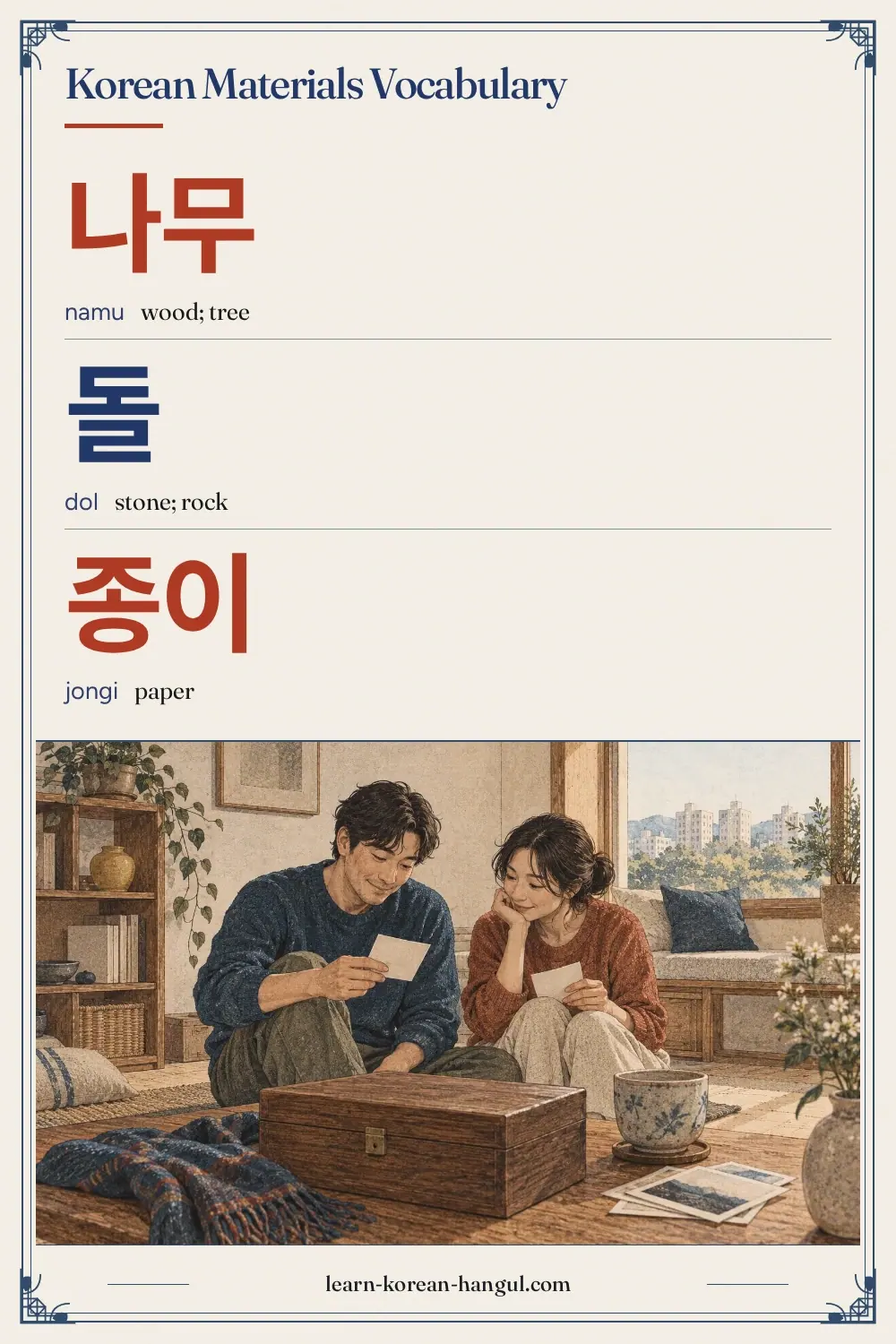
Korean Materials Vocabulary at a Glance
This list has 30 words in five groups of six. It starts with the two general words for material, then the natural materials you find outdoors, then metals, the fabrics and leather on clothing labels, the plastics in packaging, and the glass, brick and tile of buildings. It belongs to Shapes, Materials and Measurements in Korean and follows Korean Shapes Vocabulary.
| Group | Words | Use |
|---|---|---|
| Material words and natural materials | 6 | General words and things from nature |
| Metals | 6 | Metals and the metal words on labels |
| Fabrics and leather | 6 | Words on clothing labels |
| Plastics and synthetics | 6 | Plastics, rubber and man-made fibres |
| Glass, ceramics and building materials | 6 | Materials of buildings and dishes |
All 30 are nouns. Many are loanwords from English, such as 플라스틱, 알루미늄 and 폴리에스터, so you can often guess them. The rest are short native or Sino-Korean words, such as 나무, 돌, 철 and 금, that are worth learning by heart. The pattern for saying what something is made of is the same for every word, and the next section shows it.
Which Materials Should You Learn First?
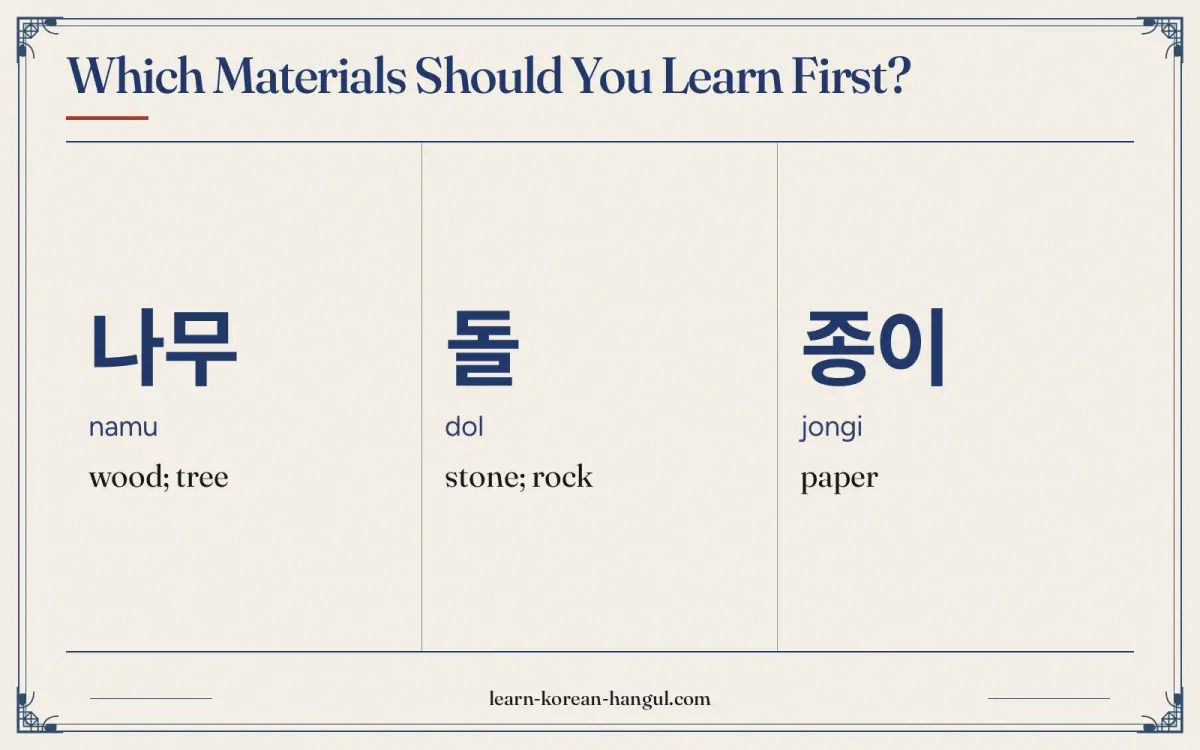
Learn 나무 (wood), 종이 (paper), 유리 (glass), 플라스틱 (plastic) and 면 (cotton) first. These five cover most of the objects around you, and they are the ones you see on shopping labels. After them, add 금속 (metal), 가죽 (leather) and 소재 (material).
- Words to say. 나무, 종이, 유리, 플라스틱, 가죽. You use these when you describe an object or ask what it is made of.
- Words to recognise. 면, 울, 폴리에스터, 나일론, 리넨. These appear on clothing labels, and you read them rather than say them.
- Words to understand when spoken. 콘크리트, 시멘트, 벽돌, 구리. A builder, a guide or a science video uses these.
There are two general words for material. 재료 (jaeryo) is the stuff something is made from, including cooking ingredients, so 요리 재료 is a cooking ingredient. 소재 (sojae) is the material of a product, and it is the word on clothing labels and in product descriptions. Both can be translated as "material", but they are not interchangeable: a chef talks about 재료, and a shop assistant talks about 소재. For the single-word pages, see wood in korean and glass in korean.
Word · 12
- 1
나무
namu
wood; tree
- 2
돌
dol
stone; rock
- 3
종이
jongi
paper
- 4
철
cheol
iron
- 5
금
geum
gold
- 6
가죽
gajuk
leather; hide
- 7
면
myeon
cotton
- 8
플라스틱
peullaseutik
plastic
- 9
고무
gomu
rubber
- 10
유리
yuri
glass
- 11
벽돌
byeokdol
brick
- 12
도자기
dojagi
ceramics; porcelain; pottery
Natural Materials
This group starts with the two general words for material and continues with four natural materials. You will use the first two to ask a question, and the other four to answer it. Wood and paper come from the same source, so they are easy to remember together.
| No. | Hangul | Revised Romanization | Meaning and note | Example sentence | Audio assetId |
|---|---|---|---|---|---|
| 1 | 재료 | jaeryo | material; ingredient. What something is made from. For food it means an ingredient, and for crafts it means the supplies. | 요리 재료를 샀어요. (I bought cooking ingredients.) | au-pg-vocabulary-descriptions-materials-1; example: au-pg-vocabulary-descriptions-materials-31 |
| 2 | 소재 | sojae | material (of a product). The word on labels and product pages. A shop assistant asks 소재가 뭐예요? (What is the material?). | 이 가방은 소재가 부드러워요. (The material of this bag is soft.) | au-pg-vocabulary-descriptions-materials-2; example: au-pg-vocabulary-descriptions-materials-32 |
| 3 | 나무 | namu | wood; tree. The same word means the tree and the wood from it. 목재 is the formal word for timber. | 이 의자는 나무로 만들었어요. (This chair is made of wood.) | au-pg-vocabulary-descriptions-materials-3; example: au-pg-vocabulary-descriptions-materials-33 |
| 4 | 돌 | dol | stone; rock. A small or middle-sized stone. 바위 is a big rock. It is also the word for a baby's first birthday, 돌, so context decides. | 돌을 던지지 마세요. (Please do not throw stones.) | au-pg-vocabulary-descriptions-materials-4; example: au-pg-vocabulary-descriptions-materials-34 |
| 5 | 흙 | heuk | soil; earth; clay. Said [흑]. Written with a double final consonant, but only one sound is said. Before a vowel it links: 흙을 is [흘글]. | 화분에 흙을 넣어요. (I put soil in the flowerpot.) | au-pg-vocabulary-descriptions-materials-5; example: au-pg-vocabulary-descriptions-materials-35 |
| 6 | 종이 | jongi | paper. The everyday word for paper in any form. A sheet of paper is 종이 한 장. | 종이에 이름을 써요. (I write my name on paper.) | au-pg-vocabulary-descriptions-materials-6; example: au-pg-vocabulary-descriptions-materials-36 |
Example Sentences
The sentences use three frames. The first is thing + 은/는 + material + (으)로 + 만들었어요, as in 이 의자는 나무로 만들었어요 (this chair is made of wood). The particle 로 follows a vowel, as in 나무로, and 으로 follows a consonant, as in 흙으로. The second is object + 을/를 + verb, as in 돌을 던지지 마세요 (please do not throw stones), where 지 마세요 means please do not. The third is place + 에 + object + 을/를 + verb, as in 화분에 흙을 넣어요 and 종이에 이름을 써요, where 에 marks the place or surface. Say each sentence aloud after its clip.
How Do You Say Metals in Korean?
Korean has one general word for metal and short single-syllable names for the traditional metals. The three one-syllable words, 철, 금 and 은, are Sino-Korean and appear in many compounds. The last two are longer: 구리 is a native word, and 알루미늄 is a loanword.
| No. | Hangul | Revised Romanization | Meaning and note | Example sentence | Audio assetId |
|---|---|---|---|---|---|
| 7 | 금속 | geumsok | metal. The general word for metal as a class of material. It is built from 금 (metal) and 속 (kind). | 금속은 차가워요. (Metal is cold.) | au-pg-vocabulary-descriptions-materials-7; example: au-pg-vocabulary-descriptions-materials-37 |
| 8 | 철 | cheol | iron. The common word for iron. 쇠 is the plain word for iron or metal in daily speech. A different 철 appears in 철이 없다 (to be childish), so check the context. | 이 다리는 철로 만들었어요. (This bridge is made of iron.) | au-pg-vocabulary-descriptions-materials-8; example: au-pg-vocabulary-descriptions-materials-38 |
| 9 | 금 | geum | gold. A one-syllable Sino-Korean word. It is also a prefix, as in 금반지 (gold ring). | 금은 비싸요. (Gold is expensive.) | au-pg-vocabulary-descriptions-materials-9; example: au-pg-vocabulary-descriptions-materials-39 |
| 10 | 은 | eun | silver. The same sound as the topic particle 은. As a noun it often goes before another noun: 은 목걸이 (silver necklace). | 은 목걸이를 선물했어요. (I gave a silver necklace as a gift.) | au-pg-vocabulary-descriptions-materials-10; example: au-pg-vocabulary-descriptions-materials-40 |
| 11 | 구리 | guri | copper. Also the name of a city near Seoul. For wire and coins the word is 구리. | 구리는 전기가 잘 통해요. (Copper conducts electricity well.) | au-pg-vocabulary-descriptions-materials-11; example: au-pg-vocabulary-descriptions-materials-41 |
| 12 | 알루미늄 | alluminyum | aluminium. A loanword. 알루미늄 캔 is an aluminium can. The ㄹ of 알 and the ㄹ of 루 meet as a long l. | 알루미늄 캔을 모아요. (I collect aluminium cans.) | au-pg-vocabulary-descriptions-materials-12; example: au-pg-vocabulary-descriptions-materials-42 |
Note the sentence 금은 비싸요. It has 금 (gold) followed by the topic particle 은. The same works for silver: 은은 비싸요 (silver is expensive), where the first 은 is the noun and the second is the particle. For the particle itself, see topic particles.
Metal words are often followed by 제품 (product) or 그릇 (dish), so 금속 제품 is a metal product and 철 그릇 is an iron bowl.
Fabrics and Leather
These six words come from clothing labels and shop descriptions. 천 is the general word for fabric, 가죽 is leather, and the other four are the most common cloth names. Most are loanwords or short Sino-Korean words, so they are quick to learn.
| No. | Hangul | Revised Romanization | Meaning and note | Example sentence | Audio assetId |
|---|---|---|---|---|---|
| 13 | 천 | cheon | cloth; fabric. The general word for cloth. It sounds like the number thousand (천), so context decides. | 천으로 가방을 만들어요. (I make a bag from cloth.) | au-pg-vocabulary-descriptions-materials-13; example: au-pg-vocabulary-descriptions-materials-43 |
| 14 | 가죽 | gajuk | leather; hide. Leather shoes are 가죽 신발, and a leather bag is 가죽 가방. Faux leather is 인조 가죽. | 가죽 신발을 신어요. (I wear leather shoes.) | au-pg-vocabulary-descriptions-materials-14; example: au-pg-vocabulary-descriptions-materials-44 |
| 15 | 면 | myeon | cotton. The usual label word for cotton. It also means noodles (면) and a surface, so check the topic. Cotton wool is 솜. | 여름에는 면 옷을 입어요. (In summer I wear cotton clothes.) | au-pg-vocabulary-descriptions-materials-15; example: au-pg-vocabulary-descriptions-materials-45 |
| 16 | 실크 | silkeu | silk. A loanword. The older word 비단 means silk cloth and is used for traditional garments. | 실크 스카프를 샀어요. (I bought a silk scarf.) | au-pg-vocabulary-descriptions-materials-16; example: au-pg-vocabulary-descriptions-materials-46 |
| 17 | 울 | ul | wool. A loanword from English. The Sino-Korean word 양모 (sheep's wool) is also common on labels. | 겨울에는 울 코트를 입어요. (In winter I wear a wool coat.) | au-pg-vocabulary-descriptions-materials-17; example: au-pg-vocabulary-descriptions-materials-47 |
| 18 | 리넨 | rinen | linen. A loanword. The spelling 린넨 is also very common on labels and shops, but 리넨 is the standard loanword spelling. It is a summer cloth. | 리넨 셔츠는 시원해요. (A linen shirt is cool.) | au-pg-vocabulary-descriptions-materials-18; example: au-pg-vocabulary-descriptions-materials-48 |
Clothing labels list the material by percent, for example 면 100%. A label may read 면 80%, 폴리에스터 20%, with the number after the material. Read the label from left to right and look for the first word you know. For the words that name the clothes themselves, see clothing.
The word 면 has several meanings, and a clothing label settles the question. Next to a percent it means cotton, and in a restaurant 면 means noodles, as in 냉면 (cold noodles). The two share a spelling and a sound, and you tell them apart from the setting.
How Do You Say Plastics and Synthetics in Korean?
Most synthetic materials are loanwords, and the words are used on packaging, in recycling and on clothing labels. This group has two plastic words, a rubber word, two synthetic fibres and a foam. All six are nouns.
| No. | Hangul | Revised Romanization | Meaning and note | Example sentence | Audio assetId |
|---|---|---|---|---|---|
| 19 | 플라스틱 | peullaseutik | plastic. A loanword. Plastic bags are 비닐봉지, not 플라스틱 봉지. Recycling bins show the word 플라스틱. | 플라스틱 컵을 써요. (I use a plastic cup.) | au-pg-vocabulary-descriptions-materials-19; example: au-pg-vocabulary-descriptions-materials-49 |
| 20 | 비닐 | binil | vinyl; thin plastic film. The word for thin plastic wrap and bags. It is the usual word for a plastic bag: 비닐봉지. | 비닐은 물에 젖지 않아요. (Vinyl does not get wet.) | au-pg-vocabulary-descriptions-materials-20; example: au-pg-vocabulary-descriptions-materials-50 |
| 21 | 고무 | gomu | rubber. Used in many compounds, such as 고무장갑 (rubber gloves) and 고무줄 (rubber band). | 고무는 잘 늘어나요. (Rubber stretches well.) | au-pg-vocabulary-descriptions-materials-21; example: au-pg-vocabulary-descriptions-materials-51 |
| 22 | 나일론 | naillon | nylon. A loanword. It is common in bags and jackets. | 이 가방은 나일론이에요. (This bag is nylon.) | au-pg-vocabulary-descriptions-materials-22; example: au-pg-vocabulary-descriptions-materials-52 |
| 23 | 폴리에스터 | pollieseuteo | polyester. A long loanword with five syllables. It is the most common synthetic fibre on labels. The dictionary spelling is 폴리에스테르, but labels and shops usually write 폴리에스터. | 이 티셔츠는 폴리에스터예요. (This T-shirt is polyester.) | au-pg-vocabulary-descriptions-materials-23; example: au-pg-vocabulary-descriptions-materials-53 |
| 24 | 스티로폼 | seutiropom | styrofoam; polystyrene foam. A loanword from the English brand name Styrofoam. It is used for boxes and cups. | 스티로폼 상자는 가벼워요. (A styrofoam box is light.) | au-pg-vocabulary-descriptions-materials-24; example: au-pg-vocabulary-descriptions-materials-54 |
Korea sorts rubbish by material, so these words appear on bins and bags. You will see the word 플라스틱 on a bin for plastic, 비닐 on a bin for plastic bags and film, and 스티로폼 on a bin for foam packaging. Recycling labels also print the material in letters, such as PET or PE, with the Korean word beside them. Learn the Korean words and you can sort the rubbish without asking.
Building Materials
The last group names the materials of buildings, floors and dishes. Glass and ceramics are also materials of everyday objects, so they fit here. These words appear on construction signs, in house descriptions and in museums.
| No. | Hangul | Revised Romanization | Meaning and note | Example sentence | Audio assetId |
|---|---|---|---|---|---|
| 25 | 유리 | yuri | glass. The ordinary word for glass. A drinking glass is 유리잔, and a window is 유리창. Eyeglasses are not 유리, but 안경. | 창문 유리가 깨졌어요. (The window glass broke.) | au-pg-vocabulary-descriptions-materials-25; example: au-pg-vocabulary-descriptions-materials-55 |
| 26 | 콘크리트 | konkeuriteu | concrete. A loanword. Korean adds the vowel ㅡ after ㅋ and ㅌ, which is why it has four syllables. | 이 건물은 콘크리트로 지었어요. (This building was built of concrete.) | au-pg-vocabulary-descriptions-materials-26; example: au-pg-vocabulary-descriptions-materials-56 |
| 27 | 벽돌 | byeokdol | brick. Said [벽똘]. 벽 (wall) + 돌 (stone). The ㄷ is tense after the final ㄱ, and the Romanization does not show it. | 벽돌집이에요. (It is a brick house. 벽돌집 is written as one word.) | au-pg-vocabulary-descriptions-materials-27; example: au-pg-vocabulary-descriptions-materials-57 |
| 28 | 시멘트 | simenteu | cement. A loanword. 시멘트 is cement, the powder; 콘크리트 is the hard mixture. | 시멘트가 단단해요. (The cement is hard.) | au-pg-vocabulary-descriptions-materials-28; example: au-pg-vocabulary-descriptions-materials-58 |
| 29 | 타일 | tail | tile. A loanword. Bathroom and kitchen floors are often tiled: 타일 바닥. | 화장실 바닥은 타일이에요. (The bathroom floor is tile.) | au-pg-vocabulary-descriptions-materials-29; example: au-pg-vocabulary-descriptions-materials-59 |
| 30 | 도자기 | dojagi | ceramics; porcelain; pottery. The general word for fired clay dishes. Korean celadon is called 청자 and white porcelain 백자. | 도자기 그릇이 예뻐요. (The ceramic bowl is pretty.) | au-pg-vocabulary-descriptions-materials-30; example: au-pg-vocabulary-descriptions-materials-60 |
The words 시멘트 and 콘크리트 are easy to confuse, because English speakers use both for the same grey material. In Korean, 시멘트 is the grey powder, and 콘크리트 is the hard, mixed building material. On a site, builders say 콘크리트를 부어요 (they pour concrete). In a shop, the bag says 시멘트.
Ceramics have a long history in Korea, and 도자기 is the word used for museum labels and gift shops. Related words, such as 청자 (celadon) and 백자 (white porcelain), appear on those labels, but they are not on this list.
How Do You Say What Something Is Made Of?
Korean says what something is made of with the pattern thing + 은/는 + material + (으)로 + 만들었어요. The particle 로 or 으로 marks the material, much like "of" or "from" in English. Use 로 after a vowel or after ㄹ, and 으로 after any other consonant.
| Material | With 로/으로 | Example | Meaning |
|---|---|---|---|
| 나무 | 나무로 | 나무로 만들었어요. | It is made of wood. |
| 돌 | 돌로 | 돌로 만들었어요. | It is made of stone. |
| 철 | 철로 | 철로 만들었어요. | It is made of iron. |
| 종이 | 종이로 | 종이로 만들었어요. | It is made of paper. |
| 면 | 면으로 | 면으로 만들었어요. | It is made of cotton. |
| 가죽 | 가죽으로 | 가죽으로 만들었어요. | It is made of leather. |
The question is 뭐로 만들었어요? (What is it made of?). The word 뭐로 is short for 무엇으로. A shop assistant may also ask the shorter 소재가 뭐예요?. There are two verbs for making. 만들다 is for making something from raw material, and 되다 describes what the thing is, as in 이 그릇은 유리로 되어 있어요 (this bowl is made of glass). You can use either, and 만들었어요 is the safer one at beginner level. The verb 만들다 drops its ㄹ before ㅅ, so the polite form is 만들어요 and the honorific form is 만드세요.
The question word for what, 뭐, is covered on the 뭐 and 무엇 page.
What Do the Recycling and Packaging Words Mean?
Packaging prints material words in Korean next to a recycling symbol, so these words are useful in daily life. In an apartment building, bins are labelled by material, such as 종이 (paper), 플라스틱 (plastic), 비닐 (vinyl), 유리 (glass) and 캔 (cans). Fabric goes in a separate clothing bin. The bin labels use the words in this list, so you can read them without a dictionary.
| Label | Where you see it | What goes in |
|---|---|---|
| 종이 | Recycling bin | Paper, cardboard |
| 플라스틱 | Recycling bin | Plastic bottles, containers |
| 비닐 | Recycling bin | Plastic bags and film |
| 유리 | Recycling bin | Glass bottles |
| 스티로폼 | Recycling bin | White foam packaging |
Local rules vary, so check the notice in your building or the website of your district office. The labels use the same words, but which items go where can differ.
How Do You Pronounce These Words?
Most material words are easy to say, but a few have sounds that differ from the spelling. The main changes are a double final consonant in 흙, tensing in 벽돌, and the double ㄹ in loanwords such as 알루미늄 and 폴리에스터. Standard pronunciation follows the National Institute of Korean Language (국립국어원) rules, and the romanization follows the Revised Romanization of Korean, which records some sound changes and ignores others.
| Spelling | Sounds like | What changes |
|---|---|---|
| 흙 | [흑] | The double final ㄺ is said as a single ㄱ sound when nothing follows. With 을 it links: 흙을 is [흘글]. |
| 벽돌 | [벽똘] | The ㄷ becomes tense after the final ㄱ. The Romanization does not show the tensing: byeokdol. |
| 알루미늄 | [알루미늄] | The final ㄹ of 알 and the ㄹ of 루 make a long l sound. The Romanization writes alluminyum. |
| 나일론 | [나일론] | No change in sound. The ㄹ of 일 and the ㄹ of 론 meet, so the Romanization writes ll: naillon. |
| 스티로폼 | [스티로폼] | No change. The vowel ㅡ is unrounded. |
| 콘크리트 | [콘크리트] | No change. The two ㅡ vowels are short and unrounded. |
| 면 | [면] | No change. Write it with an initial ㅁ and a final ㄴ: myeon. |
Loanwords such as 플라스틱 (peullaseutik) and 콘크리트 (konkeuriteu) add a vowel ㅡ (eu) between consonants that English says together. This is the biggest difference between a loanword and the English original. Say 플 as peul, not pl, and 크 as keu, not k. The extra vowel is short, but it is there. Listening to the clip will help you hear it.
Audio and Slow Playback
Every headword and every example sentence has its own audio. The five clips below replay the trickiest words slowly. Play one, repeat it aloud, then play it again and compare.
What Mistakes Do Learners Make with Materials?
These five mistakes come up often with material words.
- Using 에 instead of (으)로 for the material. 나무에 만들었어요 is wrong. The material takes 로 or 으로: 나무로 만들었어요.
- Choosing the wrong form of the particle. After a vowel use 로, as in 나무로, and after a consonant use 으로, as in 면으로. The exception is ㄹ: 철, 돌 and 울 take 로, not 으로 (철로, 돌로, 울로).
- Mixing up 재료 and 소재. 재료 is the stuff or the ingredient, and 소재 is the material of a finished product. 요리 소재 is odd, and 가방 재료 describes the supplies for making a bag.
- Reading 면 as noodles on a clothing label. On a clothing label, 면 100% means cotton. The same word means noodles on a menu, as in 냉면.
- Pronouncing 흙 with the double letters. The word has two consonant letters at the end, but on its own you say only [흑]. Do not try to say both.
A habit that avoids most of these: always say the material first, then the particle, then the verb. Say 나무로 만들었어요 as one unit, and you will not forget the particle.
Practice: Flashcards and Worksheet
Study in three steps. First, run the flashcard deck in recognition mode until you know each of the 30 words. Second, switch to listening mode and answer from the audio alone. Third, take the quiz. The deck covers all 30 words with audio, and your progress stays in your browser. The vocabulary flashcard decks page lists the other decks.
Practice · 65
- 01재료
Show answer
headword 1: material; ingredient
- 02소재
Show answer
headword 2: material (of a product)
- 03나무
Show answer
headword 3: wood; tree
- 04돌
Show answer
headword 4: stone; rock
- 05흙
Show answer
headword 5: soil; earth; clay
- 06종이
Show answer
headword 6: paper
- 07금속
Show answer
headword 7: metal
- 08철
Show answer
headword 8: iron
- 09금
Show answer
headword 9: gold
- 10은
Show answer
headword 10: silver
- 11구리
Show answer
headword 11: copper
- 12알루미늄
Show answer
headword 12: aluminium
- 13천
Show answer
headword 13: cloth; fabric
- 14가죽
Show answer
headword 14: leather; hide
- 15면
Show answer
headword 15: cotton
- 16실크
Show answer
headword 16: silk
- 17울
Show answer
headword 17: wool
- 18리넨
Show answer
headword 18: linen
- 19플라스틱
Show answer
headword 19: plastic
- 20비닐
Show answer
headword 20: vinyl; thin plastic film
- 21고무
Show answer
headword 21: rubber
- 22나일론
Show answer
headword 22: nylon
- 23폴리에스터
Show answer
headword 23: polyester
- 24스티로폼
Show answer
headword 24: styrofoam; polystyrene foam
- 25유리
Show answer
headword 25: glass
- 26콘크리트
Show answer
headword 26: concrete
- 27벽돌
Show answer
headword 27: brick
- 28시멘트
Show answer
headword 28: cement
- 29타일
Show answer
headword 29: tile
- 30도자기
Show answer
headword 30: ceramics; porcelain; pottery
- 31요리 재료를 샀어요.
Show answer
example sentence for 재료: I bought cooking ingredients.
- 32이 가방은 소재가 부드러워요.
Show answer
example sentence for 소재: The material of this bag is soft.
- 33이 의자는 나무로 만들었어요.
Show answer
example sentence for 나무: This chair is made of wood.
- 34돌을 던지지 마세요.
Show answer
example sentence for 돌: Please do not throw stones.
- 35화분에 흙을 넣어요.
Show answer
example sentence for 흙: I put soil in the flowerpot.
- 36종이에 이름을 써요.
Show answer
example sentence for 종이: I write my name on paper.
- 37금속은 차가워요.
Show answer
example sentence for 금속: Metal is cold.
- 38이 다리는 철로 만들었어요.
Show answer
example sentence for 철: This bridge is made of iron.
- 39금은 비싸요.
Show answer
example sentence for 금: Gold is expensive.
- 40은 목걸이를 선물했어요.
Show answer
example sentence for 은: I gave a silver necklace as a gift.
- 41구리는 전기가 잘 통해요.
Show answer
example sentence for 구리: Copper conducts electricity well.
- 42알루미늄 캔을 모아요.
Show answer
example sentence for 알루미늄: I collect aluminium cans.
- 43천으로 가방을 만들어요.
Show answer
example sentence for 천: I make a bag from cloth.
- 44가죽 신발을 신어요.
Show answer
example sentence for 가죽: I wear leather shoes.
- 45여름에는 면 옷을 입어요.
Show answer
example sentence for 면: In summer I wear cotton clothes.
- 46실크 스카프를 샀어요.
Show answer
example sentence for 실크: I bought a silk scarf.
- 47겨울에는 울 코트를 입어요.
Show answer
example sentence for 울: In winter I wear a wool coat.
- 48리넨 셔츠는 시원해요.
Show answer
example sentence for 리넨: A linen shirt is cool.
- 49플라스틱 컵을 써요.
Show answer
example sentence for 플라스틱: I use a plastic cup.
- 50비닐은 물에 젖지 않아요.
Show answer
example sentence for 비닐: Vinyl does not get wet.
- 51고무는 잘 늘어나요.
Show answer
example sentence for 고무: Rubber stretches well.
- 52이 가방은 나일론이에요.
Show answer
example sentence for 나일론: This bag is nylon.
- 53이 티셔츠는 폴리에스터예요.
Show answer
example sentence for 폴리에스터: This T-shirt is polyester.
- 54스티로폼 상자는 가벼워요.
Show answer
example sentence for 스티로폼: A styrofoam box is light.
- 55창문 유리가 깨졌어요.
Show answer
example sentence for 유리: The window glass broke.
- 56이 건물은 콘크리트로 지었어요.
Show answer
example sentence for 콘크리트: This building was built of concrete.
- 57벽돌집이에요.
Show answer
example sentence for 벽돌: It is a brick house.
- 58시멘트가 단단해요.
Show answer
example sentence for 시멘트: The cement is hard.
- 59화장실 바닥은 타일이에요.
Show answer
example sentence for 타일: The bathroom floor is tile.
- 60도자기 그릇이 예뻐요.
Show answer
example sentence for 도자기: The ceramic bowl is pretty.
- 61흙
Show answer
slow playback of the headword 흙
- 62알루미늄
Show answer
slow playback of the headword 알루미늄
- 63폴리에스터
Show answer
slow playback of the headword 폴리에스터
- 64벽돌
Show answer
slow playback of the headword 벽돌
- 65콘크리트
Show answer
slow playback of the headword 콘크리트
Practice · 8
What does 나무 (namu) mean?
Show answer
wood; tree
나무 means wood; tree. Example: 이 의자는 나무로 만들었어요. (This chair is made of wood.)
What does 흙 (heuk) mean?
Show answer
soil; earth; clay
흙 means soil; earth; clay. Example: 화분에 흙을 넣어요. (I put soil in the flowerpot.)
What does 구리 (guri) mean?
Show answer
copper
구리 means copper. Example: 구리는 전기가 잘 통해요. (Copper conducts electricity well.)
What does 가죽 (gajuk) mean?
Show answer
leather; hide
가죽 means leather; hide. Example: 가죽 신발을 신어요. (I wear leather shoes.)
What does 비닐 (binil) mean?
Show answer
vinyl; thin plastic film
비닐 means vinyl; thin plastic film. Example: 비닐은 물에 젖지 않아요. (Vinyl does not get wet.)
What does 고무 (gomu) mean?
Show answer
rubber
고무 means rubber. Example: 고무는 잘 늘어나요. (Rubber stretches well.)
What does 벽돌 (byeokdol) mean?
Show answer
brick
벽돌 means brick. Example: 벽돌집이에요. (It is a brick house.)
What does 도자기 (dojagi) mean?
Show answer
ceramics; porcelain; pottery
도자기 means ceramics; porcelain; pottery. Example: 도자기 그릇이 예뻐요. (The ceramic bowl is pretty.)
Korean Materials Vocabulary Worksheet (PDF)
A printable worksheet for these words (word list, matching, writing practice, fill-in-the-blank exercises and answer key) is available in A4 and US Letter from the download card on this page. For practice, pick five objects around you, such as a cup, a chair, a bag, a shirt and a window, and say what each is made of: 이 컵은 유리로 만들었어요. Saying the sentence while you hold the object fixes both the word and the pattern.
Where to Go Next
After this page, continue with Korean Measurement Vocabulary, which teaches words for length, weight and temperature, or go back to Korean Shapes Vocabulary. For the clothes that these fabrics make, see clothing. To return to the full set, go to Shapes, Materials and Measurements in Korean.
Frequently Asked Questions
How Do You Say Wood in Korean?
Wood is 나무 (namu). The same word also means a tree. To say something is made of wood, use 나무로 만들었어요. The formal word for timber is 목재, but 나무 is enough in daily speech. The single-word page on wood in korean gives more examples.
How Do You Pronounce 유리 (yuri)?
Say yu-ri, with two short syllables. The first vowel ㅠ is like "you" with no final w. The ㄹ between vowels is a light tap, like the "tt" in the American "butter". There is no sound change, so the spelling matches the sound. The page on glass in korean has more detail.
How Many Materials Should I Learn First?
Five first: 나무, 종이, 유리, 플라스틱 and 면. At five new words a day, the whole list of 30 takes six days plus review. Add 소재 and 금속 on day two, since you will meet them on product labels.
Where Can I Practise Materials with Flashcards?
Use the vocabulary flashcard decks. The deck for this page holds all 30 words with Hangul, romanization and audio, and it offers recognition and listening modes. Your progress stays in your browser, so return daily and review the cards you missed.
Is the Romanization on This Page Official?
It follows the Revised Romanization of Korean, which South Korea adopted on 7 July 2000 and whose rules the National Institute of Korean Language (국립국어원) publishes. It is a learning aid and does not show every sound change, so rely on the Hangul and the audio.
Is There a Printable Worksheet for Materials?
A printable worksheet for these words (word list, matching, writing practice, fill-in-the-blank exercises and answer key) is available in A4 and US Letter from the download card on this page. For practice, copy the tables on this page by hand or use the flashcard deck, which carries the same 30 words.