Korean Shapes Vocabulary at a Glance
This list has 25 words in five groups of five. It begins with the words you need to point at a circle or a star, moves to the names used in maths class, then to solid shapes, lines and angles, and ends with the shapes you see on bags, shirts and umbrellas. It belongs to Shapes, Materials and Measurements in Korean and pairs with Korean Materials Vocabulary.
| Group | Words | Use |
|---|---|---|
| Everyday shapes | 5 | The words children and adults use daily |
| School maths shapes | 5 | Names used in maths class and on tests |
| Solid shapes | 5 | Three-dimensional figures and flat surfaces |
| Lines and angles | 5 | Drawing, maths and giving directions |
| Shapes on objects | 5 | Hearts, patterns and clothing |
Almost all of these are nouns. The same noun can often be placed in front of another noun to describe it, as in 세모 모양 (a triangle shape) or 줄무늬 셔츠 (a striped shirt). Adjectives that describe shapes, such as 둥글다 (round), are on the size, shape and color adjectives pages.
Which Shapes Should You Learn First?
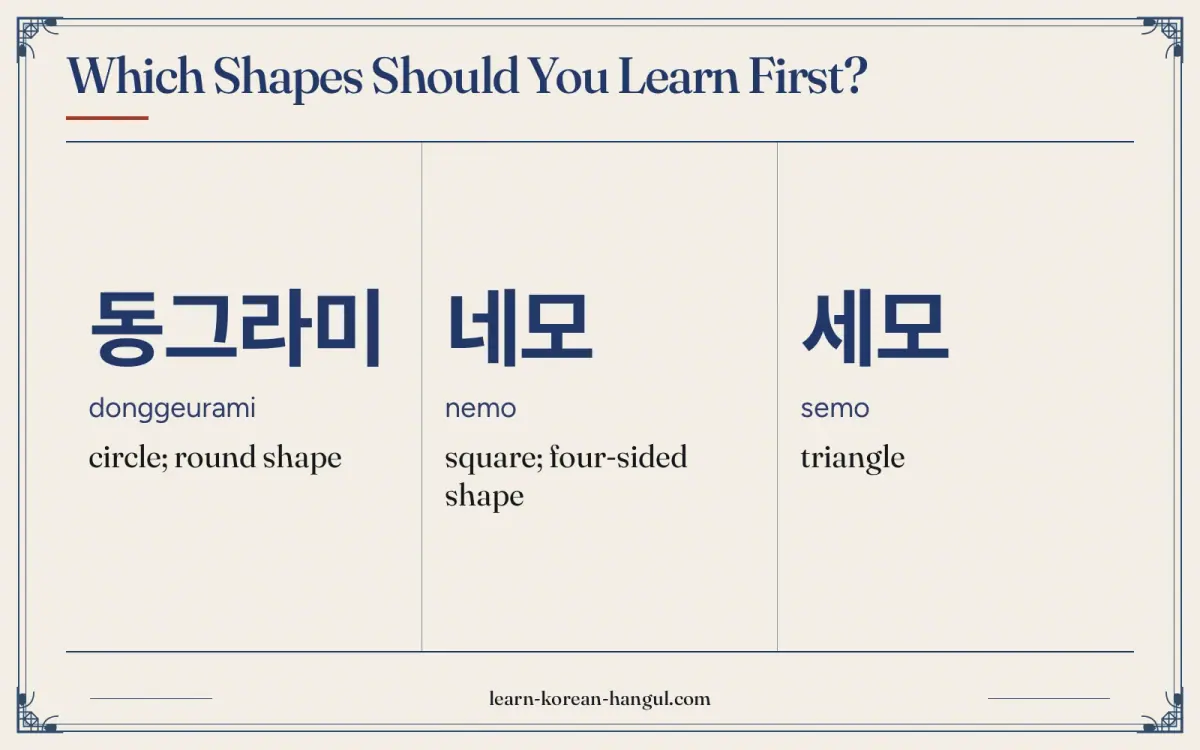
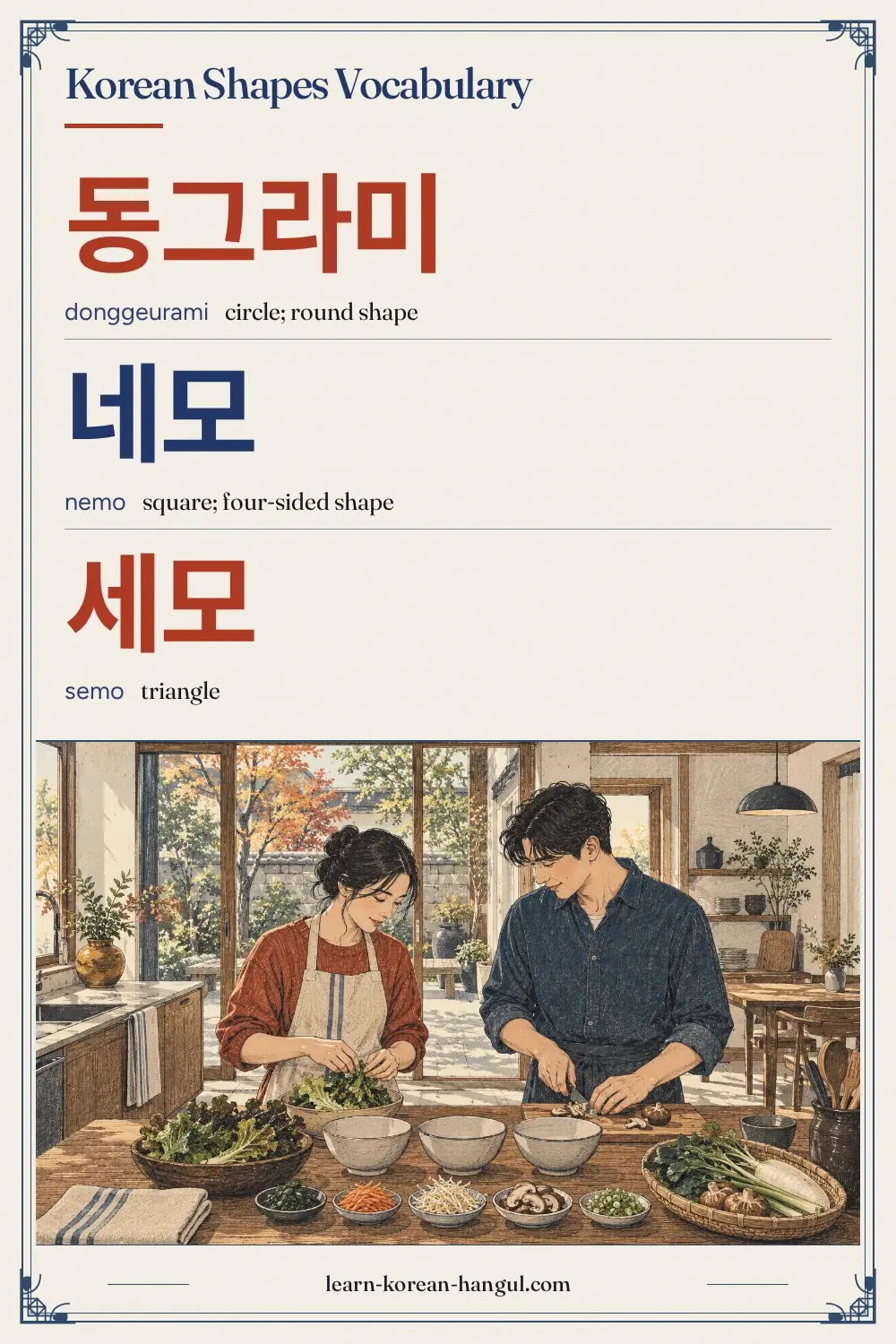
Learn 모양 (shape), 동그라미 (circle), 네모 (square), 세모 (triangle) and 별 (star) first. These five words are the ones children use, and adults use them in everyday talk too. They are short, they are all nouns, and they let you describe most objects in a sentence.
- Words to say. 모양, 동그라미, 네모, 세모, 별, 하트. You use these when you draw, shop or describe something.
- Words to recognise. 무늬, 줄무늬, 체크무늬, 직선, 곡선. These appear on clothing labels, in drawing tasks and in school books.
- Words to understand when spoken. 삼각형, 사각형, 원기둥, 원뿔, 직각. A teacher or a maths video uses these, and you only need to follow them at first.
Many flat shapes have two names, and you will meet both. 동그라미, 네모 and 세모 are the plain everyday words. 원, 사각형 and 삼각형 are the Sino-Korean words that school books use, built from Chinese-character roots (the same roots as in Japanese and Chinese). Both sets are correct. Use the plain set with friends and children, and expect the school set in textbooks and on tests. For the single-word answers, see circle in korean and triangle in korean.
Word · 10
- 1
동그라미
donggeurami
circle; round shape
- 2
네모
nemo
square; four-sided shape
- 3
세모
semo
triangle
- 4
별
byeol
star
- 5
하트
hateu
heart (shape)
- 6
원기둥
wongidung
cylinder
- 7
원뿔
wonppul
cone
- 8
줄무늬
julmunui
stripes; striped pattern
- 9
체크무늬
chekeumunui
check; plaid pattern
- 10
물방울무늬
mulbangulmunui
polka dots; dotted pattern
Everyday Shapes
These five words name the shapes you can point at and draw. They are the first ones children learn, and they work in any casual conversation. 모양 is the general word for shape, and the other four are particular shapes you see every day. The first three are easy to remember because 네모 and 세모 differ by only one sound.
| No. | Hangul | Revised Romanization | Meaning and note | Example sentence | Audio assetId |
|---|---|---|---|---|---|
| 1 | 모양 | moyang | shape; form. The general word for how something looks. It can end a phrase: 세모 모양 (triangle shape). | 이 컵은 모양이 예뻐요. (This cup has a pretty shape.) | au-pg-vocabulary-descriptions-shapes-1; example: au-pg-vocabulary-descriptions-shapes-26 |
| 2 | 동그라미 | donggeurami | circle; round shape. The plain word for a circle drawn on paper or a ring. In class, teachers also use it for the circle you draw around a correct answer. | 정답에 동그라미를 쳐요. (I draw a circle around the correct answer.) | au-pg-vocabulary-descriptions-shapes-2; example: au-pg-vocabulary-descriptions-shapes-27 |
| 3 | 네모 | nemo | square; four-sided shape. Used for anything boxy, from a square to a rectangle. It is informal and child-friendly. The school word is 사각형. | 네모 상자를 샀어요. (I bought a square box.) | au-pg-vocabulary-descriptions-shapes-3; example: au-pg-vocabulary-descriptions-shapes-28 |
| 4 | 세모 | semo | triangle. The plain word for a three-sided shape. 네모 and 세모 rhyme, so children learn them together. The school word is 삼각형. | 세모 모양 샌드위치예요. (It is a triangle-shaped sandwich.) | au-pg-vocabulary-descriptions-shapes-4; example: au-pg-vocabulary-descriptions-shapes-29 |
| 5 | 별 | byeol | star. Also the word for a star in the night sky. It names both the real star and a star-shaped mark or sticker. | 별 모양 스티커를 붙여요. (I stick on a star sticker.) | au-pg-vocabulary-descriptions-shapes-5; example: au-pg-vocabulary-descriptions-shapes-30 |
Example Sentences
The sentences in this group use three simple frames. The first is thing + 이/가 + description, as in 컵이 예뻐요 (the cup is pretty). The second is shape + 모양 + noun, as in 세모 모양 샌드위치 (a triangle-shaped sandwich). The third is object + 을/를 + verb, as in 별 모양 스티커를 붙여요 (I stick on a star sticker). After a vowel the subject particle is 가 and the object particle is 를, and after a consonant they are 이 and 을, so 컵이 (after the consonant ㅂ) but 스티커를 (after the vowel ㅓ). Say each sentence aloud after the clip.
How Do You Say Circle, Triangle and Rectangle in School Korean?
School maths uses a second set of shape names. They are Sino-Korean words, so each one is built from short parts you can reuse. If you learn the parts, you learn the whole family. The five words below cover the flat shapes taught in primary school.
| No. | Hangul | Revised Romanization | Meaning and note | Example sentence | Audio assetId |
|---|---|---|---|---|---|
| 6 | 원 | won | circle (geometry). A Sino-Korean one-syllable word. It is also the currency unit, the won, as in 천 원. Context shows which one. | 컴퍼스로 원을 그려요. (I draw a circle with a compass.) | au-pg-vocabulary-descriptions-shapes-6; example: au-pg-vocabulary-descriptions-shapes-31 |
| 7 | 삼각형 | samgakhyeong | triangle (geometry). Said [삼가켱]. 삼 (three) + 각 (angle) + 형 (shape). The noun keeps its h in Revised Romanization. | 삼각형은 변이 세 개예요. (A triangle has three sides.) | au-pg-vocabulary-descriptions-shapes-7; example: au-pg-vocabulary-descriptions-shapes-32 |
| 8 | 사각형 | sagakhyeong | quadrilateral; four-sided figure. Said [사가켱]. 사 (four) + 각 + 형. It covers squares, rectangles and other four-sided shapes. | 사각형은 각이 네 개예요. (A quadrilateral has four angles.) | au-pg-vocabulary-descriptions-shapes-8; example: au-pg-vocabulary-descriptions-shapes-33 |
| 9 | 직사각형 | jiksagakhyeong | rectangle. Said [직싸가켱]. 직 means straight or right, so the whole word means a four-sided figure with right angles. | 이 책상은 직사각형이에요. (This desk is a rectangle.) | au-pg-vocabulary-descriptions-shapes-9; example: au-pg-vocabulary-descriptions-shapes-34 |
| 10 | 정사각형 | jeongsagakhyeong | square (geometry). Said [정사가켱]. 정 means regular or exact. A 정사각형 has four equal sides, and 네모 is its everyday cousin. | 정사각형은 네 변의 길이가 같아요. (A square has four sides of equal length.) | au-pg-vocabulary-descriptions-shapes-10; example: au-pg-vocabulary-descriptions-shapes-35 |
The school words follow a pattern. A number or quality comes first, then 각 (angle), then 형 (shape): 삼 + 각 + 형 is a three-angle shape, and 사 + 각 + 형 is a four-angle shape. The same pattern gives 오각형 (pentagon) and 육각형 (hexagon). Once you know the counting pattern, you can read most polygon names without a lookup. The Sino-Korean numbers 삼, 사, 오 and 육 are explained on the Sino-Korean numbers page.
Notice the sentence 삼각형은 변이 세 개예요. It uses 세 (three), the native number, with the counter 개, because 변 (side) is a countable thing. The topic particle is 은 after the consonant in 삼각형 (the final ㅇ counts as a consonant).
How Do You Say 3D Shapes in Korean?
Solid shapes have a body, and Korean names them by adding a part word to a flat shape. The first word is the sphere, the next two are the cylinder and the cone, and the last two name the idea of solid and flat. They appear in maths books, science videos and building toys.
| No. | Hangul | Revised Romanization | Meaning and note | Example sentence | Audio assetId |
|---|---|---|---|---|---|
| 11 | 구 | gu | sphere; globe-shaped solid. A one-syllable maths word. In daily life a ball is 공, and a sphere is 구. It sounds like the number nine, so context matters. | 지구는 구 모양이에요. (The Earth is sphere-shaped.) | au-pg-vocabulary-descriptions-shapes-11; example: au-pg-vocabulary-descriptions-shapes-36 |
| 12 | 원기둥 | wongidung | cylinder. 원 (circle) + 기둥 (pillar). A cylinder is literally a circle pillar. Cans and pipes are 원기둥 shapes. | 캔은 원기둥 모양이에요. (A can is cylinder-shaped.) | au-pg-vocabulary-descriptions-shapes-12; example: au-pg-vocabulary-descriptions-shapes-37 |
| 13 | 원뿔 | wonppul | cone. 원 (circle) + 뿔 (horn). A cone is a circle with a horn. The ㅃ is a tense consonant. | 아이스크림 콘은 원뿔 모양이에요. (An ice-cream cone is cone-shaped.) | au-pg-vocabulary-descriptions-shapes-13; example: au-pg-vocabulary-descriptions-shapes-38 |
| 14 | 입체 | ipche | three-dimensional shape; solid. 입 means standing and 체 means body, so a standing body. 입체 도형 is a solid figure. | 입체 도형을 그려요. (I draw a solid figure.) | au-pg-vocabulary-descriptions-shapes-14; example: au-pg-vocabulary-descriptions-shapes-39 |
| 15 | 평면 | pyeongmyeon | flat surface; plane. The opposite of 입체 in maths. 평면 도형 is a plane figure, and 평 means flat. | 평면 도형을 종이에 그려요. (I draw a plane figure on paper.) | au-pg-vocabulary-descriptions-shapes-15; example: au-pg-vocabulary-descriptions-shapes-40 |
The solid-shape words are built from the flat-shape words. 원 (circle) becomes 원기둥 (cylinder) and 원뿔 (cone) when you add a part word: 기둥 (pillar) and 뿔 (horn). A school diagram often shows a flat shape and its solid partner side by side, which makes a good memory aid. Draw 원 next to 구 and 원 next to 원기둥 on a sheet of paper and say each pair aloud. For the matching adjectives, see the size, shape and color adjectives.
Lines and Angles
These five words describe what you draw and where lines meet. You need them for drawing tasks, diagrams and instructions such as "draw a straight line". Each is a noun, and the verb that goes with most of them is 그리다 (draw), as in 선을 그려요.
| No. | Hangul | Revised Romanization | Meaning and note | Example sentence | Audio assetId |
|---|---|---|---|---|---|
| 16 | 선 | seon | line; also a wire or cable. The general word for a drawn line. 줄 is the word for a line of people or a rope. | 선을 따라 그려요. (I draw along the line.) | au-pg-vocabulary-descriptions-shapes-16; example: au-pg-vocabulary-descriptions-shapes-41 |
| 17 | 직선 | jikseon | straight line. Said [직썬]. 직 means straight. The ㅅ is tense after the final ㄱ sound, and the Romanization does not show it. | 자로 직선을 그어요. (I draw a straight line with a ruler.) | au-pg-vocabulary-descriptions-shapes-17; example: au-pg-vocabulary-descriptions-shapes-42 |
| 18 | 곡선 | gokseon | curve; curved line. Said [곡썬]. 곡 means bent. A road with bends is a 곡선 도로. | 이 길은 곡선이에요. (This road is a curve.) | au-pg-vocabulary-descriptions-shapes-18; example: au-pg-vocabulary-descriptions-shapes-43 |
| 19 | 직각 | jikgak | right angle. Said [직깍]. 직 + 각 (angle). A square corner has 90 degrees. | 이 모서리는 직각이에요. (This corner is a right angle.) | au-pg-vocabulary-descriptions-shapes-19; example: au-pg-vocabulary-descriptions-shapes-44 |
| 20 | 모서리 | moseori | corner; edge. The corner of a table, a box or a wall. It names the sharp outside edge of an object. | 책상 모서리에 부딪혔어요. (I bumped into the corner of the desk.) | au-pg-vocabulary-descriptions-shapes-20; example: au-pg-vocabulary-descriptions-shapes-45 |
Lines and angles are the words you need to read drawing instructions. 선 is the general noun, 직선 is the straight type, and 곡선 is the curved type. The prefix 직 means straight or direct in many Sino-Korean words, so 직각 is a "straight-cornered" angle, that is, a right angle. The word 각 (angle) alone also means a corner, as in 사각형, which is why the shape word has 각 in the middle.
Tensing is the rule to watch. In 직선, 곡선 and 직각, a final ㄱ sound before ㅅ or ㄱ makes the next consonant tense. You say [직썬], [곡썬] and [직깍]. The Revised Romanization does not show that tensing, so it writes jikseon, gokseon and jikgak.
Shapes in Objects and Patterns
Shapes also appear as decoration. This group begins with the heart, a popular symbol on stickers and cards, and then gives four pattern words. They are the words shop assistants use when you ask about the design of a shirt, a bag or an umbrella.
| No. | Hangul | Revised Romanization | Meaning and note | Example sentence | Audio assetId |
|---|---|---|---|---|---|
| 21 | 하트 | hateu | heart (shape). A loanword from English. In K-pop, fans make a finger heart, called 손하트. | 카드에 하트를 그렸어요. (I drew a heart on the card.) | au-pg-vocabulary-descriptions-shapes-21; example: au-pg-vocabulary-descriptions-shapes-46 |
| 22 | 무늬 | munui | pattern; design. Said [무니]. The general word for a printed or woven pattern. The Romanization keeps the letters ui. | 이 천은 무늬가 예뻐요. (The pattern on this fabric is pretty.) | au-pg-vocabulary-descriptions-shapes-22; example: au-pg-vocabulary-descriptions-shapes-47 |
| 23 | 줄무늬 | julmunui | stripes; striped pattern. 줄 (line) + 무늬. Often followed by the item: 줄무늬 셔츠 (a striped shirt). | 줄무늬 셔츠를 입어요. (I wear a striped shirt.) | au-pg-vocabulary-descriptions-shapes-23; example: au-pg-vocabulary-descriptions-shapes-48 |
| 24 | 체크무늬 | chekeumunui | check; plaid pattern. 체크 (check) + 무늬. A loanword plus a native word. It is the usual word for tartan on shirts and skirts. | 체크무늬 치마가 있어요. (I have a checked skirt.) | au-pg-vocabulary-descriptions-shapes-24; example: au-pg-vocabulary-descriptions-shapes-49 |
| 25 | 물방울무늬 | mulbangulmunui | polka dots; dotted pattern. 물방울 (water drop) + 무늬. A literal image: dots like drops of water. Often used for umbrellas and dresses. | 물방울무늬 우산을 샀어요. (I bought a polka-dot umbrella.) | au-pg-vocabulary-descriptions-shapes-25; example: au-pg-vocabulary-descriptions-shapes-50 |
The last four words all use 무늬, the pattern word. You build a pattern name by putting something in front: 줄 (line) gives 줄무늬, 체크 gives 체크무늬, and 물방울 gives 물방울무늬. Most are written as one word. In shopping, you can say the pattern before the clothing: 줄무늬 셔츠, 체크무늬 치마, 물방울무늬 우산. The pattern words also appear in the clothing vocabulary, where you can pair them with items you wear.
How Do You Use Shape Words to Describe an Object?
Korean usually describes a shape with a noun + 모양 (shape), or with a noun + 이에요/예요 (it is a noun). Both patterns use the words from this list. The first is for "shaped like", the second is for "is a".
| Pattern | Example | Meaning |
|---|---|---|
| shape + 모양 + noun | 하트 모양 쿠키 | a heart-shaped cookie |
| shape + 모양이에요 | 이 그릇은 네모 모양이에요. | This bowl is square-shaped. |
| noun + 이/가 + shape + 이에요/예요 | 시계가 원이에요. | The clock is a circle. |
| pattern + noun | 줄무늬 양말 | striped socks |
| noun + 이/가 + pattern + 이에요/예요 | 이 우산은 물방울무늬예요. | This umbrella is polka-dotted. |
A tip for describing an object in three words: say the shape, then the colour, then the thing. 둥근 빨간 공 is a round red ball, but at beginner level, it is enough to say 빨간 동그라미 (a red circle). The colour words are in colors. Because Korean does not need "a" or "the", you can drop them completely, so 별 모양 스티커 is a star-shaped sticker, with nothing extra.
How Do You Pronounce These Words?
Most shape words are short and easy to say. A few have sounds that differ from the spelling, mainly tensing after a final consonant and the way ㅢ is read in 무늬. Standard pronunciation follows the National Institute of Korean Language (국립국어원) rules, and the romanization follows the Revised Romanization of Korean, which records some sound changes and ignores others.
| Spelling | Sounds like | What changes |
|---|---|---|
| 직선 | [직썬] | ㅅ becomes tense after the final ㄱ sound. The Romanization writes jikseon. |
| 곡선 | [곡썬] | The same tensing: ㅅ becomes tense after a final ㄱ. |
| 직각 | [직깍] | The first ㄱ of 각 becomes tense after the final ㄱ of 직. |
| 삼각형 | [삼가켱] | ㄱ and ㅎ join into a single aspirated ㅋ sound. The Romanization keeps the h in nouns: samgakhyeong. |
| 무늬 | [무니] | After a consonant, ㅢ is read as [이]. The Romanization keeps ui: munui. |
| 원뿔 | [원뿔] | The doubled ㅃ is tense from the start, so the Romanization shows pp: wonppul. |
| 동그라미 | [동그라미] | No change. The ㄱ after ㅇ stays a soft g sound. |
The vowel ㅡ in 동그라미 (donggeurami) is the one learners find hardest. It is an unrounded vowel: spread your lips as for a smile and say "uh" with your tongue back. Do not round the lips like "oo". The same vowel is in 체크 (chekeu), where it is the last sound. The Romanization writes it eu, and it is worth listening to the clip rather than reading the letters.
Audio and Slow Playback
Every headword and every example sentence has its own audio. The five clips below replay the trickiest words slowly. Play one, repeat it aloud, then play it again and compare.
What Mistakes Do Learners Make with Shapes?
These five mistakes come up often with shape words.
- Treating 네모 as only a square. 네모 means any boxy shape, including a rectangle. For a shape with four equal sides, a teacher says 정사각형.
- Mixing the school and plain words in one sentence. 삼각형 and 세모 mean the same thing, but a maths worksheet uses the school word. Use 삼각형 in writing and 세모 in speech with children.
- Reading 원 as the currency. 원 is both a circle and the won. In 원을 그려요 (I draw a circle), the verb shows the shape meaning. In 천 원이에요 (it is 1,000 won), the number shows the currency.
- Leaving out 모양 when you mean "shaped". 하트 쿠키 is understood, but 하트 모양 쿠키 says clearly that the cookie is heart-shaped. Add 모양 when you describe the form of a thing.
- Pronouncing the tense sounds as plain. 직선 is [직썬], not [직선]. Plain ㅅ after a stop sound sounds too soft in Korean. Say the second consonant a little harder and shorter.
One habit avoids most of these: learn each flat shape as a pair, such as 세모 and 삼각형, and say the pair together. Then you will recognise whichever one you hear.
Practice: Flashcards and Worksheet
Study in three steps. First, run the flashcard deck in recognition mode until you know each of the 25 words. Second, switch to listening mode and answer from the audio alone. Third, take the quiz. The deck covers all 25 words with audio, and your progress stays in your browser. The vocabulary flashcard decks page lists the other decks.
Practice · 55
- 01모양
Show answer
headword 1: shape; form
- 02동그라미
Show answer
headword 2: circle; round shape
- 03네모
Show answer
headword 3: square; four-sided shape
- 04세모
Show answer
headword 4: triangle
- 05별
Show answer
headword 5: star
- 06원
Show answer
headword 6: circle (geometry)
- 07삼각형
Show answer
headword 7: triangle (geometry)
- 08사각형
Show answer
headword 8: quadrilateral; four-sided figure
- 09직사각형
Show answer
headword 9: rectangle
- 10정사각형
Show answer
headword 10: square (geometry)
- 11구
Show answer
headword 11: sphere; globe-shaped solid
- 12원기둥
Show answer
headword 12: cylinder
- 13원뿔
Show answer
headword 13: cone
- 14입체
Show answer
headword 14: three-dimensional shape; solid
- 15평면
Show answer
headword 15: flat surface; plane
- 16선
Show answer
headword 16: line; also a wire or cable
- 17직선
Show answer
headword 17: straight line
- 18곡선
Show answer
headword 18: curve; curved line
- 19직각
Show answer
headword 19: right angle
- 20모서리
Show answer
headword 20: corner; edge
- 21하트
Show answer
headword 21: heart (shape)
- 22무늬
Show answer
headword 22: pattern; design
- 23줄무늬
Show answer
headword 23: stripes; striped pattern
- 24체크무늬
Show answer
headword 24: check; plaid pattern
- 25물방울무늬
Show answer
headword 25: polka dots; dotted pattern
- 26이 컵은 모양이 예뻐요.
Show answer
example sentence for 모양: This cup has a pretty shape.
- 27정답에 동그라미를 쳐요.
Show answer
example sentence for 동그라미: I draw a circle around the correct answer.
- 28네모 상자를 샀어요.
Show answer
example sentence for 네모: I bought a square box.
- 29세모 모양 샌드위치예요.
Show answer
example sentence for 세모: It is a triangle-shaped sandwich.
- 30별 모양 스티커를 붙여요.
Show answer
example sentence for 별: I stick on a star sticker.
- 31컴퍼스로 원을 그려요.
Show answer
example sentence for 원: I draw a circle with a compass.
- 32삼각형은 변이 세 개예요.
Show answer
example sentence for 삼각형: A triangle has three sides.
- 33사각형은 각이 네 개예요.
Show answer
example sentence for 사각형: A quadrilateral has four angles.
- 34이 책상은 직사각형이에요.
Show answer
example sentence for 직사각형: This desk is a rectangle.
- 35정사각형은 네 변의 길이가 같아요.
Show answer
example sentence for 정사각형: A square has four sides of equal length.
- 36지구는 구 모양이에요.
Show answer
example sentence for 구: The Earth is sphere-shaped.
- 37캔은 원기둥 모양이에요.
Show answer
example sentence for 원기둥: A can is cylinder-shaped.
- 38아이스크림 콘은 원뿔 모양이에요.
Show answer
example sentence for 원뿔: An ice-cream cone is cone-shaped.
- 39입체 도형을 그려요.
Show answer
example sentence for 입체: I draw a solid figure.
- 40평면 도형을 종이에 그려요.
Show answer
example sentence for 평면: I draw a plane figure on paper.
- 41선을 따라 그려요.
Show answer
example sentence for 선: I draw along the line.
- 42자로 직선을 그어요.
Show answer
example sentence for 직선: I draw a straight line with a ruler.
- 43이 길은 곡선이에요.
Show answer
example sentence for 곡선: This road is a curve.
- 44이 모서리는 직각이에요.
Show answer
example sentence for 직각: This corner is a right angle.
- 45책상 모서리에 부딪혔어요.
Show answer
example sentence for 모서리: I bumped into the corner of the desk.
- 46카드에 하트를 그렸어요.
Show answer
example sentence for 하트: I drew a heart on the card.
- 47이 천은 무늬가 예뻐요.
Show answer
example sentence for 무늬: The pattern on this fabric is pretty.
- 48줄무늬 셔츠를 입어요.
Show answer
example sentence for 줄무늬: I wear a striped shirt.
- 49체크무늬 치마가 있어요.
Show answer
example sentence for 체크무늬: I have a checked skirt.
- 50물방울무늬 우산을 샀어요.
Show answer
example sentence for 물방울무늬: I bought a polka-dot umbrella.
- 51동그라미
Show answer
slow playback of the headword 동그라미
- 52삼각형
Show answer
slow playback of the headword 삼각형
- 53원뿔
Show answer
slow playback of the headword 원뿔
- 54직선
Show answer
slow playback of the headword 직선
- 55물방울무늬
Show answer
slow playback of the headword 물방울무늬
Practice · 8
What does 동그라미 (donggeurami) mean?
Show answer
circle; round shape
동그라미 means circle; round shape. Example: 정답에 동그라미를 쳐요. (I draw a circle around the correct answer.)
What does 네모 (nemo) mean?
Show answer
square; four-sided shape
네모 means square; four-sided shape. Example: 네모 상자를 샀어요. (I bought a square box.)
What does 세모 (semo) mean?
Show answer
triangle
세모 means triangle. Example: 세모 모양 샌드위치예요. (It is a triangle-shaped sandwich.)
What does 원 (won) mean?
Show answer
circle (geometry)
원 means circle (geometry). Example: 컴퍼스로 원을 그려요. (I draw a circle with a compass.)
What does 원기둥 (wongidung) mean?
Show answer
cylinder
원기둥 means cylinder. Example: 캔은 원기둥 모양이에요. (A can is cylinder-shaped.)
What does 곡선 (gokseon) mean?
Show answer
curve; curved line
곡선 means curve; curved line. Example: 이 길은 곡선이에요. (This road is a curve.)
What does 무늬 (munui) mean?
Show answer
pattern; design
무늬 means pattern; design. Example: 이 천은 무늬가 예뻐요. (The pattern on this fabric is pretty.)
What does 모서리 (moseori) mean?
Show answer
corner; edge
모서리 means corner; edge. Example: 책상 모서리에 부딪혔어요. (I bumped into the corner of the desk.)
Korean Shapes Vocabulary Worksheet (PDF)
A printable worksheet for these words (word list, matching, writing practice, fill-in-the-blank exercises and answer key) is available in A4 and US Letter from the download card on this page. For practice, draw a circle, a square, a triangle and a star on a sheet of paper, write the Korean word under each one, and say it aloud. A drawing exercise like this fixes the word and the shape together.
Where to Go Next
After this page, continue with Korean Materials Vocabulary, which teaches what things are made of, or Korean Measurement Vocabulary for length and size. For the clothing patterns in use, see clothing. To return to the full set, go back to Shapes, Materials and Measurements in Korean.
Frequently Asked Questions
How Do You Say Circle in Korean?
Circle is 동그라미 (donggeurami) in everyday speech and 원 (won) in maths class. Both are correct. Use 동그라미 for a circle you draw or a round shape, as in 동그라미를 그려요 (I draw a circle). The single-word page on circle in korean gives more examples.
How Do You Pronounce 네모 (nemo)?
Say ne-mo, with two short syllables. The first vowel ㅔ is like the "e" in "bed", and the ㅗ is a rounded "o", like in "go" but shorter. There is no sound change, so the spelling matches the sound. Press the audio button for the normal and slow versions.
How Many Shapes Should I Learn First?
Five first: 모양, 동그라미, 네모, 세모 and 별. At five new words a day, the whole list of 25 takes five days plus review. Add 원 and 삼각형 on day two if you have a maths class or a drawing task.
Where Can I Practise Shapes with Flashcards?
Use the vocabulary flashcard decks. The deck for this page holds all 25 words with Hangul, romanization and audio, and it offers recognition and listening modes. Your progress stays in your browser, so return daily and review the cards you missed.
Is the Romanization on This Page Official?
It follows the Revised Romanization of Korean, which South Korea adopted on 7 July 2000 and whose rules the National Institute of Korean Language (국립국어원) publishes. It is a learning aid and does not show every sound change, so rely on the Hangul and the audio.
Is There a Printable Worksheet for Shapes?
A printable worksheet for these words (word list, matching, writing practice, fill-in-the-blank exercises and answer key) is available in A4 and US Letter from the download card on this page. For practice, copy the tables on this page by hand or use the flashcard deck, which carries the same 25 words.