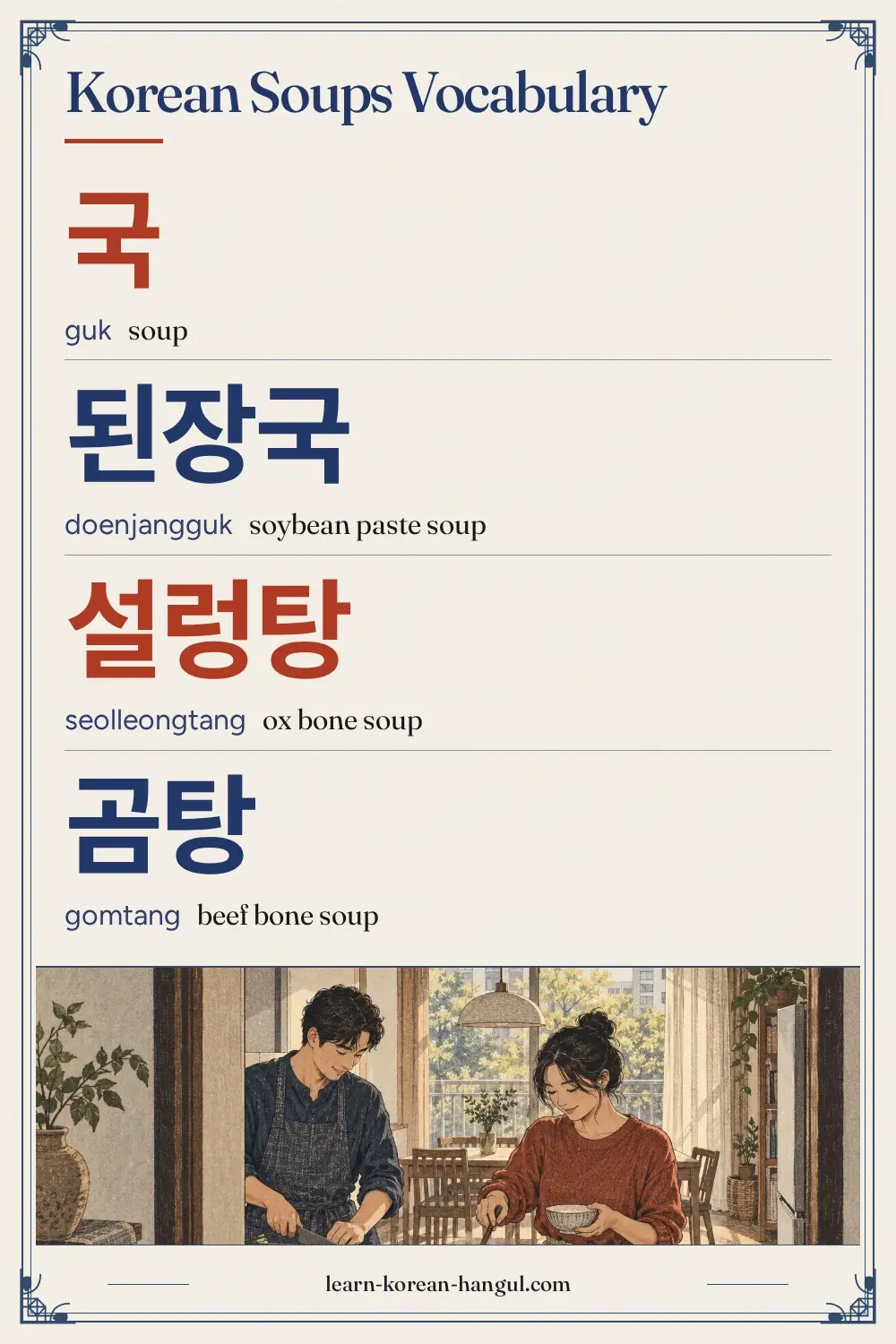
Korean Soups Vocabulary at a Glance
This list has 25 words in five groups of five. It starts with everyday 국, moves to the heavier 탕, then gives a whole group to seaweed soup and its customs, a group for hangover and summer-heat soups, and ends with cold soups. It sits inside Korean Dishes and is the lighter companion to the page on stews.
| Group | Words | Use |
|---|---|---|
| Everyday soups (국) | 5 | Naming the light soups served with rice |
| Hot meaty soups (탕) | 5 | Naming heartier soups made from bones and meat |
| Seaweed soup and birthday custom | 5 | Naming seaweed soup and the words around its custom |
| Hangover and summer soups | 5 | Naming soups tied to a season or a hard morning |
| Cold soups | 5 | Naming chilled soups for summer |
Almost every name here follows one pattern: main ingredient + 국 or 탕. 콩나물 (bean sprouts) + 국 gives 콩나물국, and 갈비 (short rib) + 탕 gives 갈비탕. A few names break the pattern, such as 해장국 (hangover soup), which is named for its job and not its ingredient.
Which Soup Names Should You Learn First?
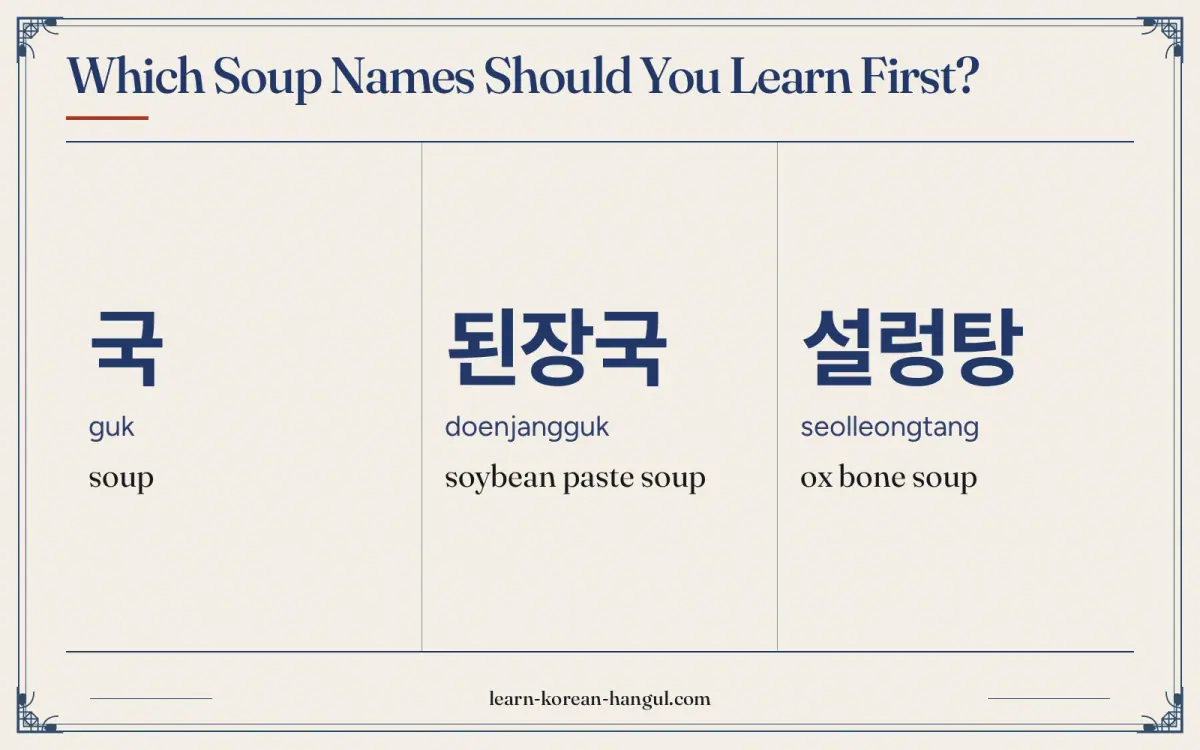
Learn 국 (soup), 미역국 (seaweed soup), 떡국 (rice cake soup), 삼계탕 (ginseng chicken soup) and 갈비탕 (short rib soup) first. They are the soups with the most cultural weight, and each one is tied to a custom or a season, which helps you remember it.
- Words to say. 국, 미역국, 삼계탕, 갈비탕. You will order them in a restaurant.
- Words to recognise. 북엇국, 곰탕, 해장국, 육수. They appear on menus and in recipes.
- Words about custom. 생일, 산모, 복날. They explain why a soup is eaten.
Soup is part of the basic Korean meal. A standard table is rice (밥), soup (국), and side dishes (반찬). Soup comes with the meal, not before it, and it is eaten alongside the rice.
Word · 8
- 1
국
guk
soup
- 2
된장국
doenjangguk
soybean paste soup
- 3
설렁탕
seolleongtang
ox bone soup
- 4
곰탕
gomtang
beef bone soup
- 5
미역
miyeok
seaweed (brown)
- 6
삼계탕
samgyetang
ginseng chicken soup
- 7
오이냉국
oinaengguk
cold cucumber soup
- 8
콩국
kongguk
cold soybean soup
Everyday Soups (국)
국 is the soup that sits beside the rice at a normal meal. It is light, clear and mild, and it is meant to be eaten with rice rather than alone. Home cooks make a pot for several days. The five words here are among the most common soups at breakfast, lunch or a holiday.
| No. | Hangul | Revised Romanization | Meaning and note | Example sentence | Audio assetId |
|---|---|---|---|---|---|
| 1 | 국 | guk | soup. The general word for a light soup served in a bowl. | 국을 먹어요. (I eat soup.) | au-pg-vocabulary-food-korean-dishes-soups-guk-tang-1; example: au-pg-vocabulary-food-korean-dishes-soups-guk-tang-26 |
| 2 | 콩나물국 | kongnamulguk | bean sprout soup. Said [콩나물꾹]. A clear, refreshing soup; often eaten the morning after drinking. | 콩나물국이 시원해요. (The bean sprout soup is refreshing.) | au-pg-vocabulary-food-korean-dishes-soups-guk-tang-2; example: au-pg-vocabulary-food-korean-dishes-soups-guk-tang-27 |
| 3 | 떡국 | tteokguk | rice cake soup. Said [떡꾹]. Sliced rice cakes in beef broth; eaten at the New Year. | 설날에 떡국을 먹어요. (On New Year's Day I eat rice cake soup.) | au-pg-vocabulary-food-korean-dishes-soups-guk-tang-3; example: au-pg-vocabulary-food-korean-dishes-soups-guk-tang-28 |
| 4 | 된장국 | doenjangguk | soybean paste soup. Said [된장꾹]. A thin soup of soybean paste with vegetables; milder than the stew. | 된장국을 끓여요. (I boil soybean paste soup.) | au-pg-vocabulary-food-korean-dishes-soups-guk-tang-4; example: au-pg-vocabulary-food-korean-dishes-soups-guk-tang-29 |
| 5 | 북엇국 | bugeotguk | dried pollock soup. Said [부거꾹] or [부걷꾹]. A clear soup of dried pollock; a classic recovery soup. | 북엇국 한 그릇 주세요. (One bowl of dried pollock soup, please.) | au-pg-vocabulary-food-korean-dishes-soups-guk-tang-5; example: au-pg-vocabulary-food-korean-dishes-soups-guk-tang-30 |
Every name ends in 국 and begins with the main ingredient, so 콩나물국 means bean sprout soup and 떡국 is 떡 (rice cake) + 국. 떡국 is also the one with a calendar: it is the dish of 설날, the Lunar New Year.
Example Sentences
Three frames cover almost every example. The first is noun + 을/를 + verb, as in 국을 먹어요 (I eat soup). The second is noun + 이/가 or 은/는 + adjective, as in 콩나물국이 시원해요 (the bean sprout soup is refreshing). The third is noun + 한 그릇 주세요 (please give me one bowl of noun), the natural way to order a bowl of soup. The counter 그릇 means bowl. Play the audio, then say each sentence aloud before moving on to the words that describe a broth.
How Do You Describe a Soup's Broth?
Soup talk is mostly about the broth. Koreans use a few short adjectives to say what it is like. Each one is given below in the form that goes before a noun, so you can say 맑은 국 (a clear soup).
| Word | Meaning | Typical soup |
|---|---|---|
| 맑은 (malgeun) | clear, light | 콩나물국, 북엇국 |
| 얼큰한 (eolkeunhan) | hot, spicy and satisfying | 해장국, 매운탕 |
| 구수한 (gusuhan) | savoury, earthy, comforting | 된장국 |
| 시원한 (siwonhan) | refreshing, clean | 콩나물국, 냉국 |
Be careful with 시원하다. It does not only mean cool. For a hot soup it means refreshing and satisfying, as in 국물이 시원해요 (the broth is refreshing). You can use it for a cold drink too. If you want to say a broth is spicy, use 매워요, and if you want to say it is warm, use 따뜻해요.
How Do You Say Hot Meaty Soups (탕) in Korean?
탕 is a hot soup that is richer and heavier than 국. It is usually based on bones or meat that simmer for hours, and the broth is served in a large bowl with rice. Restaurants often specialise in one 탕, and you can tell what they sell by the word on the sign. Bone soups such as 설렁탕 come lightly seasoned, and you add salt at the table to taste.
| No. | Hangul | Revised Romanization | Meaning and note | Example sentence | Audio assetId |
|---|---|---|---|---|---|
| 6 | 탕 | tang | hot meaty soup. A hot, rich soup; the second word in many dish names. | 탕은 뜨거워요. (Tang soup is hot.) | au-pg-vocabulary-food-korean-dishes-soups-guk-tang-6; example: au-pg-vocabulary-food-korean-dishes-soups-guk-tang-31 |
| 7 | 설렁탕 | seolleongtang | ox bone soup. A milky white broth from ox bones; salted at the table. | 설렁탕에 소금을 넣어요. (I add salt to the ox bone soup.) | au-pg-vocabulary-food-korean-dishes-soups-guk-tang-7; example: au-pg-vocabulary-food-korean-dishes-soups-guk-tang-32 |
| 8 | 갈비탕 | galbitang | short rib soup. Clear beef broth with short ribs and glass noodles. | 갈비탕을 좋아해요. (I like short rib soup.) | au-pg-vocabulary-food-korean-dishes-soups-guk-tang-8; example: au-pg-vocabulary-food-korean-dishes-soups-guk-tang-33 |
| 9 | 곰탕 | gomtang | beef bone soup. A clearer broth made mainly from beef cuts with some bones; 설렁탕 uses more bones and is milkier. | 곰탕 한 그릇 주세요. (One bowl of beef bone soup, please.) | au-pg-vocabulary-food-korean-dishes-soups-guk-tang-9; example: au-pg-vocabulary-food-korean-dishes-soups-guk-tang-34 |
| 10 | 감자탕 | gamjatang | pork bone potato soup. A spicy soup of pork bones and potatoes; shared and eaten late at night. | 감자탕은 매워요. (Pork bone soup is spicy.) | au-pg-vocabulary-food-korean-dishes-soups-guk-tang-10; example: au-pg-vocabulary-food-korean-dishes-soups-guk-tang-35 |
Do not think of 탕 as a different kind of food. It is a heavier version of the same idea, and the line is blurry. The practical test is the situation: a 국 is part of an everyday meal, and a 탕 is the main dish or a special meal.
Seaweed Soup and Birthday Custom
미역국 is the soup most tied to a custom. Many Koreans eat it on their birthday, and new mothers traditionally eat it for weeks after giving birth, because the seaweed (미역) is believed to help a mother recover. On a birthday, the soup is also a way to remember the mother who gave birth, so eating it is a quiet thank-you.
| No. | Hangul | Revised Romanization | Meaning and note | Example sentence | Audio assetId |
|---|---|---|---|---|---|
| 11 | 미역 | miyeok | seaweed (brown). Dried or fresh brown seaweed; sold in dried bundles that swell in water. | 미역을 물에 불려요. (I soak seaweed in water.) | au-pg-vocabulary-food-korean-dishes-soups-guk-tang-11; example: au-pg-vocabulary-food-korean-dishes-soups-guk-tang-36 |
| 12 | 미역국 | miyeokguk | seaweed soup. Said [미역꾹]. Seaweed simmered in beef or fish broth; the birthday soup. | 생일에 미역국을 먹어요. (On my birthday I eat seaweed soup.) | au-pg-vocabulary-food-korean-dishes-soups-guk-tang-12; example: au-pg-vocabulary-food-korean-dishes-soups-guk-tang-37 |
| 13 | 생일 | saengil | birthday. The day of birth; the day seaweed soup is traditionally eaten. | 오늘은 제 생일이에요. (Today is my birthday.) | au-pg-vocabulary-food-korean-dishes-soups-guk-tang-13; example: au-pg-vocabulary-food-korean-dishes-soups-guk-tang-38 |
| 14 | 산모 | sanmo | new mother. A woman who has just given birth; the soup is served to her. | 산모가 미역국을 먹어요. (The new mother eats seaweed soup.) | au-pg-vocabulary-food-korean-dishes-soups-guk-tang-14; example: au-pg-vocabulary-food-korean-dishes-soups-guk-tang-39 |
| 15 | 소고기미역국 | sogogimiyeokguk | beef seaweed soup. Said [소고기미역꾹]. The common home version made with beef. | 소고기미역국을 끓여요. (I boil beef seaweed soup.) | au-pg-vocabulary-food-korean-dishes-soups-guk-tang-15; example: au-pg-vocabulary-food-korean-dishes-soups-guk-tang-40 |
Do not skip the custom when you learn the word. Saying 미역국 먹었어요? (did you eat seaweed soup?) is a friendly way to ask someone about their birthday. Keep in mind that this is a general custom. Individual families and regions vary, and some people prefer other dishes.
Why Do Koreans Eat Seaweed Soup on Birthdays?
Seaweed soup is eaten on birthdays because it is tied to childbirth. After a birth, a mother is traditionally given 미역국 for the first weeks to help her recover. Over time, the soup became linked to the birth itself, so on a birthday many Koreans eat 미역국 as a way to honour their mother.
There is a second belief that learners hear: the seaweed is slippery, and 미끄러지다 (to slip) is also slang for failing an exam, so some people avoid it before exams. This is a folk belief and not a rule, and it comes up as a joke. If you ever hear 시험 전에는 미역국을 안 먹어요 (I do not eat seaweed soup before an exam), that is the idea. The first custom is the one worth learning. Say 생일 축하해요 (happy birthday) and then ask 미역국 먹었어요?
How Do You Say Hangover and Summer Soups in Korean?
Two situations call for a soup in Korean life: a hot summer, and a hard morning after drinking. For the first, Koreans eat 삼계탕 on the hottest days. This is an idea called 이열치열 (fighting heat with heat), the belief that hot food restores energy in hot weather. For the second, they eat 해장국, a soup meant to soothe the stomach.
| No. | Hangul | Revised Romanization | Meaning and note | Example sentence | Audio assetId |
|---|---|---|---|---|---|
| 16 | 삼계탕 | samgyetang | ginseng chicken soup. A whole young chicken stuffed with rice and ginseng in broth. | 여름에 삼계탕을 먹어요. (In summer I eat ginseng chicken soup.) | au-pg-vocabulary-food-korean-dishes-soups-guk-tang-16; example: au-pg-vocabulary-food-korean-dishes-soups-guk-tang-41 |
| 17 | 해장국 | haejangguk | hangover soup. Said [해장꾹]. A hot soup, often with beef blood curd and cabbage, eaten to soothe the stomach. | 해장국을 먹으러 가요. (I go to eat hangover soup.) | au-pg-vocabulary-food-korean-dishes-soups-guk-tang-17; example: au-pg-vocabulary-food-korean-dishes-soups-guk-tang-42 |
| 18 | 복날 | bongnal | hottest days of summer. Said [봉날]. Three days in midsummer when people eat stamina food. | 복날에는 삼계탕을 먹어요. (On the hottest days I eat ginseng chicken soup.) | au-pg-vocabulary-food-korean-dishes-soups-guk-tang-18; example: au-pg-vocabulary-food-korean-dishes-soups-guk-tang-43 |
| 19 | 보양식 | boyangsik | stamina food. Food eaten to restore energy in summer or illness. | 보양식은 몸에 좋아요. (Stamina food is good for the body.) | au-pg-vocabulary-food-korean-dishes-soups-guk-tang-19; example: au-pg-vocabulary-food-korean-dishes-soups-guk-tang-44 |
| 20 | 인삼 | insam | ginseng. The root added to samgyetang; a symbol of health. | 삼계탕에 인삼을 넣어요. (I put ginseng in the ginseng chicken soup.) | au-pg-vocabulary-food-korean-dishes-soups-guk-tang-20; example: au-pg-vocabulary-food-korean-dishes-soups-guk-tang-45 |
Both customs are part of the way people talk about food, so you will hear them in daily conversation. 보양식 is the general word for stamina food eaten for health. A Korean friend may say 오늘은 삼계탕 먹자 (let us eat samgyetang today, casual speech) on a day that feels especially hot.
Cold Soups
Cold soups are a surprise to many visitors, but they are common in Korean summers. A cold soup is called 냉국 (naengguk), from 냉, which means cold. It is made by pouring a chilled broth over thin vegetables, with vinegar and soy sauce for a sour taste. 콩국 is a different idea, a cold soup of ground soybeans that is usually eaten with noodles.
| No. | Hangul | Revised Romanization | Meaning and note | Example sentence | Audio assetId |
|---|---|---|---|---|---|
| 21 | 냉국 | naengguk | cold soup. Said [냉꾹]. A chilled, sour soup served in summer. | 냉국은 차가워요. (Cold soup is cold.) | au-pg-vocabulary-food-korean-dishes-soups-guk-tang-21; example: au-pg-vocabulary-food-korean-dishes-soups-guk-tang-46 |
| 22 | 오이냉국 | oinaengguk | cold cucumber soup. Said [오이냉꾹]. Thin cucumber slices in a chilled, vinegary broth. | 여름에 오이냉국을 먹어요. (In summer I eat cold cucumber soup.) | au-pg-vocabulary-food-korean-dishes-soups-guk-tang-22; example: au-pg-vocabulary-food-korean-dishes-soups-guk-tang-47 |
| 23 | 미역냉국 | miyeongnaengguk | cold seaweed soup. Said [미영냉꾹]. Seaweed in a chilled broth with vinegar. | 미역냉국이 시원해요. (The cold seaweed soup is refreshing.) | au-pg-vocabulary-food-korean-dishes-soups-guk-tang-23; example: au-pg-vocabulary-food-korean-dishes-soups-guk-tang-48 |
| 24 | 콩국 | kongguk | cold soybean soup. Said [콩꾹]. A thick, chilled soup of ground soybeans. | 콩국은 고소해요. (Cold soybean soup is nutty.) | au-pg-vocabulary-food-korean-dishes-soups-guk-tang-24; example: au-pg-vocabulary-food-korean-dishes-soups-guk-tang-49 |
| 25 | 육수 | yuksu | broth; stock. Said [육쑤]. The base liquid for soups; made from beef, anchovies or vegetables. | 육수를 끓여요. (I boil the broth.) | au-pg-vocabulary-food-korean-dishes-soups-guk-tang-25; example: au-pg-vocabulary-food-korean-dishes-soups-guk-tang-50 |
육수, the stock, is the base of both hot and cold soups: a 국 uses it hot, and some 냉국 recipes use it chilled. The cold noodle dish 냉면 is also served in a chilled broth; see the Korean noodles vocabulary page.
How Do You Pronounce These Words?
Soup names contain many tense sounds. After a final ㄱ, ㄷ or ㅂ sound, the ㄱ of 국 is always tense (미역국 [미역꾹]); after ㅇ, ㄴ, ㄹ or ㅁ, the tensing is a property of each compound word (해장국 [해장꾹]), so learn it word by word. Standard pronunciation follows the National Institute of Korean Language (국립국어원) rules, and the romanization on this page follows the Revised Romanization of Korean, which does not mark every sound change.
| Spelling | Sounds like | What changes |
|---|---|---|
| 미역국 | [미역꾹] | The ㄱ of 국 is said tight after the final ㄱ of 역. |
| 북엇국 | [부거꾹] or [부걷꾹] | The linking ㅅ makes the ㄱ of 국 tense; the ㅅ itself may be said as a short [ㄷ] or dropped. |
| 복날 | [봉날] | Final ㄱ before ㄴ is said as [ㅇ]. |
| 미역냉국 | [미영냉꾹] | Final ㄱ before ㄴ is [ㅇ], and the ㄱ of 국 becomes tense. |
| 육수 | [육쑤] | After a final ㄱ, the ㅅ of 수 is said as a tense [ㅆ]. |
| 해장국 | [해장꾹] | In this compound the ㄱ of 국 is said tight as [ㄲ], although nothing in the spelling shows it. |
The tense [꾹] in 국 is the sound learners most often get wrong. It occurs in most soup names on this page where 국 follows a consonant. Say it with a tight throat and no puff of air. Many learners hear it as a hard g, but it is not a voiced sound.
Audio and Slow Playback
Every word and every example sentence has its own clip. The five clips below replay the trickiest words slowly. Play one, repeat it aloud, then play it again and compare.
What Mistakes Do Learners Make with Soup Names?
These five mistakes cause most of the confusion at a soup restaurant.
- Using 국 and 탕 as if they were the same. 국 is an everyday soup, and 탕 is a heartier dish. 갈비탕 is ordered as a meal on its own, while 콩나물국 usually comes as part of a set meal.
- Forgetting the tense [꾹]. Say [미역꾹], not [미역국]. The tight sound is part of the word.
- Looking for a knife for 삼계탕. The chicken comes whole. Pull the meat off with chopsticks and a spoon, and eat the rice stuffed inside.
- Taking 시원하다 to mean cold only. For a hot soup, it means refreshing. A 시원한 국물 can be piping hot.
- Assuming the birthday custom is a rule. It is a widespread custom, and families differ.
With the main-ingredient pattern and the 국 versus 탕 distinction, you can read a soup menu even when you do not know every word. The next step is to drill the words.
Practice: Flashcards and Worksheet
Study in three steps. First, run the flashcard deck in recognition mode until you recognise each of the 25 words. Second, switch to listening mode. Third, take the quiz. Your progress stays in your browser, and the vocabulary flashcard decks page lists the other decks.
Practice · 55
- 01국
Show answer
headword 1: soup
- 02콩나물국
Show answer
headword 2: bean sprout soup
- 03떡국
Show answer
headword 3: rice cake soup
- 04된장국
Show answer
headword 4: soybean paste soup
- 05북엇국
Show answer
headword 5: dried pollock soup
- 06탕
Show answer
headword 6: hot meaty soup
- 07설렁탕
Show answer
headword 7: ox bone soup
- 08갈비탕
Show answer
headword 8: short rib soup
- 09곰탕
Show answer
headword 9: beef bone soup
- 10감자탕
Show answer
headword 10: pork bone potato soup
- 11미역
Show answer
headword 11: seaweed (brown)
- 12미역국
Show answer
headword 12: seaweed soup
- 13생일
Show answer
headword 13: birthday
- 14산모
Show answer
headword 14: new mother
- 15소고기미역국
Show answer
headword 15: beef seaweed soup
- 16삼계탕
Show answer
headword 16: ginseng chicken soup
- 17해장국
Show answer
headword 17: hangover soup
- 18복날
Show answer
headword 18: hottest days of summer
- 19보양식
Show answer
headword 19: stamina food
- 20인삼
Show answer
headword 20: ginseng
- 21냉국
Show answer
headword 21: cold soup
- 22오이냉국
Show answer
headword 22: cold cucumber soup
- 23미역냉국
Show answer
headword 23: cold seaweed soup
- 24콩국
Show answer
headword 24: cold soybean soup
- 25육수
Show answer
headword 25: broth; stock
- 26국을 먹어요.
Show answer
example sentence for 국
- 27콩나물국이 시원해요.
Show answer
example sentence for 콩나물국
- 28설날에 떡국을 먹어요.
Show answer
example sentence for 떡국
- 29된장국을 끓여요.
Show answer
example sentence for 된장국
- 30북엇국 한 그릇 주세요.
Show answer
example sentence for 북엇국
- 31탕은 뜨거워요.
Show answer
example sentence for 탕
- 32설렁탕에 소금을 넣어요.
Show answer
example sentence for 설렁탕
- 33갈비탕을 좋아해요.
Show answer
example sentence for 갈비탕
- 34곰탕 한 그릇 주세요.
Show answer
example sentence for 곰탕
- 35감자탕은 매워요.
Show answer
example sentence for 감자탕
- 36미역을 물에 불려요.
Show answer
example sentence for 미역
- 37생일에 미역국을 먹어요.
Show answer
example sentence for 미역국
- 38오늘은 제 생일이에요.
Show answer
example sentence for 생일
- 39산모가 미역국을 먹어요.
Show answer
example sentence for 산모
- 40소고기미역국을 끓여요.
Show answer
example sentence for 소고기미역국
- 41여름에 삼계탕을 먹어요.
Show answer
example sentence for 삼계탕
- 42해장국을 먹으러 가요.
Show answer
example sentence for 해장국
- 43복날에는 삼계탕을 먹어요.
Show answer
example sentence for 복날
- 44보양식은 몸에 좋아요.
Show answer
example sentence for 보양식
- 45삼계탕에 인삼을 넣어요.
Show answer
example sentence for 인삼
- 46냉국은 차가워요.
Show answer
example sentence for 냉국
- 47여름에 오이냉국을 먹어요.
Show answer
example sentence for 오이냉국
- 48미역냉국이 시원해요.
Show answer
example sentence for 미역냉국
- 49콩국은 고소해요.
Show answer
example sentence for 콩국
- 50육수를 끓여요.
Show answer
example sentence for 육수
- 51북엇국
Show answer
slow playback: 북엇국
- 52설렁탕
Show answer
slow playback: 설렁탕
- 53삼계탕
Show answer
slow playback: 삼계탕
- 54해장국
Show answer
slow playback: 해장국
- 55미역냉국
Show answer
slow playback: 미역냉국
Practice · 5
What does 떡국 (tteokguk) mean?
Show answer
rice cake soup
떡국 means rice cake soup. Example: 설날에 떡국을 먹어요. (On New Year's Day I eat rice cake soup.)
What does 설렁탕 (seolleongtang) mean?
Show answer
ox bone soup
설렁탕 means ox bone soup. Example: 설렁탕에 소금을 넣어요. (I add salt to the ox bone soup.)
What does 미역국 (miyeokguk) mean?
Show answer
seaweed soup
미역국 means seaweed soup. Example: 생일에 미역국을 먹어요. (On my birthday I eat seaweed soup.)
What does 삼계탕 (samgyetang) mean?
Show answer
ginseng chicken soup
삼계탕 means ginseng chicken soup. Example: 여름에 삼계탕을 먹어요. (In summer I eat ginseng chicken soup.)
What does 냉국 (naengguk) mean?
Show answer
cold soup
냉국 means cold soup. Example: 냉국은 차가워요. (Cold soup is cold.)
Korean Soups Vocabulary Worksheet (PDF)
A printable worksheet for these words (word list, matching, writing practice, fill-in-the-blank exercises and answer key) is available in A4 and US Letter from the download card on this page. For practice, copy the 25 words by hand and circle the 국 or 탕 ending in each name.
Where to Go Next
Once the Korean soups vocabulary on this page feels familiar, continue with Korean Stews (Jjigae) Vocabulary, the thicker dishes, or Korean Side Dishes (Banchan) Vocabulary for the small plates that come with soup. To move up a level, return to Korean Dishes.
Frequently Asked Questions
How Do You Say Soup in Korean?
Soup is 국 (guk) for an everyday soup served in a bowl, and 탕 (tang) for a hearty hot soup. Name the dish with the main ingredient, as in 콩나물국 or 갈비탕. To order, say 갈비탕 한 그릇 주세요 (one bowl of short rib soup, please).
What Is the Difference between Guk and Tang?
A 국 is a lighter, everyday soup served with rice. A 탕 is a heartier hot soup, often from bones or meat, eaten as a main dish or on a special day. The line is not strict, so use the dish name rather than relying on the ending alone.
What Is Samgyetang?
삼계탕 (samgyetang) is a whole young chicken stuffed with glutinous rice, ginseng, jujube and garlic and simmered in broth. It is eaten most on 복날, the hottest days of summer, following the idea 이열치열 (fight heat with heat). Season it at the table with the salt and pepper provided.
Where Can I Practise Soup Words with Flashcards?
Use the vocabulary flashcard decks. The deck for this page holds all 25 words with Hangul, romanization and audio, in recognition and listening modes. Your progress stays in your browser, so you can return daily and review the cards you missed.
Is the Romanization on This Page Official?
It follows the Revised Romanization of Korean, which South Korea adopted on 7 July 2000 and whose rules the National Institute of Korean Language (국립국어원) publishes. It is a learning aid and does not mark every sound change, so rely on the Hangul and the audio.
Is There a Printable Worksheet for Soup Words?
A printable worksheet for these words (word list, matching, writing practice, fill-in-the-blank exercises and answer key) is available in A4 and US Letter from the download card on this page. For practice, copy the tables on this page by hand or use the flashcard deck, which carries the same 25 words.