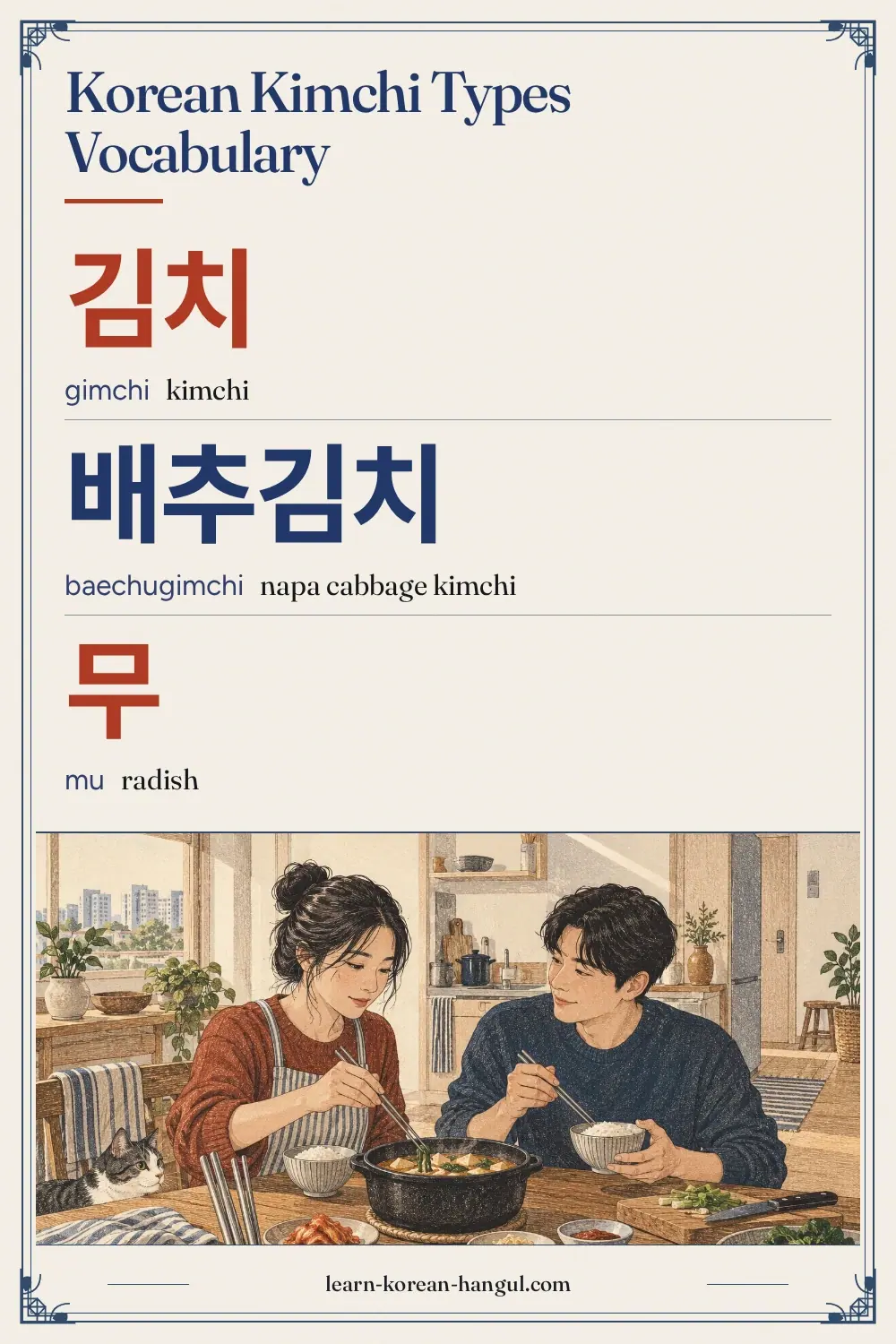
Korean Kimchi Types Vocabulary at a Glance
This list has 25 words in five groups of five. It begins with cabbage kimchi, then moves to radish kimchi, kimchi in a salty liquid, leaf and green kimchi, and finally the words that describe making kimchi. The page sits inside Korean Dishes, and a separate page covers the single word kimchi in Korean.
| Group | Words | Use |
|---|---|---|
| Cabbage kimchi | 5 | Naming kimchi made from napa cabbage |
| Radish kimchi | 5 | Naming kimchi made from radish |
| Water kimchi | 5 | Naming kimchi served in a cool, salty liquid |
| Leaf and green kimchi | 5 | Naming kimchi made from leaves and green onions |
| Making kimchi (김장) | 5 | Naming the event and the ingredients of kimchi making |
The key rule is the one in the key facts: vegetable + 김치. If you know the vegetable, you can name the kimchi. 배추 (napa cabbage) + 김치 gives 배추김치, and 파 (green onion) + 김치 gives 파김치. The exceptions are short names for old favourites, such as 깍두기, which is kimchi in everything but name.
Which Kimchi Types Should You Learn First?
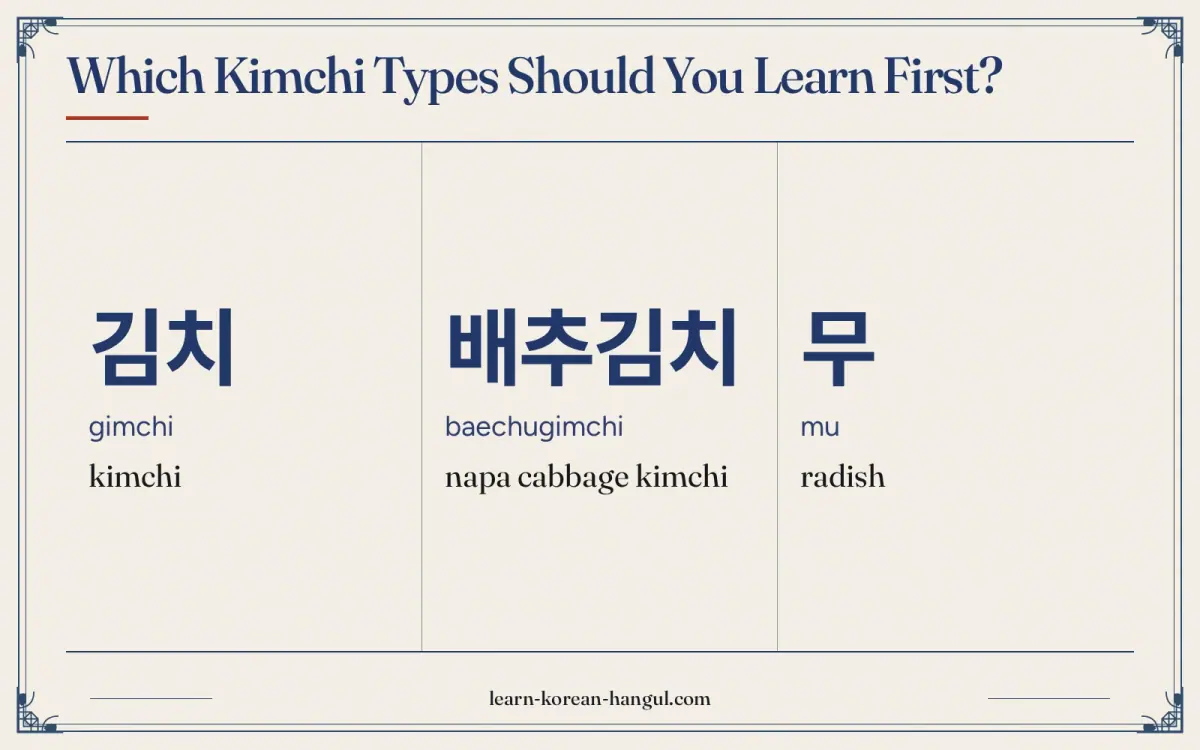
Learn 김치 (kimchi), 배추김치 (napa cabbage kimchi), 깍두기 (cubed radish kimchi), 동치미 (radish water kimchi) and 김장 (kimchi-making) first. They cover the cabbage and radish kinds that appear at nearly every table, the one kimchi that is a liquid, and the yearly event that produces most of it.
- Words to say. 김치, 배추김치, 깍두기. These are the names of the kimchi on your table.
- Words to recognise. 열무김치, 파김치, 총각김치, 물김치. They appear on menus and in shops.
- Words about making it. 김장, 고춧가루, 젓갈, 절이다. They appear in recipes and in news about the season.
Kimchi is eaten with almost every meal. It is a side dish, a seasoning for stews and pancakes and, when old, an ingredient for cooking.
Word · 8
- 1
김치
gimchi
kimchi
- 2
배추김치
baechugimchi
napa cabbage kimchi
- 3
무
mu
radish
- 4
물김치
mulgimchi
water kimchi
- 5
동치미
dongchimi
radish water kimchi
- 6
파김치
pagimchi
green onion kimchi
- 7
김장
gimjang
kimchi-making season
- 8
마늘
maneul
garlic
Cabbage Kimchi
Cabbage kimchi is the kimchi most people picture. It is made from 배추 (napa cabbage) that is salted, coated with a chilli paste and left to ferment. 김치 is the general word, and 배추김치 is the specific one. A whole head cut in half is 포기김치, from 포기, the counter word for a head of cabbage. The same cabbage can taste fresh or deep and sour depending on its age.
| No. | Hangul | Revised Romanization | Meaning and note | Example sentence | Audio assetId |
|---|---|---|---|---|---|
| 1 | 김치 | gimchi | kimchi. Salted and seasoned fermented vegetables; the general word. | 김치를 담가요. (I make kimchi.) | au-pg-vocabulary-food-korean-dishes-kimchi-1; example: au-pg-vocabulary-food-korean-dishes-kimchi-26 |
| 2 | 배추김치 | baechugimchi | napa cabbage kimchi. The standard kimchi made from napa cabbage. | 배추김치를 좋아해요. (I like napa cabbage kimchi.) | au-pg-vocabulary-food-korean-dishes-kimchi-2; example: au-pg-vocabulary-food-korean-dishes-kimchi-27 |
| 3 | 포기김치 | pogigimchi | whole-head cabbage kimchi. Cabbage kept in large pieces; cut at the table. | 포기김치를 잘라요. (I cut the whole-head kimchi.) | au-pg-vocabulary-food-korean-dishes-kimchi-3; example: au-pg-vocabulary-food-korean-dishes-kimchi-28 |
| 4 | 겉절이 | geotjeori | fresh kimchi salad. Said [걷쩌리]. Cabbage seasoned and eaten right away without fermenting. | 겉절이는 신선해요. (Fresh kimchi salad tastes crisp and fresh.) | au-pg-vocabulary-food-korean-dishes-kimchi-4; example: au-pg-vocabulary-food-korean-dishes-kimchi-29 |
| 5 | 묵은지 | mugeunji | aged kimchi. Kimchi aged for many months, often a year or more; sour and used for cooking. | 묵은지는 맛이 깊어요. (Aged kimchi has a deep taste.) | au-pg-vocabulary-food-korean-dishes-kimchi-5; example: au-pg-vocabulary-food-korean-dishes-kimchi-30 |
Example Sentences
Three frames cover most of the examples. The first is noun + 을/를 + verb, as in 마늘을 다져요 (I mince garlic). The second is noun + 은/는 + adjective, as in 묵은지는 맛이 깊어요 (aged kimchi has a deep taste). The third is noun + 에 + verb, as in 가을에 김장을 해요 (in autumn we make kimchi), where 에 marks time. Use the audio, then say each sentence aloud.
The age of the kimchi gives the last two words in this group. 겉절이 is eaten right after it is made, so it is crisp and bright. 묵은지 has fermented for many months, often a year or more, and it is sour and soft, mostly used for cooking. The word 묵은 means old or aged.
Is It Gimchi or Kimchi?
Both spellings are common, and both are correct in their own system. The Revised Romanization of Korean, the official system, writes the first letter ㄱ as g before a vowel, so 김치 becomes gimchi. English-language food writing has long used kimchi, and that spelling is the better known in shops and menus abroad. On this site, the romanization column uses gimchi, and the text uses kimchi when it refers to the dish in English.
| Form | Where you see it |
|---|---|
| gimchi | Revised Romanization; Korean government and dictionaries |
| kimchi | English menus, supermarkets, news in English |
The lesson is not to worry. If you search for a recipe, use the Hangul 김치, which works everywhere. The same applies to 김밥, which is gimbap in the official system and kimbap on many menus.
How Does Kimchi Change as It Ages?
Kimchi keeps fermenting after it is made, so its taste changes with age. A new batch tastes fresh and crunchy. After a few weeks in the fridge it becomes sour and tangy. After many months, often a year or more, it becomes 묵은지, which is soft and deeply sour.
| Stage | Word | Taste | Typical use |
|---|---|---|---|
| fresh, unfermented | 겉절이 | bright, crisp | eaten at once |
| ripe | 김치 | tangy, balanced | side dish |
| aged | 묵은지 | deep, sour | stews, braises, pancakes |
Because of this, a cook may keep several jars at different ages. The same name 김치 covers the ripe middle stage, and the two special words cover the ends.
How Do You Say Radish Kimchi in Korean?
Radish kimchi is crunchy and cheaper to make than cabbage kimchi. The base word is 무 (radish). 깍두기 is radish cut into cubes, and it is the kimchi often served with soup. 총각무 is a small radish with its leaves, and 총각김치 is the kimchi made from it. 열무 is a young summer radish, and 열무김치 is a light, often juicy kimchi eaten in the hot months.
| No. | Hangul | Revised Romanization | Meaning and note | Example sentence | Audio assetId |
|---|---|---|---|---|---|
| 6 | 무 | mu | radish. The white Korean radish; thick and watery. | 무를 썰어요. (I slice the radish.) | au-pg-vocabulary-food-korean-dishes-kimchi-6; example: au-pg-vocabulary-food-korean-dishes-kimchi-31 |
| 7 | 깍두기 | kkakdugi | cubed radish kimchi. Said [깍뚜기]. Radish cut into cubes and seasoned; served with soup. | 깍두기가 아삭해요. (The cubed radish kimchi is crunchy.) | au-pg-vocabulary-food-korean-dishes-kimchi-7; example: au-pg-vocabulary-food-korean-dishes-kimchi-32 |
| 8 | 총각김치 | chonggakgimchi | ponytail radish kimchi. Kimchi of small whole radishes with their stems. | 총각김치를 먹어요. (I eat ponytail radish kimchi.) | au-pg-vocabulary-food-korean-dishes-kimchi-8; example: au-pg-vocabulary-food-korean-dishes-kimchi-33 |
| 9 | 총각무 | chonggangmu | ponytail radish. Said [총강무]. The small radish with leaves used for 총각김치. | 총각무는 작아요. (Ponytail radishes are small.) | au-pg-vocabulary-food-korean-dishes-kimchi-9; example: au-pg-vocabulary-food-korean-dishes-kimchi-34 |
| 10 | 열무김치 | yeolmugimchi | young summer radish kimchi. A light kimchi of young radish greens; eaten in summer. | 열무김치는 여름에 먹어요. (I eat young radish kimchi in summer.) | au-pg-vocabulary-food-korean-dishes-kimchi-10; example: au-pg-vocabulary-food-korean-dishes-kimchi-35 |
The word 총각 means a bachelor or young man. A common explanation is that the small radish with its tail looks like a bachelor's hair. Treat this as a folk story, because the true origin is not certain. What matters is the form: 총각무 for the radish and 총각김치 for the kimchi.
Water Kimchi
Water kimchi is kimchi in a bowl of liquid. 물김치 is the general word (물 is water), and the liquid is as important as the vegetables. 동치미 is a winter kimchi of whole radishes in a clear salty broth, and 나박김치 is a pink, mild one with thin slices. 백김치 is white kimchi, made without chilli, and it is a gentle option for children and guests who avoid spicy food.
| No. | Hangul | Revised Romanization | Meaning and note | Example sentence | Audio assetId |
|---|---|---|---|---|---|
| 11 | 물김치 | mulgimchi | water kimchi. Kimchi in a mild salty liquid; served cold. | 물김치는 국물이 있어요. (Water kimchi has broth.) | au-pg-vocabulary-food-korean-dishes-kimchi-11; example: au-pg-vocabulary-food-korean-dishes-kimchi-36 |
| 12 | 동치미 | dongchimi | radish water kimchi. Whole radish in a clear, salty broth; a winter dish. | 동치미는 겨울에 먹어요. (I eat radish water kimchi in winter.) | au-pg-vocabulary-food-korean-dishes-kimchi-12; example: au-pg-vocabulary-food-korean-dishes-kimchi-37 |
| 13 | 나박김치 | nabakgimchi | sliced radish water kimchi. A pink, mild kimchi of thin radish slices in liquid. | 나박김치는 맵지 않아요. (Sliced radish water kimchi is not spicy.) | au-pg-vocabulary-food-korean-dishes-kimchi-13; example: au-pg-vocabulary-food-korean-dishes-kimchi-38 |
| 14 | 백김치 | baekgimchi | white kimchi. Kimchi made without chilli powder; mild and clear. | 백김치는 하얀색이에요. (Baekgimchi is white in colour.) | au-pg-vocabulary-food-korean-dishes-kimchi-14; example: au-pg-vocabulary-food-korean-dishes-kimchi-39 |
| 15 | 국물 | gungmul | broth; liquid. Said [궁물]. The liquid of a kimchi, soup or stew. | 국물이 시원해요. (The broth is refreshing.) | au-pg-vocabulary-food-korean-dishes-kimchi-15; example: au-pg-vocabulary-food-korean-dishes-kimchi-40 |
You drink the liquid, not only the vegetables. The word is 국물, said [궁물], and it is eaten with a spoon. A bowl of cold 동치미 broth is a classic partner for sweet potatoes or rice cakes in winter, and it is said to help digestion. The 국물 is also used as a base for cold noodles.
How Do You Say Leaf and Green Kimchi in Korean?
Many plants other than cabbage and radish are made into kimchi. Green onion becomes 파김치, perilla leaf becomes 깻잎김치, and chives become 부추김치. 갓 is mustard greens, and 갓김치 is a sharp, peppery kimchi from it. 쪽파 is the thin scallion that is the base of 파김치. Each of these kimchi has a strong smell and is eaten in small amounts with rice.
| No. | Hangul | Revised Romanization | Meaning and note | Example sentence | Audio assetId |
|---|---|---|---|---|---|
| 16 | 파김치 | pagimchi | green onion kimchi. Whole green onions seasoned and fermented; strong and rich. | 파김치는 향이 강해요. (Green onion kimchi has a strong aroma.) | au-pg-vocabulary-food-korean-dishes-kimchi-16; example: au-pg-vocabulary-food-korean-dishes-kimchi-41 |
| 17 | 갓김치 | gatgimchi | mustard leaf kimchi. A sharp, peppery kimchi from mustard greens. | 갓김치를 먹어요. (I eat mustard leaf kimchi.) | au-pg-vocabulary-food-korean-dishes-kimchi-17; example: au-pg-vocabulary-food-korean-dishes-kimchi-42 |
| 18 | 깻잎김치 | kkaennipgimchi | perilla leaf kimchi. Perilla leaves layered with seasoning. | 깻잎김치를 밥에 싸요. (I wrap rice in perilla leaf kimchi.) | au-pg-vocabulary-food-korean-dishes-kimchi-18; example: au-pg-vocabulary-food-korean-dishes-kimchi-43 |
| 19 | 부추김치 | buchugimchi | chive kimchi. Chives seasoned with fish sauce and chilli; eaten fresh. | 부추김치를 좋아해요. (I like chive kimchi.) | au-pg-vocabulary-food-korean-dishes-kimchi-19; example: au-pg-vocabulary-food-korean-dishes-kimchi-44 |
| 20 | 쪽파 | jjokpa | scallion. A thin green onion used for 파김치. | 쪽파를 다듬어요. (I trim the scallions.) | au-pg-vocabulary-food-korean-dishes-kimchi-20; example: au-pg-vocabulary-food-korean-dishes-kimchi-45 |
These kimchi are seasonal, and shops sell them as small tubs. 깻잎김치 is often eaten by wrapping a leaf around a spoonful of rice. If you meet a kimchi name you do not know, split it into plant + 김치 and look up the plant.
Making Kimchi (김장)
김장 (gimjang) is the yearly making of a large supply of kimchi, done together by families and neighbours in late autumn. UNESCO added kimjang culture to its list of intangible cultural heritage in 2013. The work has a few main steps: salting the vegetables, making the seasoning, mixing and packing the jars. The words in this group name the main ingredients and the first step.
| No. | Hangul | Revised Romanization | Meaning and note | Example sentence | Audio assetId |
|---|---|---|---|---|---|
| 21 | 김장 | gimjang | kimchi-making season. The yearly making of a large batch of kimchi in late autumn. | 가을에 김장을 해요. (In autumn we make kimchi for the year.) | au-pg-vocabulary-food-korean-dishes-kimchi-21; example: au-pg-vocabulary-food-korean-dishes-kimchi-46 |
| 22 | 고춧가루 | gochutgaru | chilli powder. Said [고추까루]. Dried chilli flakes; the red colour of kimchi. | 고춧가루를 넣어요. (I add chilli powder.) | au-pg-vocabulary-food-korean-dishes-kimchi-22; example: au-pg-vocabulary-food-korean-dishes-kimchi-47 |
| 23 | 젓갈 | jeotgal | salted fermented seafood. Said [젇깔]. Salted shrimp or fish; gives kimchi depth. | 김치에 젓갈이 들어가요. (Salted seafood goes into kimchi.) | au-pg-vocabulary-food-korean-dishes-kimchi-23; example: au-pg-vocabulary-food-korean-dishes-kimchi-48 |
| 24 | 마늘 | maneul | garlic. A main flavour of the kimchi paste. | 마늘을 다져요. (I mince garlic.) | au-pg-vocabulary-food-korean-dishes-kimchi-24; example: au-pg-vocabulary-food-korean-dishes-kimchi-49 |
| 25 | 절이다 | jeorida | to salt (vegetables). To soak vegetables in salt until they soften. | 배추를 소금에 절여요. (I salt the cabbage.) | au-pg-vocabulary-food-korean-dishes-kimchi-25; example: au-pg-vocabulary-food-korean-dishes-kimchi-50 |
The seasoning paste combines 고춧가루 (chilli powder), 마늘 (garlic), 젓갈 (salted seafood) and often sweet rice paste. The cabbage must first be 절이다, salted until it softens. When you read a recipe, the verbs matter as much as the nouns: 절이다, 담그다 (to make kimchi) and 버무리다 (to mix) are the three you meet first. The single-word page on kimchi making in Korean explains 김장 in more detail.
How Do You Pronounce These Words?
Kimchi names contain several tense sounds and linking sounds. Standard pronunciation follows the National Institute of Korean Language (국립국어원) rules, and the romanization on this page follows the Revised Romanization of Korean, which does not mark every sound change.
| Spelling | Sounds like | What changes |
|---|---|---|
| 깍두기 | [깍뚜기] | After the final ㄱ, the ㄷ of 두 is said as a tense [ㄸ]. |
| 겉절이 | [걷쩌리] | Final ㅌ is said as [ㄷ], the ㅈ after it is tense [ㅉ], and the final sound links to 이. |
| 총각무 | [총강무] | Final ㄱ before ㅁ is said as [ㅇ]. |
| 국물 | [궁물] | Final ㄱ before ㅁ is said as [ㅇ]. |
| 고춧가루 | [고추까루] | The ㄱ of 가 is said as a tense [ㄲ] after the ㅅ-sound in 춧. |
| 젓갈 | [젇깔] | Final ㅅ is said as [ㄷ], and the ㄱ after it is tense [ㄲ]. |
The tense sounds in 깍두기 and 젓갈 are the ones learners most often miss. Say them with a tight throat and no puff of air. For 고춧가루, two pronunciations are accepted in the standard rules ([고추까루] and [고춛까루]), and the one shown here is listed first.
Audio and Slow Playback
Every word and every example sentence has its own clip. The five clips below replay the trickiest words slowly. Play one, repeat it aloud, then play it again and compare.
What Mistakes Do Learners Make with Kimchi Types?
These five mistakes come up most often with kimchi words.
- Thinking kimchi is one dish. 김치 is a family. Ask for the type by name, such as 깍두기 or 동치미.
- Mixing up 겉절이 and 묵은지. 겉절이 is fresh and crisp. 묵은지 is aged and sour. They are at opposite ends.
- Saying 총각 for the whole dish. 총각무 is the radish and 총각김치 is the kimchi.
- Forgetting the liquid in 물김치. You drink the 국물, not only the vegetables.
- Writing kimchi with a k in a Korean-system context. The official romanization is gimchi. Both forms are accepted in English.
If you remember the vegetable + 김치 rule and the age words, you can read nearly any kimchi menu.
Practice: Flashcards and Worksheet
Study in three steps. First, run the flashcard deck in recognition mode until you recognise each of the 25 words. Second, switch to listening mode. Third, take the quiz. Your progress stays in your browser, and the vocabulary flashcard decks page lists the other decks.
Practice · 55
- 01김치
Show answer
headword 1: kimchi
- 02배추김치
Show answer
headword 2: napa cabbage kimchi
- 03포기김치
Show answer
headword 3: whole-head cabbage kimchi
- 04겉절이
Show answer
headword 4: fresh kimchi salad
- 05묵은지
Show answer
headword 5: aged kimchi
- 06무
Show answer
headword 6: radish
- 07깍두기
Show answer
headword 7: cubed radish kimchi
- 08총각김치
Show answer
headword 8: ponytail radish kimchi
- 09총각무
Show answer
headword 9: ponytail radish
- 10열무김치
Show answer
headword 10: young summer radish kimchi
- 11물김치
Show answer
headword 11: water kimchi
- 12동치미
Show answer
headword 12: radish water kimchi
- 13나박김치
Show answer
headword 13: sliced radish water kimchi
- 14백김치
Show answer
headword 14: white kimchi
- 15국물
Show answer
headword 15: broth; liquid
- 16파김치
Show answer
headword 16: green onion kimchi
- 17갓김치
Show answer
headword 17: mustard leaf kimchi
- 18깻잎김치
Show answer
headword 18: perilla leaf kimchi
- 19부추김치
Show answer
headword 19: chive kimchi
- 20쪽파
Show answer
headword 20: scallion
- 21김장
Show answer
headword 21: kimchi-making season
- 22고춧가루
Show answer
headword 22: chilli powder
- 23젓갈
Show answer
headword 23: salted fermented seafood
- 24마늘
Show answer
headword 24: garlic
- 25절이다
Show answer
headword 25: to salt (vegetables)
- 26김치를 담가요.
Show answer
example sentence for 김치
- 27배추김치를 좋아해요.
Show answer
example sentence for 배추김치
- 28포기김치를 잘라요.
Show answer
example sentence for 포기김치
- 29겉절이는 신선해요.
Show answer
example sentence for 겉절이
- 30묵은지는 맛이 깊어요.
Show answer
example sentence for 묵은지
- 31무를 썰어요.
Show answer
example sentence for 무
- 32깍두기가 아삭해요.
Show answer
example sentence for 깍두기
- 33총각김치를 먹어요.
Show answer
example sentence for 총각김치
- 34총각무는 작아요.
Show answer
example sentence for 총각무
- 35열무김치는 여름에 먹어요.
Show answer
example sentence for 열무김치
- 36물김치는 국물이 있어요.
Show answer
example sentence for 물김치
- 37동치미는 겨울에 먹어요.
Show answer
example sentence for 동치미
- 38나박김치는 맵지 않아요.
Show answer
example sentence for 나박김치
- 39백김치는 하얀색이에요.
Show answer
example sentence for 백김치
- 40국물이 시원해요.
Show answer
example sentence for 국물
- 41파김치는 향이 강해요.
Show answer
example sentence for 파김치
- 42갓김치를 먹어요.
Show answer
example sentence for 갓김치
- 43깻잎김치를 밥에 싸요.
Show answer
example sentence for 깻잎김치
- 44부추김치를 좋아해요.
Show answer
example sentence for 부추김치
- 45쪽파를 다듬어요.
Show answer
example sentence for 쪽파
- 46가을에 김장을 해요.
Show answer
example sentence for 김장
- 47고춧가루를 넣어요.
Show answer
example sentence for 고춧가루
- 48김치에 젓갈이 들어가요.
Show answer
example sentence for 젓갈
- 49마늘을 다져요.
Show answer
example sentence for 마늘
- 50배추를 소금에 절여요.
Show answer
example sentence for 절이다
- 51깍두기
Show answer
slow playback: 깍두기
- 52겉절이
Show answer
slow playback: 겉절이
- 53총각무
Show answer
slow playback: 총각무
- 54고춧가루
Show answer
slow playback: 고춧가루
- 55묵은지
Show answer
slow playback: 묵은지
Practice · 5
What does 배추김치 (baechugimchi) mean?
Show answer
napa cabbage kimchi
배추김치 means napa cabbage kimchi. Example: 배추김치를 좋아해요. (I like napa cabbage kimchi.)
What does 무 (mu) mean?
Show answer
radish
무 means radish. Example: 무를 썰어요. (I slice the radish.)
What does 물김치 (mulgimchi) mean?
Show answer
water kimchi
물김치 means water kimchi. Example: 물김치는 국물이 있어요. (Water kimchi has broth.)
What does 갓김치 (gatgimchi) mean?
Show answer
mustard leaf kimchi
갓김치 means mustard leaf kimchi. Example: 갓김치를 먹어요. (I eat mustard leaf kimchi.)
What does 김장 (gimjang) mean?
Show answer
kimchi-making season
김장 means kimchi-making season. Example: 가을에 김장을 해요. (In autumn we make kimchi for the year.)
Korean Kimchi Types Vocabulary Worksheet (PDF)
A printable worksheet for these words (word list, matching, writing practice, fill-in-the-blank exercises and answer key) is available in A4 and US Letter from the download card on this page. For practice, copy the 25 words by hand and underline the vegetable name in each kimchi.
Where to Go Next
Korean kimchi types vocabulary shows up again wherever kimchi is cooked or served. After this page, continue with Korean Noodles Vocabulary, where cold noodles use kimchi broth, or Korean BBQ Vocabulary, where kimchi is grilled and eaten with meat. For the single word, see kimchi in Korean. To move up a level, return to Korean Dishes.
Frequently Asked Questions
How Do You Say Kimchi in Korean?
Kimchi is 김치 (gimchi) in Hangul. Add the vegetable in front to name the type, as in 배추김치 (napa cabbage kimchi) or 열무김치 (young radish kimchi). To ask for it at a table, say 김치 더 주세요 (more kimchi, please).
How Do You Pronounce 깍두기 (kkakdugi)?
Say kkak-du-gi, but make the second sound tense: [깍뚜기]. After the final ㄱ, the ㄷ is said tight, with no puff of air. The first sound is also tense. Press the slow audio button on this page to compare.
How Many Kimchi Types Should I Learn First?
Five first: 김치, 배추김치, 깍두기, 동치미 and 김장. At five new words a day, the whole list of 25 takes five days plus review. Then add the types you actually eat, such as 파김치 or 열무김치. 김장 is not a kimchi type but the event, and it unlocks the making vocabulary.
Where Can I Practise Kimchi Words with Flashcards?
Use the vocabulary flashcard decks. The deck for this page holds all 25 words with Hangul, romanization and audio, in recognition and listening modes. Your progress stays in your browser, so you can return daily and review the cards you missed.
Is the Romanization on This Page Official?
It follows the Revised Romanization of Korean, which South Korea adopted on 7 July 2000 and whose rules the National Institute of Korean Language (국립국어원) publishes. It is a learning aid and does not mark every sound change, so rely on the Hangul and the audio.
Is There a Printable Worksheet for Kimchi Words?
A printable worksheet for these words (word list, matching, writing practice, fill-in-the-blank exercises and answer key) is available in A4 and US Letter from the download card on this page. For practice, copy the tables on this page by hand or use the flashcard deck, which carries the same 25 words.