
Korean BBQ Vocabulary at a Glance
This list has 35 words in seven groups of five. It follows a meal in order: the pork cuts, the beef cuts, the leaves and wraps, the sauces, the ordering words, the grilling verbs and finally the drinks and dishes that end the meal. The page sits inside Korean Dishes, and the single phrase is explained on the page for Korean BBQ in Korean.
| Group | Words | Use |
|---|---|---|
| Pork cuts | 5 | Naming the main pork cuts you grill |
| Beef cuts | 5 | Naming beef and marinated beef dishes |
| Side items and wraps | 5 | Naming leaves and extras used to wrap meat |
| Sauces and seasonings | 5 | Naming dips and seasonings for meat |
| Ordering | 5 | Ordering portions, extras and grill care |
| Grilling | 5 | Understanding what staff say while they cook |
| Drinks and finishing dishes | 5 | Naming drinks and the dishes that end the meal |
At a BBQ restaurant, a grill is built into the table. You order raw meat, and you or the staff cook it in front of you. Most of the vocabulary comes from that routine: you name the cut, ask for a portion, cook it, cut it, wrap it and finish with a bowl of noodles or a stew.
Which Korean BBQ Words Should You Learn First?
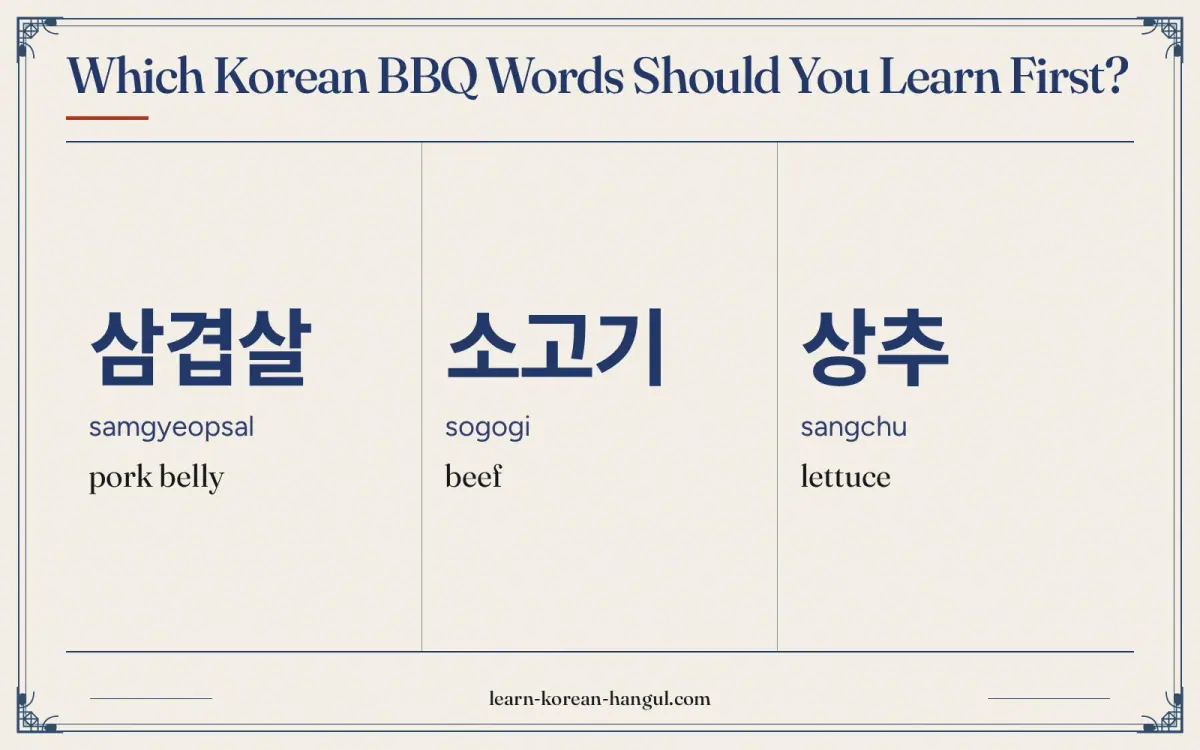
Learn 삼겹살 (pork belly), 갈비 (ribs), 인분 (portion), 쌈 (wrap) and 쌈장 (wrap sauce) first. With those five you can order meat, say how much you want and understand what the staff bring to the table.
- Words to say. 삼겹살, 갈비, 인분, 주세요. These are what you say to order.
- Words to recognise. 목살, 항정살, 등심, 양념. They appear on the menu board.
- Words to understand when spoken. 뒤집다, 자르다, 구워요. The staff say these while they cook for you.
A menu price is for one portion, typically 150 to 200 grams, though the weight differs by restaurant.
Word · 8
- 1
삼겹살
samgyeopsal
pork belly
- 2
소고기
sogogi
beef
- 3
상추
sangchu
lettuce
- 4
쌈장
ssamjang
wrap sauce
- 5
불판
bulpan
grill plate
- 6
숯불
sutbul
charcoal fire
- 7
집게
jipge
tongs
- 8
맥주
maekju
beer
Pork Cuts
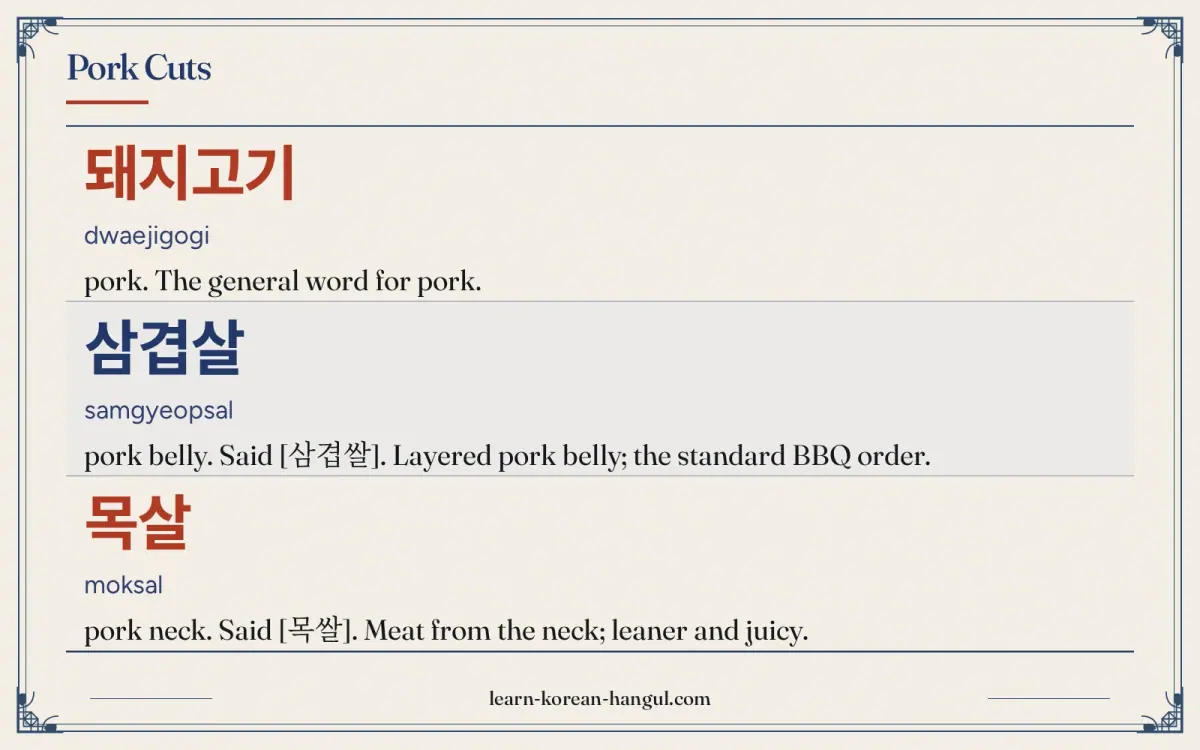
Pork is the meat most often grilled in Korea, and each cut has its own name. The general word is 돼지고기 (pork), made of 돼지 (pig) and 고기 (meat). The most famous cut is 삼겹살, pork belly, whose name means three layers: 삼 (three), 겹 (layer) and 살 (flesh). The other cuts are named for the body part, so learn the parts and you can read the whole menu.
| No. | Hangul | Revised Romanization | Meaning and note | Example sentence | Audio assetId |
|---|---|---|---|---|---|
| 1 | 돼지고기 | dwaejigogi | pork. The general word for pork. | 돼지고기를 구워요. (I grill pork.) | au-pg-vocabulary-food-korean-dishes-korean-bbq-1; example: au-pg-vocabulary-food-korean-dishes-korean-bbq-36 |
| 2 | 삼겹살 | samgyeopsal | pork belly. Said [삼겹쌀]. Layered pork belly; the standard BBQ order. | 삼겹살 이 인분 주세요. (Two portions of pork belly, please.) | au-pg-vocabulary-food-korean-dishes-korean-bbq-2; example: au-pg-vocabulary-food-korean-dishes-korean-bbq-37 |
| 3 | 목살 | moksal | pork neck. Said [목쌀]. Meat from the neck; leaner and juicy. | 목살은 부드러워요. (Pork neck is tender.) | au-pg-vocabulary-food-korean-dishes-korean-bbq-3; example: au-pg-vocabulary-food-korean-dishes-korean-bbq-38 |
| 4 | 항정살 | hangjeongsal | pork jowl. A rare, chewy cut near the jaw and neck. | 항정살은 쫄깃해요. (Pork jowl is chewy.) | au-pg-vocabulary-food-korean-dishes-korean-bbq-4; example: au-pg-vocabulary-food-korean-dishes-korean-bbq-39 |
| 5 | 갈매기살 | galmaegisal | pork skirt. A thin, firm cut from the diaphragm; the name sounds like 갈매기 (seagull) but is usually traced to 가로막살 (diaphragm meat). | 갈매기살을 좋아해요. (I like pork skirt.) | au-pg-vocabulary-food-korean-dishes-korean-bbq-5; example: au-pg-vocabulary-food-korean-dishes-korean-bbq-40 |
The ending 살 means flesh or meat and appears in most cut names. 목살 is the neck, 항정살 is a cut from the neck and jaw area, and 갈매기살 is a thin cut near the diaphragm. The names differ a little by region and butcher, so treat the English glosses as a guide and not an exact map.
Example Sentences
Three frames cover most of the examples. The first is noun + 주세요 (please give me noun), as in 등심 주세요. The second is noun + 을/를 + verb, as in 고기를 구워요 (I grill meat). The third is number + 인분 + 주세요, as in 삼 인분 주세요 (three portions, please). Play the audio, then say each sentence aloud before you move on to the beef cuts.
How Do You Say Beef Cuts in Korean?
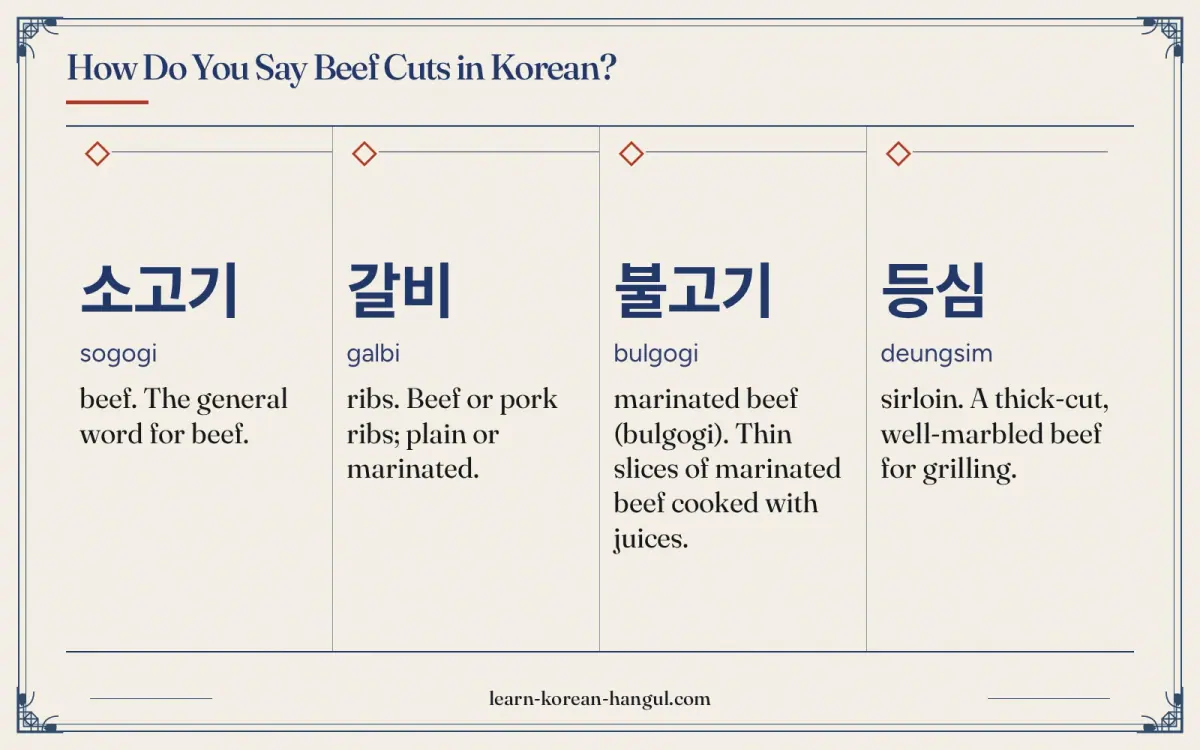
Beef is called 소고기 (sogogi); the older form 쇠고기 (soegogi) is also standard and appears on some menus. Beef costs more than pork for the same portion. The dish most visitors know is 불고기 (bulgogi), thin marinated beef. 갈비 are ribs, and they are sold plain or marinated. 등심 is the sirloin and 안심 is the tenderloin, and both are served in thick slices for grilling.
| No. | Hangul | Revised Romanization | Meaning and note | Example sentence | Audio assetId |
|---|---|---|---|---|---|
| 6 | 소고기 | sogogi | beef. The general word for beef. | 소고기를 먹어요. (I eat beef.) | au-pg-vocabulary-food-korean-dishes-korean-bbq-6; example: au-pg-vocabulary-food-korean-dishes-korean-bbq-41 |
| 7 | 갈비 | galbi | ribs. Beef or pork ribs; plain or marinated. | 갈비는 비싸요. (Ribs are expensive.) | au-pg-vocabulary-food-korean-dishes-korean-bbq-7; example: au-pg-vocabulary-food-korean-dishes-korean-bbq-42 |
| 8 | 불고기 | bulgogi | marinated beef (bulgogi). Thin slices of marinated beef cooked with juices. | 불고기는 달아요. (Bulgogi is sweet.) | au-pg-vocabulary-food-korean-dishes-korean-bbq-8; example: au-pg-vocabulary-food-korean-dishes-korean-bbq-43 |
| 9 | 등심 | deungsim | sirloin. A thick-cut, well-marbled beef for grilling. | 등심 주세요. (Sirloin, please.) | au-pg-vocabulary-food-korean-dishes-korean-bbq-9; example: au-pg-vocabulary-food-korean-dishes-korean-bbq-44 |
| 10 | 안심 | ansim | tenderloin. The tender, lean beef cut. | 안심은 부드러워요. (Tenderloin is tender.) | au-pg-vocabulary-food-korean-dishes-korean-bbq-10; example: au-pg-vocabulary-food-korean-dishes-korean-bbq-45 |
Marinated meat has the word 양념 (seasoning) in its name: 양념갈비 is marinated ribs. Meat without a marinade is 생 (raw), as in 생갈비. For more on the word itself, see the page on bulgogi in Korean. 불고기 is often cooked in a shallow pan with its juices rather than directly on the grill.
Which Cuts Are Pork and Which Are Beef?
Many learners cannot tell which cuts belong to which animal, and the names do not say. The table below sorts the cuts used on this page.
| Cut | Animal | Part |
|---|---|---|
| 삼겹살 | pork | belly |
| 목살 | pork | neck |
| 항정살 | pork | jowl and neck |
| 갈매기살 | pork | skirt near the diaphragm |
| 갈비 | pork or beef | ribs |
| 등심 | beef | sirloin |
| 안심 | beef | tenderloin |
The animal comes first when you need to be exact. 돼지갈비 is pork ribs and 소갈비 is beef ribs. A menu may list just 갈비, so check whether the heading says 돼지 or 소.
How Do You Say Side Items and Wraps in Korean?
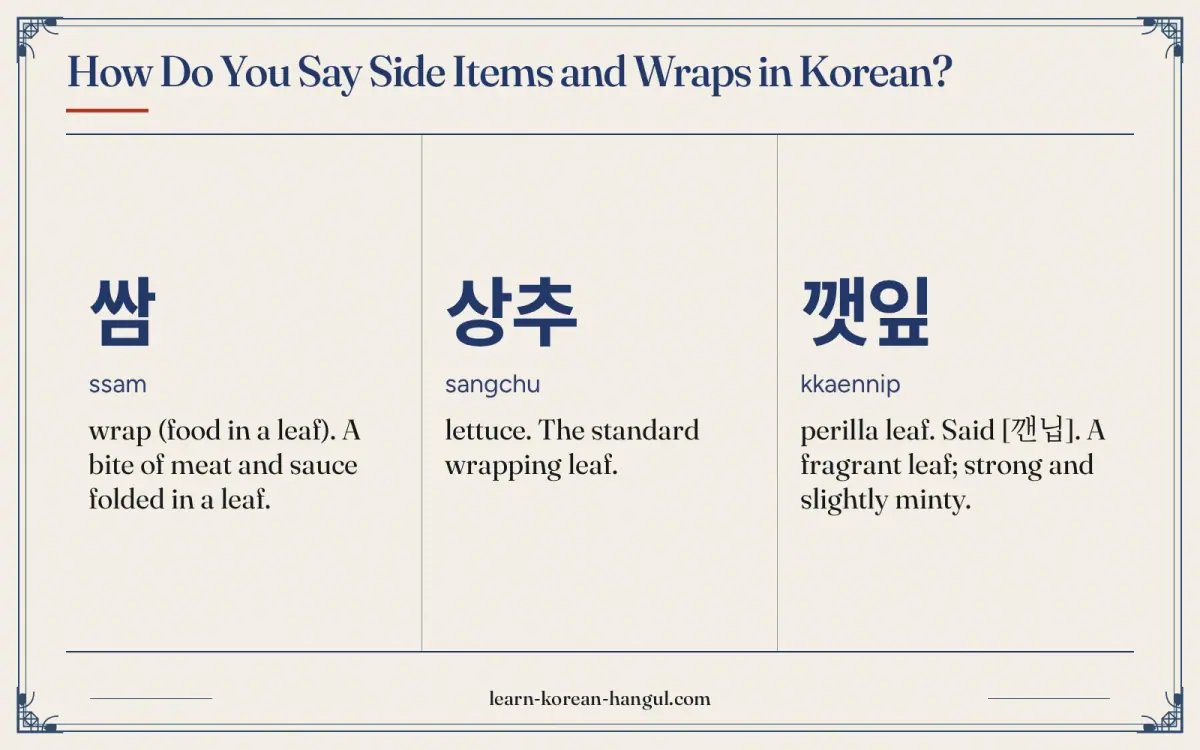
Korean BBQ meat is usually eaten wrapped, not on its own. You put a piece in a leaf and fold it into a bite, called 쌈 (ssam), a noun formed from the verb 싸다, to wrap. The leaves are 상추 (lettuce) and 깻잎 (perilla leaf). Whole garlic cloves and chilli peppers are grilled or eaten raw alongside. The staff bring these with the meat, and refills are common.
| No. | Hangul | Revised Romanization | Meaning and note | Example sentence | Audio assetId |
|---|---|---|---|---|---|
| 11 | 쌈 | ssam | wrap (food in a leaf). A bite of meat and sauce folded in a leaf. | 쌈을 싸요. (I make a wrap.) | au-pg-vocabulary-food-korean-dishes-korean-bbq-11; example: au-pg-vocabulary-food-korean-dishes-korean-bbq-46 |
| 12 | 상추 | sangchu | lettuce. The standard wrapping leaf. | 상추에 고기를 싸요. (I wrap meat in lettuce.) | au-pg-vocabulary-food-korean-dishes-korean-bbq-12; example: au-pg-vocabulary-food-korean-dishes-korean-bbq-47 |
| 13 | 깻잎 | kkaennip | perilla leaf. Said [깬닙]. A fragrant leaf; strong and slightly minty. | 깻잎 더 주세요. (More perilla leaves, please.) | au-pg-vocabulary-food-korean-dishes-korean-bbq-13; example: au-pg-vocabulary-food-korean-dishes-korean-bbq-48 |
| 14 | 마늘 | maneul | garlic. Grilled or raw cloves eaten with the wrap. | 마늘을 구워요. (I grill garlic.) | au-pg-vocabulary-food-korean-dishes-korean-bbq-14; example: au-pg-vocabulary-food-korean-dishes-korean-bbq-49 |
| 15 | 고추 | gochu | chilli pepper. Green chilli eaten raw with the meat. | 고추를 같이 먹어요. (I eat chilli peppers together with it.) | au-pg-vocabulary-food-korean-dishes-korean-bbq-15; example: au-pg-vocabulary-food-korean-dishes-korean-bbq-50 |
A wrap is built in a set order: leaf first, then a piece of meat, then a dab of sauce, a slice of garlic and sometimes a pickle, then the whole thing goes into the mouth in one bite. The polite request for more leaves is 상추 더 주세요 (more lettuce, please).
Sauces and Seasonings
Sauce is a large part of the Korean BBQ taste. 쌈장 is a thick paste of soybean and chilli paste, used inside a wrap. 기름장 is sesame oil with salt, and it is the classic dip for beef. 소금 (salt) is used for plain pork. 양념 is the general word for seasoning or marinade, and 파채 is a salad of shredded green onion in a tangy dressing that goes on top of the meat.
| No. | Hangul | Revised Romanization | Meaning and note | Example sentence | Audio assetId |
|---|---|---|---|---|---|
| 16 | 쌈장 | ssamjang | wrap sauce. A thick paste of soybean and chilli paste for wraps. | 쌈장을 찍어요. (I dab on some wrap sauce.) | au-pg-vocabulary-food-korean-dishes-korean-bbq-16; example: au-pg-vocabulary-food-korean-dishes-korean-bbq-51 |
| 17 | 기름장 | gireumjang | sesame oil dip. Sesame oil with salt; the classic dip for beef. | 기름장에 찍어요. (I dip it in the sesame oil dip.) | au-pg-vocabulary-food-korean-dishes-korean-bbq-17; example: au-pg-vocabulary-food-korean-dishes-korean-bbq-52 |
| 18 | 소금 | sogeum | salt. Coarse salt for plain pork. | 소금 좀 주세요. (Some salt, please.) | au-pg-vocabulary-food-korean-dishes-korean-bbq-18; example: au-pg-vocabulary-food-korean-dishes-korean-bbq-53 |
| 19 | 양념 | yangnyeom | seasoning; marinade. A mix of soy sauce, garlic, sugar and other flavourings. | 양념이 맛있어요. (The marinade is tasty.) | au-pg-vocabulary-food-korean-dishes-korean-bbq-19; example: au-pg-vocabulary-food-korean-dishes-korean-bbq-54 |
| 20 | 파채 | pachae | shredded green onion salad. Thin strips of green onion with a tangy dressing. | 파채를 올려요. (I put green onion salad on top.) | au-pg-vocabulary-food-korean-dishes-korean-bbq-20; example: au-pg-vocabulary-food-korean-dishes-korean-bbq-55 |
Different meats pair with different sauces. Pork belly usually goes with 쌈장, and beef goes with 기름장. The verb for dipping is 찍다, used in both sauce examples above: 쌈장을 찍어요 and 기름장에 찍어요. Ask for more sauce with 쌈장 더 주세요.
How Do You Say Ordering Words for Korean BBQ?
Ordering is more structured than at other restaurants. You pick a cut, state the number of portions with 인분 and name the extras. 인분 is the counter for portions of food, and it is used with Sino-Korean numbers: 일 인분, 이 인분, 삼 인분. 추가 means an addition, and it is the word on a menu for extra items. The grill itself is the 불판, and the fire can be 숯불, a charcoal fire.
| No. | Hangul | Revised Romanization | Meaning and note | Example sentence | Audio assetId |
|---|---|---|---|---|---|
| 21 | 인분 | inbun | portion (counter). The counter for servings of food; used with Sino-Korean numbers. | 삼 인분 주세요. (Three portions, please.) | au-pg-vocabulary-food-korean-dishes-korean-bbq-21; example: au-pg-vocabulary-food-korean-dishes-korean-bbq-56 |
| 22 | 추가 | chuga | addition; extra. An extra order on top of the first. | 고기를 추가해요. (I add more meat.) | au-pg-vocabulary-food-korean-dishes-korean-bbq-22; example: au-pg-vocabulary-food-korean-dishes-korean-bbq-57 |
| 23 | 불판 | bulpan | grill plate. The metal plate of the grill. | 불판을 바꿔 주세요. (Please change the grill plate.) | au-pg-vocabulary-food-korean-dishes-korean-bbq-23; example: au-pg-vocabulary-food-korean-dishes-korean-bbq-58 |
| 24 | 숯불 | sutbul | charcoal fire. Said [숟뿔]. Cooking over charcoal; gives a smoky taste. | 숯불에 구워요. (I grill it over charcoal.) | au-pg-vocabulary-food-korean-dishes-korean-bbq-24; example: au-pg-vocabulary-food-korean-dishes-korean-bbq-59 |
| 25 | 구이 | gui | grilled dish. A noun that also ends dish names, as in 생선구이 (grilled fish). | 생선구이를 좋아해요. (I like grilled fish.) | au-pg-vocabulary-food-korean-dishes-korean-bbq-25; example: au-pg-vocabulary-food-korean-dishes-korean-bbq-60 |
Many restaurants set a minimum of two portions per cut, so check the menu if you are eating alone. For other words you need at a table, such as asking for water or the bill, see the restaurant phrases. The portion counter is explained on the food counters page.
How Does Ordering by 인분 Work?
A 인분 is a portion, and the price on the menu is for one portion. Say the number first, then 인분: 이 인분 (two portions). Use Sino-Korean numbers with 인분: 일, 이, 삼, 사. On menus and receipts you will usually see Arabic numerals with no space, as in 2인분.
| You say | Meaning |
|---|---|
| 일 인분 주세요 | one portion, please |
| 이 인분 주세요 | two portions, please |
| 삼겹살 이 인분, 목살 일 인분 | two portions of pork belly and one of neck |
If you are alone, ask whether one portion is possible: 일 인분 돼요? (is one portion okay?). Some places say no, and others add a small charge. This is a custom that differs by restaurant and not a national rule.
How Do You Say Grilling Verbs in Korean?
At many Korean BBQ restaurants the staff cook the first round for you. What you hear are short verbs. 굽다 means to grill, 뒤집다 means to flip and 자르다 means to cut. The tools are 가위 (scissors) and 집게 (tongs). Meat is cut at the table with scissors instead of a knife, so thick slices become bite-size pieces on the grill.
| No. | Hangul | Revised Romanization | Meaning and note | Example sentence | Audio assetId |
|---|---|---|---|---|---|
| 26 | 굽다 | gupda | to grill. The main cooking verb; ㅂ-irregular. | 고기를 구워요. (I grill meat.) | au-pg-vocabulary-food-korean-dishes-korean-bbq-26; example: au-pg-vocabulary-food-korean-dishes-korean-bbq-61 |
| 27 | 뒤집다 | dwijipda | to flip. Turn the meat over on the grill. | 고기를 뒤집어요. (I flip the meat.) | au-pg-vocabulary-food-korean-dishes-korean-bbq-27; example: au-pg-vocabulary-food-korean-dishes-korean-bbq-62 |
| 28 | 자르다 | jareuda | to cut. Cut with scissors at the table. | 고기를 잘라요. (I cut the meat.) | au-pg-vocabulary-food-korean-dishes-korean-bbq-28; example: au-pg-vocabulary-food-korean-dishes-korean-bbq-63 |
| 29 | 가위 | gawi | scissors. Kitchen scissors used at the grill. | 가위로 잘라요. (I cut it with scissors.) | au-pg-vocabulary-food-korean-dishes-korean-bbq-29; example: au-pg-vocabulary-food-korean-dishes-korean-bbq-64 |
| 30 | 집게 | jipge | tongs. Said [집께]. The tongs used to lift the meat. | 집게로 집어요. (I pick it up with tongs.) | au-pg-vocabulary-food-korean-dishes-korean-bbq-30; example: au-pg-vocabulary-food-korean-dishes-korean-bbq-65 |
The verb 굽다 is irregular: before a vowel its ㅂ becomes 우, so the polite present is 구워요 and not 굽어요. 자르다 is irregular too (르-irregular): it doubles the ㄹ, giving 잘라요. 뒤집다 is regular (뒤집어요). If a server says 아직이에요 (not yet), the meat is not ready. Listen for 다 익었어요, which tells you it is cooked.
Drinks and Finishing Dishes
The last group covers what surrounds the meat. 소주 (soju) and 맥주 (beer) are the usual drinks, ordered by the bottle (병) or glass (잔). After the meat, many people order a finishing dish: 냉면 for a cold end, 된장찌개 for a warm one, or 볶음밥 cooked on the grill plate. A finishing dish is a meal in itself, so people order it after the meat is finished.
| No. | Hangul | Revised Romanization | Meaning and note | Example sentence | Audio assetId |
|---|---|---|---|---|---|
| 31 | 소주 | soju | soju. The clear Korean spirit; ordered by the bottle. | 소주 한 병 주세요. (One bottle of soju, please.) | au-pg-vocabulary-food-korean-dishes-korean-bbq-31; example: au-pg-vocabulary-food-korean-dishes-korean-bbq-66 |
| 32 | 맥주 | maekju | beer. Said [맥쭈]. Beer, ordered by the glass or bottle. | 맥주 한 잔 주세요. (One glass of beer, please.) | au-pg-vocabulary-food-korean-dishes-korean-bbq-32; example: au-pg-vocabulary-food-korean-dishes-korean-bbq-67 |
| 33 | 냉면 | naengmyeon | cold noodles. A cold finishing dish after meat. | 마지막에 냉면을 먹어요. (At the end I eat cold noodles.) | au-pg-vocabulary-food-korean-dishes-korean-bbq-33; example: au-pg-vocabulary-food-korean-dishes-korean-bbq-68 |
| 34 | 된장찌개 | doenjangjjigae | soybean paste stew. A savoury stew eaten with rice to finish the meal. | 식사로 된장찌개를 먹어요. (For the meal I eat soybean paste stew.) | au-pg-vocabulary-food-korean-dishes-korean-bbq-34; example: au-pg-vocabulary-food-korean-dishes-korean-bbq-69 |
| 35 | 볶음밥 | bokkeumbap | fried rice. Said [보끔밥], often [보끔빱]. Rice fried on the grill plate with kimchi and seaweed. | 마지막에 볶음밥을 먹어요. (At the end I eat fried rice.) | au-pg-vocabulary-food-korean-dishes-korean-bbq-35; example: au-pg-vocabulary-food-korean-dishes-korean-bbq-70 |
Korea's youth protection rules bar alcohol sales to anyone under 19, counted by year of birth. The finishing dish is a good place to practise: ask 식사는 뭐가 있어요? (what meals do you have?) and choose one. The noodles are covered on the noodles page, and fried rice on the rice dishes page.
In What Order Is a Korean BBQ Meal Eaten?
A typical meal has four steps. First come the side dishes and leaves. Second, the meat is grilled and eaten in wraps. Third, garlic and kimchi are often grilled in the meat fat on the plate. Fourth, you order a finishing dish: cold noodles, a stew or fried rice.
| Step | What happens | Words |
|---|---|---|
| 1 | table is set | 쌈, 상추, 쌈장 |
| 2 | meat is grilled | 굽다, 뒤집다, 자르다 |
| 3 | extras are grilled | 마늘, 김치 |
| 4 | the meal is finished | 냉면, 된장찌개, 볶음밥 |
The order is a habit, not a rule. You can skip a step. For more on the kimchi that is grilled on the plate, see the kimchi types page.
How Do You Pronounce These Words?
Most of the tricky sounds in BBQ words are tense consonants: a plain ㅅ, ㅈ or ㅂ is said tense after a final ㄱ, ㄷ or ㅂ sound, as in 삼겹살 [삼겹쌀]. Standard pronunciation follows the National Institute of Korean Language (국립국어원) rules, and the romanization on this page follows the Revised Romanization of Korean, which does not mark every sound change.
| Spelling | Sounds like | What changes |
|---|---|---|
| 삼겹살 | [삼겹쌀] | After the final ㅂ of 겹, the ㅅ of 살 is said as a tense [ㅆ]. |
| 목살 | [목쌀] | After the final ㄱ of 목, the ㅅ of 살 becomes tense [ㅆ]. |
| 깻잎 | [깬닙] | Final ㅅ is [ㄷ], then ㄴ is added before 잎 and ㄷ becomes [ㄴ]. |
| 숯불 | [숟뿔] | Final ㅊ is said as [ㄷ], and the ㅂ after it is tense [ㅃ]. |
| 맥주 | [맥쭈] | After the final ㄱ, the ㅈ of 주 becomes tense [ㅉ]. |
| 볶음밥 | [보끔밥] | The final ㄲ links to 음. Many speakers also make the ㅂ of 밥 tense, [보끔빱]. |
The tense [쌀] in 삼겹살 and 목살 is the sound learners most often miss. Say it with a tight throat and no puff of air. On its own, 살 starts with a plain ㅅ; it becomes tense only after the stop sound at the end of 겹 or 목.
Audio and Slow Playback
Every word and every example sentence has its own clip. The five clips below replay the trickiest words slowly. Play one, repeat it aloud, then play it again and compare.
What Mistakes Do Learners Make with Korean BBQ Words?
These five mistakes come up most often at the grill.
- Asking for Korean BBQ by that name. 고기구이 means grilled meat, but people usually name the cut. Say 삼겹살 or 갈비 in the restaurant.
- Saying 삼겹살 with a plain [살]. After the final ㅂ of 겹 it is tense: [삼겹쌀].
- Ordering one portion and expecting it to be allowed. Many places set a two-portion minimum. Check the menu.
- Confusing 갈비 and 불고기. 갈비 are ribs. 불고기 is thin marinated beef, cooked in a pan.
- Saying 굽어요 for grill. The verb is irregular. The polite present is 구워요.
With the cut names, the portion counter and the grilling verbs, you can get through a whole BBQ meal in Korean. The last step is to drill the words.
Practice: Flashcards and Worksheet
Study in three steps. First, run the flashcard deck in recognition mode until you recognise each of the 35 words. Second, switch to listening mode. Third, take the quiz. Your progress stays in your browser, and the vocabulary flashcard decks page lists the other decks.
Practice · 75
- 01돼지고기
Show answer
headword 1: pork
- 02삼겹살
Show answer
headword 2: pork belly
- 03목살
Show answer
headword 3: pork neck
- 04항정살
Show answer
headword 4: pork jowl
- 05갈매기살
Show answer
headword 5: pork skirt
- 06소고기
Show answer
headword 6: beef
- 07갈비
Show answer
headword 7: ribs
- 08불고기
Show answer
headword 8: marinated beef (bulgogi)
- 09등심
Show answer
headword 9: sirloin
- 10안심
Show answer
headword 10: tenderloin
- 11쌈
Show answer
headword 11: wrap (food in a leaf)
- 12상추
Show answer
headword 12: lettuce
- 13깻잎
Show answer
headword 13: perilla leaf
- 14마늘
Show answer
headword 14: garlic
- 15고추
Show answer
headword 15: chilli pepper
- 16쌈장
Show answer
headword 16: wrap sauce
- 17기름장
Show answer
headword 17: sesame oil dip
- 18소금
Show answer
headword 18: salt
- 19양념
Show answer
headword 19: seasoning; marinade
- 20파채
Show answer
headword 20: shredded green onion salad
- 21인분
Show answer
headword 21: portion (counter)
- 22추가
Show answer
headword 22: addition; extra
- 23불판
Show answer
headword 23: grill plate
- 24숯불
Show answer
headword 24: charcoal fire
- 25구이
Show answer
headword 25: grilled dish
- 26굽다
Show answer
headword 26: to grill
- 27뒤집다
Show answer
headword 27: to flip
- 28자르다
Show answer
headword 28: to cut
- 29가위
Show answer
headword 29: scissors
- 30집게
Show answer
headword 30: tongs
- 31소주
Show answer
headword 31: soju
- 32맥주
Show answer
headword 32: beer
- 33냉면
Show answer
headword 33: cold noodles
- 34된장찌개
Show answer
headword 34: soybean paste stew
- 35볶음밥
Show answer
headword 35: fried rice
- 36돼지고기를 구워요.
Show answer
example sentence for 돼지고기
- 37삼겹살 이 인분 주세요.
Show answer
example sentence for 삼겹살
- 38목살은 부드러워요.
Show answer
example sentence for 목살
- 39항정살은 쫄깃해요.
Show answer
example sentence for 항정살
- 40갈매기살을 좋아해요.
Show answer
example sentence for 갈매기살
- 41소고기를 먹어요.
Show answer
example sentence for 소고기
- 42갈비는 비싸요.
Show answer
example sentence for 갈비
- 43불고기는 달아요.
Show answer
example sentence for 불고기
- 44등심 주세요.
Show answer
example sentence for 등심
- 45안심은 부드러워요.
Show answer
example sentence for 안심
- 46쌈을 싸요.
Show answer
example sentence for 쌈
- 47상추에 고기를 싸요.
Show answer
example sentence for 상추
- 48깻잎 더 주세요.
Show answer
example sentence for 깻잎
- 49마늘을 구워요.
Show answer
example sentence for 마늘
- 50고추를 같이 먹어요.
Show answer
example sentence for 고추
- 51쌈장을 찍어요.
Show answer
example sentence for 쌈장
- 52기름장에 찍어요.
Show answer
example sentence for 기름장
- 53소금 좀 주세요.
Show answer
example sentence for 소금
- 54양념이 맛있어요.
Show answer
example sentence for 양념
- 55파채를 올려요.
Show answer
example sentence for 파채
- 56삼 인분 주세요.
Show answer
example sentence for 인분
- 57고기를 추가해요.
Show answer
example sentence for 추가
- 58불판을 바꿔 주세요.
Show answer
example sentence for 불판
- 59숯불에 구워요.
Show answer
example sentence for 숯불
- 60생선구이를 좋아해요.
Show answer
example sentence for 구이
- 61고기를 구워요.
Show answer
example sentence for 굽다
- 62고기를 뒤집어요.
Show answer
example sentence for 뒤집다
- 63고기를 잘라요.
Show answer
example sentence for 자르다
- 64가위로 잘라요.
Show answer
example sentence for 가위
- 65집게로 집어요.
Show answer
example sentence for 집게
- 66소주 한 병 주세요.
Show answer
example sentence for 소주
- 67맥주 한 잔 주세요.
Show answer
example sentence for 맥주
- 68마지막에 냉면을 먹어요.
Show answer
example sentence for 냉면
- 69식사로 된장찌개를 먹어요.
Show answer
example sentence for 된장찌개
- 70마지막에 볶음밥을 먹어요.
Show answer
example sentence for 볶음밥
- 71삼겹살
Show answer
slow playback: 삼겹살
- 72항정살
Show answer
slow playback: 항정살
- 73깻잎
Show answer
slow playback: 깻잎
- 74숯불
Show answer
slow playback: 숯불
- 75볶음밥
Show answer
slow playback: 볶음밥
Practice · 7
What does 삼겹살 (samgyeopsal) mean?
Show answer
pork belly
삼겹살 means pork belly. Example: 삼겹살 이 인분 주세요. (Two portions of pork belly, please.)
What does 갈비 (galbi) mean?
Show answer
ribs
갈비 means ribs. Example: 갈비는 비싸요. (Ribs are expensive.)
What does 쌈 (ssam) mean?
Show answer
wrap (food in a leaf)
쌈 means wrap (food in a leaf). Example: 쌈을 싸요. (I make a wrap.)
What does 쌈장 (ssamjang) mean?
Show answer
wrap sauce
쌈장 means wrap sauce. Example: 쌈장을 찍어요. (I dab on some wrap sauce.)
What does 인분 (inbun) mean?
Show answer
portion (counter)
인분 means portion (counter). Example: 삼 인분 주세요. (Three portions, please.)
What does 뒤집다 (dwijipda) mean?
Show answer
to flip
뒤집다 means to flip. Example: 고기를 뒤집어요. (I flip the meat.)
What does 소주 (soju) mean?
Show answer
soju
소주 means soju. Example: 소주 한 병 주세요. (One bottle of soju, please.)
Korean BBQ Vocabulary Worksheet (PDF)
A printable worksheet for these words (word list, matching, writing practice, fill-in-the-blank exercises and answer key) is available in A4 and US Letter from the download card on this page. For practice, copy the 35 words by hand and mark each cut as pork or beef.
Where to Go Next
Once the Korean BBQ vocabulary on this page feels familiar, continue with Korean Rice Dishes Vocabulary, which covers the fried rice that closes the meal, or go back to Korean Kimchi Types Vocabulary. For the single phrase, see Korean BBQ in Korean. To move up a level, return to Korean Dishes.
Frequently Asked Questions
How Do You Say Korean BBQ in Korean?
Korean BBQ is 고기구이 (gogigui), grilled meat, but Koreans usually name the cut instead. Say 삼겹살 (pork belly) or 갈비 (ribs). To order, give the number of portions and add 주세요, as in 삼겹살 이 인분 주세요 (two portions of pork belly, please).
What Does Samgyeopsal Mean?
삼겹살 (samgyeopsal) is pork belly. The name means three layers: 삼 (three), 겹 (layer) and 살 (flesh), after the stripes of fat and meat. It is said [삼겹쌀], with a tense last syllable, and it is the cut most people order first at a Korean BBQ restaurant.
How Do You Order Meat at a Korean BBQ Restaurant?
Say the cut, the number of portions with 인분 and 주세요. For example, 목살 이 인분 주세요 means two portions of pork neck, please. Use Sino-Korean numbers (일, 이, 삼) before 인분. Many restaurants set a minimum of two portions per cut, so check the menu if you are alone.
Where Can I Practise Korean BBQ Words with Flashcards?
Use the vocabulary flashcard decks. The deck for this page holds all 35 words with Hangul, romanization and audio, in recognition and listening modes. Your progress stays in your browser, so you can return daily and review the cards you missed.
Is the Romanization on This Page Official?
It follows the Revised Romanization of Korean, which South Korea adopted on 7 July 2000 and whose rules the National Institute of Korean Language (국립국어원) publishes. It is a learning aid and does not mark every sound change, so rely on the Hangul and the audio.
Is There a Printable Worksheet for Korean BBQ Words?
A printable worksheet for these words (word list, matching, writing practice, fill-in-the-blank exercises and answer key) is available in A4 and US Letter from the download card on this page. For practice, copy the tables on this page by hand or use the flashcard deck, which carries the same 35 words.