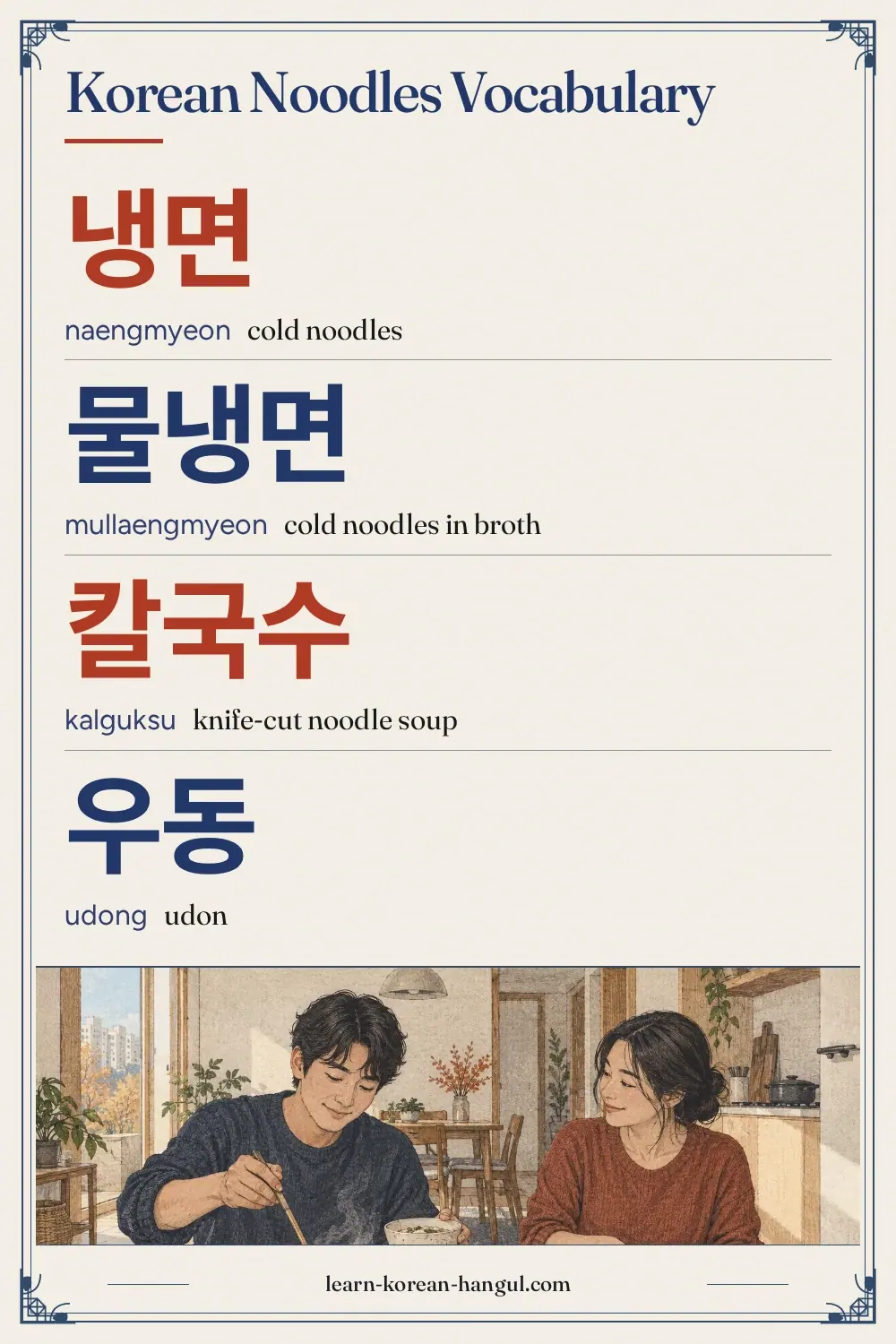
Korean Noodles Vocabulary at a Glance
This list has 25 words in five groups of five. It starts with cold noodles, moves to hot noodle soups, then the noodle dishes of Chinese-Korean restaurants, then instant noodles and finally the terms for noodle types and toppings. The page sits inside Korean Dishes, with a related single-word page on noodles in Korean.
| Group | Words | Use |
|---|---|---|
| Cold noodles | 5 | Naming noodles served in a chilled broth or with sauce |
| Hot noodles | 5 | Naming warm noodle soups |
| Black bean and fusion noodles | 5 | Naming the noodle dishes of Chinese-Korean restaurants |
| Instant noodles | 5 | Naming packaged noodles and how they are made |
| Noodle types and toppings | 5 | Naming noodle kinds and what goes on top |
Noodles are eaten all year, but the choice changes with the season. Cold 냉면 belongs to summer, a hot 칼국수 to a rainy day, and a pot of 라면 to a late-night snack. Knowing the name tells you what to expect: the temperature, the thickness of the noodle and the broth.
Which Noodle Dishes Should You Learn First?
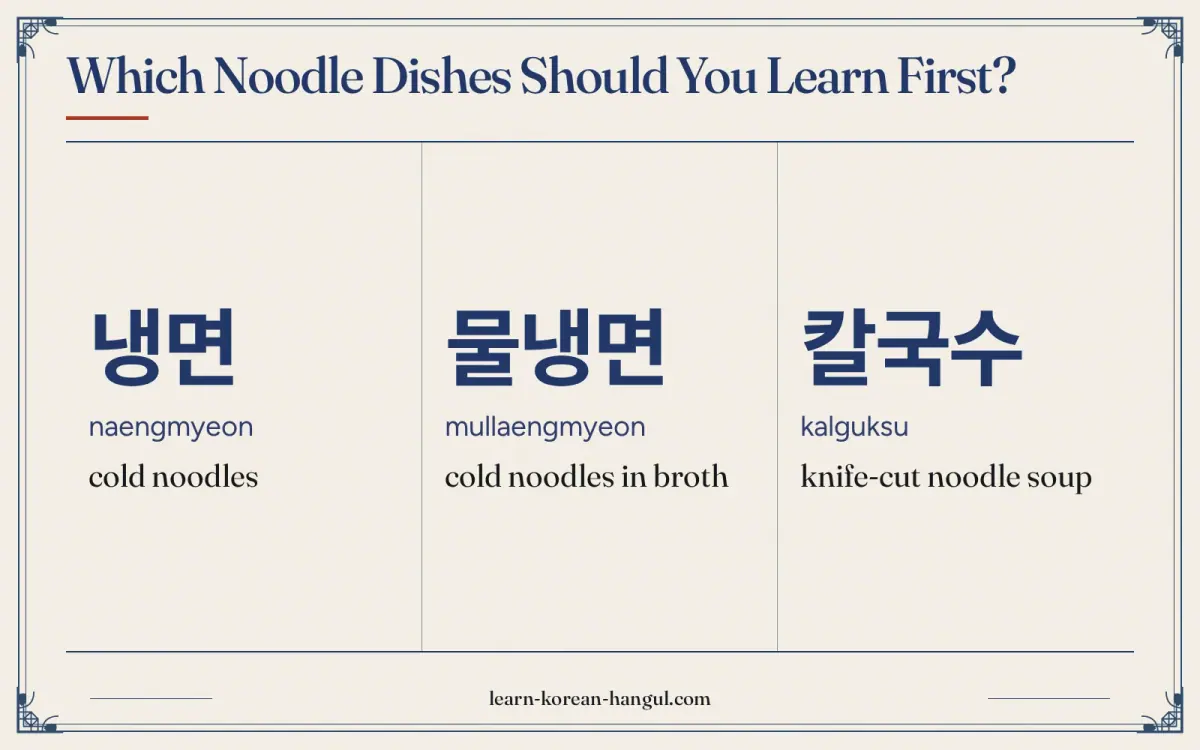
Learn 면 (noodle), 냉면 (cold noodles), 칼국수 (knife-cut noodles), 자장면 (black bean noodles) and 라면 (instant noodles) first. Each one stands for a different style: cold, hot soup, Chinese-Korean and instant.
- Words to say. 라면, 냉면, 짬뽕. These are the orders you use most.
- Words to recognise. 칼국수, 잔치국수, 수제비, 우동. They appear on menus of noodle shops.
- Words for the kitchen. 소면, 당면, 고명. They help you read recipes and package labels.
A noodle shop is called a 국숫집 or a 면집, and most also sell dumplings (만두). Noodles are slurped. Slurping is normal and is not considered rude.
Word · 8
- 1
냉면
naengmyeon
cold noodles
- 2
물냉면
mullaengmyeon
cold noodles in broth
- 3
칼국수
kalguksu
knife-cut noodle soup
- 4
우동
udong
udon
- 5
자장면
jajangmyeon
black bean noodles (standard spelling)
- 6
중국집
junggukjip
Chinese-Korean restaurant
- 7
라면
ramyeon
instant noodles
- 8
당면
dangmyeon
glass noodles
Cold Noodles
Cold noodles are a summer dish. 냉면 (naengmyeon) is made of thin, chewy noodles in an icy broth or with a spicy sauce, and it comes with sliced pear, cucumber and egg. The first syllable 냉 means cold. Two versions are common: 물냉면 with the broth and 비빔냉면 with the sauce. 콩국수 is a different cold noodle dish with a soybean soup.
| No. | Hangul | Revised Romanization | Meaning and note | Example sentence | Audio assetId |
|---|---|---|---|---|---|
| 1 | 면 | myeon | noodle. The general word for noodle; the end of most noodle dish names. | 면을 좋아해요. (I like noodles.) | au-pg-vocabulary-food-korean-dishes-noodles-1; example: au-pg-vocabulary-food-korean-dishes-noodles-26 |
| 2 | 냉면 | naengmyeon | cold noodles. Thin, chewy noodles in an icy broth or with a spicy sauce. | 여름에 냉면을 먹어요. (In summer I eat cold noodles.) | au-pg-vocabulary-food-korean-dishes-noodles-2; example: au-pg-vocabulary-food-korean-dishes-noodles-27 |
| 3 | 물냉면 | mullaengmyeon | cold noodles in broth. Said [물랭면]. The soupy version with a tangy cold beef or radish broth. | 물냉면 주세요. (Cold noodles in broth, please.) | au-pg-vocabulary-food-korean-dishes-noodles-3; example: au-pg-vocabulary-food-korean-dishes-noodles-28 |
| 4 | 비빔냉면 | bibimnaengmyeon | spicy mixed cold noodles. The version with a red chilli sauce and no broth; you mix it. | 비빔냉면은 매워요. (Spicy mixed cold noodles are spicy.) | au-pg-vocabulary-food-korean-dishes-noodles-4; example: au-pg-vocabulary-food-korean-dishes-noodles-29 |
| 5 | 콩국수 | kongguksu | cold soybean noodle soup. Said [콩국쑤]. Noodles in a chilled soybean soup; creamy and nutty. | 콩국수는 고소해요. (Cold soybean noodles are nutty.) | au-pg-vocabulary-food-korean-dishes-noodles-5; example: au-pg-vocabulary-food-korean-dishes-noodles-30 |
The prefix 물 (water) and the prefix 비빔 (mixed) are the keys. 물냉면 is the one in broth, and 비빔냉면 is the one you mix with sauce. Many 냉면 restaurants also bring a kettle of warm meat broth (육수, yuksu) to sip from a cup before or during the meal.
Example Sentences
Three frames cover most of the examples. The first is noun + 을/를 + verb, as in 라면을 끓여요 (I boil instant noodles). The second is noun + 은/는 + adjective, as in 짬뽕은 매워요 (spicy seafood noodle soup is spicy), where the particle 은/는 marks the topic. The third is noun + 주세요 (please give me noun), the polite way to order. Play the audio, then say each sentence aloud before moving on to the hot noodle soups.
How Do You Say Hot Noodles in Korean?
Hot noodles are a comfort food. The core word is 국수 (guksu), which means noodles in a broth. Three dishes use it as their last word: 칼국수 (knife-cut noodle soup), 잔치국수 (banquet noodle soup) and 콩국수. The first part tells you the kind of noodle or the occasion. 칼 means knife, since the dough is cut by hand, and 잔치 means a feast or banquet.
| No. | Hangul | Revised Romanization | Meaning and note | Example sentence | Audio assetId |
|---|---|---|---|---|---|
| 6 | 국수 | guksu | noodles in broth; noodles. Said [국쑤]. The general word for a bowl of noodles; often thin wheat noodles. | 국수를 먹어요. (I eat noodles.) | au-pg-vocabulary-food-korean-dishes-noodles-6; example: au-pg-vocabulary-food-korean-dishes-noodles-31 |
| 7 | 칼국수 | kalguksu | knife-cut noodle soup. Said [칼국쑤]. Thick, hand-cut noodles in a clam or chicken broth. | 칼국수는 면이 굵어요. (Knife-cut noodles are thick.) | au-pg-vocabulary-food-korean-dishes-noodles-7; example: au-pg-vocabulary-food-korean-dishes-noodles-32 |
| 8 | 잔치국수 | janchiguksu | banquet noodle soup. Said [잔치국쑤]. Thin noodles in clear anchovy broth; served at weddings and parties. | 잔치국수는 따뜻해요. (Banquet noodle soup is warm.) | au-pg-vocabulary-food-korean-dishes-noodles-8; example: au-pg-vocabulary-food-korean-dishes-noodles-33 |
| 9 | 수제비 | sujebi | hand-torn dough soup. Flat flakes of dough in a clear broth with zucchini and potato. | 수제비를 좋아해요. (I like hand-torn dough soup.) | au-pg-vocabulary-food-korean-dishes-noodles-9; example: au-pg-vocabulary-food-korean-dishes-noodles-34 |
| 10 | 우동 | udong | udon. Thick wheat noodles in a mild broth; a loanword from Japanese. | 우동 주세요. (Udon, please.) | au-pg-vocabulary-food-korean-dishes-noodles-10; example: au-pg-vocabulary-food-korean-dishes-noodles-35 |
수제비 is a cousin of the noodle soup. The dough is torn into flat pieces by hand and dropped into the broth, so it is eaten like noodles but is not a noodle. 우동 is a thick wheat noodle in a mild broth, a name borrowed from Japanese. Korean udon is usually lighter than ramyeon.
Black Bean and Fusion Noodles
Korea has its own style of Chinese restaurant, called 중국집. The food is Korean-Chinese and adapted for local taste. Three dishes stand for it. 자장면 is noodles in a thick black bean sauce, 짬뽕 is a spicy red seafood noodle soup, and 탕수육 is sweet and sour fried pork. Together they are a delivery favourite and a common meal on moving day.
| No. | Hangul | Revised Romanization | Meaning and note | Example sentence | Audio assetId |
|---|---|---|---|---|---|
| 11 | 자장면 | jajangmyeon | black bean noodles (standard spelling). Noodles in a black bean sauce; the older standard spelling. | 자장면을 시켜요. (I order black bean noodles.) | au-pg-vocabulary-food-korean-dishes-noodles-11; example: au-pg-vocabulary-food-korean-dishes-noodles-36 |
| 12 | 짜장면 | jjajangmyeon | black bean noodles (spoken spelling). The same dish; the spelling most menus use. | 짜장면은 검은색이에요. (Black bean noodles are black.) | au-pg-vocabulary-food-korean-dishes-noodles-12; example: au-pg-vocabulary-food-korean-dishes-noodles-37 |
| 13 | 짬뽕 | jjamppong | spicy seafood noodle soup. A red, spicy broth with seafood and vegetables. | 짬뽕은 매워요. (Spicy seafood noodle soup is spicy.) | au-pg-vocabulary-food-korean-dishes-noodles-13; example: au-pg-vocabulary-food-korean-dishes-noodles-38 |
| 14 | 탕수육 | tangsuyuk | sweet and sour pork. Crisp fried pork in a sweet and sour sauce; eaten with the noodles. | 탕수육은 달콤해요. (Sweet and sour pork is sweet.) | au-pg-vocabulary-food-korean-dishes-noodles-14; example: au-pg-vocabulary-food-korean-dishes-noodles-39 |
| 15 | 중국집 | junggukjip | Chinese-Korean restaurant. Said [중국찝]. A restaurant that serves 자장면, 짬뽕 and 탕수육. | 중국집에서 자장면을 먹어요. (I eat black bean noodles at a Chinese-Korean restaurant.) | au-pg-vocabulary-food-korean-dishes-noodles-15; example: au-pg-vocabulary-food-korean-dishes-noodles-40 |
Pay attention to the two spellings of the first dish, because they are both on this page. 짜장면 is how most people say it and write it on menus. 자장면 is the older standard spelling. The National Institute of Korean Language (국립국어원) accepts both, so you will see either one in books and shops.
Is It 자장면 or 짜장면?
Both are correct, and this is a good example of how Korean spelling can follow speech. The standard once allowed only 자장면, written with a plain ㅈ, because the word comes from the Chinese 炸醬麵 and the loanword rules avoid tense letters. In speech almost everyone says 짜장면 with a tense sound, so in 2011 the National Institute of Korean Language (국립국어원) added 짜장면 as a second standard spelling.
| Form | Romanization | Where you see it |
|---|---|---|
| 자장면 | jajangmyeon | older books, formal writing |
| 짜장면 | jjajangmyeon | shop signs, menus, speech |
짬뽕, by contrast, is spelled with tense letters in every dictionary. The practical advice: use 짜장면 when you speak or order, and recognise 자장면 when you read.
How Do You Say Instant Noodles in Korean?
라면 (ramyeon) is instant noodles in a packet, and for many Koreans it is a food of its own. It is boiled in a pot with a seasoning sachet, and people add egg, green onion or cheese. Do not confuse it with 라멘, the Japanese ramen restaurant dish. Korean ramyeon is the packaged noodle and the pot-cooked dish at home.
| No. | Hangul | Revised Romanization | Meaning and note | Example sentence | Audio assetId |
|---|---|---|---|---|---|
| 16 | 라면 | ramyeon | instant noodles. Packaged noodles boiled in a pot with a seasoning sachet. | 라면을 끓여요. (I boil instant noodles.) | au-pg-vocabulary-food-korean-dishes-noodles-16; example: au-pg-vocabulary-food-korean-dishes-noodles-41 |
| 17 | 라멘 | ramen | Japanese ramen. The Japanese noodle soup, sold in restaurants; the loanword spelling. | 라멘은 일본 음식이에요. (Ramen is Japanese food.) | au-pg-vocabulary-food-korean-dishes-noodles-17; example: au-pg-vocabulary-food-korean-dishes-noodles-42 |
| 18 | 컵라면 | keomnamyeon | cup noodles. Said [컴나면]. Instant noodles in a cup; add hot water and wait. | 컵라면에 물을 부어요. (I pour water into the cup noodles.) | au-pg-vocabulary-food-korean-dishes-noodles-18; example: au-pg-vocabulary-food-korean-dishes-noodles-43 |
| 19 | 비빔면 | bibimmyeon | mixed instant noodles. Cold instant noodles mixed with a sweet-spicy sauce. | 비빔면은 차가워요. (Mixed instant noodles are cold.) | au-pg-vocabulary-food-korean-dishes-noodles-19; example: au-pg-vocabulary-food-korean-dishes-noodles-44 |
| 20 | 냄비 | naembi | pot. The pot used to boil ramyeon. | 냄비에 물을 끓여요. (I boil water in a pot.) | au-pg-vocabulary-food-korean-dishes-noodles-20; example: au-pg-vocabulary-food-korean-dishes-noodles-45 |
컵라면 is the cup version, made by pouring hot water into the cup. 비빔면 is a cold, mixed instant noodle with a sweet-spicy sauce. The pot where you cook ramyeon is a 냄비, and it is a good word to know because the verb 끓이다 (to boil) goes with it. For the word on its own, see ramyeon in Korean.
What Is the Difference between 라면 and 라멘?
라면 is the Korean word for instant noodles, and it is one of the best-known Korean foods abroad. 라멘 is the Japanese dish served in ramen shops, with a rich pork or soy broth and fresh noodles. Koreans use both words, and a menu with 라멘 usually means a Japanese-style restaurant.
A home 라면 is cooked in a 냄비 (pot), often eaten straight from the pot, and extended with toppings. The common additions are 계란 (egg) and 파, plus 치즈 (cheese) or 김치 for a stronger taste. A packet of 라면 is also the usual 사리 (extra noodle serving) that restaurants add to a stew. See the stews page for that word.
Noodle Types and Toppings
The last group covers kinds of noodles and the toppings. 당면 (glass noodles) are clear noodles made of sweet potato starch, and they are the base of 잡채. 소면 is the thin wheat noodle used in 잔치국수. 고명 are the toppings that decorate a dish, such as egg strips and sliced green onion. 파 is the green onion that goes in almost every broth.
| No. | Hangul | Revised Romanization | Meaning and note | Example sentence | Audio assetId |
|---|---|---|---|---|---|
| 21 | 당면 | dangmyeon | glass noodles. Clear sweet potato starch noodles; chewy. | 당면은 투명해요. (Glass noodles are clear.) | au-pg-vocabulary-food-korean-dishes-noodles-21; example: au-pg-vocabulary-food-korean-dishes-noodles-46 |
| 22 | 잡채 | japchae | stir-fried glass noodles. Glass noodles with vegetables and beef; a party dish. | 잡채를 좋아해요. (I like japchae.) | au-pg-vocabulary-food-korean-dishes-noodles-22; example: au-pg-vocabulary-food-korean-dishes-noodles-47 |
| 23 | 소면 | somyeon | thin wheat noodles. Thin white wheat noodles used for 잔치국수. | 소면을 삶아요. (I boil thin wheat noodles.) | au-pg-vocabulary-food-korean-dishes-noodles-23; example: au-pg-vocabulary-food-korean-dishes-noodles-48 |
| 24 | 고명 | gomyeong | topping; garnish. Strips of egg, green onion or chilli placed on a dish. | 고명을 올려요. (I put on the toppings.) | au-pg-vocabulary-food-korean-dishes-noodles-24; example: au-pg-vocabulary-food-korean-dishes-noodles-49 |
| 25 | 파 | pa | green onion. A key vegetable in broths and toppings. | 파를 썰어요. (I slice green onion.) | au-pg-vocabulary-food-korean-dishes-noodles-25; example: au-pg-vocabulary-food-korean-dishes-noodles-50 |
Toppings matter in Korean cooking because they add colour. The usual toppings follow a five-colour idea: green, yellow, red, white and black. You do not need to learn the theory, but it explains why a bowl of noodles often looks so neat.
How Do You Order Noodles and Ask about the Broth?
To order, say the dish and 주세요: 칼국수 주세요 (knife-cut noodles, please). Three small words help you adapt the order. 국물 is the broth, and it is said [궁물]. 곱빼기 is a larger portion for a small extra charge at many shops, and 보통 is the regular size. For heat, say 덜 맵게 해 주세요 (please make it less spicy), 안 맵게 해 주세요 (please make it not spicy) or 맵게 해 주세요 (please make it spicy).
| You want | You say |
|---|---|
| regular size | 보통으로 주세요 |
| a bigger bowl | 곱빼기로 주세요 |
| less heat | 덜 맵게 해 주세요 |
| no heat | 안 맵게 해 주세요 |
| more broth | 국물 더 주세요 |
The word 더 means more, and it works with any noun: 국물 더 주세요 (more broth, please). A bowl with its broth is eaten with both chopsticks and a spoon.
How Do You Pronounce These Words?
Noodle names contain tense sounds and linking sounds. Standard pronunciation follows the National Institute of Korean Language (국립국어원) rules, and the romanization on this page follows the Revised Romanization of Korean, which does not mark every sound change.
| Spelling | Sounds like | What changes |
|---|---|---|
| 국수 | [국쑤] | After a final ㄱ, the ㅅ of 수 is said as a tense [ㅆ]. |
| 칼국수 | [칼국쑤] | The same rule applies, with the ㄱ held before the tense [ㅆ]. |
| 중국집 | [중국찝] | After the final ㄱ, the ㅈ of 집 becomes a tense [ㅉ]. |
| 컵라면 | [컴나면] | After final ㅂ, ㄹ is said [ㄴ]; the ㅂ then becomes [ㅁ] before that [ㄴ]. |
| 물냉면 | [물랭면] | After final ㄹ, the ㄴ of 냉 is said [ㄹ]. |
| 국물 | [궁물] | Final ㄱ before ㅁ is said as [ㅇ]. |
| 짬뽕 | [짬뽕] | No change; both ㅉ and ㅃ are already tense letters, so keep them tight. |
The tense [쑤] in 국수 and the nasal [컴나면] are the sounds learners most often miss. For the first, tighten the throat before the ㅅ. For the second, say the ㅂ as an m and then start 라면 with an n.
Audio and Slow Playback
Every word and every example sentence has its own clip. The five clips below replay the trickiest words slowly. Play one, repeat it aloud, then play it again and compare.
What Mistakes Do Learners Make with Noodle Dishes?
These five mistakes cause the most confusion when ordering noodles.
- Using 라면 and 라멘 as one word. 라면 is instant noodles, and 라멘 is the Japanese restaurant dish.
- Expecting 냉면 to be only cold broth. 비빔냉면 has no broth. It is mixed with a spicy sauce.
- Saying 국수 for every noodle. 국수 is a general word, and 칼국수 and 잔치국수 are different dishes with different noodles.
- Correcting 자장면 to 짜장면, or the reverse. Both spellings are standard. Use the one you see on the menu.
- Treating 수제비 as noodles. 수제비 is torn dough and it is a cousin of the noodle soup.
With the dish names and the order phrases, you can read the menu of most noodle shops. The next step is to drill the words.
Practice: Flashcards and Worksheet
Study in three steps. First, run the flashcard deck in recognition mode until you recognise each of the 25 words. Second, switch to listening mode. Third, take the quiz. Your progress stays in your browser, and the vocabulary flashcard decks page lists the other decks.
Practice · 55
- 01면
Show answer
headword 1: noodle
- 02냉면
Show answer
headword 2: cold noodles
- 03물냉면
Show answer
headword 3: cold noodles in broth
- 04비빔냉면
Show answer
headword 4: spicy mixed cold noodles
- 05콩국수
Show answer
headword 5: cold soybean noodle soup
- 06국수
Show answer
headword 6: noodles in broth; noodles
- 07칼국수
Show answer
headword 7: knife-cut noodle soup
- 08잔치국수
Show answer
headword 8: banquet noodle soup
- 09수제비
Show answer
headword 9: hand-torn dough soup
- 10우동
Show answer
headword 10: udon
- 11자장면
Show answer
headword 11: black bean noodles (standard spelling)
- 12짜장면
Show answer
headword 12: black bean noodles (spoken spelling)
- 13짬뽕
Show answer
headword 13: spicy seafood noodle soup
- 14탕수육
Show answer
headword 14: sweet and sour pork
- 15중국집
Show answer
headword 15: Chinese-Korean restaurant
- 16라면
Show answer
headword 16: instant noodles
- 17라멘
Show answer
headword 17: Japanese ramen
- 18컵라면
Show answer
headword 18: cup noodles
- 19비빔면
Show answer
headword 19: mixed instant noodles
- 20냄비
Show answer
headword 20: pot
- 21당면
Show answer
headword 21: glass noodles
- 22잡채
Show answer
headword 22: stir-fried glass noodles
- 23소면
Show answer
headword 23: thin wheat noodles
- 24고명
Show answer
headword 24: topping; garnish
- 25파
Show answer
headword 25: green onion
- 26면을 좋아해요.
Show answer
example sentence for 면
- 27여름에 냉면을 먹어요.
Show answer
example sentence for 냉면
- 28물냉면 주세요.
Show answer
example sentence for 물냉면
- 29비빔냉면은 매워요.
Show answer
example sentence for 비빔냉면
- 30콩국수는 고소해요.
Show answer
example sentence for 콩국수
- 31국수를 먹어요.
Show answer
example sentence for 국수
- 32칼국수는 면이 굵어요.
Show answer
example sentence for 칼국수
- 33잔치국수는 따뜻해요.
Show answer
example sentence for 잔치국수
- 34수제비를 좋아해요.
Show answer
example sentence for 수제비
- 35우동 주세요.
Show answer
example sentence for 우동
- 36자장면을 시켜요.
Show answer
example sentence for 자장면
- 37짜장면은 검은색이에요.
Show answer
example sentence for 짜장면
- 38짬뽕은 매워요.
Show answer
example sentence for 짬뽕
- 39탕수육은 달콤해요.
Show answer
example sentence for 탕수육
- 40중국집에서 자장면을 먹어요.
Show answer
example sentence for 중국집
- 41라면을 끓여요.
Show answer
example sentence for 라면
- 42라멘은 일본 음식이에요.
Show answer
example sentence for 라멘
- 43컵라면에 물을 부어요.
Show answer
example sentence for 컵라면
- 44비빔면은 차가워요.
Show answer
example sentence for 비빔면
- 45냄비에 물을 끓여요.
Show answer
example sentence for 냄비
- 46당면은 투명해요.
Show answer
example sentence for 당면
- 47잡채를 좋아해요.
Show answer
example sentence for 잡채
- 48소면을 삶아요.
Show answer
example sentence for 소면
- 49고명을 올려요.
Show answer
example sentence for 고명
- 50파를 썰어요.
Show answer
example sentence for 파
- 51칼국수
Show answer
slow playback: 칼국수
- 52비빔냉면
Show answer
slow playback: 비빔냉면
- 53짬뽕
Show answer
slow playback: 짬뽕
- 54컵라면
Show answer
slow playback: 컵라면
- 55탕수육
Show answer
slow playback: 탕수육
Practice · 5
What does 냉면 (naengmyeon) mean?
Show answer
cold noodles
냉면 means cold noodles. Example: 여름에 냉면을 먹어요. (In summer I eat cold noodles.)
What does 칼국수 (kalguksu) mean?
Show answer
knife-cut noodle soup
칼국수 means knife-cut noodle soup. Example: 칼국수는 면이 굵어요. (Knife-cut noodles are thick.)
What does 짜장면 (jjajangmyeon) mean?
Show answer
black bean noodles (spoken spelling)
짜장면 means black bean noodles (spoken spelling). Example: 짜장면은 검은색이에요. (Black bean noodles are black.)
What does 라면 (ramyeon) mean?
Show answer
instant noodles
라면 means instant noodles. Example: 라면을 끓여요. (I boil instant noodles.)
What does 당면 (dangmyeon) mean?
Show answer
glass noodles
당면 means glass noodles. Example: 당면은 투명해요. (Glass noodles are clear.)
Korean Noodles Vocabulary Worksheet (PDF)
A printable worksheet for these words (word list, matching, writing practice, fill-in-the-blank exercises and answer key) is available in A4 and US Letter from the download card on this page. For practice, copy the 25 words by hand and circle the 면 or 국수 part of each name.
Where to Go Next
Once the Korean noodles vocabulary on this page feels familiar, continue with Korean Desserts and Rice Cakes Vocabulary, or Korean Kimchi Types Vocabulary for the pickle that goes with every bowl. For the single word, see ramyeon in Korean and noodles in Korean. To move up a level, return to Korean Dishes.
Frequently Asked Questions
How Do You Say Noodles in Korean?
Noodles are 면 (myeon). A bowl of noodles in broth is 국수 (guksu). Add the kind in front, as in 냉면 (cold noodles) or 칼국수 (knife-cut noodles). To order, say the name and 주세요, as in 냉면 주세요 (cold noodles, please).
What Is Usually Served with Jajangmyeon?
자장면 usually comes with 단무지 (danmuji, yellow pickled radish) and raw onion with a dab of 춘장 (chunjang, black bean paste). Many people also order 탕수육 (sweet and sour pork) to share. If you cannot choose between the mild and the spicy dish, some shops sell a split bowl called 짬짜면.
Is It Jajangmyeon or Jjajangmyeon?
Both are correct. 자장면 is the older standard spelling, and 짜장면 is how most people say and write it. The National Institute of Korean Language (국립국어원) added 짜장면 as a standard spelling in 2011, so both are now accepted. The Revised Romanization forms are jajangmyeon and jjajangmyeon.
Where Can I Practise Noodle Words with Flashcards?
Use the vocabulary flashcard decks. The deck for this page holds all 25 words with Hangul, romanization and audio, in recognition and listening modes. Your progress stays in your browser, so you can return daily and review the cards you missed.
Is the Romanization on This Page Official?
It follows the Revised Romanization of Korean, which South Korea adopted on 7 July 2000 and whose rules the National Institute of Korean Language (국립국어원) publishes. It is a learning aid and does not mark every sound change, so rely on the Hangul and the audio.
Is There a Printable Worksheet for Noodle Words?
A printable worksheet for these words (word list, matching, writing practice, fill-in-the-blank exercises and answer key) is available in A4 and US Letter from the download card on this page. For practice, copy the tables on this page by hand or use the flashcard deck, which carries the same 25 words.