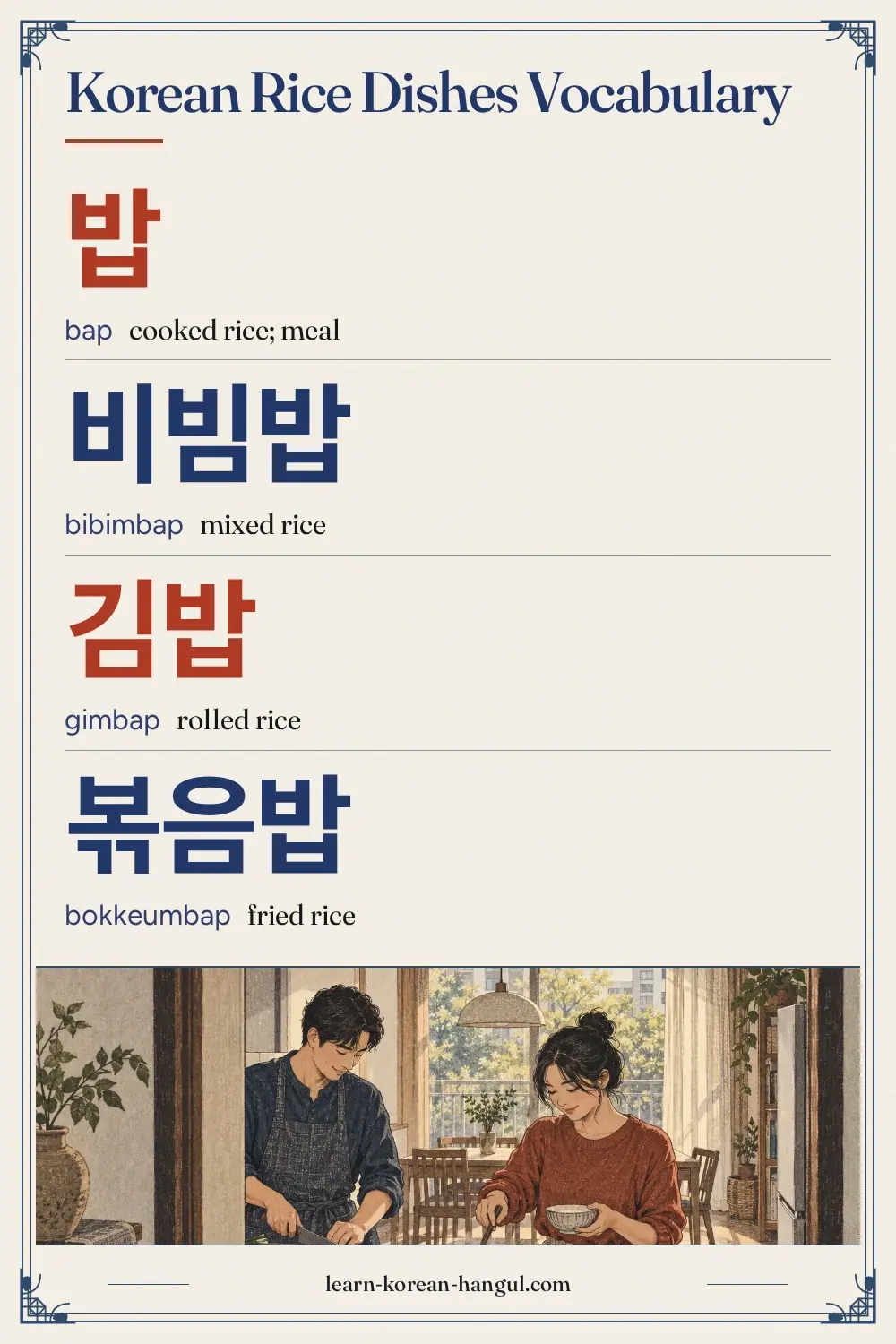
Korean Rice Dishes Vocabulary at a Glance
This list has 25 words in five groups of five. It starts with the words for plain rice, moves to mixed rice, rolled rice and fried rice, and ends with rice served under a topping or in soup. The page sits inside Korean Dishes, and the two best-known dishes also have their own single-word pages.
| Group | Words | Use |
|---|---|---|
| Plain rice and rice words | 5 | Naming raw rice, cooked rice and rice servings |
| Mixed rice | 5 | Naming bibimbap and what goes into it |
| Rolled rice | 5 | Naming gimbap and its portable cousins |
| Fried rice | 5 | Naming rice stir-fried or cooked with sauce |
| Rice with toppings | 5 | Naming rice served under a topping or in soup |
The ending 밥 is the key to the page. Once you see it, you know the dish is built on rice, and the part before it names the style: 비빔 (mixed), 김 (laver), 볶음 (fried), 덮 (covered) or 국 (soup). A new rice dish usually fits one of those five patterns.
Which Rice Dishes Should You Learn First?
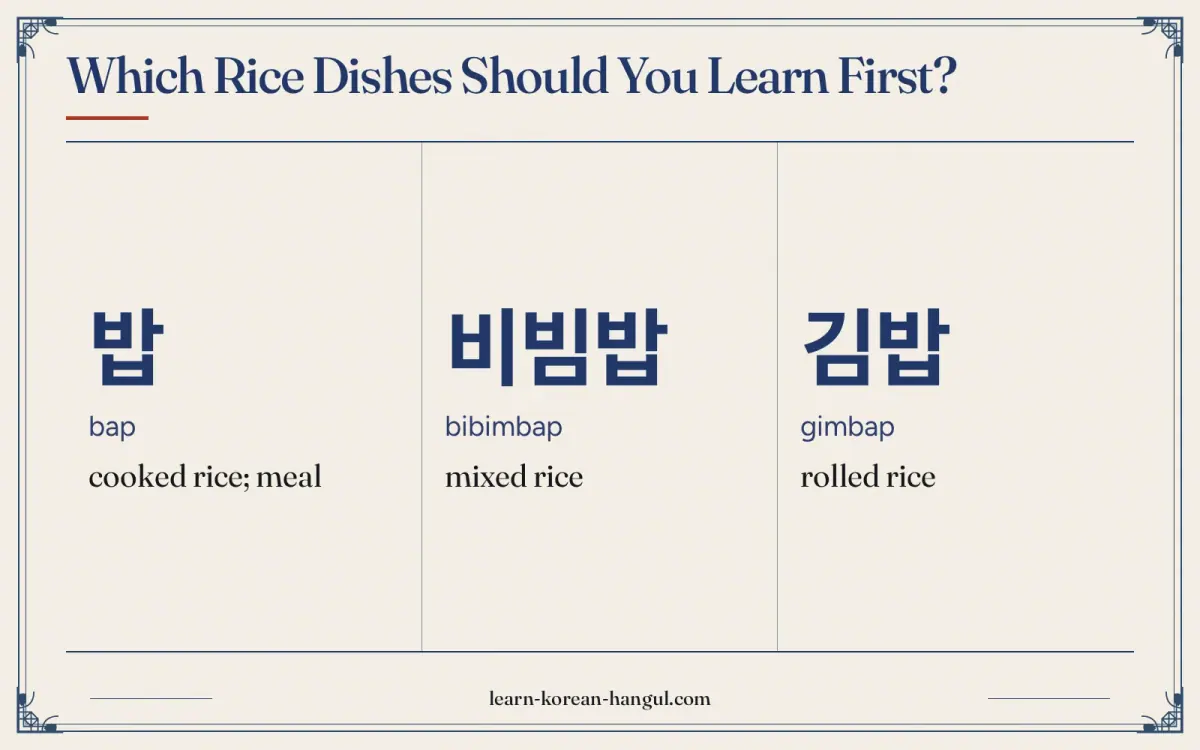
Learn 밥 (cooked rice or meal), 쌀 (uncooked rice), 비빔밥 (mixed rice), 김밥 (rolled rice) and 볶음밥 (fried rice) first. Together they cover the plain rice at every meal and the four rice dishes that visitors order most.
- Words to say. 밥, 비빔밥, 김밥, 볶음밥. You will say these at the table or in a shop.
- Words to recognise. 공깃밥, 덮밥, 국밥, 주먹밥. They appear on menus and in convenience stores.
- Words for ingredients. 고추장, 참기름. You will see them in a recipe for 비빔밥.
Rice is the centre of a Korean meal. Soup and side dishes are arranged around it, which is why the word for a meal is the same as the word for cooked rice.
Word · 8
- 1
밥
bap
cooked rice; meal
- 2
비빔밥
bibimbap
mixed rice
- 3
김밥
gimbap
rolled rice
- 4
볶음밥
bokkeumbap
fried rice
- 5
덮밥
deopbap
rice bowl with topping
- 6
공깃밥
gonggitbap
bowl of rice
- 7
고추장
gochujang
red chilli paste
- 8
돼지국밥
dwaejigukbap
pork rice soup
Plain Rice and Rice Words
Korean separates rice at each stage. 쌀 is the raw grain you buy in a bag, and 밥 is the same grain after cooking. A bowl of plain rice served with a meal is 공깃밥, from 공기 (a small bowl) plus 밥, with a linking ㅅ in the standard spelling; menus often write it 공기밥. New rice from the latest harvest is 햅쌀, and it is prized in autumn. 누룽지 is the crisp layer of rice that sticks to the pot.
| No. | Hangul | Revised Romanization | Meaning and note | Example sentence | Audio assetId |
|---|---|---|---|---|---|
| 1 | 쌀 | ssal | uncooked rice. The raw grain; sold by the bag. | 쌀을 씻어요. (I wash the rice.) | au-pg-vocabulary-food-korean-dishes-rice-dishes-1; example: au-pg-vocabulary-food-korean-dishes-rice-dishes-26 |
| 2 | 밥 | bap | cooked rice; meal. Cooked rice; also the general word for a meal. | 밥을 먹어요. (I eat rice.) | au-pg-vocabulary-food-korean-dishes-rice-dishes-2; example: au-pg-vocabulary-food-korean-dishes-rice-dishes-27 |
| 3 | 공깃밥 | gonggitbap | bowl of rice. Said [공기빱] or [공긷빱]. The standard spelling has a linking ㅅ; many menus write 공기밥. | 공깃밥 하나 추가해 주세요. (Please add one bowl of rice.) | au-pg-vocabulary-food-korean-dishes-rice-dishes-3; example: au-pg-vocabulary-food-korean-dishes-rice-dishes-28 |
| 4 | 햅쌀 | haepssal | new rice. Rice from the newest harvest, sold in autumn. | 햅쌀로 밥을 지어요. (I cook rice with new rice.) | au-pg-vocabulary-food-korean-dishes-rice-dishes-4; example: au-pg-vocabulary-food-korean-dishes-rice-dishes-29 |
| 5 | 누룽지 | nurungji | scorched rice. The crisp layer from the bottom of the pot; also eaten as a soup. | 누룽지를 먹어요. (I eat scorched rice.) | au-pg-vocabulary-food-korean-dishes-rice-dishes-5; example: au-pg-vocabulary-food-korean-dishes-rice-dishes-30 |
Keep the pair 쌀 and 밥 clear. If you say 쌀 when you want a meal, you are asking for raw rice. The verb 짓다 (to make or cook) goes with 밥 in the phrase 밥을 짓다, which means to cook rice. The polite present is 지어요 because 짓다 drops its ㅅ before a vowel.
Example Sentences
Three frames cover most of the examples. The first is noun + 을/를 + verb, as in 비빔밥을 좋아해요 (I like bibimbap) or 밥을 먹어요 (I eat rice). The second is noun + 은/는 + adjective, as in 돌솥비빔밥은 뜨거워요 (stone pot bibimbap is hot). The third is noun + 주세요 (please give me noun), as in 새우볶음밥 주세요. Play the audio, then say each sentence aloud before moving on to why 밥 also means a meal.
Why Does 밥 Also Mean a Meal?
In Korean, 밥 is both cooked rice and the general word for a meal, because rice was the centre of every meal. So 밥 먹었어요? can mean did you eat rice, but it really means did you have a meal. Koreans also use it as a friendly greeting, in the same way that English speakers say how are you. A typical reply is 네, 먹었어요 (yes, I have eaten) or 아직 안 먹었어요 (not yet).
The question is not an invitation, so you do not need to answer with details. It simply shows care for the other person. See the Korean greetings page for the other everyday openers and how to answer them. The verb is 먹다, and its polite past form is 먹었어요.
Mixed Rice
비빔밥 is rice mixed with vegetables, egg, meat and a spoonful of chilli paste. The first part, 비빔, comes from the verb 비비다 (to mix). You mix the bowl yourself just before eating, so every spoonful holds a bit of each ingredient. In a stone pot, 돌솥비빔밥, the rice crisps at the bottom, and the bowl arrives sizzling.
| No. | Hangul | Revised Romanization | Meaning and note | Example sentence | Audio assetId |
|---|---|---|---|---|---|
| 6 | 비빔밥 | bibimbap | mixed rice. Said [비빔빱]. Rice topped with vegetables, egg and chilli paste, mixed before eating. | 비빔밥을 좋아해요. (I like bibimbap.) | au-pg-vocabulary-food-korean-dishes-rice-dishes-6; example: au-pg-vocabulary-food-korean-dishes-rice-dishes-31 |
| 7 | 돌솥비빔밥 | dolsotbibimbap | stone pot bibimbap. Said [돌솓삐빔빱]. Bibimbap served in a hot stone pot; the rice crisps. | 돌솥비빔밥은 뜨거워요. (Stone pot bibimbap is hot.) | au-pg-vocabulary-food-korean-dishes-rice-dishes-7; example: au-pg-vocabulary-food-korean-dishes-rice-dishes-32 |
| 8 | 고추장 | gochujang | red chilli paste. A fermented chilli paste; sweet, salty and spicy. | 고추장을 넣어요. (I add chilli paste.) | au-pg-vocabulary-food-korean-dishes-rice-dishes-8; example: au-pg-vocabulary-food-korean-dishes-rice-dishes-33 |
| 9 | 참기름 | chamgireum | sesame oil. Toasted sesame oil, added at the end. | 참기름이 고소해요. (Sesame oil is nutty.) | au-pg-vocabulary-food-korean-dishes-rice-dishes-9; example: au-pg-vocabulary-food-korean-dishes-rice-dishes-34 |
| 10 | 비비다 | bibida | to mix. The verb behind 비빔밥; to mix by stirring. | 밥을 비벼요. (I mix the rice.) | au-pg-vocabulary-food-korean-dishes-rice-dishes-10; example: au-pg-vocabulary-food-korean-dishes-rice-dishes-35 |
Two sauces appear in nearly every recipe. 고추장 is the red chilli paste, and 참기름 is toasted sesame oil, which gives the nutty smell. Learn the pair, because they also appear in the cold-noodle and rolled-rice recipes. The dish is known abroad as bibimbap, and the single-word page on bibimbap in Korean goes into detail.
How Is Bibimbap Spelled in English?
You will see bibimbap, bibimbab and bibimbop on menus. They all try to write the Korean sounds in Latin letters. The Revised Romanization of Korean, the official system, gives bibimbap for 비빔밥, because it writes ㅂ as p at the end of a word and does not show tensing caused by a neighbouring sound, so the [빱] of the real pronunciation [비빔빱] is not shown.
| Form | Where you see it |
|---|---|
| bibimbap | Revised Romanization; most dictionaries |
| bibimbab | some menus, following the letter ㅂ |
| bibimbop | some older English-language menus |
The same pattern applies to 김밥. The Revised Romanization is gimbap, and the English spelling kimbap is also common. Use the Hangul when you search for a recipe, because the spelling is fixed there.
How Do You Say Rolled Rice in Korean?
김밥 is rice and fillings rolled in a sheet of laver (김) and sliced into rounds. The fillings usually include egg, pickled radish, carrot, spinach and ham, and a roll is the standard picnic and lunchbox food. Rolls are sold by the 줄 (line), so you ask for 김밥 한 줄 (one roll). A few relatives, such as 주먹밥, are rice that you shape by hand.
| No. | Hangul | Revised Romanization | Meaning and note | Example sentence | Audio assetId |
|---|---|---|---|---|---|
| 11 | 김밥 | gimbap | rolled rice. Said [김밥] or [김빱]; both are standard. Rice and fillings rolled in laver and sliced. | 김밥을 싸요. (I roll gimbap.) | au-pg-vocabulary-food-korean-dishes-rice-dishes-11; example: au-pg-vocabulary-food-korean-dishes-rice-dishes-36 |
| 12 | 참치김밥 | chamchigimbap | tuna gimbap. Said [참치김밥] or [참치김빱]. Gimbap filled with tuna and mayonnaise. | 참치김밥 한 줄 주세요. (One roll of tuna gimbap, please.) | au-pg-vocabulary-food-korean-dishes-rice-dishes-12; example: au-pg-vocabulary-food-korean-dishes-rice-dishes-37 |
| 13 | 충무김밥 | chungmugimbap | Chungmu gimbap. Said [충무김밥] or [충무김빱]. Small plain rolls served with spicy squid and radish on the side; Chungmu is the old name of Tongyeong. | 충무김밥은 반찬이 따로 나와요. (Chungmu gimbap comes with the side dishes separate.) | au-pg-vocabulary-food-korean-dishes-rice-dishes-13; example: au-pg-vocabulary-food-korean-dishes-rice-dishes-38 |
| 14 | 주먹밥 | jumeokbap | rice ball. Said [주먹빱]. Rice shaped by hand into a ball; named for the fist (주먹). | 주먹밥을 만들어요. (I make rice balls.) | au-pg-vocabulary-food-korean-dishes-rice-dishes-14; example: au-pg-vocabulary-food-korean-dishes-rice-dishes-39 |
| 15 | 삼각김밥 | samgakgimbap | triangle gimbap. Said [삼각김밥] or [삼각김빱]. Packaged triangular rice, sold in convenience stores. | 삼각김밥은 편의점에서 팔아요. (Triangle gimbap is sold in convenience stores.) | au-pg-vocabulary-food-korean-dishes-rice-dishes-15; example: au-pg-vocabulary-food-korean-dishes-rice-dishes-40 |
김밥 looks like sushi, but it is not the same dish. The rice is seasoned with sesame oil and salt, not vinegar, and the fillings are cooked or pickled rather than raw fish. Do not translate 김밥 as Korean sushi. For more on the word, see gimbap in Korean.
Fried Rice
볶음밥 is rice stir-fried in a pan with oil, vegetables and other ingredients. The word 볶음 means stir-frying, as in the side dishes, so the pattern is the same: ingredient + 볶음밥. 김치볶음밥 is the most common fried rice and is easy to make at home with leftover rice. The last two words in this group are dishes borrowed from Western and Japanese-style cooking: 오므라이스 and 카레라이스.
| No. | Hangul | Revised Romanization | Meaning and note | Example sentence | Audio assetId |
|---|---|---|---|---|---|
| 16 | 볶음밥 | bokkeumbap | fried rice. Said [보끔밥], often [보끔빱]. Rice stir-fried in a pan with oil and other ingredients. | 볶음밥을 만들어요. (I make fried rice.) | au-pg-vocabulary-food-korean-dishes-rice-dishes-16; example: au-pg-vocabulary-food-korean-dishes-rice-dishes-41 |
| 17 | 김치볶음밥 | gimchibokkeumbap | kimchi fried rice. Said [김치보끔밥], often [김치보끔빱]. Fried rice made with sour kimchi; often topped with a fried egg. | 김치볶음밥이 매워요. (The kimchi fried rice is spicy.) | au-pg-vocabulary-food-korean-dishes-rice-dishes-17; example: au-pg-vocabulary-food-korean-dishes-rice-dishes-42 |
| 18 | 새우볶음밥 | saeubokkeumbap | shrimp fried rice. Said [새우보끔밥], often [새우보끔빱]. Fried rice with shrimp and vegetables. | 새우볶음밥 주세요. (Shrimp fried rice, please.) | au-pg-vocabulary-food-korean-dishes-rice-dishes-18; example: au-pg-vocabulary-food-korean-dishes-rice-dishes-43 |
| 19 | 오므라이스 | omeuraiseu | omelette rice. Fried rice wrapped in a thin omelette with ketchup. | 오므라이스에 케첩을 뿌려요. (I put ketchup on the omelette rice.) | au-pg-vocabulary-food-korean-dishes-rice-dishes-19; example: au-pg-vocabulary-food-korean-dishes-rice-dishes-44 |
| 20 | 카레라이스 | kareraiseu | curry rice. Rice with a mild yellow curry sauce. | 카레라이스를 먹어요. (I eat curry rice.) | au-pg-vocabulary-food-korean-dishes-rice-dishes-20; example: au-pg-vocabulary-food-korean-dishes-rice-dishes-45 |
The two borrowed words end in 라이스, from the English word rice, and both reached Korea through Japanese cooking. They use 라이스 instead of 밥, so the ending tells you the dish has a foreign origin.
How Do You Say Rice with Toppings in Korean?
Some rice dishes are defined by what is on or in the rice. 덮밥 is rice covered with a topping, from 덮다 (to cover). Two common versions are 제육덮밥, with pork (제육) stir-fried in chilli sauce, and 회덮밥, with raw fish (회). 국밥 is rice served in a hot soup, a fast, filling meal that many shops sell all day.
| No. | Hangul | Revised Romanization | Meaning and note | Example sentence | Audio assetId |
|---|---|---|---|---|---|
| 21 | 덮밥 | deopbap | rice bowl with topping. Said [덥빱]. Rice covered with a topping in a single bowl. | 점심에 덮밥을 먹어요. (I eat a rice bowl for lunch.) | au-pg-vocabulary-food-korean-dishes-rice-dishes-21; example: au-pg-vocabulary-food-korean-dishes-rice-dishes-46 |
| 22 | 제육덮밥 | jeyukdeopbap | spicy pork rice bowl. Said [제육덥빱]. Rice topped with chilli-marinated stir-fried pork. | 제육덮밥을 시켜요. (I order a spicy pork rice bowl.) | au-pg-vocabulary-food-korean-dishes-rice-dishes-22; example: au-pg-vocabulary-food-korean-dishes-rice-dishes-47 |
| 23 | 회덮밥 | hoedeopbap | raw fish rice bowl. Said [회덥빱]. Rice topped with raw fish, vegetables and chilli sauce. | 회덮밥은 차가워요. (The raw fish rice bowl is cold.) | au-pg-vocabulary-food-korean-dishes-rice-dishes-23; example: au-pg-vocabulary-food-korean-dishes-rice-dishes-48 |
| 24 | 국밥 | gukbap | rice in soup. Said [국빱]. Rice served in a hot soup; a quick, filling meal. | 국밥 한 그릇 주세요. (One bowl of rice soup, please.) | au-pg-vocabulary-food-korean-dishes-rice-dishes-24; example: au-pg-vocabulary-food-korean-dishes-rice-dishes-49 |
| 25 | 돼지국밥 | dwaejigukbap | pork rice soup. Said [돼지국빱]. A pork bone soup with rice; a speciality of Busan. | 돼지국밥은 부산 음식이에요. (Pork rice soup is a Busan food.) | au-pg-vocabulary-food-korean-dishes-rice-dishes-25; example: au-pg-vocabulary-food-korean-dishes-rice-dishes-50 |
When 국밥 comes with the rice in a separate bowl, you tip the rice into the soup; the verb is 말다, as in 국에 밥을 말아요 (I put rice into the soup). 돼지국밥 is the pork version from the city of Busan. If you travel, you will find that every region has a different 국밥.
How Do You Pronounce These Words?
Many rice dish names make the 밥 at the end tense. After ㄱ, ㄷ or ㅂ sounds this is automatic (국밥 [국빱]); after ㅁ it is a property of each compound, so check the dictionary (비빔밥 [비빔빱], but 김밥 allows [김밥] or [김빱]). Standard pronunciation follows the National Institute of Korean Language (국립국어원) rules, and the romanization on this page follows the Revised Romanization of Korean, which does not mark every sound change.
| Spelling | Sounds like | What changes |
|---|---|---|
| 비빔밥 | [비빔빱] | After the final ㅁ, the ㅂ of 밥 is said as a tense [ㅃ]. |
| 김밥 | [김밥] or [김빱] | Both are standard; [김빱] was added as an accepted pronunciation. |
| 볶음밥 | [보끔밥] | The final ㄲ links to 음. Many speakers also make the ㅂ of 밥 tense, [보끔빱]. |
| 덮밥 | [덥빱] | Final ㅍ is said as [ㅂ], and the next ㅂ is tense [ㅃ]. |
| 국밥 | [국빱] | After a final ㄱ, the ㅂ of 밥 becomes tense. |
| 돌솥비빔밥 | [돌솓삐빔빱] | Final ㅌ in 솥 is said [ㄷ], so the ㅂ of 비 after it is tense [ㅃ]; the 밥 is tense as in 비빔밥. |
The tense [빱] in the ending 밥 is the sound learners most often miss. In words like 비빔밥 and 국밥, 밥 is said with a tight throat and no puff of air, so 비빔밥 sounds like bi-bim-ppap. Alone, 밥 is a plain [밥].
Audio and Slow Playback
Every word and every example sentence has its own clip. The five clips below replay the trickiest words slowly. Play one, repeat it aloud, then play it again and compare.
What Mistakes Do Learners Make with Rice Dishes?
These five mistakes come up most often with rice words.
- Mixing up 쌀 and 밥. 쌀 is uncooked rice, and 밥 is cooked rice or a meal. Ask for 공깃밥 at a restaurant, not 쌀.
- Saying the ending 밥 with a plain [ㅂ] in 비빔밥 or 국밥. In these words it is tense: [비빔빱], [국빱].
- Calling 김밥 sushi. The rice is seasoned with sesame oil and the fillings are cooked, so the taste is different.
- Forgetting to mix. 비빔밥 is eaten after you mix it. Leaving it unmixed is not wrong, but it misses the idea.
- Expecting 덮밥 to be soup. 덮밥 is rice with a topping, and 국밥 is rice in soup.
If you remember the five dish patterns and the tense sound at the end, you can read most rice menus. The next step is to drill the words.
Practice: Flashcards and Worksheet
Study in three steps. First, run the flashcard deck in recognition mode until you recognise each of the 25 words. Second, switch to listening mode. Third, take the quiz. Your progress stays in your browser, and the vocabulary flashcard decks page lists the other decks.
Practice · 55
- 01쌀
Show answer
headword 1: uncooked rice
- 02밥
Show answer
headword 2: cooked rice; meal
- 03공깃밥
Show answer
headword 3: bowl of rice
- 04햅쌀
Show answer
headword 4: new rice
- 05누룽지
Show answer
headword 5: scorched rice
- 06비빔밥
Show answer
headword 6: mixed rice
- 07돌솥비빔밥
Show answer
headword 7: stone pot bibimbap
- 08고추장
Show answer
headword 8: red chilli paste
- 09참기름
Show answer
headword 9: sesame oil
- 10비비다
Show answer
headword 10: to mix
- 11김밥
Show answer
headword 11: rolled rice
- 12참치김밥
Show answer
headword 12: tuna gimbap
- 13충무김밥
Show answer
headword 13: Chungmu gimbap
- 14주먹밥
Show answer
headword 14: rice ball
- 15삼각김밥
Show answer
headword 15: triangle gimbap
- 16볶음밥
Show answer
headword 16: fried rice
- 17김치볶음밥
Show answer
headword 17: kimchi fried rice
- 18새우볶음밥
Show answer
headword 18: shrimp fried rice
- 19오므라이스
Show answer
headword 19: omelette rice
- 20카레라이스
Show answer
headword 20: curry rice
- 21덮밥
Show answer
headword 21: rice bowl with topping
- 22제육덮밥
Show answer
headword 22: spicy pork rice bowl
- 23회덮밥
Show answer
headword 23: raw fish rice bowl
- 24국밥
Show answer
headword 24: rice in soup
- 25돼지국밥
Show answer
headword 25: pork rice soup
- 26쌀을 씻어요.
Show answer
example sentence for 쌀
- 27밥을 먹어요.
Show answer
example sentence for 밥
- 28공깃밥 하나 추가해 주세요.
Show answer
example sentence for 공깃밥
- 29햅쌀로 밥을 지어요.
Show answer
example sentence for 햅쌀
- 30누룽지를 먹어요.
Show answer
example sentence for 누룽지
- 31비빔밥을 좋아해요.
Show answer
example sentence for 비빔밥
- 32돌솥비빔밥은 뜨거워요.
Show answer
example sentence for 돌솥비빔밥
- 33고추장을 넣어요.
Show answer
example sentence for 고추장
- 34참기름이 고소해요.
Show answer
example sentence for 참기름
- 35밥을 비벼요.
Show answer
example sentence for 비비다
- 36김밥을 싸요.
Show answer
example sentence for 김밥
- 37참치김밥 한 줄 주세요.
Show answer
example sentence for 참치김밥
- 38충무김밥은 반찬이 따로 나와요.
Show answer
example sentence for 충무김밥
- 39주먹밥을 만들어요.
Show answer
example sentence for 주먹밥
- 40삼각김밥은 편의점에서 팔아요.
Show answer
example sentence for 삼각김밥
- 41볶음밥을 만들어요.
Show answer
example sentence for 볶음밥
- 42김치볶음밥이 매워요.
Show answer
example sentence for 김치볶음밥
- 43새우볶음밥 주세요.
Show answer
example sentence for 새우볶음밥
- 44오므라이스에 케첩을 뿌려요.
Show answer
example sentence for 오므라이스
- 45카레라이스를 먹어요.
Show answer
example sentence for 카레라이스
- 46점심에 덮밥을 먹어요.
Show answer
example sentence for 덮밥
- 47제육덮밥을 시켜요.
Show answer
example sentence for 제육덮밥
- 48회덮밥은 차가워요.
Show answer
example sentence for 회덮밥
- 49국밥 한 그릇 주세요.
Show answer
example sentence for 국밥
- 50돼지국밥은 부산 음식이에요.
Show answer
example sentence for 돼지국밥
- 51비빔밥
Show answer
slow playback: 비빔밥
- 52돌솥비빔밥
Show answer
slow playback: 돌솥비빔밥
- 53볶음밥
Show answer
slow playback: 볶음밥
- 54덮밥
Show answer
slow playback: 덮밥
- 55삼각김밥
Show answer
slow playback: 삼각김밥
Practice · 5
What does 쌀 (ssal) mean?
Show answer
uncooked rice
쌀 means uncooked rice. Example: 쌀을 씻어요. (I wash the rice.)
What does 비빔밥 (bibimbap) mean?
Show answer
mixed rice
비빔밥 means mixed rice. Example: 비빔밥을 좋아해요. (I like bibimbap.)
What does 김밥 (gimbap) mean?
Show answer
rolled rice
김밥 means rolled rice. Example: 김밥을 싸요. (I roll gimbap.)
What does 볶음밥 (bokkeumbap) mean?
Show answer
fried rice
볶음밥 means fried rice. Example: 볶음밥을 만들어요. (I make fried rice.)
What does 덮밥 (deopbap) mean?
Show answer
rice bowl with topping
덮밥 means rice bowl with topping. Example: 점심에 덮밥을 먹어요. (I eat a rice bowl for lunch.)
Korean Rice Dishes Vocabulary Worksheet (PDF)
A printable worksheet for these words (word list, matching, writing practice, fill-in-the-blank exercises and answer key) is available in A4 and US Letter from the download card on this page. For practice, copy the 25 words by hand and circle the 밥 ending in each dish name.
Where to Go Next
Once the Korean rice dishes vocabulary on this page feels familiar, continue with Korean BBQ Vocabulary, where fried rice is the closing dish of the meal. For the single words, see bibimbap in Korean and gimbap in Korean. To move up a level, return to Korean Dishes.
Frequently Asked Questions
How Do You Say Rice in Korean?
Cooked rice is 밥 (bap), and uncooked rice is 쌀 (ssal). 밥 is also the general word for a meal. A single bowl of plain rice at a restaurant is 공깃밥 (gonggitbap). To ask for one, say 공깃밥 하나 주세요 (one bowl of rice, please).
What Is the Difference between Bibimbap and Gimbap?
비빔밥 (bibimbap) is a bowl of rice topped with vegetables, egg and chilli paste, mixed before eating. 김밥 (gimbap) is rice and fillings rolled in laver and sliced into rounds. One is eaten with a spoon, and the other is eaten by hand or with chopsticks.
How Do You Pronounce 비빔밥 (bibimbap)?
Say bi-bim-bap, but make the last syllable tense: [비빔빱]. In this word the ㅂ of 밥 is said tight, with no puff of air, even though the romanization bibimbap does not show it. Press the slow audio button on this page, repeat after it and compare.
Where Can I Practise Rice Dish Words with Flashcards?
Use the vocabulary flashcard decks. The deck for this page holds all 25 words with Hangul, romanization and audio, in recognition and listening modes. Your progress stays in your browser, so you can return daily and review the cards you missed.
Is the Romanization on This Page Official?
It follows the Revised Romanization of Korean, which South Korea adopted on 7 July 2000 and whose rules the National Institute of Korean Language (국립국어원) publishes. It is a learning aid and does not mark every sound change, so rely on the Hangul and the audio.
Is There a Printable Worksheet for Rice Dish Words?
A printable worksheet for these words (word list, matching, writing practice, fill-in-the-blank exercises and answer key) is available in A4 and US Letter from the download card on this page. For practice, copy the tables on this page by hand or use the flashcard deck, which carries the same 25 words.