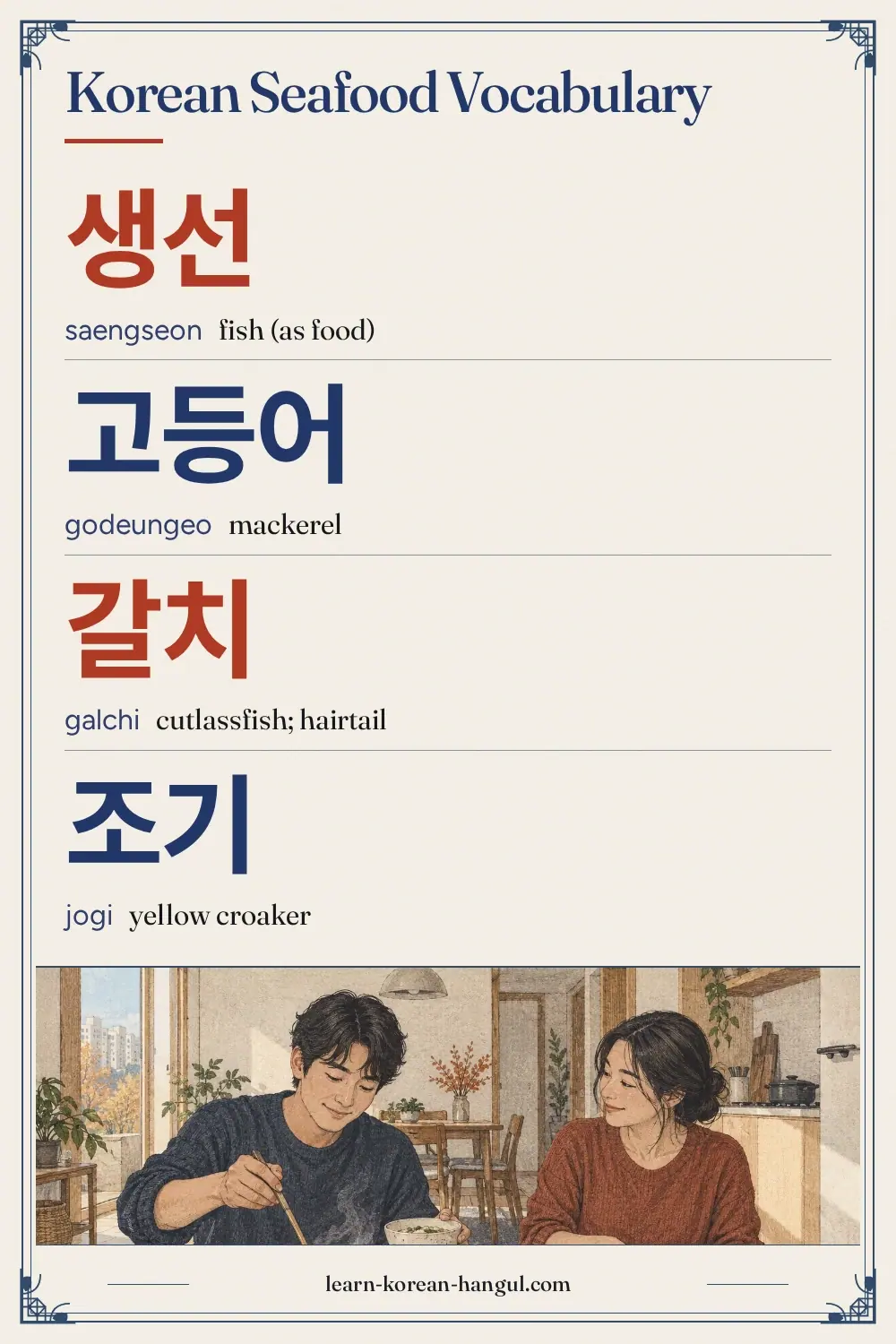
Korean Seafood Vocabulary at a Glance
This list has 30 words in five groups. It belongs to Ingredients. The groups follow the market: fish, shellfish, squid and octopus, seaweed and the raw-fish counter. Seafood is a large part of the Korean diet, and the language has many specific names, so a general word is often not enough at a market.
| Group | Words | Use |
|---|---|---|
| Fish | 10 | Fish names, including the pollock family |
| Shellfish | 6 | Shrimp, crab, clams and oysters |
| Squid and octopus | 4 | Cephalopods |
| Seaweed | 5 | Laver, sea mustard and kelp |
| Raw fish and fish market | 5 | Raw fish and market words |
Because several seafood names have no shared root, this is mostly a memory list. Learn them in their groups, and pair each name with its dish: 고등어 with grilled fish, 미역 with birthday soup and 오징어 with a dried snack.
Which Seafood Words Should You Learn First?
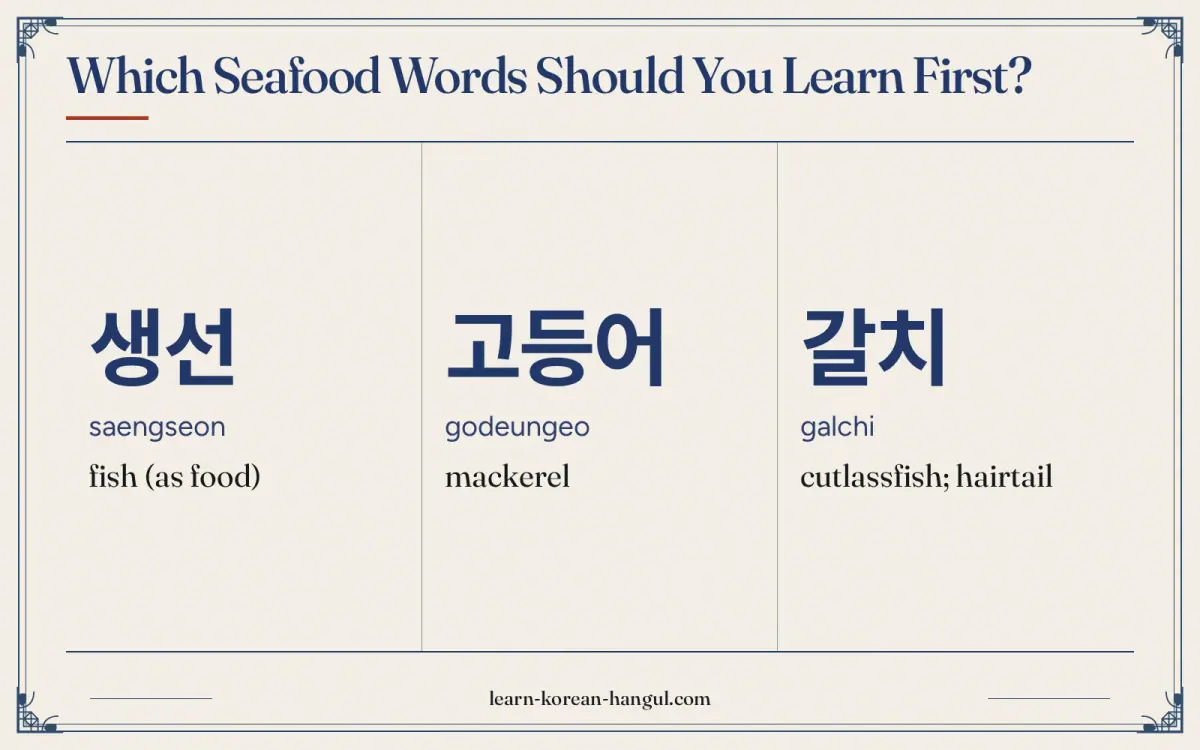
Learn 생선, 새우, 오징어, 김 and 회 first. They cover fish, shellfish, squid, seaweed and raw fish, one from each group. The sentence 생선을 구워요 (I grill fish) uses the first with a common cooking verb.
- Words to say. 생선, 새우, 오징어, 김, 회. Use them when you shop, cook or order.
- Words to recognise. 고등어, 갈치, 미역, 낙지, 수산시장. They appear on menus and market signs.
- Words that explain a menu. 명태, 동태, 북어 and 황태 are all pollock, at different stages.
Seafood is also a common allergy group. Learn 새우 and 조개 early, and use the restaurant phrases page for the full request. The scene below shows a fish market with numbered objects that match the list.
Word · 24
- 1
생선
saengseon
fish (as food)
- 2
고등어
godeungeo
mackerel
- 3
갈치
galchi
cutlassfish; hairtail
- 4
조기
jogi
yellow croaker
- 5
연어
yeoneo
salmon
- 6
참치
chamchi
tuna
- 7
명태
myeongtae
pollock
- 8
동태
dongtae
frozen pollock
- 9
북어
bugeo
dried pollock
- 10
황태
hwangtae
yellow pollock; winter-dried pollock
- 11
새우
saeu
shrimp; prawn
- 12
게
ge
crab
- 13
꽃게
kkotge
blue crab; swimming crab
- 14
조개
jogae
clam; shellfish
- 15
굴
gul
oyster
- 16
전복
jeonbok
abalone
- 17
오징어
ojingeo
squid
- 18
낙지
nakji
small octopus
- 19
문어
muneo
octopus (large)
- 20
주꾸미
jukkumi
webfoot octopus
- 21
김
gim
seaweed; laver
- 22
미역
miyeok
sea mustard; brown seaweed
- 23
다시마
dasima
kelp
- 24
파래
parae
green laver
Fish
Fish words come in two layers. 생선 is fish as food, and 물고기 is fish as a living animal. Then each species has its own name. The most unusual case is pollock, one fish that has four different Korean names depending on how it has been processed. This group teaches the general word, five common species and the four pollock names.
| No. | Hangul | Revised Romanization | Meaning and note | Example sentence | Audio assetId |
|---|---|---|---|---|---|
| 1 | 생선 | saengseon | fish (as food). The animal is 물고기. | 생선을 구워요. (I grill fish.) | au-pg-vocabulary-food-ingredients-seafood-1; example: au-pg-vocabulary-food-ingredients-seafood-31 |
| 2 | 고등어 | godeungeo | mackerel. Usually grilled or braised. | 고등어구이를 먹어요. (I eat grilled mackerel.) | au-pg-vocabulary-food-ingredients-seafood-2; example: au-pg-vocabulary-food-ingredients-seafood-32 |
| 3 | 갈치 | galchi | cutlassfish; hairtail. A long silver fish. | 갈치조림을 좋아해요. (I like braised cutlassfish.) | au-pg-vocabulary-food-ingredients-seafood-3; example: au-pg-vocabulary-food-ingredients-seafood-33 |
| 4 | 조기 | jogi | yellow croaker. Counted by the fish with 마리. | 조기 한 마리 주세요. (One yellow croaker, please.) | au-pg-vocabulary-food-ingredients-seafood-4; example: au-pg-vocabulary-food-ingredients-seafood-34 |
| 5 | 연어 | yeoneo | salmon. Said [여너]; the ㄴ joins the next vowel. | 연어는 분홍색이에요. (Salmon is pink.) | au-pg-vocabulary-food-ingredients-seafood-5; example: au-pg-vocabulary-food-ingredients-seafood-35 |
| 6 | 참치 | chamchi | tuna. Popular in canned form and in gimbap. | 참치 김밥을 먹어요. (I eat tuna gimbap.) | au-pg-vocabulary-food-ingredients-seafood-6; example: au-pg-vocabulary-food-ingredients-seafood-36 |
| 7 | 명태 | myeongtae | pollock. The species name; fresh pollock is also sold as 생태. | 명태는 바다에서 잡아요. (Pollock is caught at sea.) | au-pg-vocabulary-food-ingredients-seafood-7; example: au-pg-vocabulary-food-ingredients-seafood-37 |
| 8 | 동태 | dongtae | frozen pollock. 동 means frozen. | 동태는 얼린 명태예요. (Dongtae is frozen pollock.) | au-pg-vocabulary-food-ingredients-seafood-8; example: au-pg-vocabulary-food-ingredients-seafood-38 |
| 9 | 북어 | bugeo | dried pollock. Said [부거]. Dried hard, used in soup. | 북어는 말린 명태예요. (Bugeo is dried pollock.) | au-pg-vocabulary-food-ingredients-seafood-9; example: au-pg-vocabulary-food-ingredients-seafood-39 |
| 10 | 황태 | hwangtae | yellow pollock; winter-dried pollock. Dried outdoors in winter so it turns yellow. | 황태국을 끓여요. (I boil hwangtae soup.) | au-pg-vocabulary-food-ingredients-seafood-10; example: au-pg-vocabulary-food-ingredients-seafood-40 |
One fish, four names: 명태 is the fish itself, 동태 is the frozen one, 북어 is the dried one and 황태 is the one dried through freezing and thawing outdoors. The names mark processing stages, so a shopper who asks for 명태 and gets 동태 has not been misled. Names for individual sea animals such as whales and sharks are on the sea animals page.
Example Sentences
Three frames carry most of the examples. The first is seafood + 을/를 + cooking verb, as in 생선을 구워요 (I grill fish). The second is seafood + 은/는 + description, as in 굴은 겨울이 제철이에요 (oysters are in season in winter). The third is dish + 을/를 + 먹어요, as in 전복죽을 먹어요 (I eat abalone porridge). Say each aloud after the audio and swap in another seafood. Use 을 after a consonant (생선을) and 를 after a vowel (새우를).
How Do You Say Shellfish in Korean?
Shellfish words are short and common. 새우 (shrimp) and 게 (crab) are single-meaning words, while 조개 covers clams and many other shelled animals. Shellfish is also a common allergy group, so these words matter on menus. Seafood stews use most of them.
| No. | Hangul | Revised Romanization | Meaning and note | Example sentence | Audio assetId |
|---|---|---|---|---|---|
| 11 | 새우 | saeu | shrimp; prawn. Counted by the animal with 마리. | 새우를 까요. (I peel the shrimp.) | au-pg-vocabulary-food-ingredients-seafood-11; example: au-pg-vocabulary-food-ingredients-seafood-41 |
| 12 | 게 | ge | crab. A single syllable, said clearly with ㅔ. | 게를 쪄요. (I steam the crab.) | au-pg-vocabulary-food-ingredients-seafood-12; example: au-pg-vocabulary-food-ingredients-seafood-42 |
| 13 | 꽃게 | kkotge | blue crab; swimming crab. Said [꼳께]. Used in stew and in soy-marinated crab (간장게장). | 꽃게탕을 먹어요. (I eat blue crab stew.) | au-pg-vocabulary-food-ingredients-seafood-13; example: au-pg-vocabulary-food-ingredients-seafood-43 |
| 14 | 조개 | jogae | clam; shellfish. A general word for bivalves. | 조개가 입을 벌려요. (The clams open their shells.) | au-pg-vocabulary-food-ingredients-seafood-14; example: au-pg-vocabulary-food-ingredients-seafood-44 |
| 15 | 굴 | gul | oyster. In season in winter. | 굴은 겨울이 제철이에요. (Oysters are in season in winter.) | au-pg-vocabulary-food-ingredients-seafood-15; example: au-pg-vocabulary-food-ingredients-seafood-45 |
| 16 | 전복 | jeonbok | abalone. Used in porridge and as a gift. | 전복죽을 먹어요. (I eat abalone porridge.) | au-pg-vocabulary-food-ingredients-seafood-16; example: au-pg-vocabulary-food-ingredients-seafood-46 |
게 and 굴 are short, but they are easy to mishear. Say 게 with a clear ㅔ vowel, as in egg, and 굴 with a closed ㅜ, as in goose. The word 굴 also means cave or tunnel, but the shop and menu context makes the meaning plain.
Squid and Octopus
Squid and octopus are a distinct group in Korean cooking. 오징어 is the squid, usually dried or grilled. 낙지 is a small long-armed octopus eaten stir-fried or even raw, 주꾸미 is a smaller type, and 문어 is the large octopus. Telling them apart matters because each is cooked a different way.
| No. | Hangul | Revised Romanization | Meaning and note | Example sentence | Audio assetId |
|---|---|---|---|---|---|
| 17 | 오징어 | ojingeo | squid. Dried squid is a common snack. | 오징어를 말려요. (I dry the squid.) | au-pg-vocabulary-food-ingredients-seafood-17; example: au-pg-vocabulary-food-ingredients-seafood-47 |
| 18 | 낙지 | nakji | small octopus. Said [낙찌]. Long thin arms; eaten stir-fried, or raw as 산낙지. | 낙지볶음을 시켜요. (I order stir-fried octopus.) | au-pg-vocabulary-food-ingredients-seafood-18; example: au-pg-vocabulary-food-ingredients-seafood-48 |
| 19 | 문어 | muneo | octopus (large). Said [무너]. Boiled and sliced. | 문어는 다리가 여덟 개예요. (An octopus has eight legs.) | au-pg-vocabulary-food-ingredients-seafood-19; example: au-pg-vocabulary-food-ingredients-seafood-49 |
| 20 | 주꾸미 | jukkumi | webfoot octopus. A small spring seafood. | 주꾸미는 작아요. (The webfoot octopus is small.) | au-pg-vocabulary-food-ingredients-seafood-20; example: au-pg-vocabulary-food-ingredients-seafood-50 |
In Korean the squid and octopus names do not share a root, so you must learn them one by one. The word 오징어 also appears in the title of the TV drama 오징어 게임 (Squid Game).
How Do You Say Seaweed in Korean?
Seaweed is a daily food in Korea, not a garnish. 김 is the dried laver sheet, 미역 is the soft sea mustard used in soup, and 다시마 is the thick kelp used for stock. Each has a different job in the kitchen, so the three words are worth learning together.
| No. | Hangul | Revised Romanization | Meaning and note | Example sentence | Audio assetId |
|---|---|---|---|---|---|
| 21 | 김 | gim | seaweed; laver. Dried sheets for gimbap and as a side dish. Also a common family name. | 김에 밥을 싸요. (I wrap rice in laver.) | au-pg-vocabulary-food-ingredients-seafood-21; example: au-pg-vocabulary-food-ingredients-seafood-51 |
| 22 | 미역 | miyeok | sea mustard; brown seaweed. Eaten in soup on a birthday. | 미역국을 끓여요. (I boil seaweed soup.) | au-pg-vocabulary-food-ingredients-seafood-22; example: au-pg-vocabulary-food-ingredients-seafood-52 |
| 23 | 다시마 | dasima | kelp. Thick and used for stock. | 다시마로 국물을 내요. (I make broth with kelp.) | au-pg-vocabulary-food-ingredients-seafood-23; example: au-pg-vocabulary-food-ingredients-seafood-53 |
| 24 | 파래 | parae | green laver. Tossed as a side dish. | 파래무침을 먹어요. (I eat seasoned green laver.) | au-pg-vocabulary-food-ingredients-seafood-24; example: au-pg-vocabulary-food-ingredients-seafood-54 |
| 25 | 해초 | haecho | sea plant; seaweed (general). Used for seaweed in a general sense. | 해초 샐러드를 먹어요. (I eat seaweed salad.) | au-pg-vocabulary-food-ingredients-seafood-25; example: au-pg-vocabulary-food-ingredients-seafood-55 |
미역국 (seaweed soup) is traditionally eaten on a birthday and by new mothers, which makes 미역 one of the most culturally loaded food words. The word 김 is also the name of the most common Korean family name, so context separates laver from a person called Kim.
Raw Fish and Fish Market
A fish market visit has its own words. 회 is raw fish, sliced and eaten with sauce. 활어 is live fish, which is sold in tanks and chosen by the customer. A 횟집 is a restaurant for raw fish, and a 수산시장 is the fish market itself. 어묵 is the processed fish cake that you find at street stalls.
| No. | Hangul | Revised Romanization | Meaning and note | Example sentence | Audio assetId |
|---|---|---|---|---|---|
| 26 | 회 | hoe | raw fish; sashimi. Dipped in 초장 (vinegar chili paste) or in soy sauce with wasabi. | 회를 먹어요. (I eat raw fish.) | au-pg-vocabulary-food-ingredients-seafood-26; example: au-pg-vocabulary-food-ingredients-seafood-56 |
| 27 | 활어 | hwareo | live fish. Said [화러]. Seen in tanks at the market. | 활어는 살아 있는 생선이에요. (활어 is fish that is still alive.) | au-pg-vocabulary-food-ingredients-seafood-27; example: au-pg-vocabulary-food-ingredients-seafood-57 |
| 28 | 횟집 | hoejip | raw fish restaurant. Said [회찝]; the ㅅ in the spelling (사이시옷) makes the ㅈ tense. | 횟집에 가요. (I go to a raw fish restaurant.) | au-pg-vocabulary-food-ingredients-seafood-28; example: au-pg-vocabulary-food-ingredients-seafood-58 |
| 29 | 수산시장 | susansijang | fish market. 수산 (marine products) + 시장 (market). | 수산시장에서 생선을 사요. (I buy fish at the fish market.) | au-pg-vocabulary-food-ingredients-seafood-29; example: au-pg-vocabulary-food-ingredients-seafood-59 |
| 30 | 어묵 | eomuk | fish cake. Served on skewers in soup at street stalls. | 어묵 국물을 마셔요. (I drink the fish cake broth.) | au-pg-vocabulary-food-ingredients-seafood-30; example: au-pg-vocabulary-food-ingredients-seafood-60 |
Note that 회 is one syllable, said close to 'hweh', because most speakers pronounce ㅚ as the diphthong [we]. The same 회 appears in 육회 (raw beef) on the Korean Meat Vocabulary page, where it means raw dish.
How Do You Pronounce These Words?
Seafood words contain linking, nasal and tense sounds. Standard pronunciation follows the National Institute of Korean Language (국립국어원) rules, and the romanization follows the Revised Romanization of Korean, which writes the sound you hear in some cases and the spelling in others.
| Spelling | Sounds like | What changes |
|---|---|---|
| 연어 | [여너] | The final ㄴ of 연 links to the vowel of 어. |
| 북어 | [부거] | The final ㄱ of 북 links to the vowel of 어. |
| 꽃게 | [꼳께] | The final ㅊ is said [ㄷ], and the ㄱ after it becomes tense [ㄲ]. |
| 낙지 | [낙찌] | The ㅈ after a final ㄱ becomes a tense [ㅉ]. |
| 활어 | [화러] | The final ㄹ of 활 links to the vowel of 어. |
Five of the hardest words here share a pattern: a final consonant in the first syllable meets a vowel or consonant in the next. Say them as a chain, not syllable by syllable. 연어 is yeo-neo, not yeon-eo.
Audio and Slow Playback
Each word and sentence has its own clip. The five clips below replay the hardest words slowly. Play one, repeat it aloud, then play it again and compare.
What Mistakes Do Learners Make with Seafood Words?
Five mistakes appear often.
- Using 물고기 on a menu. 물고기 is a live fish. As food, say 생선.
- Reading 연어 as yeon-eo. It sounds like yeo-neo, because the final ㄴ moves to the next syllable.
- Treating 명태, 동태, 북어 and 황태 as four fish. They are one fish: the species name and its frozen, dried and winter-dried forms.
- Mixing 오징어 and 낙지. 오징어 is squid, and 낙지 is a small octopus. The cooking methods differ.
- Thinking 김 is only a name. 김 is also laver, which is the dried seaweed sheet used in gimbap.
Keeping the stage names apart saves the most confusion. For single words, see fish in Korean.
Practice: Flashcards and Worksheet
Study in three steps. First, run the flashcard deck in recognition mode until you recognise all 30 words. Second, switch to listening mode. Third, take the quiz. The deck holds all 30 words with audio, and your progress stays in your browser. The vocabulary flashcard decks page lists the other decks.
Practice · 65
- 01생선
Show answer
headword 1: fish (as food)
- 02고등어
Show answer
headword 2: mackerel
- 03갈치
Show answer
headword 3: cutlassfish; hairtail
- 04조기
Show answer
headword 4: yellow croaker
- 05연어
Show answer
headword 5: salmon
- 06참치
Show answer
headword 6: tuna
- 07명태
Show answer
headword 7: pollock
- 08동태
Show answer
headword 8: frozen pollock
- 09북어
Show answer
headword 9: dried pollock
- 10황태
Show answer
headword 10: yellow pollock; winter-dried pollock
- 11새우
Show answer
headword 11: shrimp; prawn
- 12게
Show answer
headword 12: crab
- 13꽃게
Show answer
headword 13: blue crab; swimming crab
- 14조개
Show answer
headword 14: clam; shellfish
- 15굴
Show answer
headword 15: oyster
- 16전복
Show answer
headword 16: abalone
- 17오징어
Show answer
headword 17: squid
- 18낙지
Show answer
headword 18: small octopus
- 19문어
Show answer
headword 19: octopus (large)
- 20주꾸미
Show answer
headword 20: webfoot octopus
- 21김
Show answer
headword 21: seaweed; laver
- 22미역
Show answer
headword 22: sea mustard; brown seaweed
- 23다시마
Show answer
headword 23: kelp
- 24파래
Show answer
headword 24: green laver
- 25해초
Show answer
headword 25: sea plant; seaweed (general)
- 26회
Show answer
headword 26: raw fish; sashimi
- 27활어
Show answer
headword 27: live fish
- 28횟집
Show answer
headword 28: raw fish restaurant
- 29수산시장
Show answer
headword 29: fish market
- 30어묵
Show answer
headword 30: fish cake
- 31생선을 구워요.
Show answer
example for 생선
- 32고등어구이를 먹어요.
Show answer
example for 고등어
- 33갈치조림을 좋아해요.
Show answer
example for 갈치
- 34조기 한 마리 주세요.
Show answer
example for 조기
- 35연어는 분홍색이에요.
Show answer
example for 연어
- 36참치 김밥을 먹어요.
Show answer
example for 참치
- 37명태는 바다에서 잡아요.
Show answer
example for 명태
- 38동태는 얼린 명태예요.
Show answer
example for 동태
- 39북어는 말린 명태예요.
Show answer
example for 북어
- 40황태국을 끓여요.
Show answer
example for 황태
- 41새우를 까요.
Show answer
example for 새우
- 42게를 쪄요.
Show answer
example for 게
- 43꽃게탕을 먹어요.
Show answer
example for 꽃게
- 44조개가 입을 벌려요.
Show answer
example for 조개
- 45굴은 겨울이 제철이에요.
Show answer
example for 굴
- 46전복죽을 먹어요.
Show answer
example for 전복
- 47오징어를 말려요.
Show answer
example for 오징어
- 48낙지볶음을 시켜요.
Show answer
example for 낙지
- 49문어는 다리가 여덟 개예요.
Show answer
example for 문어
- 50주꾸미는 작아요.
Show answer
example for 주꾸미
- 51김에 밥을 싸요.
Show answer
example for 김
- 52미역국을 끓여요.
Show answer
example for 미역
- 53다시마로 국물을 내요.
Show answer
example for 다시마
- 54파래무침을 먹어요.
Show answer
example for 파래
- 55해초 샐러드를 먹어요.
Show answer
example for 해초
- 56회를 먹어요.
Show answer
example for 회
- 57활어는 살아 있는 생선이에요.
Show answer
example for 활어
- 58횟집에 가요.
Show answer
example for 횟집
- 59수산시장에서 생선을 사요.
Show answer
example for 수산시장
- 60어묵 국물을 마셔요.
Show answer
example for 어묵
- 61꽃게
Show answer
slow playback: 꽃게
- 62낙지
Show answer
slow playback: 낙지
- 63활어
Show answer
slow playback: 활어
- 64황태
Show answer
slow playback: 황태
- 65주꾸미
Show answer
slow playback: 주꾸미
Practice · 6
What does 생선 (saengseon) mean?
Show answer
fish (as food)
생선 means fish (as food). Example: 생선을 구워요. (I grill fish.)
What does 참치 (chamchi) mean?
Show answer
tuna
참치 means tuna. Example: 참치 김밥을 먹어요. (I eat tuna gimbap.)
What does 새우 (saeu) mean?
Show answer
shrimp; prawn
새우 means shrimp; prawn. Example: 새우를 까요. (I peel the shrimp.)
What does 전복 (jeonbok) mean?
Show answer
abalone
전복 means abalone. Example: 전복죽을 먹어요. (I eat abalone porridge.)
What does 김 (gim) mean?
Show answer
seaweed; laver
김 means seaweed; laver. Example: 김에 밥을 싸요. (I wrap rice in laver.)
What does 회 (hoe) mean?
Show answer
raw fish; sashimi
회 means raw fish; sashimi. Example: 회를 먹어요. (I eat raw fish.)
Korean Seafood Vocabulary Worksheet (PDF)
A printable worksheet for these words (word list, matching, writing practice, fill-in-the-blank exercises and answer key) is available in A4 and US Letter from the download card on this page. For practice, pick five seafood words and write the dish you would cook with each.
Where to Go Next
Once this Korean seafood vocabulary feels familiar, add the seasonings that go with it. After this page, continue with Korean Spices and Sauces Vocabulary. Go back to Korean Meat Vocabulary for the other protein list. To move up a level, return to Ingredients.
Frequently Asked Questions
How Do You Say Fish in Korean?
Fish as food is 생선 (saengseon), and a fish as an animal is 물고기 (mulgogi). In a market or restaurant you hear 생선. A particular fish has its own name, such as 고등어 (mackerel). The single-word page on fish in Korean has more.
How Do You Say Shrimp and Crab in Korean?
Shrimp is 새우 (saeu) and crab is 게 (ge). A blue crab used in stew is 꽃게. These words also matter for allergy requests, so learn them early and check the restaurant phrases page for full sentences.
Why Does Pollock Have Four Names in Korean?
Korean names the fish by how it has been processed. 명태 is the species, 동태 is frozen, 북어 is dried and 황태 is dried outdoors in winter. The names matter in soups and stews, where each gives a different taste and texture.
What Is the Difference between 김 and 미역?
김 is dried laver, sold in thin sheets for gimbap and side dishes. 미역 is sea mustard, soft and used in soup. 다시마 is kelp, thick and used for stock. All three are seaweed, but each has its own cooking use.
What Is 회?
회 is raw fish, usually sliced and eaten with sauce. A restaurant that serves it is a 횟집. The same 회 can also name other raw dishes, such as 육회 (raw beef). Say it in one beat.
Is the Romanization on This Page Official?
It follows the Revised Romanization of Korean, which South Korea adopted on 7 July 2000 and whose rules the National Institute of Korean Language (국립국어원) publishes. It is a learning aid, so rely on the Hangul and the audio.