Korean Wild Animals Vocabulary at a Glance
Wild animals are useful for zoo visits, nature films, children's books and talk about Korean mountains. Most names are native Korean words of two or three syllables, such as 코끼리, 원숭이 and 다람쥐. A few are English loanwords, such as 치타 (cheetah) and 고릴라 (gorilla).
The words are arranged by where you meet the animal. The predators come first, then the animals of the forest, then the savanna and zoo animals, and last the reptiles and the amphibian 개구리. The pages on pets and farm animals cover the animals that live with people.
The list holds 30 words. By origin, the list has 19 native, 6 Sino-Korean, 3 loanword and 2 mixed words. "Mixed" means a word that combines parts of different origins: 표범 joins Sino-Korean 표 (豹, leopard) and native 범 (tiger), and 호랑이 joins 호랑 (虎狼) with the native ending 이. The loanwords stay close to the English sound.
| Group | Words | Examples |
|---|---|---|
| Big cats and predators | 8 | 호랑이, 사자, 표범, 치타 |
| Forest animals | 8 | 사슴, 다람쥐, 멧돼지, 고라니 |
| Savanna and zoo animals | 8 | 코끼리, 기린, 원숭이, 얼룩말 |
| Reptiles | 6 | 뱀, 거북이, 악어, 도마뱀 |
This page expands the wild animals group of Animals. The other lists in the same section are Korean Pets Vocabulary and Korean Farm Animals Vocabulary.
Which Wild Animal Names Should You Learn First?
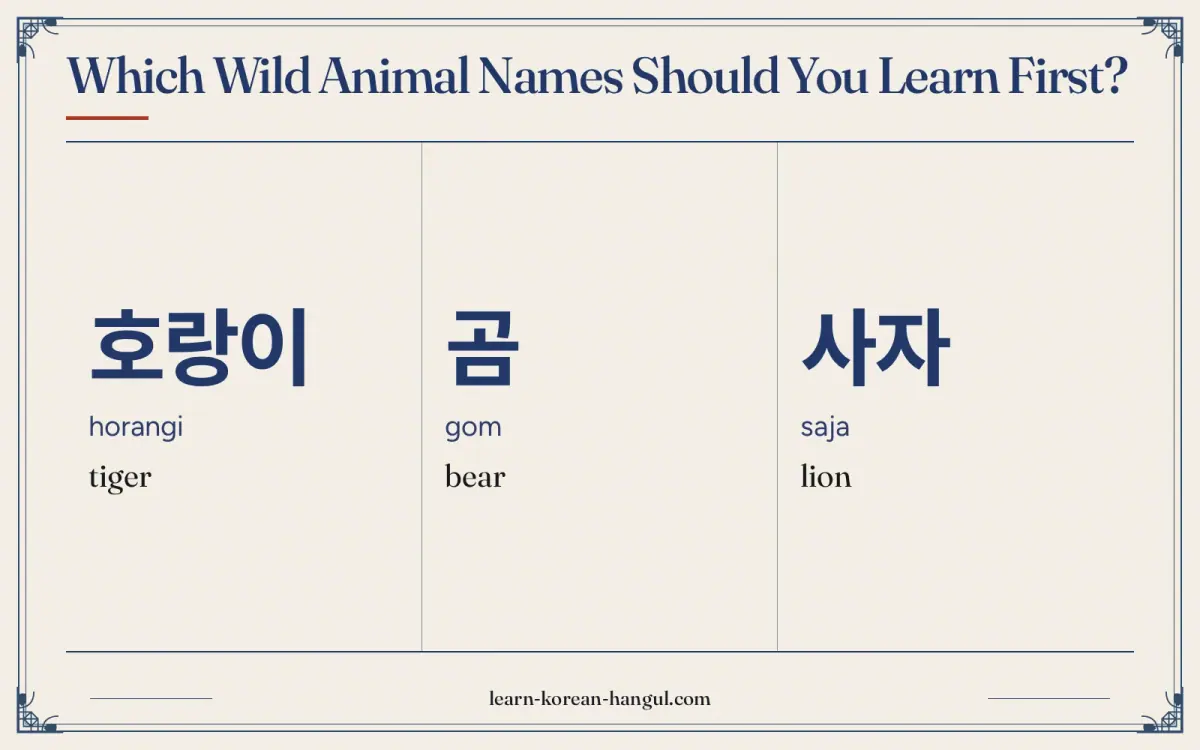
Start with five animals that appear in nearly every zoo trip and picture book: 호랑이, 곰, 사자, 코끼리 and 원숭이. Use the scene to see eight animals at once, then press play and the slow button on each of the five and say the word aloud.
Word · 8
- 1
호랑이
horangi
tiger
- 2
곰
gom
bear
- 3
사자
saja
lion
- 4
코끼리
kokkiri
elephant
- 5
기린
girin
giraffe
- 6
원숭이
wonsungi
monkey
- 7
뱀
baem
snake
- 8
다람쥐
daramjwi
squirrel
호랑이 (horangi) means tiger. The word has three syllables and ends in a clear 이. In Korean folk tales the tiger is a favourite character. Example: 호랑이는 한국 이야기에 자주 나와요. (Tigers often appear in Korean stories.)
곰 (gom) means bear. The word is one syllable and ends in ㅁ. Said alone it is gom with lips closed at the end. Example: 곰이 겨울잠을 자요. (The bear hibernates.)
사자 (saja) means lion. Example: 사자는 동물원에 있어요. (The lion is at the zoo.)
코끼리 (kokkiri) means elephant. The tense ㄲ in the middle is said without a puff of air, and the word has three syllables: ko-kki-ri. Example: 코끼리는 코가 길어요. (The elephant has a long trunk.)
원숭이 (wonsungi) means monkey. The ㅇ in the middle of the word is the ng sound, as in English "sing". Example: 원숭이가 나무를 타요. (The monkey climbs a tree.)
Big Cats and Predators
The first group names animals that hunt. The group has eight words, and you will meet them in stories, films and zoo signs. Two of them, 치타 and 하이에나, are English loanwords.
| No. | Hangul | Revised Romanization | Meaning | Origin | Example sentence | Audio assetId |
|---|---|---|---|---|---|---|
| 1 | 호랑이 | horangi | tiger | mixed | 호랑이는 한국 이야기에 자주 나와요. (horangineun hanguk iyagie jaju nawayo; Tigers often appear in Korean stories.) | au-pg-vocabulary-nature-animals-wild-animals-1; example: au-pg-vocabulary-nature-animals-wild-animals-101 |
| 2 | 사자 | saja | lion | Sino-Korean | 사자는 동물원에 있어요. (sajaneun dongmurwone isseoyo; The lion is at the zoo.) | au-pg-vocabulary-nature-animals-wild-animals-2; example: au-pg-vocabulary-nature-animals-wild-animals-102 |
| 3 | 표범 | pyobeom | leopard | mixed | 표범은 빨라요. (pyobeomeun ppallayo; Leopards are fast.) | au-pg-vocabulary-nature-animals-wild-animals-3; example: au-pg-vocabulary-nature-animals-wild-animals-103 |
| 4 | 치타 | chita | cheetah | loanword | 치타가 달려요. (chitaga dallyeoyo; The cheetah runs.) | au-pg-vocabulary-nature-animals-wild-animals-4; example: au-pg-vocabulary-nature-animals-wild-animals-104 |
| 5 | 늑대 | neukdae | wolf | native | 늑대가 밤에 울어요. (neukdaega bame ureoyo; The wolf howls at night.) | au-pg-vocabulary-nature-animals-wild-animals-5; example: au-pg-vocabulary-nature-animals-wild-animals-105 |
| 6 | 여우 | yeou | fox | native | 여우는 영리해요. (yeouneun yeongnihaeyo; The fox is clever.) | au-pg-vocabulary-nature-animals-wild-animals-6; example: au-pg-vocabulary-nature-animals-wild-animals-106 |
| 7 | 곰 | gom | bear | native | 곰이 겨울잠을 자요. (gomi gyeouljameul jayo; The bear hibernates.) | au-pg-vocabulary-nature-animals-wild-animals-7; example: au-pg-vocabulary-nature-animals-wild-animals-107 |
| 8 | 하이에나 | haiena | hyena | loanword | 하이에나가 웃는 소리를 내요. (haienaga unneun sorireul naeyo; The hyena makes a laughing sound.) | au-pg-vocabulary-nature-animals-wild-animals-8; example: au-pg-vocabulary-nature-animals-wild-animals-108 |
- 호랑이 appears in Korean sayings and folk tales more than any other animal, and the next section tells one of the stories.
- 여우 (fox) and 늑대 (wolf) are both characters in children's stories, and 여우 is often used for a clever or sly person.
- 곰 has a very short sound: say go and then close the lips for m.
Example Sentences
Wild animal sentences use animal + 이/가 + verb or adjective. The topic marker 은/는 is common for general facts: 사슴은 뿔이 있어요 (deer have antlers). Use 이 or 은 after a consonant, and 가 or 는 after a vowel. To describe a body part, the pattern is animal + 은/는 + body part + 이/가 + adjective: 코끼리는 코가 길어요 (the elephant has a long trunk; literally, as for the elephant, the nose is long). The same pattern works for 기린은 목이 길어요 (the giraffe has a long neck).
How Do You Say Forest Animals in Korean?
These animals live in woods, mountains and fields. The group has eight words, and several of them are animals that people in Korea can actually see near hiking trails. They are useful for reading signs and news.
| No. | Hangul | Revised Romanization | Meaning | Origin | Example sentence | Audio assetId |
|---|---|---|---|---|---|---|
| 9 | 사슴 | saseum | deer | native | 사슴은 뿔이 있어요. (saseumeun ppuri isseoyo; Deer have antlers.) | au-pg-vocabulary-nature-animals-wild-animals-9; example: au-pg-vocabulary-nature-animals-wild-animals-109 |
| 10 | 다람쥐 | daramjwi | squirrel | native | 다람쥐가 도토리를 먹어요. (daramjwiga dotorireul meogeoyo; The squirrel eats acorns.) | au-pg-vocabulary-nature-animals-wild-animals-10; example: au-pg-vocabulary-nature-animals-wild-animals-110 |
| 11 | 멧돼지 | metdwaeji | wild boar | native | 멧돼지가 산에서 나왔어요. (metdwaejiga saneseo nawasseoyo; A wild boar came out of the mountain.) | au-pg-vocabulary-nature-animals-wild-animals-11; example: au-pg-vocabulary-nature-animals-wild-animals-111 |
| 12 | 고라니 | gorani | Korean water deer | native | 고라니가 길을 건너요. (goraniga gireul geonneoyo; A water deer crosses the road.) | au-pg-vocabulary-nature-animals-wild-animals-12; example: au-pg-vocabulary-nature-animals-wild-animals-112 |
| 13 | 너구리 | neoguri | raccoon dog | native | 너구리는 밤에 돌아다녀요. (neogurineun bame doradanyeoyo; Raccoon dogs roam at night.) | au-pg-vocabulary-nature-animals-wild-animals-13; example: au-pg-vocabulary-nature-animals-wild-animals-113 |
| 14 | 오소리 | osori | badger | native | 오소리는 굴을 파요. (osorineun gureul payo; Badgers dig burrows.) | au-pg-vocabulary-nature-animals-wild-animals-14; example: au-pg-vocabulary-nature-animals-wild-animals-114 |
| 15 | 박쥐 | bakjwi | bat | native | 박쥐는 동굴에 살아요. (bakjwineun donggure sarayo; Bats live in caves.) | au-pg-vocabulary-nature-animals-wild-animals-15; example: au-pg-vocabulary-nature-animals-wild-animals-115 |
| 16 | 두더지 | dudeoji | mole | native | 두더지는 땅속에 살아요. (dudeojineun ttangsoge sarayo; Moles live underground.) | au-pg-vocabulary-nature-animals-wild-animals-16; example: au-pg-vocabulary-nature-animals-wild-animals-116 |
- 사슴 is pronounced sa-seum, and the last syllable ends with ㅁ.
- 멧돼지 is said [메뙈지], also [멛뙈지]: the ㅅ written between the two parts makes the following ㄷ tense. Revised Romanization shows only metdwaeji.
- 고라니 is a small deer-like animal that is common in Korea.
Savanna and Zoo Animals
Savanna animals are the stars of a zoo trip. The group has eight words. Some names describe the animal: 코뿔소 joins 코 (nose), 뿔 (horn) and 소 (cow), and 얼룩말 joins 얼룩 (a spot or stripe) and 말 (horse).
| No. | Hangul | Revised Romanization | Meaning | Origin | Example sentence | Audio assetId |
|---|---|---|---|---|---|---|
| 17 | 코끼리 | kokkiri | elephant | native | 코끼리는 코가 길어요. (kokkirineun koga gireoyo; The elephant has a long trunk.) | au-pg-vocabulary-nature-animals-wild-animals-17; example: au-pg-vocabulary-nature-animals-wild-animals-117 |
| 18 | 기린 | girin | giraffe | Sino-Korean | 기린은 목이 길어요. (girineun mogi gireoyo; The giraffe has a long neck.) | au-pg-vocabulary-nature-animals-wild-animals-18; example: au-pg-vocabulary-nature-animals-wild-animals-118 |
| 19 | 원숭이 | wonsungi | monkey | native | 원숭이가 나무를 타요. (wonsungiga namureul tayo; The monkey climbs a tree.) | au-pg-vocabulary-nature-animals-wild-animals-19; example: au-pg-vocabulary-nature-animals-wild-animals-119 |
| 20 | 얼룩말 | eollungmal | zebra | native | 얼룩말은 줄무늬가 있어요. (eollungmareun julmunuiga isseoyo; Zebras have stripes.) | au-pg-vocabulary-nature-animals-wild-animals-20; example: au-pg-vocabulary-nature-animals-wild-animals-120 |
| 21 | 하마 | hama | hippo | Sino-Korean | 하마가 물속에 있어요. (hamaga mulsoge isseoyo; The hippo is in the water.) | au-pg-vocabulary-nature-animals-wild-animals-21; example: au-pg-vocabulary-nature-animals-wild-animals-121 |
| 22 | 코뿔소 | koppulso | rhino | native | 코뿔소는 뿔이 있어요. (koppulsoneun ppuri isseoyo; Rhinos have horns.) | au-pg-vocabulary-nature-animals-wild-animals-22; example: au-pg-vocabulary-nature-animals-wild-animals-122 |
| 23 | 낙타 | nakta | camel | Sino-Korean | 낙타는 사막에서 살아요. (naktaneun samageseo sarayo; Camels live in the desert.) | au-pg-vocabulary-nature-animals-wild-animals-23; example: au-pg-vocabulary-nature-animals-wild-animals-123 |
| 24 | 고릴라 | gorilla | gorilla | loanword | 고릴라는 힘이 세요. (gorillaneun himi seyo; Gorillas are strong.) | au-pg-vocabulary-nature-animals-wild-animals-24; example: au-pg-vocabulary-nature-animals-wild-animals-124 |
- Two names are compounds you can read part by part: 코뿔소 is nose + horn + cow, and 얼룩말 is stripe + horse.
- 코끼리 has no final consonant in any syllable, so it is easy to read: ko, kki, ri.
- 기린 is a Sino-Korean word, and the animal is easy to remember because of the long neck (목) in the sentence 기린은 목이 길어요.
How Do You Say Reptiles in Korean?
The last group has six words. Four are reptiles, 개구리 is an amphibian, and 용 (dragon) is the mythical creature, which has a section of its own below.
| No. | Hangul | Revised Romanization | Meaning | Origin | Example sentence | Audio assetId |
|---|---|---|---|---|---|---|
| 25 | 뱀 | baem | snake | native | 뱀이 풀 속에 있어요. (baemi pul soge isseoyo; The snake is in the grass.) | au-pg-vocabulary-nature-animals-wild-animals-25; example: au-pg-vocabulary-nature-animals-wild-animals-125 |
| 26 | 거북이 | geobugi | turtle | native | 거북이가 바다로 가요. (geobugiga badaro gayo; The turtle goes to the sea.) | au-pg-vocabulary-nature-animals-wild-animals-26; example: au-pg-vocabulary-nature-animals-wild-animals-126 |
| 27 | 악어 | ageo | crocodile | Sino-Korean | 악어는 이빨이 많아요. (ageoneun ippari manayo; Crocodiles have many teeth.) | au-pg-vocabulary-nature-animals-wild-animals-27; example: au-pg-vocabulary-nature-animals-wild-animals-127 |
| 28 | 도마뱀 | domabaem | lizard | native | 도마뱀이 벽에 붙어 있어요. (domabaemi byeoge buteo isseoyo; The lizard is clinging to the wall.) | au-pg-vocabulary-nature-animals-wild-animals-28; example: au-pg-vocabulary-nature-animals-wild-animals-128 |
| 29 | 용 | yong | dragon | Sino-Korean | 용은 전설 속의 동물이에요. (yongeun jeonseol sogui dongmurieyo; The dragon is an animal from legends.) | au-pg-vocabulary-nature-animals-wild-animals-29; example: au-pg-vocabulary-nature-animals-wild-animals-129 |
| 30 | 개구리 | gaeguri | frog | native | 개구리가 연못에 있어요. (gaeguriga yeonmose isseoyo; The frog is in the pond.) | au-pg-vocabulary-nature-animals-wild-animals-30; example: au-pg-vocabulary-nature-animals-wild-animals-130 |
- 도마뱀 contains 뱀 (snake), and it means lizard.
- 거북이 is also a pet animal. It appears in the pets and sea animals lists.
Korean Wildlife
Some of the animals on this list are zoo animals that you see in books, and some live in Korea. The ones you may meet on a hiking trail or near a village are 고라니, 멧돼지, 너구리, 다람쥐 and 오소리. Learning them helps with the signs, news and warnings you may read near mountains.
- 고라니 (gorani) is a small deer-like animal. Its call is loud at night, and it often crosses roads.
- 멧돼지 (metdwaeji) is the wild pig. It is the wild form of 돼지, and the first part 멧 means "of the mountain".
- 너구리 (neoguri) is the raccoon dog, an animal of the Korean countryside.
- 다람쥐 (daramjwi) is the squirrel, a common sight in a park or on a mountain path.
The mountain animals link to the trail words on the Korean Mountains and Hiking Vocabulary page. Another large group is the sea animals, on the Korean Sea Animals Vocabulary page.
The Tiger in Korean Culture
The tiger holds a special place in Korean culture. It appears in folk tales, in paintings and in sayings, and it is often described as a symbol of Korea. The mascot of the 1988 Seoul Olympics, Hodori (호돌이), was a tiger cub.
A well-known folk tale is 호랑이와 곶감 (the tiger and the dried persimmon). In the story a mother tells a crying child that a tiger is coming, and the child keeps crying. When she says that she has a dried persimmon (곶감), the child stops. The tiger outside hears this and believes that a dried persimmon must be a creature even scarier than itself. The tale shows how the tiger is both feared and made a little funny in Korean stories.
Useful phrases for the tiger:
- 호랑이 (horangi) is the tiger itself.
- 호랑이와 곶감 (horangiwa gotgam) is the name of the folk tale.
Explore the tiger word page for its pronunciation and ordinary example sentences.
용 (dragon): the Animal That Is Not Real
용 (yong) is the dragon. It is a mythical creature rather than an animal found in nature. Use the word when describing a dragon in a story or a picture.
The word is only one syllable, so it is easy to remember: say yong, with the ng sound at the end. Compare it with 뱀 (snake), a real animal. Both words are one syllable, but their vowels and final consonants differ. The examples in the table show how to describe each one in a sentence.
How Do You Pronounce These Words?
Wild animal names contain tense and aspirated starts and a few final-consonant changes. The table lists five words, following the Standard Pronunciation rules (표준 발음법) of the 국립국어원.
| Word | Romanization | Said | Rule |
|---|---|---|---|
| 멧돼지 | metdwaeji | [메뙈지] or [멛뙈지] | the ㅅ between the two parts (사이시옷) makes the next ㄷ tense |
| 코끼리 | kokkiri | [코끼리] | ㄲ is tense: tighten the throat and say it without a puff of air |
| 늑대 | neukdae | [늑때] | ㄷ after final ㄱ is said tense |
| 얼룩말 | eollungmal | [얼룽말] | final ㄱ before ㅁ becomes the ng sound |
| 원숭이 | wonsungi | [원숭이] | the ㅇ of 숭 is the ng sound, and it links to the final vowel |
Revised Romanization is the official romanization system of South Korea, announced on 7 July 2000. It follows most sound changes, such as linking and nasalization, and it spells the written double letters (ㄲ as kk), but it does not show tensing caused by a neighbouring sound: 늑대 is said [늑때] but written neukdae. It is a learning aid, so always read the Hangul as well.
Audio and Slow Playback
Each headword and each example sentence has its own audio clip, and the five words in the learn-first section also have a slow clip at 0.8 times the speed. Nothing plays until you press a button. Listen once, repeat aloud, and only then check the romanization.
What Mistakes Do Learners Make with Wild Animal Names?
- Dropping the middle sound of 호랑이. The ㅇ under the second syllable is the ng sound, so say ho-rang-i with three even beats.
- Mixing 곰 (bear) with 감 (persimmon) or 검 (sword). They differ by only one vowel, so listen to the vowel.
- Calling every wild deer in Korea a 사슴. 사슴 is the general word, but the small, tusked deer seen near Korean fields and roads is the 고라니 (water deer).
- Calling every large cat 호랑이. The leopard is 표범, the cheetah is 치타 and the lion is 사자.
- Reading the romanization instead of the sounds. Words such as 멧돼지 contain tense sounds, but Revised Romanization shows only metdwaeji.
Practice: Flashcards and Worksheet
Drill these 30 words with the vocabulary flashcard decks: each card shows the Hangul on one side and the meaning on the other, so you can test recall instead of recognition. Print a labelling sheet from the vocabulary worksheets and write the Korean word for each numbered animal in the scene above. A simple plan is to learn six words a day, one group at a time.
Korean Wild Animals Worksheet
Try this five-question check, then say the words aloud once more.
Practice · 5
What does 호랑이 mean?
Show answer
tiger
호랑이 (horangi) means tiger.
What does 곰 mean?
Show answer
bear
곰 (gom) means bear.
What does 너구리 mean?
Show answer
raccoon dog
너구리 (neoguri) means raccoon dog.
What does 원숭이 mean?
Show answer
monkey
원숭이 (wonsungi) means monkey.
What does 뱀 mean?
Show answer
snake
뱀 (baem) means snake.
Self-Test: 10 Sentences
Fill each blank with a word from this page. Say the whole sentence aloud when you have it. The answers follow the test.
- ___는 한국 이야기에 자주 나와요. (Tigers often appear in Korean stories.)
- ___은 빨라요. (Leopards are fast.)
- ___는 영리해요. (The fox is clever.)
- ___가 도토리를 먹어요. (The squirrel eats acorns.)
- ___가 길을 건너요. (A water deer crosses the road.)
- ___는 동굴에 살아요. (Bats live in caves.)
- ___은 목이 길어요. (The giraffe has a long neck.)
- ___은 줄무늬가 있어요. (Zebras have stripes.)
- ___는 사막에서 살아요. (Camels live in the desert.)
- ___는 이빨이 많아요. (Crocodiles have many teeth.)
Answers: 1. 호랑이; 2. 표범; 3. 여우; 4. 다람쥐; 5. 고라니; 6. 박쥐; 7. 기린; 8. 얼룩말; 9. 낙타; 10. 악어.
A score of 8 or more suggests the words are settling in. If you scored lower, reread the groups where you missed words.
Where to Go Next
After wild animals, many learners move on to Korean Farm Animals Vocabulary and Korean Sea Animals Vocabulary. This list sits inside Animals.
Related pages:
- tiger in korean: a single-word entry with pronunciation notes, usage and more example sentences.
- bear in korean: a single-word entry with pronunciation notes, usage and more example sentences.
Frequently Asked Questions
How Do You Say Tiger in Korean?
Say 호랑이 (horangi). It has three syllables, ho-rang-i, and the ㅇ in the middle is the ng sound. For a full word entry, see tiger in korean.
How Do You Pronounce 곰 (gom)?
Say gom: start with a plain g, then the vowel ㅗ with rounded lips, then close the lips for the final ㅁ. Hold the last sound for a moment, because the ㅁ is not followed by a vowel. For a full word entry, see bear in korean.
How Many Wild Animal Names Should I Learn First?
Learn the five starter words, 호랑이, 곰, 사자, 코끼리 and 원숭이, then add one group at a time. Six new words a day with a short review of the older ones is a steady pace, and the full list takes about five days.
Where Can I Practise Wild Animal Names with Flashcards?
Use the vocabulary flashcard decks. Start with the predators and zoo animals, then add the forest animals and reptiles. Review the older cards before you add new ones, so the earlier words do not fade.
Is the Romanization on This Page Official?
Yes, as a learning aid. It follows the Revised Romanization of Korean, the system South Korea has officially used since 7 July 2000, and the page also gives the Hangul for every word. It follows most sound changes but does not show tensing: 늑대 is written neukdae but is said [늑때]. Treat the Hangul as the real spelling.
Is There a Printable Worksheet for Wild Animal Names?
The vocabulary worksheets page lists the printable sheets. The sheet for this topic is a labelling task built on the same illustrated scene as this page, so you write the Korean word next to each numbered animal.