Korean Post Office Vocabulary at a Glance
This list has 30 words in five groups of six. The groups follow a visit: choose what you are sending, write the address, ask the price, pick a delivery service and, for foreign mail, pass customs. It is a deeper page of Around the City, next to Korean Shops and Buildings Vocabulary.
| Group | Words | Use |
|---|---|---|
| Mail types | 6 | Kinds of mail you can send |
| Addresses and postal codes | 6 | Writing the destination correctly |
| Fees and weights | 6 | Prices, size and proof of payment |
| Delivery services | 6 | Courier, shipping and tracking |
| Customs and the counter | 6 | Declarations and counter procedure |
The headline word 우체국 is not in the table, because it sits in the city list. For a short page on the word itself, see post office in korean, and for the other two frequent post words, parcel delivery in korean and address in korean. The next section picks what to learn first.
Which Post Office Words Should You Learn First?
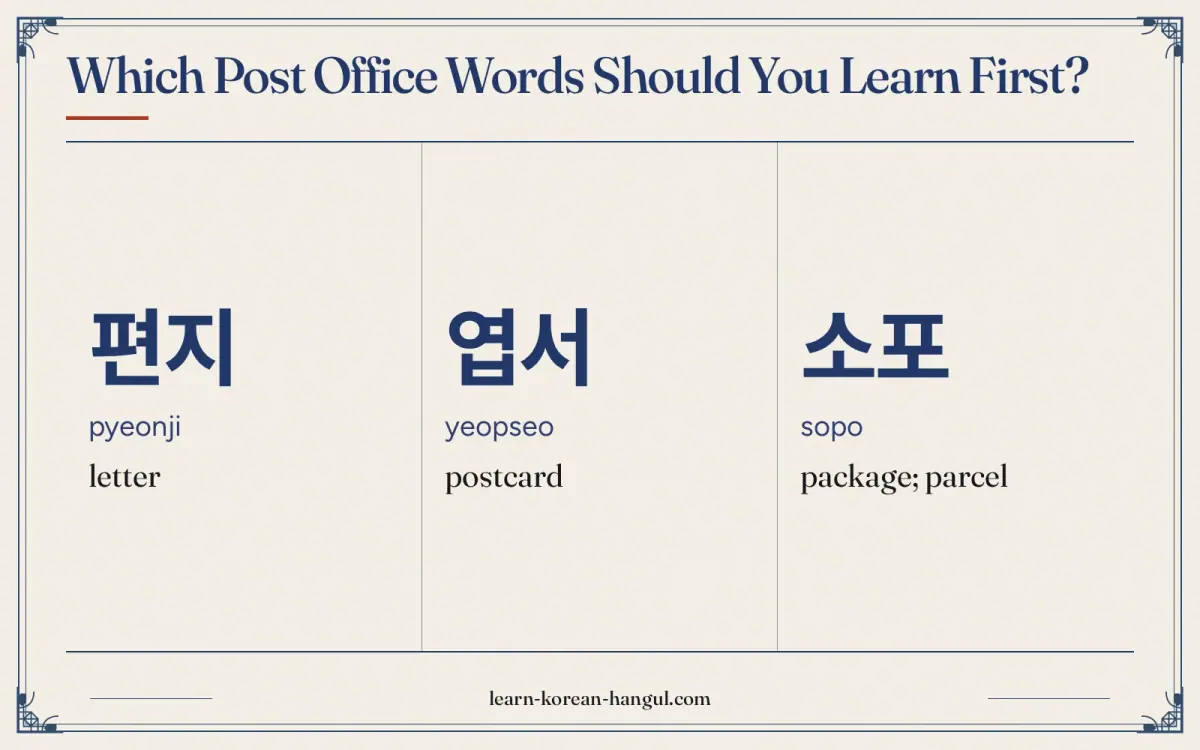
Learn 소포 (package), 주소 (address), 우편번호 (postal code), 요금 (fee) and 택배 (courier delivery) first. With these five you can state what you are sending, where it goes and ask what it costs. Add 해외 발송 and 세관 only when you send abroad.
- Words to say at the counter. 소포, 편지, 등기, 택배, 해외 발송.
- Words to write on a form. 주소, 우편번호, 받는 사람, 보내는 사람, 내용물.
- Words to understand when the clerk speaks. 무게, 요금, 수수료, 도착, 추적.
In practice, much domestic sending in Korea goes through private courier firms and convenience-store pickup points, which use the word 택배. The post office handles letters, registered mail and international parcels, and it also runs its own parcel service, 우체국 택배. The words on this page are the ones you need at its counter and on its forms.
Word · 8
- 1
편지
pyeonji
letter
- 2
엽서
yeopseo
postcard
- 3
소포
sopo
package; parcel
- 4
우표
upyo
stamp
- 5
주소
juso
address
- 6
우편번호
upyeonbeonho
postal code
- 7
창구
changgu
service window; counter
- 8
택배
taekbae
courier delivery; parcel
Mail Types
These six words name what is in the envelope or the box. A clerk asks about the type first, because the type decides the price and the form.
| No. | Hangul | Revised Romanization | Meaning and note | Example sentence | Audio assetId |
|---|---|---|---|---|---|
| 1 | 편지 | pyeonji | letter. The general word for a letter. 편지를 쓰다 means to write a letter. | 친구에게 편지를 써요. (I write a letter to a friend.) | au-pg-vocabulary-places-city-post-office-1; example: au-pg-vocabulary-places-city-post-office-2 |
| 2 | 엽서 | yeopseo | postcard. Said [엽써]. A card without an envelope, usually with a picture. | 여행지에서 엽서를 보냈어요. (I sent a postcard from my trip.) | au-pg-vocabulary-places-city-post-office-3; example: au-pg-vocabulary-places-city-post-office-4 |
| 3 | 소포 | sopo | package; parcel. A box or bundle sent by post. For a courier parcel, use 택배. | 소포를 보내고 싶어요. (I want to send a package.) | au-pg-vocabulary-places-city-post-office-5; example: au-pg-vocabulary-places-city-post-office-6 |
| 4 | 우편 | upyeon | mail; post. The general word for the postal system. Appears in compounds such as 우편번호. | 우편은 오전에 와요. (The mail comes in the morning.) | au-pg-vocabulary-places-city-post-office-7; example: au-pg-vocabulary-places-city-post-office-8 |
| 5 | 등기 | deunggi | registered mail. Mail with a tracking record and a signature on receipt. Often used for important papers. | 등기로 보내 주세요. (Please send it by registered mail.) | au-pg-vocabulary-places-city-post-office-9; example: au-pg-vocabulary-places-city-post-office-10 |
| 6 | 국제우편 | gukjeupyeon | international mail. 국제 means international. The service for sending outside Korea. | 국제우편은 시간이 걸려요. (International mail takes time.) | au-pg-vocabulary-places-city-post-office-11; example: au-pg-vocabulary-places-city-post-office-12 |
The word for a text message is 문자, not 편지. The registered service 등기 is the one to ask for if you need proof of delivery. The word 우편 appears in the next group too, so learn it as a root.
Addresses and Postal Codes
An address is the part of a parcel that must be correct. Korean addresses run from big to small, and the postal code goes with them. These six words cover the fields on a form.
| No. | Hangul | Revised Romanization | Meaning and note | Example sentence | Audio assetId |
|---|---|---|---|---|---|
| 7 | 주소 | juso | address. The standard word for the place where a person lives or works. | 주소를 알려 주세요. (Please tell me the address.) | au-pg-vocabulary-places-city-post-office-13; example: au-pg-vocabulary-places-city-post-office-14 |
| 8 | 우편번호 | upyeonbeonho | postal code. 우편 is mail and 번호 is a number. Five digits in the current system. | 우편번호가 뭐예요? (What is the postal code?) | au-pg-vocabulary-places-city-post-office-15; example: au-pg-vocabulary-places-city-post-office-16 |
| 9 | 도로명 주소 | doromyeong juso | road-name address. The official address style: city, district, road name and building number. | 도로명 주소를 써 주세요. (Please write the road-name address.) | au-pg-vocabulary-places-city-post-office-17; example: au-pg-vocabulary-places-city-post-office-18 |
| 10 | 받는 사람 | banneun saram | recipient. Literally "person who receives". Said [반는 사람]. The field on a form for the receiver. | 받는 사람 이름을 쓰세요. (Please write the recipient's name.) | au-pg-vocabulary-places-city-post-office-19; example: au-pg-vocabulary-places-city-post-office-20 |
| 11 | 보내는 사람 | bonaeneun saram | sender. Literally "person who sends". The field for the sender. | 보내는 사람은 저예요. (The sender is me.) | au-pg-vocabulary-places-city-post-office-21; example: au-pg-vocabulary-places-city-post-office-22 |
| 12 | 전화번호 | jeonhwabeonho | phone number. Couriers and the post office ask for the receiver's number. | 전화번호도 쓰세요. (Please write the phone number too.) | au-pg-vocabulary-places-city-post-office-23; example: au-pg-vocabulary-places-city-post-office-24 |
The two forms 받는 사람 and 보내는 사람 are noun phrases built from a verb plus the modifier ending -는 and the word 사람 (person). The same pattern gives 가는 사람 (the person who goes) and 먹는 사람 (the person who eats). Korean addresses and postal codes are a topic of their own, and the next section explains them.
Fees and Weights
At the counter the clerk weighs the item and gives a price. These six words cover what is measured, what is charged and what you get back.
| No. | Hangul | Revised Romanization | Meaning and note | Example sentence | Audio assetId |
|---|---|---|---|---|---|
| 13 | 우표 | upyo | stamp. A postage stamp. Stamps for letters are sold at the counter. | 우표를 붙여요. (I put on a stamp.) | au-pg-vocabulary-places-city-post-office-25; example: au-pg-vocabulary-places-city-post-office-26 |
| 14 | 요금 | yogeum | fee; charge; fare. The general word for a service charge. Also used for bus and taxi fares. | 요금이 얼마예요? (How much is the fee?) | au-pg-vocabulary-places-city-post-office-27; example: au-pg-vocabulary-places-city-post-office-28 |
| 15 | 무게 | muge | weight. Measured in grams (그램) or kilograms (킬로그램). | 무게를 재 주세요. (Please weigh it.) | au-pg-vocabulary-places-city-post-office-29; example: au-pg-vocabulary-places-city-post-office-30 |
| 16 | 크기 | keugi | size. How large a box is. The clerk may measure the sides. | 크기가 너무 커요. (The size is too big.) | au-pg-vocabulary-places-city-post-office-31; example: au-pg-vocabulary-places-city-post-office-32 |
| 17 | 수수료 | susuryo | handling fee; commission. An extra charge for a service such as registration. | 수수료가 있어요. (There is a handling fee.) | au-pg-vocabulary-places-city-post-office-33; example: au-pg-vocabulary-places-city-post-office-34 |
| 18 | 영수증 | yeongsujeung | receipt. Keep it when you send a registered item. Needed for a claim. | 영수증 주세요. (A receipt, please.) | au-pg-vocabulary-places-city-post-office-35; example: au-pg-vocabulary-places-city-post-office-36 |
You often hear 무게 and 요금 in one sentence: 무게는 삼 킬로그램이고 요금은 팔천 원이에요 is how a clerk might answer, but the figure changes every time. The point is the pattern: noun + 은/는 + number + 이에요. Read the numbers with Sino-Korean numerals, as covered in the numbers section.
Delivery Services
Parcel delivery is part of daily life in Korea, and these six words are everywhere in apps and on packages. Three of them are everyday words you will hear outside the post office too.
| No. | Hangul | Revised Romanization | Meaning and note | Example sentence | Audio assetId |
|---|---|---|---|---|---|
| 19 | 택배 | taekbae | courier delivery; parcel. Said [택빼]. The standard word for door-to-door parcel delivery. | 택배가 도착했어요. (The parcel has arrived.) | au-pg-vocabulary-places-city-post-office-37; example: au-pg-vocabulary-places-city-post-office-38 |
| 20 | 배송 | baesong | shipping; delivery. The shipping stage in an online order. Appears on order screens. | 배송은 이틀 걸려요. (Delivery takes two days.) | au-pg-vocabulary-places-city-post-office-39; example: au-pg-vocabulary-places-city-post-office-40 |
| 21 | 배달 | baedal | delivery (of food or goods). More often used for hot food or a local run, as in 음식 배달. | 배달을 시켜요. (I order a delivery.) | au-pg-vocabulary-places-city-post-office-41; example: au-pg-vocabulary-places-city-post-office-42 |
| 22 | 해외 발송 | haeoe balsong | sending abroad; overseas shipping. 해외 means overseas and 발송 means dispatch. Said [해외 발쏭]. | 해외 발송을 하고 싶어요. (I want to send something overseas.) | au-pg-vocabulary-places-city-post-office-43; example: au-pg-vocabulary-places-city-post-office-44 |
| 23 | 추적 | chujeok | tracking. Follow a parcel by its number. 추적하다 means to track. | 택배를 추적해요. (I track the parcel.) | au-pg-vocabulary-places-city-post-office-45; example: au-pg-vocabulary-places-city-post-office-46 |
| 24 | 도착 | dochak | arrival. 도착하다 means to arrive. | 언제 도착해요? (When will it arrive?) | au-pg-vocabulary-places-city-post-office-47; example: au-pg-vocabulary-places-city-post-office-48 |
The three delivery words are close but not the same. 택배 is the parcel and the service, 배송 is the stage of moving it, and 배달 is delivery of food or an item over a short distance. Use 택배 at a counter, 배송 on an online order screen and 배달 for a restaurant order.
Customs and the Counter
International mail passes through customs, and the counter has its own words. These six words are the ones foreigners meet when they send something abroad.
| No. | Hangul | Revised Romanization | Meaning and note | Example sentence | Audio assetId |
|---|---|---|---|---|---|
| 25 | 세관 | segwan | customs (office). The government office that checks goods crossing the border. | 세관에서 확인해요. (They check it at customs.) | au-pg-vocabulary-places-city-post-office-49; example: au-pg-vocabulary-places-city-post-office-50 |
| 26 | 관세 | gwanse | customs duty; tariff. A tax on imported goods. The rules depend on the receiving country. | 관세를 내야 해요. (I have to pay customs duty.) | au-pg-vocabulary-places-city-post-office-51; example: au-pg-vocabulary-places-city-post-office-52 |
| 27 | 신고서 | singoseo | declaration form. 신고 means to report or declare. The form lists the contents and value. | 신고서를 쓰세요. (Please fill in the declaration form.) | au-pg-vocabulary-places-city-post-office-53; example: au-pg-vocabulary-places-city-post-office-54 |
| 28 | 내용물 | naeyongmul | contents. What is inside the parcel. The clerk may ask 내용물이 뭐예요? | 내용물이 뭐예요? (What are the contents?) | au-pg-vocabulary-places-city-post-office-55; example: au-pg-vocabulary-places-city-post-office-56 |
| 29 | 창구 | changgu | service window; counter. The window where you hand things to the clerk. Banks and the post office both use it. | 3번 창구로 가세요. (Please go to window number 3.) | au-pg-vocabulary-places-city-post-office-57; example: au-pg-vocabulary-places-city-post-office-58 |
| 30 | 접수 | jeopsu | acceptance; filing. Said [접쑤]. The step where the clerk accepts your item. | 접수가 끝났어요. (Your item has been accepted.) | au-pg-vocabulary-places-city-post-office-59; example: au-pg-vocabulary-places-city-post-office-60 |
The phrase 내용물이 뭐예요? is worth saying aloud, because the clerk will ask it. A short answer is 책이에요 (books), 옷이에요 (clothes) or 선물이에요 (a gift). Be exact on the customs form: describe items in plain words and list the value.
How Does a Korean Address Work at the Post Office?
A Korean address runs from the largest unit to the smallest, the reverse of English. The order is city, district, road name, building number and then the unit inside the building. The five-digit postal code, the 우편번호, goes with the address. Korea moved to five-digit postal codes in 2015, replacing a six-digit system, and to road-name addresses for official use in 2014.
| Part | Hangul | Example (a format, not a real address) |
|---|---|---|
| City | 시 | 서울시 |
| District | 구 | 강남구 |
| Road and number | 로 + 번호 | 테헤란로 123 |
| Unit in building | 호 | 405호 |
| Postal code | 우편번호 | five digits |
If you send a parcel to an address in Korea, write it in the order above, in Hangul, and add the Revised Romanization beside it only if the carrier asks. The word 호 (ho) after a number means a room or unit number, so 405호 is room 405. For the address system across the section, see Places and Travel.
What Do You Say at the Counter?
A parcel visit follows a short script. The sentences below use only words from this page plus basic verbs, and each is built from a pattern you can reuse.
| Step | You say | Meaning |
|---|---|---|
| State what you want | 이 소포를 미국으로 보내고 싶어요. | I want to send this package to the United States. |
| Ask how long | 얼마나 걸려요? | How long does it take? |
| Ask the price | 요금이 얼마예요? | How much is the fee? |
| Ask for weighing | 무게를 재 주세요. | Please weigh it. |
| Ask for registered mail | 등기로 보내 주세요. | Please send it by registered mail. |
| Ask for a receipt | 영수증 주세요. | A receipt, please. |
The verb in the first sentence is 보내다 (to send), with 보내고 싶어요 meaning "I want to send". The verb in the second sentence is 걸리다 (to take, of time), and 걸려요 is the polite present form. The particle 으로 after a country marks the direction: 미국으로 means to the United States, and the clerk may reply with the cost and with 알겠습니다 (understood).
How Do You Send Something Abroad?
Sending abroad adds a few steps. First, tell the clerk it is overseas with 해외 발송. Second, the clerk asks for the 내용물 (contents) and its value. Third, you fill in the 신고서 (declaration form), which customs, the 세관, uses to check the parcel. The receiver's country may charge 관세 (duty) when the parcel arrives, and the sender does not control that.
The international services have names that you see on screens. The Korean name for the international mail service is 국제우편, and the fast international option is known as EMS, shown in English letters on forms and signs. Prices depend on weight (무게), destination and speed. Keep the 영수증 and the tracking number, then use 추적 to follow the parcel.
How Do You Pronounce Korean Post Office Words?
Post office words contain several sound changes that the spelling hides. The Revised Romanization of Korean records the spelling and ignores most of these changes, and the standard pronunciation rules published by the National Institute of Korean Language (국립국어원) give the spoken form.
| Spelling | Sounds like | What changes |
|---|---|---|
| 엽서 | [엽써] | After a final ㅂ, the ㅅ of 서 becomes tense [ㅆ]. |
| 받는 사람 | [반는 사람] | The final ㄷ sound of 받 becomes [ㄴ] before ㄴ. |
| 택배 | [택빼] | After a final ㄱ, the ㅂ of 배 becomes tense [ㅃ]. |
| 해외 발송 | [해외 발쏭] | After ㄹ in a Sino-Korean word, the ㅅ of 송 is said tense [ㅆ]. |
| 접수 | [접쑤] | After a final ㅂ, the ㅅ of 수 becomes tense [ㅆ]. |
| 국제우편 | [국쩨우편] | After the final ㄱ of 국, the ㅈ of 제 becomes tense [ㅉ]. |
The tense sounds in 엽서, 택배, 접수 and 국제우편 appear after a final ㅂ or ㄱ. Say the second consonant tight, with no puff of air. The spelling does not show the change, so use the audio as your guide.
Audio and Slow Playback
Each headword and each example sentence has its own audio clip. The clips below replay the trickiest words at a slower pace. Play one, repeat it aloud, then play it again and compare.
What Mistakes Do Learners Make with Post Office Words?
These five mistakes come up most at the post office.
- Using 편지 for every kind of mail. 편지 is a letter. A box is a 소포 and a courier parcel is a 택배.
- Writing the address in English order. Korean starts from the city and ends with the room number, so reverse the order.
- Forgetting the postal code. The 우편번호 is part of the address. Five digits, not six.
- Mixing 택배, 배송 and 배달. 택배 is the parcel service, 배송 is the shipping stage and 배달 is food or local delivery.
- Using 요금 and 수수료 as the same thing. 요금 is the main fee and 수수료 is an extra service charge.
If you remember only one, remember to write the address from big to small, because a wrong order delays delivery.
Practice: Flashcards and Worksheet
Study in three steps. First, run the flashcard deck in recognition mode until you know each of the 30 words. Second, switch to listening mode and answer from the audio alone. Third, take the quiz. The deck covers all 30 words with audio, and your progress stays in your browser. The vocabulary flashcard decks page lists the other decks.
Practice · 65
- 01편지
Show answer
headword 1: letter
- 02친구에게 편지를 써요.
Show answer
example sentence for 편지: I write a letter to a friend.
- 03엽서
Show answer
headword 2: postcard
- 04여행지에서 엽서를 보냈어요.
Show answer
example sentence for 엽서: I sent a postcard from my trip.
- 05소포
Show answer
headword 3: package; parcel
- 06소포를 보내고 싶어요.
Show answer
example sentence for 소포: I want to send a package.
- 07우편
Show answer
headword 4: mail; post
- 08우편은 오전에 와요.
Show answer
example sentence for 우편: The mail comes in the morning.
- 09등기
Show answer
headword 5: registered mail
- 10등기로 보내 주세요.
Show answer
example sentence for 등기: Please send it by registered mail.
- 11국제우편
Show answer
headword 6: international mail
- 12국제우편은 시간이 걸려요.
Show answer
example sentence for 국제우편: International mail takes time.
- 13주소
Show answer
headword 7: address
- 14주소를 알려 주세요.
Show answer
example sentence for 주소: Please tell me the address.
- 15우편번호
Show answer
headword 8: postal code
- 16우편번호가 뭐예요?
Show answer
example sentence for 우편번호: What is the postal code?
- 17도로명 주소
Show answer
headword 9: road-name address
- 18도로명 주소를 써 주세요.
Show answer
example sentence for 도로명 주소: Please write the road-name address.
- 19받는 사람
Show answer
headword 10: recipient
- 20받는 사람 이름을 쓰세요.
Show answer
example sentence for 받는 사람: Please write the recipient's name.
- 21보내는 사람
Show answer
headword 11: sender
- 22보내는 사람은 저예요.
Show answer
example sentence for 보내는 사람: The sender is me.
- 23전화번호
Show answer
headword 12: phone number
- 24전화번호도 쓰세요.
Show answer
example sentence for 전화번호: Please write the phone number too.
- 25우표
Show answer
headword 13: stamp
- 26우표를 붙여요.
Show answer
example sentence for 우표: I put on a stamp.
- 27요금
Show answer
headword 14: fee; charge; fare
- 28요금이 얼마예요?
Show answer
example sentence for 요금: How much is the fee?
- 29무게
Show answer
headword 15: weight
- 30무게를 재 주세요.
Show answer
example sentence for 무게: Please weigh it.
- 31크기
Show answer
headword 16: size
- 32크기가 너무 커요.
Show answer
example sentence for 크기: The size is too big.
- 33수수료
Show answer
headword 17: handling fee; commission
- 34수수료가 있어요.
Show answer
example sentence for 수수료: There is a handling fee.
- 35영수증
Show answer
headword 18: receipt
- 36영수증 주세요.
Show answer
example sentence for 영수증: A receipt, please.
- 37택배
Show answer
headword 19: courier delivery; parcel
- 38택배가 도착했어요.
Show answer
example sentence for 택배: The parcel has arrived.
- 39배송
Show answer
headword 20: shipping; delivery
- 40배송은 이틀 걸려요.
Show answer
example sentence for 배송: Delivery takes two days.
- 41배달
Show answer
headword 21: delivery (of food or goods)
- 42배달을 시켜요.
Show answer
example sentence for 배달: I order a delivery.
- 43해외 발송
Show answer
headword 22: sending abroad; overseas shipping
- 44해외 발송을 하고 싶어요.
Show answer
example sentence for 해외 발송: I want to send something overseas.
- 45추적
Show answer
headword 23: tracking
- 46택배를 추적해요.
Show answer
example sentence for 추적: I track the parcel.
- 47도착
Show answer
headword 24: arrival
- 48언제 도착해요?
Show answer
example sentence for 도착: When will it arrive?
- 49세관
Show answer
headword 25: customs (office)
- 50세관에서 확인해요.
Show answer
example sentence for 세관: They check it at customs.
- 51관세
Show answer
headword 26: customs duty; tariff
- 52관세를 내야 해요.
Show answer
example sentence for 관세: I have to pay customs duty.
- 53신고서
Show answer
headword 27: declaration form
- 54신고서를 쓰세요.
Show answer
example sentence for 신고서: Please fill in the declaration form.
- 55내용물
Show answer
headword 28: contents
- 56내용물이 뭐예요?
Show answer
example sentence for 내용물: What are the contents?
- 57창구
Show answer
headword 29: service window; counter
- 583번 창구로 가세요.
Show answer
example sentence for 창구: Please go to window number 3.
- 59접수
Show answer
headword 30: acceptance; filing
- 60접수가 끝났어요.
Show answer
example sentence for 접수: The acceptance is done.
- 61엽서
Show answer
slow playback of 엽서
- 62택배
Show answer
slow playback of 택배
- 63접수
Show answer
slow playback of 접수
- 64등기
Show answer
slow playback of 등기
- 65도로명 주소
Show answer
slow playback of 도로명 주소
Practice · 5
What does 소포 (sopo) mean?
Show answer
package; parcel
소포 means package; parcel. Example: 소포를 보내고 싶어요. (I want to send a package.)
What does 우편번호 (upyeonbeonho) mean?
Show answer
postal code
우편번호 means postal code. Example: 우편번호가 뭐예요? (What is the postal code?)
What does 택배 (taekbae) mean?
Show answer
courier delivery; parcel
택배 means courier delivery; parcel. Example: 택배가 도착했어요. (The parcel has arrived.)
What does 신고서 (singoseo) mean?
Show answer
declaration form
신고서 means declaration form. Example: 신고서를 쓰세요. (Please fill in the declaration form.)
What does 등기 (deunggi) mean?
Show answer
registered mail
등기 means registered mail. Example: 등기로 보내 주세요. (Please send it by registered mail.)
Korean Post Office Vocabulary Worksheet (PDF)
A printable worksheet for these words (word list, matching, writing practice, fill-in-the-blank exercises and answer key) is available in A4 and US Letter from the download card on this page. For practice, copy the 30 words by hand and write the meaning next to each. Fill in a practice address in Korean order to rehearse the form.
Where to Go Next
After this page, continue with Korean Shops and Buildings Vocabulary, the other deeper page of the city list, or return to Around the City. For the sentences you say when travelling, see travel phrases. For a short page on the word itself, see post office in korean.
Frequently Asked Questions
How Do You Say Post Office in Korean?
Post office is 우체국 (ucheguk). The 우 comes from 우편 (mail) and 국 means an office or bureau. You say 우체국에 가요 for I go to the post office. The headline word has its own page.
How Do You Say Letter in Korean?
Letter is 편지 (pyeonji). To say you write one, use 편지를 써요, and to say you send one, use 편지를 보내요. A postcard is 엽서 and a package is 소포. A text message is a different word, 문자, so do not use 편지 for a phone message.
How Do You Say Package in Korean?
Package is 소포 (sopo) for a parcel sent by the post office, and 택배 (taekbae) for a courier parcel. Say 소포를 보내고 싶어요 for I want to send a package. The two words overlap, and both are everyday words.
How Do You Pronounce 우체국?
Say u-che-guk, with three short syllables. The first vowel is a rounded [u], the second is [e] and the last syllable ends in a held [k]. There is no hidden sound change. The word's audio is in the city list and on the post office word page.
What Do I Write for an Overseas Parcel?
Write the receiver's name and address in the receiver's country format and fill in the 신고서 (declaration form) with the contents and the value. The clerk will tell you the rest. This page explains only the Korean words, not the rules of any particular country.
Is the Romanization on This Page Official?
It follows the Revised Romanization of Korean, which South Korea adopted on 7 July 2000 and whose rules the National Institute of Korean Language (국립국어원) publishes. It is a learning aid and does not mark every sound change, so rely on the Hangul and the audio.