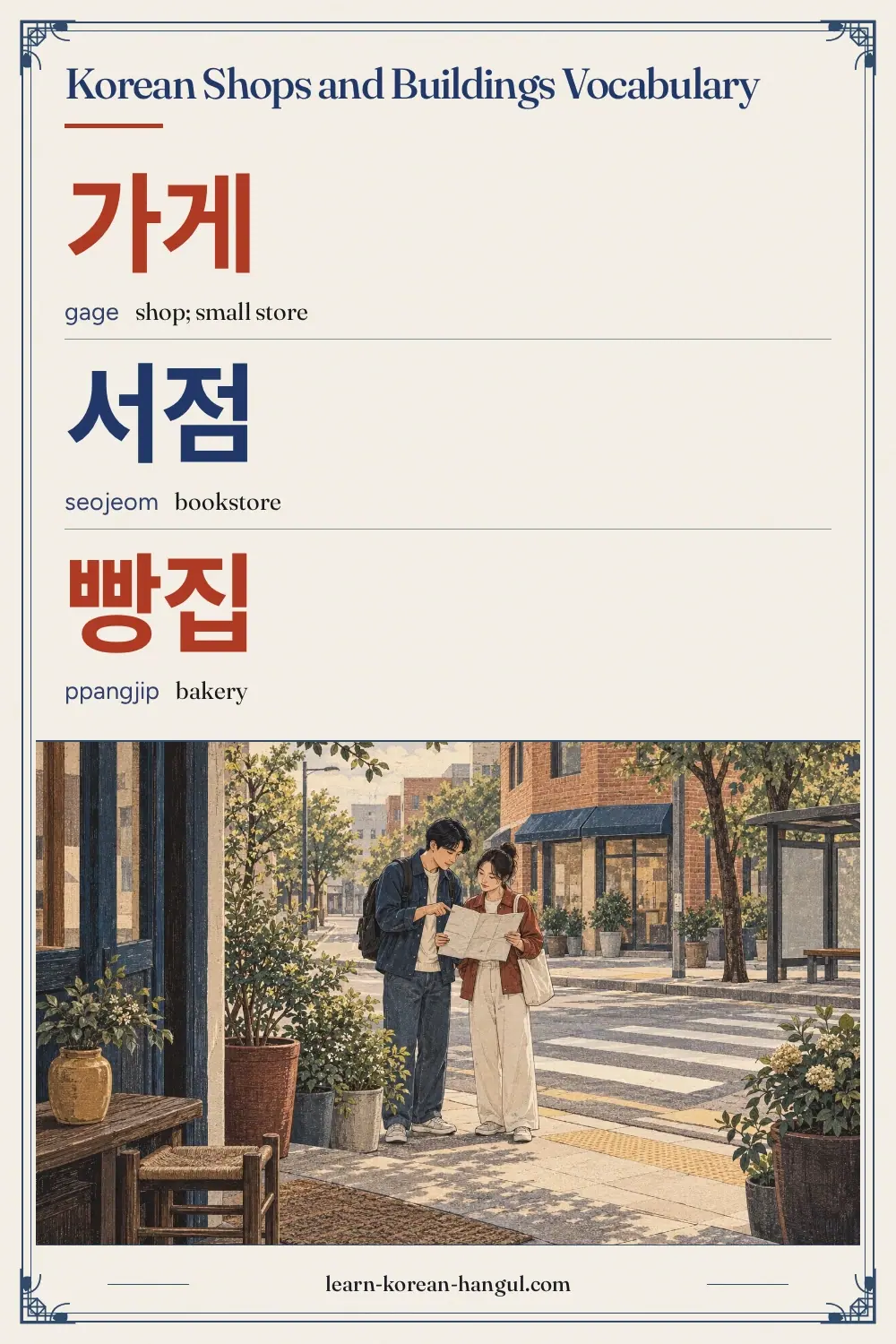
Korean Shops and Buildings Vocabulary at a Glance
This list has 40 words in five groups of eight: everyday shops, big stores, specialty shops, eateries and trades, and cultural and government buildings. It is a deeper page of Around the City, next to Korean Post Office Vocabulary, and it goes into more detail on shops than the city list does.
| Group | Words | Use |
|---|---|---|
| Everyday shops | 8 | Small shops on a neighbourhood street |
| Big stores | 8 | Supermarkets, malls and markets |
| Specialty shops | 8 | Clothes, goods and phones |
| Eateries and trades | 8 | Casual eating places and repair trades |
| Cultural and government buildings | 8 | Museums, theaters and public offices |
Some places, such as 서점 and 빵집, also appear on the city list as short samples. Here they are taught with the full set of shop endings. For the shopping words that go with these places, see shopping. The next section says where to start.
Which Shop and Building Names Should You Learn First?
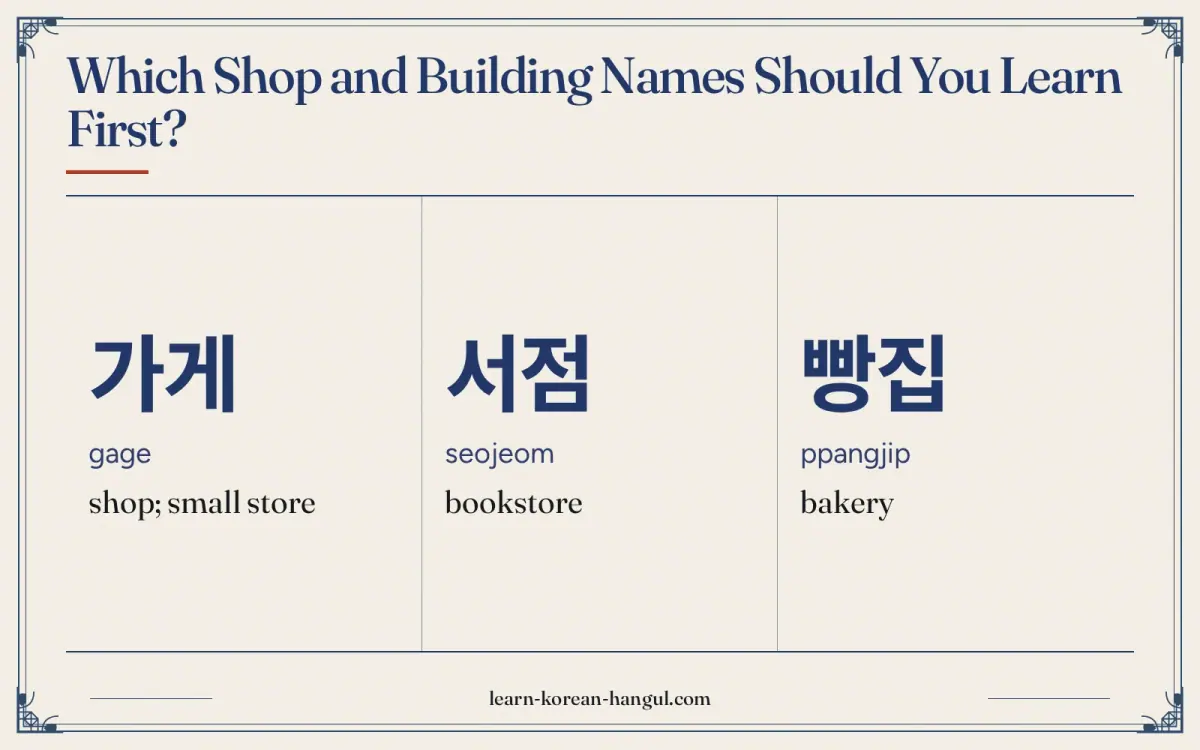
Learn 가게 (shop), 마트 (supermarket), 백화점 (department store), 서점 (bookstore) and 빵집 (bakery) first. They cover most of a shopping day, and each shows a different ending. Then add 시청 (city hall) and 주민센터 (neighbourhood office) if you plan to live in Korea.
- Words to say. 가게, 마트, 서점, 빵집, 꽃집, 카페.
- Words to read on street signs. 문구점, 면세점, 철물점, 가구점, 매장.
- Words for offices and culture. 시청, 구청, 주민센터, 박물관, 극장.
One point sets Korean shopping apart. Many small shops carry the owner's name or the goods they sell, plus a short ending. A sign that reads 영희 문구점 is Younghee's stationery shop, and the ending tells you the type before you read the first word.
Word · 8
- 1
가게
gage
shop; small store
- 2
서점
seojeom
bookstore
- 3
빵집
ppangjip
bakery
- 4
꽃집
kkotjip
flower shop
- 5
문구점
mungujeom
stationery shop
- 6
마트
mateu
mart; supermarket
- 7
백화점
baekhwajeom
department store
- 8
주민센터
juminsenteo
neighborhood community center
Everyday Shops
These eight words cover the small shops of a residential street. The first two are general words for a shop, and the next six name a specific kind.
| No. | Hangul | Revised Romanization | Meaning and note | Example sentence | Audio assetId |
|---|---|---|---|---|---|
| 1 | 가게 | gage | shop; small store. The everyday word for a small shop. It does not say what is sold. | 저 가게에서 과일을 팔아요. (They sell fruit at that shop.) | au-pg-vocabulary-places-city-shops-buildings-1; example: au-pg-vocabulary-places-city-shops-buildings-2 |
| 2 | 상점 | sangjeom | shop; store (formal). A more formal word, often seen in writing and in compounds such as 상점가 (shopping street). | 이 거리에는 상점이 많아요. (There are many shops on this street.) | au-pg-vocabulary-places-city-shops-buildings-3; example: au-pg-vocabulary-places-city-shops-buildings-4 |
| 3 | 문구점 | mungujeom | stationery shop. 문구 means stationery. The place for pens, notebooks and school supplies. | 문구점에서 공책을 사요. (I buy a notebook at the stationery shop.) | au-pg-vocabulary-places-city-shops-buildings-5; example: au-pg-vocabulary-places-city-shops-buildings-6 |
| 4 | 서점 | seojeom | bookstore. 서 means book and 점 means shop. | 서점에서 소설을 찾아요. (I look for a novel at the bookstore.) | au-pg-vocabulary-places-city-shops-buildings-7; example: au-pg-vocabulary-places-city-shops-buildings-8 |
| 5 | 빵집 | ppangjip | bakery. Said [빵찝]. 빵 is bread and 집 is a shop in this use. | 빵집 앞에서 기다려요. (I wait in front of the bakery.) | au-pg-vocabulary-places-city-shops-buildings-9; example: au-pg-vocabulary-places-city-shops-buildings-10 |
| 6 | 꽃집 | kkotjip | flower shop. Said [꼳찝]. 꽃 is flower. | 꽃집에서 장미를 샀어요. (I bought roses at the flower shop.) | au-pg-vocabulary-places-city-shops-buildings-11; example: au-pg-vocabulary-places-city-shops-buildings-12 |
| 7 | 정육점 | jeongyukjeom | butcher shop. 정육 means trimmed meat. Sells beef, pork and chicken by weight. | 정육점에서 고기를 사요. (I buy meat at the butcher shop.) | au-pg-vocabulary-places-city-shops-buildings-13; example: au-pg-vocabulary-places-city-shops-buildings-14 |
| 8 | 과일 가게 | gwail gage | fruit shop. 과일 is fruit. A roadside stall is often called this too. | 과일 가게가 문을 열었어요. (The fruit shop is open.) | au-pg-vocabulary-places-city-shops-buildings-15; example: au-pg-vocabulary-places-city-shops-buildings-16 |
The words 가게 and 상점 both mean shop, but 가게 is the one you say. 상점 is how a sign or a news article names a shop. Place the type before the ending to build a name: 꽃 + 집 = 꽃집, and 과일 + 가게 = 과일 가게. Both patterns are common.
Big Stores
Large stores work on a different scale from small shops. These eight words are the places where you shop for a full list, buy gifts or hunt for a discount.
| No. | Hangul | Revised Romanization | Meaning and note | Example sentence | Audio assetId |
|---|---|---|---|---|---|
| 9 | 마트 | mateu | mart; supermarket. From English "mart". A large supermarket. Chains are named by brand. | 마트에서 장을 봐요. (I do my grocery shopping at the mart.) | au-pg-vocabulary-places-city-shops-buildings-17; example: au-pg-vocabulary-places-city-shops-buildings-18 |
| 10 | 대형 마트 | daehyeong mateu | large supermarket; hypermarket. 대형 means large size. Often has a parking lot and a food court. | 대형 마트는 주말에 붐벼요. (The hypermarket is crowded on weekends.) | au-pg-vocabulary-places-city-shops-buildings-19; example: au-pg-vocabulary-places-city-shops-buildings-20 |
| 11 | 슈퍼 | syupeo | small supermarket; grocery store. The short form of 슈퍼마켓. A neighbourhood store. | 슈퍼에서 우유를 사요. (I buy milk at the grocery store.) | au-pg-vocabulary-places-city-shops-buildings-21; example: au-pg-vocabulary-places-city-shops-buildings-22 |
| 12 | 백화점 | baekhwajeom | department store. Said [배콰점]. Literally "hundred-goods shop". Sells clothes, cosmetics and gifts. | 백화점에서 선물을 골라요. (I choose a gift at the department store.) | au-pg-vocabulary-places-city-shops-buildings-23; example: au-pg-vocabulary-places-city-shops-buildings-24 |
| 13 | 쇼핑몰 | syopingmol | shopping mall. A loanword. A building of many stores, restaurants and a cinema. | 쇼핑몰에서 영화를 봐요. (I watch a movie at the shopping mall.) | au-pg-vocabulary-places-city-shops-buildings-25; example: au-pg-vocabulary-places-city-shops-buildings-26 |
| 14 | 아울렛 | aullet | outlet mall. A loanword. A mall with discounted goods, often outside the city centre. The dictionary spelling is 아웃렛, but signs and brand names almost always write 아울렛. | 아울렛은 가격이 싸요. (The outlet mall has cheap prices.) | au-pg-vocabulary-places-city-shops-buildings-27; example: au-pg-vocabulary-places-city-shops-buildings-28 |
| 15 | 면세점 | myeonsejeom | duty-free shop. 면세 means tax-free. Found at airports and in central city areas. | 면세점에서 화장품을 샀어요. (I bought cosmetics at the duty-free shop.) | au-pg-vocabulary-places-city-shops-buildings-29; example: au-pg-vocabulary-places-city-shops-buildings-30 |
| 16 | 전통 시장 | jeontong sijang | traditional market. 전통 means tradition. An open-air market with stalls and street food. | 전통 시장에는 먹을 것이 많아요. (The traditional market has lots to eat.) | au-pg-vocabulary-places-city-shops-buildings-31; example: au-pg-vocabulary-places-city-shops-buildings-32 |
Choose by purpose. A 슈퍼 is for a quick errand, a 마트 for the weekly shop, a 백화점 for gifts and a 전통 시장 for fresh food and street snacks. Loanwords such as 쇼핑몰 and 아울렛 keep their English shape and are written in Hangul only. The longer shopping vocabulary is on the shopping page.
Specialty Shops
These eight words cover shops that sell one kind of good. Several are built from a goods word plus 가게, so you can add your own: 신발 + 가게 gives shoe shop.
| No. | Hangul | Revised Romanization | Meaning and note | Example sentence | Audio assetId |
|---|---|---|---|---|---|
| 17 | 옷 가게 | ot gage | clothing shop. 옷 is clothes. A general word for a small clothing shop. | 옷 가게에서 바지를 샀어요. (I bought trousers at the clothing shop.) | au-pg-vocabulary-places-city-shops-buildings-33; example: au-pg-vocabulary-places-city-shops-buildings-34 |
| 18 | 신발 가게 | sinbal gage | shoe shop. 신발 is footwear. | 신발 가게는 2층에 있어요. (The shoe shop is on the second floor.) | au-pg-vocabulary-places-city-shops-buildings-35; example: au-pg-vocabulary-places-city-shops-buildings-36 |
| 19 | 화장품 가게 | hwajangpum gage | cosmetics shop. 화장품 means cosmetics. Skin-care shops are common in city centres. | 화장품 가게가 많아요. (There are many cosmetics shops.) | au-pg-vocabulary-places-city-shops-buildings-37; example: au-pg-vocabulary-places-city-shops-buildings-38 |
| 20 | 가구점 | gagujeom | furniture store. 가구 means furniture. | 가구점에서 의자를 봐요. (I look at chairs in the furniture store.) | au-pg-vocabulary-places-city-shops-buildings-39; example: au-pg-vocabulary-places-city-shops-buildings-40 |
| 21 | 철물점 | cheolmuljeom | hardware store. 철물 means ironware. Sells tools, nails and household fixings. | 철물점에서 못을 샀어요. (I bought nails at the hardware store.) | au-pg-vocabulary-places-city-shops-buildings-41; example: au-pg-vocabulary-places-city-shops-buildings-42 |
| 22 | 휴대폰 매장 | hyudaepon maejang | mobile phone store. 휴대폰 is a mobile phone and 매장 is a store floor. | 휴대폰 매장에 갔어요. (I went to the mobile phone store.) | au-pg-vocabulary-places-city-shops-buildings-43; example: au-pg-vocabulary-places-city-shops-buildings-44 |
| 23 | 매장 | maejang | store; shop floor; outlet. The word for a branch or a retail floor. Appears on signs and ads. | 매장은 지하 일 층에 있어요. (The store is on the first basement level.) | au-pg-vocabulary-places-city-shops-buildings-45; example: au-pg-vocabulary-places-city-shops-buildings-46 |
| 24 | 잡화점 | japhwajeom | variety store; general goods store. 잡화 means miscellaneous goods. Sells small household items. | 잡화점에서 열쇠고리를 샀어요. (I bought a key ring at the variety store.) | au-pg-vocabulary-places-city-shops-buildings-47; example: au-pg-vocabulary-places-city-shops-buildings-48 |
The word 매장 deserves a note. It means the retail space of a business, so 매장 안내 is a store directory and 매장 이용 means using the shop floor. It also names a branch: 이 매장 (this branch). A shopper hears it often in announcements, which is why it is worth learning early.
Eateries and Trades
Korean streets are lined with small eateries and trade shops, and most end in -집. This group collects the ones you will see and the repair trades that keep a neighbourhood running.
| No. | Hangul | Revised Romanization | Meaning and note | Example sentence | Audio assetId |
|---|---|---|---|---|---|
| 25 | 분식집 | bunsikjip | snack bar. 분식 means flour-based snacks such as tteokbokki and gimbap. | 분식집에서 떡볶이를 먹어요. (I eat tteokbokki at the snack bar.) | au-pg-vocabulary-places-city-shops-buildings-49; example: au-pg-vocabulary-places-city-shops-buildings-50 |
| 26 | 치킨집 | chikinjip | fried chicken restaurant. Chicken places are common and many deliver. | 치킨집에 전화해요. (I call the fried chicken shop.) | au-pg-vocabulary-places-city-shops-buildings-51; example: au-pg-vocabulary-places-city-shops-buildings-52 |
| 27 | 술집 | suljip | bar; pub. 술 is alcohol. A place to drink with food. | 술집은 밤에 열어요. (The bar opens at night.) | au-pg-vocabulary-places-city-shops-buildings-53; example: au-pg-vocabulary-places-city-shops-buildings-54 |
| 28 | 고깃집 | gogitjip | barbecue restaurant. 고기 is meat and the ㅅ between is a linking letter. A table grill restaurant. | 고깃집에서 삼겹살을 먹어요. (I eat pork belly at the barbecue restaurant.) | au-pg-vocabulary-places-city-shops-buildings-55; example: au-pg-vocabulary-places-city-shops-buildings-56 |
| 29 | 수선집 | suseonjip | clothes repair shop. 수선 means mending. Shortens trousers and fixes zips. | 수선집에서 바지를 줄여요. (I get my trousers shortened at the repair shop.) | au-pg-vocabulary-places-city-shops-buildings-57; example: au-pg-vocabulary-places-city-shops-buildings-58 |
| 30 | 열쇠 가게 | yeolsoe gage | key shop; locksmith. 열쇠 is key. Copies keys and opens locks. | 열쇠 가게에서 열쇠를 만들었어요. (I had a key made at the key shop.) | au-pg-vocabulary-places-city-shops-buildings-59; example: au-pg-vocabulary-places-city-shops-buildings-60 |
| 31 | 이발소 | ibalso | barbershop. 이발 means a haircut. Mostly for men. | 이발소에서 머리를 깎아요. (I get a haircut at the barbershop.) | au-pg-vocabulary-places-city-shops-buildings-61; example: au-pg-vocabulary-places-city-shops-buildings-62 |
| 32 | 목욕탕 | mogyoktang | public bathhouse. A bath with hot pools, smaller than a 찜질방. | 목욕탕에 가요. (I go to the bathhouse.) | au-pg-vocabulary-places-city-shops-buildings-63; example: au-pg-vocabulary-places-city-shops-buildings-64 |
The ending -집 is the colloquial ending for a shop or an eatery, and it is the marker of a casual place: 치킨집 is a chicken place, not a formal restaurant. The formal ending is 점. Both can sometimes name the same business, but -집 sounds closer to speech and -점 closer to a sign.
Cultural and Government Buildings
The last group names the public buildings that foreign residents and visitors use. The first four are cultural and the last four are government offices, which run from the city level down to the neighbourhood.
| No. | Hangul | Revised Romanization | Meaning and note | Example sentence | Audio assetId |
|---|---|---|---|---|---|
| 33 | 박물관 | bangmulgwan | museum. Said [방물관]. Shows history and objects. | 박물관에서 역사를 배워요. (I learn history at the museum.) | au-pg-vocabulary-places-city-shops-buildings-65; example: au-pg-vocabulary-places-city-shops-buildings-66 |
| 34 | 미술관 | misulgwan | art museum. 미술 is art. Shows paintings and modern work. | 미술관은 월요일에 쉬어요. (The art museum is closed on Mondays.) | au-pg-vocabulary-places-city-shops-buildings-67; example: au-pg-vocabulary-places-city-shops-buildings-68 |
| 35 | 도서관 | doseogwan | library. 도서 is books. A public library lends books. | 도서관에서 책을 반납해요. (I return a book at the library.) | au-pg-vocabulary-places-city-shops-buildings-69; example: au-pg-vocabulary-places-city-shops-buildings-70 |
| 36 | 극장 | geukjang | theater; cinema. Said [극짱]. For films and live shows. | 극장에서 영화를 봐요. (I watch a movie at the theater.) | au-pg-vocabulary-places-city-shops-buildings-71; example: au-pg-vocabulary-places-city-shops-buildings-72 |
| 37 | 시청 | sicheong | city hall. The main office of a city government. | 시청 앞에서 만나요. (Let's meet in front of city hall.) | au-pg-vocabulary-places-city-shops-buildings-73; example: au-pg-vocabulary-places-city-shops-buildings-74 |
| 38 | 구청 | gucheong | district office. 구 is a district of a large city. A step below city hall. | 구청에서 서류를 받아요. (I get a document at the district office.) | au-pg-vocabulary-places-city-shops-buildings-75; example: au-pg-vocabulary-places-city-shops-buildings-76 |
| 39 | 주민센터 | juminsenteo | neighborhood community center. 주민 means resident. The local office for paperwork and certificates. Many now carry the official name 행정복지센터, but people still say 주민센터. | 주민센터에서 서류를 떼요. (I get a document at the community center.) | au-pg-vocabulary-places-city-shops-buildings-77; example: au-pg-vocabulary-places-city-shops-buildings-78 |
| 40 | 법원 | beobwon | court. Said [버붠]. The place where cases are tried. | 법원은 시청 근처에 있어요. (The court is near city hall.) | au-pg-vocabulary-places-city-shops-buildings-79; example: au-pg-vocabulary-places-city-shops-buildings-80 |
The three offices run from big to small. 시청 serves a whole city, 구청 a district of it and 주민센터 a single neighbourhood. Most everyday paperwork for residents goes through the 주민센터 first. The address system that places them is explained on the Places and Travel page.
What Is the Difference between 가게, 상점, 마트 and 백화점?
All four mean a place that sells goods, but they differ in size and register. The table compares them with the situation where each fits.
| Word | Size | Register | Typical use |
|---|---|---|---|
| 가게 | small | everyday speech | a corner shop or stall |
| 상점 | small to medium | written, formal | signs, news and compounds |
| 마트 | large | everyday speech | the weekly grocery shop |
| 백화점 | very large | everyday speech | gifts, clothes and cosmetics |
The choice shows in a sentence. 가게에 가요 means you go to a shop nearby, and the shop is probably small. 마트에 가요 means a supermarket trip. 백화점에 가요 is usually for something special. The word 상점 is not wrong, but a Korean speaker would say 가게 in the same sentence.
Why Do Some Shops End in -점, -집 and -가게?
Shop names come in three common patterns, and the ending tells you the register.
- -점 (jeom). The formal ending, as in 서점, 문구점 and 면세점. It appears on signs and in writing.
- -집 (jip). The colloquial ending, as in 빵집, 꽃집 and 술집. It sounds like speech and is common for food and drink.
- -가게 (gage). A two-word pattern, as in 과일 가게 and 열쇠 가게. It names a small shop, with the goods first.
You can often swap the endings: 꽃집 and 꽃 가게 are both understood. The words 빵집 and 서점 are fixed, though, so you would not say 빵점 for a bakery; 빵점 means a score of zero. The ending also changes sound. In most -집 compounds the ㅈ of 집 is said tense, so 빵집 is said [빵찝]. For the everyday places around these shops, such as banks, stations and parks, see the Around the City list.
How Do You Ask Whether a Shop Is Nearby?
The pattern is 근처에 [shop] 있어요? (Is there a [shop] nearby?). For example, 근처에 서점 있어요? asks whether a bookstore is nearby. A clerk or passer-by answers with 네, 있어요 (yes, there is) and a position, such as 저기 편의점 옆에 있어요 (It is over there next to the convenience store). The pattern links to the position words on the Korean Directions Vocabulary page.
A related question is 어디에서 살 수 있어요? (Where can I buy it?), which asks about a place of purchase. The answer names one of the shops above. For shop-front vocabulary such as prices and sale signs, see shopping.
How Do You Pronounce Korean Shop and Building Names?
Shop and building names contain several sound changes that the spelling hides. The Revised Romanization of Korean records the spelling and ignores many of these changes. The standard pronunciation rules published by the National Institute of Korean Language (국립국어원) give the spoken form.
| Spelling | Sounds like | What changes |
|---|---|---|
| 분식집 | [분식찝] | After a final ㄱ, the ㅈ of 집 becomes tense [ㅉ]. |
| 술집 | [술찝] | The ㅈ of 집 becomes tense [ㅉ] in this compound. |
| 빵집 | [빵찝] | The ㅈ of 집 becomes tense [ㅉ] in this compound. |
| 극장 | [극짱] | After a final ㄱ, the ㅈ of 장 becomes tense [ㅉ]. |
| 법원 | [버붠] | The final ㅂ of 법 links to the vowel of 원. |
| 백화점 | [배콰점] | ㄱ and ㅎ merge into an aspirated [ㅋ]. |
The tense [ㅉ] in -집 words is the most common slip. Say the ㅈ tight, with no puff of air. The Hangul does not show the change, so the audio is your guide.
Audio and Slow Playback
Each headword and each example sentence has its own audio clip. The clips below replay the trickiest words at a slower pace. Play one, repeat it aloud, then play it again and compare.
What Mistakes Do Learners Make with Shop and Building Names?
These five mistakes come up most when learners name places.
- Saying 상점 in everyday speech. It is correct but stiff. Say 가게 for a small shop.
- Treating 집 only as "house". In 빵집 and 술집, 집 marks a shop or eatery. In 우리 집 it means home.
- Mixing 시청, 구청 and 주민센터. They are three levels of office: city, district and neighbourhood.
- Confusing 서점 and 문구점. A 서점 sells books. A 문구점 sells pens, notebooks and school supplies, and the two are different shops, even when they stand side by side.
- Forgetting the tense sound in -집 words. 빵집 is said [빵찝], not [빵집].
If you remember only one, remember the three offices, because each handles different paperwork.
Practice: Flashcards and Worksheet
Study in three steps. First, run the flashcard deck in recognition mode until you know each of the 40 words. Second, switch to listening mode and answer from the audio alone. Third, take the quiz. The deck covers all 40 words with audio, and your progress stays in your browser. The vocabulary flashcard decks page lists the other decks.
Practice · 85
- 01가게
Show answer
headword 1: shop; small store
- 02저 가게에서 과일을 팔아요.
Show answer
example sentence for 가게: They sell fruit at that shop.
- 03상점
Show answer
headword 2: shop; store (formal)
- 04이 거리에는 상점이 많아요.
Show answer
example sentence for 상점: There are many shops on this street.
- 05문구점
Show answer
headword 3: stationery shop
- 06문구점에서 공책을 사요.
Show answer
example sentence for 문구점: I buy a notebook at the stationery shop.
- 07서점
Show answer
headword 4: bookstore
- 08서점에서 소설을 찾아요.
Show answer
example sentence for 서점: I look for a novel at the bookstore.
- 09빵집
Show answer
headword 5: bakery
- 10빵집 앞에서 기다려요.
Show answer
example sentence for 빵집: I wait in front of the bakery.
- 11꽃집
Show answer
headword 6: flower shop
- 12꽃집에서 장미를 샀어요.
Show answer
example sentence for 꽃집: I bought roses at the flower shop.
- 13정육점
Show answer
headword 7: butcher shop
- 14정육점에서 고기를 사요.
Show answer
example sentence for 정육점: I buy meat at the butcher shop.
- 15과일 가게
Show answer
headword 8: fruit shop
- 16과일 가게가 문을 열었어요.
Show answer
example sentence for 과일 가게: The fruit shop is open.
- 17마트
Show answer
headword 9: mart; supermarket
- 18마트에서 장을 봐요.
Show answer
example sentence for 마트: I do my grocery shopping at the mart.
- 19대형 마트
Show answer
headword 10: large supermarket; hypermarket
- 20대형 마트는 주말에 붐벼요.
Show answer
example sentence for 대형 마트: The hypermarket is crowded on weekends.
- 21슈퍼
Show answer
headword 11: small supermarket; grocery store
- 22슈퍼에서 우유를 사요.
Show answer
example sentence for 슈퍼: I buy milk at the grocery store.
- 23백화점
Show answer
headword 12: department store
- 24백화점에서 선물을 골라요.
Show answer
example sentence for 백화점: I choose a gift at the department store.
- 25쇼핑몰
Show answer
headword 13: shopping mall
- 26쇼핑몰에서 영화를 봐요.
Show answer
example sentence for 쇼핑몰: I watch a movie at the shopping mall.
- 27아울렛
Show answer
headword 14: outlet mall
- 28아울렛은 가격이 싸요.
Show answer
example sentence for 아울렛: The outlet mall has cheap prices.
- 29면세점
Show answer
headword 15: duty-free shop
- 30면세점에서 화장품을 샀어요.
Show answer
example sentence for 면세점: I bought cosmetics at the duty-free shop.
- 31전통 시장
Show answer
headword 16: traditional market
- 32전통 시장에는 먹을 것이 많아요.
Show answer
example sentence for 전통 시장: The traditional market has lots to eat.
- 33옷 가게
Show answer
headword 17: clothing shop
- 34옷 가게에서 바지를 샀어요.
Show answer
example sentence for 옷 가게: I bought trousers at the clothing shop.
- 35신발 가게
Show answer
headword 18: shoe shop
- 36신발 가게는 2층에 있어요.
Show answer
example sentence for 신발 가게: The shoe shop is on the second floor.
- 37화장품 가게
Show answer
headword 19: cosmetics shop
- 38화장품 가게가 많아요.
Show answer
example sentence for 화장품 가게: There are many cosmetics shops.
- 39가구점
Show answer
headword 20: furniture store
- 40가구점에서 의자를 봐요.
Show answer
example sentence for 가구점: I look at chairs in the furniture store.
- 41철물점
Show answer
headword 21: hardware store
- 42철물점에서 못을 샀어요.
Show answer
example sentence for 철물점: I bought nails at the hardware store.
- 43휴대폰 매장
Show answer
headword 22: mobile phone store
- 44휴대폰 매장에 갔어요.
Show answer
example sentence for 휴대폰 매장: I went to the mobile phone store.
- 45매장
Show answer
headword 23: store; shop floor; outlet
- 46매장은 지하 일 층에 있어요.
Show answer
example sentence for 매장: The store is on the first basement level.
- 47잡화점
Show answer
headword 24: variety store; general goods store
- 48잡화점에서 열쇠고리를 샀어요.
Show answer
example sentence for 잡화점: I bought a key ring at the variety store.
- 49분식집
Show answer
headword 25: snack bar
- 50분식집에서 떡볶이를 먹어요.
Show answer
example sentence for 분식집: I eat tteokbokki at the snack bar.
- 51치킨집
Show answer
headword 26: fried chicken restaurant
- 52치킨집에 전화해요.
Show answer
example sentence for 치킨집: I call the fried chicken shop.
- 53술집
Show answer
headword 27: bar; pub
- 54술집은 밤에 열어요.
Show answer
example sentence for 술집: The bar opens at night.
- 55고깃집
Show answer
headword 28: barbecue restaurant
- 56고깃집에서 삼겹살을 먹어요.
Show answer
example sentence for 고깃집: I eat pork belly at the barbecue restaurant.
- 57수선집
Show answer
headword 29: clothes repair shop
- 58수선집에서 바지를 줄여요.
Show answer
example sentence for 수선집: I get my trousers shortened at the repair shop.
- 59열쇠 가게
Show answer
headword 30: key shop; locksmith
- 60열쇠 가게에서 열쇠를 만들었어요.
Show answer
example sentence for 열쇠 가게: I had a key made at the key shop.
- 61이발소
Show answer
headword 31: barbershop
- 62이발소에서 머리를 깎아요.
Show answer
example sentence for 이발소: I get a haircut at the barbershop.
- 63목욕탕
Show answer
headword 32: public bathhouse
- 64목욕탕에 가요.
Show answer
example sentence for 목욕탕: I go to the bathhouse.
- 65박물관
Show answer
headword 33: museum
- 66박물관에서 역사를 배워요.
Show answer
example sentence for 박물관: I learn history at the museum.
- 67미술관
Show answer
headword 34: art museum
- 68미술관은 월요일에 쉬어요.
Show answer
example sentence for 미술관: The art museum is closed on Mondays.
- 69도서관
Show answer
headword 35: library
- 70도서관에서 책을 반납해요.
Show answer
example sentence for 도서관: I return a book at the library.
- 71극장
Show answer
headword 36: theater; cinema
- 72극장에서 영화를 봐요.
Show answer
example sentence for 극장: I watch a movie at the theater.
- 73시청
Show answer
headword 37: city hall
- 74시청 앞에서 만나요.
Show answer
example sentence for 시청: Let's meet in front of city hall.
- 75구청
Show answer
headword 38: district office
- 76구청에서 서류를 받아요.
Show answer
example sentence for 구청: I get a document at the district office.
- 77주민센터
Show answer
headword 39: neighborhood community center
- 78주민센터에서 서류를 떼요.
Show answer
example sentence for 주민센터: I get a document at the community center.
- 79법원
Show answer
headword 40: court
- 80법원은 시청 근처에 있어요.
Show answer
example sentence for 법원: The court is near city hall.
- 81분식집
Show answer
slow playback of 분식집
- 82법원
Show answer
slow playback of 법원
- 83백화점
Show answer
slow playback of 백화점
- 84주민센터
Show answer
slow playback of 주민센터
- 85면세점
Show answer
slow playback of 면세점
Practice · 5
What does 문구점 (mungujeom) mean?
Show answer
stationery shop
문구점 means stationery shop. Example: 문구점에서 공책을 사요. (I buy a notebook at the stationery shop.)
What does 면세점 (myeonsejeom) mean?
Show answer
duty-free shop
면세점 means duty-free shop. Example: 면세점에서 화장품을 샀어요. (I bought cosmetics at the duty-free shop.)
What does 구청 (gucheong) mean?
Show answer
district office
구청 means district office. Example: 구청에서 서류를 받아요. (I get a document at the district office.)
What does 분식집 (bunsikjip) mean?
Show answer
snack bar
분식집 means snack bar. Example: 분식집에서 떡볶이를 먹어요. (I eat tteokbokki at the snack bar.)
What does 이발소 (ibalso) mean?
Show answer
barbershop
이발소 means barbershop. Example: 이발소에서 머리를 깎아요. (I get a haircut at the barbershop.)
Korean Shops and Buildings Vocabulary Worksheet (PDF)
A printable worksheet for these words (word list, matching, writing practice, fill-in-the-blank exercises and answer key) is available in A4 and US Letter from the download card on this page. For practice, copy the 40 words by hand and write the meaning next to each. Sketch your own street and label each shop in Korean.
Where to Go Next
After this page, return to Around the City or continue with Korean Post Office Vocabulary. For the single queries on their own, see bookstore in korean and department store in korean. For things to buy, see shopping.
Frequently Asked Questions
How Do You Say Bookstore in Korean?
Bookstore is 서점 (seojeom), from 서 (book) and 점 (shop). In a sentence, 서점에서 소설을 찾아요 means I look for a novel at the bookstore. A stationery shop is a different place, 문구점, and a library, where you borrow books, is 도서관.
How Do You Say Bakery in Korean?
Bakery is 빵집 (ppangjip). The word is said [빵찝], with a tense ㅈ. 빵 is bread and 집 marks a shop. A baker, the person, is 제빵사. Say 빵집에서 빵을 사요 for I buy bread at the bakery.
How Do You Say Flower Shop in Korean?
Flower shop is 꽃집 (kkotjip), said [꼳찝]. 꽃 is flower and 집 is a shop. You can also say 꽃 가게. The word is everyday speech, as in 꽃집에서 장미를 샀어요 (I bought roses at the flower shop).
How Do You Pronounce 서점?
Say seo-jeom, with two clear syllables. The first vowel is the open [eo], and the second syllable ends in [m]. There is no sound change. Play the 서점 clip in the everyday-shops table to hear it.
What Is the Difference between 가게 and 상점?
Both mean shop. 가게 is the everyday word for a small shop, and 상점 is a more formal word for signs, news and compounds such as 상점가 (shopping street). In speech, say 가게, as in 저 가게에서 과일을 팔아요 (They sell fruit at that shop).
Is the Romanization on This Page Official?
It follows the Revised Romanization of Korean, which South Korea adopted on 7 July 2000 and whose rules the National Institute of Korean Language (국립국어원) publishes. It is a learning aid and does not mark every sound change, so rely on the Hangul and the audio.