Korean City Vocabulary at a Glance
This list has 50 words in five groups of ten, ordered by what you meet as you walk through a city: public buildings, shops, leisure places, services and stations, and the streets between them. It sits in Places and Travel and has two deeper pages, Korean Post Office Vocabulary and Korean Shops and Buildings Vocabulary.
| Group | Words | Use |
|---|---|---|
| Public buildings | 10 | Offices and institutions |
| Shops and stores | 10 | Places to buy food and goods |
| Leisure places | 10 | Parks, culture and entertainment |
| Services and stations | 10 | Transit stops and everyday services |
| Streets and neighbourhoods | 10 | Roads, crossings and the area around you |
The shop and building names in the second and third groups are short samples. The deeper pages give the full sets, so this page keeps to the places that every visitor meets. The next section picks the words to learn first.
Which City Places Should You Learn First?
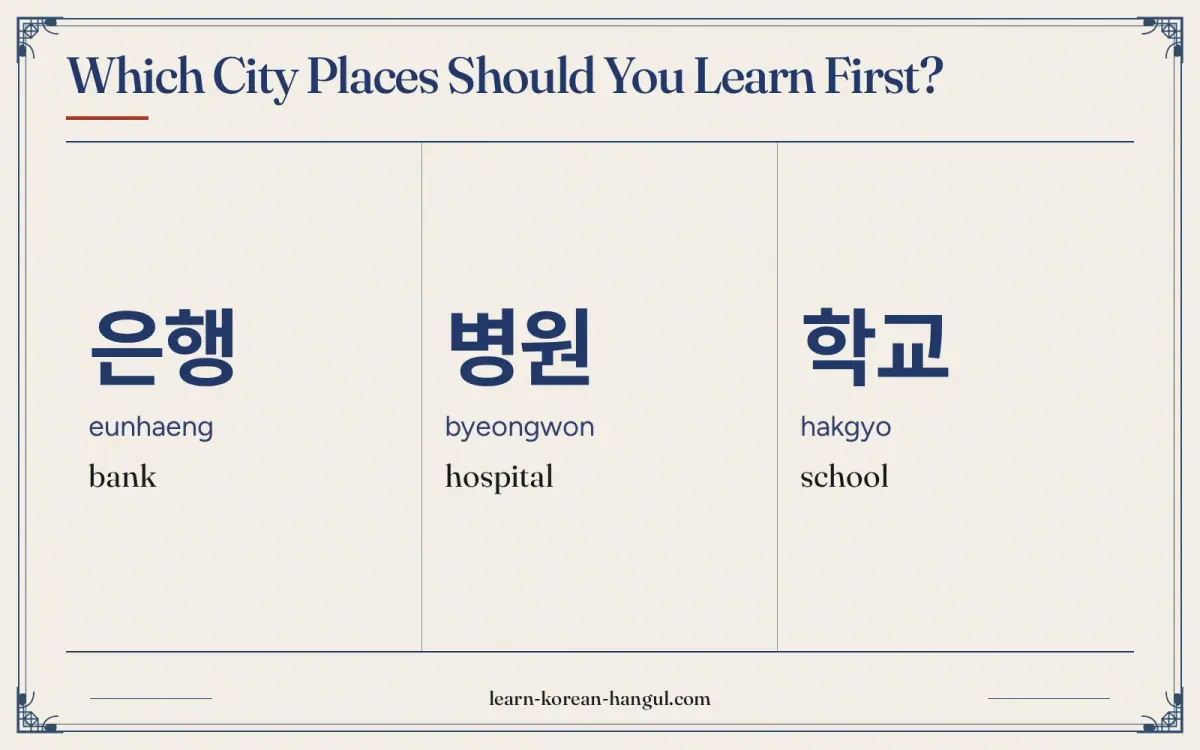
Learn 은행, 병원, 학교, 약국, 편의점 and 역 first. These six are the stops of an ordinary day, and each appears on a street sign. Add 화장실 (toilet) from the places hub, and 공원 (park) for a break. After these, work through the groups in order.
- Words to read on signs. 은행, 병원, 약국, 우체국, 경찰서, 주차장.
- Words to say when asking the way. 역, 버스 정류장, 편의점, 사거리, 횡단보도.
- Words to recognise in conversation. 동네, 골목, 부동산, 헬스장, 찜질방.
Before you start, remember a habit of Korean cities: businesses stack vertically. One building can hold a 병원 on the second floor, a 약국 on the first and a 노래방 in the basement. A sign lists the floor with the name, so a place word usually comes with a floor number.
Word · 10
- 1
은행
eunhaeng
bank
- 2
병원
byeongwon
hospital
- 3
학교
hakgyo
school
- 4
도서관
doseogwan
library
- 5
우체국
ucheguk
post office
- 6
경찰서
gyeongchalseo
police station
- 7
공원
gongwon
park
- 8
시장
sijang
market
- 9
편의점
pyeonuijeom
convenience store
- 10
약국
yakguk
pharmacy
Public Buildings
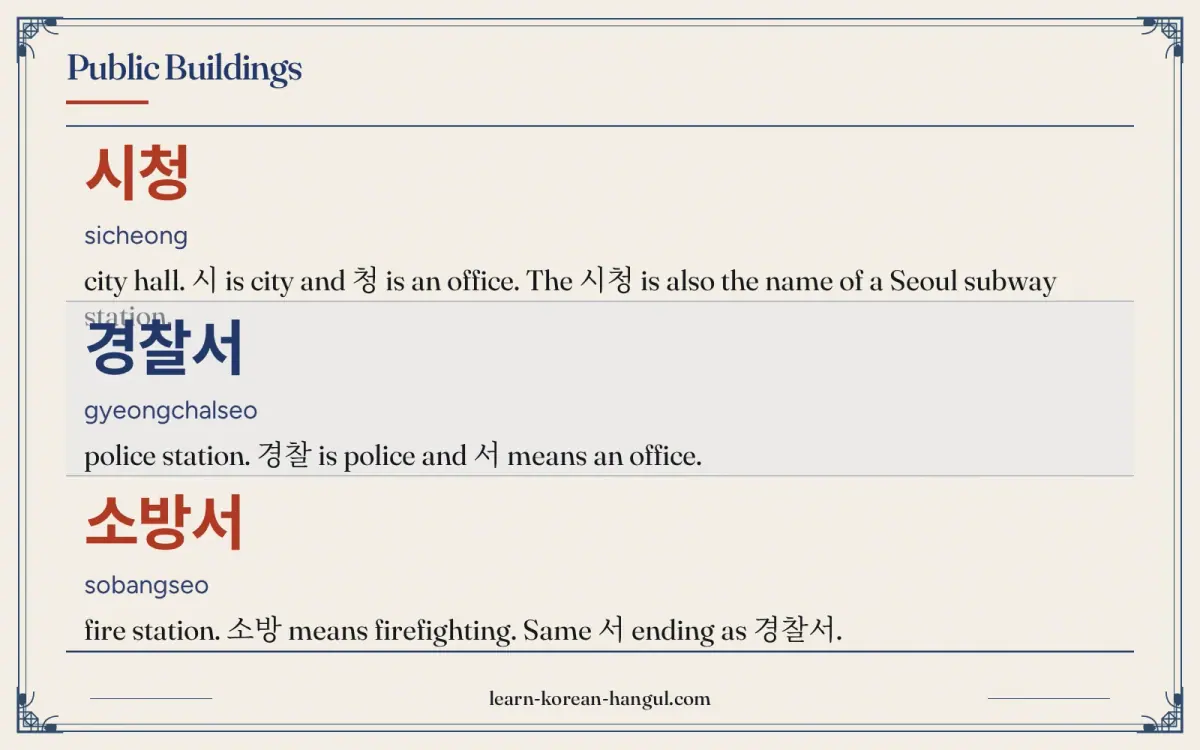
These ten buildings serve the whole city. Most end in a suffix that names the kind of place, such as -서 (an office, as in 경찰서) or -관 (a hall, as in 도서관).
| No. | Hangul | Revised Romanization | Meaning and note | Example sentence | Audio assetId |
|---|---|---|---|---|---|
| 1 | 시청 | sicheong | city hall. 시 is city and 청 is an office. The 시청 is also the name of a Seoul subway station. | 시청에서 서류를 받아요. (I get documents at city hall.) | au-pg-vocabulary-places-city-1; example: au-pg-vocabulary-places-city-2 |
| 2 | 경찰서 | gyeongchalseo | police station. 경찰 is police and 서 means an office. | 경찰서가 저기 있어요. (The police station is over there.) | au-pg-vocabulary-places-city-3; example: au-pg-vocabulary-places-city-4 |
| 3 | 소방서 | sobangseo | fire station. 소방 means firefighting. Same 서 ending as 경찰서. | 소방서는 학교 옆에 있어요. (The fire station is next to the school.) | au-pg-vocabulary-places-city-5; example: au-pg-vocabulary-places-city-6 |
| 4 | 우체국 | ucheguk | post office. The place for letters and parcels. The full word list is on a separate page. | 우체국에 가요. (I go to the post office.) | au-pg-vocabulary-places-city-7; example: au-pg-vocabulary-places-city-8 |
| 5 | 은행 | eunhaeng | bank. The word uses none of the place endings. Most banks give out a queue ticket at the door. | 은행에서 돈을 찾아요. (I withdraw money at the bank.) | au-pg-vocabulary-places-city-9; example: au-pg-vocabulary-places-city-10 |
| 6 | 도서관 | doseogwan | library. 도서 means books and 관 marks a public hall. | 도서관에서 책을 빌려요. (I borrow a book at the library.) | au-pg-vocabulary-places-city-11; example: au-pg-vocabulary-places-city-12 |
| 7 | 병원 | byeongwon | hospital. 병 is illness and 원 is an institute. The word covers clinics too. | 병원이 어디예요? (Where is the hospital?) | au-pg-vocabulary-places-city-13; example: au-pg-vocabulary-places-city-14 |
| 8 | 학교 | hakgyo | school. Said [학꾜]. The general word for school at any level. | 학교에 가요. (I go to school.) | au-pg-vocabulary-places-city-15; example: au-pg-vocabulary-places-city-16 |
| 9 | 대학교 | daehakgyo | university. Said [대학꾜]. Short form: 대학. 대학생 is a university student. | 대학교는 서울에 있어요. (The university is in Seoul.) | au-pg-vocabulary-places-city-17; example: au-pg-vocabulary-places-city-18 |
| 10 | 대사관 | daesagwan | embassy. 대사 is ambassador and 관 marks a hall. Foreign travellers use this word when they lose a passport. | 대사관에 전화해요. (I call the embassy.) | au-pg-vocabulary-places-city-19; example: au-pg-vocabulary-places-city-20 |
The endings help you read ahead. Words ending in 서 name an office (경찰서, 소방서), and those ending in 관 name a hall (도서관, 대사관). The two particles in the examples, 에 and 에서, do different jobs, which a later section explains.
Shops and Stores
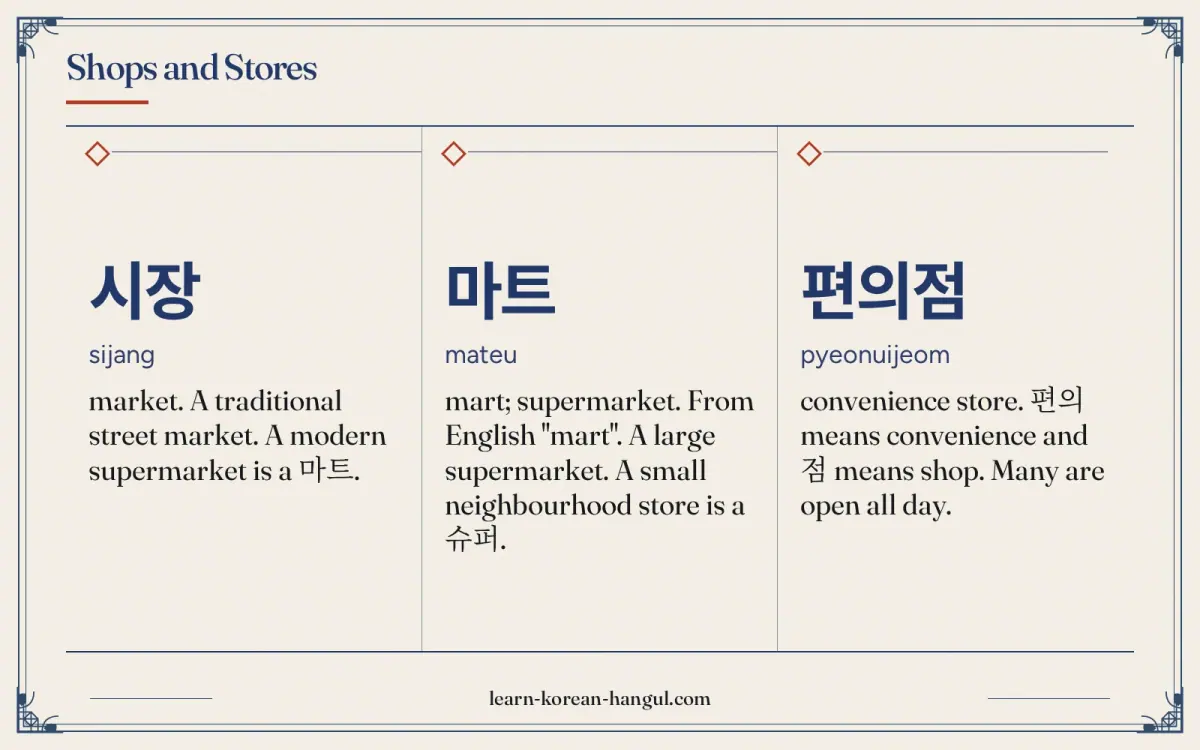
Shops are the most common places in a Korean street. Ten words cover the stores a visitor uses most; the full set of shop types is on the shops and buildings page.
| No. | Hangul | Revised Romanization | Meaning and note | Example sentence | Audio assetId |
|---|---|---|---|---|---|
| 11 | 시장 | sijang | market. A traditional street market. A modern supermarket is a 마트. | 시장에서 과일을 사요. (I buy fruit at the market.) | au-pg-vocabulary-places-city-21; example: au-pg-vocabulary-places-city-22 |
| 12 | 마트 | mateu | mart; supermarket. From English "mart". A large supermarket. A small neighbourhood store is a 슈퍼. | 마트에 가요. (I go to the supermarket.) | au-pg-vocabulary-places-city-23; example: au-pg-vocabulary-places-city-24 |
| 13 | 편의점 | pyeonuijeom | convenience store. 편의 means convenience and 점 means shop. Many are open all day. | 편의점에서 물을 사요. (I buy water at the convenience store.) | au-pg-vocabulary-places-city-25; example: au-pg-vocabulary-places-city-26 |
| 14 | 백화점 | baekhwajeom | department store. Literally "hundred-goods shop". Said [배콰점]. | 백화점에서 옷을 사요. (I buy clothes at the department store.) | au-pg-vocabulary-places-city-27; example: au-pg-vocabulary-places-city-28 |
| 15 | 서점 | seojeom | bookstore. 서 is book and 점 is shop. Often sits next to a stationery shop. | 서점에서 책을 사요. (I buy a book at the bookstore.) | au-pg-vocabulary-places-city-29; example: au-pg-vocabulary-places-city-30 |
| 16 | 약국 | yakguk | pharmacy. Said [약꾹]. Medicine is sold here with a pharmacist's advice. | 약국에서 약을 사요. (I buy medicine at the pharmacy.) | au-pg-vocabulary-places-city-31; example: au-pg-vocabulary-places-city-32 |
| 17 | 빵집 | ppangjip | bakery. Said [빵찝]. 집 here means a shop, not a house. | 빵집에서 빵을 사요. (I buy bread at the bakery.) | au-pg-vocabulary-places-city-33; example: au-pg-vocabulary-places-city-34 |
| 18 | 꽃집 | kkotjip | flower shop. Said [꼳찝]. The same 집 as in 빵집. | 꽃집은 지하철역 앞에 있어요. (The flower shop is in front of the subway station.) | au-pg-vocabulary-places-city-35; example: au-pg-vocabulary-places-city-36 |
| 19 | 식당 | sikdang | restaurant. Said [식땅]. The general word for a place to eat a meal. | 식당에서 점심을 먹어요. (I eat lunch at a restaurant.) | au-pg-vocabulary-places-city-37; example: au-pg-vocabulary-places-city-38 |
| 20 | 카페 | kape | cafe. A loanword. Cafes are everywhere, and they are a study spot for many students. | 카페에서 커피를 마셔요. (I drink coffee at a cafe.) | au-pg-vocabulary-places-city-39; example: au-pg-vocabulary-places-city-40 |
Two endings meet here. The formal ending -점 (as in 서점 and 편의점) and the colloquial ending -집 (as in 빵집 and 꽃집) both mean a shop. The -집 words are everyday speech and sound more homely. For the many other shop types, see Korean Shops and Buildings Vocabulary.
Leisure Places
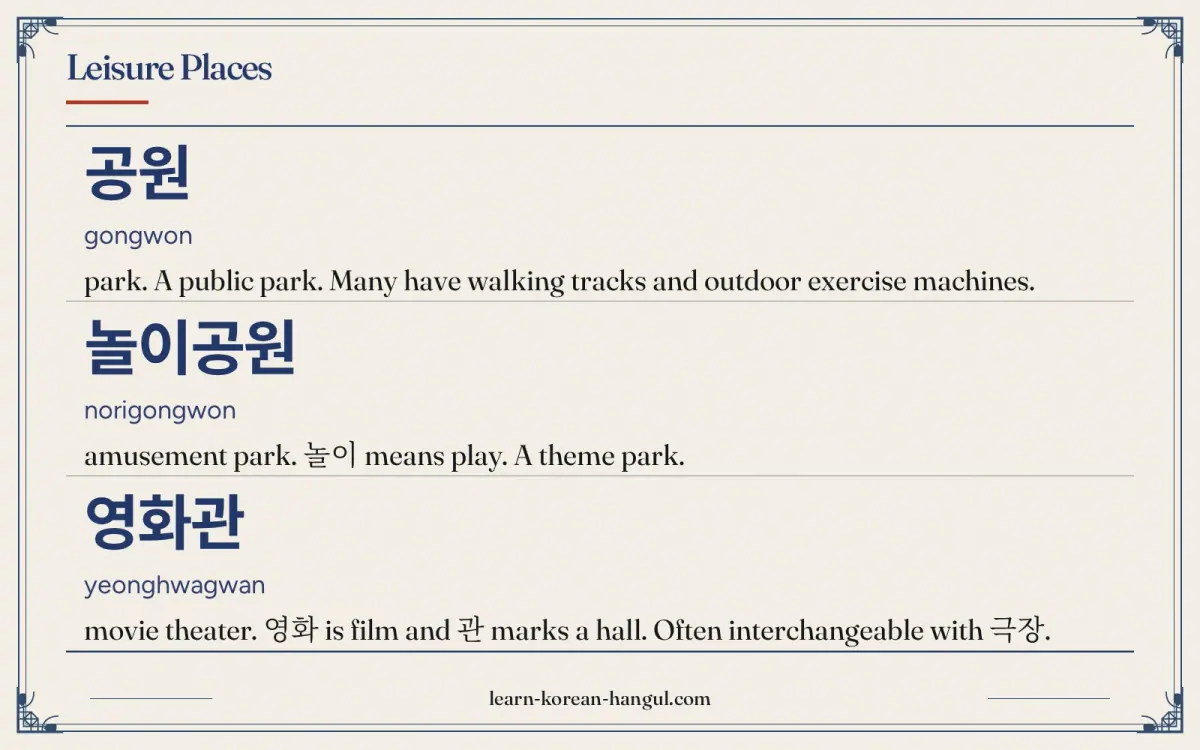
Koreans spend free time in places that have no exact English equivalent. This group has the standard parks and cultural halls, and three uniquely Korean spaces: the singing room, the PC room and the bathhouse.
| No. | Hangul | Revised Romanization | Meaning and note | Example sentence | Audio assetId |
|---|---|---|---|---|---|
| 21 | 공원 | gongwon | park. A public park. Many have walking tracks and outdoor exercise machines. | 공원에서 산책해요. (I take a walk in the park.) | au-pg-vocabulary-places-city-41; example: au-pg-vocabulary-places-city-42 |
| 22 | 놀이공원 | norigongwon | amusement park. 놀이 means play. A theme park. | 놀이공원에 가고 싶어요. (I want to go to the amusement park.) | au-pg-vocabulary-places-city-43; example: au-pg-vocabulary-places-city-44 |
| 23 | 영화관 | yeonghwagwan | movie theater. 영화 is film and 관 marks a hall. Often interchangeable with 극장. | 영화관에서 영화를 봐요. (I watch a movie at the movie theater.) | au-pg-vocabulary-places-city-45; example: au-pg-vocabulary-places-city-46 |
| 24 | 극장 | geukjang | theater; cinema. Said [극짱]. 극장 is the older word for a movie house. | 극장은 이쪽이에요. (The theater is this way.) | au-pg-vocabulary-places-city-47; example: au-pg-vocabulary-places-city-48 |
| 25 | 미술관 | misulgwan | art museum. 미술 means art. Shows paintings and modern work. | 미술관에서 그림을 봐요. (I look at pictures at the art museum.) | au-pg-vocabulary-places-city-49; example: au-pg-vocabulary-places-city-50 |
| 26 | 박물관 | bangmulgwan | museum. Said [방물관]. Shows history and objects. | 박물관은 월요일에 쉬어요. (The museum is closed on Monday.) | au-pg-vocabulary-places-city-51; example: au-pg-vocabulary-places-city-52 |
| 27 | 노래방 | noraebang | karaoke room. Literally "song room". A private room you rent by the hour. | 친구와 노래방에 가요. (I go to the karaoke room with friends.) | au-pg-vocabulary-places-city-53; example: au-pg-vocabulary-places-city-54 |
| 28 | PC방 | pisibang | internet cafe; gaming room. Read 피시방, often heard as [피씨방]. A room full of computers for games. | PC방에서 게임을 해요. (I play games at the PC room.) | au-pg-vocabulary-places-city-55; example: au-pg-vocabulary-places-city-56 |
| 29 | 찜질방 | jjimjilbang | Korean bathhouse; sauna. Said [찜질빵]. A large public bath with hot rooms and sleeping areas. | 주말에 찜질방에 가요. (I go to the bathhouse on weekends.) | au-pg-vocabulary-places-city-57; example: au-pg-vocabulary-places-city-58 |
| 30 | 운동장 | undongjang | sports ground; playground. 운동 means exercise and 장 means a field or lot. Found at schools. | 아이들이 운동장에서 놀아요. (The children play on the playground.) | au-pg-vocabulary-places-city-59; example: au-pg-vocabulary-places-city-60 |
The suffix -방 (bang, room) is the key to three of the most Korean places on this list: 노래방, PC방 and 찜질방. Each is a room, or a set of rooms, that you rent for a time. Learn the suffix and you can read 만화방 (comic-book room) and others. The words are everyday speech and appear in many dramas.
Services and Stations
This group holds the places you visit for a single errand: catching transport, parking, cleaning clothes or getting a haircut. Several end in -소, -실 or -장, which name the kind of place.
| No. | Hangul | Revised Romanization | Meaning and note | Example sentence | Audio assetId |
|---|---|---|---|---|---|
| 31 | 역 | yeok | station. A train or subway station. Station names come first in directions. | 역 앞에서 만나요. (Let's meet in front of the station.) | au-pg-vocabulary-places-city-61; example: au-pg-vocabulary-places-city-62 |
| 32 | 버스 정류장 | beoseu jeongnyujang | bus stop. Said [버스 정뉴장]. 정류장 is a stopping place. | 버스 정류장은 저기예요. (The bus stop is over there.) | au-pg-vocabulary-places-city-63; example: au-pg-vocabulary-places-city-64 |
| 33 | 주차장 | juchajang | parking lot. 주차 means parking and 장 means a lot. | 주차장은 지하에 있어요. (The parking lot is underground.) | au-pg-vocabulary-places-city-65; example: au-pg-vocabulary-places-city-66 |
| 34 | 주유소 | juyuso | gas station. 주유 means refuelling and 소 marks a small place. | 주유소가 가까워요. (The gas station is close.) | au-pg-vocabulary-places-city-67; example: au-pg-vocabulary-places-city-68 |
| 35 | 세탁소 | setakso | laundry; dry cleaner. 세탁 is washing. The same 소 ending as 주유소. | 세탁소에 옷을 맡겨요. (I leave clothes at the dry cleaner.) | au-pg-vocabulary-places-city-69; example: au-pg-vocabulary-places-city-70 |
| 36 | 미용실 | miyongsil | hair salon. 미용 means beauty care and 실 means room. | 미용실에서 머리를 잘라요. (I get a haircut at the hair salon.) | au-pg-vocabulary-places-city-71; example: au-pg-vocabulary-places-city-72 |
| 37 | 헬스장 | helseujang | gym. 헬스 is from English "health". Also called 헬스클럽. | 헬스장에서 운동해요. (I exercise at the gym.) | au-pg-vocabulary-places-city-73; example: au-pg-vocabulary-places-city-74 |
| 38 | 부동산 | budongsan | real estate agency; real estate. Literally "not-moving property". Agencies display listings in the window. | 부동산에서 집을 찾아요. (I look for a house at the real estate agency.) | au-pg-vocabulary-places-city-75; example: au-pg-vocabulary-places-city-76 |
| 39 | 안경점 | angyeongjeom | optician; glasses shop. 안경 means glasses and 점 means shop. | 안경점에서 안경을 맞춰요. (I get glasses made at the optician.) | au-pg-vocabulary-places-city-77; example: au-pg-vocabulary-places-city-78 |
| 40 | 사진관 | sajingwan | photo studio. 사진 means photo and 관 marks a hall. Used for passport and ID photos. | 사진관에서 증명사진을 찍어요. (I get an ID photo taken at the photo studio.) | au-pg-vocabulary-places-city-79; example: au-pg-vocabulary-places-city-80 |
Notice the endings again: 주유소 and 세탁소 end in 소, 미용실 in 실, and 주차장 and 헬스장 in 장. The endings group places by type: -소 is a service point, -실 a room and -장 a field or lot. The rule is a guide, not a law, and many words fall outside it, such as 역.
Streets and Neighbourhoods
The last group names the spaces between buildings: roads, crossings, bridges and the neighbourhood itself. These are the words you use to say where to meet or how to get there.
| No. | Hangul | Revised Romanization | Meaning and note | Example sentence | Audio assetId |
|---|---|---|---|---|---|
| 41 | 길 | gil | road; way. The most general word. Also means a path in an abstract way, as in 길을 잃다 (get lost). | 이 길로 가세요. (Please go this way.) | au-pg-vocabulary-places-city-81; example: au-pg-vocabulary-places-city-82 |
| 42 | 도로 | doro | road; roadway. A formal word for a paved road for cars. | 도로가 막혀요. (The road is jammed.) | au-pg-vocabulary-places-city-83; example: au-pg-vocabulary-places-city-84 |
| 43 | 거리 | geori | street. A street with shops and people, often for a walk. Not to be confused with 거리 meaning distance. | 거리에 사람이 많아요. (There are many people on the street.) | au-pg-vocabulary-places-city-85; example: au-pg-vocabulary-places-city-86 |
| 44 | 골목 | golmok | alley. A narrow lane between buildings. Many small cafes hide in 골목. | 골목 끝에 식당이 있어요. (There is a restaurant at the end of the alley.) | au-pg-vocabulary-places-city-87; example: au-pg-vocabulary-places-city-88 |
| 45 | 사거리 | sageori | four-way intersection. 사 is four and 거리 is street. Used as a meeting landmark. | 사거리에서 오른쪽으로 가세요. (Turn right at the intersection.) | au-pg-vocabulary-places-city-89; example: au-pg-vocabulary-places-city-90 |
| 46 | 횡단보도 | hoengdanbodo | crosswalk. 횡단 is crossing and 보도 is a sidewalk. | 횡단보도를 건너요. (I cross the crosswalk.) | au-pg-vocabulary-places-city-91; example: au-pg-vocabulary-places-city-92 |
| 47 | 신호등 | sinhodeung | traffic light. 신호 is signal and 등 means light. | 신호등이 빨간색이에요. (The traffic light is red.) | au-pg-vocabulary-places-city-93; example: au-pg-vocabulary-places-city-94 |
| 48 | 다리 | dari | bridge. The same sound as the word for leg, 다리. Context shows which meaning. | 다리를 건너요. (I cross the bridge.) | au-pg-vocabulary-places-city-95; example: au-pg-vocabulary-places-city-96 |
| 49 | 인도 | indo | sidewalk. The path for walkers beside the road. 보도 is a synonym. | 인도로 걸어가세요. (Please walk on the sidewalk.) | au-pg-vocabulary-places-city-97; example: au-pg-vocabulary-places-city-98 |
| 50 | 동네 | dongne | neighborhood; local area. A friendly word for one's own area. A person's 동네 is the streets around their home. | 우리 동네는 조용해요. (Our neighborhood is quiet.) | au-pg-vocabulary-places-city-99; example: au-pg-vocabulary-places-city-100 |
Two words here are homophones. 다리 means bridge and leg, and 거리 means street and distance. Read the surrounding words to know which is meant: 다리를 건너요 (I cross the bridge) versus 다리가 아파요 (my leg hurts). The directions page uses 사거리 and 횡단보도 constantly: see Korean Directions Vocabulary.
How Do You Say 'Go to a Place' and 'Be at a Place'?
Two frames carry the whole page. To say you go somewhere, use [place]에 가요. To say you are or something is at a place, use [place]에 있어요. To say where you do an action, use [place]에서 + verb. The particle 에 marks a destination or a location of being, and 에서 marks the place of an action.
| Meaning | Pattern | Example | Translation |
|---|---|---|---|
| Go to a place | [place]에 가요 | 은행에 가요. | I go to the bank. |
| Be at a place | [place]에 있어요 | 은행에 있어요. | I am at the bank. |
| Do something at a place | [place]에서 + verb | 은행에서 일해요. | I work at the bank. |
| Ask where a place is | [place]이/가 어디예요? | 병원이 어디예요? | Where is the hospital? |
The contrast is easy to test: 도서관에 있어요 (I am at the library) versus 도서관에서 공부해요 (I study at the library). The first describes where you are. The second names where an action takes place. The location particles page explains the rule in full.
Which Places Are Special to Korean Cities?
Four places on this page have no neat English equivalent, and visitors often ask about them.
- 찜질방. A large public bathhouse with hot rooms, sleeping areas and snacks. Families go on weekends, and some are open all night.
- 노래방. A private karaoke room rented by the hour, not a bar stage. A group sings in turn.
- PC방. A room of computers where people play online games and pay by the hour.
- 편의점. More than a shop: many convenience stores have tables and hot water, and people eat ramyeon there.
All four are part of daily life, and each appears in dramas. They are also useful words for making a plan with a friend: 오늘 노래방 갈래요? (Shall we go to the karaoke room today?).
What Do the Endings -관, -원, -소, -실 and -점 Mean?
Place words are built from a root plus a short ending. The table shows each ending, its meaning and examples from the list above.
| Ending | Meaning | Examples on this page |
|---|---|---|
| -관 | hall or public building | 도서관, 박물관, 미술관, 영화관, 대사관 |
| -원 | garden, park or institute | 공원, 병원 |
| -소 | a small service place | 주유소, 세탁소 |
| -실 | room | 미용실 |
| -점 | shop | 서점, 편의점, 백화점, 안경점 |
| -서 | office | 경찰서, 소방서 |
| -방 | room, rented by time | 노래방, PC방, 찜질방 |
| -집 | shop (colloquial) | 빵집, 꽃집 |
Use the ending to guess. If you meet 약국 or 학원 for the first time, the ending tells you the kind of place before you check the dictionary. The pattern also helps you build sentences, such as 서점에서 책을 사요 (I buy a book at the bookstore).
How Do You Pronounce Korean Place Words?
Place words contain many tense sounds that the spelling does not show. The Revised Romanization of Korean records the spelling and ignores most of these changes. The standard pronunciation rules published by the National Institute of Korean Language (국립국어원) give the spoken form.
| Spelling | Sounds like | What changes |
|---|---|---|
| 약국 | [약꾹] | After a final ㄱ, the ㄱ of 국 becomes tense [ㄲ]. |
| 식당 | [식땅] | After a final ㄱ, the ㄷ of 당 becomes tense [ㄸ]. |
| 학교 | [학꾜] | After a final ㄱ, the ㄱ of 교 becomes tense [ㄲ]. |
| 빵집 | [빵찝] | In this compound the ㅈ of 집 is said tense [ㅉ], although nothing in the spelling shows it. |
| 꽃집 | [꼳찝] | The final ㅊ is said [ㄷ], and the ㅈ of 집 becomes tense. |
| 박물관 | [방물관] | The final ㄱ becomes [ㅇ] before ㅁ. |
| 찜질방 | [찜질빵] | The ㅂ of 방 becomes tense [ㅃ] in this compound. |
| 버스 정류장 | [버스 정뉴장] | The ㄹ of 류 becomes [ㄴ] after ㅇ. |
The tense sounds in 약국, 식당 and 학교 are the easiest to miss. Say the second consonant tight, with no puff of air, as if you stopped just before saying it. The Hangul does not show the change, so the audio is the best guide.
Audio and Slow Playback
Each headword and each example sentence has its own audio clip. The clips below replay the trickiest words at a slower pace. Play one, repeat it aloud, then play it again and compare.
What Mistakes Do Learners Make with City Places?
These five mistakes come up most when learners talk about places.
- Using 에 for an action place. Say 도서관에서 공부해요 (I study at the library), not 도서관에 공부해요.
- Reading 집 only as "house". In 빵집 and 꽃집, 집 means a shop. In 우리 집 it means home. Context decides.
- Confusing 마트 and 시장. 마트 is a supermarket and 시장 is an open market with stalls.
- Missing the tense sound. 약국 is said [약꾹], with a tight kk sound in the second syllable, not a soft yak-guk. The spelling hides it.
- Mixing 다리 meanings. 다리 is both bridge and leg. Use 다리를 건너요 for the bridge.
If you remember only one, remember 에 versus 에서, because it changes every place sentence.
Practice: Flashcards and Worksheet
Study in three steps. First, run the flashcard deck in recognition mode until you know each of the 50 words. Second, switch to listening mode and answer from the audio alone. Third, take the quiz. The deck covers all 50 words with audio, and your progress stays in your browser. The vocabulary flashcard decks page lists the other decks.
Practice · 105
- 01시청
Show answer
headword 1: city hall
- 02시청에서 서류를 받아요.
Show answer
example sentence for 시청: I get documents at city hall.
- 03경찰서
Show answer
headword 2: police station
- 04경찰서가 저기 있어요.
Show answer
example sentence for 경찰서: The police station is over there.
- 05소방서
Show answer
headword 3: fire station
- 06소방서는 학교 옆에 있어요.
Show answer
example sentence for 소방서: The fire station is next to the school.
- 07우체국
Show answer
headword 4: post office
- 08우체국에 가요.
Show answer
example sentence for 우체국: I go to the post office.
- 09은행
Show answer
headword 5: bank
- 10은행에서 돈을 찾아요.
Show answer
example sentence for 은행: I withdraw money at the bank.
- 11도서관
Show answer
headword 6: library
- 12도서관에서 책을 빌려요.
Show answer
example sentence for 도서관: I borrow a book at the library.
- 13병원
Show answer
headword 7: hospital
- 14병원이 어디예요?
Show answer
example sentence for 병원: Where is the hospital?
- 15학교
Show answer
headword 8: school
- 16학교에 가요.
Show answer
example sentence for 학교: I go to school.
- 17대학교
Show answer
headword 9: university
- 18대학교는 서울에 있어요.
Show answer
example sentence for 대학교: The university is in Seoul.
- 19대사관
Show answer
headword 10: embassy
- 20대사관에 전화해요.
Show answer
example sentence for 대사관: I call the embassy.
- 21시장
Show answer
headword 11: market
- 22시장에서 과일을 사요.
Show answer
example sentence for 시장: I buy fruit at the market.
- 23마트
Show answer
headword 12: mart; supermarket
- 24마트에 가요.
Show answer
example sentence for 마트: I go to the supermarket.
- 25편의점
Show answer
headword 13: convenience store
- 26편의점에서 물을 사요.
Show answer
example sentence for 편의점: I buy water at the convenience store.
- 27백화점
Show answer
headword 14: department store
- 28백화점에서 옷을 사요.
Show answer
example sentence for 백화점: I buy clothes at the department store.
- 29서점
Show answer
headword 15: bookstore
- 30서점에서 책을 사요.
Show answer
example sentence for 서점: I buy a book at the bookstore.
- 31약국
Show answer
headword 16: pharmacy
- 32약국에서 약을 사요.
Show answer
example sentence for 약국: I buy medicine at the pharmacy.
- 33빵집
Show answer
headword 17: bakery
- 34빵집에서 빵을 사요.
Show answer
example sentence for 빵집: I buy bread at the bakery.
- 35꽃집
Show answer
headword 18: flower shop
- 36꽃집은 지하철역 앞에 있어요.
Show answer
example sentence for 꽃집: The flower shop is in front of the subway station.
- 37식당
Show answer
headword 19: restaurant
- 38식당에서 점심을 먹어요.
Show answer
example sentence for 식당: I eat lunch at a restaurant.
- 39카페
Show answer
headword 20: cafe
- 40카페에서 커피를 마셔요.
Show answer
example sentence for 카페: I drink coffee at a cafe.
- 41공원
Show answer
headword 21: park
- 42공원에서 산책해요.
Show answer
example sentence for 공원: I take a walk in the park.
- 43놀이공원
Show answer
headword 22: amusement park
- 44놀이공원에 가고 싶어요.
Show answer
example sentence for 놀이공원: I want to go to the amusement park.
- 45영화관
Show answer
headword 23: movie theater
- 46영화관에서 영화를 봐요.
Show answer
example sentence for 영화관: I watch a movie at the movie theater.
- 47극장
Show answer
headword 24: theater; cinema
- 48극장은 이쪽이에요.
Show answer
example sentence for 극장: The theater is this way.
- 49미술관
Show answer
headword 25: art museum
- 50미술관에서 그림을 봐요.
Show answer
example sentence for 미술관: I look at pictures at the art museum.
- 51박물관
Show answer
headword 26: museum
- 52박물관은 월요일에 쉬어요.
Show answer
example sentence for 박물관: The museum is closed on Monday.
- 53노래방
Show answer
headword 27: karaoke room
- 54친구와 노래방에 가요.
Show answer
example sentence for 노래방: I go to the karaoke room with friends.
- 55PC방
Show answer
headword 28: internet cafe; gaming room
- 56PC방에서 게임을 해요.
Show answer
example sentence for PC방: I play games at the PC room.
- 57찜질방
Show answer
headword 29: Korean bathhouse; sauna
- 58주말에 찜질방에 가요.
Show answer
example sentence for 찜질방: I go to the bathhouse on weekends.
- 59운동장
Show answer
headword 30: sports ground; playground
- 60아이들이 운동장에서 놀아요.
Show answer
example sentence for 운동장: The children play on the playground.
- 61역
Show answer
headword 31: station
- 62역 앞에서 만나요.
Show answer
example sentence for 역: Let's meet in front of the station.
- 63버스 정류장
Show answer
headword 32: bus stop
- 64버스 정류장은 저기예요.
Show answer
example sentence for 버스 정류장: The bus stop is over there.
- 65주차장
Show answer
headword 33: parking lot
- 66주차장은 지하에 있어요.
Show answer
example sentence for 주차장: The parking lot is underground.
- 67주유소
Show answer
headword 34: gas station
- 68주유소가 가까워요.
Show answer
example sentence for 주유소: The gas station is close.
- 69세탁소
Show answer
headword 35: laundry; dry cleaner
- 70세탁소에 옷을 맡겨요.
Show answer
example sentence for 세탁소: I leave clothes at the dry cleaner.
- 71미용실
Show answer
headword 36: hair salon
- 72미용실에서 머리를 잘라요.
Show answer
example sentence for 미용실: I get a haircut at the hair salon.
- 73헬스장
Show answer
headword 37: gym
- 74헬스장에서 운동해요.
Show answer
example sentence for 헬스장: I exercise at the gym.
- 75부동산
Show answer
headword 38: real estate agency; real estate
- 76부동산에서 집을 찾아요.
Show answer
example sentence for 부동산: I look for a house at the real estate agency.
- 77안경점
Show answer
headword 39: optician; glasses shop
- 78안경점에서 안경을 맞춰요.
Show answer
example sentence for 안경점: I get glasses made at the optician.
- 79사진관
Show answer
headword 40: photo studio
- 80사진관에서 증명사진을 찍어요.
Show answer
example sentence for 사진관: I get an ID photo taken at the photo studio.
- 81길
Show answer
headword 41: road; way
- 82이 길로 가세요.
Show answer
example sentence for 길: Please go this way.
- 83도로
Show answer
headword 42: road; roadway
- 84도로가 막혀요.
Show answer
example sentence for 도로: The road is jammed.
- 85거리
Show answer
headword 43: street
- 86거리에 사람이 많아요.
Show answer
example sentence for 거리: There are many people on the street.
- 87골목
Show answer
headword 44: alley
- 88골목 끝에 식당이 있어요.
Show answer
example sentence for 골목: There is a restaurant at the end of the alley.
- 89사거리
Show answer
headword 45: four-way intersection
- 90사거리에서 오른쪽으로 가세요.
Show answer
example sentence for 사거리: Turn right at the intersection.
- 91횡단보도
Show answer
headword 46: crosswalk
- 92횡단보도를 건너요.
Show answer
example sentence for 횡단보도: I cross the crosswalk.
- 93신호등
Show answer
headword 47: traffic light
- 94신호등이 빨간색이에요.
Show answer
example sentence for 신호등: The traffic light is red.
- 95다리
Show answer
headword 48: bridge
- 96다리를 건너요.
Show answer
example sentence for 다리: I cross the bridge.
- 97인도
Show answer
headword 49: sidewalk
- 98인도로 걸어가세요.
Show answer
example sentence for 인도: Please walk on the sidewalk.
- 99동네
Show answer
headword 50: neighborhood; local area
- 100우리 동네는 조용해요.
Show answer
example sentence for 동네: Our neighborhood is quiet.
- 101약국
Show answer
slow playback of 약국
- 102학교
Show answer
slow playback of 학교
- 103박물관
Show answer
slow playback of 박물관
- 104찜질방
Show answer
slow playback of 찜질방
- 105횡단보도
Show answer
slow playback of 횡단보도
Practice · 5
What does 약국 (yakguk) mean?
Show answer
pharmacy
약국 means pharmacy. Example: 약국에서 약을 사요. (I buy medicine at the pharmacy.)
What does 미술관 (misulgwan) mean?
Show answer
art museum
미술관 means art museum. Example: 미술관에서 그림을 봐요. (I look at pictures at the art museum.)
What does 사거리 (sageori) mean?
Show answer
four-way intersection
사거리 means four-way intersection. Example: 사거리에서 오른쪽으로 가세요. (Turn right at the intersection.)
What does 경찰서 (gyeongchalseo) mean?
Show answer
police station
경찰서 means police station. Example: 경찰서가 저기 있어요. (The police station is over there.)
What does 찜질방 (jjimjilbang) mean?
Show answer
Korean bathhouse; sauna
찜질방 means Korean bathhouse; sauna. Example: 주말에 찜질방에 가요. (I go to the bathhouse on weekends.)
Korean City Vocabulary Worksheet (PDF)
A printable worksheet for these words (word list, matching, writing practice, fill-in-the-blank exercises and answer key) is available in A4 and US Letter from the download card on this page. For practice, copy the 50 words by hand and write the meaning next to each. Draw a map of your own street and label the places in Korean.
Where to Go Next
After this page, continue with Korean Post Office Vocabulary or Korean Shops and Buildings Vocabulary, the two deeper pages. For getting around, see Transportation, Travel and Airport and Korean Directions Vocabulary. To move up a level, return to Places and Travel.
Frequently Asked Questions
How Do You Say Art Museum in Korean?
Art museum is 미술관 (misulgwan). 미술 means art and 관 marks a public hall. A general museum, for history and objects, is 박물관 (bangmulgwan), said [방물관]. Say mi-sul-gwan, and ask 미술관이 어디예요? (Where is the art museum?).
How Do You Say Bookstore in Korean?
Bookstore is 서점 (seojeom), from 서 (book) and 점 (shop). In a sentence, 서점에서 책을 사요 means I buy a book at the bookstore. Say seo-jeom, with two clear syllables. A shop for pens and notebooks is a different place, the 문구점.
How Do You Say Cafe in Korean?
Cafe is 카페 (kape), a loanword from English. Many shop signs also write it in Latin letters, as CAFE. It is used for coffee shops of every kind, and many students use cafes as study spots. Say 카페에서 커피를 마셔요 for I drink coffee at a cafe.
How Do You Pronounce 미술관?
Say mi-sul-gwan, with three short syllables. The ㄹ at the end of 술 is a light l that runs straight into 관, and there is no hidden sound change. Play the 미술관 clip in the leisure table to hear the normal speed.
What Is the Difference between 에 and 에서 with Places?
에 marks a destination or a place of being: 은행에 가요 (I go to the bank), 은행에 있어요 (I am at the bank). 에서 marks the place where an action happens: 은행에서 일해요 (I work at the bank).
Is the Romanization on This Page Official?
It follows the Revised Romanization of Korean, which South Korea adopted on 7 July 2000 and whose rules the National Institute of Korean Language (국립국어원) publishes. It is a learning aid and does not mark every sound change, so rely on the Hangul and the audio.