Korean Airport Vocabulary at a Glance
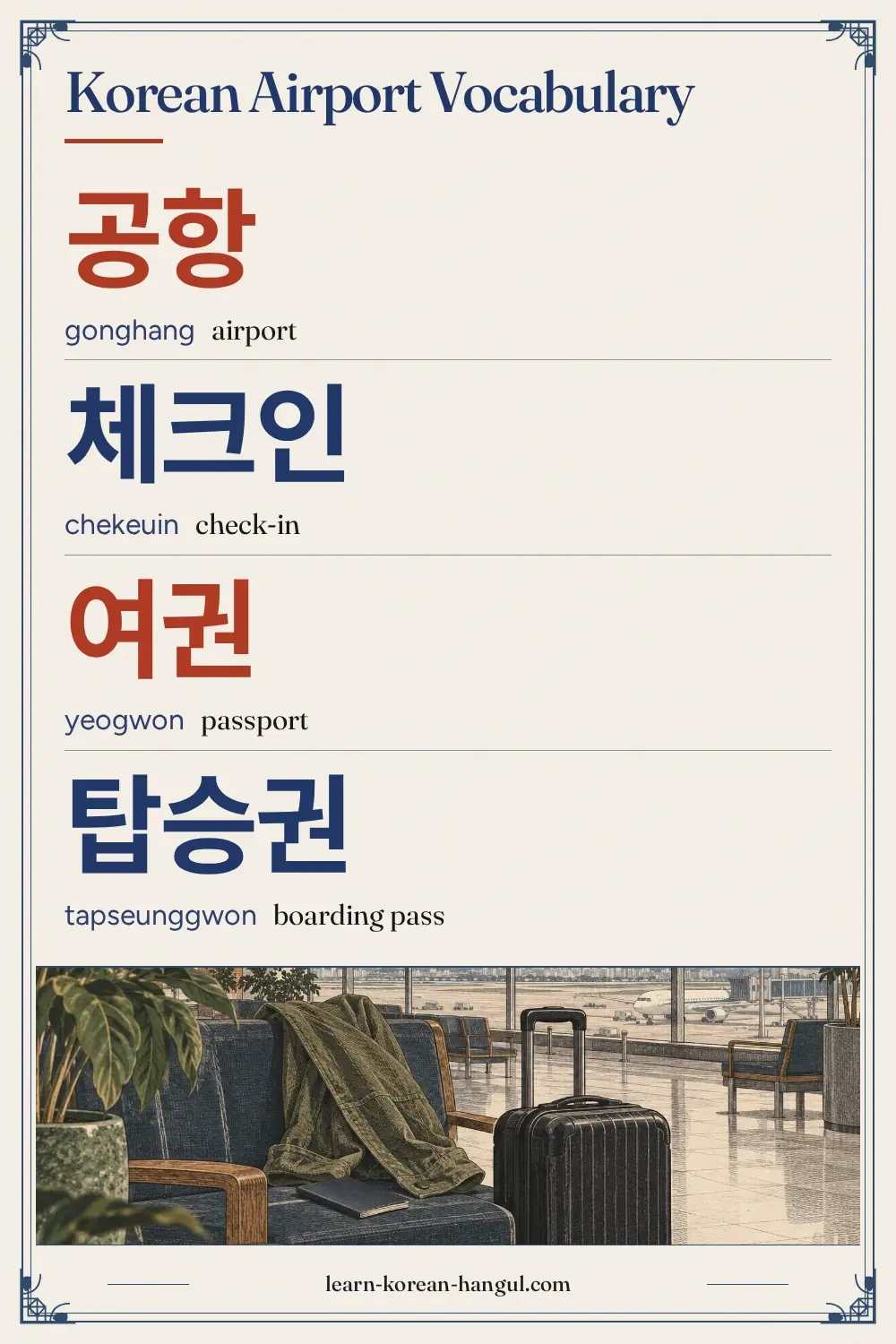
The list has 35 words in five groups of seven. It follows the order a traveller meets them: counter, checkpoints, gate, arrival hall and the services around them. It belongs to Travel and Airport. Nearly every airport sign is a Sino-Korean noun, so a few word parts such as 국 (country) and 권 (ticket) explain many signs.
| Group | Words | Use |
|---|---|---|
| Check-in | 7 | Counter, documents and bags |
| Security and immigration | 7 | Screening and passport checks |
| Gate and boarding | 7 | The departures board and gate |
| Arrival and baggage | 7 | Belt, customs and lost items |
| Airport services | 7 | Exchange, SIM, rail and flight types |
If you only need the one word, airport in Korean gives the meaning, pronunciation and a use. This page puts the whole airport vocabulary on one list.
Which Airport Words Should You Learn First?
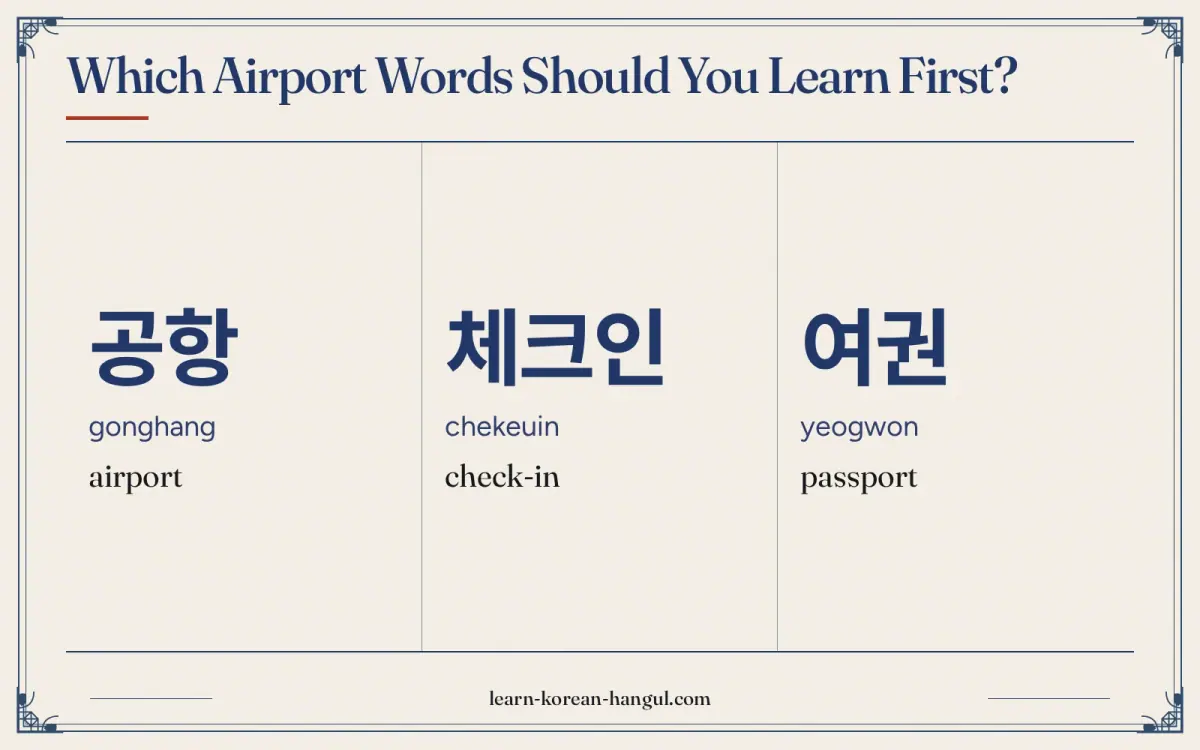
Learn 공항 (airport), 여권 (passport), 탑승구 (boarding gate), 수하물 (baggage) and 환전 (currency exchange) first. They let you reach the right desk and answer the first request you hear, 여권 주세요 (your passport, please).
- Words to say. 공항, 여권, 가방, 환전, 유심.
- Words to recognise. 출국 심사, 입국 심사, 탑승구, 수하물 찾는 곳, 세관. Signs show them in this order.
- Words to react to. 지연 and 결항 on the board mean you should speak to the airline.
The scene below shows ten airport objects with numbers that match the word list.
Word · 10
- 1
공항
gonghang
airport
- 2
체크인
chekeuin
check-in
- 3
여권
yeogwon
passport
- 4
탑승권
tapseunggwon
boarding pass
- 5
보안 검색
boan geomsaek
security screening
- 6
탑승구
tapseunggu
boarding gate
- 7
수하물
suhamul
baggage (airline term)
- 8
수하물 찾는 곳
suhamul channeun got
baggage claim
- 9
카트
kateu
luggage cart
- 10
환전
hwanjeon
currency exchange
Check-In
Airport signs in Korea use compact Sino-Korean nouns, and the first stop is the airline counter. Many of the words end in 권 (ticket or voucher) or 사 (company), which makes them easier to spot once you know the endings. Check-in is also where the loanword 체크인 appears, next to its Korean-style counter signs.
| No. | Hangul | Revised Romanization | Meaning and note | Example sentence | Audio assetId |
|---|---|---|---|---|---|
| 1 | 공항 | gonghang | airport. 공 is air; 항 is port. | 공항에 가요. (I go to the airport.) | au-pg-vocabulary-places-travel-airport-1; example: au-pg-vocabulary-places-travel-airport-36 |
| 2 | 체크인 | chekeuin | check-in. Loanword; also a hotel word. | 체크인을 해요. (I check in.) | au-pg-vocabulary-places-travel-airport-2; example: au-pg-vocabulary-places-travel-airport-37 |
| 3 | 항공사 | hanggongsa | airline. 항공 is aviation; 사 is company. | 항공사 카운터는 저기예요. (The airline counter is over there.) | au-pg-vocabulary-places-travel-airport-3; example: au-pg-vocabulary-places-travel-airport-38 |
| 4 | 항공권 | hanggonggwon | air ticket. Said [항공꿘]. | 항공권을 예약해요. (I book an air ticket.) | au-pg-vocabulary-places-travel-airport-4; example: au-pg-vocabulary-places-travel-airport-39 |
| 5 | 여권 | yeogwon | passport. Said [여꿘]. | 여권을 보여 주세요. (Please show your passport.) | au-pg-vocabulary-places-travel-airport-5; example: au-pg-vocabulary-places-travel-airport-40 |
| 6 | 탑승권 | tapseunggwon | boarding pass. Said [탑씅꿘]. | 탑승권을 받아요. (I receive my boarding pass.) | au-pg-vocabulary-places-travel-airport-6; example: au-pg-vocabulary-places-travel-airport-41 |
| 7 | 가방 | gabang | bag. The everyday word for a bag. | 가방이 무거워요. (The bag is heavy.) | au-pg-vocabulary-places-travel-airport-7; example: au-pg-vocabulary-places-travel-airport-42 |
Three documents, one ending. 항공권 is the ticket you booked, 탑승권 is the pass you carry to the gate, and 여권 is the travel document. All three end in 권, pronounced with a tense [꿘] in speech. The request 보여 주세요 combines 보이다 (to show) with 주세요 (please give), and it is the usual way to ask someone to show something; the plain polite form is 보여요.
How Do You Say Security and Immigration in Korean?
Departure has two checkpoints: the bag screening and the passport check. They sit one after the other, and the signs call them 보안 검색 and 출국 심사. On the way back in, the passport check becomes 입국 심사. The pair 출국 and 입국 uses the same 국 (country), with 출 (go out) and 입 (come in).
| No. | Hangul | Revised Romanization | Meaning and note | Example sentence | Audio assetId |
|---|---|---|---|---|---|
| 8 | 보안 검색 | boan geomsaek | security screening. 보안 is security. | 보안 검색을 받아요. (I go through security screening.) | au-pg-vocabulary-places-travel-airport-8; example: au-pg-vocabulary-places-travel-airport-43 |
| 9 | 검색대 | geomsaekdae | screening checkpoint. Said [검색때]. | 검색대에 가방을 올려요. (I put my bag on the screening table.) | au-pg-vocabulary-places-travel-airport-9; example: au-pg-vocabulary-places-travel-airport-44 |
| 10 | 출국 심사 | chulguk simsa | departure inspection. 출국 is leaving the country. | 출국 심사는 이쪽이에요. (Departure inspection is this way.) | au-pg-vocabulary-places-travel-airport-10; example: au-pg-vocabulary-places-travel-airport-45 |
| 11 | 입국 심사 | ipguk simsa | immigration inspection. Said [입꾹 심사]. | 입국 심사를 받아요. (I go through immigration.) | au-pg-vocabulary-places-travel-airport-11; example: au-pg-vocabulary-places-travel-airport-46 |
| 12 | 면세점 | myeonsejeom | duty-free shop. 면세 is tax-free. | 면세점에서 화장품을 사요. (I buy cosmetics at the duty-free shop.) | au-pg-vocabulary-places-travel-airport-12; example: au-pg-vocabulary-places-travel-airport-47 |
| 13 | 액체 | aekche | liquid. A word on screening rules. | 액체는 안 돼요. (Liquids are not allowed.) | au-pg-vocabulary-places-travel-airport-13; example: au-pg-vocabulary-places-travel-airport-48 |
| 14 | 비자 | bija | visa. Loanword. | 비자가 필요해요. (I need a visa.) | au-pg-vocabulary-places-travel-airport-14; example: au-pg-vocabulary-places-travel-airport-49 |
The structure Sino-Korean noun + 심사 (inspection) is productive: 출국 심사 and 입국 심사 differ only in the first word. The sentence 액체는 안 돼요 uses 안 돼요, the standard way to say something is not allowed or not possible. The deeper visa and entry-document words are on Korean Immigration and Visa Vocabulary.
Gate and Boarding
Gate announcements and the departures board repeat a few words all day. The board shows 출발 (departing) and 도착 (arriving), a gate number, and a status such as 지연 (delayed). Learn the status words first, because they change your plans.
| No. | Hangul | Revised Romanization | Meaning and note | Example sentence | Audio assetId |
|---|---|---|---|---|---|
| 15 | 탑승구 | tapseunggu | boarding gate. Said [탑씅구]. | 탑승구가 몇 번이에요? (What number is the boarding gate?) | au-pg-vocabulary-places-travel-airport-15; example: au-pg-vocabulary-places-travel-airport-50 |
| 16 | 탑승 | tapseung | boarding. Also the first part of 탑승권. | 탑승이 시작돼요. (Boarding starts.) | au-pg-vocabulary-places-travel-airport-16; example: au-pg-vocabulary-places-travel-airport-51 |
| 17 | 출발 | chulbal | departure. Opposite of 도착. | 비행기가 곧 출발해요. (The plane departs soon.) | au-pg-vocabulary-places-travel-airport-17; example: au-pg-vocabulary-places-travel-airport-52 |
| 18 | 도착 | dochak | arrival. Printed on the board beside 출발. | 도착 시간을 확인해요. (I check the arrival time.) | au-pg-vocabulary-places-travel-airport-18; example: au-pg-vocabulary-places-travel-airport-53 |
| 19 | 비행기 | bihaenggi | airplane. 비행 is flying; 기 is machine. | 비행기를 타요. (I board a plane.) | au-pg-vocabulary-places-travel-airport-19; example: au-pg-vocabulary-places-travel-airport-54 |
| 20 | 지연 | jiyeon | delay. Usually shown in red or bold. | 비행기가 지연돼요. (The flight is delayed.) | au-pg-vocabulary-places-travel-airport-20; example: au-pg-vocabulary-places-travel-airport-55 |
| 21 | 결항 | gyeolhang | cancelled flight. 결 is lacking; 항 is flight. | 오늘 비행기는 결항이에요. (Today's flight is cancelled.) | au-pg-vocabulary-places-travel-airport-21; example: au-pg-vocabulary-places-travel-airport-56 |
The verb ending 되다 in 시작돼요 and 지연돼요 means that something happens or is done; it turns a noun into a passive-like event. You will see the same ending on many announcements. When you hear 지연 or 결항, go straight to the airline desk, since the board seldom gives the new time at once.
How Do You Say Arrival and Baggage in Korean?
On landing, the signs change. You follow 입국 to immigration, then 수하물 to the belt, then 세관 to customs. If something goes missing, the word to look for is 분실. This group has the nouns for that sequence.
| No. | Hangul | Revised Romanization | Meaning and note | Example sentence | Audio assetId |
|---|---|---|---|---|---|
| 22 | 수하물 | suhamul | baggage (airline term). Covers checked and carry-on bags; 짐 in speech. | 수하물을 부쳐요. (I check my baggage.) | au-pg-vocabulary-places-travel-airport-22; example: au-pg-vocabulary-places-travel-airport-57 |
| 23 | 수하물 찾는 곳 | suhamul channeun got | baggage claim. Said [수하물 찬는 곧]. | 수하물 찾는 곳은 아래층이에요. (The baggage claim is downstairs.) | au-pg-vocabulary-places-travel-airport-23; example: au-pg-vocabulary-places-travel-airport-58 |
| 24 | 세관 | segwan | customs. Where goods are declared. | 세관을 통과해요. (I pass through customs.) | au-pg-vocabulary-places-travel-airport-24; example: au-pg-vocabulary-places-travel-airport-59 |
| 25 | 신고서 | singoseo | declaration form. 신고 is a report to authorities. | 신고서를 써요. (I fill in the declaration form.) | au-pg-vocabulary-places-travel-airport-25; example: au-pg-vocabulary-places-travel-airport-60 |
| 26 | 카트 | kateu | luggage cart. Loanword. | 카트를 밀어요. (I push the cart.) | au-pg-vocabulary-places-travel-airport-26; example: au-pg-vocabulary-places-travel-airport-61 |
| 27 | 분실 | bunsil | loss. Add 물 for lost property. | 가방을 분실했어요. (I lost my bag.) | au-pg-vocabulary-places-travel-airport-27; example: au-pg-vocabulary-places-travel-airport-62 |
| 28 | 입국장 | ipgukjang | arrival hall. Said [입꾹짱]. | 입국장에서 만나요. (Let's meet in the arrival hall.) | au-pg-vocabulary-places-travel-airport-28; example: au-pg-vocabulary-places-travel-airport-63 |
수하물 is the formal baggage word on tickets and signs, while people say 짐 in speech. On airline forms, checked baggage is 위탁 수하물 and carry-on baggage is 기내 수하물, so the same word covers both. The past form 분실했어요 shows a typical report: the noun 분실 plus 하다 in the past. At a lost-property desk, give the noun first, then the verb.
Airport Services
Beyond the flight itself, an airport sells a handful of services that new arrivals often need in the first hour: money, a SIM card, a network and a train into the city. The words below also include the two kinds of flight, domestic and international, which decide which terminal area you walk to.
| No. | Hangul | Revised Romanization | Meaning and note | Example sentence | Audio assetId |
|---|---|---|---|---|---|
| 29 | 환전 | hwanjeon | currency exchange. 환 is exchange; 전 is money. | 환전을 해요. (I exchange money.) | au-pg-vocabulary-places-travel-airport-29; example: au-pg-vocabulary-places-travel-airport-64 |
| 30 | 유심 | yusim | SIM card. Loanword from USIM. | 유심을 사요. (I buy a SIM card.) | au-pg-vocabulary-places-travel-airport-30; example: au-pg-vocabulary-places-travel-airport-65 |
| 31 | 와이파이 | waipai | Wi-Fi. Loanword. | 와이파이가 잘 돼요. (The Wi-Fi works well.) | au-pg-vocabulary-places-travel-airport-31; example: au-pg-vocabulary-places-travel-airport-66 |
| 32 | 공항철도 | gonghangcheoldo | airport railroad. The rail link to the city. | 공항철도를 타요. (I take the airport railroad.) | au-pg-vocabulary-places-travel-airport-32; example: au-pg-vocabulary-places-travel-airport-67 |
| 33 | 국내선 | gungnaeseon | domestic flights. Said [궁내선]. | 국내선 터미널은 저쪽이에요. (The domestic terminal is over there.) | au-pg-vocabulary-places-travel-airport-33; example: au-pg-vocabulary-places-travel-airport-68 |
| 34 | 국제선 | gukjeseon | international flights. Said [국쩨선]. | 국제선을 타요. (I take an international flight.) | au-pg-vocabulary-places-travel-airport-34; example: au-pg-vocabulary-places-travel-airport-69 |
| 35 | 안내 데스크 | annae deseukeu | information desk. Loanword 데스크. | 안내 데스크에 물어봐요. (I ask at the information desk.) | au-pg-vocabulary-places-travel-airport-35; example: au-pg-vocabulary-places-travel-airport-70 |
선 (line) ends both flight types, and 국내 (inside the country) contrasts with 국제 (between countries). The wider money and exchange words sit on Travel and Airport, and the practical phrases for the counters are on airport phrases. For after you leave the arrival hall, the rail link continues in Transportation.
How Do You Pronounce Korean Airport Words?
Airport words are full of tense consonants. After a final ㅂ or ㄱ, the next ㅅ, ㄷ, ㅈ or ㄱ is said as a tense sound. The ending 권 is a special case: it is said [꿘] even after a vowel or ㅇ, as in 여권 [여꿘] and 항공권 [항공꿘]. The National Institute of Korean Language (국립국어원) standard pronunciation rules cover this. Revised Romanization writes the plain letters and leaves the tense sound for you to learn.
| Spelling | Sounds like | What changes |
|---|---|---|
| 탑승권 | [탑씅꿘] | After final ㅂ, the ㅅ is tense; the ㄱ of 권 is tense. |
| 입국 심사 | [입꾹 심사] | After final ㅂ, the ㄱ of 국 is tense. |
| 검색대 | [검색때] | After final ㄱ, the ㄷ is tense. |
| 국내선 | [궁내선] | Final ㄱ becomes ㅇ before ㄴ. |
| 수하물 찾는 곳 | [수하물 찬는 곧] | Final ㅈ is said as ㄷ, then ㄷ becomes ㄴ before ㄴ; final ㅅ in 곳 is ㄷ. |
Audio and Slow Playback
The five clips below replay the hardest words slowly, in the order in which you would meet them. Play 탑승권 first, since its tense sounds are the model for the others.
What Mistakes Do Learners Make with Airport Words?
Four of the five slips below come from similar-looking pairs.
- Mixing 출국 and 입국. 출 means out and 입 means in. 출국 심사 is for leaving Korea, and 입국 심사 is for arriving.
- Mixing 출발 and 도착. On the board, 출발 is the departure time and 도착 is the arrival time. Reading the wrong column leads to the wrong gate.
- Saying 탑승권 with plain consonants. Written 탑승권, spoken [탑씅꿘]. Plain sounds are understood, but the tense forms are the standard.
- Using 수하물 for any bag. 수하물 is the airline's word for baggage, as on tickets and signs. A personal bag is a 가방, and speech often uses 짐 for luggage in general.
- Using 국제선 for a domestic flight. 국내선 is domestic and 국제선 is international. The two use different terminal areas in many airports.
If you remember 출 and 입 as out and in, and 국내 and 국제 as inside and between countries, most signs read themselves.
Practice: Flashcards and Worksheet
Work in three steps. First, run the deck in recognition mode until the 35 words are familiar. Second, switch to listening mode. Third, take the five-question quiz. The deck keeps your progress in your browser, and the vocabulary flashcard decks page lists the other decks.
Practice · 75
- 01공항
Show answer
headword 1: airport
- 02체크인
Show answer
headword 2: check-in
- 03항공사
Show answer
headword 3: airline
- 04항공권
Show answer
headword 4: air ticket
- 05여권
Show answer
headword 5: passport
- 06탑승권
Show answer
headword 6: boarding pass
- 07가방
Show answer
headword 7: bag
- 08보안 검색
Show answer
headword 8: security screening
- 09검색대
Show answer
headword 9: screening checkpoint
- 10출국 심사
Show answer
headword 10: departure inspection
- 11입국 심사
Show answer
headword 11: immigration inspection
- 12면세점
Show answer
headword 12: duty-free shop
- 13액체
Show answer
headword 13: liquid
- 14비자
Show answer
headword 14: visa
- 15탑승구
Show answer
headword 15: boarding gate
- 16탑승
Show answer
headword 16: boarding
- 17출발
Show answer
headword 17: departure
- 18도착
Show answer
headword 18: arrival
- 19비행기
Show answer
headword 19: airplane
- 20지연
Show answer
headword 20: delay
- 21결항
Show answer
headword 21: cancelled flight
- 22수하물
Show answer
headword 22: baggage (airline term)
- 23수하물 찾는 곳
Show answer
headword 23: baggage claim
- 24세관
Show answer
headword 24: customs
- 25신고서
Show answer
headword 25: declaration form
- 26카트
Show answer
headword 26: luggage cart
- 27분실
Show answer
headword 27: loss
- 28입국장
Show answer
headword 28: arrival hall
- 29환전
Show answer
headword 29: currency exchange
- 30유심
Show answer
headword 30: SIM card
- 31와이파이
Show answer
headword 31: Wi-Fi
- 32공항철도
Show answer
headword 32: airport railroad
- 33국내선
Show answer
headword 33: domestic flights
- 34국제선
Show answer
headword 34: international flights
- 35안내 데스크
Show answer
headword 35: information desk
- 36공항에 가요.
Show answer
example sentence for 공항
- 37체크인을 해요.
Show answer
example sentence for 체크인
- 38항공사 카운터는 저기예요.
Show answer
example sentence for 항공사
- 39항공권을 예약해요.
Show answer
example sentence for 항공권
- 40여권을 보여 주세요.
Show answer
example sentence for 여권
- 41탑승권을 받아요.
Show answer
example sentence for 탑승권
- 42가방이 무거워요.
Show answer
example sentence for 가방
- 43보안 검색을 받아요.
Show answer
example sentence for 보안 검색
- 44검색대에 가방을 올려요.
Show answer
example sentence for 검색대
- 45출국 심사는 이쪽이에요.
Show answer
example sentence for 출국 심사
- 46입국 심사를 받아요.
Show answer
example sentence for 입국 심사
- 47면세점에서 화장품을 사요.
Show answer
example sentence for 면세점
- 48액체는 안 돼요.
Show answer
example sentence for 액체
- 49비자가 필요해요.
Show answer
example sentence for 비자
- 50탑승구가 몇 번이에요?
Show answer
example sentence for 탑승구
- 51탑승이 시작돼요.
Show answer
example sentence for 탑승
- 52비행기가 곧 출발해요.
Show answer
example sentence for 출발
- 53도착 시간을 확인해요.
Show answer
example sentence for 도착
- 54비행기를 타요.
Show answer
example sentence for 비행기
- 55비행기가 지연돼요.
Show answer
example sentence for 지연
- 56오늘 비행기는 결항이에요.
Show answer
example sentence for 결항
- 57수하물을 부쳐요.
Show answer
example sentence for 수하물
- 58수하물 찾는 곳은 아래층이에요.
Show answer
example sentence for 수하물 찾는 곳
- 59세관을 통과해요.
Show answer
example sentence for 세관
- 60신고서를 써요.
Show answer
example sentence for 신고서
- 61카트를 밀어요.
Show answer
example sentence for 카트
- 62가방을 분실했어요.
Show answer
example sentence for 분실
- 63입국장에서 만나요.
Show answer
example sentence for 입국장
- 64환전을 해요.
Show answer
example sentence for 환전
- 65유심을 사요.
Show answer
example sentence for 유심
- 66와이파이가 잘 돼요.
Show answer
example sentence for 와이파이
- 67공항철도를 타요.
Show answer
example sentence for 공항철도
- 68국내선 터미널은 저쪽이에요.
Show answer
example sentence for 국내선
- 69국제선을 타요.
Show answer
example sentence for 국제선
- 70안내 데스크에 물어봐요.
Show answer
example sentence for 안내 데스크
- 71탑승권
Show answer
slow playback of 탑승권
- 72입국 심사
Show answer
slow playback of 입국 심사
- 73탑승구
Show answer
slow playback of 탑승구
- 74세관
Show answer
slow playback of 세관
- 75국내선
Show answer
slow playback of 국내선
Practice · 5
What does 공항 (gonghang) mean?
Show answer
airport
공항 means airport. Example: 공항에 가요. (I go to the airport.)
What does 여권 (yeogwon) mean?
Show answer
passport
여권 means passport. Example: 여권을 보여 주세요. (Please show your passport.)
What does 입국 심사 (ipguk simsa) mean?
Show answer
immigration inspection
입국 심사 means immigration inspection. Example: 입국 심사를 받아요. (I go through immigration.)
What does 탑승구 (tapseunggu) mean?
Show answer
boarding gate
탑승구 means boarding gate. Example: 탑승구가 몇 번이에요? (What number is the boarding gate?)
What does 카트 (kateu) mean?
Show answer
luggage cart
카트 means luggage cart. Example: 카트를 밀어요. (I push the cart.)
Korean Airport Vocabulary Worksheet (PDF)
A printable worksheet for these words (word list, matching, writing practice, fill-in-the-blank exercises and answer key) is available in A4 and US Letter from the download card on this page. For additional practice, list the airport stops of your own last trip and write each in Korean.
Where to Go Next
After this page, continue with Korean Immigration and Visa Vocabulary or Korean Tourist Attractions Vocabulary. For ready-made lines to say at the counter, see airport phrases. To move up a level, return to Travel and Airport.
Frequently Asked Questions
How Do You Say Airport in Korean?
Airport is 공항 (gonghang). It joins 공 (air) and 항 (port). The two big gateways near Seoul are named with it, for example 인천공항 (Incheon Airport). The single-word page on airport in Korean gives more detail.
How Do You Pronounce 탑승권 (tapseunggwon)?
Say it in three beats: tap, seung, gwon. In normal speech the ㅅ after the final ㅂ is tense, and the ㄱ of 권 is tense, so the standard sound is [탑씅꿘]. It means boarding pass. Press the audio button to hear it.
How Many Airport Words Should I Learn First?
Five: 공항, 여권, 탑승구, 수하물 and 환전. At five new words a day the 35 words take a week plus review. Add 출국 심사 and 입국 심사 before your first flight, since both are on every sign.
What Is the Difference between 수하물 and 짐?
수하물 is the formal word used on tickets and airline signs, and it means baggage handled by the airline. 짐 is the everyday word for luggage or things you carry. At the counter you may hear either one.
Where Can I Practise Airport Words with Flashcards?
Use the vocabulary flashcard decks. The deck for this page holds all 35 words with Hangul, romanization and audio. Your progress stays in your browser. Before a flight, drill the sign words such as 출국 심사, 탑승구 and 세관 in recognition mode, since you will read them rather than say them.
Is There a Printable Worksheet for Airport Words?
A printable worksheet for these words (word list, matching, writing practice, fill-in-the-blank exercises and answer key) is available in A4 and US Letter from the download card on this page. For practice, copy the tables on this page by hand or use the deck. A useful paper drill is to write the signs in the order you pass them, from 체크인 through 보안 검색 and 출국 심사 to 탑승구.