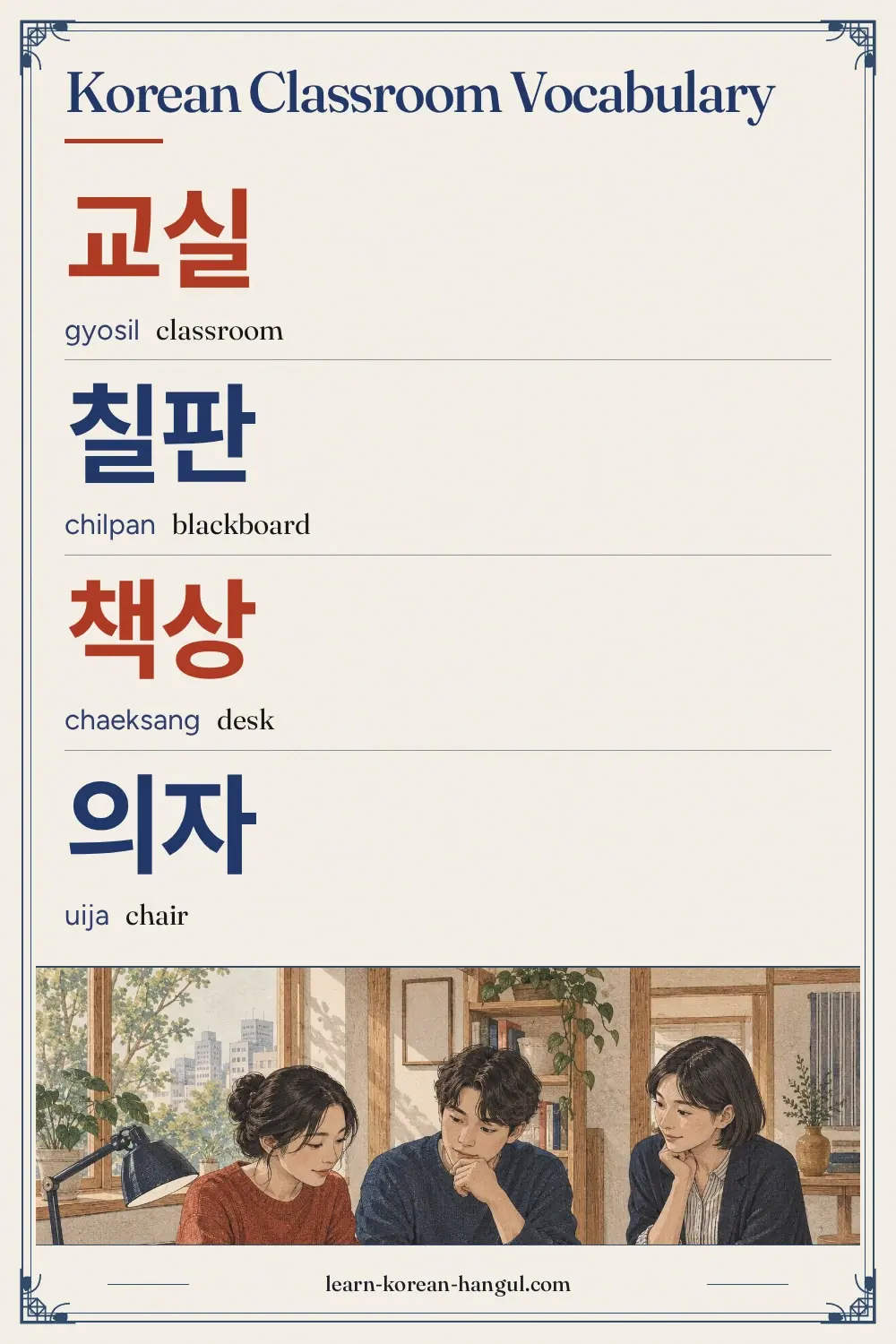
Korean Classroom Vocabulary at a Glance
The list has 40 words in five groups of eight. It runs from the furniture to the people, the rhythm of a school day, the exam and the language you learn. It belongs to School. Many of the nouns are Sino-Korean, built from short parts such as 교 (teach), 답 (answer) and 문 (ask), so learning the parts gives you more words for free.
| Group | Words | Use |
|---|---|---|
| Classroom objects | 8 | Room, board, desk and clock |
| People in class | 8 | Teacher, students and roles |
| Lesson words | 8 | Lessons, homework and questions |
| Exam words | 8 | Tests, answers and scores |
| Language-learning words | 8 | Words, grammar and dictionaries |
For the single entry on the room itself, see classroom in Korean. Phrases that teachers say in Korean are on Korean classroom phrases, and this page covers the nouns.
Which Classroom Words Should You Learn First?
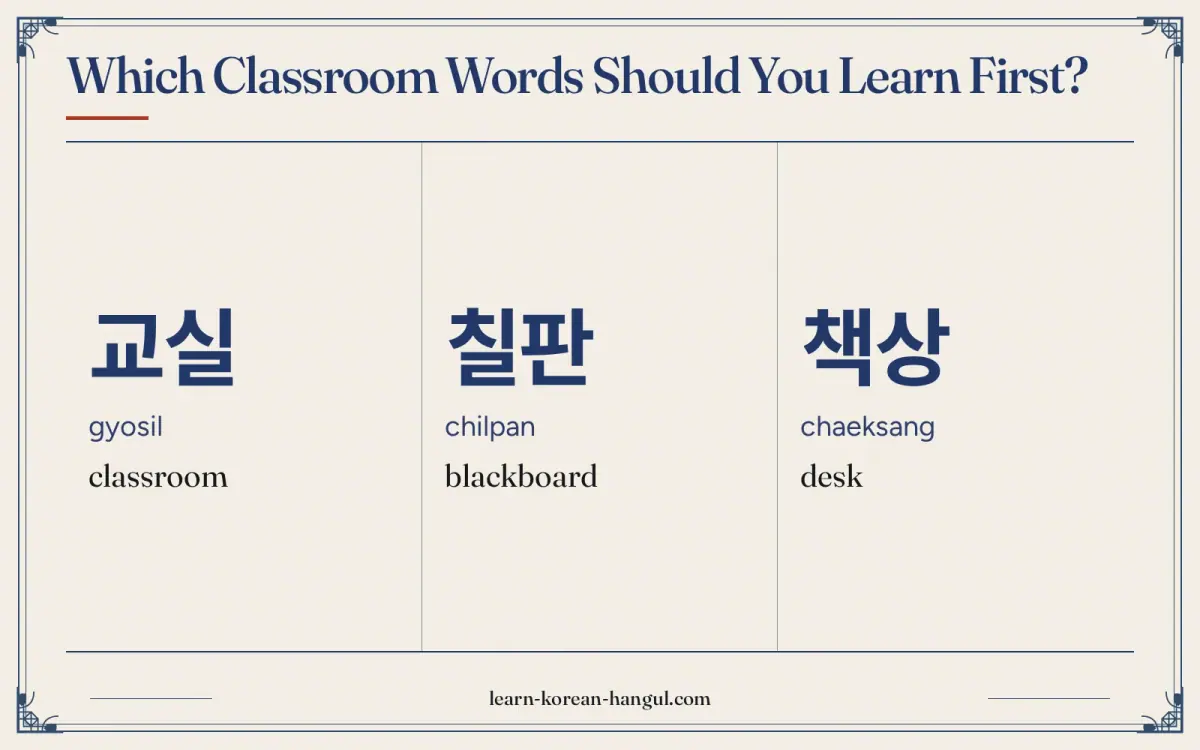
Learn 교실 (classroom), 선생님 (teacher), 학생 (student), 숙제 (homework) and 질문 (question) first. They let you say who is there, what you do, and that you have a question. 질문이 있어요 (I have a question) is the most useful sentence on this page for a new learner.
- Words to say. 선생님, 학생, 숙제, 질문, 대답.
- Words to recognise. 시간표, 출석, 점수, 답안지. You read them on forms and boards.
- Words for studying Korean. 단어, 문장, 뜻, 사전. They help you ask about the language in Korean.
The scene below shows ten objects of a classroom with numbers that match the list.
Word · 10
- 1
교실
gyosil
classroom
- 2
칠판
chilpan
blackboard
- 3
책상
chaeksang
desk
- 4
의자
uija
chair
- 5
교과서
gyogwaseo
textbook
- 6
공책
gongchaek
notebook
- 7
지우개
jiugae
eraser
- 8
시계
sigye
clock
- 9
선생님
seonsaengnim
teacher
- 10
학생
haksaeng
student
Classroom Objects
Start with what you can see and touch. Korean classrooms are named with the Sino-Korean prefix 교 (teach), as in 교실 (teaching room), 교과서 (teaching-subject book) and the later word 교수님 (professor). Most of the other objects are short Sino-Korean compounds too, such as 책상, a desk made from 책 (book) and 상 (table); 지우개 is a native word, from 지우다 (to erase).
| No. | Hangul | Revised Romanization | Meaning and note | Example sentence | Audio assetId |
|---|---|---|---|---|---|
| 1 | 교실 | gyosil | classroom. 교 is teaching; 실 is room. | 교실에 가요. (I go to the classroom.) | au-pg-vocabulary-school-work-school-classroom-1; example: au-pg-vocabulary-school-work-school-classroom-41 |
| 2 | 칠판 | chilpan | blackboard. Used for whiteboards too. | 칠판을 봐요. (I look at the board.) | au-pg-vocabulary-school-work-school-classroom-2; example: au-pg-vocabulary-school-work-school-classroom-42 |
| 3 | 책상 | chaeksang | desk. Said [책쌍]. | 책상이 커요. (The desk is big.) | au-pg-vocabulary-school-work-school-classroom-3; example: au-pg-vocabulary-school-work-school-classroom-43 |
| 4 | 의자 | uija | chair. Sit on it with 앉다. | 의자에 앉아요. (I sit on the chair.) | au-pg-vocabulary-school-work-school-classroom-4; example: au-pg-vocabulary-school-work-school-classroom-44 |
| 5 | 교과서 | gyogwaseo | textbook. 교과 is school subject. | 교과서를 펴요. (I open the textbook.) | au-pg-vocabulary-school-work-school-classroom-5; example: au-pg-vocabulary-school-work-school-classroom-45 |
| 6 | 공책 | gongchaek | notebook. Plain notebook for notes. | 공책에 써요. (I write in the notebook.) | au-pg-vocabulary-school-work-school-classroom-6; example: au-pg-vocabulary-school-work-school-classroom-46 |
| 7 | 지우개 | jiugae | eraser. From 지우다, to erase. | 지우개가 없어요. (I do not have an eraser.) | au-pg-vocabulary-school-work-school-classroom-7; example: au-pg-vocabulary-school-work-school-classroom-47 |
| 8 | 시계 | sigye | clock. The standard allows both [시계] and [시게]. | 시계가 벽에 있어요. (The clock is on the wall.) | au-pg-vocabulary-school-work-school-classroom-8; example: au-pg-vocabulary-school-work-school-classroom-48 |
Look at the verbs in these sentences. 펴다 (open out, spread) is the verb for textbooks and notebooks, and it makes 펴요. 앉다 (sit) is regular and makes 앉아요. The particle 에 after 의자 and 벽 marks a place where something is or happens. The pencils, pens and supplies that fill the desk have their own list on Korean Stationery Vocabulary.
Who Is Who in a Korean Class?
Korean school life has more named roles than most learners expect. Students talk about their 담임 선생님, the homeroom teacher who looks after one class, and the 반장, the class president. Seniors are 선배, and the classmate who shares your desk is your 짝. All eight words work at every school level.
| No. | Hangul | Revised Romanization | Meaning and note | Example sentence | Audio assetId |
|---|---|---|---|---|---|
| 9 | 선생님 | seonsaengnim | teacher. 님 is respectful; do not drop it. | 선생님이 와요. (The teacher is coming.) | au-pg-vocabulary-school-work-school-classroom-9; example: au-pg-vocabulary-school-work-school-classroom-49 |
| 10 | 학생 | haksaeng | student. Said [학쌩]. | 학생이 많아요. (There are many students.) | au-pg-vocabulary-school-work-school-classroom-10; example: au-pg-vocabulary-school-work-school-classroom-50 |
| 11 | 친구 | chingu | friend. Same age or close in age. | 친구와 앉아요. (I sit with a friend.) | au-pg-vocabulary-school-work-school-classroom-11; example: au-pg-vocabulary-school-work-school-classroom-51 |
| 12 | 반 | ban | class (group). The group of students, not the lesson. | 우리 반은 스무 명이에요. (Our class has twenty people.) | au-pg-vocabulary-school-work-school-classroom-12; example: au-pg-vocabulary-school-work-school-classroom-52 |
| 13 | 담임 선생님 | damim seonsaengnim | homeroom teacher. 담임 is being in charge of a class. | 담임 선생님은 친절해요. (The homeroom teacher is kind.) | au-pg-vocabulary-school-work-school-classroom-13; example: au-pg-vocabulary-school-work-school-classroom-53 |
| 14 | 반장 | banjang | class president. Elected by the class. | 반장이 인사해요. (The class president says hello.) | au-pg-vocabulary-school-work-school-classroom-14; example: au-pg-vocabulary-school-work-school-classroom-54 |
| 15 | 짝 | jjak | desk partner. Also means a pair. | 짝과 이야기해요. (I talk with my partner.) | au-pg-vocabulary-school-work-school-classroom-15; example: au-pg-vocabulary-school-work-school-classroom-55 |
| 16 | 선배 | seonbae | senior student. The opposite is 후배. | 선배가 도와줘요. (A senior helps me.) | au-pg-vocabulary-school-work-school-classroom-16; example: au-pg-vocabulary-school-work-school-classroom-56 |
선생님 is made of 선생 (teacher) and the suffix 님, which adds respect. Because the respect is already built in, you never add it again, and you also use 선생님 to address a teacher directly. The word 반 means a group of students, so 우리 반 is our class, while the lesson itself is 수업, in the next group. The verb 도와주다 (to help) is regular, and its polite form is 도와줘요.
Lesson Words
A school day is a rhythm of lessons, breaks and tasks, and each part has a noun. A 시간표 tells you the order. A 수업 is one lesson, with a break called 쉬는 시간 after it, and the teacher may call attendance or ask for a talk. These eight words describe that rhythm.
| No. | Hangul | Revised Romanization | Meaning and note | Example sentence | Audio assetId |
|---|---|---|---|---|---|
| 17 | 수업 | sueop | lesson; class. The lesson, not the group. | 수업이 시작돼요. (The lesson begins.) | au-pg-vocabulary-school-work-school-classroom-17; example: au-pg-vocabulary-school-work-school-classroom-57 |
| 18 | 숙제 | sukje | homework. Verb: 하다 for doing it. | 숙제를 해요. (I do my homework.) | au-pg-vocabulary-school-work-school-classroom-18; example: au-pg-vocabulary-school-work-school-classroom-58 |
| 19 | 시간표 | siganpyo | timetable. 시간 is time; 표 is chart. | 시간표를 봐요. (I look at the timetable.) | au-pg-vocabulary-school-work-school-classroom-19; example: au-pg-vocabulary-school-work-school-classroom-59 |
| 20 | 쉬는 시간 | swineun sigan | break time. 쉬다 is to rest. | 지금은 쉬는 시간이에요. (It is break time now.) | au-pg-vocabulary-school-work-school-classroom-20; example: au-pg-vocabulary-school-work-school-classroom-60 |
| 21 | 발표 | balpyo | presentation. Also means an announcement. | 오늘 발표를 해요. (I give a presentation today.) | au-pg-vocabulary-school-work-school-classroom-21; example: au-pg-vocabulary-school-work-school-classroom-61 |
| 22 | 출석 | chulseok | attendance. Said [출썩]. | 선생님이 출석을 불러요. (The teacher calls the register.) | au-pg-vocabulary-school-work-school-classroom-22; example: au-pg-vocabulary-school-work-school-classroom-62 |
| 23 | 질문 | jilmun | question (asked). Something you ask. | 질문이 있어요. (I have a question.) | au-pg-vocabulary-school-work-school-classroom-23; example: au-pg-vocabulary-school-work-school-classroom-63 |
| 24 | 대답 | daedap | answer; reply. A spoken reply. | 대답을 해요. (I give an answer.) | au-pg-vocabulary-school-work-school-classroom-24; example: au-pg-vocabulary-school-work-school-classroom-64 |
Two of these pairs repay attention. 수업 and 숙제 both start with 수 and 숙, and learners swap them: 수업 is the class, 숙제 is the homework. And 질문 and 대답 are partners in conversation, a question and its answer. The noun 문제, covered with the exam words, is not a question you ask. See the nuance in the mistakes section. The set phrases a teacher says out loud are on Korean classroom phrases.
Which Words Describe a Korean Exam?
Exam vocabulary shows how one noun can cover two meanings. 문제 is both a problem and a question on a test, and 정답 and 오답 are the right and wrong answers. A 점수 is a score, a 성적 a set of grades. The next stage, which includes results and university entry, is on Korean Exams and Grades Vocabulary.
| No. | Hangul | Revised Romanization | Meaning and note | Example sentence | Audio assetId |
|---|---|---|---|---|---|
| 25 | 시험 | siheom | test; exam. You take it with 보다. | 시험을 봐요. (I take a test.) | au-pg-vocabulary-school-work-school-classroom-25; example: au-pg-vocabulary-school-work-school-classroom-65 |
| 26 | 문제 | munje | problem; test question. Not the same as 질문. | 문제가 어려워요. (The question is hard.) | au-pg-vocabulary-school-work-school-classroom-26; example: au-pg-vocabulary-school-work-school-classroom-66 |
| 27 | 정답 | jeongdap | correct answer. 정 is correct. | 정답을 맞혀요. (I get the right answer.) | au-pg-vocabulary-school-work-school-classroom-27; example: au-pg-vocabulary-school-work-school-classroom-67 |
| 28 | 오답 | odap | wrong answer. 오 is mistaken. | 오답을 고쳐요. (I correct the wrong answer.) | au-pg-vocabulary-school-work-school-classroom-28; example: au-pg-vocabulary-school-work-school-classroom-68 |
| 29 | 점수 | jeomsu | score. Said [점쑤]. | 점수가 높아요. (The score is high.) | au-pg-vocabulary-school-work-school-classroom-29; example: au-pg-vocabulary-school-work-school-classroom-69 |
| 30 | 성적 | seongjeok | grades; results. Standard [성적], with no tensing, though [성쩍] is often heard. | 성적이 올라요. (My grades go up.) | au-pg-vocabulary-school-work-school-classroom-30; example: au-pg-vocabulary-school-work-school-classroom-70 |
| 31 | 답안지 | dabanji | answer sheet. 안 is plan or draft; 지 is paper. | 답안지를 내요. (I hand in the answer sheet.) | au-pg-vocabulary-school-work-school-classroom-31; example: au-pg-vocabulary-school-work-school-classroom-71 |
| 32 | 합격 | hapgyeok | pass. Said [합껵]. | 시험에 합격해요. (I pass the exam.) | au-pg-vocabulary-school-work-school-classroom-32; example: au-pg-vocabulary-school-work-school-classroom-72 |
Look at the verbs that go with exams. You 봐요 a test, you 맞혀요 an answer, you 고쳐요 a mistake and you 내요 a sheet. Each is a different verb for a different action, and the English words do not map one to one. The answer pair 정답 and 오답 shares the part 답, which means answer, with the 대답 you met above. For more on 정답 and how it is used, see correct answer in Korean.
Language-Learning Words
Once you take a Korean class yourself, you need the words for what you are learning. They are the nouns teachers use about language: word, sentence, grammar, pronunciation, translation and meaning. Learn them early, because they let you ask for help in Korean instead of English.
| No. | Hangul | Revised Romanization | Meaning and note | Example sentence | Audio assetId |
|---|---|---|---|---|---|
| 33 | 단어 | daneo | word. Used for vocabulary items. | 단어를 외워요. (I memorise words.) | au-pg-vocabulary-school-work-school-classroom-33; example: au-pg-vocabulary-school-work-school-classroom-73 |
| 34 | 문장 | munjang | sentence. A full sentence. | 문장을 써요. (I write a sentence.) | au-pg-vocabulary-school-work-school-classroom-34; example: au-pg-vocabulary-school-work-school-classroom-74 |
| 35 | 문법 | munbeop | grammar. Said [문뻡]. | 문법이 어려워요. (Grammar is hard.) | au-pg-vocabulary-school-work-school-classroom-35; example: au-pg-vocabulary-school-work-school-classroom-75 |
| 36 | 발음 | bareum | pronunciation. Said [바름]. | 발음이 좋아요. (Your pronunciation is good.) | au-pg-vocabulary-school-work-school-classroom-36; example: au-pg-vocabulary-school-work-school-classroom-76 |
| 37 | 번역 | beonyeok | translation. Said [버녁]. | 번역을 해요. (I translate.) | au-pg-vocabulary-school-work-school-classroom-37; example: au-pg-vocabulary-school-work-school-classroom-77 |
| 38 | 뜻 | tteut | meaning. Native word; asked as 뜻이 뭐예요? | 이 단어의 뜻을 알아요. (I know the meaning of this word.) | au-pg-vocabulary-school-work-school-classroom-38; example: au-pg-vocabulary-school-work-school-classroom-78 |
| 39 | 의미 | uimi | meaning (formal). Sino-Korean equivalent of 뜻. | 의미를 설명해요. (I explain the meaning.) | au-pg-vocabulary-school-work-school-classroom-39; example: au-pg-vocabulary-school-work-school-classroom-79 |
| 40 | 사전 | sajeon | dictionary. Verb: 찾다 to look up. | 사전을 찾아요. (I look it up in the dictionary.) | au-pg-vocabulary-school-work-school-classroom-40; example: au-pg-vocabulary-school-work-school-classroom-80 |
뜻 and 의미 both mean meaning. 뜻 is the native word and is common in speech, and 의미 is Sino-Korean and sits more easily in writing and in explanations. Asking 뜻이 뭐예요? (What does it mean?) is a safe classroom question. The verb 외우다 (memorise) makes 외워요, and 찾다 (look up) makes 찾아요 with the ㅊ kept intact.
How Do You Pronounce Korean Classroom Words?
Classroom words show the most common sound change in Korean, tensing. After a final ㄱ, ㅂ or ㄹ in these words, the next ㅅ or ㄱ is said as a tense sound; 문법 has a tense ㅂ after ㄴ; and a final ㄴ moves onto a following vowel, as in 번역 [버녁]. The National Institute of Korean Language (국립국어원) standard pronunciation rules describe each case. Revised Romanization leaves the tense sounds unmarked.
| Spelling | Sounds like | What changes |
|---|---|---|
| 책상 | [책쌍] | After final ㄱ, the ㅅ is tense. |
| 학생 | [학쌩] | After final ㄱ, the ㅅ is tense. |
| 출석 | [출썩] | After the final ㄹ of 출, the ㅅ of 석 is tense (a Sino-Korean ㄹ + ㅅ pair). |
| 문법 | [문뻡] | In this word the ㅂ of 법 is said tense after the final ㄴ; the spelling does not show it. |
| 합격 | [합껵] | After final ㅂ, the ㄱ is tense. |
| 번역 | [버녁] | The final ㄴ links to the vowel of 역. |
Audio and Slow Playback
Five clips replay the hardest words slowly: a desk, a student, a register, grammar and a pass. Listen for the tense sound in the middle of each word, repeat, and play the clip again.
What Mistakes Do Learners Make with Classroom Words?
Five confusions come up again and again.
- Using 문제 for a question you ask. You ask a 질문. 문제 is a problem, or a question printed on an exam. So 질문이 있어요 is I have a question, and 문제가 있어요 is something is wrong.
- Saying 시험을 해요. You take a test with 보다: 시험을 봐요. 숙제 and 발표 take 하다 instead, as in 숙제를 해요.
- Adding 님 twice. 선생님 already has 님. Writing 선생님님 is a doubled suffix. Address your teacher as 선생님.
- Using 반 for a lesson. 반 is a group of students, such as 우리 반. The lesson is 수업, and a 수업 can happen for many 반.
- Treating 뜻 and 의미 as different meanings. Both mean meaning; they differ in register. Use 뜻 for the question 뜻이 뭐예요?, and keep 의미 for written explanations.
Keep these pairs together and the other 35 words stay in place: 질문 and 문제, 보다 and 하다, 반 and 수업.
Practice: Flashcards and Worksheet
Study in three steps. First, run the deck in recognition mode until the 40 words feel familiar. Second, switch to listening mode and play the clip before you flip each card. Third, take the five-question quiz. Progress stays in your browser, and the vocabulary flashcard decks page lists the other decks.
Practice · 85
- 01교실
Show answer
headword 1: classroom
- 02칠판
Show answer
headword 2: blackboard
- 03책상
Show answer
headword 3: desk
- 04의자
Show answer
headword 4: chair
- 05교과서
Show answer
headword 5: textbook
- 06공책
Show answer
headword 6: notebook
- 07지우개
Show answer
headword 7: eraser
- 08시계
Show answer
headword 8: clock
- 09선생님
Show answer
headword 9: teacher
- 10학생
Show answer
headword 10: student
- 11친구
Show answer
headword 11: friend
- 12반
Show answer
headword 12: class (group)
- 13담임 선생님
Show answer
headword 13: homeroom teacher
- 14반장
Show answer
headword 14: class president
- 15짝
Show answer
headword 15: desk partner
- 16선배
Show answer
headword 16: senior student
- 17수업
Show answer
headword 17: lesson; class
- 18숙제
Show answer
headword 18: homework
- 19시간표
Show answer
headword 19: timetable
- 20쉬는 시간
Show answer
headword 20: break time
- 21발표
Show answer
headword 21: presentation
- 22출석
Show answer
headword 22: attendance
- 23질문
Show answer
headword 23: question (asked)
- 24대답
Show answer
headword 24: answer; reply
- 25시험
Show answer
headword 25: test; exam
- 26문제
Show answer
headword 26: problem; test question
- 27정답
Show answer
headword 27: correct answer
- 28오답
Show answer
headword 28: wrong answer
- 29점수
Show answer
headword 29: score
- 30성적
Show answer
headword 30: grades; results
- 31답안지
Show answer
headword 31: answer sheet
- 32합격
Show answer
headword 32: pass
- 33단어
Show answer
headword 33: word
- 34문장
Show answer
headword 34: sentence
- 35문법
Show answer
headword 35: grammar
- 36발음
Show answer
headword 36: pronunciation
- 37번역
Show answer
headword 37: translation
- 38뜻
Show answer
headword 38: meaning
- 39의미
Show answer
headword 39: meaning (formal)
- 40사전
Show answer
headword 40: dictionary
- 41교실에 가요.
Show answer
example sentence for 교실
- 42칠판을 봐요.
Show answer
example sentence for 칠판
- 43책상이 커요.
Show answer
example sentence for 책상
- 44의자에 앉아요.
Show answer
example sentence for 의자
- 45교과서를 펴요.
Show answer
example sentence for 교과서
- 46공책에 써요.
Show answer
example sentence for 공책
- 47지우개가 없어요.
Show answer
example sentence for 지우개
- 48시계가 벽에 있어요.
Show answer
example sentence for 시계
- 49선생님이 와요.
Show answer
example sentence for 선생님
- 50학생이 많아요.
Show answer
example sentence for 학생
- 51친구와 앉아요.
Show answer
example sentence for 친구
- 52우리 반은 스무 명이에요.
Show answer
example sentence for 반
- 53담임 선생님은 친절해요.
Show answer
example sentence for 담임 선생님
- 54반장이 인사해요.
Show answer
example sentence for 반장
- 55짝과 이야기해요.
Show answer
example sentence for 짝
- 56선배가 도와줘요.
Show answer
example sentence for 선배
- 57수업이 시작돼요.
Show answer
example sentence for 수업
- 58숙제를 해요.
Show answer
example sentence for 숙제
- 59시간표를 봐요.
Show answer
example sentence for 시간표
- 60지금은 쉬는 시간이에요.
Show answer
example sentence for 쉬는 시간
- 61오늘 발표를 해요.
Show answer
example sentence for 발표
- 62선생님이 출석을 불러요.
Show answer
example sentence for 출석
- 63질문이 있어요.
Show answer
example sentence for 질문
- 64대답을 해요.
Show answer
example sentence for 대답
- 65시험을 봐요.
Show answer
example sentence for 시험
- 66문제가 어려워요.
Show answer
example sentence for 문제
- 67정답을 맞혀요.
Show answer
example sentence for 정답
- 68오답을 고쳐요.
Show answer
example sentence for 오답
- 69점수가 높아요.
Show answer
example sentence for 점수
- 70성적이 올라요.
Show answer
example sentence for 성적
- 71답안지를 내요.
Show answer
example sentence for 답안지
- 72시험에 합격해요.
Show answer
example sentence for 합격
- 73단어를 외워요.
Show answer
example sentence for 단어
- 74문장을 써요.
Show answer
example sentence for 문장
- 75문법이 어려워요.
Show answer
example sentence for 문법
- 76발음이 좋아요.
Show answer
example sentence for 발음
- 77번역을 해요.
Show answer
example sentence for 번역
- 78이 단어의 뜻을 알아요.
Show answer
example sentence for 뜻
- 79의미를 설명해요.
Show answer
example sentence for 의미
- 80사전을 찾아요.
Show answer
example sentence for 사전
- 81책상
Show answer
slow playback of 책상
- 82학생
Show answer
slow playback of 학생
- 83출석
Show answer
slow playback of 출석
- 84문법
Show answer
slow playback of 문법
- 85합격
Show answer
slow playback of 합격
Practice · 5
What does 칠판 (chilpan) mean?
Show answer
blackboard
칠판 means blackboard. Example: 칠판을 봐요. (I look at the board.)
What does 반 (ban) mean?
Show answer
class (group)
반 means class (group). Example: 우리 반은 스무 명이에요. (Our class has twenty people.)
What does 질문 (jilmun) mean?
Show answer
question (asked)
질문 means question (asked). Example: 질문이 있어요. (I have a question.)
What does 문제 (munje) mean?
Show answer
problem; test question
문제 means problem; test question. Example: 문제가 어려워요. (The question is hard.)
What does 뜻 (tteut) mean?
Show answer
meaning
뜻 means meaning. Example: 이 단어의 뜻을 알아요. (I know the meaning of this word.)
Korean Classroom Vocabulary Worksheet (PDF)
A printable worksheet for these words (word list, matching, writing practice, fill-in-the-blank exercises and answer key) is available in A4 and US Letter from the download card on this page. For additional practice, label five things in your own classroom or study room with sticky notes in Korean.
Where to Go Next
After this page, continue with Korean Stationery Vocabulary or Korean Exams and Grades Vocabulary. For using the words in speech, see everyday conversation. To move up a level, return to School.
Frequently Asked Questions
How Do You Say Classroom in Korean?
Classroom is 교실 (gyosil). The first part 교 means teach and 실 means room. A class as a group of students is 반 (ban), and a lesson is 수업 (sueop). The single-word page on classroom in Korean gives more detail.
How Do You Pronounce 칠판 (chilpan)?
Say chil-pan in two beats. The first syllable starts with an aspirated ch, with a puff of air, and ends in l. The second starts with an aspirated p and ends in n. It means blackboard. Press the audio button to hear it.
How Many Classroom Words Should I Learn First?
Five: 교실, 선생님, 학생, 숙제 and 질문. With them you can already say 질문이 있어요 (I have a question). At five new words a day the full 40 take eight days plus review. Add the language-learning group when you start a Korean course.
What Is the Difference between 질문 and 문제?
질문 is a question you ask someone, as in 질문이 있어요. 문제 is a problem, or a question printed on an exam, as in 문제가 어려워요. When you want the teacher to answer you, use 질문.
Where Can I Practise Classroom Words with Flashcards?
Use the vocabulary flashcard decks. The deck for this page holds all 40 words with Hangul, romanization and audio. Your progress stays in your browser. If you are in a Korean course, start with the language-learning group, since 단어, 뜻 and 발음 come up in every lesson.
Is There a Printable Worksheet for Classroom Words?
A printable worksheet for these words (word list, matching, writing practice, fill-in-the-blank exercises and answer key) is available in A4 and US Letter from the download card on this page. For practice, copy the tables on this page by hand or use the deck. Another drill is to write three exam sentences with 봐요, 맞혀요 and 내요.