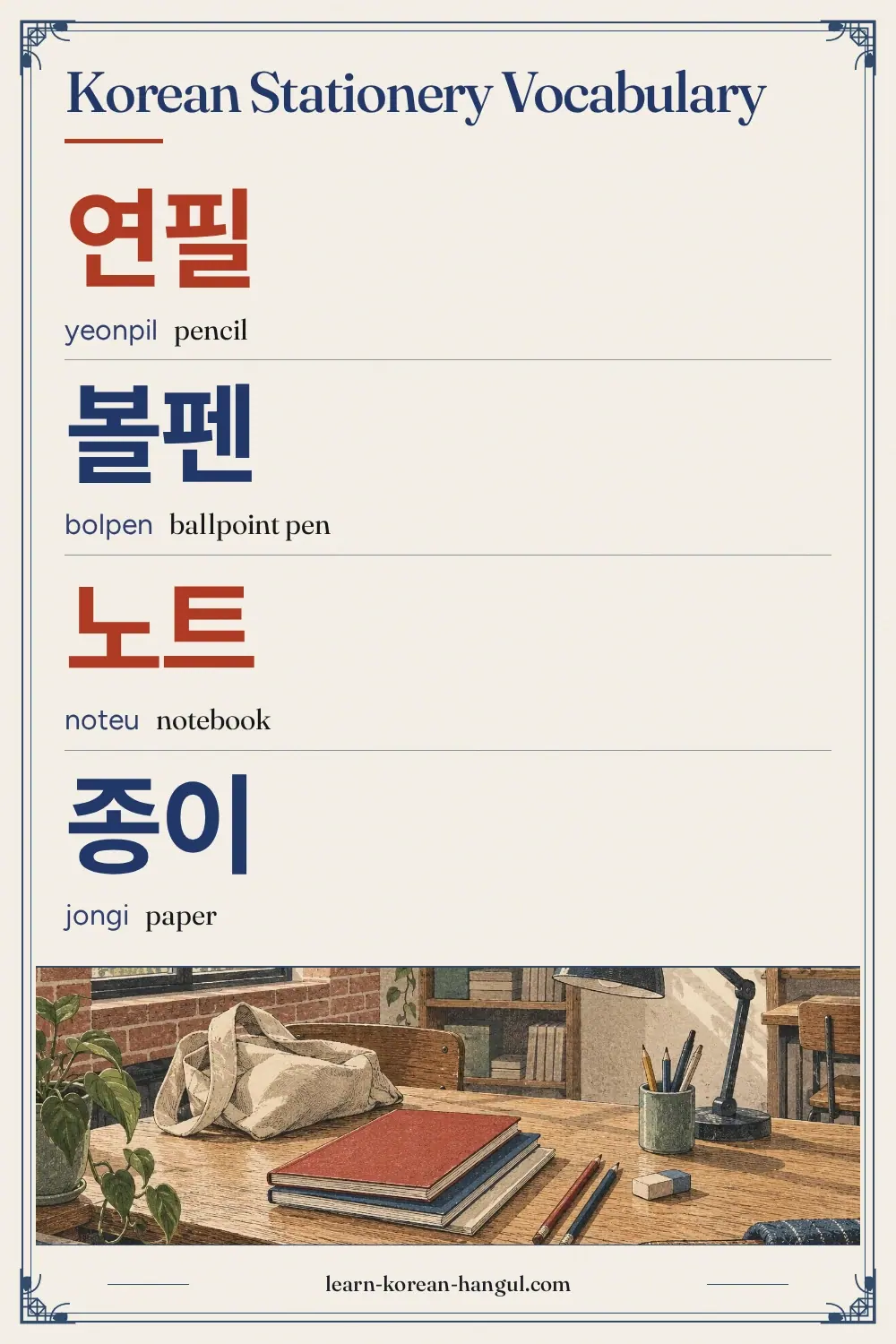
Korean Stationery Vocabulary at a Glance
The list has 30 words in five groups of six. It moves from what you write with to what you write on, what you cut and stick with, what you draw with, and what you carry it all in. It belongs to School. About half the words are loanwords, so many will feel familiar.
| Group | Words | Use |
|---|---|---|
| Writing tools | 6 | Pencils, pens and the sharpener |
| Paper and notebooks | 6 | Sheets, pads and books |
| Desk tools | 6 | Cutting, sticking and measuring |
| Art supplies | 6 | Paint, brushes and crayons |
| Bags and cases | 6 | Carrying, storing and buying |
If you want only the one word, pencil in Korean gives its meaning, pronunciation and a use. This page puts all the school supplies in one list.
Which Stationery Words Should You Learn First?
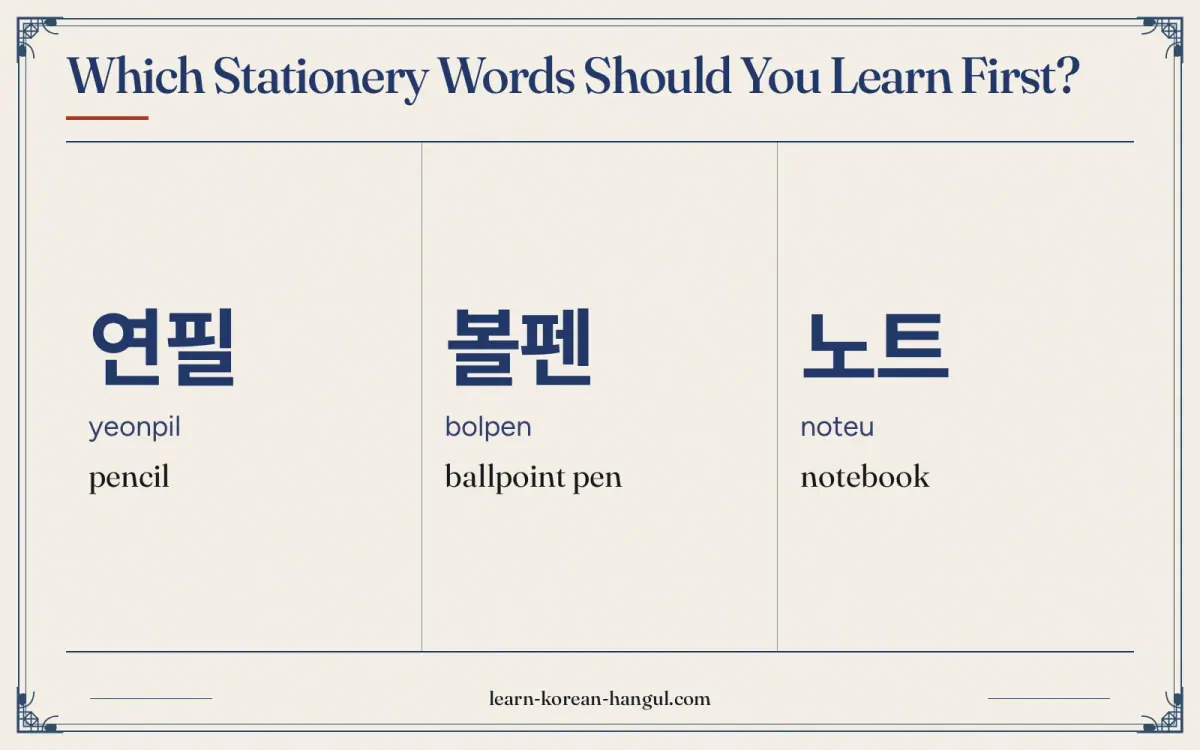
Learn 연필 (pencil), 볼펜 (ballpoint pen), 노트 (notebook), 지우개 (eraser, on the classroom page) and 가위 (scissors) first. They let you ask to borrow something, and the easiest request is the noun plus 주세요: 볼펜 주세요 means a pen, please.
- Words to say. 연필, 볼펜, 노트, 가위, 풀.
- Words to recognise. 형광펜, 샤프, 스테이플러, 바인더. They appear in shops and on lists.
- Counters to learn with them. 자루 for pencils and pens, 권 for notebooks and 장 for sheets.
The scene below numbers ten supplies, with numbers that match the word list.
Word · 10
- 1
연필
yeonpil
pencil
- 2
볼펜
bolpen
ballpoint pen
- 3
노트
noteu
notebook
- 4
종이
jongi
paper
- 5
가위
gawi
scissors
- 6
풀
pul
glue
- 7
자
ja
ruler
- 8
물감
mulgam
paint
- 9
필통
piltong
pencil case
- 10
책가방
chaekgabang
school bag
Writing Tools
Writing tools are where Korean stationery borrows most heavily from English. 볼펜 comes from ballpoint pen, 샤프 from the first part of sharp pencil, and 사인펜 from sign pen. Only 연필 (pencil) is fully Sino-Korean, and 형광펜 joins Sino-Korean 형광 to the loanword 펜. The result is a short list that mixes both sources, and the loanwords are clipped in ways that English speakers do not expect.
| No. | Hangul | Revised Romanization | Meaning and note | Example sentence | Audio assetId |
|---|---|---|---|---|---|
| 1 | 연필 | yeonpil | pencil. Sino-Korean: 연 is lead; 필 is brush. | 연필 한 자루 주세요. (One pencil, please.) | au-pg-vocabulary-school-work-school-stationery-1; example: au-pg-vocabulary-school-work-school-stationery-31 |
| 2 | 볼펜 | bolpen | ballpoint pen. From ball + pen. | 볼펜으로 써요. (I write with a ballpoint pen.) | au-pg-vocabulary-school-work-school-stationery-2; example: au-pg-vocabulary-school-work-school-stationery-32 |
| 3 | 샤프 | syapeu | mechanical pencil. Clipped from sharp pencil. | 샤프가 필요해요. (I need a mechanical pencil.) | au-pg-vocabulary-school-work-school-stationery-3; example: au-pg-vocabulary-school-work-school-stationery-33 |
| 4 | 형광펜 | hyeonggwangpen | highlighter. 형광 is fluorescent. | 형광펜으로 칠해요. (I mark it with a highlighter.) | au-pg-vocabulary-school-work-school-stationery-4; example: au-pg-vocabulary-school-work-school-stationery-34 |
| 5 | 사인펜 | sainpen | felt-tip pen. From sign + pen. | 사인펜으로 이름을 써요. (I write my name with a felt-tip pen.) | au-pg-vocabulary-school-work-school-stationery-5; example: au-pg-vocabulary-school-work-school-stationery-35 |
| 6 | 연필깎이 | yeonpilkkakki | pencil sharpener. Said [연필까끼]. | 연필깎이로 연필을 깎아요. (I sharpen the pencil with a sharpener.) | au-pg-vocabulary-school-work-school-stationery-6; example: au-pg-vocabulary-school-work-school-stationery-36 |
The counter for pencils and pens is 자루, as in 연필 한 자루 (one pencil). It is used for long, thin things, and the number before it is native Korean: 한, 두, 세. The verb 깎다 (to peel or sharpen) has the tense ㄲ built into its stem and makes 깎아요. See counters for things for the other counters on this page.
How Do You Say Paper and Notebooks in Korean?
Paper words split into two families. Sheets and pads are counted with 장 and named with 지 (paper) or loanwords, while bound notebooks are counted with 권 and named 노트. Coloured paper for folding has its own name, 색종이, and it is the paper children use in school.
| No. | Hangul | Revised Romanization | Meaning and note | Example sentence | Audio assetId |
|---|---|---|---|---|---|
| 7 | 노트 | noteu | notebook. Loanword; 공책 is the older word. | 노트에 적어요. (I write it in the notebook.) | au-pg-vocabulary-school-work-school-stationery-7; example: au-pg-vocabulary-school-work-school-stationery-37 |
| 8 | 종이 | jongi | paper. The general word. | 종이가 얇아요. (The paper is thin.) | au-pg-vocabulary-school-work-school-stationery-8; example: au-pg-vocabulary-school-work-school-stationery-38 |
| 9 | 메모지 | memoji | memo pad. 메모 is a note. | 메모지에 써요. (I write on a memo pad.) | au-pg-vocabulary-school-work-school-stationery-9; example: au-pg-vocabulary-school-work-school-stationery-39 |
| 10 | 포스트잇 | poseuteuit | sticky note. A brand name that became the word. | 포스트잇을 붙여요. (I stick on a sticky note.) | au-pg-vocabulary-school-work-school-stationery-10; example: au-pg-vocabulary-school-work-school-stationery-40 |
| 11 | 색종이 | saekjongi | coloured paper. Said [색쫑이]. | 색종이를 접어요. (I fold coloured paper.) | au-pg-vocabulary-school-work-school-stationery-11; example: au-pg-vocabulary-school-work-school-stationery-41 |
| 12 | 스케치북 | seukechibuk | sketchbook. Loanword. | 스케치북에 그려요. (I draw in the sketchbook.) | au-pg-vocabulary-school-work-school-stationery-12; example: au-pg-vocabulary-school-work-school-stationery-42 |
Sheets are counted with 장: 종이 세 장 (three sheets of paper). Bound books are counted with 권: 노트 두 권 (two notebooks). The verbs in this group are all everyday ones: 붙이다 (to stick on) makes 붙여요, 접다 (to fold) makes 접어요, and 그리다 (to draw) makes 그려요. They pair with the noun that comes before them, so learn each noun with its verb.
Desk Tools
The desk tools are the small things that cut, stick, measure and hold. Several are plain native words with one syllable, 풀 and 자, which makes them easy to say and easy to confuse with other words. Context does the work: 풀 on a desk is glue, and the same sound outdoors is grass.
| No. | Hangul | Revised Romanization | Meaning and note | Example sentence | Audio assetId |
|---|---|---|---|---|---|
| 13 | 가위 | gawi | scissors. One word for the whole tool; Korean needs no "pair of". | 가위로 잘라요. (I cut with scissors.) | au-pg-vocabulary-school-work-school-stationery-13; example: au-pg-vocabulary-school-work-school-stationery-43 |
| 14 | 풀 | pul | glue. Also means grass. | 풀을 발라요. (I spread glue.) | au-pg-vocabulary-school-work-school-stationery-14; example: au-pg-vocabulary-school-work-school-stationery-44 |
| 15 | 테이프 | teipeu | tape. Loanword. | 테이프를 붙여요. (I stick on tape.) | au-pg-vocabulary-school-work-school-stationery-15; example: au-pg-vocabulary-school-work-school-stationery-45 |
| 16 | 스테이플러 | seuteipeulleo | stapler. Loanword; many people also say 호치키스, from a brand name. | 스테이플러가 어디에 있어요? (Where is the stapler?) | au-pg-vocabulary-school-work-school-stationery-16; example: au-pg-vocabulary-school-work-school-stationery-46 |
| 17 | 자 | ja | ruler. A one-syllable native word. | 자로 길이를 재요. (I measure the length with a ruler.) | au-pg-vocabulary-school-work-school-stationery-17; example: au-pg-vocabulary-school-work-school-stationery-47 |
| 18 | 클립 | keullip | paper clip. Loanword. | 클립이 작아요. (The paper clip is small.) | au-pg-vocabulary-school-work-school-stationery-18; example: au-pg-vocabulary-school-work-school-stationery-48 |
The verbs show how Korean treats each tool. You 자르다 (cut) with 가위, which gives 잘라요 by the 르 pattern. You 바르다 (spread) 풀, which gives 발라요. And you 재다 (measure) with 자, which gives 재요. A good test of the desk list is to say what you do with each tool: the verb is the second half of every sentence.
How Do You Say Art Supplies in Korean?
Art supplies appear in school from the first grade, and their names mix native words like 물감 and 붓, the Sino-Korean 도화지, and loanwords such as 크레파스 and 팔레트. Two of them show tense and linking sounds that are worth hearing: 색연필 and the particle after 붓.
| No. | Hangul | Revised Romanization | Meaning and note | Example sentence | Audio assetId |
|---|---|---|---|---|---|
| 19 | 물감 | mulgam | paint. Native word: 물 is water; 감 is material. | 물감을 섞어요. (I mix the paint.) | au-pg-vocabulary-school-work-school-stationery-19; example: au-pg-vocabulary-school-work-school-stationery-49 |
| 20 | 붓 | but | brush. Said [붇]; with 으로 [부스로]. | 붓으로 칠해요. (I paint with a brush.) | au-pg-vocabulary-school-work-school-stationery-20; example: au-pg-vocabulary-school-work-school-stationery-50 |
| 21 | 도화지 | dohwaji | drawing paper. Thick paper for drawing. | 도화지가 커요. (The drawing paper is big.) | au-pg-vocabulary-school-work-school-stationery-21; example: au-pg-vocabulary-school-work-school-stationery-51 |
| 22 | 크레파스 | keurepaseu | crayon. From crayon + pastel. | 크레파스로 그려요. (I draw with crayons.) | au-pg-vocabulary-school-work-school-stationery-22; example: au-pg-vocabulary-school-work-school-stationery-52 |
| 23 | 색연필 | saengnyeonpil | coloured pencil. Said [생년필]. | 색연필을 사요. (I buy coloured pencils.) | au-pg-vocabulary-school-work-school-stationery-23; example: au-pg-vocabulary-school-work-school-stationery-53 |
| 24 | 팔레트 | palleteu | palette. Loanword. | 팔레트에 물감을 짜요. (I squeeze paint onto the palette.) | au-pg-vocabulary-school-work-school-stationery-24; example: au-pg-vocabulary-school-work-school-stationery-54 |
The word 색 (colour) shows up twice: in 색연필 and, as you saw above, in 색종이. Whenever you see 색 in a compound, think colour. The verb 섞다 (to mix) makes 섞어요, and 짜다 (to squeeze) makes 짜요. In the brush sentence, the final ㅅ of 붓 moves to the particle, so 붓으로 sounds like 부스로.
Bags and Cases
The last group is for carrying and storing. A pencil case, a school bag, a book stand, a folder and a binder each have a name, and so does the shop where you buy them. Korean cities have many small 문구점 near schools, and the word is the best answer to the question of where to find any item on this page.
| No. | Hangul | Revised Romanization | Meaning and note | Example sentence | Audio assetId |
|---|---|---|---|---|---|
| 25 | 필통 | piltong | pencil case. 필 is writing brush; 통 is tube. | 필통에 연필이 있어요. (There are pencils in the pencil case.) | au-pg-vocabulary-school-work-school-stationery-25; example: au-pg-vocabulary-school-work-school-stationery-55 |
| 26 | 책가방 | chaekgabang | school bag. Said [책까방]. | 책가방이 무거워요. (The school bag is heavy.) | au-pg-vocabulary-school-work-school-stationery-26; example: au-pg-vocabulary-school-work-school-stationery-56 |
| 27 | 책꽂이 | chaekkkoji | desk bookshelf. From 꽂다, to insert. | 책꽂이에 노트를 꽂아요. (I put the notebook on the bookshelf.) | au-pg-vocabulary-school-work-school-stationery-27; example: au-pg-vocabulary-school-work-school-stationery-57 |
| 28 | 파일 | pail | file folder. Loanword. | 파일에 종이를 넣어요. (I put the paper in the file.) | au-pg-vocabulary-school-work-school-stationery-28; example: au-pg-vocabulary-school-work-school-stationery-58 |
| 29 | 바인더 | baindeo | binder. Loanword. | 바인더가 두꺼워요. (The binder is thick.) | au-pg-vocabulary-school-work-school-stationery-29; example: au-pg-vocabulary-school-work-school-stationery-59 |
| 30 | 문구점 | mungujeom | stationery shop. 문구 is writing gear; 점 is shop. | 문구점에서 사요. (I buy it at the stationery shop.) | au-pg-vocabulary-school-work-school-stationery-30; example: au-pg-vocabulary-school-work-school-stationery-60 |
점 (shop) appears in 문구점 and also in 면세점 (duty-free shop) and 서점 (bookstore). For the broader school vocabulary, including the desk and the room, see Korean Classroom Vocabulary.
How Do You Pronounce These Words?
Stationery words show tensing and linking in compounds. After a final ㄱ, a following ㄱ, ㄷ, ㅂ, ㅅ or ㅈ is always said tense, as in 책가방 [책까방] and 색종이 [색쫑이], and a final consonant moves forward when a vowel follows. These are patterns in the National Institute of Korean Language (국립국어원) standard pronunciation rules. Revised Romanization writes the plain letters.
| Spelling | Sounds like | What changes |
|---|---|---|
| 연필깎이 | [연필까끼] | The final ㄲ of 깎 moves to the start of 이. |
| 색종이 | [색쫑이] | After final ㄱ, the ㅈ is tense. |
| 색연필 | [생년필] | ㄴ is added before 연, then final ㄱ becomes ㅇ before ㄴ. |
| 책가방 | [책까방] | After final ㄱ, the ㄱ is tense. |
| 붓으로 | [부스로] | The final ㅅ moves to the next syllable. |
Audio and Slow Playback
Each word and example has its own clip, and five more replay the hard ones slowly. Play 색연필 first: its added ㄴ is the least familiar sound on the page.
What Mistakes Do Learners Make with Stationery Words?
Five mistakes appear often with school supplies.
- Counting everything with 개. 개 is common in casual speech, but pencils take 자루, notebooks 권 and sheets 장, and these are what shops, teachers and forms use: 연필 한 자루, 노트 두 권, 종이 세 장.
- Taking 노트북 for a notebook. 노트북 is a laptop computer. A paper notebook is 노트 or 공책.
- Adding 펜슬 to 샤프. The short form 샤프 is the usual word. The long form 샤프펜슬 exists, but speakers shorten it.
- Reading 풀 only as grass. On a desk, 풀 is glue, and the verb that follows is 바르다, spread.
- Writing 색연필 as it sounds. It sounds like [생년필], but you write 색연필. Keep the spelling and learn the sound as a pair.
The shop word 문구점 is the best fix for any gap on this page: say what you need and ask the shop.
Practice: Flashcards and Worksheet
Study in three steps. First, run the deck in recognition mode until the 30 words are familiar. Second, switch to listening mode and play each clip before the card turns. Third, take the five-question quiz. Progress stays in your browser, and the vocabulary flashcard decks page lists the other decks.
Practice · 65
- 01연필
Show answer
headword 1: pencil
- 02볼펜
Show answer
headword 2: ballpoint pen
- 03샤프
Show answer
headword 3: mechanical pencil
- 04형광펜
Show answer
headword 4: highlighter
- 05사인펜
Show answer
headword 5: felt-tip pen
- 06연필깎이
Show answer
headword 6: pencil sharpener
- 07노트
Show answer
headword 7: notebook
- 08종이
Show answer
headword 8: paper
- 09메모지
Show answer
headword 9: memo pad
- 10포스트잇
Show answer
headword 10: sticky note
- 11색종이
Show answer
headword 11: coloured paper
- 12스케치북
Show answer
headword 12: sketchbook
- 13가위
Show answer
headword 13: scissors
- 14풀
Show answer
headword 14: glue
- 15테이프
Show answer
headword 15: tape
- 16스테이플러
Show answer
headword 16: stapler
- 17자
Show answer
headword 17: ruler
- 18클립
Show answer
headword 18: paper clip
- 19물감
Show answer
headword 19: paint
- 20붓
Show answer
headword 20: brush
- 21도화지
Show answer
headword 21: drawing paper
- 22크레파스
Show answer
headword 22: crayon
- 23색연필
Show answer
headword 23: coloured pencil
- 24팔레트
Show answer
headword 24: palette
- 25필통
Show answer
headword 25: pencil case
- 26책가방
Show answer
headword 26: school bag
- 27책꽂이
Show answer
headword 27: desk bookshelf
- 28파일
Show answer
headword 28: file folder
- 29바인더
Show answer
headword 29: binder
- 30문구점
Show answer
headword 30: stationery shop
- 31연필 한 자루 주세요.
Show answer
example sentence for 연필
- 32볼펜으로 써요.
Show answer
example sentence for 볼펜
- 33샤프가 필요해요.
Show answer
example sentence for 샤프
- 34형광펜으로 칠해요.
Show answer
example sentence for 형광펜
- 35사인펜으로 이름을 써요.
Show answer
example sentence for 사인펜
- 36연필깎이로 연필을 깎아요.
Show answer
example sentence for 연필깎이
- 37노트에 적어요.
Show answer
example sentence for 노트
- 38종이가 얇아요.
Show answer
example sentence for 종이
- 39메모지에 써요.
Show answer
example sentence for 메모지
- 40포스트잇을 붙여요.
Show answer
example sentence for 포스트잇
- 41색종이를 접어요.
Show answer
example sentence for 색종이
- 42스케치북에 그려요.
Show answer
example sentence for 스케치북
- 43가위로 잘라요.
Show answer
example sentence for 가위
- 44풀을 발라요.
Show answer
example sentence for 풀
- 45테이프를 붙여요.
Show answer
example sentence for 테이프
- 46스테이플러가 어디에 있어요?
Show answer
example sentence for 스테이플러
- 47자로 길이를 재요.
Show answer
example sentence for 자
- 48클립이 작아요.
Show answer
example sentence for 클립
- 49물감을 섞어요.
Show answer
example sentence for 물감
- 50붓으로 칠해요.
Show answer
example sentence for 붓
- 51도화지가 커요.
Show answer
example sentence for 도화지
- 52크레파스로 그려요.
Show answer
example sentence for 크레파스
- 53색연필을 사요.
Show answer
example sentence for 색연필
- 54팔레트에 물감을 짜요.
Show answer
example sentence for 팔레트
- 55필통에 연필이 있어요.
Show answer
example sentence for 필통
- 56책가방이 무거워요.
Show answer
example sentence for 책가방
- 57책꽂이에 노트를 꽂아요.
Show answer
example sentence for 책꽂이
- 58파일에 종이를 넣어요.
Show answer
example sentence for 파일
- 59바인더가 두꺼워요.
Show answer
example sentence for 바인더
- 60문구점에서 사요.
Show answer
example sentence for 문구점
- 61연필깎이
Show answer
slow playback of 연필깎이
- 62색종이
Show answer
slow playback of 색종이
- 63스테이플러
Show answer
slow playback of 스테이플러
- 64색연필
Show answer
slow playback of 색연필
- 65책가방
Show answer
slow playback of 책가방
Practice · 5
What does 연필 (yeonpil) mean?
Show answer
pencil
연필 means pencil. Example: 연필 한 자루 주세요. (One pencil, please.)
What does 가위 (gawi) mean?
Show answer
scissors
가위 means scissors. Example: 가위로 잘라요. (I cut with scissors.)
What does 풀 (pul) mean?
Show answer
glue
풀 means glue. Example: 풀을 발라요. (I spread glue.)
What does 물감 (mulgam) mean?
Show answer
paint
물감 means paint. Example: 물감을 섞어요. (I mix the paint.)
What does 필통 (piltong) mean?
Show answer
pencil case
필통 means pencil case. Example: 필통에 연필이 있어요. (There are pencils in the pencil case.)
Korean Stationery Vocabulary Worksheet (PDF)
A printable worksheet for these words (word list, matching, writing practice, fill-in-the-blank exercises and answer key) is available in A4 and US Letter from the download card on this page. For practice, write the five groups on a sheet of paper and list the items on your own desk under each.
Where to Go Next
After this page, continue with Korean Classroom Vocabulary for the room and the people, or with Korean Exams and Grades Vocabulary for tests. To move up a level, return to School.
Frequently Asked Questions
How Do You Say Pencil in Korean?
Pencil is 연필 (yeonpil). A mechanical pencil is 샤프, a ballpoint pen is 볼펜 and a coloured pencil is 색연필. Pencils are counted with 자루, as in 연필 한 자루. The single-word page on pencil in Korean gives more detail.
How Do You Pronounce 볼펜 (bolpen)?
Say bol-pen in two beats. The first syllable ends in an l sound with the tongue touching the ridge behind the upper teeth. The second starts with an aspirated p, a puff of air, and ends in n. It means ballpoint pen. Press the audio button to hear it.
How Many Stationery Words Should I Learn First?
Five: 연필, 볼펜, 노트, 가위 and 풀. At five new words a day the full 30 take six days plus review. Learn the counters 자루, 권 and 장 at the same time.
What Counter Do I Use for Pencils, Notebooks and Paper?
Use 자루 for pencils and pens, 권 for notebooks and books, and 장 for sheets of paper. Put a native Korean number before the counter: 한 자루, 두 권, 세 장. See counters for things.
Where Can I Practise Stationery Words with Flashcards?
Use the vocabulary flashcard decks. The deck for this page holds all 30 words with Hangul, romanization and audio. Run it in recognition mode first, then switch to listening mode. Your progress stays in your browser.
Is There a Printable Worksheet for Stationery Words?
A printable worksheet for these words (word list, matching, writing practice, fill-in-the-blank exercises and answer key) is available in A4 and US Letter from the download card on this page. For practice, copy the tables on this page by hand or use the deck.