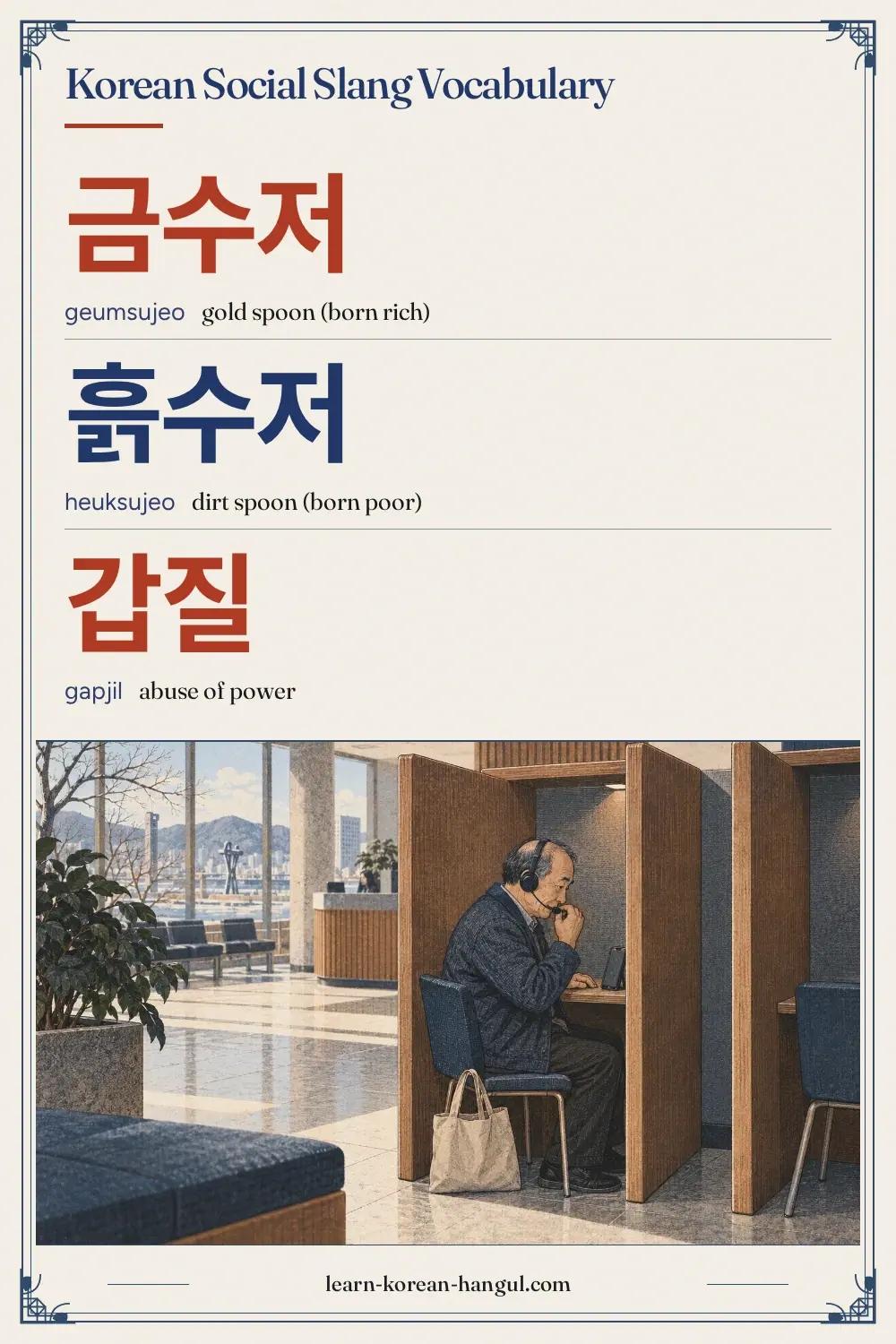
Korean Social Slang Vocabulary at a Glance
Korean social slang vocabulary is a way of talking about unfairness and daily life that news and young people share. It names the family you were born into (금수저, 흙수저), the person who has power over you at work (갑질, 꼰대), the habit of doing things alone (혼밥, 혼술) and the rhythm of office life (회식, 야근). These words matter because Korean news, dramas and online posts use them without explaining them.
| Group | Words | Use |
|---|---|---|
| Spoon class terms | 7 | Family wealth and advantage |
| Power words | 8 | Who has power over whom |
| Solo culture | 8 | Living and doing things alone |
| Work culture | 7 | Life in the office |
The 30 words fall into four groups. The first two are critical words about money and power, the third is about living alone, and the fourth is about the office. Read the first two groups with care, because they describe inequality and some words are judgements.
Fast-changing youth slang, such as 갑분싸, is on the Korean Gen Z slang page, and shortened words such as 알바 are on the Korean abbreviations page. This list sits inside Internet Slang and Abbreviations.
Which Social Slang Words Should You Learn First?
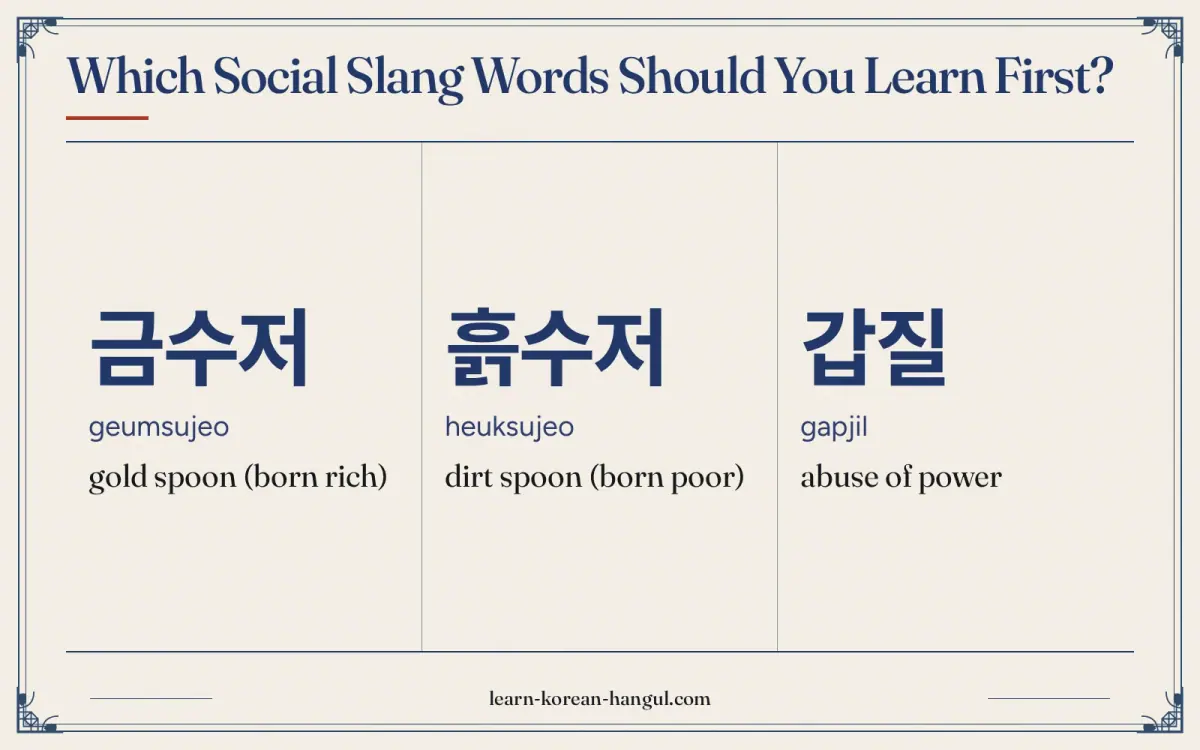
Learn 금수저, 흙수저, 갑질, 꼰대 and 혼밥 first. They appear in news stories, dramas and everyday talk, and you cannot follow Korean social talk without them. After them, add the ladder words and the work words, because they let you describe your own situation.
- Day one (7 words). The spoon ladder: 수저, 금수저, 은수저, 동수저, 흙수저, 부모 찬스 and 개천용.
- Day two (8 words). The power words: 갑, 을, 갑질, 꼰대, 라떼는 말이야, 직장 내 괴롭힘, 막말 and 낙하산.
- Day three (8 words). The solo words: 혼자, 혼밥, 혼술, 혼영, 혼행, 1인 가구, 솔로 and 자취.
- Day four (7 words). The work words: 회식, 야근, 상사, 월급, 이직, 퇴사 and 번아웃.
At 7 to 8 words a day, the list takes four days plus review. The scene below puts eight of the words on one picture.
Word · 8
- 1
금수저
geumsujeo
gold spoon (born rich)
- 2
흙수저
heuksujeo
dirt spoon (born poor)
- 3
갑질
gapjil
abuse of power
- 4
꼰대
kkondae
condescending elder
- 5
혼자
honja
alone; by oneself
- 6
혼술
honsul
drinking alone
- 7
1인 가구
irin gagu
one-person household
- 8
번아웃
beonaut
burnout
The Origin column shows how the words are built. Most of the words use Sino-Korean or mixed parts, because office and law words come from Chinese characters. The solo words use the native word 혼자 (alone) and add a second word: 혼밥 is 혼자 and 밥, and 혼술 is 혼자 and 술. The Sino-Korean words page explains how to read the Chinese-character parts.
Spoon Class Terms (금수저, 흙수저)
The spoon words rank people by the family they were born into. A 금수저 (gold spoon) has rich parents, a 은수저 (silver spoon) has comfortable ones, a 동수저 (bronze spoon) has modest ones and a 흙수저 (dirt spoon) has poor ones. The word 수저 itself is the everyday word for a spoon and chopsticks set, so you can use it at the dinner table too.
| No. | Hangul | Revised Romanization | Origin | Meaning | Example sentence | Audio assetId |
|---|---|---|---|---|---|---|
| 1 | 수저 | sujeo | native | spoon and chopsticks | 식탁에 수저를 놓아요. (I put the spoon and chopsticks on the table.) | au-pg-vocabulary-slang-internet-slang-social-slang-1; example: au-pg-vocabulary-slang-internet-slang-social-slang-31 |
| 2 | 금수저 | geumsujeo | mixed | gold spoon (born rich) | 그 친구는 금수저라서 걱정이 없어요. (That friend is a gold spoon, so he has no worries.) | au-pg-vocabulary-slang-internet-slang-social-slang-2; example: au-pg-vocabulary-slang-internet-slang-social-slang-32 |
| 3 | 은수저 | eunsujeo | mixed | silver spoon (comfortable family) | 우리 집은 은수저 정도예요. (My family is about silver-spoon level.) | au-pg-vocabulary-slang-internet-slang-social-slang-3; example: au-pg-vocabulary-slang-internet-slang-social-slang-33 |
| 4 | 동수저 | dongsujeo | mixed | bronze spoon (modest family) | 동수저는 흙수저보다 조금 나아요. (A bronze spoon is a little better off than a dirt spoon.) | au-pg-vocabulary-slang-internet-slang-social-slang-4; example: au-pg-vocabulary-slang-internet-slang-social-slang-34 |
| 5 | 흙수저 | heuksujeo | native | dirt spoon (born poor) | 저는 흙수저라고 생각해요. (I think of myself as a dirt spoon.) | au-pg-vocabulary-slang-internet-slang-social-slang-5; example: au-pg-vocabulary-slang-internet-slang-social-slang-35 |
| 6 | 부모 찬스 | bumo chanseu | mixed | parents' advantage; family help | 그 사람은 부모 찬스를 받았어요. (He received his parents' help.) | au-pg-vocabulary-slang-internet-slang-social-slang-6; example: au-pg-vocabulary-slang-internet-slang-social-slang-36 |
| 7 | 개천용 | gaecheonnyong | Sino-Korean | dragon from a stream (rose from humble origins) | 개천용이 되기는 쉽지 않아요. (It is not easy to become a dragon from a stream.) | au-pg-vocabulary-slang-internet-slang-social-slang-7; example: au-pg-vocabulary-slang-internet-slang-social-slang-37 |
The ladder echoes the English saying that a lucky child is born with a silver spoon in the mouth. In Korean the spoon is also part of every meal, so the picture is natural. People use these words about themselves in a half-joking, half-bitter way, as in 저는 흙수저라고 생각해요. When they use them about someone else, the tone can be harsh, so it is better to describe than to label.
부모 찬스 means the help that parents give, such as a connection or money, and it usually has a critical tone. 개천용 is the opposite story: someone who rose from humble origins. It comes from the proverb that a dragon rises from a small stream, and people use it with admiration. For a single word, see gold spoon in Korean and dirt spoon in Korean.
Example Sentences
Each example is a short sentence in the polite 해요 style. Most follow the pattern noun + 이/가 + verb, as in 회식이 있어요, or noun + 을/를 + verb, as in 막말을 했어요. Say each sentence aloud, then swap the noun: replace 회식 with 회의 and you get 오늘 저녁에 회의가 있어요, which is also natural.
How Do You Say Power Words (갑질, 꼰대) in Korean?
Power words describe who is above and who is below. In a contract, the stronger party is called 갑 and the weaker party 을. When the 갑 treats the 을 badly, that is 갑질. An older person who lectures younger people with a superior tone is a 꼰대, and the phrase 라떼는 말이야 (back in my day) is the way a 꼰대 starts a story.
| No. | Hangul | Revised Romanization | Origin | Meaning | Example sentence | Audio assetId |
|---|---|---|---|---|---|---|
| 8 | 갑 | gap | Sino-Korean | the stronger party in a contract | 이 계약에서는 우리 회사가 갑이에요. (In this contract our company is the stronger party.) | au-pg-vocabulary-slang-internet-slang-social-slang-8; example: au-pg-vocabulary-slang-internet-slang-social-slang-38 |
| 9 | 을 | eul | Sino-Korean | the weaker party in a contract | 저는 이 계약에서 을이에요. (In this contract I am the weaker party.) | au-pg-vocabulary-slang-internet-slang-social-slang-9; example: au-pg-vocabulary-slang-internet-slang-social-slang-39 |
| 10 | 갑질 | gapjil | mixed | abuse of power | 회사 상사의 갑질이 문제가 됐어요. (The boss's abuse of power became a problem.) | au-pg-vocabulary-slang-internet-slang-social-slang-10; example: au-pg-vocabulary-slang-internet-slang-social-slang-40 |
| 11 | 꼰대 | kkondae | native | condescending elder | 꼰대처럼 말하지 마세요. (Don't talk like a condescending elder.) | au-pg-vocabulary-slang-internet-slang-social-slang-11; example: au-pg-vocabulary-slang-internet-slang-social-slang-41 |
| 12 | 라떼는 말이야 | ratteneun mariya | mixed | "back in my day" talk | 부장님이 "라떼는 말이야" 하고 이야기를 시작했어요. (My manager began a story with "back in my day".) | au-pg-vocabulary-slang-internet-slang-social-slang-12; example: au-pg-vocabulary-slang-internet-slang-social-slang-42 |
| 13 | 직장 내 괴롭힘 | jikjang nae goerophim | mixed | workplace harassment | 직장 내 괴롭힘은 신고할 수 있어요. (You can report workplace harassment.) | au-pg-vocabulary-slang-internet-slang-social-slang-13; example: au-pg-vocabulary-slang-internet-slang-social-slang-43 |
| 14 | 막말 | mangmal | native | harsh words; reckless talk | 그는 화가 나서 막말을 했어요. (He was angry and said harsh things.) | au-pg-vocabulary-slang-internet-slang-social-slang-14; example: au-pg-vocabulary-slang-internet-slang-social-slang-44 |
| 15 | 낙하산 | nakhasan | Sino-Korean | parachute (an appointee placed by connections) | 새 팀장은 낙하산이에요. (The new team leader is a parachute appointee.) | au-pg-vocabulary-slang-internet-slang-social-slang-15; example: au-pg-vocabulary-slang-internet-slang-social-slang-45 |
갑 and 을 come from the old way of numbering people in a contract, where 갑 is the first party and 을 the second. The ending 질 in 갑질 turns a noun into an action with a critical tone, as in 도둑질 (stealing). Because 갑질 describes an act, a news story can use it in a serious sentence: 갑질 문제 (the abuse-of-power problem).
꼰대 is different. It labels a person, so it is rude if said to someone's face, and many young people use it only about people who are not there. The phrase 라떼는 말이야 is a joke at the expense of older people who begin with "in my day". 직장 내 괴롭힘 is the formal term for harassment at work, and 막말 and 낙하산 are everyday words in office talk. For single words, see abuse of power in Korean and condescending elder in Korean.
Solo Culture (혼밥, 혼술)
Solo culture words treat doing things alone as a normal choice. The prefix 혼 comes from 혼자 (alone). Add it to a word and you get a short word for an action done alone: 혼밥 (eating alone), 혼술 (drinking alone), 혼영 (watching a movie alone) and 혼행 (travelling alone).
| No. | Hangul | Revised Romanization | Origin | Meaning | Example sentence | Audio assetId |
|---|---|---|---|---|---|---|
| 16 | 혼자 | honja | native | alone; by oneself | 오늘은 혼자 영화를 봤어요. (Today I watched a movie alone.) | au-pg-vocabulary-slang-internet-slang-social-slang-16; example: au-pg-vocabulary-slang-internet-slang-social-slang-46 |
| 17 | 혼밥 | honbap | native | eating alone | 저는 혼밥이 편해요. (I am comfortable eating alone.) | au-pg-vocabulary-slang-internet-slang-social-slang-17; example: au-pg-vocabulary-slang-internet-slang-social-slang-47 |
| 18 | 혼술 | honsul | native | drinking alone | 집에서 혼술을 해요. (I drink alone at home.) | au-pg-vocabulary-slang-internet-slang-social-slang-18; example: au-pg-vocabulary-slang-internet-slang-social-slang-48 |
| 19 | 혼영 | honyeong | mixed | watching a movie alone | 주말에 혼영을 했어요. (I watched a movie alone at the weekend.) | au-pg-vocabulary-slang-internet-slang-social-slang-19; example: au-pg-vocabulary-slang-internet-slang-social-slang-49 |
| 20 | 혼행 | honhaeng | mixed | travelling alone | 올여름에는 혼행을 갈 거예요. (This summer I will go on a solo trip.) | au-pg-vocabulary-slang-internet-slang-social-slang-20; example: au-pg-vocabulary-slang-internet-slang-social-slang-50 |
| 21 | 1인 가구 | irin gagu | Sino-Korean | one-person household | 이 아파트에는 1인 가구가 많아요. (This apartment building has many one-person households.) | au-pg-vocabulary-slang-internet-slang-social-slang-21; example: au-pg-vocabulary-slang-internet-slang-social-slang-51 |
| 22 | 솔로 | sollo | loanword | single; not in a relationship | 저는 아직 솔로예요. (I am still single.) | au-pg-vocabulary-slang-internet-slang-social-slang-22; example: au-pg-vocabulary-slang-internet-slang-social-slang-52 |
| 23 | 자취 | jachwi | Sino-Korean | living on your own away from family | 대학생 때부터 자취를 했어요. (I have lived on my own since I was a university student.) | au-pg-vocabulary-slang-internet-slang-social-slang-23; example: au-pg-vocabulary-slang-internet-slang-social-slang-53 |
The pattern is easy to extend, and young people invent new words with it: any activity can become a 혼 word. A 1인 가구 is a one-person household, and the word is common in news about housing and shops. 자취 is living on your own away from your family, usually while studying or working. 솔로 means single, from the English solo.
These words are friendly and neutral, and they show that eating or travelling alone is now ordinary. The single-word pages eating alone in Korean and drinking alone in Korean give more detail on 혼밥 and 혼술.
How Do You Say Work Culture in Korean?
Work culture words describe office life. A 회식 is a company dinner with the team, often with drinks. A 야근 is overtime at night, a 상사 is your boss, and a 월급 is your monthly pay. When people change company it is an 이직, and when they leave a company it is a 퇴사. If the work is too much, it can end in 번아웃.
| No. | Hangul | Revised Romanization | Origin | Meaning | Example sentence | Audio assetId |
|---|---|---|---|---|---|---|
| 24 | 회식 | hoesik | Sino-Korean | company dinner | 오늘 저녁에 회식이 있어요. (There is a company dinner this evening.) | au-pg-vocabulary-slang-internet-slang-social-slang-24; example: au-pg-vocabulary-slang-internet-slang-social-slang-54 |
| 25 | 야근 | yageun | Sino-Korean | overtime work at night | 이번 주에는 야근이 많아요. (I have a lot of overtime this week.) | au-pg-vocabulary-slang-internet-slang-social-slang-25; example: au-pg-vocabulary-slang-internet-slang-social-slang-55 |
| 26 | 상사 | sangsa | Sino-Korean | boss; superior at work | 새 상사는 친절해요. (My new boss is kind.) | au-pg-vocabulary-slang-internet-slang-social-slang-26; example: au-pg-vocabulary-slang-internet-slang-social-slang-56 |
| 27 | 월급 | wolgeup | Sino-Korean | monthly salary | 월급날에는 기분이 좋아요. (I feel good on payday.) | au-pg-vocabulary-slang-internet-slang-social-slang-27; example: au-pg-vocabulary-slang-internet-slang-social-slang-57 |
| 28 | 이직 | ijik | Sino-Korean | changing jobs | 더 좋은 회사로 이직하고 싶어요. (I want to move to a better company.) | au-pg-vocabulary-slang-internet-slang-social-slang-28; example: au-pg-vocabulary-slang-internet-slang-social-slang-58 |
| 29 | 퇴사 | toesa | Sino-Korean | quitting a company | 다음 달에 퇴사할 예정이에요. (I plan to quit next month.) | au-pg-vocabulary-slang-internet-slang-social-slang-29; example: au-pg-vocabulary-slang-internet-slang-social-slang-59 |
| 30 | 번아웃 | beonaut | loanword | burnout | 일이 너무 많아서 번아웃이 왔어요. (I have so much work that I burned out.) | au-pg-vocabulary-slang-internet-slang-social-slang-30; example: au-pg-vocabulary-slang-internet-slang-social-slang-60 |
회식 is a good example of a word that carries a culture. It is a team dinner after work. In some companies people feel they have to go, and in others it is optional. 번아웃 is a loanword that came from English burnout.
For the formal side of work, the office vocabulary page has full titles, meetings and emails.
Money and Status
Class words are about inequality, so it helps to know how people use them. The table sums up the spoon ladder and what each word says.
| Word | Family background | Typical use |
|---|---|---|
| 금수저 | Rich | Often envy or criticism: 금수저라서 쉽게 성공했다 |
| 은수저 | Comfortable | Rare; used for contrast |
| 동수저 | Modest | Rare; used for contrast |
| 흙수저 | Poor | A way to talk about disadvantage, often about oneself |
Use these words as a way to understand Korean conversations, and be careful in your own speech. Calling a person a 흙수저 can hurt, even if you mean it kindly, and calling a person a 금수저 can sound like an accusation. Talking about your own situation is safer than labelling a friend. Koreans often use the words when they discuss housing, education and job chances, and in those talks the words are about the system and not about one person.
The words also have a hopeful side. 개천용 praises a person who rises from a poor start, and a 월급 that grows each year is a more positive topic. When you are not sure, describe the situation in plain Korean instead, for example 부모님 도움을 받았어요 (I got help from my parents).
How Do You Pronounce These Words?
Slang follows the spelling less than plain words do. The table lists the changes that learners most often miss.
| Spelling | Pronunciation | What happens |
|---|---|---|
| 갑질 | [갑찔] | The ㅈ after a final ㅂ becomes tense |
| 흙수저 | [흑쑤저] | The final cluster ㄺ is said as ㄱ, and the ㅅ after it becomes tense |
| 낙하산 | [나카산] | Final ㄱ and ㅎ join into an aspirated ㅋ, and the sound moves to the next syllable |
| 막말 | [망말] | A final ㄱ before ㅁ is said as ng |
| 번아웃 | [버나욷] | The final ㄴ of 번 moves to the empty ㅇ of 아, and the final ㅅ of 웃 is said as ㄷ |
| 개천용 | [개천뇽] | An n sound is added before 용 (ㄴ-insertion) |
| 1인 가구 | [이린 가구] | The number 일 is said with its final ㄹ linking into 인 |
The Revised Romanization shows the linking, the nasal ng and the added n in beonaut, mangmal and gaecheonnyong. It keeps the h of a noun such as nakhasan, and it does not show tensing caused by a neighbouring sound, so gapjil and heuksujeo look the same as the spelling. Learn the Hangul and use the audio to hear the real sound. The rules come from the Standard Pronunciation rules (표준 발음법) of the 국립국어원.
Audio and Slow Playback
Each word has a normal clip, and 5 key words also have a slow clip at 0.8 times the speed: 금수저, 흙수저, 꼰대, 라떼는 말이야 and 번아웃. Nothing plays until you press a button.
Listen to 흙수저 first. You should hear [흑쑤저], three beats, with no l sound and a tense ㅅ.
What Mistakes Do Learners Make with Social Slang Words?
- Reading 흙수저 with an l sound in the first syllable. The spoken form is [흑쑤저].
- Using 꼰대 to someone's face. It is a rude label, so use it only when you describe behaviour in general.
- Treating 갑 and 을 as a pair of names. They are positions in a contract, not people, and 을 is not a rude word.
- Writing 혼밥 or 혼술 with a space (혼 밥). Write each one as a single word.
- Reading 번아웃 as beon-a-out. Koreans say [버나욷], in three beats.
The first and fifth mistakes change the sound, and the others change the register or the form. The next section turns the list into practice.
Practice: Flashcards and Worksheet
Drill these words with the vocabulary flashcard decks. The Internet Slang and Abbreviations flashcards already hold some of the social words, and you can add the spoon and solo words to your own review. A printable worksheet for these words (word list, matching, writing practice, fill-in-the-blank exercises and answer key) is available in A4 and US Letter from the download card on this page. A printable worksheet for these words (word list, matching, writing practice, fill-in-the-blank exercises and answer key) is available in A4 and US Letter from the download card on this page. Progress in the decks is saved only in your browser.
Korean Social Slang Vocabulary Worksheet
Try this five-question check, then say the 30 words aloud once more.
Practice · 5
What does 금수저 mean?
Show answer
gold spoon (born rich)
금수저 (geumsujeo) means gold spoon (born rich).
What does 흙수저 mean?
Show answer
dirt spoon (born poor)
흙수저 (heuksujeo) means dirt spoon (born poor).
What does 꼰대 mean?
Show answer
condescending elder
꼰대 (kkondae) means condescending elder.
What does 라떼는 말이야 mean?
Show answer
"back in my day" talk
라떼는 말이야 (ratteneun mariya) means "back in my day" talk.
What does 혼밥 mean?
Show answer
eating alone
혼밥 (honbap) means eating alone.
Where to Go Next
This list sits inside Internet Slang and Abbreviations. After Korean social slang vocabulary, many learners move on to Korean Gen Z slang for youth words, or to Korean Abbreviations Vocabulary for shortened words.
Frequently Asked Questions
How Do You Say Gold Spoon in Korean?
A gold spoon is 금수저 (geumsujeo). It means a person born to a rich family, as in 그 친구는 금수저예요 (geu chinguneun geumsujeoyeyo), which means that friend is a gold spoon. The opposite is 흙수저 (heuksujeo), the dirt spoon. Press the audio button to hear the word.
How Do You Pronounce 흙수저 (heuksujeo)?
흙수저 is said [흑쑤저], in three beats. The final cluster ㄺ of 흙 is said as ㄱ, so the ㄹ is silent, and the ㅅ of 수 becomes tense. The ㅎ at the start of the word is still heard. The vowel ㅡ in the first beat is made with unrounded lips. Use the slow clip to match the rhythm, and keep the syllables even.
How Many Social Slang Words Should I Learn First?
Learn five first: 금수저, 흙수저, 갑질, 꼰대 and 혼밥. That takes one day. Then add the ladder words, the other power words, the solo words and the work words. The whole list of 30 takes four days at 7 to 8 words a day, with review on the fifth day.
Where Can I Practise Social Slang Words with Flashcards?
Use the vocabulary flashcard decks, which list every deck with audio. The Internet Slang and Abbreviations deck already contains some of these words. Progress stays in your browser.
Is the Romanization on This Page Official?
It follows the Revised Romanization of Korean, which South Korea officially adopted on 7 July 2000 and whose rules the National Institute of Korean Language (국립국어원) publishes. It is a learning aid that does not mark every sound change, so learn the Hangul and use the audio to hear the real sound.
Is There a Printable Worksheet for Social Slang Words?
A printable worksheet for these words (word list, matching, writing practice, fill-in-the-blank exercises and answer key) is available in A4 and US Letter from the download card on this page. For practice, copy the tables above by hand: write the Hangul, cover the English column, and check your answers against the page.