
Korean Swear Words at a Glance
Korean swear words matter for one reason: you will hear them, and it helps to know what they mean and how strong they are. A 헐 (OMG) is harmless among friends, but a 씨발 is among the strongest words in the language, and no polite speaker uses it with strangers. Between those two ends lies a wide range, and the same word can be a joke between friends and a serious insult to a stranger.
| Group | Words | Use |
|---|---|---|
| Mild exclamations | 8 | Reacting to surprise and annoyance |
| Insults and their strength | 7 | Insults, from mild to strong |
| Prefix intensifiers | 6 | Adding force to a word |
| Words to avoid | 4 | Words to recognise and not use |
| What to say instead | 5 | Polite words for strong feelings |
This page sorts the words into five groups: mild exclamations, insults of different strength, prefixes that add force, words to avoid, and words to say instead. Read the strength label before the meaning, and treat the list as listening knowledge. If you are a beginner, learn the first group and the last group, and only recognise the middle ones.
Korean law has an offence of insult (모욕죄), so abusive words aimed at a person in public or online can lead to legal trouble, apart from the social cost. This is a general note and not legal advice. For polite replies, see common responses. This list sits inside Korean Slang.
Which Swear Words Should You Learn First?
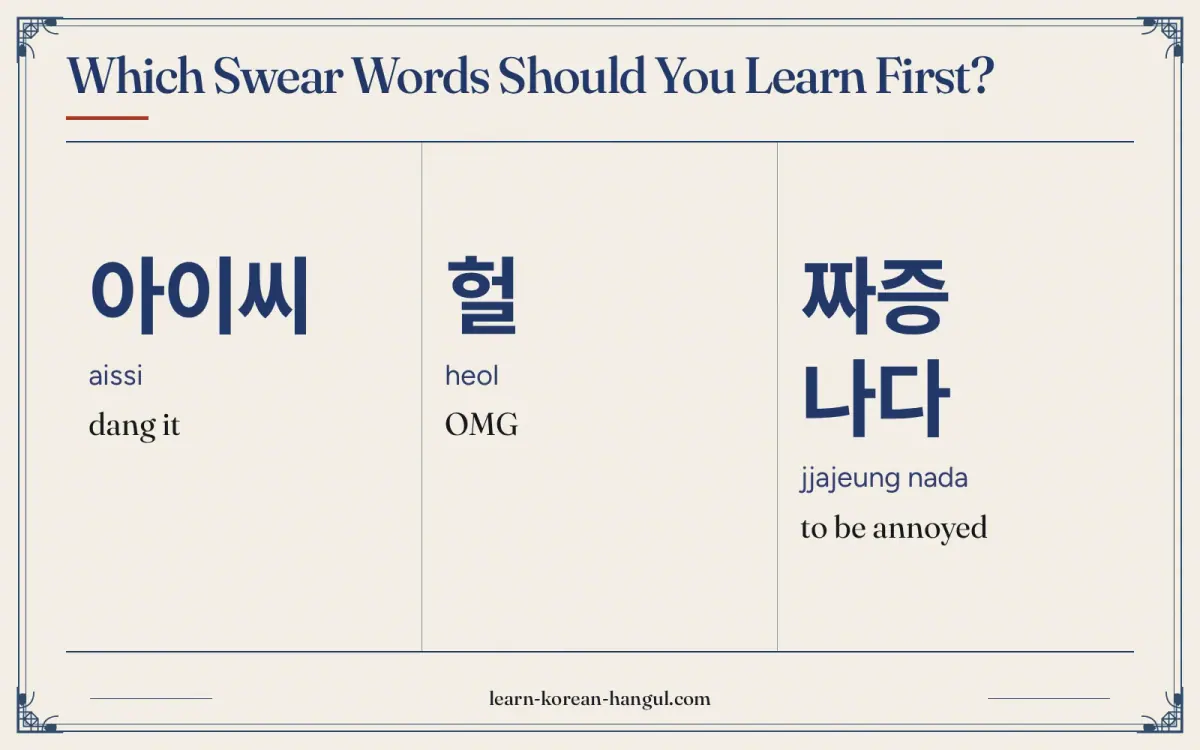
Learn 헐, 아이고, 어휴, 바보 and 욕 first. These five are mild or neutral, you hear them everywhere, and none of them can get you into trouble. Then learn the last group, because 속상해요 and 그만해 주세요 let you show strong feelings politely. Treat the strongest words only as words to recognise.
- Day one (8 words). The mild group: 아이씨, 헐, 아이고, 어휴, 맙소사, 에이, 아 진짜 and 짜증 나다.
- Day two (7 words). The insults, as listening words only: 바보, 멍청이, 또라이, 찌질이, 쓰레기, 미친 and 꼴통.
- Day three (6 words). The prefixes: 개-, 존-, 졸라, 핵-, 겁나 and 완전.
- Day four (9 words). The four words to avoid, for recognition only, and the five polite alternatives: 욕, 욕설, 비속어, 속상해요 and 그만해 주세요.
At 6 to 9 words a day (8 + 7 + 6 + 9 = 30), the list takes four days plus review. The scene below puts eight of the words on one picture.
Word · 8
- 1
아이씨
aissi
dang it
- 2
헐
heol
OMG
- 3
짜증 나다
jjajeung nada
to be annoyed
- 4
바보
babo
fool
- 5
미친
michin
crazy; insane
- 6
개-
gae-
extremely (prefix)
- 7
완전
wanjeon
totally; completely
- 8
속상해요
soksanghaeyo
I'm upset (say this instead)
The Strength column replaces the usual origin column on this page, because strength is the first thing you need to know. Neutral words are safe in any setting, mild words are fine with friends, medium words hurt if aimed at a person, strong words are offensive almost everywhere, and taboo words should be recognised only. The labels are editorial and the real effect depends on who says what to whom, in what tone.
Mild Exclamations
Mild exclamations are sounds of surprise or annoyance that carry no insult. 아이고 and 어휴 are the sounds of a sigh, 맙소사 is good grief, and 에이 is a way to say that cannot be true. 헐 is the modern OMG, and 아 진짜 is a fed-up ugh. The word 아이씨 is a softened version of a stronger swear, so some people avoid it with elders.
| No. | Hangul | Revised Romanization | Strength | Meaning | Example sentence | Audio assetId |
|---|---|---|---|---|---|---|
| 1 | 아이씨 | aissi | mild (softened curse) | dang it | 아이씨, 버스를 놓쳤어요. (Dang it, I missed the bus.) | au-pg-vocabulary-slang-curse-words-1; example: au-pg-vocabulary-slang-curse-words-31 |
| 2 | 헐 | heol | mild | OMG | 헐, 진짜예요? (OMG, really?) | au-pg-vocabulary-slang-curse-words-2; example: au-pg-vocabulary-slang-curse-words-32 |
| 3 | 아이고 | aigo | neutral | oh dear | 아이고, 너무 힘들어요. (Oh dear, it is so hard.) | au-pg-vocabulary-slang-curse-words-3; example: au-pg-vocabulary-slang-curse-words-33 |
| 4 | 어휴 | eohyu | neutral | phew; ugh | 어휴, 오늘은 정말 피곤해요. (Ugh, I am really tired today.) | au-pg-vocabulary-slang-curse-words-4; example: au-pg-vocabulary-slang-curse-words-34 |
| 5 | 맙소사 | mapsosa | neutral | good grief | 맙소사, 시험이 내일이에요. (Good grief, the exam is tomorrow.) | au-pg-vocabulary-slang-curse-words-5; example: au-pg-vocabulary-slang-curse-words-35 |
| 6 | 에이 | ei | mild | aw, come on | 에이, 그럴 리가 없어요. (Aw, that cannot be true.) | au-pg-vocabulary-slang-curse-words-6; example: au-pg-vocabulary-slang-curse-words-36 |
| 7 | 아 진짜 | a jinjja | mild | ugh, seriously | 아 진짜, 또 비가 와요. (Ugh, seriously, it is raining again.) | au-pg-vocabulary-slang-curse-words-7; example: au-pg-vocabulary-slang-curse-words-37 |
| 8 | 짜증 나다 | jjajeung nada | mild | to be annoyed | 이 소음이 너무 짜증 나요. (This noise is so annoying.) | au-pg-vocabulary-slang-curse-words-8; example: au-pg-vocabulary-slang-curse-words-38 |
The word 아이씨 needs care. It sounds like a mild word, but it is a euphemism that echoes a stronger swear. Among friends it passes, and children say it, yet a teacher or a boss may find it rude. When you want a safe sigh, pick 아이고 or 어휴. The word 짜증 나다 is written with a space, because 짜증 (irritation) is a noun and 나다 means to come out. In the 해요 form, as in 너무 짜증 나요, it is the everyday way to say you are annoyed, but it still sounds blunt to an elder.
These words are also easy to place in a sentence. They stand alone before the main statement, followed by a comma: 헐, 진짜예요? or 아이고, 너무 힘들어요. You can add them to almost any message with a friend, and you hear them in every drama.
Example Sentences
Each example is a short sentence in the polite 해요 style or a plain statement. Most follow the pattern noun + 이/가 + verb, as in 싸움이 날 수 있어요, or noun + 은/는 + noun + 이에요, as in 지랄은 센 욕이에요. Several describe how a word works, because the goal is to understand it. Say each one aloud, then swap the noun: replace 비속어 with 욕설 and you get 뉴스에서는 보통 욕설을 쓰지 않아요, which is also natural.
How Do You Say Insults and Their Strength in Korean?
Insults come in steps. A 바보 (fool) is the mildest and can even be said fondly to a friend or a child. A 멍청이 (idiot), a 또라이 (nutcase), a 찌질이 (loser) and a 꼴통 (blockhead) are medium: they hurt if aimed at a person, even in fun. The strongest on this list are 쓰레기 (trash) said about a person, and 미친 (crazy).
| No. | Hangul | Revised Romanization | Strength | Meaning | Example sentence | Audio assetId |
|---|---|---|---|---|---|---|
| 9 | 바보 | babo | mild | fool | 그는 바보가 아니에요. (He is not a fool.) | au-pg-vocabulary-slang-curse-words-9; example: au-pg-vocabulary-slang-curse-words-39 |
| 10 | 멍청이 | meongcheongi | medium | idiot | 멍청이는 사람을 낮추는 말이에요. (Meongcheongi is a word that puts a person down.) | au-pg-vocabulary-slang-curse-words-10; example: au-pg-vocabulary-slang-curse-words-40 |
| 11 | 또라이 | ttorai | medium | weirdo; nutcase | 또라이는 친한 친구끼리만 써요. (Only close friends use ttorai.) | au-pg-vocabulary-slang-curse-words-11; example: au-pg-vocabulary-slang-curse-words-41 |
| 12 | 찌질이 | jjijiri | medium | loser; pathetic person | 찌질이는 약한 사람을 놀리는 말이에요. (Jjijiri is a word for mocking a weak person.) | au-pg-vocabulary-slang-curse-words-12; example: au-pg-vocabulary-slang-curse-words-42 |
| 13 | 쓰레기 | sseuregi | strong when said of a person | trash; an insult for a person | 사람에게 쓰레기라고 하면 큰 실례예요. (Calling a person trash is very rude.) | au-pg-vocabulary-slang-curse-words-13; example: au-pg-vocabulary-slang-curse-words-43 |
| 14 | 미친 | michin | strong | crazy; insane | 미친 듯이 뛰었어요. (I ran like crazy.) | au-pg-vocabulary-slang-curse-words-14; example: au-pg-vocabulary-slang-curse-words-44 |
| 15 | 꼴통 | kkoltong | medium | hard-headed troublemaker | 그 사람은 꼴통이라서 말이 안 통해요. (That person is hard-headed, so you cannot reason with him.) | au-pg-vocabulary-slang-curse-words-15; example: au-pg-vocabulary-slang-curse-words-45 |
The example sentences talk about the words, because the point is to understand them. Notice that most are about how the word is used, as in 멍청이는 사람을 낮추는 말이에요. Calling a real person any of these words to their face can start a quarrel.
쓰레기 is the same word as ordinary trash. When it is about a thing, as in 쓰레기를 버려요, it is neutral. When it is about a person, it is a serious insult. Context decides, and the trash in Korean page covers the plain meaning. 미친 works the same way: 미친 듯이 뛰었어요 describes a speed, but 미친 사람 aimed at someone is an insult.
Prefix Intensifiers (개-, 존-)
Prefix intensifiers add force to the word that follows. The prefix 개- comes from the word for dog and adds a sense of extreme, as in 개웃겨요. 존- and 졸라 are stronger and vulgar-leaning, and you hear them in K-drama dialogue. 핵- adds a sense of extreme in a playful way, and 겁나 is a slang adverb that some regions use a lot. 완전 means totally and is neutral.
| No. | Hangul | Revised Romanization | Strength | Meaning | Example sentence | Audio assetId |
|---|---|---|---|---|---|---|
| 16 | 개- | gae- | informal, can be rude | extremely (prefix) | 이 영화 개웃겨요. (This movie is crazy funny.) | au-pg-vocabulary-slang-curse-words-16; example: au-pg-vocabulary-slang-curse-words-46 |
| 17 | 존- | jon- | vulgar-leaning | extremely (prefix) | 이 떡볶이 존맛이에요. (This tteokbokki is crazy good.) | au-pg-vocabulary-slang-curse-words-17; example: recognition only (vulgar slang; no audio) |
| 18 | 졸라 | jolla | vulgar-leaning | damn; extremely | 오늘은 졸라 추워요. (It is damn cold today.) | au-pg-vocabulary-slang-curse-words-18; example: au-pg-vocabulary-slang-curse-words-48 |
| 19 | 핵- | haek- | informal | super (prefix) | 그 영화는 핵꿀잼이었어요. (That movie was super fun.) | au-pg-vocabulary-slang-curse-words-19; example: au-pg-vocabulary-slang-curse-words-49 |
| 20 | 겁나 | geomna | informal, regional | really; extremely | 이 집 음식이 겁나 맛있어요. (The food at this place is really delicious.) | au-pg-vocabulary-slang-curse-words-20; example: au-pg-vocabulary-slang-curse-words-50 |
| 21 | 완전 | wanjeon | neutral | totally; completely | 이 케이크는 완전 맛있어요. (This cake is totally delicious.) | au-pg-vocabulary-slang-curse-words-21; example: au-pg-vocabulary-slang-curse-words-51 |
These words are not insults, but their tone is rough. They work like the English very, really and damn: the safe one is 완전 or 진짜, and the rougher ones are for friends. 개- and 핵- are common in young people's speech, and 존- and 졸라 are stronger and often avoided in front of older people.
존맛 (so tasty) is a typical case. Teachers treat it as vulgar-leaning slang, and people use it with friends about food. A safer choice with a teacher is 아주 맛있어요 or 정말 맛있어요.
How Do You Say Words to Avoid in Korean?
Words to avoid are the ones that offend nearly everyone. 씨발 and 지랄 are strong swear words, and 꺼져 and 닥쳐 are rude commands that mean get lost and shut up. You may hear them in a film or a fight, and it helps to know that they are serious. Do not use them, even as a joke, and do not repeat them to a Korean friend.
| No. | Hangul | Revised Romanization | Strength | Meaning | Example sentence | Audio assetId |
|---|---|---|---|---|---|---|
| 22 | 씨발 | ssibal | taboo | a very strong swear word | 씨발은 아주 심한 욕이라서 쓰면 안 돼요. (Ssibal is a very strong swear word, so you must not use it.) | no audio (recognition only); example: au-pg-vocabulary-slang-curse-words-52 |
| 23 | 지랄 | jiral | strong, taboo | a strong swear word for rage or nonsense | 지랄은 센 욕이에요. (Jiral is a strong swear word.) | no audio (recognition only); example: au-pg-vocabulary-slang-curse-words-53 |
| 24 | 꺼져 | kkeojyeo | rude command | get lost | 꺼지라고 하면 싸움이 날 수 있어요. (If you tell someone to get lost, a fight can start.) | no audio (recognition only); example: au-pg-vocabulary-slang-curse-words-54 |
| 25 | 닥쳐 | dakchyeo | rude command | shut up | 닥쳐는 아주 무례한 말이에요. (Dakchyeo is a very rude phrase.) | no audio (recognition only); example: au-pg-vocabulary-slang-curse-words-55 |
These four are taught only so that you recognise them. The examples are about the words, not about people. If you hear one aimed at you, the safe answer is to leave the situation, not to answer in kind.
Remember that K-drama subtitles often soften these words, so a rough scene may look milder in English than it sounds in Korean.
What to Say Instead
You can show strong feelings without swearing. The word 욕 means a swear word, 욕설 is the formal word for abusive language, and 비속어 is the formal word for vulgar words. When you are upset, say 속상해요, which means I am upset, and when someone goes too far, say 그만해 주세요, which means please stop.
| No. | Hangul | Revised Romanization | Strength | Meaning | Example sentence | Audio assetId |
|---|---|---|---|---|---|---|
| 26 | 욕 | yok | neutral | swear word; curse | 욕을 하면 안 돼요. (You must not swear.) | au-pg-vocabulary-slang-curse-words-26; example: au-pg-vocabulary-slang-curse-words-56 |
| 27 | 욕설 | yokseol | formal | abusive language | 욕설은 문제가 될 수 있어요. (Abusive language can cause trouble.) | au-pg-vocabulary-slang-curse-words-27; example: au-pg-vocabulary-slang-curse-words-57 |
| 28 | 비속어 | bisogeo | formal | vulgar word; coarse slang | 뉴스에서는 보통 비속어를 쓰지 않아요. (The news does not usually use vulgar words.) | au-pg-vocabulary-slang-curse-words-28; example: au-pg-vocabulary-slang-curse-words-58 |
| 29 | 속상해요 | soksanghaeyo | polite phrase | I'm upset (say this instead) | 시험을 못 봐서 속상해요. (I did badly on the exam, so I am upset.) | au-pg-vocabulary-slang-curse-words-29; example: au-pg-vocabulary-slang-curse-words-59 |
| 30 | 그만해 주세요 | geumanhae juseyo | polite phrase | please stop | 그만해 주세요, 불편해요. (Please stop, it makes me uncomfortable.) | au-pg-vocabulary-slang-curse-words-30; example: au-pg-vocabulary-slang-curse-words-60 |
속상해요 is for sadness mixed with frustration, as when you did badly on an exam. For anger at a person, a calm 기분이 안 좋아요 (I do not feel good about this) works, and for a request to stop, 그만해 주세요 is clear and polite. The thank you, sorry and please page covers more polite phrases.
The verb 욕하다 (to swear at) is used with 욕을 하다, as in 욕을 하면 안 돼요, which means you must not swear.
Strength Scale
The table puts the words on one scale, from neutral to taboo. The scale is a guide, because the same word can change level with tone, setting and relationship.
| Level | Words | What to do |
|---|---|---|
| Neutral | 아이고, 어휴, 맙소사, 에이, 완전 | Safe in any setting |
| Mild | 헐, 아 진짜, 아이씨, 바보, 핵- | Fine with friends, avoid with elders |
| Medium | 멍청이, 또라이, 찌질이, 꼴통, 개- | Hurtful if aimed at a person |
| Strong | 쓰레기 (about a person), 미친 (about a person), 존-, 졸라 | Rude or vulgar to most listeners; do not use |
| Taboo | 씨발, 지랄, 꺼져, 닥쳐 | Recognise only; never use |
Age and setting change the level. A word that is mild between classmates is rude to a teacher, and a word that is fine at a friend's party is not fine in a message to a client. Rough words usually appear in casual speech, not in polite speech, and the casual style is explained on the casual speech page.
How Do You Pronounce These Words?
Swear words follow the usual pronunciation rules, so the table lists the changes that learners most often miss.
| Spelling | Pronunciation | What happens |
|---|---|---|
| 맙소사 | [맙쏘사] | The ㅅ after a final ㅂ becomes tense |
| 욕설 | [욕썰] | The ㅅ after a final ㄱ becomes tense |
| 꺼져 | [꺼저] | The vowel ㅕ after ㅈ is said as ㅓ |
| 닥쳐 | [닥처] | The vowel ㅕ after ㅊ is said as ㅓ |
| 겁나 | [검나] | A final ㅂ before ㄴ is said as m |
| 비속어 | [비소거] | The final ㄱ of 속 moves to the empty ㅇ of 어 |
| 찌질이 | [찌지리] | The final ㄹ of 질 moves to the empty ㅇ of 이 |
The Revised Romanization shows the linking and the m sound in bisogeo, jjijiri and geomna, and it writes kkeojyeo and dakchyeo as they are spelled. It does not show tensing caused by a neighbouring sound, so mapsosa and yokseol look the same as the spelling. Learn the Hangul and use the audio to hear the real sound. The rules come from the Standard Pronunciation rules (표준 발음법) of the 국립국어원.
Audio and Slow Playback
Each word except the four taboo ones has a normal clip, and 5 key words also have a slow clip at 0.8 times the speed: 헐, 아이고, 어휴, 속상해요 and 그만해 주세요. Nothing plays until you press a button.
Listen to 헐 first. You should hear one short beat, [헐], with the ㅓ made with unrounded lips, a puff of air on the ㅎ and a clear l at the end.
What Mistakes Do Learners Make with Swear Words?
- Using 아이씨 with a teacher or boss. It sounds mild, but it echoes a stronger swear, so use 아이고 or 어휴 instead.
- Copying drama language into real life. Characters in dramas speak roughly in scenes made for effect, and real people usually do not.
- Treating 미친 as a compliment with people you do not know. Among close friends 미쳤다 can mean amazing, but to a stranger it is an insult.
- Thinking 개- is only about dogs. In 개웃겨요 it adds the sense of extremely, and the dog meaning is gone.
- Reading 꺼져 as kkeo-jyeo with a y glide. The spoken form is [꺼저].
The fifth mistake changes the sound, and the others change the register or the meaning. The next section turns the list into practice.
Practice: Flashcards and Worksheet
Drill the mild and polite words with the vocabulary flashcard decks. The Internet Slang and Abbreviations flashcards already hold 헐 and 대박, which pair well with this list. A printable worksheet for these words (word list, matching, writing practice, fill-in-the-blank exercises and answer key) is available in A4 and US Letter from the download card on this page. A printable worksheet for these words (word list, matching, writing practice, fill-in-the-blank exercises and answer key) is available in A4 and US Letter from the download card on this page. Progress in the decks is saved only in your browser.
Korean Swear Words Worksheet
Try this five-question check, then say the 30 words aloud once more.
Practice · 5
What does 아이씨 mean?
Show answer
dang it
아이씨 (aissi) means dang it.
What does 헐 mean?
Show answer
OMG
헐 (heol) means OMG.
What does 바보 mean?
Show answer
fool
바보 (babo) means fool.
What does 쓰레기 mean?
Show answer
trash; an insult for a person
쓰레기 (sseuregi) means trash; an insult for a person.
What does 욕설 mean?
Show answer
abusive language
욕설 (yokseol) means abusive language.
Where to Go Next
This list sits inside Korean Slang. After Korean swear words, many learners move on to Texting Shortcuts for chat letters and short forms, or to Internet Slang and Abbreviations for the wider slang list.
Frequently Asked Questions
How Do You Say Dang It in Korean?
Dang it is 아이씨 (aissi). It is a mild, softened curse that friends say when something goes wrong, as in 아이씨, 버스를 놓쳤어요 (aissi, beoseureul nochyeosseoyo), which means dang it, I missed the bus. Some people avoid it with elders, and 아이고 (aigo) is a safer sigh. Press the audio button to hear the word.
How Do You Pronounce 헐 (heol)?
헐 is said heol, in one beat. It starts with ㅎ, a breathy h, and the vowel ㅓ is made with unrounded lips, so the mouth stays flat. It ends in an l sound, with the tongue tip touching the ridge behind the upper teeth. It means OMG, and it is common in chat. Use the slow clip to match the sound.
How Many Swear Words Should I Learn First?
Learn five first: 헐, 아이고, 어휴, 바보 and 욕. They are mild or neutral. Then add the polite words 속상해요 and 그만해 주세요. Treat the strongest words only as words to recognise. The whole list of 30 takes four days at 6 to 9 words a day, with review on the fifth day.
Where Can I Practise Swear Words with Flashcards?
Use the vocabulary flashcard decks, which list every deck with audio. The Internet Slang and Abbreviations deck already contains 헐 and 대박. A deck for the whole list is not published. Progress stays in your browser.
Is the Romanization on This Page Official?
It follows the Revised Romanization of Korean, which South Korea officially adopted on 7 July 2000 and whose rules the National Institute of Korean Language (국립국어원) publishes. It is a learning aid that does not mark every sound change, so learn the Hangul and use the audio to hear the real sound.
Is There a Printable Worksheet for Swear Words?
A printable worksheet for these words (word list, matching, writing practice, fill-in-the-blank exercises and answer key) is available in A4 and US Letter from the download card on this page. For practice, copy the tables above by hand: write the Hangul, cover the English column, and check your answers against the page.