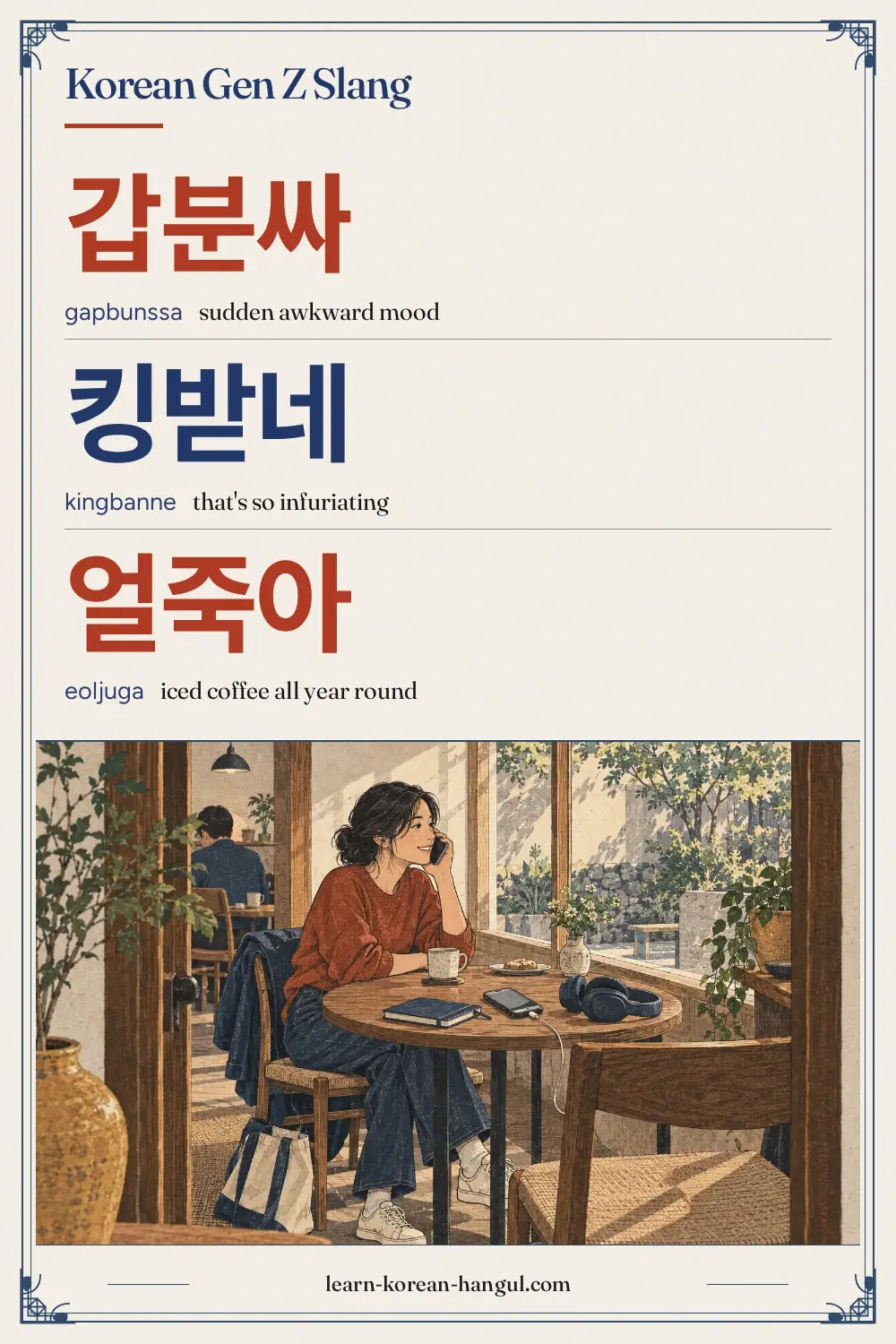
Korean Gen Z Slang at a Glance
Korean Gen Z slang is mostly about speed and humour. Young Koreans shorten long phrases into a few syllables, borrow English letters and words, and turn a joke into a new word overnight. A 갑분싸 saves you the whole sentence 갑자기 분위기 싸해짐 (the mood suddenly went cold). A 점메추 saves you 점심 메뉴 추천 (please recommend a lunch menu). This page teaches 35 words, with the full form of each so you can see how it was built.
| Group | Words | Use |
|---|---|---|
| Reaction words | 9 | Showing surprise, shock or annoyance |
| Shortened words | 8 | Saving time in chat |
| Money and lifestyle | 9 | Spending, saving and daily habits |
| Dating and friendship | 9 | Talking about love and friends |
The words fall into four groups. You will hear the first group when something surprises or annoys someone, the second in quick chat, the third when people talk about money and habits, and the fourth in talk about love and friends.
Slang about class and power, such as 금수저 and 꼰대, is on the Korean social slang page, and shortenings of everyday words are on the Korean abbreviations page. This list sits inside Internet Slang and Abbreviations.
Which Gen Z Slang Words Should You Learn First?
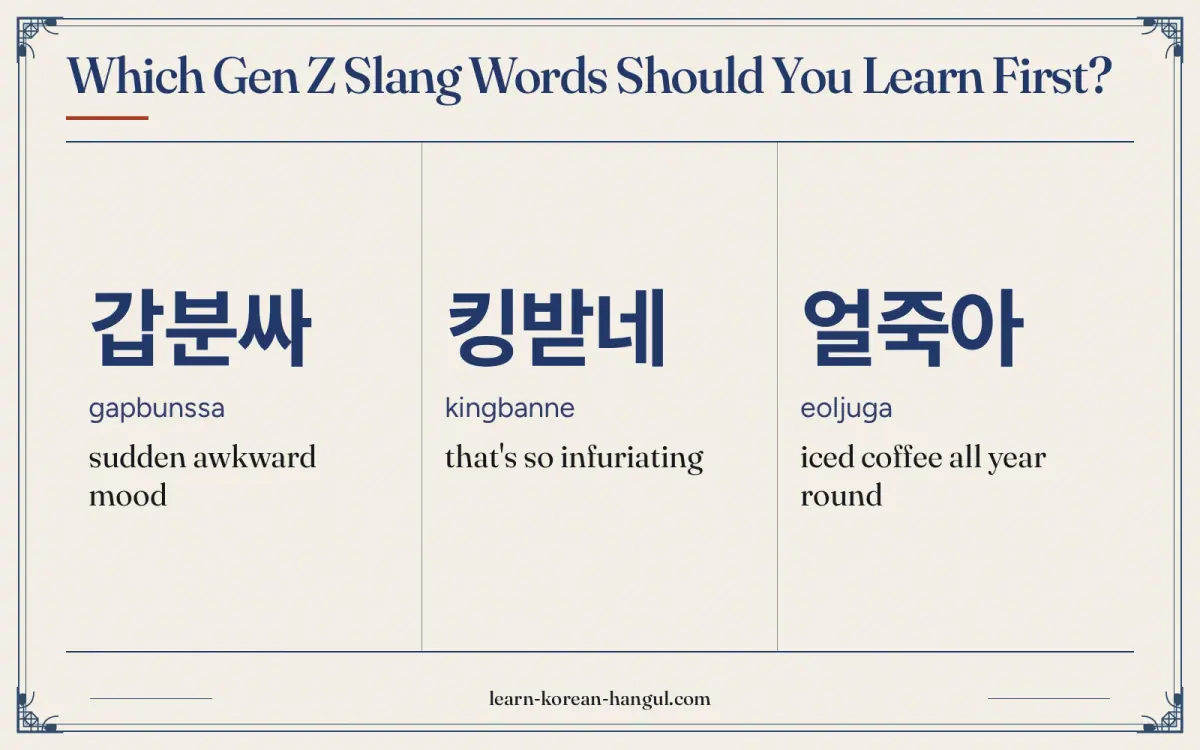
Learn 갑분싸, 얼죽아, 꿀팁, 케바케 and 썸 first. They are the words you hear most in videos, shows and cafes, and they are not tied to one short-lived joke. Wait on 어쩔티비 and 킹받네 until you have heard them used around you, because they carry a stronger tone and their popularity can change quickly.
- Day one (9 words). The reaction words: 갑분싸, 킹받네, 어쩔티비, 실화냐, 팩폭, TMI, 멘붕, 폭망 and 현웃. Learn 킹받네 and 어쩔티비 to recognise, not yet to use.
- Day two (8 words). The shortened words: 얼죽아, 점메추, 저메추, 별다줄, 케바케, 엄친아, 안물안궁 and 금사빠.
- Day three (9 words). The money and lifestyle words: 갓생, 가심비, 갓성비, 득템, 꿀팁, 플렉스, 탕진잼, 소확행 and 영끌.
- Day four (9 words). The dating and friendship words: 썸, 심쿵, 남사친, 여사친, 모솔, 핵인싸, 맞팔, 손절 and 커플템.
At 8 to 9 words a day, the list takes four days plus review. The scene below puts eight of the words on one picture.
Word · 8
- 1
갑분싸
gapbunssa
sudden awkward mood
- 2
킹받네
kingbanne
that's so infuriating
- 3
얼죽아
eoljuga
iced coffee all year round
- 4
점메추
jeommechu
lunch menu recommendation
- 5
케바케
kebake
case by case
- 6
갓생
gatsaeng
an organised, productive life
- 7
꿀팁
kkultip
handy tip
- 8
심쿵
simkung
heart flutter
The Built from column shows how each word was made, because the building pattern is the easiest way to remember slang. Many of the words contain an English word or letters, such as TMI, 플렉스, 커플템 and 썸. The others are built from Korean words that were cut down, such as 갑분싸, or from shortened mixed and Sino-Korean words, such as 멘붕 (멘탈 + 붕괴) and 손절 (손절매). The Konglish and loanwords page explains how English words are spelled in Hangul.
Reaction Words
Reaction words are what people type or say when something happens. A 갑분싸 is the cold silence after a joke falls flat, 실화냐 asks whether something can really be true, and 멘붕 and 폭망 describe a bad day at school or work. A 현웃 is a real laugh out loud, not only a typed ㅋㅋ.
| No. | Hangul | Revised Romanization | Built from | Meaning | Example sentence | Audio assetId |
|---|---|---|---|---|---|---|
| 1 | 갑분싸 | gapbunssa | 갑자기 분위기 싸해짐 | sudden awkward mood | 제 농담 때문에 갑분싸가 됐어요. (My joke made the mood suddenly awkward.) | au-pg-vocabulary-slang-internet-slang-gen-z-1; example: au-pg-vocabulary-slang-internet-slang-gen-z-36 |
| 2 | 킹받네 | kingbanne | 킹 (king) + 열받다 | that's so infuriating | 버스를 또 놓쳤어. 진짜 킹받네. (I missed the bus again. That is so annoying.) | au-pg-vocabulary-slang-internet-slang-gen-z-2; example: au-pg-vocabulary-slang-internet-slang-gen-z-37 |
| 3 | 어쩔티비 | eojjeoltibi | 어쩔 + TV | so what? (a dismissive retort) | 친구가 장난으로 "어쩔티비"라고 했어요. (My friend said "eojjeoltibi" as a joke.) | au-pg-vocabulary-slang-internet-slang-gen-z-3; example: au-pg-vocabulary-slang-internet-slang-gen-z-38 |
| 4 | 실화냐 | silhwanya | 실화 + -냐 | is this for real? | 이 가격이 실화냐? (Is this price for real?) | au-pg-vocabulary-slang-internet-slang-gen-z-4; example: au-pg-vocabulary-slang-internet-slang-gen-z-39 |
| 5 | 팩폭 | paekpok | 팩트 폭력 | brutal truth | 친구의 팩폭에 정신이 번쩍 들었어요. (My friend's blunt truth snapped me awake.) | au-pg-vocabulary-slang-internet-slang-gen-z-5; example: au-pg-vocabulary-slang-internet-slang-gen-z-40 |
| 6 | TMI | tiemai | 티엠아이 (T-M-I) | too much information | TMI라서 미안해요. (Sorry, that's too much information.) | au-pg-vocabulary-slang-internet-slang-gen-z-6; example: au-pg-vocabulary-slang-internet-slang-gen-z-41 |
| 7 | 멘붕 | menbung | 멘탈 붕괴 | mental breakdown; meltdown | 시험 문제를 보고 멘붕이 왔어요. (I had a meltdown when I saw the exam questions.) | au-pg-vocabulary-slang-internet-slang-gen-z-7; example: au-pg-vocabulary-slang-internet-slang-gen-z-42 |
| 8 | 폭망 | pongmang | 폭 + 망하다 | total failure | 이번 시험은 폭망이에요. (This exam is a total disaster.) | au-pg-vocabulary-slang-internet-slang-gen-z-8; example: au-pg-vocabulary-slang-internet-slang-gen-z-43 |
| 9 | 현웃 | hyeonut | 현실 웃음 | a real laugh out loud | 그 영상을 보고 현웃이 터졌어요. (I really burst out laughing at that video.) | au-pg-vocabulary-slang-internet-slang-gen-z-9; example: au-pg-vocabulary-slang-internet-slang-gen-z-44 |
Three of the nine are strong. 킹받네 means something has made the speaker very angry or annoyed, in a joking way. 어쩔티비 is a dismissive retort from teenagers, roughly "so what, talk to the TV", and it can sound rude if you are serious. 팩폭 describes a hard truth said without softening. Use these three only with close friends, and only after you have heard people your age use them.
The word 현웃 is a good example of a slang word that makes a distinction the language did not have before. Typed laughter is ㅋㅋ, and when a person laughs for real, with a real voice, they say 현웃 터졌다. The word comes from 현실 (reality) and 웃음 (laugh).
Example Sentences
Each example is a short sentence in everyday style. Most use the polite 해요 style, such as 플렉스를 해요, and a few use casual speech, such as 실화냐, because that is how the word is really said among friends. Most sentences follow the pattern noun + 을/를 + verb, as in 신발을 득템했어요, or noun + 이/가 + 되다, as in 갑분싸가 됐어요. Say each one aloud, then swap the noun: replace 신발 with 가방 and you get 가방을 득템했어요, which is also natural.
How Do You Say Shortened Words in Korean?
Shortened words are the heart of Gen Z slang, because each one packs a long phrase into three or four syllables. A 얼죽아 is someone who drinks iced coffee even when it is freezing, from 얼어 죽어도 아이스 아메리카노. A 점메추 asks what to eat for lunch, and a 저메추 asks the same about dinner. A 케바케 means it depends on the case, and an 엄친아 is the perfect child that parents compare you with.
| No. | Hangul | Revised Romanization | Built from | Meaning | Example sentence | Audio assetId |
|---|---|---|---|---|---|---|
| 10 | 얼죽아 | eoljuga | 얼어 죽어도 아이스 아메리카노 | iced coffee all year round | 저는 얼죽아라서 겨울에도 아아를 마셔요. (I drink iced coffee even in winter.) | au-pg-vocabulary-slang-internet-slang-gen-z-10; example: au-pg-vocabulary-slang-internet-slang-gen-z-45 |
| 11 | 점메추 | jeommechu | 점심 메뉴 추천 | lunch menu recommendation | 점메추 부탁해요. (Please recommend a lunch menu.) | au-pg-vocabulary-slang-internet-slang-gen-z-11; example: au-pg-vocabulary-slang-internet-slang-gen-z-46 |
| 12 | 저메추 | jeomechu | 저녁 메뉴 추천 | dinner menu recommendation | 저메추 있어요? (Do you have a dinner suggestion?) | au-pg-vocabulary-slang-internet-slang-gen-z-12; example: au-pg-vocabulary-slang-internet-slang-gen-z-47 |
| 13 | 별다줄 | byeoldajul | 별걸 다 줄인다 | you shorten everything | 아아, 갑분싸, 얼죽아… 정말 별다줄이에요. (Iced americano, gapbunssa, eoljuga... you really shorten everything.) | au-pg-vocabulary-slang-internet-slang-gen-z-13; example: au-pg-vocabulary-slang-internet-slang-gen-z-48 |
| 14 | 케바케 | kebake | 케이스 바이 케이스 | case by case | 그건 사람마다 케바케예요. (That depends on the person.) | au-pg-vocabulary-slang-internet-slang-gen-z-14; example: au-pg-vocabulary-slang-internet-slang-gen-z-49 |
| 15 | 엄친아 | eomchina | 엄마 친구 아들 | mom's friend's son (the perfect child) | 그 사람은 완전 엄친아예요. (He is a total "perfect son" type.) | au-pg-vocabulary-slang-internet-slang-gen-z-15; example: au-pg-vocabulary-slang-internet-slang-gen-z-50 |
| 16 | 안물안궁 | anmurangung | 안 물어봤고 안 궁금해 | didn't ask, don't care | 그 얘기는 안물안궁이에요. (I did not ask about that, and I do not care.) | au-pg-vocabulary-slang-internet-slang-gen-z-16; example: au-pg-vocabulary-slang-internet-slang-gen-z-51 |
| 17 | 금사빠 | geumsappa | 금방 사랑에 빠지는 사람 | someone who falls in love quickly | 제 친구는 금사빠예요. (My friend falls in love quickly.) | au-pg-vocabulary-slang-internet-slang-gen-z-17; example: au-pg-vocabulary-slang-internet-slang-gen-z-52 |
Two of the words need a warning. 안물안궁 means "I did not ask and I do not care", and it can end a conversation if you say it to a person who is trying to share something. 금사빠 is a light label for a person who falls in love fast, and it is fine for a friend but not for a stranger. 별다줄 is a joke about people who shorten everything, and it is itself a shortening.
To see more of this pattern, open the abbreviations list, which explains the syllable-picking rules in detail.
Money and Lifestyle
Money and lifestyle words show how young Koreans think about work, shopping and happiness. A 갓생 is a productive, organised life, a 소확행 is a small but certain pleasure, and a 영끌 is borrowing every possible won to buy a home. A 가심비 or 갓성비 shopper looks for good value, and a 득템 is a lucky find at a low price.
| No. | Hangul | Revised Romanization | Built from | Meaning | Example sentence | Audio assetId |
|---|---|---|---|---|---|---|
| 18 | 갓생 | gatsaeng | 갓 (god) + 생 (life) | an organised, productive life | 올해는 갓생을 살 거예요. (This year I will live a productive life.) | au-pg-vocabulary-slang-internet-slang-gen-z-18; example: au-pg-vocabulary-slang-internet-slang-gen-z-53 |
| 19 | 가심비 | gasimbi | 가격 대비 심리적 만족 | value in satisfaction for the price | 가심비가 좋으면 사요. (If it feels worth the price, I buy it.) | au-pg-vocabulary-slang-internet-slang-gen-z-19; example: au-pg-vocabulary-slang-internet-slang-gen-z-54 |
| 20 | 갓성비 | gatseongbi | 갓 + 가성비 | amazing value for money | 이 가방은 갓성비예요. (This bag is amazing value for money.) | au-pg-vocabulary-slang-internet-slang-gen-z-20; example: au-pg-vocabulary-slang-internet-slang-gen-z-55 |
| 21 | 득템 | deuktem | 득 (gain) + 템 (item) | scoring a great find | 세일에서 신발을 득템했어요. (I scored a great pair of shoes at the sale.) | au-pg-vocabulary-slang-internet-slang-gen-z-21; example: au-pg-vocabulary-slang-internet-slang-gen-z-56 |
| 22 | 꿀팁 | kkultip | 꿀 (honey) + 팁 (tip) | handy tip | 여행 꿀팁이 있어요. (I have a handy travel tip.) | au-pg-vocabulary-slang-internet-slang-gen-z-22; example: au-pg-vocabulary-slang-internet-slang-gen-z-57 |
| 23 | 플렉스 | peullekseu | flex (English) | splurging; showing off spending | 월급날에는 가끔 플렉스를 해요. (On payday I sometimes splurge.) | au-pg-vocabulary-slang-internet-slang-gen-z-23; example: au-pg-vocabulary-slang-internet-slang-gen-z-58 |
| 24 | 탕진잼 | tangjinjaem | 탕진 + 재미 | the thrill of spending money | 쇼핑할 때 탕진잼을 느꼈어요. (I felt the thrill of splurging when I shopped.) | au-pg-vocabulary-slang-internet-slang-gen-z-24; example: au-pg-vocabulary-slang-internet-slang-gen-z-59 |
| 25 | 소확행 | sohwakhaeng | 소소하지만 확실한 행복 | small but certain happiness | 퇴근 후 맥주 한 잔이 소확행이에요. (A beer after work is a small, certain happiness.) | au-pg-vocabulary-slang-internet-slang-gen-z-25; example: au-pg-vocabulary-slang-internet-slang-gen-z-60 |
| 26 | 영끌 | yeongkkeul | 영혼까지 끌어모으다 | borrowing to the limit | 영끌해서 집을 샀어요. (They borrowed to the limit to buy a house.) | au-pg-vocabulary-slang-internet-slang-gen-z-26; example: au-pg-vocabulary-slang-internet-slang-gen-z-61 |
The prefix 갓 comes from the English god, and it adds the sense of excellent. You see it in 갓생 and 갓성비. The word 가성비 (value for money) was explained on the abbreviations page, and 가심비 swaps 성능 (performance) for 심리 (feelings), so it measures how good a purchase feels, not how well it works.
영끌 is not only slang. It appears in news stories about house prices and debt, so it is one of the few words on this page that you will meet in serious writing.
How Do You Say Dating and Friendship in Korean?
Dating and friendship words describe the stages between strangers and a couple. A 썸 is the talking stage before dating, and a 심쿵 is the flutter you feel when someone does something charming. A 남사친 or 여사친 is a friend of the other sex with no romance involved. A 모솔 has never had a relationship, a 맞팔 is a follow-back on social media, and a 손절 is cutting someone off.
| No. | Hangul | Revised Romanization | Built from | Meaning | Example sentence | Audio assetId |
|---|---|---|---|---|---|---|
| 27 | 썸 | sseom | some (English) | talking stage; not yet dating | 우리는 아직 썸 타는 중이에요. (We are still in the talking stage.) | au-pg-vocabulary-slang-internet-slang-gen-z-27; example: au-pg-vocabulary-slang-internet-slang-gen-z-62 |
| 28 | 심쿵 | simkung | 심장이 쿵 | heart flutter | 그 장면에서 심쿵했어요. (My heart fluttered at that scene.) | au-pg-vocabulary-slang-internet-slang-gen-z-28; example: au-pg-vocabulary-slang-internet-slang-gen-z-63 |
| 29 | 남사친 | namsachin | 남자 사람 친구 | male friend (not a boyfriend) | 남사친이랑 영화를 봤어요. (I watched a movie with my male friend.) | au-pg-vocabulary-slang-internet-slang-gen-z-29; example: au-pg-vocabulary-slang-internet-slang-gen-z-64 |
| 30 | 여사친 | yeosachin | 여자 사람 친구 | female friend (not a girlfriend) | 여사친한테 선물을 받았어요. (I got a present from my female friend.) | au-pg-vocabulary-slang-internet-slang-gen-z-30; example: au-pg-vocabulary-slang-internet-slang-gen-z-65 |
| 31 | 모솔 | mosol | 모태솔로 | never had a relationship | 저는 모솔이라서 연애가 어려워요. (I have never dated, so dating feels hard.) | au-pg-vocabulary-slang-internet-slang-gen-z-31; example: au-pg-vocabulary-slang-internet-slang-gen-z-66 |
| 32 | 핵인싸 | haeginssa | 핵 + 인싸 | super social butterfly | 그 친구는 학교에서 핵인싸예요. (That friend is a super social butterfly at school.) | au-pg-vocabulary-slang-internet-slang-gen-z-32; example: au-pg-vocabulary-slang-internet-slang-gen-z-67 |
| 33 | 맞팔 | matpal | 맞팔로우 | following each other back | 우리 인스타 맞팔해요. (Let us follow each other on Instagram.) | au-pg-vocabulary-slang-internet-slang-gen-z-33; example: au-pg-vocabulary-slang-internet-slang-gen-z-68 |
| 34 | 손절 | sonjeol | 손절매 (stop-loss) | cutting someone off | 그 친구와는 손절했어요. (I cut that friend out of my life.) | au-pg-vocabulary-slang-internet-slang-gen-z-34; example: au-pg-vocabulary-slang-internet-slang-gen-z-69 |
| 35 | 커플템 | keopeultem | 커플 + 아이템 | matching couple item | 우리는 커플템으로 반지를 샀어요. (We bought rings as our couple item.) | au-pg-vocabulary-slang-internet-slang-gen-z-35; example: au-pg-vocabulary-slang-internet-slang-gen-z-70 |
손절 is borrowed from the stock market, where it means selling at a loss to stop further losses. Young people use it for ending a friendship, and the image is clear: you stop the damage. Because it is final, say it carefully.
Be careful with 모솔. It is a casual label that people sometimes use on themselves with a smile, but it can embarrass someone if you say it about them. The same goes for 금사빠 in the earlier group.
How Are Gen Z Slang Words Built?
Korean slang follows a handful of building patterns. If you know them, you can often work out a new word the first time you hear it.
| Pattern | Examples | How it works |
|---|---|---|
| Syllables from a whole phrase | 갑분싸, 얼죽아, 점메추, 케바케 | Take one syllable from each key word |
| Two words fused | 소확행, 심쿵, 탕진잼 | Join the strongest syllables of two ideas |
| A prefix added to a word | 갓생, 갓성비, 핵인싸 | 갓 adds excellent, 핵 adds extreme |
| English letters or words | TMI, 플렉스, 커플템 | Keep the English and spell it in Hangul |
| A borrowed term with a new meaning | 손절, 영끌 | Reuse a word from finance or hard work |
The first pattern makes the most words. It also makes them hard to guess, because you need to know which syllables the speaker kept. The best habit is to ask a friend for the full phrase, as the Built from column does for you here.
Memes and Trends
Some slang words last for years and some last for a season. The best clue is whether a word is tied to one joke. 어쩔티비, 킹받네 and 별다줄 grew out of internet jokes and videos, so their popularity depends on who is laughing at that joke. Words such as 갓생, 가심비, 소확행 and 손절 name ideas that people keep needing, so they tend to stay. No one can say for sure which words will last, and a Korean friend of your age is the best guide.
The table below marks where each group of words fits. Use it as a starting point and not as a rule.
| Label | Words | Where it fits |
|---|---|---|
| Safe almost anywhere | 꿀팁, 가심비, 소확행, 영끌 | News, school and work chat, with a normal tone |
| Peers and friends | 갑분싸, 케바케, 득템, 갓생, 썸, 맞팔 | Chat and casual talk with people your age |
| Close friends only | 킹받네, 어쩔티비, 안물안궁, 팩폭, 금사빠, 모솔 | Jokes with friends; can sound rude or hurtful otherwise |
If you are not sure, copy the people around you. When a new word appears in a video, wait until you hear it said by several different people before you use it yourself. In a job interview, a class presentation or a message to an older person, write the full phrase instead.
How Do You Pronounce These Words?
Slang follows the spelling less than plain words do, because many of these words squeeze syllables together. The table lists the changes that learners most often miss.
| Spelling | Pronunciation | What happens |
|---|---|---|
| 갑분싸 | [갑뿐싸] | The ㅂ of 분 becomes tense after the final ㅂ of 갑 |
| 얼죽아 | [얼주가] | The final ㄱ of 죽 moves to the empty ㅇ of 아 |
| 현웃 | [혀눋] | The final ㄴ of 현 moves to the empty ㅇ of 웃, and the final ㅅ is said as ㄷ |
| 엄친아 | [엄치나] | The final ㄴ of 친 moves to the empty ㅇ of 아 |
| 안물안궁 | [안무란궁] | The final ㄹ of 물 moves to the empty ㅇ of 안 |
| 소확행 | [소화캥] | Final ㄱ and ㅎ join into an aspirated ㅋ, and the sound moves to the next syllable |
| 킹받네 | [킹반네] | The final ㄷ sound of 받 turns into n before ㄴ |
| 맞팔 | [맏팔] | The final ㅈ of 맞 is said as ㄷ |
The Revised Romanization shows the linking and the n sound in eomchina, anmurangung, hyeonut and kingbanne. It keeps the h of a noun such as sohwakhaeng, and it does not show tensing caused by a neighbouring sound, so gapbunssa looks the same as the spelling. Learn the Hangul and use the audio to hear the real sound. The rules come from the Standard Pronunciation rules (표준 발음법) of the 국립국어원.
Audio and Slow Playback
Each word has a normal clip, and 5 key words also have a slow clip at 0.8 times the speed: 갑분싸, 얼죽아, 안물안궁, 가심비 and 꿀팁. Nothing plays until you press a button.
Listen to 얼죽아 first. You should hear three even beats, eol-ju-ga, with a plain ㅈ and the l sound at the end of the first beat.
What Mistakes Do Learners Make with Gen Z Slang Words?
- Using strong words with people you do not know. 킹받네, 어쩔티비 and 안물안궁 are for close friends only.
- Learning a word and ignoring its age. A meme word can fade, so check that people around you still say it.
- Saying 갑분싸 with a plain ㅂ in the second syllable. The spoken form is [갑뿐싸], with a tense ㅃ.
- Treating 남사친 as a boyfriend. It means a friend who is a man, with no romance.
- Saying the English letters TMI in an English way. In Korean the letters are read as 티엠아이.
The third and fifth mistakes change the sound, and the others change the register or the meaning. The next section turns the list into practice.
Practice: Flashcards and Worksheet
Drill these words with the vocabulary flashcard decks. The Internet Slang and Abbreviations flashcards already hold several of the words on this page, such as 갑분싸, 꿀팁, 멘붕 and 심쿵. A printable worksheet for these words (word list, matching, writing practice, fill-in-the-blank exercises and answer key) is available in A4 and US Letter from the download card on this page. A printable worksheet for these words (word list, matching, writing practice, fill-in-the-blank exercises and answer key) is available in A4 and US Letter from the download card on this page. Progress in the decks is saved only in your browser.
Korean Gen Z Slang Worksheet
Try this five-question check, then say the 35 words aloud once more.
Practice · 5
What does 갑분싸 mean?
Show answer
sudden awkward mood
갑분싸 (gapbunssa) means sudden awkward mood.
What does 얼죽아 mean?
Show answer
iced coffee all year round
얼죽아 (eoljuga) means iced coffee all year round.
What does 케바케 mean?
Show answer
case by case
케바케 (kebake) means case by case.
What does 득템 mean?
Show answer
scoring a great find
득템 (deuktem) means scoring a great find.
What does 썸 mean?
Show answer
talking stage; not yet dating
썸 (sseom) means talking stage; not yet dating.
For one word at a time, see talking stage in Korean and slang in Korean.
Where to Go Next
This list sits inside Internet Slang and Abbreviations. After Korean Gen Z slang, many learners move on to Korean Social Slang Vocabulary for words about class, power and living alone, or to Korean Abbreviations Vocabulary for the shortening rules.
Frequently Asked Questions
How Do You Say Sudden Awkward Mood in Korean?
A sudden awkward mood is 갑분싸 (gapbunssa), said [갑뿐싸]. It is short for 갑자기 분위기 싸해짐, which means the mood suddenly went cold. For example, 제 농담 때문에 갑분싸가 됐어요 means my joke made the mood suddenly awkward. Press the audio button to hear the word.
How Do You Pronounce 얼죽아 (eoljuga)?
얼죽아 is said eol-ju-ga, in three beats. The first syllable 얼 has the vowel ㅓ, made with unrounded lips, and ends in an l sound. The ㅈ of 죽 is plain, and the final ㄱ of 죽 moves to the empty ㅇ of 아, so the spoken form is [얼주가]. It is short for 얼어 죽어도 아이스 아메리카노. Use the slow clip to match the rhythm.
How Many Gen Z Slang Words Should I Learn First?
Learn five first: 갑분싸, 얼죽아, 꿀팁, 케바케 and 썸. That takes one day. Then add the other reaction words, the shortened words, the money words and the dating words. The whole list of 35 takes four days at 8 to 9 words a day, with review on the fifth day.
Where Can I Practise Gen Z Slang Words with Flashcards?
Use the vocabulary flashcard decks, which list every deck with audio. The Internet Slang and Abbreviations deck already contains several of these words. Progress stays in your browser.
Is the Romanization on This Page Official?
It follows the Revised Romanization of Korean, which South Korea officially adopted on 7 July 2000 and whose rules the National Institute of Korean Language (국립국어원) publishes. It is a learning aid that does not mark every sound change, so learn the Hangul and use the audio to hear the real sound.
Is There a Printable Worksheet for Gen Z Slang Words?
A printable worksheet for these words (word list, matching, writing practice, fill-in-the-blank exercises and answer key) is available in A4 and US Letter from the download card on this page. For practice, copy the tables above by hand: write the Hangul, cover the English column, and check your answers against the page.