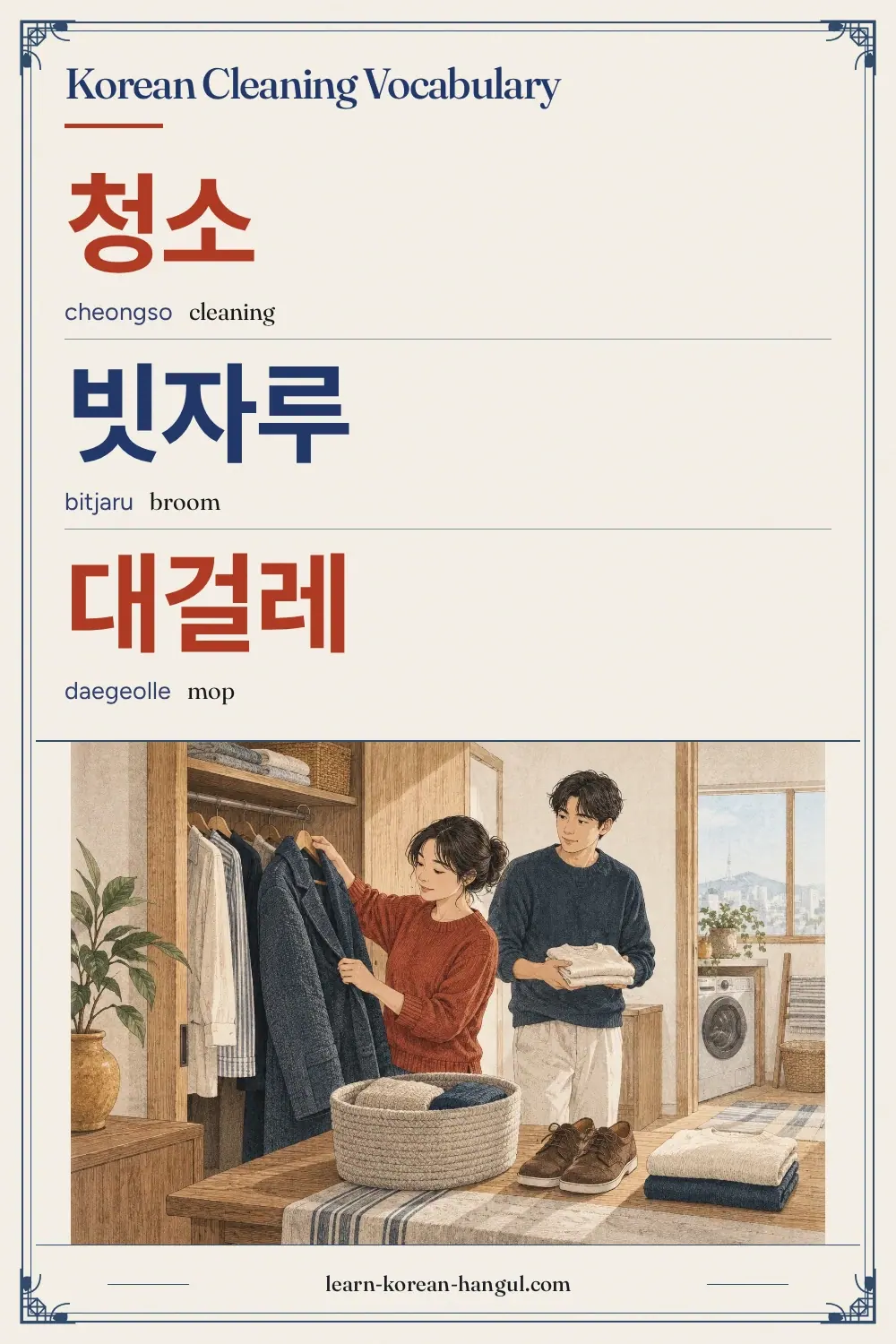
Korean Cleaning Vocabulary at a Glance
This list has 30 words in five groups of six. It follows a household chore order: you clean with tools, wash clothes, wash dishes, sort the rubbish and read the labels of cleaning products. It belongs to House and Home. The words help in a rented flat, a guesthouse or a shared house, where chores and rubbish rules are explained in Korean.
| Group | Words | Use |
|---|---|---|
| Cleaning tools | 6 | Sweeping, mopping and wiping |
| Laundry | 6 | Washing, drying and ironing clothes |
| Dishes and kitchen cleaning | 6 | Washing dishes and wiping surfaces |
| Trash and recycling | 6 | Sorting and throwing away rubbish |
| Cleaning products | 6 | Reading labels on cleaning products |
The recycling group is especially useful, because Korea separates waste carefully and the rules appear on notices in most apartment blocks. The next section ranks the words.
Which Cleaning and Laundry Words Should You Learn First?
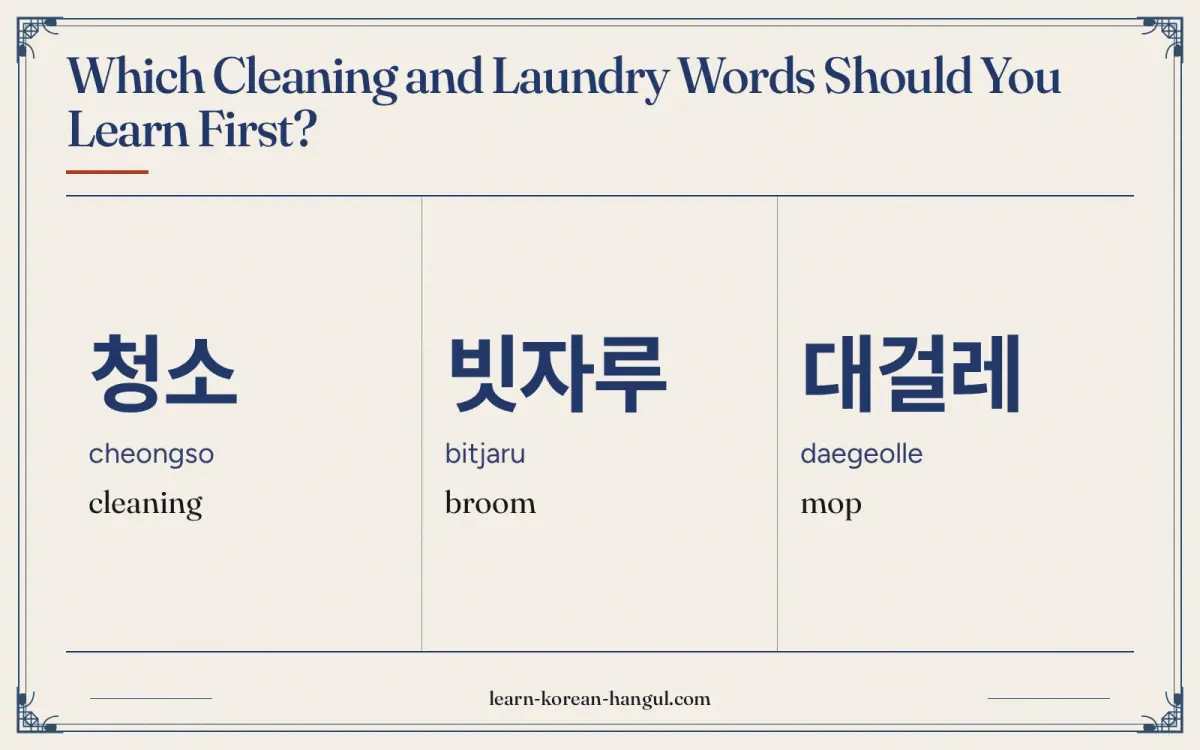
Learn 청소 (cleaning), 빨래 (laundry), 설거지 (washing dishes), 쓰레기 (rubbish) and 분리수거 (sorting recyclables) first. They name the five chores you will do or hear about in your first week in a Korean home. The sentence 청소를 해요 (I clean) and the other chore names all use the verb 하다.
- Words to say. 청소, 빨래, 설거지, 쓰레기, 세제. Use these to talk about chores.
- Words to recognise. 분리수거, 음식물 쓰레기, 쓰레기봉투, 섬유유연제. These appear on notices and product labels.
- Words to read on packaging. 세제, 락스, 표백제, 물티슈. Learn them before you buy.
Korean separates three chores that English often blurs. 청소 is the general cleaning of a room, 설거지 is washing the dishes and 빨래 is the laundry. Each takes 를 and 하다 or 해요: 청소를 해요, 설거지를 해요, 빨래를 해요. The scene below shows a flat's laundry corner and kitchen with numbered objects that match the list.
Word · 9
- 1
청소
cheongso
cleaning
- 2
빗자루
bitjaru
broom
- 3
대걸레
daegeolle
mop
- 4
세탁기
setakgi
washing machine
- 5
건조대
geonjodae
drying rack
- 6
설거지
seolgeoji
washing dishes
- 7
수세미
susemi
scrubber; scouring pad
- 8
쓰레기봉투
sseuregibongtu
trash bag
- 9
세제
seje
detergent
Cleaning Tools
Cleaning tools are mostly compound nouns. A 빗자루 is a broom, and the 쓰레받기 is the dustpan used with it. A 대걸레 is a mop, built from 대 (stick) and 걸레 (cloth). A plain 걸레 is a rag. 먼지 is the dust you wipe up. 청소 is the general word for cleaning, and 청소하다 or 청소를 하다 is the verb.
| No. | Hangul | Revised Romanization | Meaning and note | Example sentence | Audio assetId |
|---|---|---|---|---|---|
| 1 | 청소 | cheongso | cleaning. Add 를 and 해요 for the chore. | 청소를 해요. (I clean.) | au-pg-vocabulary-daily-life-home-cleaning-laundry-1; example: au-pg-vocabulary-daily-life-home-cleaning-laundry-31 |
| 2 | 빗자루 | bitjaru | broom. Said [빋짜루]; 쓸다 means to sweep. | 빗자루로 쓸어요. (I sweep with a broom.) | au-pg-vocabulary-daily-life-home-cleaning-laundry-2; example: au-pg-vocabulary-daily-life-home-cleaning-laundry-32 |
| 3 | 쓰레받기 | sseurebatgi | dustpan. Said [쓰레받끼]. | 쓰레받기로 쓰레기를 담아요. (I put the rubbish in the dustpan.) | au-pg-vocabulary-daily-life-home-cleaning-laundry-3; example: au-pg-vocabulary-daily-life-home-cleaning-laundry-33 |
| 4 | 대걸레 | daegeolle | mop. 닦다 means to wipe. | 대걸레로 닦아요. (I wipe with a mop.) | au-pg-vocabulary-daily-life-home-cleaning-laundry-4; example: au-pg-vocabulary-daily-life-home-cleaning-laundry-34 |
| 5 | 걸레 | geolle | rag; cloth. Also used for dusting. | 걸레로 닦아요. (I wipe with a rag.) | au-pg-vocabulary-daily-life-home-cleaning-laundry-5; example: au-pg-vocabulary-daily-life-home-cleaning-laundry-35 |
| 6 | 먼지 | meonji | dust. 많아요 means there is a lot. | 먼지가 많아요. (There is a lot of dust.) | au-pg-vocabulary-daily-life-home-cleaning-laundry-6; example: au-pg-vocabulary-daily-life-home-cleaning-laundry-36 |
The particle 로 marks the tool you use, so 빗자루로 means with a broom. After a consonant other than ㄹ it becomes 으로, as in 고무장갑으로; after a vowel it stays 로, as in 쓰레받기로 and 걸레로. The pattern tool + 로 + verb is the most useful one in this group.
Example Sentences
Three frames carry most of the examples. The first is noun + 를/을 + 해요 (do the chore), as in 청소를 해요. The second is tool + 로/으로 + verb (with a tool), as in 걸레로 닦아요. The third is noun + 이/가 떨어졌어요 (it has run out), as in 세제가 떨어졌어요. Say each sentence aloud after the audio, then swap the noun. Choose 으로 after a consonant and 로 after a vowel or ㄹ.
How Do You Say Laundry in Korean?
Laundry is 빨래 (ppallae), and it names both the chore and the pile of clothes. The sequence of a laundry day is 세탁기 (washing machine), 건조대 (drying rack) and 다림질 (ironing). Many households dry clothes on a rack on the balcony rather than in a dryer. 세탁소 is a dry cleaner, and 빨래집게 is a clothespin.
| No. | Hangul | Revised Romanization | Meaning and note | Example sentence | Audio assetId |
|---|---|---|---|---|---|
| 7 | 빨래 | ppallae | laundry. Both the chore and the clothes. | 빨래를 해요. (I do the laundry.) | au-pg-vocabulary-daily-life-home-cleaning-laundry-7; example: au-pg-vocabulary-daily-life-home-cleaning-laundry-37 |
| 8 | 세탁기 | setakgi | washing machine. 돌리다 means to run a machine. | 세탁기를 돌려요. (I run the washing machine.) | au-pg-vocabulary-daily-life-home-cleaning-laundry-8; example: au-pg-vocabulary-daily-life-home-cleaning-laundry-38 |
| 9 | 건조대 | geonjodae | drying rack. 널다 means to hang out to dry. | 건조대에 빨래를 널어요. (I hang the laundry on the drying rack.) | au-pg-vocabulary-daily-life-home-cleaning-laundry-9; example: au-pg-vocabulary-daily-life-home-cleaning-laundry-39 |
| 10 | 빨래집게 | ppallaejipge | clothespin. 집다 means to pick up or pin. | 빨래집게로 집어요. (I pin it with a clothespin.) | au-pg-vocabulary-daily-life-home-cleaning-laundry-10; example: au-pg-vocabulary-daily-life-home-cleaning-laundry-40 |
| 11 | 다림질 | darimjil | ironing. From 다리다 (to iron) and -질 (the act of doing). | 다림질을 해요. (I iron.) | au-pg-vocabulary-daily-life-home-cleaning-laundry-11; example: au-pg-vocabulary-daily-life-home-cleaning-laundry-41 |
| 12 | 세탁소 | setakso | dry cleaner; laundry shop. 맡기다 means to leave in someone’s care. | 세탁소에 맡겨요. (I leave it at the dry cleaner.) | au-pg-vocabulary-daily-life-home-cleaning-laundry-12; example: au-pg-vocabulary-daily-life-home-cleaning-laundry-42 |
A laundry day can be said in four short sentences. 빨래를 세탁기에 넣어요 (I put the laundry in the washing machine). 세제를 넣어요 (I add detergent). 빨래를 건조대에 널어요 (I hang the laundry on the rack). 다림질을 해요 (I iron). Say them in order, because the sequence is the best way to remember the words.
Dishes and Kitchen Cleaning
Dish washing is 설거지 (seolgeoji), a native Korean word that you pair with 하다. A 수세미 is the scrubber, a 행주 is a dishcloth and a 고무장갑 is a pair of rubber gloves. A 싱크대 is the sink and counter unit. 주방세제 is dish soap, written as one word in labels.
| No. | Hangul | Revised Romanization | Meaning and note | Example sentence | Audio assetId |
|---|---|---|---|---|---|
| 13 | 설거지 | seolgeoji | washing dishes. Never used for laundry or cleaning. | 설거지를 해요. (I wash the dishes.) | au-pg-vocabulary-daily-life-home-cleaning-laundry-13; example: au-pg-vocabulary-daily-life-home-cleaning-laundry-43 |
| 14 | 수세미 | susemi | scrubber; scouring pad. Also the name of a gourd. | 수세미로 닦아요. (I scrub with a scourer.) | au-pg-vocabulary-daily-life-home-cleaning-laundry-14; example: au-pg-vocabulary-daily-life-home-cleaning-laundry-44 |
| 15 | 주방세제 | jubangseje | dish soap. 주방 means kitchen; 세제 means detergent. | 주방세제가 떨어졌어요. (The dish soap has run out.) | au-pg-vocabulary-daily-life-home-cleaning-laundry-15; example: au-pg-vocabulary-daily-life-home-cleaning-laundry-45 |
| 16 | 행주 | haengju | dishcloth. For counters and tables. | 행주로 닦아요. (I wipe with a dishcloth.) | au-pg-vocabulary-daily-life-home-cleaning-laundry-16; example: au-pg-vocabulary-daily-life-home-cleaning-laundry-46 |
| 17 | 고무장갑 | gomujanggap | rubber gloves. 끼다 means to wear gloves or rings. | 고무장갑을 껴요. (I put on rubber gloves.) | au-pg-vocabulary-daily-life-home-cleaning-laundry-17; example: au-pg-vocabulary-daily-life-home-cleaning-laundry-47 |
| 18 | 싱크대 | singkeudae | sink; kitchen counter unit. Loanword plus 대. | 싱크대가 막혔어요. (The sink is blocked.) | au-pg-vocabulary-daily-life-home-cleaning-laundry-18; example: au-pg-vocabulary-daily-life-home-cleaning-laundry-48 |
The word 설거지 names the whole chore of dish washing, like British English washing-up. It is also the verb object: 설거지를 하다. The related Korean Kitchen Vocabulary page has the pots, plates and spoons that you wash.
How Do You Say Trash and Recycling in Korean?
Korea sorts waste carefully, and apartment blocks often post rules in the entrance. 쓰레기 is rubbish in general and 분리수거 is the act of separating recyclables. 음식물 쓰레기 is food waste, which goes into its own container. Many local councils require a standard bag, which is why a 쓰레기봉투 is something you buy and not just a plastic bag.
| No. | Hangul | Revised Romanization | Meaning and note | Example sentence | Audio assetId |
|---|---|---|---|---|---|
| 19 | 쓰레기 | sseuregi | trash; rubbish. 버리다 means to throw away. | 쓰레기를 버려요. (I throw away the trash.) | au-pg-vocabulary-daily-life-home-cleaning-laundry-19; example: au-pg-vocabulary-daily-life-home-cleaning-laundry-49 |
| 20 | 쓰레기봉투 | sseuregibongtu | trash bag. Local rules may require a standard bag. | 쓰레기봉투가 필요해요. (I need a trash bag.) | au-pg-vocabulary-daily-life-home-cleaning-laundry-20; example: au-pg-vocabulary-daily-life-home-cleaning-laundry-50 |
| 21 | 분리수거 | bullisugeo | sorting recyclables. Said [불리수거]. | 분리수거를 해요. (I sort the recyclables.) | au-pg-vocabulary-daily-life-home-cleaning-laundry-21; example: au-pg-vocabulary-daily-life-home-cleaning-laundry-51 |
| 22 | 음식물 쓰레기 | eumsingmul sseuregi | food waste. 따로 means separately. | 음식물 쓰레기는 따로 버려요. (I throw away food waste separately.) | au-pg-vocabulary-daily-life-home-cleaning-laundry-22; example: au-pg-vocabulary-daily-life-home-cleaning-laundry-52 |
| 23 | 플라스틱 | peullaseutik | plastic. Loanword. | 플라스틱을 분리해요. (I sort the plastic.) | au-pg-vocabulary-daily-life-home-cleaning-laundry-23; example: au-pg-vocabulary-daily-life-home-cleaning-laundry-53 |
| 24 | 종이 | jongi | paper. 모으다 means to gather. | 종이를 모아요. (I collect the paper.) | au-pg-vocabulary-daily-life-home-cleaning-laundry-24; example: au-pg-vocabulary-daily-life-home-cleaning-laundry-54 |
Notice the Korean habit of putting a collection day on the notice: 분리수거 날 (recycling day). Local rules vary by city and building, so check the sign in your own block and ask a neighbour. The words connect to environment vocabulary, where the wider topic is covered.
Cleaning Products
Cleaning product names appear on bottles and packs. 세제 is detergent in general, 섬유유연제 is fabric softener and 락스 is household bleach; it began as a brand name and is now used for bleach in general. 표백제 is the plain word for bleach. 방향제 is an air freshener, and 물티슈 is a wet wipe. Many labels carry a warning, so learn the word 주의 (caution).
| No. | Hangul | Revised Romanization | Meaning and note | Example sentence | Audio assetId |
|---|---|---|---|---|---|
| 25 | 세제 | seje | detergent. Used for laundry and dishes. | 세제를 넣어요. (I add detergent.) | au-pg-vocabulary-daily-life-home-cleaning-laundry-25; example: au-pg-vocabulary-daily-life-home-cleaning-laundry-55 |
| 26 | 섬유유연제 | seomyuyuyeonje | fabric softener. Added in the rinse. | 섬유유연제를 넣어요. (I add fabric softener.) | au-pg-vocabulary-daily-life-home-cleaning-laundry-26; example: au-pg-vocabulary-daily-life-home-cleaning-laundry-56 |
| 27 | 락스 | rakseu | bleach (household). 조심하다 means to be careful. | 락스를 조심하세요. (Be careful with bleach.) | au-pg-vocabulary-daily-life-home-cleaning-laundry-27; example: au-pg-vocabulary-daily-life-home-cleaning-laundry-57 |
| 28 | 표백제 | pyobaekje | bleaching agent. 빨다 means to wash clothes. | 표백제로 빨아요. (I wash with a bleaching agent.) | au-pg-vocabulary-daily-life-home-cleaning-laundry-28; example: au-pg-vocabulary-daily-life-home-cleaning-laundry-58 |
| 29 | 방향제 | banghyangje | air freshener. 놓다 means to place. | 방향제를 놓아요. (I put out an air freshener.) | au-pg-vocabulary-daily-life-home-cleaning-laundry-29; example: au-pg-vocabulary-daily-life-home-cleaning-laundry-59 |
| 30 | 물티슈 | multisyu | wet wipe. Water + tissue. | 물티슈로 닦아요. (I wipe with a wet wipe.) | au-pg-vocabulary-daily-life-home-cleaning-laundry-30; example: au-pg-vocabulary-daily-life-home-cleaning-laundry-60 |
How Do You Pronounce These Words?
Cleaning words contain liquid and tense sounds. Standard pronunciation follows the National Institute of Korean Language (국립국어원) rules, and the romanization follows the Revised Romanization of Korean, which does not mark every sound change.
| Spelling | Sounds like | What changes |
|---|---|---|
| 분리수거 | [불리수거] | ㄴ before ㄹ is said as [ㄹ], so 분리 sounds like bul-li. |
| 쓰레받기 | [쓰레받끼] | After a final ㅂ, the next ㄱ is said tense [ㄲ]. |
| 빗자루 | [빋짜루] | The final ㅅ is said [ㄷ], and the next ㅈ becomes tense [ㅉ]. |
| 설거지 | [설거지] | No change; the final ㄹ is a clear l before ㄱ. |
| 빨래 | [빨래] | The first sound is a tense ㅃ, said with a tight throat. |
The sound change in 분리수거 is the one that surprises learners most. ㄴ + ㄹ becomes [ㄹ + ㄹ], which is called liquidization. It also explains why 신라 is said [실라]. The romanization shows the sound as bullisugeo.
Audio and Slow Playback
Each word and sentence has its own clip. The five clips below replay the hardest words slowly. Play one, repeat it aloud, then play it again and compare.
What Mistakes Do Learners Make with Cleaning and Laundry Words?
Five mistakes appear often.
- Using 청소 for washing dishes. 청소 is general cleaning. For dishes use 설거지, and for clothes use 빨래.
- Saying 빨래 only for the machine. 빨래 is the laundry. The machine is the 세탁기. Say 빨래를 세탁기에 넣어요.
- Throwing everything in one bag. Korean councils sort rubbish into recyclables, food waste and general waste. Ask a neighbour or read the notice, because rules vary by city.
- Confusing 락스 and 세제. 락스 is bleach and 세제 is detergent. Do not mix them, and read the 주의 warnings on the bottle.
- Forgetting the tool particle. The tool needs 로 or 으로: 걸레로 닦아요, not 걸레를 닦아요 (which would mean I wipe the rag).
Learning the three chore names and the tool particle fixes most errors. For single-word lookups, see laundry in Korean and cleaning in Korean. The practice section below turns the list into drills.
Practice: Flashcards and Worksheet
Study in three steps. First, run the flashcard deck in recognition mode until you recognise all 30 words. Second, switch to listening mode. Third, take the quiz. The deck holds all 30 words with audio, and your progress stays in your browser. The vocabulary flashcard decks page lists the other decks.
Practice · 65
- 01청소
Show answer
headword 1: cleaning
- 02빗자루
Show answer
headword 2: broom
- 03쓰레받기
Show answer
headword 3: dustpan
- 04대걸레
Show answer
headword 4: mop
- 05걸레
Show answer
headword 5: rag; cloth
- 06먼지
Show answer
headword 6: dust
- 07빨래
Show answer
headword 7: laundry
- 08세탁기
Show answer
headword 8: washing machine
- 09건조대
Show answer
headword 9: drying rack
- 10빨래집게
Show answer
headword 10: clothespin
- 11다림질
Show answer
headword 11: ironing
- 12세탁소
Show answer
headword 12: dry cleaner; laundry shop
- 13설거지
Show answer
headword 13: washing dishes
- 14수세미
Show answer
headword 14: scrubber; scouring pad
- 15주방세제
Show answer
headword 15: dish soap
- 16행주
Show answer
headword 16: dishcloth
- 17고무장갑
Show answer
headword 17: rubber gloves
- 18싱크대
Show answer
headword 18: sink; kitchen counter unit
- 19쓰레기
Show answer
headword 19: trash; rubbish
- 20쓰레기봉투
Show answer
headword 20: trash bag
- 21분리수거
Show answer
headword 21: sorting recyclables
- 22음식물 쓰레기
Show answer
headword 22: food waste
- 23플라스틱
Show answer
headword 23: plastic
- 24종이
Show answer
headword 24: paper
- 25세제
Show answer
headword 25: detergent
- 26섬유유연제
Show answer
headword 26: fabric softener
- 27락스
Show answer
headword 27: bleach (household)
- 28표백제
Show answer
headword 28: bleaching agent
- 29방향제
Show answer
headword 29: air freshener
- 30물티슈
Show answer
headword 30: wet wipe
- 31청소를 해요.
Show answer
example sentence for headword 1
- 32빗자루로 쓸어요.
Show answer
example sentence for headword 2
- 33쓰레받기로 쓰레기를 담아요.
Show answer
example sentence for headword 3
- 34대걸레로 닦아요.
Show answer
example sentence for headword 4
- 35걸레로 닦아요.
Show answer
example sentence for headword 5
- 36먼지가 많아요.
Show answer
example sentence for headword 6
- 37빨래를 해요.
Show answer
example sentence for headword 7
- 38세탁기를 돌려요.
Show answer
example sentence for headword 8
- 39건조대에 빨래를 널어요.
Show answer
example sentence for headword 9
- 40빨래집게로 집어요.
Show answer
example sentence for headword 10
- 41다림질을 해요.
Show answer
example sentence for headword 11
- 42세탁소에 맡겨요.
Show answer
example sentence for headword 12
- 43설거지를 해요.
Show answer
example sentence for headword 13
- 44수세미로 닦아요.
Show answer
example sentence for headword 14
- 45주방세제가 떨어졌어요.
Show answer
example sentence for headword 15
- 46행주로 닦아요.
Show answer
example sentence for headword 16
- 47고무장갑을 껴요.
Show answer
example sentence for headword 17
- 48싱크대가 막혔어요.
Show answer
example sentence for headword 18
- 49쓰레기를 버려요.
Show answer
example sentence for headword 19
- 50쓰레기봉투가 필요해요.
Show answer
example sentence for headword 20
- 51분리수거를 해요.
Show answer
example sentence for headword 21
- 52음식물 쓰레기는 따로 버려요.
Show answer
example sentence for headword 22
- 53플라스틱을 분리해요.
Show answer
example sentence for headword 23
- 54종이를 모아요.
Show answer
example sentence for headword 24
- 55세제를 넣어요.
Show answer
example sentence for headword 25
- 56섬유유연제를 넣어요.
Show answer
example sentence for headword 26
- 57락스를 조심하세요.
Show answer
example sentence for headword 27
- 58표백제로 빨아요.
Show answer
example sentence for headword 28
- 59방향제를 놓아요.
Show answer
example sentence for headword 29
- 60물티슈로 닦아요.
Show answer
example sentence for headword 30
- 61분리수거
Show answer
slow playback of headword 21: sorting recyclables
- 62쓰레받기
Show answer
slow playback of headword 3: dustpan
- 63빗자루
Show answer
slow playback of headword 2: broom
- 64빨래
Show answer
slow playback of headword 7: laundry
- 65섬유유연제
Show answer
slow playback of headword 26: fabric softener
Practice · 5
What does 청소 (cheongso) mean?
Show answer
cleaning
청소 means cleaning. Example: 청소를 해요. (I clean.)
What does 빨래 (ppallae) mean?
Show answer
laundry
빨래 means laundry. Example: 빨래를 해요. (I do the laundry.)
What does 설거지 (seolgeoji) mean?
Show answer
washing dishes
설거지 means washing dishes. Example: 설거지를 해요. (I wash the dishes.)
What does 분리수거 (bullisugeo) mean?
Show answer
sorting recyclables
분리수거 means sorting recyclables. Example: 분리수거를 해요. (I sort the recyclables.)
What does 세제 (seje) mean?
Show answer
detergent
세제 means detergent. Example: 세제를 넣어요. (I add detergent.)
Korean Cleaning Vocabulary Worksheet (PDF)
A printable worksheet for these words (word list, matching, writing practice, fill-in-the-blank exercises and answer key) is available in A4 and US Letter from the download card on this page. For practice, write a short plan for a cleaning day in Korean, using one word from each group. The laundry sequence above is a good model.
Where to Go Next
After this page, continue with Korean Household Appliances Vocabulary or Korean Everyday Objects Vocabulary. For the recycling topic, see environment vocabulary. To move up a level, return to House and Home.
Frequently Asked Questions
How Do You Say Cleaning in Korean?
Cleaning is 청소 (cheongso). To say I clean, use 청소를 해요 or 청소해요. For washing dishes use 설거지, and for laundry use 빨래. A broom is 빗자루 and a mop is 대걸레. The single-word page on cleaning in Korean gives more detail.
How Do You Pronounce 빨래 (ppallae)?
Say ppal-lae in two beats. The first sound is a tense ㅃ, said with a tight throat and no puff of air. The ㄹ at the end of the first syllable and the ㄹ at the start of the second blend into a long l sound. It means laundry. Press the audio button to hear it.
How Many Cleaning and Laundry Words Should I Learn First?
Five first: 청소, 빨래, 설거지, 쓰레기 and 분리수거. At five new words a day the whole list of 30 takes six days plus review. Learn the recycling group before you move into a flat, since the rules appear on notices.
Where Can I Practise Cleaning and Laundry Words with Flashcards?
Use the vocabulary flashcard decks. The deck for this page holds all 30 words with Hangul, romanization and audio, with recognition and listening modes. Your progress stays in your browser. Return daily and review the cards you missed.
Is the Romanization on This Page Official?
It follows the Revised Romanization of Korean, which South Korea adopted on 7 July 2000 and whose rules the National Institute of Korean Language (국립국어원) publishes. It is a learning aid and does not mark every sound change, so rely on the Hangul and the audio.
Is There a Printable Worksheet for Cleaning and Laundry Words?
A printable worksheet for these words (word list, matching, writing practice, fill-in-the-blank exercises and answer key) is available in A4 and US Letter from the download card on this page. For practice, copy the tables on this page by hand or use the flashcard deck, which carries the same 30 words.