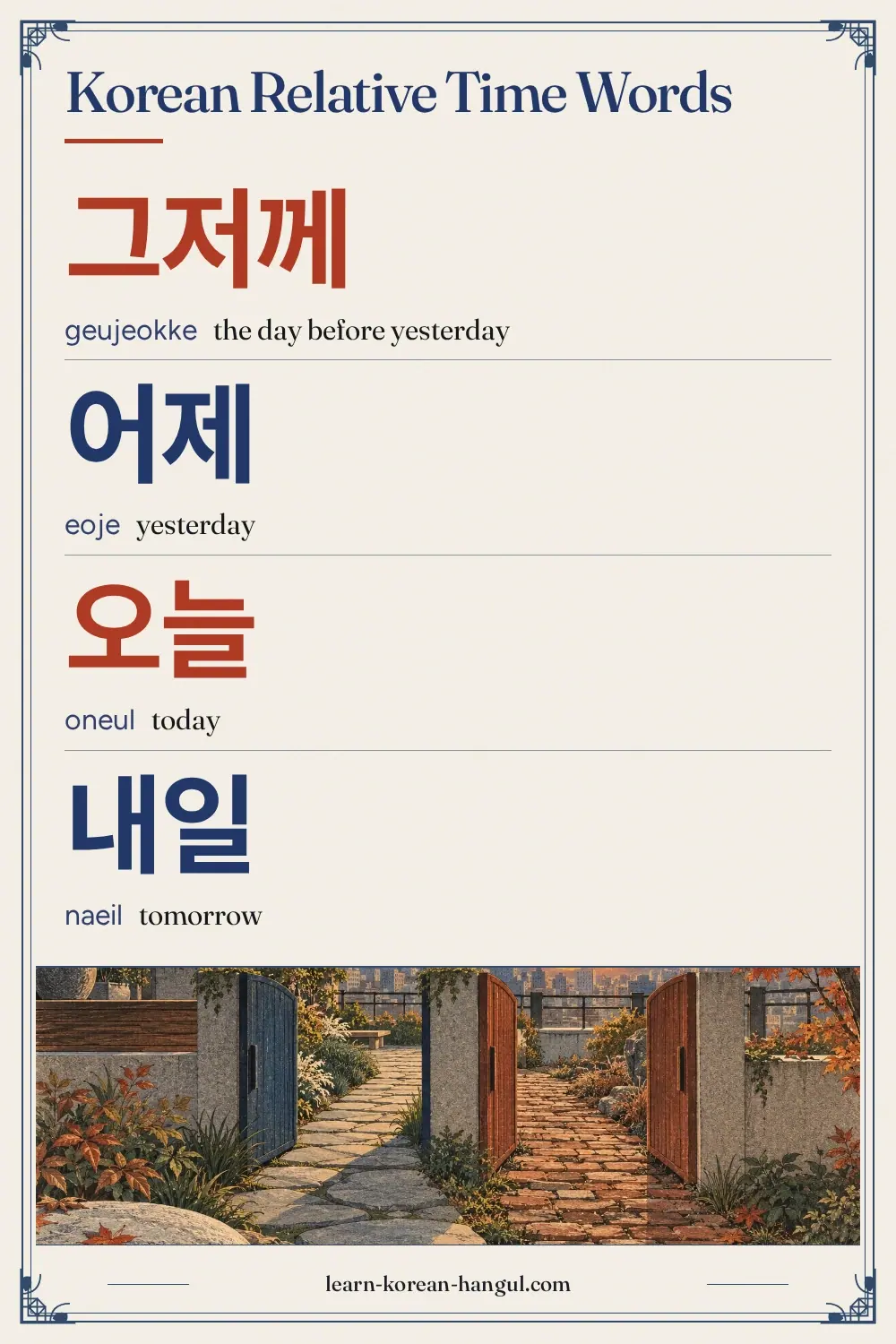
Korean Relative Time Words at a Glance
A relative time word names a moment by its distance from now, not by a date. Korean builds these words from a small set of parts: 지난 (past), 이번 (this), 다음 (next), plus a repeated first syllable for "two away": 지지난 (the one before last) and 다다음 (the one after next). The page belongs to Time Expressions, with Korean Parts of the Day and Korean Frequency Adverbs as its neighbours.
| Group | Words | What it covers |
|---|---|---|
| Days | 7 | Three days back to three days ahead |
| Weeks | 6 | Week before last to week after next |
| Months | 5 | Month before last to month after next |
| Years | 7 | Year before last to year after next |
| Now and later | 5 | Now, a while ago, before, after, later |
The central pattern is this: the first word says how far you move, and the second says which unit.
| Distance | Week | Month | Year |
|---|---|---|---|
| Two back | 지지난주 | 지지난달 | 재작년 |
| One back | 지난주 | 지난달 | 작년 |
| Current | 이번 주 | 이번 달 | 올해 |
| One ahead | 다음 주 | 다음 달 | 내년 |
| Two ahead | 다다음 주 | 다다음 달 | 내후년 |
Days and years are the exceptions. Weeks and months share the 지난, 이번, 다음 frame, but days have their own line (그저께, 어제, 오늘, 내일, 모레) and so do years (재작년, 작년, 올해, 내년, 내후년).
Which Relative Time Words Should You Learn First?
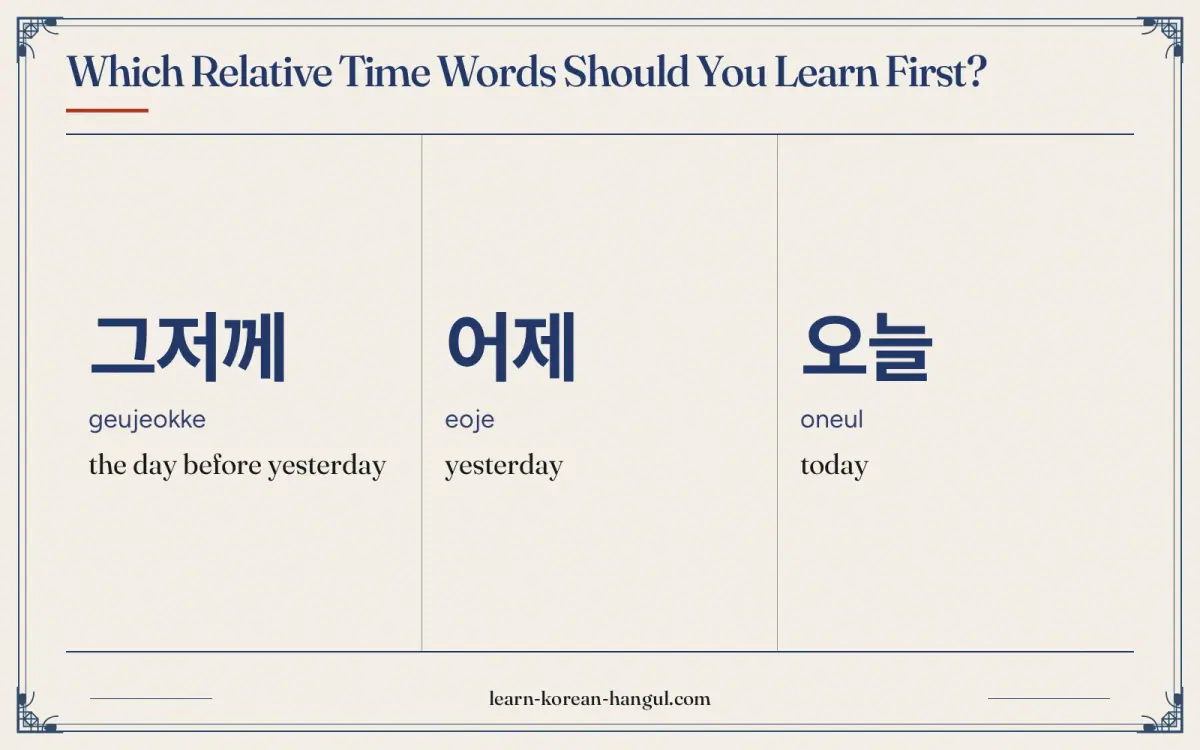
Learn the centre of the line first: 어제, 오늘, 내일, and then 지난주, 이번 주, 다음 주. These six cover most of the time talk in the first months. Add the month and year equivalents next. Learn the two-away words (그저께, 모레, 지지난주, 다다음 주) last, because they are rarer and follow the same logic.
- Say first. 어제, 오늘, 내일, 지난주, 이번 주, 다음 주, 작년, 올해, 내년.
- Pattern words. 지난, 이번, 다음, 전, 후.
- Recognise. 그끄저께, 글피, 내후년, 금년. They appear in writing and set phrases.
The scene below shows a timeline from three days back to three days ahead, with a tick on today.
Word · 10
- 1
그저께
geujeokke
the day before yesterday
- 2
어제
eoje
yesterday
- 3
오늘
oneul
today
- 4
내일
naeil
tomorrow
- 5
모레
more
the day after tomorrow
- 6
지난주
jinanju
last week
- 7
이번 주
ibeon ju
this week
- 8
다음 주
daeum ju
next week
- 9
작년
jangnyeon
last year
- 10
내년
naenyeon
next year
Days (그저께 to 모레)
Seven words make a line of days. In the middle is 오늘, and the words step out from it. Two days back is 그저께 and two ahead is 모레. Three days back is 그끄저께, and three ahead is 글피. The three-day words are rare in speech, and many people say 삼 일 전 (three days ago) instead. 어제, 오늘 and 내일 never take 에. With the rarer 모레 and 글피 you will hear both forms, with and without 에, as in 글피에 다시 만나요.
| No. | Hangul | Revised Romanization | Meaning and note | Example sentence | Audio assetId |
|---|---|---|---|---|---|
| 1 | 그끄저께 | geukkeujeokke | three days ago. Three days back. Said with tense ㄲ. | 그끄저께 비가 왔어요. (It rained three days ago.) | au-pg-vocabulary-time-time-expressions-relative-time-1; example: au-pg-vocabulary-time-time-expressions-relative-time-31 |
| 2 | 그저께 | geujeokke | the day before yesterday. Two days back. | 그저께 시험을 봤어요. (I took an exam the day before yesterday.) | au-pg-vocabulary-time-time-expressions-relative-time-2; example: au-pg-vocabulary-time-time-expressions-relative-time-32 |
| 3 | 어제 | eoje | yesterday. One day back. | 어제 늦게 잤어요. (I slept late yesterday.) | au-pg-vocabulary-time-time-expressions-relative-time-3; example: au-pg-vocabulary-time-time-expressions-relative-time-33 |
| 4 | 오늘 | oneul | today. The centre of the line. | 오늘 쉬는 날이에요. (Today is a day off.) | au-pg-vocabulary-time-time-expressions-relative-time-4; example: au-pg-vocabulary-time-time-expressions-relative-time-34 |
| 5 | 내일 | naeil | tomorrow. One day ahead. | 내일 비가 올 거예요. (It will rain tomorrow.) | au-pg-vocabulary-time-time-expressions-relative-time-5; example: au-pg-vocabulary-time-time-expressions-relative-time-35 |
| 6 | 모레 | more | the day after tomorrow. Two days ahead. | 모레 여행을 떠나요. (I leave on a trip the day after tomorrow.) | au-pg-vocabulary-time-time-expressions-relative-time-6; example: au-pg-vocabulary-time-time-expressions-relative-time-36 |
| 7 | 글피 | geulpi | three days from now. Three days ahead; the day after the day after tomorrow. | 글피에 다시 만나요. (Let us meet again in three days.) | au-pg-vocabulary-time-time-expressions-relative-time-7; example: au-pg-vocabulary-time-time-expressions-relative-time-37 |
Example Sentences
Notice the verb tense. Words on the left of 오늘 pair with a past verb: 그저께 시험을 봤어요. Words on the right pair with a present or future form: 모레 여행을 떠나요. The tense of the verb is how Korean tells a listener which side of today you mean. The forms behind 봤어요 and 왔어요 are explained in the past tense lesson.
How Do You Say Weeks in Korean?
The week set is the base for the other sets. 이번 주 is this week, 지난주 is last week, 다음 주 is next week. Add a second 지난 to move back again: 지지난주. Repeat 다음 to move forward again: 다다음 주. 일주일 names a span of seven days, and is used with 동안 to say "for a week". For a single entry, see last week in korean.
| No. | Hangul | Revised Romanization | Meaning and note | Example sentence | Audio assetId |
|---|---|---|---|---|---|
| 8 | 지지난주 | jijinanju | the week before last. 지난 repeated: two weeks back. | 지지난주에 이사했어요. (I moved the week before last.) | au-pg-vocabulary-time-time-expressions-relative-time-8; example: au-pg-vocabulary-time-time-expressions-relative-time-38 |
| 9 | 지난주 | jinanju | last week. One week back. | 지난주에 영화를 봤어요. (I saw a movie last week.) | au-pg-vocabulary-time-time-expressions-relative-time-9; example: au-pg-vocabulary-time-time-expressions-relative-time-39 |
| 10 | 이번 주 | ibeon ju | this week. The current week. | 이번 주에 시험이 있어요. (There is an exam this week.) | au-pg-vocabulary-time-time-expressions-relative-time-10; example: au-pg-vocabulary-time-time-expressions-relative-time-40 |
| 11 | 다음 주 | daeum ju | next week. One week ahead. | 다음 주에 휴가예요. (Next week is my vacation.) | au-pg-vocabulary-time-time-expressions-relative-time-11; example: au-pg-vocabulary-time-time-expressions-relative-time-41 |
| 12 | 다다음 주 | dadaeum ju | the week after next. 다음 repeated: two weeks ahead. | 다다음 주에 출장을 가요. (I go on a business trip the week after next.) | au-pg-vocabulary-time-time-expressions-relative-time-12; example: au-pg-vocabulary-time-time-expressions-relative-time-42 |
| 13 | 일주일 | iljuil | one week. A span of seven days. Said [일쭈일]. | 일주일 동안 여행했어요. (I traveled for a week.) | au-pg-vocabulary-time-time-expressions-relative-time-13; example: au-pg-vocabulary-time-time-expressions-relative-time-43 |
In casual speech you will also hear 저번 주 for last week; 지난주 works in both speech and writing, so it is the safer one to learn first. Note the spacing: 이번 주 and 다음 주 are two words, while 지난주 is one.
Months
Months follow the weeks exactly. 지난달 is last month, 이번 달 is this month, 다음 달 is next month. Add the doubling for two away: 지지난달 and 다다음 달. All five use 달, the native word, because they measure a stretch of time in the calendar rather than naming a numbered month. For the numbered names, see Months.
| No. | Hangul | Revised Romanization | Meaning and note | Example sentence | Audio assetId |
|---|---|---|---|---|---|
| 14 | 지지난달 | jijinandal | the month before last. Two months back. | 지지난달에 한국에 왔어요. (I came to Korea the month before last.) | au-pg-vocabulary-time-time-expressions-relative-time-14; example: au-pg-vocabulary-time-time-expressions-relative-time-44 |
| 15 | 지난달 | jinandal | last month. One month back. | 지난달에 월급을 받았어요. (I received my salary last month.) | au-pg-vocabulary-time-time-expressions-relative-time-15; example: au-pg-vocabulary-time-time-expressions-relative-time-45 |
| 16 | 이번 달 | ibeon dal | this month. The current month. | 이번 달에 이사해요. (I move house this month.) | au-pg-vocabulary-time-time-expressions-relative-time-16; example: au-pg-vocabulary-time-time-expressions-relative-time-46 |
| 17 | 다음 달 | daeum dal | next month. One month ahead. | 다음 달부터 운동할 거예요. (I will start exercising from next month.) | au-pg-vocabulary-time-time-expressions-relative-time-17; example: au-pg-vocabulary-time-time-expressions-relative-time-47 |
| 18 | 다다음 달 | dadaeum dal | the month after next. Two months ahead. | 다다음 달에 결혼해요. (I get married the month after next.) | au-pg-vocabulary-time-time-expressions-relative-time-18; example: au-pg-vocabulary-time-time-expressions-relative-time-48 |
Usage tip: 다음 달부터 means "from next month". The particle 부터 (from) attaches directly to the relative word, and 까지 (until) works the same way: 다음 달까지.
How Do You Say Years in Korean?
Years do not follow the 지난, 이번, 다음 frame. They have their own words. 작년 is last year and 재작년 is the year before last. 올해 is this year. 내년 is next year and 내후년 is the year after next. Two extra forms exist: 지난해 is a written variant of 작년 that is common in news writing, and 금년 is a formal word for this year, used on notices. For a single entry, see next year in korean.
| No. | Hangul | Revised Romanization | Meaning and note | Example sentence | Audio assetId |
|---|---|---|---|---|---|
| 19 | 재작년 | jaejangnyeon | the year before last. Two years back. Said [재장년]. | 재작년에 대학교를 졸업했어요. (I graduated from university the year before last.) | au-pg-vocabulary-time-time-expressions-relative-time-19; example: au-pg-vocabulary-time-time-expressions-relative-time-49 |
| 20 | 작년 | jangnyeon | last year. One year back. Everyday word. Said [장년]. | 작년에 서울에 살았어요. (I lived in Seoul last year.) | au-pg-vocabulary-time-time-expressions-relative-time-20; example: au-pg-vocabulary-time-time-expressions-relative-time-50 |
| 21 | 지난해 | jinanhae | last year. A written variant of 작년, common in news. | 지난해 매출이 늘었어요. (Last year's sales rose.) | au-pg-vocabulary-time-time-expressions-relative-time-21; example: au-pg-vocabulary-time-time-expressions-relative-time-51 |
| 22 | 올해 | olhae | this year. The current year. Everyday word. Said [올해]; often [오래] in fast speech. | 올해 스무 살이 됐어요. (I turned twenty this year.) | au-pg-vocabulary-time-time-expressions-relative-time-22; example: au-pg-vocabulary-time-time-expressions-relative-time-52 |
| 23 | 금년 | geumnyeon | this year (formal). Used on notices and in speeches. | 금년 행사는 취소됐어요. (This year's event was cancelled.) | au-pg-vocabulary-time-time-expressions-relative-time-23; example: au-pg-vocabulary-time-time-expressions-relative-time-53 |
| 24 | 내년 | naenyeon | next year. One year ahead. | 내년에 한국에 갈 거예요. (I will go to Korea next year.) | au-pg-vocabulary-time-time-expressions-relative-time-24; example: au-pg-vocabulary-time-time-expressions-relative-time-54 |
| 25 | 내후년 | naehunyeon | the year after next. Two years ahead. | 내후년에 졸업해요. (I graduate the year after next.) | au-pg-vocabulary-time-time-expressions-relative-time-25; example: au-pg-vocabulary-time-time-expressions-relative-time-55 |
올해 is the everyday word for this year and the one to learn; 금년 is formal. You can combine a year word with 에: 작년에, 내년에. Some speakers drop it in casual speech, and both are accepted.
Now and Later
The last five words are not on the day-week-month-year line. 지금 is now. 얼마 전 is a short while ago with no fixed length. 전 and 후 are "before" and "after" and need an amount in front: 삼 일 전 (three days ago), 삼 일 후 (in three days). 나중에 is open-ended later. These words give you a way out when you do not remember the special word for a day.
| No. | Hangul | Revised Romanization | Meaning and note | Example sentence | Audio assetId |
|---|---|---|---|---|---|
| 26 | 지금 | jigeum | now. Takes no 에. | 지금 어디예요? (Where are you now?) | au-pg-vocabulary-time-time-expressions-relative-time-26; example: au-pg-vocabulary-time-time-expressions-relative-time-56 |
| 27 | 얼마 전 | eolma jeon | a little while ago. An unspecified recent past. | 얼마 전에 이사했어요. (I moved a little while ago.) | au-pg-vocabulary-time-time-expressions-relative-time-27; example: au-pg-vocabulary-time-time-expressions-relative-time-57 |
| 28 | 전 | jeon | before; ago. Goes after the amount: 삼 일 전. | 삼 일 전에 왔어요. (I came three days ago.) | au-pg-vocabulary-time-time-expressions-relative-time-28; example: au-pg-vocabulary-time-time-expressions-relative-time-58 |
| 29 | 후 | hu | after; later. Goes after the amount: 삼 일 후. | 삼 일 후에 가요. (I leave in three days.) | au-pg-vocabulary-time-time-expressions-relative-time-29; example: au-pg-vocabulary-time-time-expressions-relative-time-59 |
| 30 | 나중에 | najunge | later; some other time. Open-ended later. | 나중에 연락할게요. (I will contact you later.) | au-pg-vocabulary-time-time-expressions-relative-time-30; example: au-pg-vocabulary-time-time-expressions-relative-time-60 |
Here is a sentence builder that uses the whole page. Pick one word from each column.
| Time word | Rest of the sentence | Verb |
|---|---|---|
| 어제 / 지난주 / 작년 | 친구를 | 만났어요 (past) |
| 오늘 / 이번 주 / 올해 | 친구를 | 만나요 (present) |
| 내일 / 다음 주 / 내년 | 친구를 | 만날 거예요 (future) |
So 지난주에 친구를 만났어요 is "I met a friend last week", and 내년에 친구를 만날 거예요 is "I will meet a friend next year". The verb endings follow the time word, which is why the line matters.
How Do You Pronounce These Words?
Relative time words have several sound changes where one syllable ends in a consonant and the next begins with ㄴ or a vowel. Standard pronunciation follows the National Institute of Korean Language (국립국어원) rules, and the romanization follows the Revised Romanization of Korean.
| Spelling | Sounds like | What changes |
|---|---|---|
| 작년 | [장년] | ㄱ before ㄴ becomes [ㅇ]. |
| 재작년 | [재장년] | The same change as 작년. |
| 올해 | [올해], often [오래] | In fast speech the ㅎ weakens and the ㄹ links forward. |
| 일주일 | [일쭈일] | In this Sino-Korean word, ㅈ after final ㄹ is tense. |
| 지지난주 | [지지난주] | No change; keep each 지 clear. |
| 그끄저께 | [그끄저께] | Two tense consonants; hold each stop. |
The pair to practise is 지난주 and 지지난주. The only difference is one extra 지, so count the syllables when you listen.
Audio and Slow Playback
Each word and sentence has its own clip. The clips below replay the trickiest words slowly. Play one, repeat it, then play it again and compare.
What Mistakes Do Learners Make with Relative Time Words?
Five mistakes come up often.
- Using 다음 for "last". 다음 is next; last is 지난.
- Confusing 작년 and 내년. Check the tense: 작년에 갔어요 is past, 내년에 갈 거예요 is future.
- Using the week frame for years. Say 작년, not 지난년.
- Adding 에 to 어제, 오늘 or 내일. Leave it off.
- Reading 전 and 후 without an amount. 전 means "before" and needs a number in front: 삼 일 전.
The tense link is the key habit. If the time word is on the left of the line, the verb is past.
Practice: Flashcards and Worksheet
Run the deck in recognition mode until each position on the line comes quickly, then switch to listening mode and take the quiz. The deck holds all 30 words with audio, and your progress stays in your browser. The vocabulary flashcard decks page lists the other decks.
Practice · 65
- 01그끄저께
Show answer
headword 1: three days ago
- 02그저께
Show answer
headword 2: the day before yesterday
- 03어제
Show answer
headword 3: yesterday
- 04오늘
Show answer
headword 4: today
- 05내일
Show answer
headword 5: tomorrow
- 06모레
Show answer
headword 6: the day after tomorrow
- 07글피
Show answer
headword 7: three days from now
- 08지지난주
Show answer
headword 8: the week before last
- 09지난주
Show answer
headword 9: last week
- 10이번 주
Show answer
headword 10: this week
- 11다음 주
Show answer
headword 11: next week
- 12다다음 주
Show answer
headword 12: the week after next
- 13일주일
Show answer
headword 13: one week
- 14지지난달
Show answer
headword 14: the month before last
- 15지난달
Show answer
headword 15: last month
- 16이번 달
Show answer
headword 16: this month
- 17다음 달
Show answer
headword 17: next month
- 18다다음 달
Show answer
headword 18: the month after next
- 19재작년
Show answer
headword 19: the year before last
- 20작년
Show answer
headword 20: last year
- 21지난해
Show answer
headword 21: last year
- 22올해
Show answer
headword 22: this year
- 23금년
Show answer
headword 23: this year (formal)
- 24내년
Show answer
headword 24: next year
- 25내후년
Show answer
headword 25: the year after next
- 26지금
Show answer
headword 26: now
- 27얼마 전
Show answer
headword 27: a little while ago
- 28전
Show answer
headword 28: before; ago
- 29후
Show answer
headword 29: after; later
- 30나중에
Show answer
headword 30: later; some other time
- 31그끄저께 비가 왔어요.
Show answer
example sentence for 그끄저께
- 32그저께 시험을 봤어요.
Show answer
example sentence for 그저께
- 33어제 늦게 잤어요.
Show answer
example sentence for 어제
- 34오늘 쉬는 날이에요.
Show answer
example sentence for 오늘
- 35내일 비가 올 거예요.
Show answer
example sentence for 내일
- 36모레 여행을 떠나요.
Show answer
example sentence for 모레
- 37글피에 다시 만나요.
Show answer
example sentence for 글피
- 38지지난주에 이사했어요.
Show answer
example sentence for 지지난주
- 39지난주에 영화를 봤어요.
Show answer
example sentence for 지난주
- 40이번 주에 시험이 있어요.
Show answer
example sentence for 이번 주
- 41다음 주에 휴가예요.
Show answer
example sentence for 다음 주
- 42다다음 주에 출장을 가요.
Show answer
example sentence for 다다음 주
- 43일주일 동안 여행했어요.
Show answer
example sentence for 일주일
- 44지지난달에 한국에 왔어요.
Show answer
example sentence for 지지난달
- 45지난달에 월급을 받았어요.
Show answer
example sentence for 지난달
- 46이번 달에 이사해요.
Show answer
example sentence for 이번 달
- 47다음 달부터 운동할 거예요.
Show answer
example sentence for 다음 달
- 48다다음 달에 결혼해요.
Show answer
example sentence for 다다음 달
- 49재작년에 대학교를 졸업했어요.
Show answer
example sentence for 재작년
- 50작년에 서울에 살았어요.
Show answer
example sentence for 작년
- 51지난해 매출이 늘었어요.
Show answer
example sentence for 지난해
- 52올해 스무 살이 됐어요.
Show answer
example sentence for 올해
- 53금년 행사는 취소됐어요.
Show answer
example sentence for 금년
- 54내년에 한국에 갈 거예요.
Show answer
example sentence for 내년
- 55내후년에 졸업해요.
Show answer
example sentence for 내후년
- 56지금 어디예요?
Show answer
example sentence for 지금
- 57얼마 전에 이사했어요.
Show answer
example sentence for 얼마 전
- 58삼 일 전에 왔어요.
Show answer
example sentence for 전
- 59삼 일 후에 가요.
Show answer
example sentence for 후
- 60나중에 연락할게요.
Show answer
example sentence for 나중에
- 61그끄저께
Show answer
slow playback: 그끄저께
- 62재작년
Show answer
slow playback: 재작년
- 63올해
Show answer
slow playback: 올해
- 64일주일
Show answer
slow playback: 일주일
- 65다다음 주
Show answer
slow playback: 다다음 주
Practice · 5
What does 모레 (more) mean?
Show answer
the day after tomorrow
모레 means the day after tomorrow. Example: 모레 여행을 떠나요. (I leave on a trip the day after tomorrow.)
What does 지난달 (jinandal) mean?
Show answer
last month
지난달 means last month. Example: 지난달에 월급을 받았어요. (I received my salary last month.)
What does 내후년 (naehunyeon) mean?
Show answer
the year after next
내후년 means the year after next. Example: 내후년에 졸업해요. (I graduate the year after next.)
What does 다다음 주 (dadaeum ju) mean?
Show answer
the week after next
다다음 주 means the week after next. Example: 다다음 주에 출장을 가요. (I go on a business trip the week after next.)
What does 후 (hu) mean?
Show answer
after; later
후 means after; later. Example: 삼 일 후에 가요. (I leave in three days.)
Korean Relative Time Words Worksheet (PDF)
A printable worksheet for these words (word list, matching, writing practice, fill-in-the-blank exercises and answer key) is available in A4 and US Letter from the download card on this page. For practice, draw a line with 오늘 in the middle, write the day words on either side and a verb tense under each.
Where to Go Next
Continue with Korean Parts of the Day to say which part of a day, or Korean Frequency Adverbs to say how often. To go up, return to Time Expressions.
Frequently Asked Questions
How Do You Say Day before Yesterday and Day after Tomorrow in Korean?
The day before yesterday is 그저께 (geujeokke) and the day after tomorrow is 모레 (more). Going one step further, three days back is 그끄저께 and three days ahead is 글피. In speech many people say 삼 일 전 (three days ago) and 삼 일 후 (in three days) instead of the last two.
How Do You Say Last Week, This Week and Next Week in Korean?
Last week is 지난주, this week is 이번 주 and next week is 다음 주. The week before last is 지지난주, and the week after next is 다다음 주. The same frame works for months: 지난달, 이번 달, 다음 달.
What Is the Difference between 작년 and 지난해?
Both mean last year. 작년 is the everyday word and 지난해 is a written variant that appears in news and reports. This year has the same split: 올해 is everyday and 금년 is formal.
How Do You Say the Year before Last and the Year after Next?
The year before last is 재작년 (jaejangnyeon) and the year after next is 내후년 (naehunyeon). They fit with 작년 (last year), 올해 (this year) and 내년 (next year) to form a five-word line.
How Do You Say Three Days Ago in Korean?
Say 삼 일 전 (sam il jeon), or the word 그끄저께. The pattern amount + 전 means "ago", and amount + 후 means "later", so 삼 일 후 is in three days.
Is the Romanization on This Page Official?
It follows the Revised Romanization of Korean, which South Korea adopted on 7 July 2000 and whose rules the National Institute of Korean Language (국립국어원) publishes. It is a learning aid and does not mark every sound change, so rely on the Hangul and the audio.