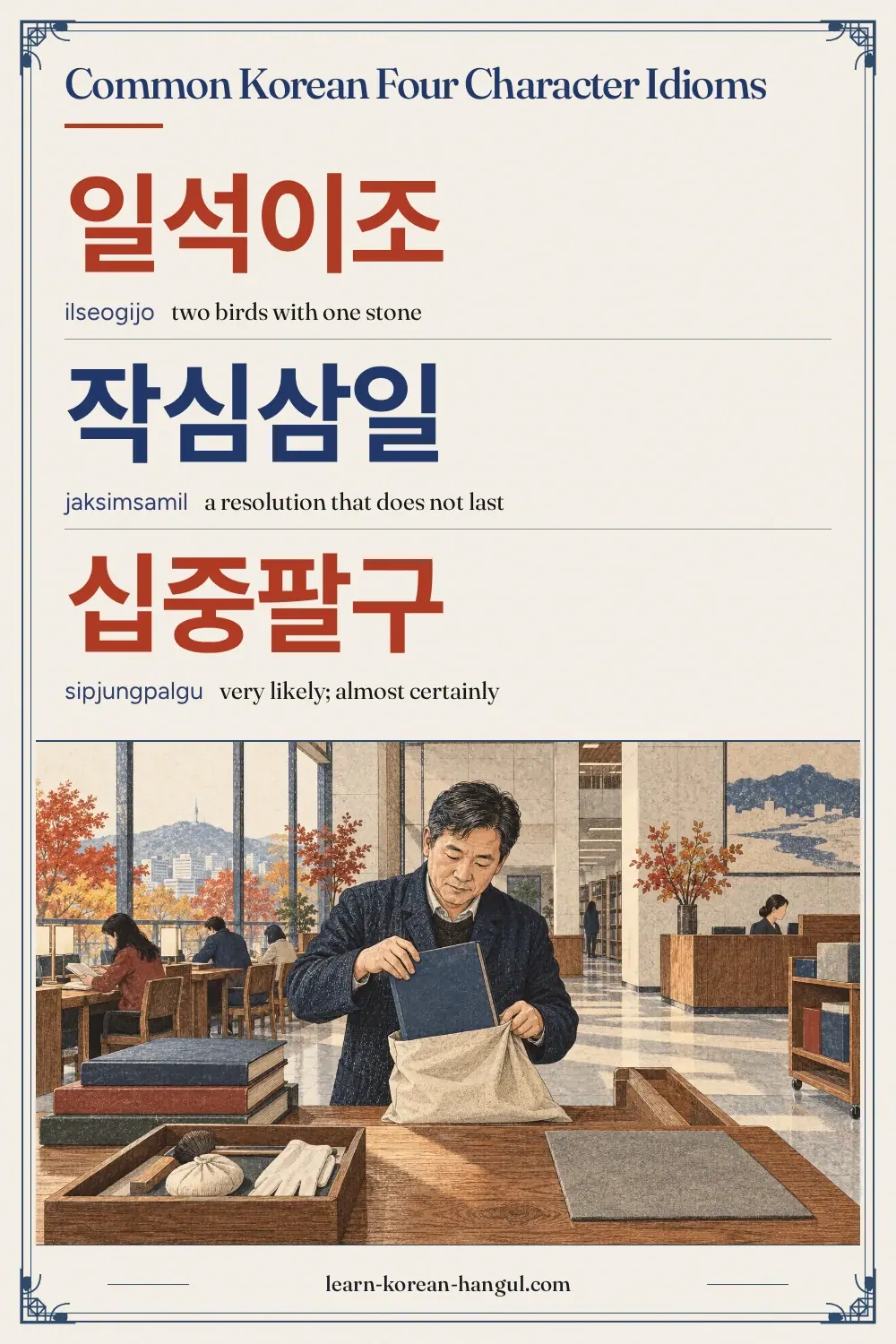
Common Korean Four Character Idioms at a Glance
Common Korean four character idioms are fixed phrases of four Chinese-origin syllables that pack a story or a lesson into four sounds. The Korean name is 사자성어 (saja seongeo): 사자 means four characters, and 성어 means a set phrase. Koreans learn them at school and use them in conversation, news headlines, essays and exams. Each one is written in Hangul and also has a Hanja form, the Chinese characters that carry the meaning.
The idioms on this page are the ones you meet most. They belong to the larger set on the Four-Character Idioms page, which also lists idioms for people, effort and stories. Here the list is arranged by situation, so you can use an idiom for the thing you want to say. The order inside each group is an editorial study order and not a count from a corpus.
| Group | Idioms | What it lets you say |
|---|---|---|
| Idioms for results and efficiency | 6 | Praise good results or describe a fizzle |
| Idioms for time and habit | 6 | Talk about resolutions, progress and balance |
| Idioms for people | 6 | Describe character and friendship |
| Idioms for situations | 6 | Describe what is likely, worse or hopeless |
| Idioms for crowds and feelings | 6 | Describe crowds, worry and laughter |
You need to read Hangul to use the tables. If you cannot yet, start with reading Hangul.
Which Common Four-Character Idioms Should You Learn First?
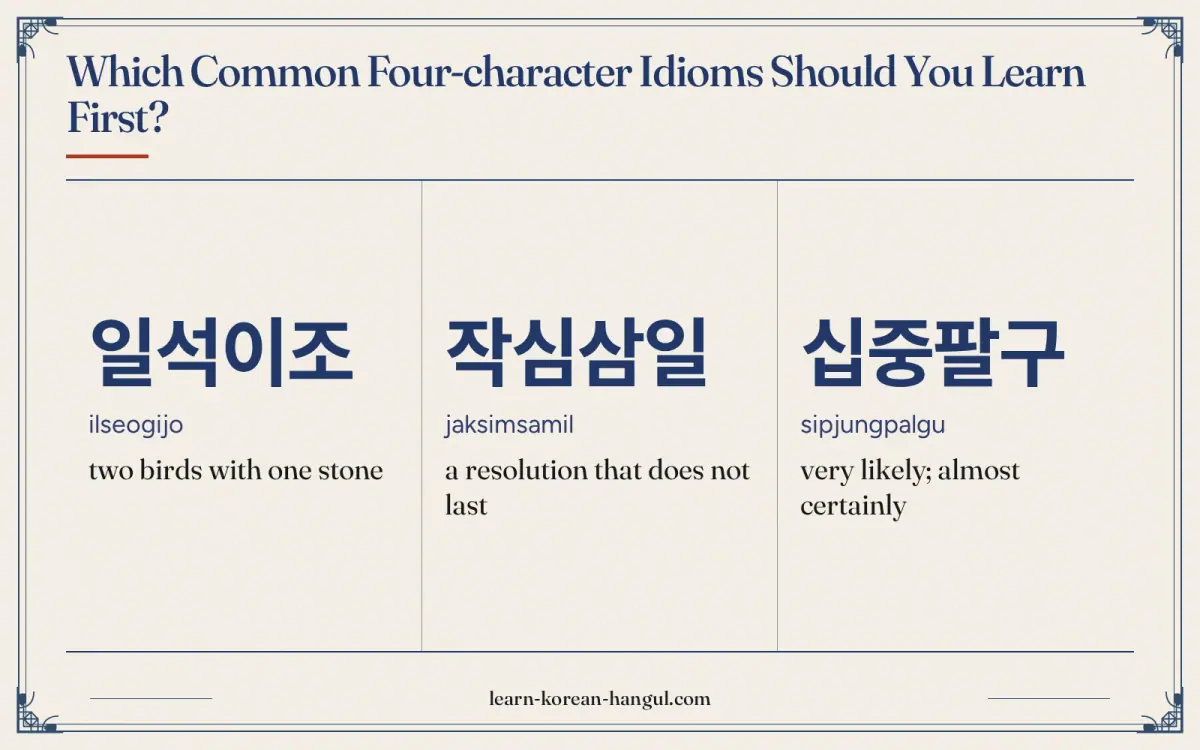
Learn the idioms you can use the same day. Five are heard almost daily: 작심삼일, 일석이조, 십중팔구, 인산인해 and 설상가상. With these five you can talk about a failed diet, a clever plan, a likely outcome, a busy holiday and a bad day. Then add by goal:
- If you want to join conversations. 작심삼일, 일석이조, 십중팔구, 설상가상, 인산인해 and 금시초문.
- If you read the news. 속수무책, 동상이몽, 시행착오, 막상막하, 우왕좌왕 and 대동소이.
- If you write essays. 시종일관, 과유불급, 유유상종, 금상첨화, 용두사미 and 일취월장.
- If you praise people. 팔방미인, 외유내강, 죽마고우, 이심전심, 일거양득 and 백발백중.
- If you prepare for exams. Learn all 30, and check the official TOPIK information on topik.go.kr for what each level tests.
The scene below numbers ten of the idioms with small pictures so that you can tie each phrase to an image.
Word · 10
- 1
일석이조
ilseogijo
two birds with one stone
- 2
작심삼일
jaksimsamil
a resolution that does not last
- 3
십중팔구
sipjungpalgu
very likely; almost certainly
- 4
설상가상
seolsanggasang
to make matters worse
- 5
동문서답
dongmunseodap
an answer that misses the question
- 6
막상막하
maksangmakha
neck and neck; too close to call
- 7
인산인해
insaninhae
a huge crowd
- 8
이심전심
isimjeonsim
understanding without words
- 9
우왕좌왕
uwangjwawang
running around in confusion
- 10
박장대소
bakjangdaeso
bursting into hearty laughter
Tap a number to hear the idiom. At 5 idioms a day the list takes six days, and a review day after each group helps.
Idioms for Results and Efficiency
These idioms judge outcomes. 일석이조 and 일거양득 praise a plan that gains twice. 금상첨화 adds something good to something already good. 백발백중 praises a perfect aim, and 용두사미 describes a grand start with a weak end. 대동소이 says two things are about the same.
| No. | Hangul | Hanja | Revised Romanization | Literally | Meaning and note | Example sentence | Audio assetId |
|---|---|---|---|---|---|---|---|
| 1 | 일석이조 | 一石二鳥 | ilseogijo [일써기조] | one stone, two birds | two birds with one stone. Heard daily. The native proverb 꿩 먹고 알 먹고 means the same. | 자전거로 출근하면 운동도 되고 돈도 아껴요. 일석이조예요. (Cycling to work is exercise and saves money. Two birds with one stone.) | au-pg-vocabulary-word-types-four-character-idioms-everyday-1; example: au-pg-vocabulary-word-types-four-character-idioms-everyday-31 |
| 2 | 일거양득 | 一擧兩得 | ilgeoyangdeuk | one move, two gains | two gains from one action. Common. Close to 일석이조, but it is more about a person gaining twice from one act. | 한국에서 일하면서 한국어도 배워요. 일거양득이에요. (I work in Korea and learn Korean too. It is a double gain.) | au-pg-vocabulary-word-types-four-character-idioms-everyday-2; example: au-pg-vocabulary-word-types-four-character-idioms-everyday-32 |
| 3 | 금상첨화 | 錦上添花 | geumsangcheomhwa | adding flowers on brocade | the icing on the cake; something good made even better. Common. The silk (brocade) was already beautiful. | 맛있는 음식에 멋진 경치까지 있으면 금상첨화예요. (Delicious food and a great view as well would be the icing on the cake.) | au-pg-vocabulary-word-types-four-character-idioms-everyday-3; example: au-pg-vocabulary-word-types-four-character-idioms-everyday-33 |
| 4 | 백발백중 | 百發百中 | baekbalbaekjung [백빨백쭝] | a hundred shots, a hundred hits | hitting the target every time; never missing. Common in sports and in praise of a good guess. | 그 선수는 활을 쏘면 백발백중이에요. (That athlete hits the target every time with a bow.) | au-pg-vocabulary-word-types-four-character-idioms-everyday-4; example: au-pg-vocabulary-word-types-four-character-idioms-everyday-34 |
| 5 | 대동소이 | 大同小異 | daedongsoi | largely the same, slightly different | much the same; little difference. Common in writing and reports. | 두 가게의 가격은 대동소이해요. (The prices of the two shops are much the same.) | au-pg-vocabulary-word-types-four-character-idioms-everyday-5; example: au-pg-vocabulary-word-types-four-character-idioms-everyday-35 |
| 6 | 용두사미 | 龍頭蛇尾 | yongdusami | dragon head, snake tail | a strong start and a weak finish; a fizzle. Common. The opposite of 시종일관. | 계획은 거창했지만 결과는 용두사미였어요. (The plan was grand, but the result was a fizzle.) | au-pg-vocabulary-word-types-four-character-idioms-everyday-6; example: au-pg-vocabulary-word-types-four-character-idioms-everyday-36 |
일석이조 and 일거양득 are near-twins, and each has a number pattern: 일 (one) plus 이 (two). 일석이조 is the image (one stone, two birds), and 일거양득 is the idea (one act, two gains). The final sound decides the copula. 일석이조 ends in a vowel, so it takes 예요 (일석이조예요). 일거양득 ends in a consonant, so it takes 이에요 (일거양득이에요).
Example Sentences
Each example is a short, polite spoken sentence. Notice the pattern noun + 이에요 or noun + 예요, where the idiom is the predicate. Say a sentence aloud, then read it again with the idiom hidden and say its meaning in English. The particles are explained in the Korean particles guide.
How Do You Say Idioms for Time and Habit in Korean?
These idioms are about how something goes over time. 작심삼일 describes a resolution that fades, and 일취월장 describes steady progress. 시종일관 describes keeping the same course, and 시행착오 describes learning through mistakes. 과유불급 warns against doing too much, and 이열치열 describes fighting heat with heat.
| No. | Hangul | Hanja | Revised Romanization | Literally | Meaning and note | Example sentence | Audio assetId |
|---|---|---|---|---|---|---|---|
| 7 | 작심삼일 | 作心三日 | jaksimsamil [작씸사밀] | a firm resolve lasts three days | a resolution that does not last. Heard daily, especially in January. | 새해 운동 계획이 작심삼일이었어요. (My New Year exercise plan fizzled out in three days.) | au-pg-vocabulary-word-types-four-character-idioms-everyday-7; example: au-pg-vocabulary-word-types-four-character-idioms-everyday-37 |
| 8 | 일취월장 | 日就月將 | ilchwiwoljang [일취월짱] | progress by day, advance by month | rapid progress. Common. Often praise for a learner. | 매일 연습해서 한국어 실력이 일취월장했어요. (Practising every day, my Korean has made rapid progress.) | au-pg-vocabulary-word-types-four-character-idioms-everyday-8; example: au-pg-vocabulary-word-types-four-character-idioms-everyday-38 |
| 9 | 시종일관 | 始終一貫 | sijongilgwan | consistent from start to finish | consistently; from beginning to end. Common in writing. Usually before a verb or with 하다. | 그는 시종일관 같은 태도를 지켰어요. (He kept the same attitude from start to finish.) | au-pg-vocabulary-word-types-four-character-idioms-everyday-9; example: au-pg-vocabulary-word-types-four-character-idioms-everyday-39 |
| 10 | 시행착오 | 試行錯誤 | sihaengchago | trying and making errors | trial and error. Very common in speech, news and essays. Often 시행착오를 겪다. | 처음에는 시행착오가 많았어요. (At first there was a lot of trial and error.) | au-pg-vocabulary-word-types-four-character-idioms-everyday-10; example: au-pg-vocabulary-word-types-four-character-idioms-everyday-40 |
| 11 | 과유불급 | 過猶不及 | gwayubulgeup | too much is like too little | too much is as bad as too little. Common in advice. It comes from the Analects of Confucius. | 공부도 과유불급이니까 쉬어 가면서 하세요. (Studying is the same: too much is as bad as too little, so take breaks.) | au-pg-vocabulary-word-types-four-character-idioms-everyday-11; example: au-pg-vocabulary-word-types-four-character-idioms-everyday-41 |
| 12 | 이열치열 | 以熱治熱 | iyeolchiyeol | treat heat with heat | fight heat with heat. Heard daily in summer, when people eat hot soup. | 더운 날에는 뜨거운 국물이 이열치열이에요. (On hot days, hot soup is fighting heat with heat.) | au-pg-vocabulary-word-types-four-character-idioms-everyday-12; example: au-pg-vocabulary-word-types-four-character-idioms-everyday-42 |
작심삼일 is the most common idiom of the page. It has the number 삼일 (three days) but is not a count: Koreans say it about any resolution that does not last, often with a smile in January. 시행착오 almost always appears with the verb 겪다 (to go through): 시행착오를 겪다 (to go through trial and error). 과유불급 comes from the Analects of Confucius (논어), so you may also see it in books of proverbs. The proverbs page covers sayings with a similar lesson.
Idioms for People
People idioms describe character. 팔방미인 and 외유내강 are praise. 죽마고우 names a friend from childhood. 우유부단 describes someone who cannot decide, 유유상종 describes friends who resemble each other, and 자화자찬 describes someone who praises their own work.
| No. | Hangul | Hanja | Revised Romanization | Literally | Meaning and note | Example sentence | Audio assetId |
|---|---|---|---|---|---|---|---|
| 13 | 팔방미인 | 八方美人 | palbangmiin | a beauty in all eight directions | an all-rounder; someone good at many things. Common and positive in Korean. | 그녀는 노래도 춤도 잘하는 팔방미인이에요. (She is an all-rounder who is good at both singing and dancing.) | au-pg-vocabulary-word-types-four-character-idioms-everyday-13; example: au-pg-vocabulary-word-types-four-character-idioms-everyday-43 |
| 14 | 외유내강 | 外柔內剛 | oeyunaegang | soft outside, strong inside | gentle outside and strong inside. Common and positive. | 그 선생님은 외유내강이라서 학생들이 존경해요. (That teacher is gentle outside and strong inside, so the students respect her.) | au-pg-vocabulary-word-types-four-character-idioms-everyday-14; example: au-pg-vocabulary-word-types-four-character-idioms-everyday-44 |
| 15 | 우유부단 | 優柔不斷 | uyubudan | soft and gentle, not cutting | indecisive. Usually as the adjective 우유부단하다. | 그는 우유부단해서 결정을 자꾸 미뤄요. (He is indecisive, so he keeps putting off decisions.) | au-pg-vocabulary-word-types-four-character-idioms-everyday-15; example: au-pg-vocabulary-word-types-four-character-idioms-everyday-45 |
| 16 | 죽마고우 | 竹馬故友 | jungmagou [중마고우] | a friend from the days of bamboo horses | a childhood friend. Common and warm. Children once rode bamboo sticks as toy horses. | 제 죽마고우는 지금도 같은 동네에 살아요. (My childhood friend still lives in the same neighbourhood.) | au-pg-vocabulary-word-types-four-character-idioms-everyday-16; example: au-pg-vocabulary-word-types-four-character-idioms-everyday-46 |
| 17 | 유유상종 | 類類相從 | yuyusangjong | similar kinds follow each other | birds of a feather flock together. Common. It can be neutral or slightly critical. | 유유상종이라고 성격이 비슷한 친구끼리 모여요. (As the saying goes, birds of a feather: friends with similar personalities gather.) | au-pg-vocabulary-word-types-four-character-idioms-everyday-17; example: au-pg-vocabulary-word-types-four-character-idioms-everyday-47 |
| 18 | 자화자찬 | 自畫自讚 | jahwajachan | praising your own painting | self-praise; blowing your own trumpet. Common. It sounds critical about the speaker. | 자기 일을 자화자찬하면 듣기 불편해요. (It is uncomfortable to listen when someone praises their own work.) | au-pg-vocabulary-word-types-four-character-idioms-everyday-18; example: au-pg-vocabulary-word-types-four-character-idioms-everyday-48 |
팔방미인 is positive in Korean: someone good at many things, such as singing, dancing and cooking. The same four characters are used in Japanese, but with a negative meaning of a person who pleases everyone, so do not carry that sense over. 자화자찬 is critical, because it is about a speaker who praises themself. To praise someone else's work say 칭찬하다 instead. 유유상종 can be neutral, as when friends with the same hobby gather, or slightly critical when it describes a group that is closed to others.
How Do You Say Idioms for Situations in Korean?
Situation idioms give a quick comment on what is happening. 십중팔구 says something is very likely. 설상가상 adds a worse event. 동문서답 describes an answer that misses the point, and 금시초문 says you have not heard the news. 속수무책 means nothing can be done, and 막상막하 means two sides are equal.
| No. | Hangul | Hanja | Revised Romanization | Literally | Meaning and note | Example sentence | Audio assetId |
|---|---|---|---|---|---|---|---|
| 19 | 십중팔구 | 十中八九 | sipjungpalgu [십쭝팔구] | eight or nine out of ten | very likely; almost certainly. Heard daily. Works like an adverb before a verb. | 이 시간이면 십중팔구 길이 막혀요. (At this hour the road is almost certainly jammed.) | au-pg-vocabulary-word-types-four-character-idioms-everyday-19; example: au-pg-vocabulary-word-types-four-character-idioms-everyday-49 |
| 20 | 설상가상 | 雪上加霜 | seolsanggasang [설쌍가상] | frost on top of snow | to make matters worse. Heard daily. Usually 설상가상으로 at the start of a clause. | 차가 고장 났는데 설상가상으로 비까지 왔어요. (The car broke down, and to make matters worse it rained too.) | au-pg-vocabulary-word-types-four-character-idioms-everyday-20; example: au-pg-vocabulary-word-types-four-character-idioms-everyday-50 |
| 21 | 동문서답 | 東問西答 | dongmunseodap | asked about the east, answered about the west | an answer that misses the question. Heard daily. Usually with 하다: 동문서답을 하다. | 질문을 잘못 들어서 동문서답을 했어요. (I misheard the question and gave an irrelevant answer.) | au-pg-vocabulary-word-types-four-character-idioms-everyday-21; example: au-pg-vocabulary-word-types-four-character-idioms-everyday-51 |
| 22 | 금시초문 | 今始初聞 | geumsichomun | hearing it now for the first time | news to me; the first I have heard of it. Heard daily. | 그가 이사 간다는 말은 금시초문이에요. (That he is moving away is news to me.) | au-pg-vocabulary-word-types-four-character-idioms-everyday-22; example: au-pg-vocabulary-word-types-four-character-idioms-everyday-52 |
| 23 | 속수무책 | 束手無策 | soksumuchaek [속쑤무책] | hands tied, no plan | helpless; no way to deal with it. Common in news about disasters and crises. | 갑작스러운 정전에 속수무책이었어요. (We were helpless in the face of the sudden blackout.) | au-pg-vocabulary-word-types-four-character-idioms-everyday-23; example: au-pg-vocabulary-word-types-four-character-idioms-everyday-53 |
| 24 | 막상막하 | 莫上莫下 | maksangmakha [막쌍마카] | nothing above, nothing below | neck and neck; too close to call. Common in sports. | 두 선수의 실력이 막상막하예요. (The two players are neck and neck in skill.) | au-pg-vocabulary-word-types-four-character-idioms-everyday-24; example: au-pg-vocabulary-word-types-four-character-idioms-everyday-54 |
십중팔구 and 설상가상 work as adverbs. 십중팔구 goes directly before a verb: 십중팔구 길이 막혀요. 설상가상 usually takes 으로 at the start of a clause: 설상가상으로 비까지 왔어요 (to make matters worse, it rained too). 속수무책 and 막상막하 take the copula: 속수무책이었어요, 막상막하예요. The grammar section below sums up the patterns.
Idioms for Crowds and Feelings
The last group is about people together and what they feel. 인산인해 describes a crowd, 이심전심 describes feelings that pass between people, and 동상이몽 describes people who want different things. 우왕좌왕 describes confusion, 노심초사 describes worry, and 박장대소 describes a burst of laughter.
| No. | Hangul | Hanja | Revised Romanization | Literally | Meaning and note | Example sentence | Audio assetId |
|---|---|---|---|---|---|---|---|
| 25 | 인산인해 | 人山人海 | insaninhae [인사닌해] | a mountain of people, a sea of people | a huge crowd. Heard daily for festivals, sales and holiday traffic. | 연휴에는 공항이 인산인해예요. (During the holiday the airport is packed with people.) | au-pg-vocabulary-word-types-four-character-idioms-everyday-25; example: au-pg-vocabulary-word-types-four-character-idioms-everyday-55 |
| 26 | 이심전심 | 以心傳心 | isimjeonsim | passing from heart to heart | understanding without words. Common in speech and writing. Warm and positive. | 말하지 않아도 이심전심으로 알았어요. (Without a word, we understood each other.) | au-pg-vocabulary-word-types-four-character-idioms-everyday-26; example: au-pg-vocabulary-word-types-four-character-idioms-everyday-56 |
| 27 | 우왕좌왕 | 右往左往 | uwangjwawang | going right, going left | running around in confusion. Common. Usually as the verb 우왕좌왕하다. | 길을 잃고 우왕좌왕했어요. (I got lost and ran around in confusion.) | au-pg-vocabulary-word-types-four-character-idioms-everyday-27; example: au-pg-vocabulary-word-types-four-character-idioms-everyday-57 |
| 28 | 노심초사 | 勞心焦思 | nosimchosa | a laboured heart, scorched thoughts | worrying anxiously. Common in writing and in speech about family. | 아들 소식이 없어서 부모님이 노심초사하세요. (There is no news from their son, so his parents are anxiously worried.) | au-pg-vocabulary-word-types-four-character-idioms-everyday-28; example: au-pg-vocabulary-word-types-four-character-idioms-everyday-58 |
| 29 | 박장대소 | 拍掌大笑 | bakjangdaeso [박짱대소] | clapping hands, laughing loudly | bursting into hearty laughter. Common in writing and stories. | 농담을 듣고 모두가 박장대소했어요. (Hearing the joke, everyone burst into hearty laughter.) | au-pg-vocabulary-word-types-four-character-idioms-everyday-29; example: au-pg-vocabulary-word-types-four-character-idioms-everyday-59 |
| 30 | 동상이몽 | 同床異夢 | dongsangimong | the same bed, different dreams | sharing a situation but wanting different things. Common in news about teams, couples and politics. | 같은 팀이지만 생각은 동상이몽이에요. (We are on the same team, but our thoughts go in different directions.) | au-pg-vocabulary-word-types-four-character-idioms-everyday-30; example: au-pg-vocabulary-word-types-four-character-idioms-everyday-60 |
인산인해 is built from two matching pairs: 인산 (a mountain of people) and 인해 (a sea of people). This 2 + 2 pattern is common in four-character idioms. 이심전심 and 동상이몽 are a pair of opposites: in the first the hearts are in tune, and in the second the dreams differ even though people share a bed. 노심초사 and 박장대소 are usually used as verbs with 하다: 노심초사하다, 박장대소하다. See the idioms hub for other kinds of idiom, such as animal and body-part idioms.
How Do Four-Character Idioms Work in a Sentence?
Most idioms behave like nouns. They appear in four patterns. The table shows the pattern and an example from this page.
| Pattern | Example | Meaning |
|---|---|---|
| Idiom + 이에요 / 예요 | 일석이조예요. | It is two birds with one stone. |
| Idiom + 으로 or no particle, as an adverb | 설상가상으로 비까지 왔어요. | To make matters worse, it rained too. |
| Idiom + 하다, as a verb | 박장대소했어요. | Everyone burst into laughter. |
| Idiom + 을/를 + verb | 시행착오를 겪었어요. | I went through trial and error. |
Not every idiom takes every pattern. 우왕좌왕, 노심초사, 박장대소, 일취월장 and 대동소이 take 하다 easily. 일석이조 and 인산인해 do not. The safest approach is to learn each idiom with its example sentence.
Register: Which Idioms Are Spoken and Which Are Written?
Some idioms are heard in daily talk, and others belong to writing. Use this guide to choose.
| Use | Idioms | Advice |
|---|---|---|
| Heard daily | 작심삼일, 일석이조, 십중팔구, 설상가상, 인산인해, 금시초문, 이열치열, 동문서답 | Use freely with anyone |
| Common in speech and writing | 일거양득, 이심전심, 우유부단, 죽마고우, 일취월장, 팔방미인, 외유내강, 시행착오, 박장대소, 우왕좌왕, 동상이몽, 노심초사, 막상막하 | Natural in conversation and the news |
| Mostly written | 시종일관, 대동소이, 용두사미, 과유불급, 유유상종, 금상첨화, 백발백중, 속수무책 | Recognise them first; common in essays and editorials |
| Critical, use with care | 자화자찬, 용두사미 | Avoid about a senior or to someone's face |
Numbers inside Idioms
Six idioms contain Sino-Korean numbers: 일석이조 (one, two), 일거양득 (one, two), 작심삼일 (three), 십중팔구 (ten, eight, nine), 백발백중 (hundred, hundred) and 팔방미인 (eight). If you know the Sino-Korean numbers, you can read the numeric part at once. See the Sino-Korean numbers lesson. The Chinese characters themselves are introduced on the basic Hanja page.
How Do You Pronounce These Words?
Most idioms are said as they are spelled, but the Sino-Korean sounds create tense consonants. The table shows eight that learners often get wrong.
| Spelling | Pronunciation | What happens |
|---|---|---|
| 일석이조 | [일써기조] | ㅅ is tense after ㄹ, and the final ㄱ of 석 links to 이 |
| 작심삼일 | [작씸사밀] | ㅅ is tense after ㄱ, and the final ㅁ of 삼 links to the vowel of 일 |
| 십중팔구 | [십쭝팔구] | ㅈ is tense after ㅂ |
| 설상가상 | [설쌍가상] | ㅅ is tense after ㄹ |
| 죽마고우 | [중마고우] | The final ㄱ becomes ㅇ before ㅁ |
| 인산인해 | [인사닌해] | The final ㄴ of 산 links to the vowel of 인 |
| 백발백중 | [백빨백쭝] | ㅂ is tense after ㄱ, and ㅈ is tense after ㄱ |
| 막상막하 | [막쌍마카] | ㅅ is tense after ㄱ, and ㄱ and ㅎ join into ㅋ |
The rules come from the Standard Pronunciation rules (표준 발음법) of the 국립국어원. Revised Romanization does not write tensing caused by a neighbouring sound, so it writes 십중팔구 as sipjungpalgu. In the tables the spoken form appears in square brackets after the Revised Romanization where it differs.
Audio and Slow Playback
Each idiom has a normal clip, and five harder ones also have a slow clip at 0.8 times the speed: 작심삼일, 십중팔구, 인산인해, 막상막하 and 일취월장. Nothing plays until you press a button.
Listen to 작심삼일 first. The ㅅ in the middle is tense, so the word sounds close to jak-ssim-sa-mil. Then listen to 인산인해, where the sounds run together as in-sa-nin-hae.
What Mistakes Do Learners Make with Common Four-Character Idioms?
- Writing 일석이조이에요. An idiom that ends in a vowel takes 예요: 일석이조예요. Idioms that end in a consonant take 이에요: 작심삼일이에요.
- Reading 일석이조 as il-seok-i-jo. The final ㄱ links to the next vowel and the ㅅ is tense, so it is [일써기조].
- Using 자화자찬 to praise another person. It only describes praising yourself. Use 칭찬하다 to praise someone else.
- Adding 하다 to every idiom. 일석이조하다 and 인산인해하다 do not exist, so check the example sentence for each one.
- Carrying the Japanese sense of 팔방미인 over into Korean. In Korean it is a compliment.
The copula rule (예요 and 이에요) is the one that learners break most often, because the idiom looks like a block and the final sound is easy to miss. The practice section turns the list into drills.
Practice: Flashcards and Worksheet
Study in three steps. First, run the deck in recognition mode until the 30 idioms feel familiar. Second, switch to listening mode and press the clip before the card turns. Third, take the quiz below. The deck stores your progress only in your browser. The vocabulary flashcard decks page lists the other decks, and the vocabulary worksheets page lists printable sheets. A printable worksheet for these words (word list, matching, writing practice, fill-in-the-blank exercises and answer key) is available in A4 and US Letter from the download card on this page.
The deck holds the same 30 cards as the tables above: Hangul, Revised Romanization and meaning.
Practice · 30
- 01일석이조
Show answer
ilseogijo
two birds with one stone
- 02일거양득
Show answer
ilgeoyangdeuk
two gains from one action
- 03금상첨화
Show answer
geumsangcheomhwa
the icing on the cake; something good made even better
- 04백발백중
Show answer
baekbalbaekjung
hitting the target every time; never missing
- 05대동소이
Show answer
daedongsoi
much the same; little difference
- 06용두사미
Show answer
yongdusami
a strong start and a weak finish; a fizzle
- 07작심삼일
Show answer
jaksimsamil
a resolution that does not last
- 08일취월장
Show answer
ilchwiwoljang
rapid progress
- 09시종일관
Show answer
sijongilgwan
consistently; from beginning to end
- 10시행착오
Show answer
sihaengchago
trial and error
- 11과유불급
Show answer
gwayubulgeup
too much is as bad as too little
- 12이열치열
Show answer
iyeolchiyeol
fight heat with heat
- 13팔방미인
Show answer
palbangmiin
an all-rounder; someone good at many things
- 14외유내강
Show answer
oeyunaegang
gentle outside and strong inside
- 15우유부단
Show answer
uyubudan
indecisive
- 16죽마고우
Show answer
jungmagou
a childhood friend
- 17유유상종
Show answer
yuyusangjong
birds of a feather flock together
- 18자화자찬
Show answer
jahwajachan
self-praise; blowing your own trumpet
- 19십중팔구
Show answer
sipjungpalgu
very likely; almost certainly
- 20설상가상
Show answer
seolsanggasang
to make matters worse
- 21동문서답
Show answer
dongmunseodap
an answer that misses the question
- 22금시초문
Show answer
geumsichomun
news to me; the first I have heard of it
- 23속수무책
Show answer
soksumuchaek
helpless; no way to deal with it
- 24막상막하
Show answer
maksangmakha
neck and neck; too close to call
- 25인산인해
Show answer
insaninhae
a huge crowd
- 26이심전심
Show answer
isimjeonsim
understanding without words
- 27우왕좌왕
Show answer
uwangjwawang
running around in confusion
- 28노심초사
Show answer
nosimchosa
worrying anxiously
- 29박장대소
Show answer
bakjangdaeso
bursting into hearty laughter
- 30동상이몽
Show answer
dongsangimong
sharing a situation but wanting different things
Common Korean Four Character Idioms Worksheet
Try this eight-question check.
Practice · 8
What does 작심삼일 (jaksimsamil) mean?
Show answer
a resolution that does not last
작심삼일 means a resolution that does not last. Example: 새해 운동 계획이 작심삼일이었어요.
What does 일석이조 (ilseogijo) mean?
Show answer
two birds with one stone
일석이조 means two birds with one stone, a double gain from one action.
Which idiom means "a huge crowd"?
Show answer
인산인해
인산인해 means a mountain and a sea of people. 이심전심 is understanding without words, 우왕좌왕 is confusion and 노심초사 is worry.
Which idiom means "understanding without words"?
Show answer
이심전심
이심전심 means passing from heart to heart. 동문서답 is an irrelevant answer, 금시초문 is news to me and 박장대소 is hearty laughter.
Which idiom means "very likely"?
Show answer
십중팔구
십중팔구 means eight or nine out of ten, so very likely. 설상가상 is "to make matters worse".
How is 설상가상 pronounced?
Show answer
[설쌍가상]
ㅅ is tense after ㄹ, so 설상가상 is said [설쌍가상].
Which ending is right after 일석이조?
Show answer
-예요
일석이조 ends in a vowel, so it takes 예요: 일석이조예요.
What does 자화자찬 (jahwajachan) mean?
Show answer
praising your own work
자화자찬 means praising your own painting, that is, self-praise.
Where to Go Next
After this page, continue with Korean Four-Character Idioms With Stories to learn the tales behind idioms such as 새옹지마 and 전화위복, or return to Four-Character Idioms for the full set.
Frequently Asked Questions
How Do You Say Short-Lived Resolution in Korean?
A short-lived resolution is 작심삼일 (jaksimsamil). The four characters mean a firm resolve lasts three days. Koreans use it for any plan that does not last, such as a diet, and say it often in January. A typical sentence is 새해 운동 계획이 작심삼일이었어요 (my New Year exercise plan fizzled out in three days).
How Do You Pronounce 일석이조 (ilseogijo)?
일석이조 is spelled il-seok-i-jo, but it is said [일써기조]. The ㅅ after ㄹ is tense, and the final ㄱ of 석 links to the vowel of 이. Say il-sseo-gi-jo as one flow, with the stress even across the four syllables. Revised Romanization writes ilseogijo.
How Many Common Four-Character Idioms Should I Learn First?
Learn about 10 first. Take the five idioms heard almost daily (작심삼일, 일석이조, 십중팔구, 설상가상 and 인산인해), then add 금시초문, 이심전심, 동문서답, 우왕좌왕 and 팔방미인. Add the rest of the 30 over the next two weeks, and revisit them with the example sentences.
Where Can I Practise Common Four-Character Idioms with Flashcards?
Use the Korean four-character idioms flashcards for a mixed deck, or the vocabulary flashcard decks page, which lists every deck with audio. This page also carries a deck with all 30 idioms in recognition mode. Your progress stays in your browser, so it is not shared with other devices.
Is the Romanization on This Page Official?
It follows the Revised Romanization of Korean, which South Korea officially adopted on 7 July 2000 and whose rules the National Institute of Korean Language (국립국어원) publishes. It is a learning aid that does not show tensing caused by a neighbouring sound, so spoken forms are given in square brackets and the Hangul and audio are the guide.
Is There a Printable Worksheet for Common Four-Character Idioms?
A printable worksheet for these words (word list, matching, writing practice, fill-in-the-blank exercises and answer key) is available in A4 and US Letter from the download card on this page. For practice, write the Hangul and Hanja from memory, cover the English column and check your answers against the tables.