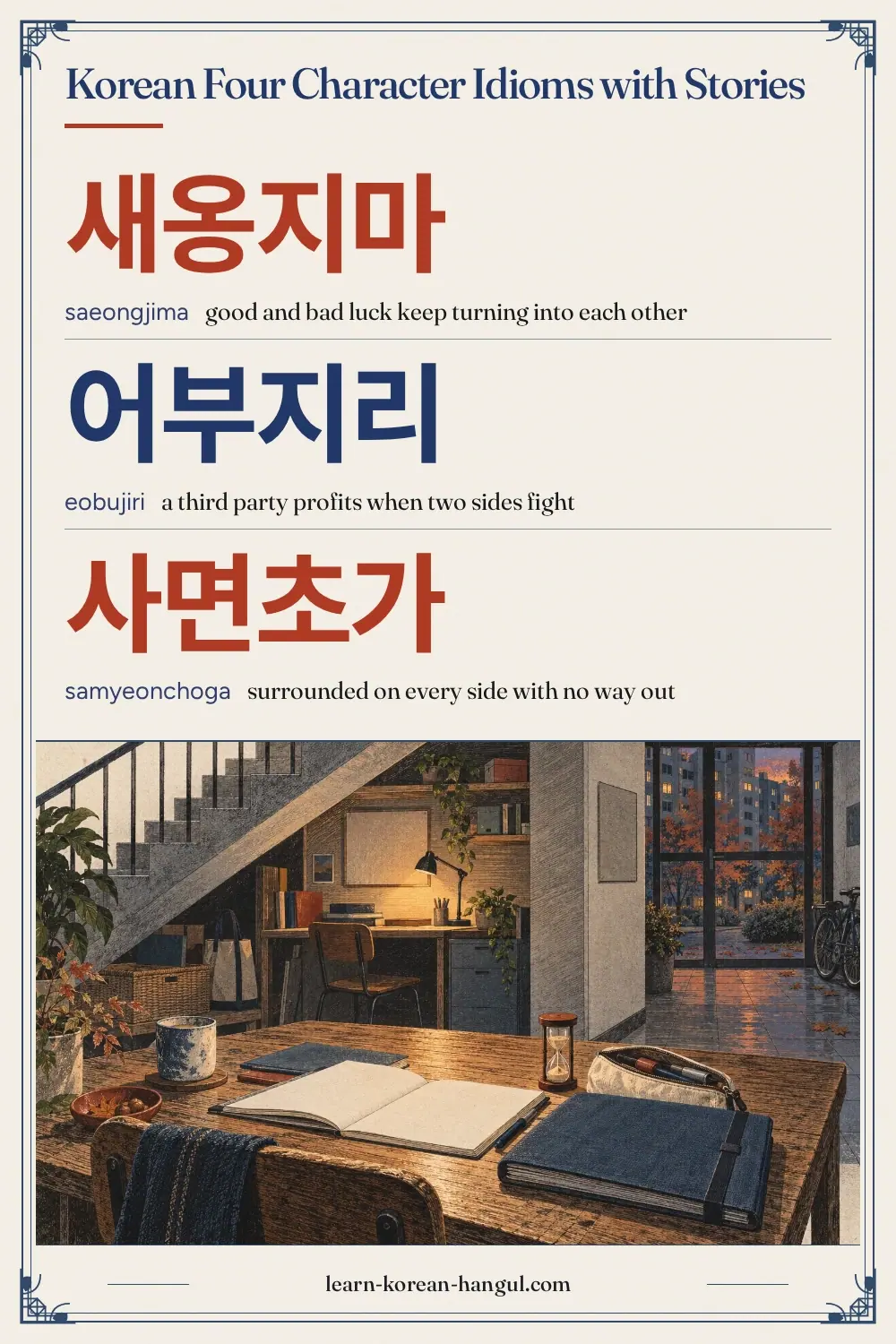
Korean Four Character Idioms with Stories at a Glance
Korean four character idioms with stories are called 고사성어 (gosa seongeo). 고사 means an old story, and 성어 means a set phrase, so a 고사성어 is a four-character idiom with a story behind it. Many of them come from Chinese classics, a few from Korean history, and a few from sayings with no single tale. They are a sub-set of 사자성어 (four-character idioms in general), and learning the story is the quickest way to remember the meaning.
The list on this page is arranged by theme. For the most common idioms that have little or no story, see Common Four-Character Idioms in Korean. The order inside each group is an editorial study order and not a count from a corpus.
| Group | Idioms | What it covers |
|---|---|---|
| Idioms from ancient China | 6 | Tales from Chinese history and philosophy |
| Idioms from Korean history | 6 | The founding legend and the Silla precepts |
| Wisdom stories | 6 | Tales of effort, friendship and fairness |
| Idioms about war and leadership | 6 | Battles, rulers and loyalty |
| Idioms about luck | 6 | Fortune, hardship and patience |
You need to read Hangul to use the tables. If you cannot yet, start with reading Hangul.
Which Four-Character Idioms with Stories Should You Learn First?
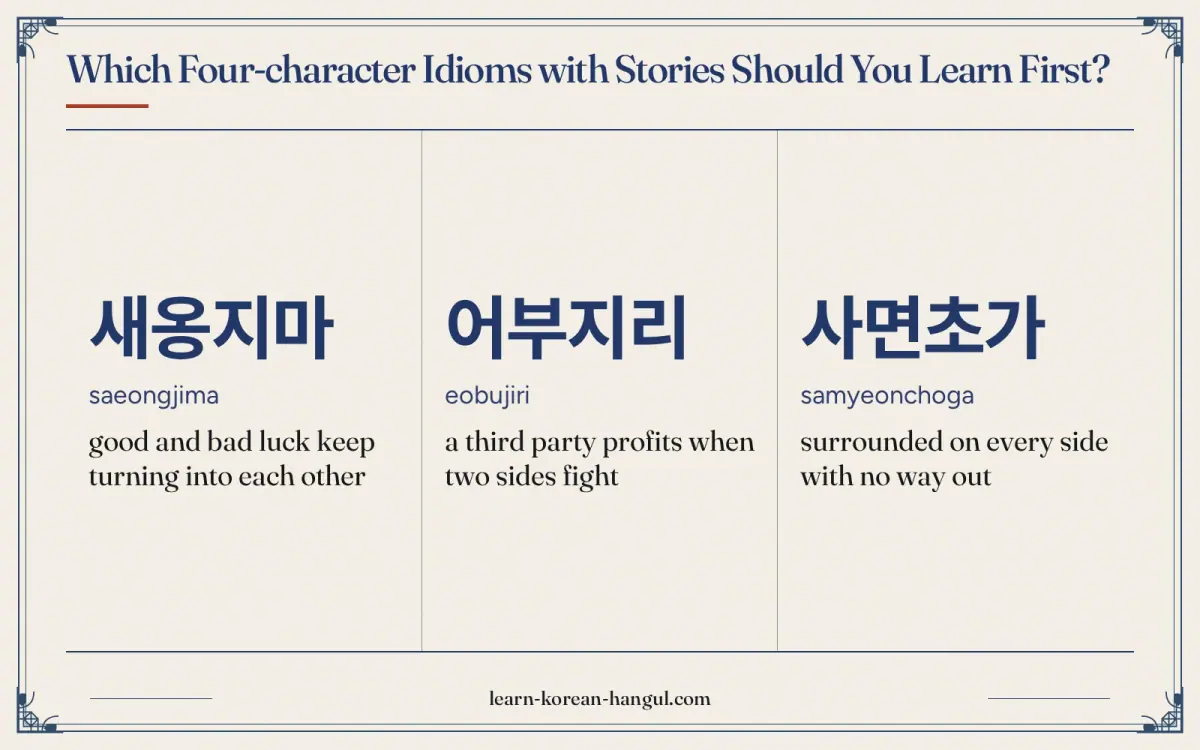
Learn the idioms you will meet most often in news and conversation, and learn the story at the same time. 새옹지마, 전화위복, 어부지리, 사면초가 and 대기만성 are five widely used ones. Then add by interest:
- If you like history. 와신상담, 삼고초려, 읍참마속, 토사구팽 and 지록위마.
- If you like philosophy. 조삼모사, 우공이산, 맹모삼천, 관포지교 and 대기만성.
- If you want to understand Korea. 홍익인간, 사군이충, 사친이효, 교우이신, 임전무퇴 and 살생유택.
- If you read the news. 어부지리, 호가호위, 토사구팽, 사면초가 and 지록위마.
- If you prepare for exams. Study all 30 slowly and check the official TOPIK information on topik.go.kr for what each level tests.
The scene below numbers ten objects that match ten of the idioms, so you can hold each story in a picture.
Word · 10
- 1
새옹지마
saeongjima
good and bad luck keep turning into each other
- 2
어부지리
eobujiri
a third party profits when two sides fight
- 3
사면초가
samyeonchoga
surrounded on every side with no way out
- 4
각주구검
gakjugugeom
stubbornly using an outdated method
- 5
조삼모사
josammosa
being fooled by a change that adds up to the same; short-sighted thinking
- 6
호가호위
hogahowi
using a powerful person's authority to threaten others
- 7
우공이산
ugongisan
persistence can move mountains
- 8
형설지공
hyeongseoljigong
studying hard despite poverty
- 9
맹모삼천
maengmosamcheon
a good environment matters for a child's education
- 10
관포지교
gwanpojigyo
a deep and selfless friendship
Tap a number to hear the idiom. At 3 idioms a day the list takes ten days.
Idioms from Ancient China
Many Korean idioms come from Chinese texts that Koreans have read for many centuries. These six come from histories and works of philosophy, and each carries a short tale. 새옹지마 (the horse of the old man at the frontier) opens the list because its short tale sums up the whole idea of this page: a story that holds a lesson. 어부지리, 사면초가 and 호가호위 are common in the news, and 각주구검 and 조삼모사 are common in essays.
| No. | Hangul | Hanja | Revised Romanization | Literally | Meaning and note | Example sentence | Audio assetId |
|---|---|---|---|---|---|---|---|
| 1 | 새옹지마 | 塞翁之馬 | saeongjima | the old frontier man's horse | good and bad luck keep turning into each other. Story: in the Huainanzi (회남자), an old man's horse runs away, returns with another horse, and then his son breaks his leg falling from it, which later saves him from war. Lesson: luck cannot be judged at once. | 회사를 그만뒀어요. 그 덕분에 더 좋은 일을 찾았어요. 인생은 새옹지마예요. (I quit my company. Thanks to that, I found a better job. Life is a turn of fortune.) | au-pg-vocabulary-word-types-four-character-idioms-stories-1; example: au-pg-vocabulary-word-types-four-character-idioms-stories-31 |
| 2 | 어부지리 | 漁夫之利 | eobujiri | the fisherman's profit | a third party profits when two sides fight. Story: in the Strategies of the Warring States (전국책), a clam and a snipe fight and neither lets go, so a fisherman picks up both. Lesson: do not fight while a third party is watching. | 두 가게가 싸우는 동안 세 번째 가게가 어부지리를 얻었어요. (While two shops fought, the third shop gained from it.) | au-pg-vocabulary-word-types-four-character-idioms-stories-2; example: au-pg-vocabulary-word-types-four-character-idioms-stories-32 |
| 3 | 사면초가 | 四面楚歌 | samyeonchoga | songs of Chu on all four sides | surrounded on every side with no way out. Story: in the Records of the Grand Historian (사기), the general Xiang Yu of Chu is surrounded, hears songs of his homeland from the enemy camp and thinks Chu has already fallen. Lesson: isolation breaks morale. | 계획이 모두 막혀서 사면초가예요. (All my plans are blocked, so I am surrounded on every side.) | au-pg-vocabulary-word-types-four-character-idioms-stories-3; example: au-pg-vocabulary-word-types-four-character-idioms-stories-33 |
| 4 | 각주구검 | 刻舟求劍 | gakjugugeom [각쭈구검] | mark the boat, look for the sword | stubbornly using an outdated method. Story: in the Lüshi Chunqiu (여씨춘추), a man drops his sword from a boat, cuts a mark on the side and looks for the sword at that mark after the boat has moved. Lesson: times change, and so must methods. | 시대가 변했는데 옛날 방식만 쓰면 각주구검이에요. (If you keep to old ways although the times have changed, it is the sword-in-the-boat mistake.) | au-pg-vocabulary-word-types-four-character-idioms-stories-4; example: au-pg-vocabulary-word-types-four-character-idioms-stories-34 |
| 5 | 조삼모사 | 朝三暮四 | josammosa | three in the morning, four at night | being fooled by a change that adds up to the same; short-sighted thinking. Story: in the Zhuangzi (장자), a keeper tells his monkeys they will get three acorns in the morning and four at night. They are angry, so he offers four in the morning and three at night, and they are happy. Lesson: do not be tricked by words. | 이름만 바꾼 할인은 조삼모사예요. (A discount that only changes the name is the same trick.) | au-pg-vocabulary-word-types-four-character-idioms-stories-5; example: au-pg-vocabulary-word-types-four-character-idioms-stories-35 |
| 6 | 호가호위 | 狐假虎威 | hogahowi | the fox borrows the tiger's might | using a powerful person's authority to threaten others. Story: in the Strategies of the Warring States (전국책), a fox claims to be king of the animals and walks ahead of a tiger, so the animals run away. They fear the tiger and not the fox. Lesson: borrowed power is not your own. | 사장님 이름을 팔아 큰소리치는 건 호가호위예요. (Throwing your weight around in the boss's name is borrowing the tiger's might.) | au-pg-vocabulary-word-types-four-character-idioms-stories-6; example: au-pg-vocabulary-word-types-four-character-idioms-stories-36 |
The stories give each idiom a clear image. In 어부지리 the winner is neither fighter, so use it for a third party that gains. In 사면초가 the speaker is the one who is trapped. 호가호위 is always critical, because it describes a person who uses another's power. 조삼모사 has two uses: it can mean being fooled by a change that adds up to the same, and it can mean short-sighted thinking. The Hanja basics page introduces some of the characters.
Example Sentences
Each example is a short, polite spoken sentence. Notice the pattern noun + 이에요 or noun + 예요, where the idiom is the predicate. Idioms that end in a vowel take 예요, as in 사면초가예요, and idioms that end in a consonant take 이에요, as in 각주구검이에요. Say a sentence aloud, then read it again with the idiom hidden and say its meaning in English. The particles are explained in the Korean particles guide.
How Do You Say Idioms from Korean History in Korean?
These six idioms are Korean, not Chinese. 홍익인간 comes from the founding legend of Gojoseon. The other five, 사군이충, 사친이효, 교우이신, 임전무퇴 and 살생유택, are the Five Precepts for Laymen (세속오계), five rules that the monk Wongwang (원광) gave to young men of Silla, one of the Three Kingdoms of early Korea. They are traditionally linked with the Hwarang, Silla's young warrior elite, and show what such young men were taught to value: loyalty, filial piety, trust, courage and care for life.
| No. | Hangul | Hanja | Revised Romanization | Literally | Meaning and note | Example sentence | Audio assetId |
|---|---|---|---|---|---|---|---|
| 7 | 홍익인간 | 弘益人間 | hongigingan [홍이긴간] | broadly benefit humankind | the founding ideal of benefiting all people. Origin: the founding legend of Gojoseon in the Samguk Yusa (삼국유사). Hwanung comes down from heaven wishing to benefit humankind. The phrase is taught in Korean schools as a national ideal. | 이 학교는 홍익인간의 정신을 가르쳐요. (This school teaches the spirit of benefiting all humankind.) | au-pg-vocabulary-word-types-four-character-idioms-stories-7; example: au-pg-vocabulary-word-types-four-character-idioms-stories-37 |
| 8 | 사군이충 | 事君以忠 | sagunichung | serve the ruler with loyalty | loyalty to one's ruler and country. Origin: the first of the Five Precepts for Laymen (세속오계) that the monk Wongwang gave to young Silla men, recorded in the Samguk Sagi (삼국사기). | 사군이충은 옛날 화랑이 지킨 가르침이에요. (Sagunichung was a teaching that the Hwarang of old kept.) | au-pg-vocabulary-word-types-four-character-idioms-stories-8; example: au-pg-vocabulary-word-types-four-character-idioms-stories-38 |
| 9 | 사친이효 | 事親以孝 | sachinihyo | serve parents with filial piety | being dutiful to one's parents. Origin: the second of the Five Precepts (세속오계) of Wongwang. Filial piety (효) is still a core value in Korean families. | 사친이효는 부모님께 효도하라는 말이에요. (Sachinihyo means to be dutiful to your parents.) | au-pg-vocabulary-word-types-four-character-idioms-stories-9; example: au-pg-vocabulary-word-types-four-character-idioms-stories-39 |
| 10 | 교우이신 | 交友以信 | gyouisin | make friends with trust | keeping faith with friends. Origin: the third of the Five Precepts (세속오계). Friends should be honest and keep their word. | 교우이신은 친구를 믿음으로 사귀라는 뜻이에요. (Gyouisin means to make friends with trust.) | au-pg-vocabulary-word-types-four-character-idioms-stories-10; example: au-pg-vocabulary-word-types-four-character-idioms-stories-40 |
| 11 | 임전무퇴 | 臨戰無退 | imjeonmutoe | never retreat in battle | fighting to the end without backing down. Origin: the fourth of the Five Precepts (세속오계), taught to Silla warriors. Today it is also used in sports and business. | 임전무퇴의 정신으로 끝까지 싸웠어요. (We fought to the end with the spirit of never retreating.) | au-pg-vocabulary-word-types-four-character-idioms-stories-11; example: au-pg-vocabulary-word-types-four-character-idioms-stories-41 |
| 12 | 살생유택 | 殺生有擇 | salsaengyutaek [살쌩유택] | choose carefully when taking life | do not kill without good reason. Origin: the fifth of the Five Precepts (세속오계), which asks warriors to take life only when needed. | 살생유택은 생명을 함부로 죽이지 말라는 가르침이에요. (Salsaengyutaek teaches not to take life carelessly.) | au-pg-vocabulary-word-types-four-character-idioms-stories-12; example: au-pg-vocabulary-word-types-four-character-idioms-stories-42 |
Three of the five share one pattern, action + 이 + virtue, where 이 (以) means with or by means of: 事君以忠 is serve the ruler with loyalty. They are short, rhythmic sentences and not fixed idioms in the same sense as 어부지리, but Korean schools teach them as 사자성어. 홍익인간 is also used today as an ideal of education and public service. You may see it on school buildings and in speeches.
Wisdom Stories
These six idioms teach a lesson. 우공이산 teaches persistence, 형설지공 teaches study despite hardship, and 맹모삼천 teaches the power of environment. 관포지교 teaches friendship. 오비이락 teaches that timing is not proof, and 사필귀정 says that justice returns. Four of them are Chinese tales, one is a Korean proverb in four characters, and one is a saying with no single tale.
| No. | Hangul | Hanja | Revised Romanization | Literally | Meaning and note | Example sentence | Audio assetId |
|---|---|---|---|---|---|---|---|
| 13 | 우공이산 | 愚公移山 | ugongisan | the foolish old man moves the mountain | persistence can move mountains. Story: in the Liezi (열자), an old man named Yu Gong starts to dig away two mountains by hand, and his family carries on after him. A god is moved and removes the mountains. Lesson: keep going. | 하루 한 장씩 읽다 보니 책 한 권을 다 읽었어요. 우공이산이에요. (Reading one page a day, I finished a whole book. Persistence moves mountains.) | au-pg-vocabulary-word-types-four-character-idioms-stories-13; example: au-pg-vocabulary-word-types-four-character-idioms-stories-43 |
| 14 | 형설지공 | 螢雪之功 | hyeongseoljigong [형설찌공] | the merit of fireflies and snow | studying hard despite poverty. Story: in the Book of Jin (진서), two poor scholars study by the light of fireflies in a bag and by the glow of snow. Lesson: where there is a will, there is a way. | 형설지공 끝에 자격증을 땄어요. (After studying hard despite my difficulties, I earned the certificate.) | au-pg-vocabulary-word-types-four-character-idioms-stories-14; example: au-pg-vocabulary-word-types-four-character-idioms-stories-44 |
| 15 | 맹모삼천 | 孟母三遷 | maengmosamcheon | Mencius's mother moved three times | a good environment matters for a child's education. Story: in the Lienü zhuan (열녀전), the mother of the philosopher Mencius moves home from a graveyard to a market and then to a school, so that her son can learn good habits. Lesson: surroundings shape children. | 맹모삼천처럼 학교 근처로 이사했어요. (Like Mencius's mother, I moved to be near the school.) | au-pg-vocabulary-word-types-four-character-idioms-stories-15; example: au-pg-vocabulary-word-types-four-character-idioms-stories-45 |
| 16 | 관포지교 | 管鮑之交 | gwanpojigyo | the friendship of Guan and Bao | a deep and selfless friendship. Story: in the Records of the Grand Historian (사기), Guan Zhong and Bao Shuya stay friends even though Guan has been selfish toward Bao, and Bao later recommends Guan as a minister. Lesson: true friends understand each other. | 두 사람은 관포지교로 유명해요. (The two are famous for a deep friendship.) | au-pg-vocabulary-word-types-four-character-idioms-stories-16; example: au-pg-vocabulary-word-types-four-character-idioms-stories-46 |
| 17 | 오비이락 | 烏飛梨落 | obiirak | the crow flies and a pear falls | a coincidence that looks like the cause. Origin: the Korean proverb 까마귀 날자 배 떨어진다. A crow takes off at the moment a pear drops, and the crow gets the blame. Lesson: timing is not proof. | 제가 컴퓨터를 만졌더니 화면이 꺼졌어요. 정말 오비이락이에요. (I touched the computer and the screen went off. It is a pure coincidence that looks like cause and effect.) | au-pg-vocabulary-word-types-four-character-idioms-stories-17; example: au-pg-vocabulary-word-types-four-character-idioms-stories-47 |
| 18 | 사필귀정 | 事必歸正 | sapilgwijeong | everything returns to what is right | justice prevails in the end. Origin: not a single tale but a long-used saying that wrongs are corrected over time. It is common in news and speeches. | 사필귀정이라고 결국 진실이 밝혀졌어요. (As they say, justice prevails: the truth came out in the end.) | au-pg-vocabulary-word-types-four-character-idioms-stories-18; example: au-pg-vocabulary-word-types-four-character-idioms-stories-48 |
우공이산 is built from 우공 (the foolish old man) and 이산 (to move a mountain), and the story teaches that a task that seems impossible can be done by persistence over generations. 오비이락 has a Korean twin: 까마귀 날자 배 떨어진다 (as the crow takes off, the pear falls). Both are used when a coincidence makes someone look guilty. 사필귀정 is not a single tale. It is a long-used saying and is common in news about court cases. Notice also that the stories behind 형설지공 and 맹모삼천 are both about learning.
How Do You Say Idioms about War and Leadership in Korean?
These six idioms come from tales of war. 와신상담 is about enduring hardship for revenge. 삼고초려 is about winning a talented person with humility. 읍참마속 is about enforcing rules at a cost. 오월동주 is about enemies who help each other. 토사구팽 is about being discarded after use, and 지록위마 is about twisting the truth.
| No. | Hangul | Hanja | Revised Romanization | Literally | Meaning and note | Example sentence | Audio assetId |
|---|---|---|---|---|---|---|---|
| 19 | 와신상담 | 臥薪嘗膽 | wasinsangdam | lie on firewood, taste gall | enduring hardship to reach a goal such as revenge. Story: in the Records of the Grand Historian (사기), the kings of Wu and Yue are said to keep themselves uncomfortable so they never forget a defeat. Tellings differ on which king did what. Lesson: remember your goal. | 그 팀은 일 년 동안 와신상담했어요. (That team endured a hard year to get its revenge.) | au-pg-vocabulary-word-types-four-character-idioms-stories-19; example: au-pg-vocabulary-word-types-four-character-idioms-stories-49 |
| 20 | 삼고초려 | 三顧草廬 | samgochoryeo | three visits to the thatched hut | persistent, humble effort to win over a talented person. Story: in the Three Kingdoms (삼국지) stories, Liu Bei visits the thatched hut of Zhuge Liang three times to ask him to be his adviser. Lesson: respect talent. | 회사는 삼고초려 끝에 그를 영입했어요. (The company recruited him after repeated visits.) | au-pg-vocabulary-word-types-four-character-idioms-stories-20; example: au-pg-vocabulary-word-types-four-character-idioms-stories-50 |
| 21 | 읍참마속 | 泣斬馬謖 | eupchammasok | weeping, cut down Ma Su | enforcing rules even against someone you love. Story: in the Three Kingdoms (삼국지) stories, Zhuge Liang has his trusted officer Ma Su executed for disobeying orders, even though he weeps. Lesson: rules apply to all. | 규칙을 위해 읍참마속의 결정을 내렸어요. (For the sake of the rules, I made a painful decision to punish even someone dear.) | au-pg-vocabulary-word-types-four-character-idioms-stories-21; example: au-pg-vocabulary-word-types-four-character-idioms-stories-51 |
| 22 | 오월동주 | 吳越同舟 | owoldongju | Wu and Yue in the same boat | enemies working together in a crisis. Story: in the Art of War (손자병법), men of the rival states Wu and Yue who hate each other help one another when a storm hits their boat. Lesson: danger can make rivals cooperate. | 경쟁 회사들이 위기에는 오월동주가 됐어요. (The competing companies became allies in the crisis.) | au-pg-vocabulary-word-types-four-character-idioms-stories-22; example: au-pg-vocabulary-word-types-four-character-idioms-stories-52 |
| 23 | 토사구팽 | 兔死狗烹 | tosagupaeng | when the hare dies, the hound is cooked | discarding a helper once he is no longer needed. Story: in the Records of the Grand Historian (사기), a minister warns that when the cunning hare is dead the hunting dog is boiled, and the same fate awaits useful helpers. Lesson: loyalty may not be rewarded. | 일이 끝나자 바로 해고되다니 토사구팽이에요. (Being fired right when the work was done is like being discarded after use.) | au-pg-vocabulary-word-types-four-character-idioms-stories-23; example: au-pg-vocabulary-word-types-four-character-idioms-stories-53 |
| 24 | 지록위마 | 指鹿爲馬 | jirogwima [지로귀마] | point at a deer and call it a horse | twisting the truth to show power. Story: in the Records of the Grand Historian (사기), the minister Zhao Gao brings a deer to the emperor and calls it a horse, to see which officials will dare to disagree. Lesson: beware those who bend the truth. | 사실을 숨기는 것은 지록위마와 같아요. (Hiding the facts is like calling a deer a horse.) | au-pg-vocabulary-word-types-four-character-idioms-stories-24; example: au-pg-vocabulary-word-types-four-character-idioms-stories-54 |
All six are Chinese tales. 삼고초려 and 읍참마속 are about the strategist Zhuge Liang, 토사구팽 and 지록위마 are about court politics, and 와신상담 and 오월동주 are about the rival states of Wu and Yue. In daily Korean, these idioms rarely refer to war. 삼고초려 is used in business about recruiting, and 와신상담 is used in sports about a team that wants revenge. 오월동주 is used when rivals cooperate, as in 경쟁 회사들이 위기에는 오월동주가 됐어요.
Idioms about Luck
The last six idioms are about fortune. 새옹지마 says luck is not fixed. 전화위복 says misfortune can become good fortune. 호사다마 warns that good events bring trouble, 고진감래 promises happiness after hardship, and 흥진비래 warns that joy ends in sorrow. 대기만성 encourages patience, and 수주대토 warns against waiting for luck instead of working.
| No. | Hangul | Hanja | Revised Romanization | Literally | Meaning and note | Example sentence | Audio assetId |
|---|---|---|---|---|---|---|---|
| 25 | 전화위복 | 轉禍爲福 | jeonhwawibok | turning misfortune into fortune | a blessing in disguise. Origin: a phrase in the Warring States texts about turning trouble into luck by wise action. Lesson: how you respond to bad luck changes the outcome. | 그 실패가 전화위복이 됐어요. (That failure turned out to be a blessing in disguise.) | au-pg-vocabulary-word-types-four-character-idioms-stories-25; example: au-pg-vocabulary-word-types-four-character-idioms-stories-55 |
| 26 | 호사다마 | 好事多魔 | hosadama | good things bring many demons | good events are often followed by trouble. Origin: a long-used saying and not a single tale. Lesson: do not relax too early. | 호사다마라더니 이사 가는 날 비가 왔어요. (As they say, good things bring trouble: it rained on moving day.) | au-pg-vocabulary-word-types-four-character-idioms-stories-26; example: au-pg-vocabulary-word-types-four-character-idioms-stories-56 |
| 27 | 고진감래 | 苦盡甘來 | gojingamnae [고진감내] | bitterness ends, sweetness comes | after hardship comes happiness. Origin: a long-used saying. The Korean twin is 고생 끝에 낙이 온다. Lesson: hard times pass. | 삼 년 동안 고생했어요. 드디어 합격했어요. 고진감래예요. (I struggled for three years. I finally passed. After hardship comes happiness.) | au-pg-vocabulary-word-types-four-character-idioms-stories-27; example: au-pg-vocabulary-word-types-four-character-idioms-stories-57 |
| 28 | 흥진비래 | 興盡悲來 | heungjinbirae | joy runs out, sorrow comes | happiness is followed by sorrow. Origin: a long-used saying that is the mirror of 고진감래. Lesson: joy and sorrow take turns. | 흥진비래라는 말처럼 좋은 일 뒤에는 힘든 일도 와요. (As the saying goes, hard times also follow good times.) | au-pg-vocabulary-word-types-four-character-idioms-stories-28; example: au-pg-vocabulary-word-types-four-character-idioms-stories-58 |
| 29 | 대기만성 | 大器晩成 | daegimanseong | a great vessel is finished late | a late bloomer; great talent matures late. Origin: the Laozi (노자), chapter 41. A great vessel takes a long time to make. Lesson: be patient with yourself. | 그 배우는 마흔 살에 유명해졌어요. 대기만성이에요. (That actor became famous at forty. A true late bloomer.) | au-pg-vocabulary-word-types-four-character-idioms-stories-29; example: au-pg-vocabulary-word-types-four-character-idioms-stories-59 |
| 30 | 수주대토 | 守株待兔 | sujudaeto | guard the stump, wait for the hare | waiting for luck instead of working. Story: in the Han Feizi (한비자), a farmer sees a hare run into a stump and die, and he gives up farming to wait for another. Lesson: one lucky event is not a plan. | 일은 안 하고 행운만 기다리는 건 수주대토예요. (Waiting only for luck without working is waiting by the stump.) | au-pg-vocabulary-word-types-four-character-idioms-stories-30; example: au-pg-vocabulary-word-types-four-character-idioms-stories-60 |
새옹지마 and 전화위복 look similar and are often mistaken for each other. 새옹지마 is a view of life: good and bad luck keep turning, so do not judge at once. 전화위복 is about one event: a bad thing turns into a good thing. The English phrase "a blessing in disguise" matches 전화위복 more closely. 고진감래 and 흥진비래 are mirror images: the first moves from bitter to sweet, and the second from joy to sorrow.
The Books behind the Idioms
The stories on this page come from a small number of books. The table lists the book, its Korean name and the idioms it gives. This helps you remember where each tale belongs.
| Book | Korean name | Idioms on this page |
|---|---|---|
| Records of the Grand Historian | 사기 | 사면초가, 관포지교, 와신상담, 토사구팽, 지록위마 |
| Strategies of the Warring States | 전국책 | 어부지리, 호가호위 |
| Zhuangzi | 장자 | 조삼모사 |
| Liezi | 열자 | 우공이산 |
| Han Feizi | 한비자 | 수주대토 |
| Lüshi Chunqiu | 여씨춘추 | 각주구검 |
| Book of Jin | 진서 | 형설지공 |
| Lienü zhuan | 열녀전 | 맹모삼천 |
| Art of War | 손자병법 | 오월동주 |
| Three Kingdoms stories | 삼국지 | 삼고초려, 읍참마속 |
| Huainanzi | 회남자 | 새옹지마 |
| Laozi | 노자 | 대기만성 |
| Samguk Yusa | 삼국유사 | 홍익인간 |
| Samguk Sagi | 삼국사기 | 사군이충, 사친이효, 교우이신, 임전무퇴, 살생유택 |
Five idioms have no single book: 오비이락, 사필귀정, 호사다마, 고진감래 and 흥진비래. And 전화위복 appears in several Warring States texts. Scholars sometimes name different books for the same idiom, so treat this table as a guide and not the last word.
How Do You Pronounce These Words?
Most idioms are said as they are spelled, but several have sound changes. The table shows eight that learners often get wrong.
| Spelling | Pronunciation | What happens |
|---|---|---|
| 각주구검 | [각쭈구검] | ㅈ is tense after ㄱ |
| 형설지공 | [형설찌공] | ㅈ is tense after ㄹ in this Sino-Korean word |
| 살생유택 | [살쌩유택] | ㅅ is tense after ㄹ |
| 홍익인간 | [홍이긴간] | The final ㄱ and ㄴ link forward to the next vowel |
| 지록위마 | [지로귀마] | The final ㄱ links to the vowel of the next syllable |
| 고진감래 | [고진감내] | ㄹ becomes ㄴ after ㅁ |
| 사군이충 | [사구니충] | The final ㄴ of 군 links to the vowel of 이 |
| 사친이효 | [사치니효] | The final ㄴ of 친 links to the vowel of 이 |
The rules come from the Standard Pronunciation rules (표준 발음법) of the 국립국어원. Revised Romanization does not write tensing caused by a neighbouring sound, so it writes 각주구검 as gakjugugeom. In the tables the spoken form appears in square brackets after the Revised Romanization where it differs.
Audio and Slow Playback
Each idiom has a normal clip, and five harder ones also have a slow clip at 0.8 times the speed: 새옹지마, 오비이락, 각주구검, 홍익인간 and 지록위마. Nothing plays until you press a button.
Listen to 오비이락 first. The four syllables are even, with the vowels o, i, i and a running together. Then listen to 지록위마, where the ㄱ of 록 links to the vowel of 위, so you hear ji-ro-gwi-ma.
What Mistakes Do Learners Make with Four-Character Idioms with Stories?
- Calling every four-character idiom a 고사성어. Only idioms with a story are 고사성어. 일석이조 is a 사자성어 without a famous tale.
- Treating 새옹지마 and 전화위복 as the same. 새옹지마 says luck keeps turning, and 전화위복 says a bad event becomes good.
- Using 호가호위 as praise. It is critical: it describes someone who abuses another's power.
- Reading 홍익인간 as hong-ik-in-gan. The ㄱ links forward, so it is [홍이긴간].
- Reading 각주구검 as gak-ju-gu-geom. The ㅈ is tense, so it is [각쭈구검].
- Using 오비이락 for any coincidence. It is used when a coincidence makes someone look guilty.
The first two mistakes are the ones that most change the meaning of a sentence, because the idioms sound alike in English. The next sections turn the list into drills.
Practice: Flashcards and Worksheet
Study in three steps. First, run the deck in recognition mode until the 30 idioms feel familiar. Second, retell each story in one sentence of your own. Third, take the quiz below. The deck stores your progress only in your browser. The vocabulary flashcard decks page lists the other decks, and the vocabulary worksheets page lists printable sheets. A printable worksheet for these words (word list, matching, writing practice, fill-in-the-blank exercises and answer key) is available in A4 and US Letter from the download card on this page.
The deck holds the same 30 cards as the tables above: Hangul, Revised Romanization and meaning.
Practice · 30
- 01새옹지마
Show answer
saeongjima
good and bad luck keep turning into each other
- 02어부지리
Show answer
eobujiri
a third party profits when two sides fight
- 03사면초가
Show answer
samyeonchoga
surrounded on every side with no way out
- 04각주구검
Show answer
gakjugugeom
stubbornly using an outdated method
- 05조삼모사
Show answer
josammosa
being fooled by a change that adds up to the same; short-sighted thinking
- 06호가호위
Show answer
hogahowi
using a powerful person's authority to threaten others
- 07홍익인간
Show answer
hongigingan
the founding ideal of benefiting all people
- 08사군이충
Show answer
sagunichung
loyalty to one's ruler and country
- 09사친이효
Show answer
sachinihyo
being dutiful to one's parents
- 10교우이신
Show answer
gyouisin
keeping faith with friends
- 11임전무퇴
Show answer
imjeonmutoe
fighting to the end without backing down
- 12살생유택
Show answer
salsaengyutaek
do not kill without good reason
- 13우공이산
Show answer
ugongisan
persistence can move mountains
- 14형설지공
Show answer
hyeongseoljigong
studying hard despite poverty
- 15맹모삼천
Show answer
maengmosamcheon
a good environment matters for a child's education
- 16관포지교
Show answer
gwanpojigyo
a deep and selfless friendship
- 17오비이락
Show answer
obiirak
a coincidence that looks like the cause
- 18사필귀정
Show answer
sapilgwijeong
justice prevails in the end
- 19와신상담
Show answer
wasinsangdam
enduring hardship to reach a goal such as revenge
- 20삼고초려
Show answer
samgochoryeo
persistent, humble effort to win over a talented person
- 21읍참마속
Show answer
eupchammasok
enforcing rules even against someone you love
- 22오월동주
Show answer
owoldongju
enemies working together in a crisis
- 23토사구팽
Show answer
tosagupaeng
discarding a helper once he is no longer needed
- 24지록위마
Show answer
jirogwima
twisting the truth to show power
- 25전화위복
Show answer
jeonhwawibok
a blessing in disguise
- 26호사다마
Show answer
hosadama
good events are often followed by trouble
- 27고진감래
Show answer
gojingamnae
after hardship comes happiness
- 28흥진비래
Show answer
heungjinbirae
happiness is followed by sorrow
- 29대기만성
Show answer
daegimanseong
a late bloomer; great talent matures late
- 30수주대토
Show answer
sujudaeto
waiting for luck instead of working
Korean Four Character Idioms with Stories Worksheet
Try this eight-question check.
Practice · 8
What does 새옹지마 (saeongjima) mean?
Show answer
good and bad luck keep turning into each other
새옹지마 comes from the tale of the old man at the frontier and his horse. Luck cannot be judged at once.
What does 어부지리 (eobujiri) mean?
Show answer
a third party profits when two sides fight
어부지리 means the fisherman's profit: a clam and a snipe fight and a fisherman takes both.
Which idiom means "surrounded with no way out"?
Show answer
사면초가
사면초가 means songs of Chu on all four sides. 오월동주 is enemies cooperating, 토사구팽 is being discarded and 지록위마 is twisting the truth.
What lesson does 우공이산 (ugongisan) teach?
Show answer
persistence can move mountains
우공이산 comes from the tale of an old man who digs away mountains. Persistence over generations can do the impossible.
Which idiom comes from the founding legend of Gojoseon?
Show answer
홍익인간
홍익인간 (broadly benefit humankind) is from the Samguk Yusa. 임전무퇴 is one of the Silla precepts.
Which idiom means "enemies working together in a crisis"?
Show answer
오월동주
오월동주 means Wu and Yue in the same boat, from the Art of War.
How is 각주구검 pronounced?
Show answer
[각쭈구검]
ㅈ is tense after ㄱ, so 각주구검 is said [각쭈구검].
Which idiom means "using a powerful person's authority to threaten others"?
Show answer
호가호위
호가호위 means the fox borrows the tiger's might. It is critical.
Where to Go Next
After this page, continue with Common Four-Character Idioms in Korean for idioms heard in daily talk, or return to Four-Character Idioms for the full set.
Frequently Asked Questions
How Do You Say Blessing in Disguise in Korean?
The closest idiom is 전화위복 (jeonhwawibok), which means turning misfortune into fortune. A similar idiom is 새옹지마 (saeongjima), which says that good luck and bad luck keep turning into each other. For example, 그 실패가 전화위복이 됐어요 means that failure turned out to be a blessing in disguise.
How Do You Pronounce 오비이락 (obiirak)?
오비이락 is said o-bi-i-rak, with four short, even syllables. The vowels o, i, i and a run together with only a slight break between the two i sounds. The last syllable ends in a stopped k sound that you do not release. The Revised Romanization writes it obiirak, and there is no sound change in the spoken form.
How Many Four-Character Idioms with Stories Should I Learn First?
Learn about 10 first. Take the five heard most often (새옹지마, 전화위복, 어부지리, 사면초가 and 대기만성), then add 조삼모사, 우공이산, 와신상담, 삼고초려 and 토사구팽. Learn each with its story in one sentence, and add the rest of the 30 over the next two weeks.
Where Can I Practise Four-Character Idioms with Stories with Flashcards?
Use the Korean four-character idioms flashcards for a mixed deck, or the vocabulary flashcard decks page, which lists every deck with audio. This page also carries a deck with all 30 idioms in recognition mode. Your progress stays in your browser, so it is not shared with other devices.
Is the Romanization on This Page Official?
It follows the Revised Romanization of Korean, which South Korea officially adopted on 7 July 2000 and whose rules the National Institute of Korean Language (국립국어원) publishes. It is a learning aid that does not show tensing caused by a neighbouring sound, so spoken forms are given in square brackets and the Hangul and audio are the guide.
Is There a Printable Worksheet for Four-Character Idioms with Stories?
A printable worksheet for these words (word list, matching, writing practice, fill-in-the-blank exercises and answer key) is available in A4 and US Letter from the download card on this page. For practice, write the Hangul and Hanja from memory, cover the English column and check your answers against the tables.