
What you will be able to do (about 30 minutes)
- Place the consonant, vowel and final consonant of a block in the right part of a box.
- Keep every block in a line at one size.
- Write twelve model blocks and fourteen basic syllables by hand.
- Check your block positions against an answer key.
Download the Blank Hangul Practice Grid
The download includes one file for A4 and one for US Letter, with the same layout. Pick the one that matches your paper. There is no sign-up step.
Blank Hangul Practice Grid
Download PDF (A4) PDF (US Letter)
Preview
Cross-Line Boxes in Three Sizes
The next section lists what each band asks you to do.
What Is on Each Page?
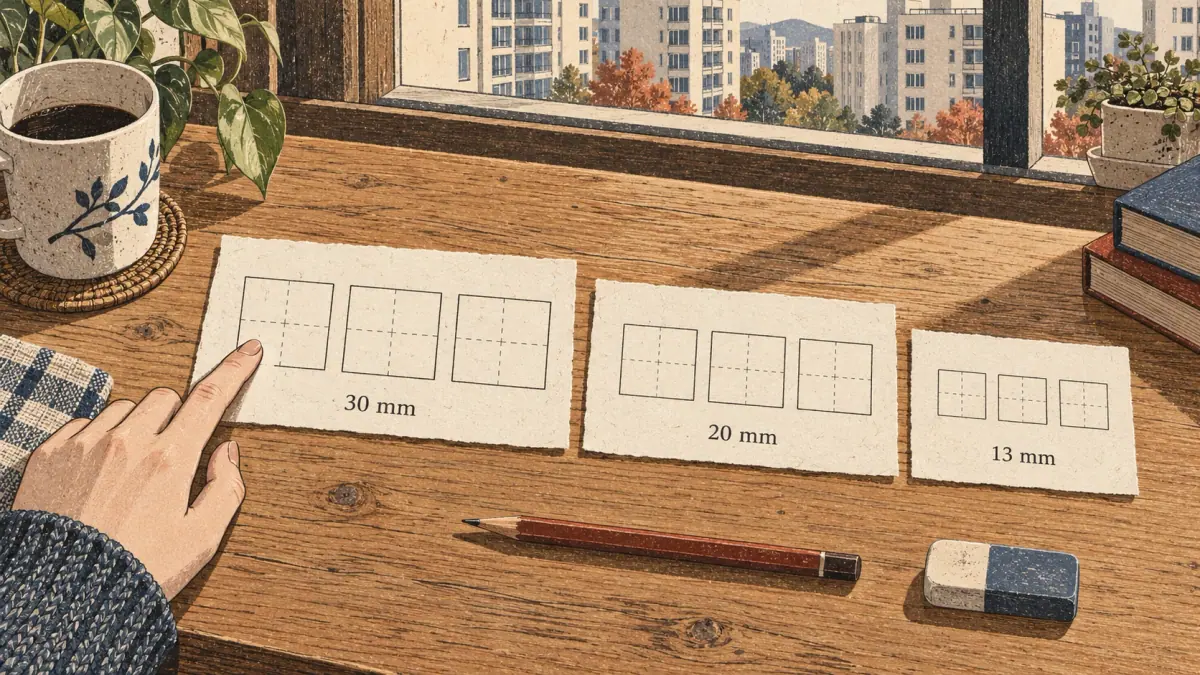
The practice page has three bands, one for each box size, and the answer key is a second sheet. Large boxes teach position, medium boxes teach rhythm, and small boxes build speed. The order goes from slow and careful to close to real handwriting.
Band 1: large boxes. The top of the page has two rows of six boxes, each 30 mm square. Row 1 starts with four dotted models, 한 글 밥 물, and two empty boxes. Row 2 is empty, for copying from memory. At this size you can see how every stroke is placed.
Band 2: medium boxes. The middle has three rows of nine boxes, each 20 mm square. Rows 1 and 2 begin with dotted models for the words 나무, 사람, 바다 and 학교, and the remaining boxes are empty. Row 3 is empty, so you can write any block you like.
Band 3: small boxes. The bottom has six rows of fourteen boxes, each 13 mm square. Row 1 shows the fourteen basic syllables 가 나 다 라 마 바 사 아 자 차 카 타 파 하 as dotted models. The other five rows are empty. This is closer to the size of normal notebook writing.
Answer key. The second sheet lists the twelve model blocks, with the consonant, vowel and final consonant of each one, plus a diagram of the four quadrants of a box.
The table below is the text version of the answer key, so you can read it before you print.
| Block | Initial | Vowel | Final | Layout |
|---|---|---|---|---|
| 한 | ㅎ | ㅏ | ㄴ | vertical vowel with final |
| 글 | ㄱ | ㅡ | ㄹ | horizontal vowel with final |
| 밥 | ㅂ | ㅏ | ㅂ | vertical vowel with final |
| 물 | ㅁ | ㅜ | ㄹ | horizontal vowel with final |
| 나 | ㄴ | ㅏ | none | vertical vowel, no final |
| 무 | ㅁ | ㅜ | none | horizontal vowel, no final |
| 사 | ㅅ | ㅏ | none | vertical vowel, no final |
| 람 | ㄹ | ㅏ | ㅁ | vertical vowel with final |
| 바 | ㅂ | ㅏ | none | vertical vowel, no final |
| 다 | ㄷ | ㅏ | none | vertical vowel, no final |
| 학 | ㅎ | ㅏ | ㄱ | vertical vowel with final |
| 교 | ㄱ | ㅛ | none | horizontal vowel, no final |
Once you know what each band holds, the next question is how the dashed cross is used.
How Do I Place a Block in the Box?
Place the initial consonant at the top left and the vowel to its right, if the vowel is vertical, or place the consonant on top and the vowel underneath, if the vowel is horizontal. A final consonant, when there is one, goes in the lower half under both. The dashed cross divides the box into four quadrants, and these rules tell you which quadrant each letter takes.
Take 한 as an example. ㅎ sits in the upper left quadrant, ㅏ takes the upper right quadrant, and ㄴ sits across the lower half. Now take 글. The vowel ㅡ is horizontal, so ㄱ sits in the top half and ㅡ sits just below the centre line, with ㄹ at the bottom. This is the same logic described in the lesson on korean syllable blocks.
A useful check is that no letter may cross the box outline, and the vowel should touch the centre line. If a letter is too wide, make it narrower rather than moving it outside the quadrant.
How Do I Use This Sheet?

Start with the large boxes and move to the small ones, because large boxes forgive position errors. Use these steps:
- Put the consonant top-left in the box if the vowel stands upright. Put it on top if the vowel lies flat.
- Use the dashed lines to centre the block: the vertical dash should fall between the consonant and a vertical vowel.
- Trace the dotted model blocks first, and then write the same blocks in the empty boxes beside them.
- Cover the models with a card and write the same blocks from memory.
- Move to band 2, and then band 3, keeping the same position rules at a smaller size.
You will know it works when the blocks in a row look like they share one invisible baseline. The sheet pairs well with the korean alphabet flashcards, which show the same letters on screen, and with the lesson how to write korean.
What Is the Answer Key For?
The answer key is for checking position, not beauty. Compare which quadrant each letter fills, and check whether you wrote a final consonant when the model has one. Look at the key after you complete a page, and keep the sheet face down while you write.
Print Settings
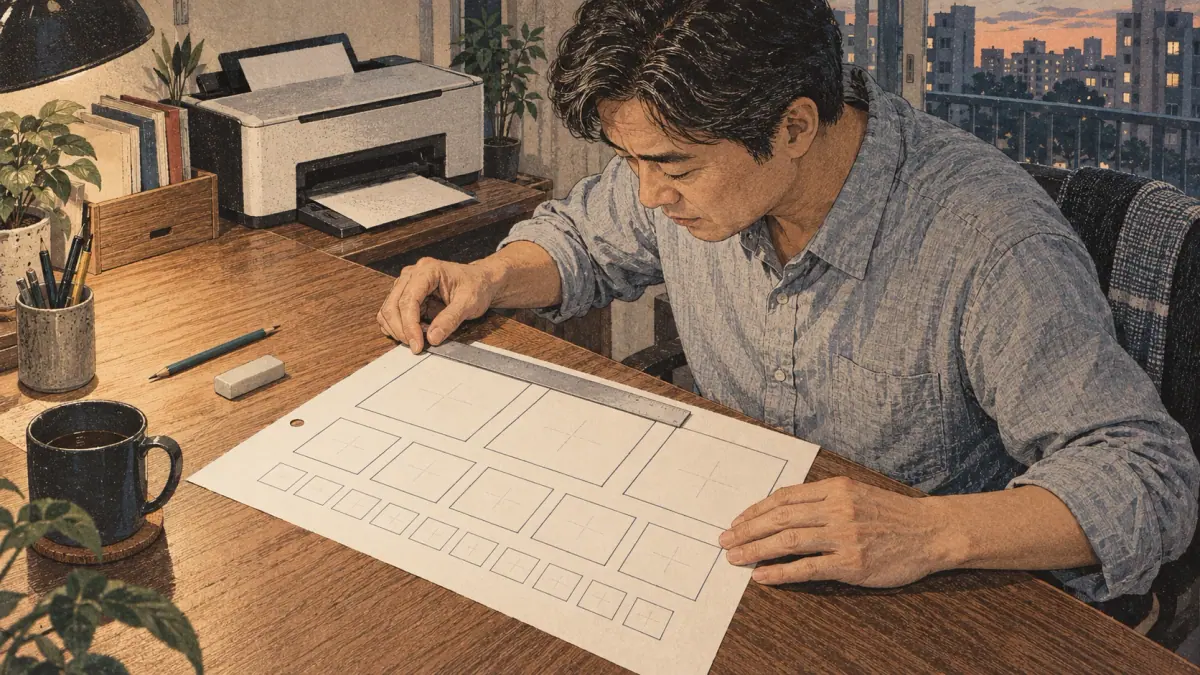
The grid needs a little care when printing, because the boxes must stay square. Use these settings:
- Paper: A4 (210 by 297 mm) or US Letter (8.5 by 11 inches). Use the matching file.
- Scale: 100 percent, with "fit to page" off. A 30 mm box printed at 80 percent becomes 24 mm and no longer matches the model.
- Margins: 12 mm, with room for a hole punch.
- Colour: black and white is enough. The dashed cross is light gray, so it prints softly and a photocopy keeps it faint.
Print one fresh page for each day of practice.
Mistakes to Watch For
Most problems on a blank grid come from size and position rather than from letter shapes.
- Writing blocks at different sizes. Tall blocks next to short blocks make a word hard to read. Use the box outline as a fixed size for every block in a row.
- Not using the cross lines. The cross is the whole point of the sheet. Without it, the consonant drifts to the centre and the vowel hangs outside the box.
- Printing too small. If a printer shrinks the page, the small band becomes too tight for a pencil. Check that the printed 30 mm box measures 30 mm with a ruler.
- Shrinking the final consonant too far. The final consonant is flatter and wider than the first consonant, but it should still fill most of the lower half of the box.
Check one block per band before you fill a whole row, because a position error repeats across the row.
What Should I Practice Next?

After the grid, practise handwriting on lines, where you must hold the size without box guides. The korean handwriting practice sheet is the next printable in the set. For on-screen recall of the letters used here, take the hangul alphabet quiz. All printables are listed on the korean printables page.
This page covers a blank grid for syllable blocks. It does not teach the stroke order of each letter, and it does not include double consonants or compound vowels in the models. Those topics have their own lessons. Used daily for a week, the blank hangul practice grid gives your hand a stable frame for every block you write.
Frequently Asked Questions
What box size should I use?
Start with the large 30 mm boxes, because they leave room to see every stroke and to fix position mistakes. Move to the 20 mm medium boxes when your blocks look steady, and finish with the 13 mm small boxes, which are close to the size of everyday notebook handwriting.
Is Korean written right to left?
No. Modern Korean is written left to right, in rows from top to bottom, like English. Inside one block the letters run left to right and top to bottom. The grid is read the same way, so you fill the first row from left to right before you start the second row.
Can I use the grid for compound vowels?
Yes. The empty boxes work for any block, including compound vowels such as ㅘ in 과 or ㅢ in 의. A mixed vowel wraps under and to the right of the consonant, so the consonant takes the upper left quadrant and the vowel fills the rest of the box. The printed models use basic vowels only.
Does it come in Letter and A4?
Both are included. The download has one file for A4 (210 by 297 mm) and one for US Letter (8.5 by 11 inches). The layout and box sizes are the same in both, and both fit inside 12 mm margins. Print at 100 percent scale, and do not choose fit to page.
Is the worksheet free to print?
Free for personal and classroom use. Teachers may print copies for their students. No reselling or republishing online.
May I use these worksheets in class?
Free for personal and classroom use. Teachers may print copies for their students. No reselling or republishing online.
Free for personal and classroom use. Teachers may print copies for their students. No reselling or republishing online.