What Are the Korean Spelling Principles?
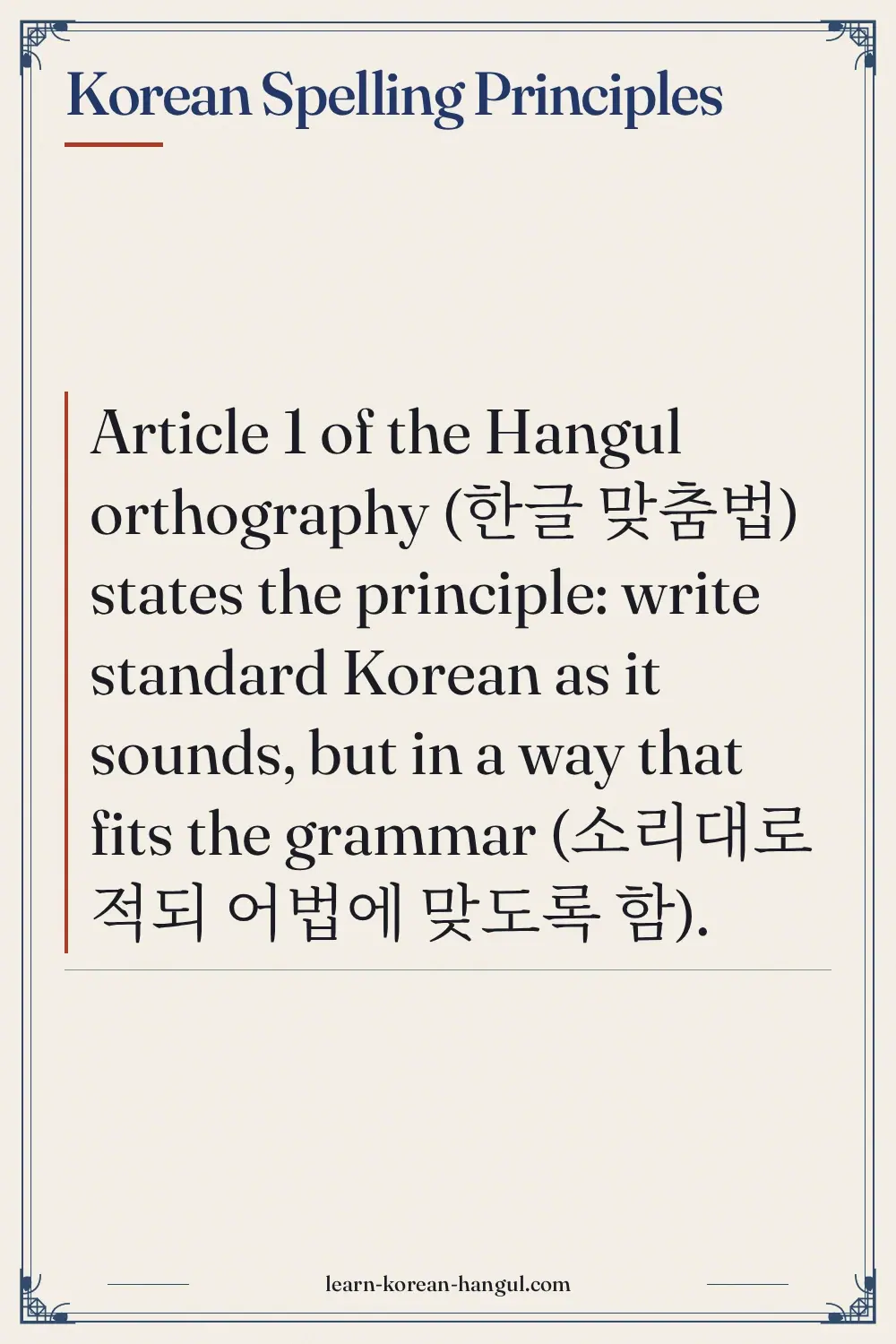
The Korean spelling principles are the general rules behind the Hangul orthography, called 한글 맞춤법 (hangeul matchumbeop). The National Institute of Korean Language (국립국어원) publishes them. They start with Article 1, which says that the orthography writes standard Korean "as it sounds, but in a way that fits the grammar":
한글 맞춤법은 표준어를 소리대로 적되, 어법에 맞도록 함을 원칙으로 한다.
The sentence has two halves, and each half pushes in a different direction.
| Half | Korean | Plain meaning | Effect on spelling |
|---|---|---|---|
| First | 소리대로 적되 | write it as it sounds | Spelling follows speech where nothing else interferes |
| Second | 어법에 맞도록 | so that it fits the grammar | Stems, nouns and endings keep one form even when their sound changes |
When both halves agree, spelling is simple. The word 나무 (namu, "tree") is said [나무] and written 나무. When they disagree, the second half wins for word parts that can be recognised, and that is where English speakers get surprised.
Here are three words that show the gap. Listen to each one first, then look at how it is written.
| Written | RR | Said | Meaning |
|---|---|---|---|
| 값이 | gapsi | [갑씨] | the price (subject) |
| 꽃이 | kkochi | [꼬치] | the flower (subject) |
| 밭이 | bachi | [바치] | the field (subject) |
In each word a final consonant of the noun moves to the next syllable, because the particle 이 starts with a vowel: the ㅅ of ㅄ in 값이, and the ㅊ in 꽃이. In 밭이 the ㅌ also changes to [ㅊ] before 이, a rule called palatalization. Your ear hears 꼬치, but the writer keeps 꽃 and 이 apart. The sound rule behind this is linking, covered in Korean liaison, and the wider set of rules is in Korean pronunciation rules.
Why Is This Hard for English Speakers?
It is hard because Hangul looks perfectly phonetic, so learners trust their ears when they write. English spelling is also far from its sound (think of "though", "through" and "tough"), but English learners expect that. Hangul seems honest: each block is a clear sound. Then a word like 꽃이 appears, and the honest-looking system hides a rule.
Reading is rarely the problem. A learner who sees 꽃이 can read it as [꼬치] after learning the linking rule. Writing is the problem, because writing goes the other way: from sound to letters, and several letter strings can give one sound.
Typing a word you heard, with no other knowledge, produces the errors below.
| What you heard | Typed by ear | Correct spelling | What the ear missed |
|---|---|---|---|
| [꼬치] | 꼬치 | 꽃이 | The noun 꽃 and the particle 이 |
| [갑씨] | 갑시 | 값이 | The noun 값 and the particle 이 |
| [바치] | 바치 | 밭이 | The noun 밭 and the particle 이 |
| [일거요] | 일거요 | 읽어요 | The stem 읽 and the ending 어요 |
Note that 꼬치 is a real word ("skewer"), so a spell checker would not flag it. Only the meaning of the sentence tells you that they are wrong. The practice section at the end trains this skill with a five-word dictation.
What Does "Write by Sound" Mean?
"Write by sound" means that a letter represents a sound the speaker really makes, and that the writer does not add marks for things the reader can predict. Most Korean words are simply written as they are said.
Three kinds of words follow the first half of the rule.
- Words where spelling and sound match. 바다 (bada, "sea") and 나무 (namu, "tree") need no thought.
- Words where a sound is written although it looks odd. 오빠 (oppa, "older brother, said by a woman") has a tense ㅃ because speakers really say a tense sound there, and there is no grammar reason to write it otherwise.
- Words written by sound because their origin is unclear. 며칠 (myeochil, "what day, how many days") is written 며칠 because it is said [며칠]. The lesson on 며칠 vs 몇 일 explains this word.
The rule also works in the other direction. Tensing that happens by a predictable sound rule is not written. The ending -(으)ㄹ게 is said [ㄹ께] but written with a plain ㄱ, as in 할게요 [할께요] (halgeyo). A reader who knows the sound rule can restore the tense sound, so the spelling does not mark it.
What Does "Fit the Grammar" Mean?
"Fit the grammar" means that a stem, a noun or an ending is written in the same form wherever it appears. Korean is an agglutinative language: it builds words by attaching endings and particles to a base. If each attachment changed the spelling of the base, you would lose sight of the base.
The noun 꽃 (kkot, "flower") shows this. It is said three different ways next to three particles, and written the same way every time.
| Written | RR | Said | Sound rule |
|---|---|---|---|
| 꽃이 | kkochi | [꼬치] | Final ㅊ links to the vowel of 이 |
| 꽃도 | kkotdo | [꼳또] | Final ㅊ becomes ㄷ, and ㄷ tenses the next ㄷ |
| 꽃만 | kkonman | [꼰만] | Final ㅊ becomes ㄷ, then ㄴ before ㅁ |
If the orthography wrote by sound only, the noun would need three spellings: 꼬치, 꼳또, 꼰만. A reader would have to work out which noun hides behind each. With one spelling, the eye sees 꽃 at once. This is the main benefit of the second half of the rule.
Verbs work the same way. The stem of 읽다 (ikda, "to read") is 읽, and the polite present is 읽어요 (ilgeoyo), said [일거요]. The written form shows stem plus ending. The speech form moves the ㄱ over to the next syllable. Conjugated forms are not shown here beyond this example, because the point is the principle.
Why 값이 Is Not Written as It Sounds
값이 is not written 갑씨 because 값 (gap, "price") is a noun in its own right and 이 is a separate particle. The sound [갑씨] comes from two ordinary rules working together. The consonant cluster ㅄ has two letters, and before a vowel the second letter ㅅ moves over to the next syllable and becomes a tense ㅆ, while ㅂ stays behind.
One spelling covers four different sounds.
| Written | RR | Said | What happens |
|---|---|---|---|
| 값 | gap | [갑] | Only ㅂ is said at the end of a word |
| 값이 | gapsi | [갑씨] | ㅅ moves to the next syllable and is tense |
| 값도 | gapdo | [갑또] | ㅅ is not said, and ㄷ is tense after ㅂ |
| 값만 | gamman | [감만] | ㅂ turns into ㅁ before ㅁ |
Imagine writing all four by sound: 갑, 갑씨, 갑또, 감만. The four strings share almost nothing on the page, but they are one word. The orthography chooses 값 once, and every reader recognises it.
A useful habit follows from this. When you hear a word and are unsure how to write it, strip the ending first. Say the word alone and with a vowel-starting particle, then decide which consonant must be at the end. Saying 값 alone gives [갑], and saying 값이 gives [갑씨], which shows that ㅅ is hiding behind ㅂ.
The Three Kinds of Spelling Decisions
Every spelling choice in Korean falls into one of three kinds. Naming the kind tells you which test to use.
| Kind | Question to ask | Example | Where it is taught |
|---|---|---|---|
| Sound-based | Do speakers really say this sound, with no rule to predict it? | 오빠, 며칠 | 며칠 vs 몇 일 |
| Grammar-based | Which stem, noun or ending is hiding here? | 꽃이, 값이, 돼요 | 되 vs 돼 and the pair lessons |
| Convention-based | Is this the form the dictionary lists, even if sound does not decide? | 개 (dog) and 게 (crab) | The Standard Korean Language Dictionary |
The third kind needs a word of explanation. The standard pronunciation rules still list ㅐ and ㅔ as two vowels, but most Seoul speakers today pronounce them the same, so 개 (dog) and 게 (crab) can sound alike. The spelling keeps them apart because the dictionary lists them as different words. No sound test can solve this, and you learn each word as you meet it. The same applies to the linking ㅅ in compounds, which has its own lesson on sai siot spelling.
Which Later Pages Apply the Principle?
Each lesson in the spelling section applies one half of the rule to one pair or group.
| Lesson | Kind | One-line test |
|---|---|---|
| 되 vs 돼 | Grammar | Swap in 하 or 해 |
| 안 vs 않 | Grammar | 안 is short for 아니, 않 is short for 아니하 |
| 에요 vs 예요 vs 이에요 | Grammar | Check whether the noun ends in a vowel |
| 며칠 vs 몇 일 | Sound | Learn 며칠 as one word |
| 왠 vs 웬 | Convention | 왠 appears only in 왠지 |
| 로서 vs 로써 | Grammar | Ask "as what?" or "by what?" |
| ㄹ게 vs ㄹ께 | Sound rule | Predictable tensing is not written |
| Sai siot spelling | Convention | Check the compound conditions |
| Final consonant homophones | Convention | Find the base form |
The whole list sits in Korean spelling rules. Spacing is a separate skill with its own rules, covered in Korean spacing rules.
Worked Example: 값이 [갑씨]
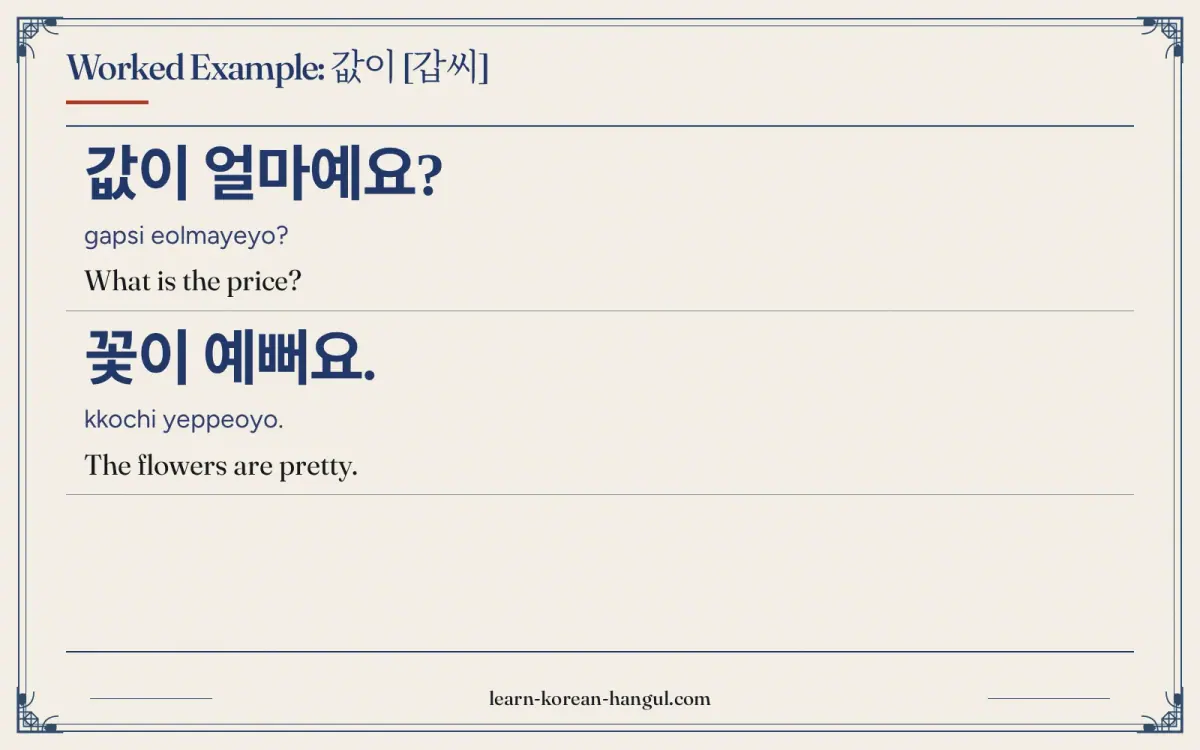
This section walks through one dictation step by step. You hear: "[갑씨 얼마예요?]" and want to write it.
- Segment the sound. The sentence has two parts: [갑씨] and [얼마예요].
- Look for a particle. The syllable [씨] after [갑] sounds like a leftover consonant plus the vowel 이. A noun plus the particle 이 is likely.
- Find the noun. Say the noun alone: [갑]. The candidates are 갑, 값 and 갚. A dictionary check shows that 값 means "price", which fits "How much is it?".
- Write the parts separately. 값 + 이, then 얼마예요.
- Check. Say 값이 aloud. If it comes out as [갑씨], you have the right letters.
값이 얼마예요?
gapsi eolmayeyo?
What is the price?
The question is a "what" question, so the voice does not rise sharply at the end. Now a second sentence with the same logic:
꽃이 예뻐요.
kkochi yeppeoyo.
The flowers are pretty.
Both sentences are written with the noun intact. The sound rule makes [꼬치] and [갑씨], and the orthography ignores that change.
What Mistakes Do Learners Make Here?
Five mistakes cover most errors. Each follows the pattern "learners often assume X, but actually Y, because Z".
- Writing what you hear. Learners often write 꼬치 for 꽃이 or 갑시 for 값이. Actually the noun must be kept whole, because the particle is a separate part.
- Thinking spelling is random. Learners often decide that Korean spelling has no logic. Actually most "irregular" spellings come from one rule: keep the base form.
- Marking predictable tensing. Learners often write 할께요 or 갈꺼예요. Actually predictable tensing is not written, so the spellings are 할게요 and 갈 거예요.
- Trusting a spell checker for look-alike words. Learners often accept 꼬치 because it is a real word. Actually a checker cannot know that you meant 꽃이. Read the sentence and ask whether the word fits.
- Treating the rule as a guarantee. Learners often think they can derive every spelling from sound plus grammar. Actually some spellings, like 개 and 게, are convention. The honest limit of this page is that you will still look words up.
Practice and Answer Key
Do the dictation before you check the answers. Play each clip, write the word with its particle, and then compare. Each answer has a clip, so you can listen again to the sound.
Dictation, five words. You hear one clip at a time: 1. [아피] 2. [달기] 3. [부어키] 4. [나제] 5. [오시].
The meanings are: "the front (subject)", "the chicken (subject)", "the kitchen (subject)", "daytime (at)" and "clothes (subject)". Each word is a noun with a particle.
Next, three quick questions on the principle.
Practice · 3
What does the second half of the principle, 어법에 맞도록, ask for?
Show answer
Keep each stem, noun and ending in one recognisable form
어법에 맞도록 means so that it fits the grammar. A noun like 꽃 is written the same way next to every particle.
You hear [갑씨]. Which written form is correct for "the price (subject)"?
Show answer
값이
The noun is 값 and the particle is 이. The ㅅ moves to the next syllable and becomes tense.
Why is 할게요 written with ㄱ although it is said [할께요]?
Show answer
Because the tense sound is predictable
Tensing after -(으)ㄹ follows a regular sound rule, so the spelling does not mark it.
Answer Key
- 앞이 (api) [아피]. The noun 앞 plus 이; ㅍ links to the vowel.
- 닭이 (dalgi) [달기]. The noun 닭 plus 이; the first letter ㄹ stays and ㄱ moves.
- 부엌이 (bueoki) [부어키]. The noun 부엌 plus 이.
- 낮에 (naje) [나제]. The noun 낮 plus the particle 에, with ㅈ linking to the vowel.
- 옷이 (osi) [오시]. The noun 옷 plus 이.
If your list had a different consonant, say the noun alone and then with the particle. The consonant that you hear only in the second version is the one you missed. You can practise the same skill with longer sentences in Korean sound change dictation.
Where to Go Next
The next lesson is 되 vs 돼, which applies the grammar half of the rule to a pair that Koreans themselves mix up. This page belongs to the Korean Spelling section, where every pair has an audio-backed test. If you want to practise the sound side first, go to Korean pronunciation rules.
Honest scope. This lesson explains the principle and a few examples. It does not list every rule of the Hangul orthography, and it does not cover spacing or punctuation. For a single word, the Standard Korean Language Dictionary (표준국어대사전) is the authority. Revised Romanization is a learning aid in this lesson, and the Hangul is the reference.
Frequently Asked Questions
Why Is Korean Spelling Not Exactly Phonetic?
Because the rules ask for two things at once. Article 1 of the Hangul orthography says to write by sound and to fit the grammar. When a word part changes its sound next to another part, the spelling keeps one fixed form. This lets a reader see the word 꽃 inside [꼬치], [꼳또] and [꼰만] without guessing.
What Does 어법에 맞도록 Mean?
어법에 맞도록 means "so that it fits the grammar". In practice it means each stem, noun and ending keeps one written form, even when its sound changes in speech. The written 읽어요 shows the stem 읽 and the ending 어요, although the speaker says [일거요].
Can I Learn Spelling from Pronunciation?
Only partly. Pronunciation tells you how a word sounds, and spelling often needs one more step: finding the base form. Learn the sound-change rules first, then use them backwards. If you hear [꼬치], ask which noun plus particle makes that sound. The answer is 꽃 plus 이.
Where Are the Official Rules?
The rules are in the Hangul orthography (한글 맞춤법) published by the National Institute of Korean Language (국립국어원). Its online Standard Korean Language Dictionary (표준국어대사전) is the place to check a single word. This page explains the principle and does not replace the full text.
Which Spelling Problems Come from This Principle?
Most of the confusing pairs in this section: 되 and 돼, 안 and 않, 에요 and 예요, 로서 and 로써, and the ending -(으)ㄹ게, often misspelled -(으)ㄹ께. Each one has a short test that brings you back to the base form or to the written convention.