
What you'll learn
- Pronounce ㅙ, ㅚ and ㅞ as one sound, [we].
- Recognise and write each of the three shapes.
- Spell 왜, 외국, 회사, 돼지 and 웨딩 correctly.
- Choose between 되 and 돼 in 5 common verb forms.
Before you start: learn ㅐ and ㅔ and the vowel ㅗ. Time: about 25 minutes.
Key facts about ㅙ, ㅚ and ㅞ
- Build: ㅚ = ㅗ + ㅣ; ㅙ = ㅗ + ㅐ; ㅞ = ㅜ + ㅔ.
- Sound: one shared sound for most speakers, close to "we" in "wet".
- Standard: Article 4 lists ㅚ as a single vowel but allows the diphthong [we].
- Contraction: 돼 = 되어.
- Romanization: ㅚ = "oe", ㅙ = "wae", ㅞ = "we".
- Where they appear: ㅚ in many everyday words, ㅙ in a small set, ㅞ mostly in loanwords.
What Sound Do ㅙ, ㅚ and ㅞ Make?
ㅙ, ㅚ and ㅞ all make the sound "we" as in "wet", for most present-day speakers: a quick w-glide with rounded lips, landing on the "e" vowel of ㅐ and ㅔ. Linguists write it [we]. Listen to all three with the buttons at the top of this lesson; they should sound the same.
ㅚ has an unusual official status. The Standard Pronunciation rules (표준 발음법) of the National Institute of Korean Language list ㅚ in Article 4 among the ten monophthongs (single, steady vowels), with a sound like German "ö", written [ø]. A note to the same article allows ㅚ to be pronounced as a diphthong. In practice most present-day speakers use that diphthong, [we], so ㅚ has merged with ㅙ and ㅞ. Because ㅐ and ㅔ have also merged, ㅙ (with ㅐ) and ㅞ (with ㅔ) end in the same "e" too.
How Are ㅙ, ㅚ and ㅞ Built from Simpler Vowels?
Each of the three letters combines a rounded vowel, ㅗ or ㅜ, with a vertical vowel. The rounded part gives the "w"; the vertical part gives the vowel after it.
| Letter | Built from | Looks like | Sounds like | RR |
|---|---|---|---|---|
| ㅚ | ㅗ + ㅣ | "o + i" | "we" (not "oi") | oe |
| ㅙ | ㅗ + ㅐ | "o + ae" | "we" | wae |
| ㅞ | ㅜ + ㅔ | "u + e" | "we" | we |
The trap is ㅚ. Its parts suggest "o + ee", like English "oy", but it never sounds that way. ㅚ is pronounced "we", so 외국 "foreign country" sounds like "we-guk".
Hangul pairs these letters by vowel class: ㅗ combines with ㅏ-type vowels (ㅘ, ㅙ) and ㅜ with ㅓ-type vowels (ㅝ, ㅞ). That is why you will never see ㅗ joined to ㅔ or ㅜ joined to ㅐ.
What Did These Vowels Sound Like Originally?
When Hangul was created in the 15th century, these letters spelled sequences that matched their shapes: ㅚ was roughly "o" gliding into "i", and ㅙ and ㅞ ended in an "i" glide as well. Over the following centuries the combinations fused. ㅚ became the steady rounded vowel [ø] that Article 4 still describes, and later most speakers changed it again to [we]. The letters kept their original shapes through all of these changes, so the spelling records history rather than today's sound.
Knowing the build makes the production steps straightforward.
How to Pronounce the Korean Vowel ㅚ Step by Step
You pronounce the Korean vowel ㅚ, and ㅙ and ㅞ, in four steps:
- Round your lips into a small circle, as for the start of "we".
- Release quickly, unrounding the lips as the jaw drops slightly.
- Land on "e", the vowel of ㅐ and ㅔ: jaw half open, tongue forward, lips relaxed.
- Hold the "e" steadily. The "w" is brief; the "e" carries the syllable.
You'll know it worked when 외 sounds like the "we" of "wet" without the t. The most common mistake is saying ㅚ as "oy" or "o-ee", which follows the shape instead of the sound. Another is making the "w" too long, which sounds like two syllables.
Expert insight: if you hear an older speaker say 외 with a steady, rounded vowel like German "ö", that is the monophthong described in Article 4, not a mistake. You do not need to copy it; [we] is the norm for most speakers today.
How Do These Differ from ㅘ and ㅝ?
Two other w-vowels, ㅘ (wa) and ㅝ (wo), are not part of the merger. Each still has its own vowel after the "w", so you can hear the difference clearly:
| Letter | Sound | Example | Meaning |
|---|---|---|---|
| ㅘ | "wa" as in "water" (without the r) | 과일 | fruit |
| ㅝ | "wo" as in "wonder" | 뭐 | what |
| ㅙ ㅚ ㅞ | "we" as in "wet" | 왜 | why |
So ㅘ, ㅝ and the ㅙ/ㅚ/ㅞ group are three distinct sounds; ㅟ (wi), the sixth w-vowel, is a fourth. Learners who can hear 와, 워 and 왜 as different syllables already have every contrast these letters need.
With the sound in place, you can read whole words.
Worked Example: Reading 왜 and 외국
Two words show the pattern: one with ㅙ, one with ㅚ.
왜 (wae) "why"
- Find the consonant slot: silent ㅇ in the top-left corner.
- Find the vowel: ㅗ under the ㅇ, then ㅐ on the right. Together that is ㅙ.
- Say the shared sound: "we".
- The word: 왜, "why".
외국 (oeguk) "foreign country"
- 외 = silent ㅇ + ㅗ underneath + ㅣ on the right = ㅚ → "we".
- 국 = ㄱ + ㅜ + final ㄱ → "guk".
- Together: 외국, pronounced "we-guk", romanized "oeguk".
All three letters wrap around the consonant, so they use the mixed layout described in how syllable blocks are shaped.
Which Words Use Which Spelling?
Since the sound is the same, you learn each word's spelling. Frequency helps you prioritise.
| Letter | Where it appears | Common words |
|---|---|---|
| ㅚ | many native and Sino-Korean words | 외국 "foreign country", 회사 "company", 되다 "to become", 참외 "Korean melon", 열쇠 "key" |
| ㅙ | a small set of high-frequency words | 왜 "why", 돼지 "pig", 괜찮다 "to be okay", 꽤 "quite" |
| ㅞ | mostly loanwords | 웨딩 "wedding", 스웨터 "sweater", 웨이터 "waiter" |
A rule of thumb: if the word comes from English and has a "we" sound, it is usually ㅞ (웨딩, 스웨터). If it is a short native word for "why", "pig", "okay" or "quite", it is ㅙ. Most other words take ㅚ.
How to Write ㅚ, ㅙ and ㅞ
Write the horizontal part first, then the vertical part, following the top-to-bottom, left-to-right rule:
| Letter | Strokes | Order |
|---|---|---|
| ㅚ | 3 | ㅗ (short vertical, then horizontal), then ㅣ |
| ㅙ | 5 | ㅗ (2 strokes), then ㅐ (vertical, short horizontal, vertical) |
| ㅞ | 5 | ㅜ (horizontal, then short vertical), then ㅔ (short horizontal, vertical, vertical) |
Practise on Paper Practise on Paper Practise on Paper
On the 2-beolsik keyboard, type the parts in order: ㅚ = ㅗ (H) + ㅣ (L); ㅙ = ㅗ (H) + ㅐ (O); ㅞ = ㅜ (N) + ㅔ (P).
Spelling by word works for nouns. For the verb 되다, there is a test you can apply every time.
ㅙ vs ㅚ vs ㅞ: One Sound, Three Spellings
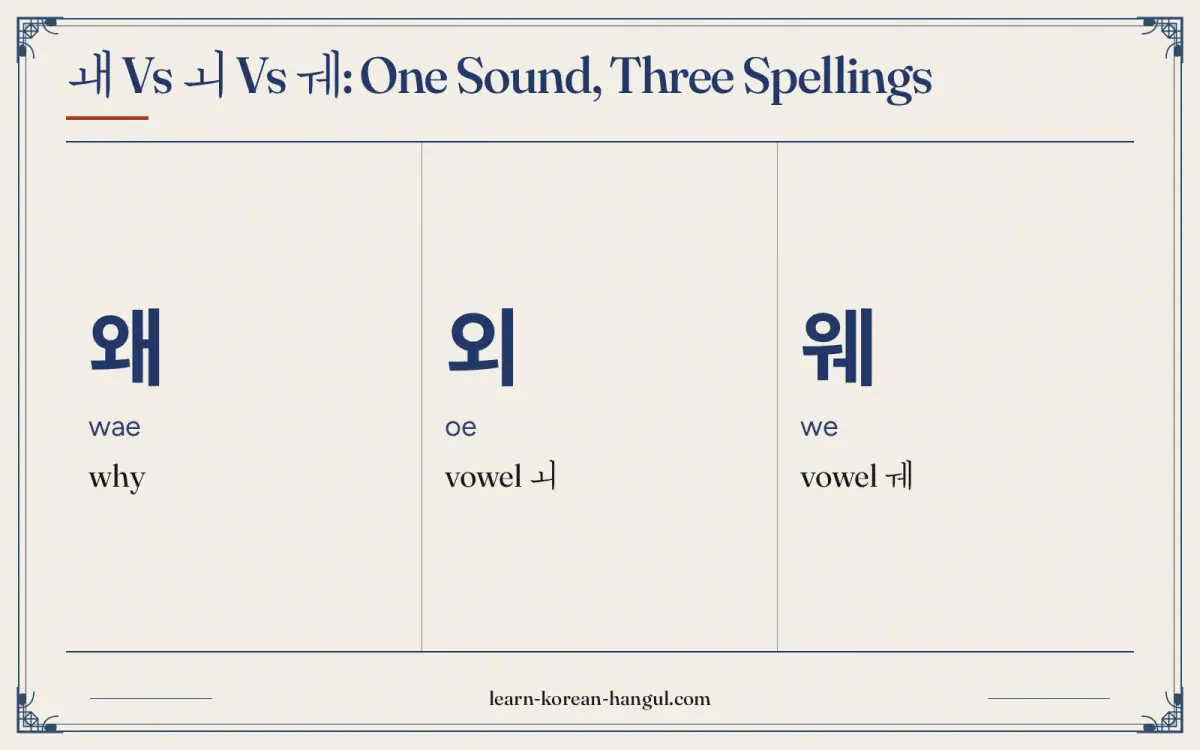
ㅙ, ㅚ and ㅞ cannot be told apart by ear in normal speech, so the spelling must come from the word or from grammar. The listening table below lets you confirm that they sound alike.
Same Sound for Most Speakers; Spelling Comes from the Word
| Korean | Romanization | Meaning | Sound |
|---|---|---|---|
| 왜 | wae | why | |
| 외 | oe | vowel ㅚ | |
| 웨 | we | vowel ㅞ |
The most important case is the verb 되다 "to become; to be possible". Its forms are spelled either 되 or 돼, and both sound "dwe". 돼 is the contraction of 되어, as Hangul Orthography (한글 맞춤법) Article 35 sets out: when ㅚ is followed by -어, the two may be written together as ㅙ.
The 하/해 test tells you which to write:
- Replace 되 or 돼 with the matching form of 하다 "to do".
- If 하 fits, write 되. If 해 fits, write 돼.
- 해 is the contraction of 하여, just as 돼 is the contraction of 되어, so the test always works.
| Sentence slot | Test with 하다 | Correct spelling | Meaning |
|---|---|---|---|
| ___요 | 해요 | 돼요 | it's possible; it becomes |
| ___었어요 | 했어요 | 됐어요 | it's done; that's enough |
| ___면 | 하면 | 되면 | if it becomes |
| 안 ___ | 안 해 | 안 돼 | no; it won't work |
| ___세요 | 하세요 | 되세요 | please become (polite) |
The Same Contraction in 뵈다: 봬요
The verb 뵈다 "to see (someone respected)" contracts in exactly the same way: 뵈어요 becomes 봬요. You will hear it in the polite goodbye 내일 봬요 "See you tomorrow". The 하/해 test works here too: 해요 fits the slot, so the spelling is 봬요, never 뵈요. Other verbs with this pattern, such as 쬐다 "to bask" (쫴요), are uncommon, so 되다 and 뵈다 cover nearly every case a beginner meets.
The 되/돼 choice is one of the Korean spelling rules that native speakers also check. For the single question of 되 vs 돼 in more contexts, see the dedicated page on 되 vs 돼.
ㅚ has a close relative in the vowel ㅟ, the other vowel that the standard lists as a monophthong but allows as a diphthong. With the spelling tools in place, here are the errors to watch for.
What Mistakes Do Learners Make with ㅙ, ㅚ and ㅞ?
Most mistakes with these letters come from reading the shape or the romanization as a sound guide.
Saying ㅚ as "oy". Learners often assume ㅚ (ㅗ + ㅣ) sounds like English "oy". Actually it sounds "we", because the combination became a single vowel and then the [we] diphthong. Fix: say 회사 as "hwe-sa", not "hoy-sa".
Reading "oe" literally. Learners often read romanized "oe" as "oh-ee" or as the "oe" in "toe". Actually "oe" is a label for ㅚ, because Revised Romanization spells letters, not sounds. Fix: read 외국 "oeguk" as "we-guk". This and similar surprises are covered in why Korean romanization looks wrong.
Writing 되 where 돼 belongs. Learners often write 안 되 or 되요. Actually these must be 안 돼 and 돼요, because the ending needs -어, and 되 + 어 = 돼. Fix: apply the 하/해 test.
Trying to hear the spelling. Learners often assume careful listening will reveal ㅙ, ㅚ or ㅞ. Actually most speakers make no difference, because the three have merged. Fix: learn spellings with meanings and use the frequency table.
Practice will show whether the fixes have stuck.
Practice: Read, Hear and Write
Answers follow the exercises.
Practice · 8
How do most present-day speakers pronounce ㅙ, ㅚ and ㅞ?
Show answer
All three the same, like "we" in "wet"
The three letters have merged for most speakers into one sound, [we].
Which spelling is correct?
Show answer
안 돼
돼 is the contraction of 되어. The 하/해 test gives 안 해 and 해요, so the forms are 안 돼 and 돼요.
Which syllable fits the blank in ___면 "if it becomes"?
Show answer
되
The 하/해 test gives 하면, so write 되: 되면.
How is 외국 (foreign country) pronounced?
Show answer
Like "we-guk"
ㅚ is pronounced "we", not "oy", even though its parts are ㅗ + ㅣ.
Which word means "why"?
Show answer
왜
왜 (with ㅙ) means why; it is one of the few common words spelled with ㅙ.
Which vowel do English loanwords such as 웨딩 (wedding) usually use?
Show answer
ㅞ
ㅞ appears mostly in loanwords like 웨딩 and 스웨터.
What is ㅚ built from?
Show answer
ㅗ + ㅣ
ㅚ = ㅗ + ㅣ; ㅙ = ㅗ + ㅐ and ㅞ = ㅜ + ㅔ.
How do you write "See you tomorrow" politely?
Show answer
내일 봬요
뵈어요 contracts to 봬요, and the 하/해 test (해요) confirms 봬요, never 뵈요.
Exercise 1: Read aloud. Read 왜, 외국, 회사, 돼지, 웨딩, 꽤, 참외 and 열쇠 with one "we" sound for each ㅙ, ㅚ or ㅞ.
Exercise 2: 되 or 돼? Fill each blank: (a) 안 ___ "No." (b) 다 ___어요 "It's all done." (c) 의사가 ___고 싶어요 "I want to become a doctor." (d) 이거 ___요? "Is this okay?" (e) 내일 ___면 좋겠어요 "I hope it works out tomorrow."
Exercise 3: Spell from meaning. Write the Korean for: (a) why, (b) company, (c) pig, (d) wedding.
Answers
- Exercise 1: every syllable with ㅙ, ㅚ or ㅞ has the same "we" vowel: 왜, 외, 회, 돼, 웨, 꽤, 외 (in 참외), 쇠 (in 열쇠).
- Exercise 2: (a) 돼 (안 해). (b) 됐 (했어요). (c) 되 (하고). (d) 돼 (해요). (e) 되 (하면).
- Exercise 3: (a) 왜, (b) 회사, (c) 돼지, (d) 웨딩.
- Bonus: if you wrote 내일 뵈요 for "See you tomorrow", apply the test: 해요 fits, so it is 내일 봬요.
Review these letters in the Hangul flashcard decks, check your ear in the Hangul quizzes, and build 왜, 외 and 웨 in the Hangul syllable builder. The interactive Hangul alphabet plays each vowel on tap.
What to Learn Next after ㅚ, ㅙ and ㅞ
After the Korean vowel ㅚ and its look-alikes ㅙ and ㅞ, continue with the vowel ㅢ (ui), the last compound vowel and the only one with three pronunciations. To see how these letters fit the rest of their family, return to Korean w-vowels. For mouth positions across all vowels, use the Korean vowel pronunciation guide.
What this lesson covers and doesn't: this page teaches the shared sound, the three shapes, spelling by word and the 되/돼 test. It does not cover the monophthong [ø] in detail, regional pronunciations, or the full conjugation of 되다. The merger described here reflects typical present-day speech; the written standard keeps all three letters.
Frequently Asked Questions about ㅚ, ㅙ and ㅞ
Why is ㅚ romanized "oe" if it sounds like "we"? Revised Romanization (2000) spells the letters, not the everyday sound. ㅚ is written with ㅗ (o) and ㅣ, and its standard description is a single vowel, so it is romanized "oe", as in 외국 oeguk and 회사 hoesa. Read "oe" as "we" when you see it in Korean names and words.
Is it 안 돼 or 안 되? It is 안 돼, meaning "no, you can't" or "it won't work". 돼 is the short form of 되어, and a sentence cannot end on the bare stem 되. A quick check: replace it with 하다. You would say 안 해, not 안 하, so the 되 form must be 돼. Use 안 돼요 in polite speech.
What does 왜 mean? 왜 means "why". It is one of the first question words learners meet, as in 왜요? "Why?" (polite) or 왜 안 와요? "Why aren't you coming?". It is also one of the few common words spelled with ㅙ, so learning it fixes the shape of that letter in your memory.
Which of the three spellings is most common? ㅚ is the most common in everyday vocabulary, appearing in many native and Sino-Korean words such as 회사, 외국 and 되다. ㅙ appears in a small set of high-frequency words like 왜, 돼지, 괜찮다 and 꽤. ㅞ is the rarest and shows up mostly in loanwords such as 웨딩 and 스웨터.
Do Koreans ever pronounce ㅚ as a single vowel? Some speakers do, mostly older people and speakers of certain regional varieties. They say ㅚ as a rounded front vowel, similar to German "ö" or French "eu". The Standard Pronunciation rules describe this single vowel but also allow the diphthong [we], which is what most present-day Seoul speakers use.