What Is 며칠 vs 몇 일?
The pair 며칠 vs 몇 일 is the choice between a correct word and a common mistake. Only 며칠 is standard. It has three uses.
| Use | Example | Meaning |
|---|---|---|
| What day of the month | 오늘이 며칠이에요? | What is the date today? |
| How many days | 며칠 걸려요? | How many days does it take? |
| A few days | 며칠 전에 왔어요. | I came a few days ago. |
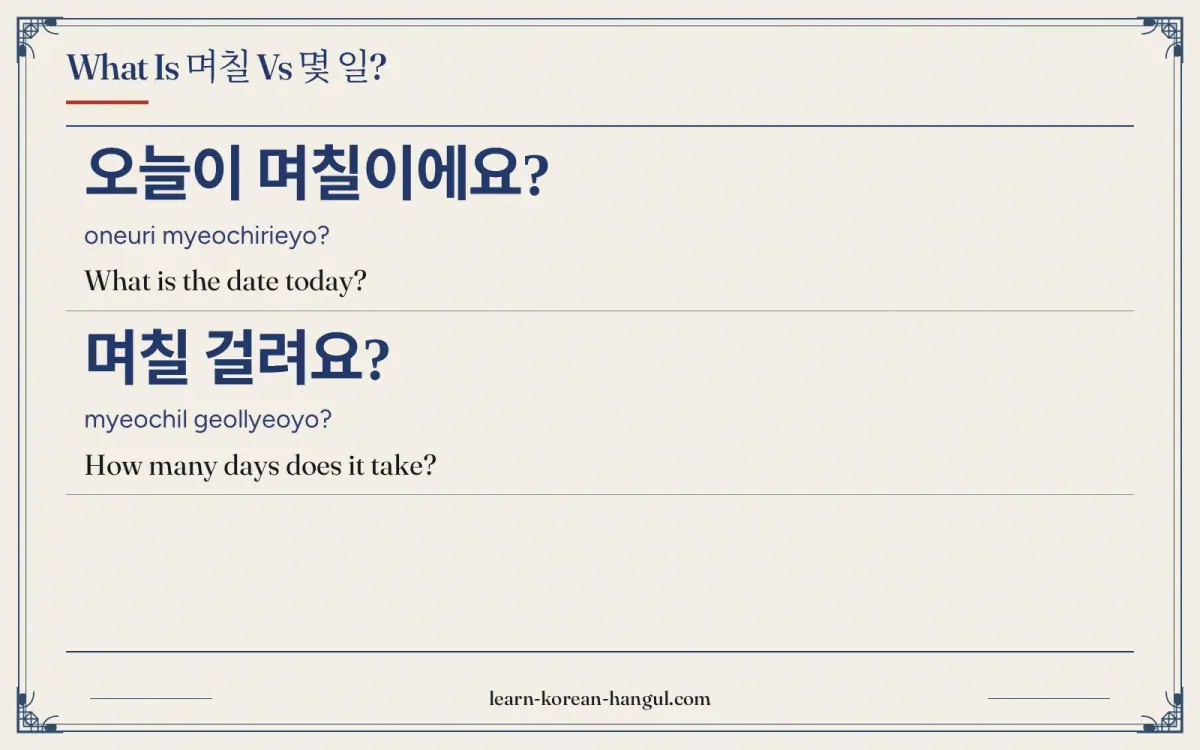
오늘이 며칠이에요?
oneuri myeochirieyo?
What is the date today?
The sentence is said [오느리 며치리에요]. Each final consonant (ㄹ in 칠, ㄹ in 오늘) moves to the next syllable, which starts with a silent ㅇ. It is a "which day" question, so the voice does not rise sharply at the end.
The second use asks about length of time. The verb is 걸리다 ("to take, to last"), and the polite present is 걸려요 (geollyeoyo).
며칠 걸려요?
myeochil geollyeoyo?
How many days does it take?
Both questions use the same word, 며칠. Context tells the listener whether you mean a date or a length of time.
Why English Speakers Struggle Here
English speakers struggle because English splits the two questions into different words, and Korean seems to use two different parts. In English, "What day of the month?" and "How many days?" do not look alike. In Korean they share 며칠, but the letters look like they hide two parts: 몇 ("how many") plus 일 ("day").
Two habits cause the mistake.
- The 몇 + counter habit. Learners meet 몇 시 (what time), 몇 살 (how old) and 몇 월 (what month). They conclude that 몇 + 일 must be 몇 일 for "how many days".
- The ear. Learners hear the ㅊ in [며칠], remember that 몇 ends in ㅊ, and conclude that the word must be 몇 plus 일. Typing from that idea gives 몇일 or 몇 일.
The result is that 몇 일 and 몇일 are very common in chat and on signs, even though they are not standard. Do not copy them, even when many people around you do.
Which Spelling Is Correct?
The correct spelling is 며칠, written as one unit. The orthography (한글 맞춤법) of the National Institute of Korean Language (국립국어원) writes this word by its sound rather than as 몇 plus 일.
| Form | Standard? | Why |
|---|---|---|
| 며칠 | Yes | One word, said [며칠] |
| 몇 일 | No | Splits the word into 몇 and 일 |
| 몇일 | No | Same mistake without a space |
| 몇 월 | Yes | Regular: 몇 plus the counter 월 |
A sound clue helps. If 며칠 were really 몇 plus 일, the final ㅊ of 몇 would be said as ㄷ and move over to 일, and the word would be [며딜]. You can hear this pattern in 몇 월 [며둴], where the ㅊ becomes a ㄷ sound. But nobody says [며딜] for the date. They say [며칠], with a clear ㅊ. The spelling follows what people say.
Compare the two sounds side by side: 며칠 [며칠] and 몇 월 [며둴]. The first has ㅊ, and the second has ㄷ. If you can hear that difference, you can also remember that the two spellings are different.
Why Is 며칠 an Exception?
며칠 is an exception because the word no longer behaves like 몇 plus a counter. Three facts show it.
- The dictionary lists it as one word. The Standard Korean Language Dictionary (표준국어대사전) has 며칠 as a noun of its own, used both in questions (며칠 걸려요?) and in statements (며칠 전, "a few days ago").
- Its sound does not follow the pattern. The pattern would give [며딜], but speakers say [며칠].
- It takes no space inside. All other 몇 words take a space, as in 몇 시 and 몇 월.
The orthography therefore treats 며칠 as a word written by its sound. The historical story of how the word formed is not needed to write it correctly, so this lesson leaves it out. If you read about it, treat it as background, not as a spelling test.
A simple memory aid: 며칠 is the only 몇 word without a space. If you need a number of days and your fingers type 몇, stop and use 며칠. A second aid is the question you are asking. If the answer is a date or a count of days, write 며칠. If the answer is a clock hour, a calendar month, a year or a number of people, write 몇 and a space, then the counter.
How Does 몇 + Counter Work?
Every other 몇 word is two words: 몇 followed by a counter or a time word. The first word, 몇 ("how many, what"), asks for a number. The second word, a counter, says what is counted. The final ㅊ of 몇 is said as ㄷ in speech, so the spoken form often looks different from the written form.
| Written | RR | Said | Meaning |
|---|---|---|---|
| 몇 월 | myeot wol | [며둴] | what month |
| 몇 시 | myeot si | [멷씨] | what time |
| 몇 년 | myeot nyeon | [면년] | what year |
| 몇 살 | myeot sal | [멷쌀] | how old |
| 몇 명 | myeot myeong | [면명] | how many people |
| 몇 개 | myeot gae | [멷깨] | how many items |
The spoken forms follow two rules. First, ㅊ is said as ㄷ at the end of a syllable. Second, the next consonant can change: ㄷ before ㄴ or ㅁ becomes ㄴ ([면년], [면명]), and ㄷ before ㅅ or ㄱ makes the next sound tense ([멷씨], [멷깨]). Revised Romanization writes the final ㅊ as t and does not show tensing that comes from a sound change, so the RR column reads myeot si even though the spoken form is [멷씨].
The topic of time is covered in telling time in Korean. The rule that these counters stay apart from 몇 is part of the larger spacing rules in spacing in Korean.
Practice Questions: Dates and How Many Days
This section gives you the answer patterns for date questions. First the month. Korean months are the Sino-Korean number plus 월, with two irregular spellings.
| Month | Korean | RR |
|---|---|---|
| January | 일월 | irwol |
| February | 이월 | iwol |
| March | 삼월 | samwol |
| June | 유월 | yuwol |
| October | 시월 | siwol |
| December | 십이월 | sibiwol |
Note 유월 and 시월. The regular forms 육월 and 십월 are not used. For the full list of numbers and dates, see dates in Korean.
Then the day. A day of the month is a Sino-Korean number plus 일: 구일 (9th), 십오일 (15th), 이십일일 (21st). For length of time, Korean also has native day words.
| Days | Native word | Sino-Korean |
|---|---|---|
| 1 day | 하루 | 1일 |
| 2 days | 이틀 | 2일 |
| 3 days | 사흘 | 3일 |
| 4 days | 나흘 | 4일 |
| 5 days | 닷새 | 5일 |
| 10 days | 열흘 | 10일 |
In daily talk, people answer a "how many days" question with either: 사흘 걸려요 or 3일 걸려요 (samil geollyeoyo, [사밀 걸려요]).
Worked Example: 오늘이 며칠이에요?
This is the full exchange, built step by step.
- Choose the question word. The speaker wants the day of the month, so the word is 며칠, written as one unit.
- Add the subject. 오늘 (today) plus the subject particle 이 gives 오늘이.
- Add the copula. 이에요 follows 며칠 because 며칠 ends in a consonant, giving 며칠이에요.
- Build the answer. The month comes first, then the day: 시월 구일.
- Add the copula. 구일 ends in a consonant too, so the answer is 시월 구일이에요.
오늘은 시월 구일이에요.
oneureun siwol guirieyo.
Today is October 9.
The answer is said [오느른 시월 구이리에요]. In 오늘은 the final ㄹ of 늘 moves over to 은, and in 구일이에요 the ㄹ of 일 moves over to 이. The month question works in the same way:
몇 월이에요?
myeot worieyo?
What month is it?
Said [며둬리에요]. The ㅊ of 몇 is said as ㄷ, and then it moves over to the silent ㅇ of 월. Compare it with 며칠이에요 [며치리에요]. In 몇 월이에요 you hear a [ㄷ] before 워. In 며칠이에요 you hear a [ㅊ] before 이.
Month and Day Together
To ask for a full date, put the month first and the day second, with a space between them: 몇 월 며칠. This is the one place where 몇 and 며칠 meet, so it is a good phrase to memorise.
생일이 몇 월 며칠이에요?
saengiri myeot wol myeochirieyo?
What month and day is your birthday?
It is said [생이리 며둴 며치리에요]. A reply could be 삼월 이일이에요 ("It is March 2"), said [사뭘 이이리에요]. Both halves of the question use a different spelling rule, and that is the contrast of this lesson: 몇 월 keeps its space, and 며칠 stays whole.
Common Learner Mistakes
Four mistakes cover most errors. Each follows the pattern "learners often assume X, but actually Y, because Z".
- Writing 몇 일. Learners often copy the 몇 + counter pattern. Actually 며칠 is a fixed word, because the orthography writes it by its sound.
- Joining the others. Learners often write 몇월, 몇시 or 몇년 as one word to be "consistent" with 며칠. Actually those are two words, so they take a space. In informal chat the closed forms are common, but the standard is two words.
- Using 며칠 for a month. Learners sometimes ask 오늘이 며칠 월이에요? Actually the month needs 몇 월, because 월 is a counter.
- Saying [며딜]. Learners often pronounce the date as it is spelled in the mistaken form. Actually the sound is [며칠], with ㅊ.
Honest limit of this lesson: the exact history of the word 며칠 is outside this lesson. What matters for writing is the standard spelling and its sound, which is covered above. The online Standard Korean Language Dictionary (표준국어대사전) lists 며칠 and is the final check.
Practice and Answer Key
Fill each blank with 며칠, 몇 월 or the right 몇 + counter. Do all five before you check the answers.
- 오늘이 ___이에요? (What is the date today?)
- 지금 ___이에요? (What month is it now?)
- 부산까지 ___ 걸려요? (How many days does it take to get to Busan?)
- 학생이 ___이에요? (How many students are there?)
- 여기에 ___ 있을 거예요? (How many days will you be here?)
Practice · 3
Which spelling is correct for "What is the date today?"
Show answer
오늘이 며칠이에요?
며칠 is the standard word for the day of the month. 몇 일 and 몇일 are not standard.
How do you write "What month is it?"
Show answer
몇 월이에요?
월 is a counter, so it follows 몇 as a separate word.
Which pair has the correct spacing?
Show answer
몇 시 and 몇 년
Regular 몇 words are written with a space, and 며칠 is written as one word.
Answer Key
- 오늘이 며칠이에요? (oneuri myeochirieyo) [오느리 며치리에요]. The date uses 며칠.
- 지금 몇 월이에요? (jigeum myeot worieyo) [지금 며둬리에요]. The month uses 몇 월.
- 부산까지 며칠 걸려요? (busankkaji myeochil geollyeoyo). Length of time uses 며칠.
- 학생이 몇 명이에요? (haksaengi myeot myeongieyo) [학쌩이 면명이에요]. People are counted with 명, so the blank is 몇 명, not 며칠.
- 여기에 며칠 있을 거예요? (yeogie myeochil isseul geoyeyo) [여기에 며칠 이쓸꺼예요]. A length of time uses 며칠. The 거 in the ending 거예요 is said tense, like [꺼], but it is spelled with a plain ㄱ.
All five are questions with a question word, so the voice falls or rise-falls at the end instead of rising sharply. If you made a mistake, check whether you asked about a date or a time (both 며칠) or about something counted (몇 plus a counter).
Where to Go Next
The next spelling lesson is 왠 vs 웬, where one exception word decides the whole rule. This page belongs to the Korean Spelling section, and the full list of pairs is in Korean spelling rules. Spaces are a separate skill, taught in Korean spacing rules.
In short, the 며칠 vs 몇 일 rule fits on one line: write 며칠 as one word for the day or the number of days, and keep 몇 plus a space for every counter such as 월, 시 and 년.
Frequently Asked Questions
Is It 몇 일 or 며칠?
It is 며칠. The spelling 몇 일 (or 몇일) is considered incorrect in standard Korean. The word is written as one unit with no 몇 and no 일, and it is said [며칠]. If you type 몇 일, a spell checker will normally change it to 며칠.
What Is the Date in Korean?
Ask 오늘이 며칠이에요? "What day of the month is it today?" The answer uses a Sino-Korean number plus 월 and 일, for example 시월 구일이에요 (October 9). For the month alone, ask 몇 월이에요? and answer with a number plus 월.
How Do I Ask How Many Days?
Use 며칠 with a verb of time. 며칠 걸려요? means "How many days does it take?" and 며칠 동안 있어요? means "How many days are you staying?". Answer with a number plus 일, as in 3일 걸려요, or with a native day word such as 사흘.
Why Is It 몇 월 but 며칠?
월 (month) is a counter that always follows 몇 as a separate word, so 몇 월 is regular. 며칠 is listed in the dictionary as a single noun, and the orthography writes it by its sound [며칠]. Learn 며칠 as the lone fixed form, and keep 몇 plus a space for every other counter.
How Do You Say 몇 월 Aloud?
The word 몇 월 is said [며둴]. The final ㅊ of 몇 is said as ㄷ and moves to the next syllable, which starts with a silent ㅇ. Compare 며칠, where the ㅊ is said as ㅊ. The two sounds are different, even though both start with 며.