What you'll learn
- Explain what an eojeol is and find the eojeol in a sentence.
- Apply the general rule: separate words, attached particles.
- Route any spacing doubt to one of six decisions.
- Space a short Korean sentence correctly.
Prerequisites: you can read Hangul and have met a particle such as 은/는 or 을/를. Time: about 30 minutes.
Key facts
- The spacing unit in Korean is the eojeol (어절), not the English word.
- Particles and verb endings attach to the word before them.
- Six decisions cover most spacing questions: particles, dependent nouns, counters, helper verbs, names and 하다 verbs.
- Spacing can change meaning, so it is part of correct spelling.
Listen to a sentence with three eojeol, first at normal speed.
The next section explains why Korean spacing needs a lesson of its own.
What Is Spacing in Korean?
Spacing in Korean, called 띄어쓰기 (ttuieosseugi), is the practice of leaving a space between the units of a sentence. The rule comes from the Hangul Orthography (한글 맞춤법) of the National Institute of Korean Language (국립국어원). Article 2 says that each word in a sentence is written separately as a principle.
The rule has one big exception, and the exception is what makes Korean different from English. A particle (조사) is a small marker that shows a noun's role. Under Article 41, particles are written attached to the word before them: 학교에, 책을, 저는. The result is that the unit between spaces is often a word plus a marker.
| Sentence | Units | Count |
|---|---|---|
| 저는 학교에 가요. | 저는 / 학교에 / 가요 | 3 |
| 친구가 책을 읽어요. | 친구가 / 책을 / 읽어요 | 3 |
| 먹고 싶어요. | 먹고 / 싶어요 | 2 |
The English habit of one space per word does not fit, because 저는 contains two parts (저 and 는) but takes no internal space. The next section explains why this surprises English speakers.
Why Do English Speakers Struggle with Korean Spacing?
English speakers carry two habits into Korean. First, they assume every grammatical word gets a space, so they write 학교 에 like "to school". Second, they assume spaces are optional, as in a text message, so they skip them completely.
Both habits fail for the same reason: the Korean space marks a unit that is bigger than a word and smaller than a phrase. Where English uses a preposition before the noun, Korean attaches a particle after it. 학교에 is "to school" in a single unit.
There is a bonus. Once you see eojeol, reading speeds up, because each eojeol is a chunk your eye can take in at once. The read Korean faster lesson uses this idea. The next section answers the first practical question.
Does Korean Use Spaces between Words?
Yes. Modern standard Korean writes spaces between eojeol, and the rules are part of standard spelling. Chat messages often drop the spaces, and signs sometimes do too, but books, news, school work and official documents keep them.
The history is less certain. Traditional Korean texts were written without word spaces, and spacing became common in the modern period, with many accounts pointing to the late 1800s. The exact history is debated, so this lesson relies only on the current rules.
Korean writers find spacing hard as well. The National Institute of Korean Language answers spacing questions from the public through its online Q&A service, which shows that even native writers look the rules up. The next section defines the unit that the rules work on.
What Is an Eojeol?
An eojeol (어절) is a chunk of written text that sits between two spaces. It is usually a content word (a noun, verb or adjective) plus whatever attaches to it: a particle, an ending, or both. Eojeol is the best unit to count when you check spacing.
Here are the typical shapes.
| Shape | Example | Parts |
|---|---|---|
| noun + particle | 학교에 | 학교 (school) + 에 (to) |
| noun + two particles | 학교에서는 | 학교 + 에서 (at) + 는 (topic) |
| verb stem + ending | 가요 | 가 (go) + -아요 (polite), contracted to 가요 |
| verb stem + linking ending | 먹고 | 먹 (eat) + 고 (and) |
| noun alone | 친구 | 친구 (friend) |
| modifier alone | 새 | 새 (new) |
Each row is one eojeol. Notice that none of them contains a space. The rows with particles show the Article 41 exception at work.
To count the eojeol in a sentence, ignore meaning and count the spaces: spaces + 1. 저는 내일 친구를 만날 거예요 has four spaces, so five eojeol.
저는 내일 친구를 만날 거예요.
jeoneun naeil chingureul mannal geoyeyo.
I will meet a friend tomorrow.
The final eojeol, 거예요, is a dependent noun 거 plus the copula ending 이에요, contracted to 예요 after a vowel, and the pronunciation is [만날꺼예요]. The next section lists the six decisions.
Which Six Decisions Cover Most Cases?
Six decisions settle most spacing questions, and each has its own lesson. The table is a flow chart you can read from top to bottom: ask the question, apply the rule, and follow the link when you need more detail.
| Question about the piece | Rule | Example | Lesson |
|---|---|---|---|
| Is it a particle? | Attach it to the word before | 학교에, 책을, 저는 | Korean particles spacing |
| Is it a dependent noun after a modifier? | Write it separately | 할 수 있다, 먹을 것 | Korean dependent nouns spacing |
| Is it a counter after a number? | Write it separately; with Arabic numerals attaching is allowed | 두 개, 3개 | Korean counter spacing |
| Is it a helper verb after a main verb? | Write it separately; many pairs also allow attaching | 먹어 보다, 먹어보다 | Korean auxiliary verb spacing |
| Is it a name with a title or 씨? | Name together; title separate | 김민수 씨 | Korean name spacing |
| Is it a noun plus 하다? | Attach; with a particle between, separate | 공부하다, 공부를 하다 | Korean hada verbs spacing |
These rules come from the Hangul Orthography: Article 41 for particles, Article 42 for dependent nouns, Article 43 for counters, Article 47 for helper verbs and Article 48 for names and titles. The numbering is given so you can look up each rule in the official text.
Three more pieces follow the same attaching habit as particles.
- Verb endings. An ending such as 요, 고 or 는 is part of the verb: 가요, 먹고, 먹는.
- Particles after quotation marks. The quoting particle 라고 attaches to the closing quotation mark: "안녕하세요"라고 말했어요.
- Punctuation. A comma or full stop attaches to the word before it, and a space follows, as in English.
Only the first decision needs no judgment. The others depend on what kind of word the piece is, so the sibling lessons teach the test for each. The section hub, Korean spacing rules, lists all six. The next section shows that spaces matter for meaning.
How Can Spacing Change Meaning?
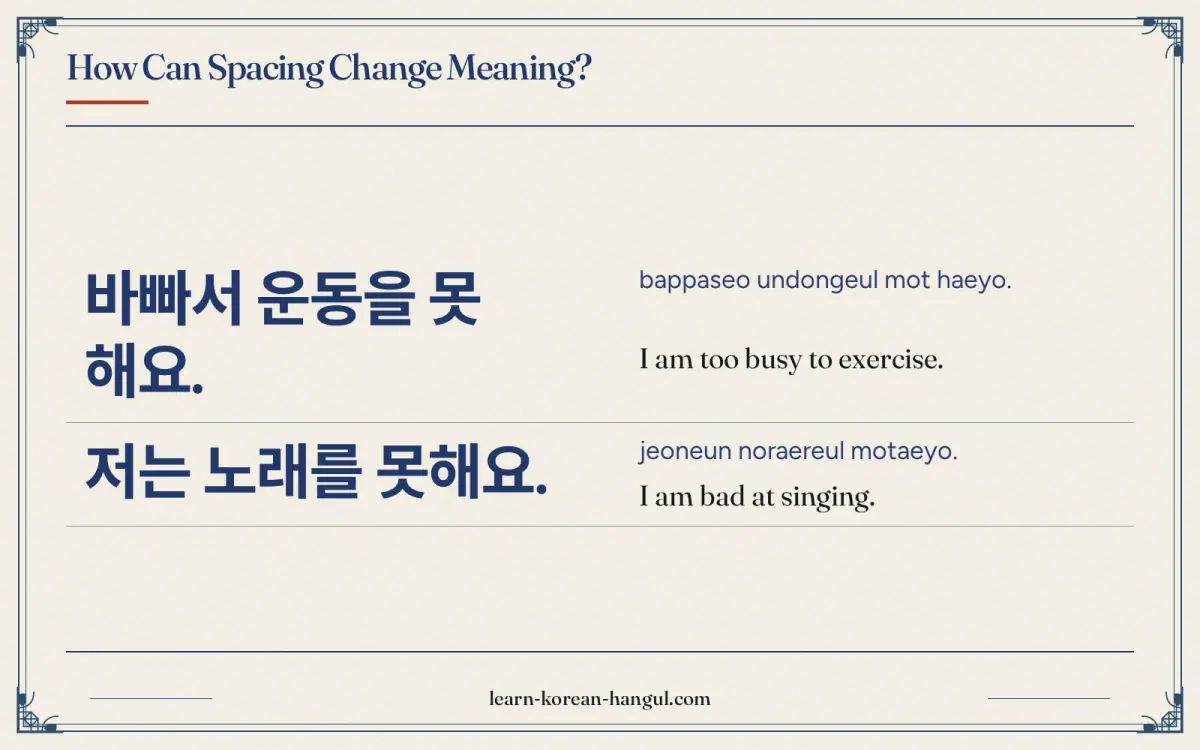
Spacing can change which words a sentence contains, so it can change the meaning. Two examples show the effect.
A classic joke. Written without spaces, 아버지가방에들어가신다 can be read two ways. Spaced as 아버지가 방에 들어가신다, it means "Father enters the room". Spaced as 아버지 가방에 들어가신다, it means "Father enters the bag". The same letters give two sentences.
A real pair. 못 해요 and 못해요 are different words. 못 해요 means "I can't do it" because of a reason such as time, and 못해요 means "I am poor at it".
| Written | Meaning | Example |
|---|---|---|
| 못 해요 | cannot do (circumstance) | 바빠서 못 해요. (I'm too busy to do it.) |
| 못해요 | is poor at | 저는 노래를 못해요. (I am bad at singing.) |
바빠서 운동을 못 해요.
bappaseo undongeul mot haeyo.
I am too busy to exercise.
저는 노래를 못해요.
jeoneun noraereul motaeyo.
I am bad at singing.
Both spellings are said [모태요] in normal speech, so only the spelling shows the difference. Revised Romanization writes the spaced words separately as mot haeyo, and it writes the single word as motaeyo, because 못하다 is one predicate and RR shows its aspiration.
The next section builds a full sentence step by step.
Worked Example: 저는 학교에 가요.
To space 저는학교에가요 correctly, use five steps.
- Find the content words. The nouns and verbs are 저, 학교 and 가다.
- Mark what attaches. 저 takes the topic particle 는. 학교 takes the particle 에. 가 takes the polite ending -아요, which contracts to 가요.
- Form the units. 저는 / 학교에 / 가요.
- Place the spaces. One space goes between each unit, and none inside a unit.
- Check the count. Two spaces plus one gives three eojeol.
You'll know it worked when you can explain why there is no space in 저는: the particle 는 is attached to 저.
Now try a harder sentence, 수영할수있어요, with the same steps. The verb 수영하다 and the ending ㄹ produce 수영할, and 수 is a dependent noun (the "way" or "possibility"), and 있어요 is a verb. The units are 수영할 / 수 / 있어요, and the result is 수영할 수 있어요, which means "I can swim". Three eojeol, two spaces.
수영할 수 있어요.
suyeonghal su isseoyo.
I can swim.
The next section lists the mistakes learners make.
What Mistakes Do Learners Make with Korean Spacing?
Learners make five predictable mistakes, and each has a one-step fix.
Learners often assume particles are separate words. Actually they attach to the word before them. Wrong: 저 는 학교 에 가요. Right: 저는 학교에 가요. Fix: attach every particle.
Learners often assume a dependent noun joins the verb. Actually dependent nouns such as 수 are separate. Wrong: 할수 있어요. Right: 할 수 있어요. Fix: treat 수 and 것 as separate words after a modifier.
Learners often assume spaces are optional. Actually spacing is part of standard spelling. Wrong: 저는한국어를공부해요. Right: 저는 한국어를 공부해요. Fix: write one space between units, as in the examples above.
Learners often add a space before punctuation. Actually Korean follows the English habit here. Wrong: 가요 . Right: 가요. Fix: attach the comma or full stop to the word before it.
Learners often assume the English word count sets the spaces. Actually Korean units are bigger. Fix: count eojeol, and remember that "to school" is one unit.
An honest limit: spacing is hard even for fluent writers, and a few cases have two accepted forms, such as 먹어 보다 and 먹어보다. This lesson gives the general rule, and each sibling lesson gives the details. A spell checker can find many spacing errors, but not all of them.
The next section tests the rule.
Practice and Answer Key
Add spaces to each string, then check the answers.
- 저는한국어를공부해요
- 친구가책을읽어요
- 내일학교에가요
- 오늘은날씨가좋아요
- 저는커피를마시고싶어요
- 수영할수있어요
Practice · 6
Which is correctly spaced?
Show answer
저는 한국어를 공부해요.
Particles attach, so 저는 and 한국어를 are single units.
Which is correctly spaced?
Show answer
친구가 책을 읽어요.
Each eojeol is separated: 친구가 / 책을 / 읽어요.
Which is correctly spaced?
Show answer
내일 학교에 가요.
내일 and 학교에 are separate units.
Which is correctly spaced?
Show answer
오늘은 날씨가 좋아요.
The topic particle 은 attaches to 오늘.
Which is correctly spaced?
Show answer
저는 커피를 마시고 싶어요.
마시고 and 싶어요 are two units: a main verb and a helper verb.
Which is correctly spaced?
Show answer
수영할 수 있어요.
수 is a dependent noun and is written separately on both sides.
Answer key
- 저는 한국어를 공부해요. (3 units)
- 친구가 책을 읽어요. (3 units)
- 내일 학교에 가요. (3 units)
- 오늘은 날씨가 좋아요. (3 units)
- 저는 커피를 마시고 싶어요. (4 units)
- 수영할 수 있어요. (3 units)
A score of 6 out of 6 means the unit idea is working. If you missed item 5 or 6, review the helper-verb and dependent-noun lessons, because those spaces do not follow the particle rule. The next section points to what comes after this lesson.
Where to Go Next after Spacing in Korean
After spacing in Korean, continue to Korean particles spacing, which covers the first and most frequent decision: attaching particles, including double particles and particles after numbers and foreign words. Learn the particles themselves in the Korean particles section.
For the whole set, return to Korean spacing rules, and for the spelling side of correct writing see Korean spelling rules. This lesson covers the general rule and the six decisions. It does not give every exception, and the article numbers above are a pointer to the official text. About this page. Last updated 2026-10-09. The Korean text, spoken forms and Revised Romanization were reviewed and signed off by Min-ji Park on 15 October 2026. Romanization is shown only as a learning aid.
Frequently Asked Questions
Does Korean use spaces? Yes. Modern Korean puts spaces between the units of a sentence, called eojeol (어절). The basic spelling rule says each word is written separately, with the main exception that particles attach to the word before them. A sentence such as 저는 학교에 가요 has three units and two spaces. Chat messages often skip spaces, but standard writing keeps them.
What is an eojeol? An eojeol is a chunk of text between two spaces. It is usually a content word plus whatever attaches to it, such as a particle or a verb ending. In 학교에 가요, there are two eojeol, 학교에 and 가요. Learning to see eojeol makes spacing easier, because every space falls between two of them.
Why is Korean spacing hard? The rule has many exceptions, and the unit is not the same as an English word. Particles attach, dependent nouns do not, and helper verbs sometimes allow both forms. Learners also tend to copy English patterns. The six decisions in this lesson sort most cases, and the sibling lessons explain each one in detail.
Which spacing mistake is most common? The most common mistake is adding a space before a particle, as in 학교 에 or 저 는. Learners treat the particle like an English preposition, which is a separate word. In Korean the particle attaches to the word before it. The next most common is joining a dependent noun, as in 할수 있어요.