Korean Body Part Idioms at a Glance
Korean body part idioms are fixed phrases that use a part of the body to say something about a person. 손이 크다 (the hand is big) does not describe the size of a hand. It says the person is generous. Korean calls such phrases 관용어 (gwanyongeo), set expressions whose meaning is not the sum of the words. They are natural in speech, and every Korean learner meets them in dramas and conversation.
The body is a good place to start with idioms because you already know the words. Korean idioms often begin close to the literal sense and then move to character: a big hand gives much, a light mouth lets secrets out, and thin ears let in every opinion. The groups here follow the body from the hands down to the feet, then up to the eyes, ears, mouth and face, and finish with the heart and the liver.
| Group | Idioms | What it describes |
|---|---|---|
| Hand and arm idioms (손) | 6 | Giving, hitting, joining and quitting |
| Foot and leg idioms (발) | 6 | Connections, speed, effort and pressure |
| Eye and ear idioms (눈, 귀) | 6 | Taste, busyness, attention and persuasion |
| Mouth and face idioms (입, 얼굴) | 6 | Talk, eating, praise and shame |
| Heart and liver idioms (마음, 간) | 6 | Decisions, worry and courage |
You need to read Hangul to use the tables. If you cannot yet, start with reading Hangul. For the plain words for body parts, see the body vocabulary page.
Which Body Part Idioms Should You Learn First?
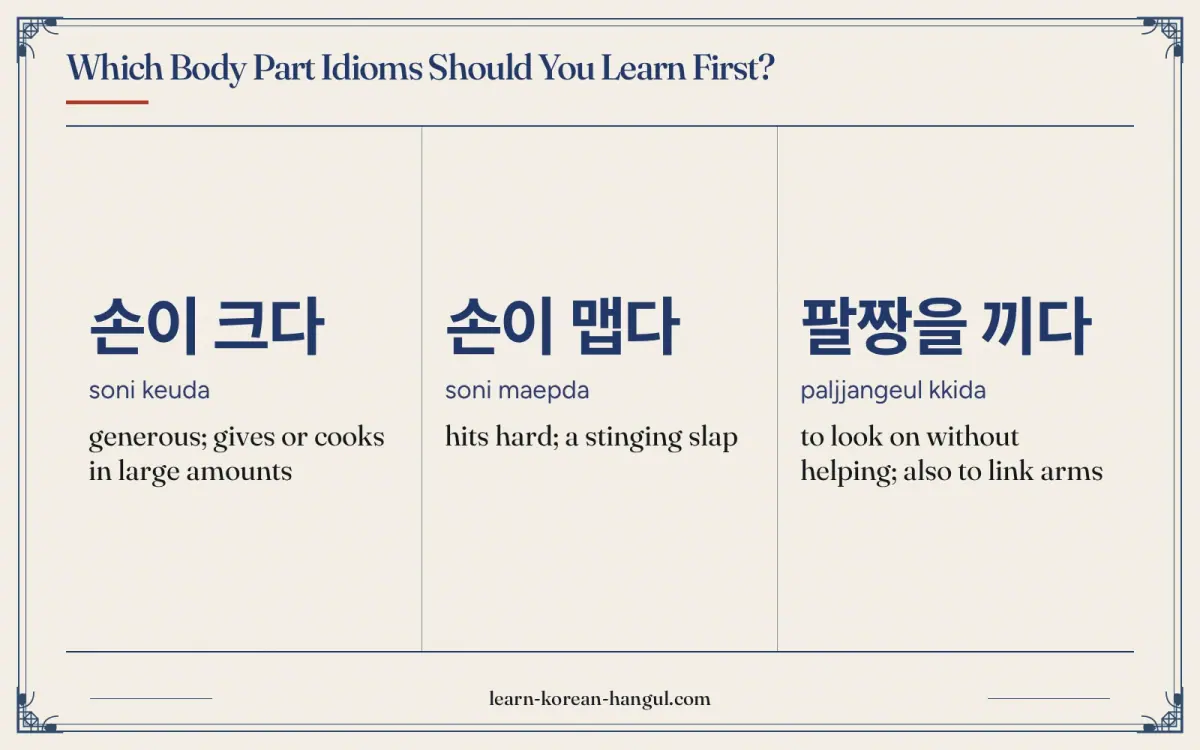
Learn the idioms that describe people you know. Five are easy to use at once: 손이 크다, 발이 넓다, 입이 가볍다, 귀가 얇다 and 눈이 높다. With these five you can describe a generous friend, a well-connected colleague, someone who cannot keep a secret, someone easily persuaded and someone with high standards. Then add by situation:
- If you talk about people. 입이 무겁다, 입이 짧다, 얼굴이 두껍다, 간이 크다 and 얼굴이 넓다.
- If you talk about work. 발등에 불이 떨어지다, 눈코 뜰 새 없다, 발목을 잡다, 손을 떼다 and 손을 잡다.
- If you talk about feelings. 마음이 무겁다, 마음을 놓다, 간이 콩알만 해지다, 간담이 서늘하다 and 손에 땀을 쥐다.
- If you listen to dramas. 귀에 못이 박히다, 눈에 띄다, 귀를 기울이다 and 팔짱을 끼다.
The scene below numbers ten of the idioms with small tags on a drawn figure, so you can tie each idiom to a body part.
Word · 10
- 1
손이 크다
soni keuda
generous; gives or cooks in large amounts
- 2
손이 맵다
soni maepda
hits hard; a stinging slap
- 3
팔짱을 끼다
paljjangeul kkida
to look on without helping; also to link arms
- 4
발이 넓다
bari neolda
well-connected; knows many people
- 5
눈이 높다
nuni nopda
to have high standards; to be picky about quality
- 6
귀가 얇다
gwiga yalda
easily persuaded; easily swayed
- 7
입이 가볍다
ibi gabyeopda
talks too much; cannot keep a secret
- 8
얼굴이 두껍다
eolguri dukkeopda
shameless; thick-skinned
- 9
마음이 무겁다
maeumi mugeopda
to feel heavy-hearted
- 10
간이 크다
gani keuda
bold; daring
Tap a number to hear the idiom. At 5 idioms a day the list takes six days.
Hand and Arm Idioms (손)
The hand idioms are about doing and giving. 손이 크다 is generous and 손이 맵다 is hits hard. 손을 잡다 and 손을 떼다 are opposites: join forces and quit. 손에 땀을 쥐다 describes tension, and 팔짱을 끼다 describes watching without helping.
| No. | Hangul | Revised Romanization | Literally | Meaning and note | Example sentence | Audio assetId |
|---|---|---|---|---|---|---|
| 1 | 손이 크다 | soni keuda [소니 크다] | the hand is big | generous; gives or cooks in large amounts. The English "big-hearted" is close, but this idiom is often about portions of food. | 우리 할머니는 손이 커서 음식을 항상 많이 만드세요. (My grandmother is generous with portions, so she always makes a lot of food.) | au-pg-vocabulary-word-types-idioms-body-part-1; example: au-pg-vocabulary-word-types-idioms-body-part-31 |
| 2 | 손이 맵다 | soni maepda [소니 맵따] | the hand is spicy | hits hard; a stinging slap. Spicy (맵다) is used for pain. The idiom is mostly about the sting of a slap. | 그 선수는 손이 매워서 한 대 맞으면 아파요. (That player hits hard, so it hurts if he hits you.) | au-pg-vocabulary-word-types-idioms-body-part-2; example: au-pg-vocabulary-word-types-idioms-body-part-32 |
| 3 | 손을 잡다 | soneul japda [소늘 잡따] | take a hand | to join hands; to team up. It can be literal or figurative, as in two companies joining forces. | 두 회사가 손을 잡았어요. (The two companies joined hands.) | au-pg-vocabulary-word-types-idioms-body-part-3; example: au-pg-vocabulary-word-types-idioms-body-part-33 |
| 4 | 손을 떼다 | soneul tteda [소늘 떼다] | take the hand off | to quit; to stop being involved. The English "wash one's hands of" is close. | 그 일에서 손을 뗐어요. (I walked away from that business.) | au-pg-vocabulary-word-types-idioms-body-part-4; example: au-pg-vocabulary-word-types-idioms-body-part-34 |
| 5 | 손에 땀을 쥐다 | sone ttameul jwida [소네 따믈 쥐다] | grip sweat in the hand | to be on the edge of one's seat. English says "sweaty palms" or "on the edge of the seat". | 경기가 끝날 때까지 손에 땀을 쥐고 봤어요. (I watched with sweaty palms until the match ended.) | au-pg-vocabulary-word-types-idioms-body-part-5; example: au-pg-vocabulary-word-types-idioms-body-part-35 |
| 6 | 팔짱을 끼다 | paljjangeul kkida [팔짱을 끼다] | fold the arms | to look on without helping; also to link arms. Often 팔짱을 끼고 보다 (to watch with folded arms). English says "sit on one's hands". | 친구가 힘든데 팔짱만 끼고 볼 수는 없어요. (My friend is struggling, so I cannot just stand and watch.) | au-pg-vocabulary-word-types-idioms-body-part-6; example: au-pg-vocabulary-word-types-idioms-body-part-36 |
손이 크다 and 손이 맵다 use the same pattern, body part + 이 + adjective, but the adjective is different. 크다 is big, so a big hand gives much. 맵다 is spicy, and in Korean spicy food also stings, so a spicy hand stings. 손을 잡다 and 손을 떼다 use 을 because the hand is the object of a verb. The first pattern describes a person, and the second describes an act.
Example Sentences
Each example is a short, polite spoken sentence. Notice the pattern person + 은/는 + body part + 이/가 + adjective. The person takes the topic particle, and the body part takes the subject particle, so 우리 할머니는 손이 커요 literally says "as for my grandmother, the hand is big". Say a sentence aloud, then read it again with the idiom hidden and say its meaning in English. The particles are explained in the Korean particles guide.
How Do You Say Foot and Leg Idioms (발) in Korean?
Foot idioms are about movement and connection. 발이 넓다 is well-connected, 발이 빠르다 is quick to act, and 발 벗고 나서다 is to take part eagerly. 발등에 불이 떨어지다 is pressure of a close deadline, 발목을 잡다 is to hold someone back, and 발을 끊다 is to stop going somewhere.
| No. | Hangul | Revised Romanization | Literally | Meaning and note | Example sentence | Audio assetId |
|---|---|---|---|---|---|---|
| 7 | 발이 넓다 | bari neolda [바리 널따] | the feet are wide | well-connected; knows many people. English says "well-connected". Compare 얼굴이 넓다 below. | 그 사람은 발이 넓어서 모르는 사람이 없어요. (He knows so many people that there is nobody he doesn't know.) | au-pg-vocabulary-word-types-idioms-body-part-7; example: au-pg-vocabulary-word-types-idioms-body-part-37 |
| 8 | 발이 빠르다 | bari ppareuda [바리 빠르다] | the feet are fast | quick to act; quick on one's feet. It can mean quick to react or to catch news. | 그는 발이 빨라서 좋은 자리를 먼저 찾았어요. (He is quick to act, so he found a good seat first.) | au-pg-vocabulary-word-types-idioms-body-part-8; example: au-pg-vocabulary-word-types-idioms-body-part-38 |
| 9 | 발 벗고 나서다 | bal beotgo naseoda [발 벋꼬 나서다] | take off shoes and step forward | to take part eagerly; to roll up one's sleeves. English says "roll up one's sleeves". | 이웃들이 발 벗고 나서서 도와줬어요. (The neighbours rolled up their sleeves and helped.) | au-pg-vocabulary-word-types-idioms-body-part-9; example: au-pg-vocabulary-word-types-idioms-body-part-39 |
| 10 | 발등에 불이 떨어지다 | baldeunge buri tteoreojida [발뜽에 부리 떠러지다] | fire falls on the top of the foot | to be under pressure of a close deadline. English says "the heat is on" or "up against the clock". | 발표가 내일인데 준비를 안 해서 발등에 불이 떨어졌어요. (The presentation is tomorrow and I haven't prepared, so the pressure is on.) | au-pg-vocabulary-word-types-idioms-body-part-10; example: au-pg-vocabulary-word-types-idioms-body-part-40 |
| 11 | 발목을 잡다 | balmogeul japda [발모글 잡따] | grab the ankle | to hold someone back. English says "hold back" or "drag down". | 작은 실수가 팀의 발목을 잡았어요. (A small mistake held the team back.) | au-pg-vocabulary-word-types-idioms-body-part-11; example: au-pg-vocabulary-word-types-idioms-body-part-41 |
| 12 | 발을 끊다 | bareul kkeunta [바를 끈타] | cut off the foot | to stop going to a place. Often used for a shop or a person you no longer visit. | 그 가게는 불친절해서 발을 끊었어요. (That shop was unfriendly, so I stopped going.) | au-pg-vocabulary-word-types-idioms-body-part-12; example: au-pg-vocabulary-word-types-idioms-body-part-42 |
발 here often means going around: the person with wide feet has been to many places and has met many people. That is why 발이 넓다 is about acquaintances and not about the size of a foot. In 발등에 불이 떨어지다 the top of the foot (발등) is where a spark would land, so the fire is right at your feet and you must act at once. 발을 끊다 also exists as 발길을 끊다, and the longer form is a little more formal.
Eye and Ear Idioms (눈, 귀)
Eye and ear idioms are about taste, attention and influence. 눈이 높다 is high standards, 눈에 띄다 is stand out, and 눈코 뜰 새 없다 is extremely busy. 귀가 얇다 is easily persuaded, 귀에 못이 박히다 is heard too often, and 귀를 기울이다 is listen carefully.
| No. | Hangul | Revised Romanization | Literally | Meaning and note | Example sentence | Audio assetId |
|---|---|---|---|---|---|---|
| 13 | 눈이 높다 | nuni nopda [누니 놉따] | the eyes are high | to have high standards; to be picky about quality. Not about height. It means you only like good things. | 동생은 눈이 높아서 마음에 드는 옷이 없어요. (My younger sibling is picky, so nothing is to their liking.) | au-pg-vocabulary-word-types-idioms-body-part-13; example: au-pg-vocabulary-word-types-idioms-body-part-43 |
| 14 | 눈코 뜰 새 없다 | nunko tteul sae eopda [눈코 뜰 쌔 업따] | there is no gap to open eyes and nose | extremely busy. Literally no time to open the eyes and nose. | 연말에는 눈코 뜰 새 없이 바빠요. (At year end I am so busy I cannot catch my breath.) | au-pg-vocabulary-word-types-idioms-body-part-14; example: au-pg-vocabulary-word-types-idioms-body-part-44 |
| 15 | 눈에 띄다 | nune ttuida [누네 띠다] | to catch the eye | to stand out. English says "catch the eye". | 빨간 가방이 눈에 띄어요. (The red bag stands out.) | au-pg-vocabulary-word-types-idioms-body-part-15; example: au-pg-vocabulary-word-types-idioms-body-part-45 |
| 16 | 귀가 얇다 | gwiga yalda [귀가 얄따] | the ears are thin | easily persuaded; easily swayed. English says "easily swayed". | 귀가 얇아서 광고만 보면 사고 싶어져요. (I am easily swayed, so I want to buy whatever I see advertised.) | au-pg-vocabulary-word-types-idioms-body-part-16; example: au-pg-vocabulary-word-types-idioms-body-part-46 |
| 17 | 귀에 못이 박히다 | gwie mosi bakida [귀에 모시 바키다] | a nail is driven into the ear | to have heard something countless times. English says "sick of hearing it". | 그 말은 귀에 못이 박히도록 들었어요. (I have heard those words until my ears are sick of them.) | au-pg-vocabulary-word-types-idioms-body-part-17; example: au-pg-vocabulary-word-types-idioms-body-part-47 |
| 18 | 귀를 기울이다 | gwireul giurida [귀를 기우리다] | tilt the ear | to listen carefully. English says "lend an ear". | 선생님의 설명에 귀를 기울였어요. (I listened carefully to the teacher's explanation.) | au-pg-vocabulary-word-types-idioms-body-part-18; example: au-pg-vocabulary-word-types-idioms-body-part-48 |
눈이 높다 is not about eyes being high: it means the standard of your taste is high. The opposite is 눈이 낮다. 귀가 얇다 uses the picture of thin ears that let every sound in. Its English twin is "easily swayed". Both 눈에 띄다 and 귀를 기울이다 are positive or neutral. 귀가 얇다 is the idiom for someone who believes whatever they hear, and it is a mild criticism.
How Do You Say Mouth and Face Idioms (입, 얼굴) in Korean?
Mouth idioms are about talk and food. 입이 가볍다 and 입이 무겁다 are opposites: talks too much and discreet. 입이 짧다 is a picky eater, and 입에 침이 마르다 is to praise again and again. Face idioms are about how others see you: 얼굴이 두껍다 is shameless, and 얼굴이 넓다 is knowing many people.
| No. | Hangul | Revised Romanization | Literally | Meaning and note | Example sentence | Audio assetId |
|---|---|---|---|---|---|---|
| 19 | 입이 가볍다 | ibi gabyeopda [이비 가볍따] | the mouth is light | talks too much; cannot keep a secret. English says "loose-lipped". | 입이 가벼운 사람에게는 비밀을 말하지 마세요. (Don't tell secrets to a person who cannot keep quiet.) | au-pg-vocabulary-word-types-idioms-body-part-19; example: au-pg-vocabulary-word-types-idioms-body-part-49 |
| 20 | 입이 무겁다 | ibi mugeopda [이비 무겁따] | the mouth is heavy | discreet; keeps secrets. The opposite of 입이 가볍다. | 민수는 입이 무거워서 믿을 수 있어요. (Minsu is discreet, so you can trust him.) | au-pg-vocabulary-word-types-idioms-body-part-20; example: au-pg-vocabulary-word-types-idioms-body-part-50 |
| 21 | 입이 짧다 | ibi jjalda [이비 짤따] | the mouth is short | a picky eater. Not about the size of the mouth. It means you eat only a few kinds of food. | 아이가 입이 짧아서 채소를 안 먹어요. (The child is a picky eater and does not eat vegetables.) | au-pg-vocabulary-word-types-idioms-body-part-21; example: au-pg-vocabulary-word-types-idioms-body-part-51 |
| 22 | 입에 침이 마르다 | ibe chimi mareuda [이베 치미 마르다] | saliva dries in the mouth | to praise again and again. Often 입에 침이 마르도록 칭찬하다 (praise until the mouth is dry). | 선생님은 그 학생을 입에 침이 마르도록 칭찬했어요. (The teacher praised that student endlessly.) | au-pg-vocabulary-word-types-idioms-body-part-22; example: au-pg-vocabulary-word-types-idioms-body-part-52 |
| 23 | 얼굴이 두껍다 | eolguri dukkeopda [얼구리 두껍따] | the face is thick | shameless; thick-skinned. The English "thick-skinned" means tough, but this idiom means shameless. | 거짓말을 하고도 웃다니 얼굴이 두껍네요. (Smiling after lying, you are really shameless.) | au-pg-vocabulary-word-types-idioms-body-part-23; example: au-pg-vocabulary-word-types-idioms-body-part-53 |
| 24 | 얼굴이 넓다 | eolguri neolda [얼구리 널따] | the face is wide | knows many people; has a wide circle. It means much the same as 발이 넓다 and is heard less often. | 시장에서는 우리 아버지가 얼굴이 넓어요. (At the market my father knows everyone.) | au-pg-vocabulary-word-types-idioms-body-part-24; example: au-pg-vocabulary-word-types-idioms-body-part-54 |
Compare idioms that learners mix up. 발이 넓다 and 얼굴이 넓다 both mean that you know many people; 발이 넓다 is the one you will hear most. 입이 가볍다 is a different thing: it does not mean you know many people, but that you cannot keep a secret. The table below sets out the contrasts.
| Idiom | Meaning | Think of |
|---|---|---|
| 발이 넓다 | well-connected | going to many places and meeting many people |
| 얼굴이 넓다 | knows many people | a face that many people recognise |
| 손이 크다 | generous | giving or cooking in large amounts |
| 입이 가볍다 | talks too much | secrets that leak out |
| 입이 무겁다 | discreet | secrets that stay in |
Heart and Liver Idioms (마음, 간)
The last group is about the inner life. 마음을 먹다, 마음이 무겁다 and 마음을 놓다 describe decisions and worries. In traditional thinking, the liver (간) was linked with courage, so 간이 크다 is bold and 간이 콩알만 해지다 is scared. 간담이 서늘하다 adds the gallbladder (담) for a chill of fear.
| No. | Hangul | Revised Romanization | Literally | Meaning and note | Example sentence | Audio assetId |
|---|---|---|---|---|---|---|
| 25 | 마음을 먹다 | maeumeul meokda [마으믈 먹따] | eat a heart | to make up one's mind. English says "make up one's mind". | 올해는 운동하기로 마음을 먹었어요. (This year I made up my mind to exercise.) | au-pg-vocabulary-word-types-idioms-body-part-25; example: au-pg-vocabulary-word-types-idioms-body-part-55 |
| 26 | 마음이 무겁다 | maeumi mugeopda [마으미 무겁따] | the heart is heavy | to feel heavy-hearted. English says "heavy heart". | 친구의 소식을 듣고 마음이 무거웠어요. (Hearing my friend's news made me heavy-hearted.) | au-pg-vocabulary-word-types-idioms-body-part-26; example: au-pg-vocabulary-word-types-idioms-body-part-56 |
| 27 | 마음을 놓다 | maeumeul nota [마으믈 노타] | put the heart down | to relax; to stop worrying. English says "set one's mind at rest". | 걱정 마세요. 이제 마음을 놓으셔도 돼요. (Don't worry. You can relax now.) | au-pg-vocabulary-word-types-idioms-body-part-27; example: au-pg-vocabulary-word-types-idioms-body-part-57 |
| 28 | 간이 크다 | gani keuda [가니 크다] | the liver is big | bold; daring. The liver (간) was once seen as the seat of courage. English says "have guts". | 혼자 여행을 가다니 간이 크네요. (Going on a trip alone: you are bold.) | au-pg-vocabulary-word-types-idioms-body-part-28; example: au-pg-vocabulary-word-types-idioms-body-part-58 |
| 29 | 간이 콩알만 해지다 | gani kongalman haejida [가니 콩알만 해지다] | the liver shrinks to the size of a bean | to get very scared. The opposite of 간이 크다. English says "scared stiff". | 큰 소리가 나서 간이 콩알만 해졌어요. (A loud noise made me terrified.) | au-pg-vocabulary-word-types-idioms-body-part-29; example: au-pg-vocabulary-word-types-idioms-body-part-59 |
| 30 | 간담이 서늘하다 | gandami seoneulhada [간다미 서늘하다] | the liver and gallbladder turn cold | to feel a chill of fear. 간담 means liver and gallbladder together. English says "a chill ran down my spine". | 갑자기 차가 달려와서 간담이 서늘했어요. (A car rushed at me suddenly and I felt a chill of fear.) | au-pg-vocabulary-word-types-idioms-body-part-30; example: au-pg-vocabulary-word-types-idioms-body-part-60 |
마음 is both heart and mind in Korean, and these idioms all use it as the place where thoughts and feelings are kept. 간 is not a poetic word here, and it is the plain word for the liver organ. 간이 크다 and 얼굴이 두껍다 can both describe someone who does something that others would not dare to do. 간이 크다 is bold and often admiring. 얼굴이 두껍다 is shameless and always critical. See also the emotion vocabulary page.
How Do Body Part Idioms Work in a Sentence?
Most body part idioms use one of four patterns. The table gives each pattern with an example from this page.
| Pattern | Example | Meaning |
|---|---|---|
| Person + 은/는 + body part + 이/가 + adjective | 민수는 입이 무거워요. | Minsu is discreet. |
| Body part + 을/를 + verb | 손을 잡았어요. | We joined hands. |
| Body part + 에 + noun + 이/가 + verb | 귀에 못이 박히도록 들었어요. | I have heard it endlessly. |
| Noun + 이/가 + body part + 에 + verb | 빨간 가방이 눈에 띄어요. | The red bag stands out. |
The idiom is fixed. You change the ending, not the words. The adjective idioms behave like any adjective: 손이 커요 (is generous), 손이 컸어요 (was generous) and 손이 큰 사람 (a generous person). The verb idioms behave like any verb: 마음을 놓다 becomes 마음을 놓았어요 or 마음을 놓으세요. Do not swap the body part. 손이 크다 is generous, and 발이 크다 means the feet are large.
How Do You Pronounce These Words?
In everyday speech the particles join the body-part word, and the final consonant moves to the next sound. The table shows eight idioms and how they sound.
| Spelling | Pronunciation | What happens |
|---|---|---|
| 손이 맵다 | [소니 맵따] | The ㄴ of 손 links to 이, and ㄷ is tense after ㅂ |
| 귀에 못이 박히다 | [귀에 모시 바키다] | The ㅅ of 못 links to 이, and ㄱ and ㅎ join into ㅋ |
| 입이 짧다 | [이비 짤따] | The ㅂ of 입 links to 이, ㅂ is dropped in 짧다, and ㄷ is tense after ㄹ |
| 눈코 뜰 새 없다 | [눈코 뜰 쌔 업따] | ㅅ of 새 is tense after the ㄹ ending, and 없다 is said [업따] |
| 발 벗고 나서다 | [발 벋꼬 나서다] | The ㅅ of 벗 is said as ㄷ, and ㄱ is tense after it |
| 발등에 불이 떨어지다 | [발뜽에 부리 떠러지다] | ㄷ is tense in 발등, and the ㄹ of 불 and 떨 links to the next vowel |
| 간이 콩알만 해지다 | [가니 콩알만 해지다] | The ㄴ of 간 links to 이 |
| 입에 침이 마르다 | [이베 치미 마르다] | The ㅂ of 입 links to 에, and the ㅁ of 침 links to 이 |
The rules come from the Standard Pronunciation rules (표준 발음법) of the 국립국어원. Revised Romanization does not write tensing caused by a neighbouring sound, so it writes 손이 맵다 as soni maepda and not soni maepta. Revised Romanization spaces the words as the Korean is spaced and shows the spoken form of each idiom in square brackets in the tables.
Audio and Slow Playback
Each idiom has a normal clip, and five harder ones also have a slow clip at 0.8 times the speed: 손이 맵다, 귀에 못이 박히다, 눈코 뜰 새 없다, 발등에 불이 떨어지다 and 간이 콩알만 해지다. Nothing plays until you press a button.
Listen to 손이 맵다 first. The syllable 손 links to 이, so you hear so-ni, and the last sound is a tense ㄸ: maep-tta. Then listen to 귀에 못이 박히다, where 못이 sounds like mo-si.
What Mistakes Do Learners Make with Body Part Idioms?
- Reading the idiom literally. 눈이 높다 is not about tall eyes, and 입이 짧다 is not about a short mouth.
- Saying 입이 작다 for a picky eater. 입이 작다 means the mouth is small. The idiom is 입이 짧다.
- Using the wrong particle. With an adjective use 이/가: 손이 크다. 손을 크다 is not Korean.
- Using 발이 크다 for a well-connected person. 발이 크다 means the feet are big. The idiom is 발이 넓다.
- Treating 얼굴이 두껍다 as a compliment. The English "thick-skinned" can be a compliment, but the Korean idiom means shameless.
- Reading 귀에 못이 박히다 as gwi-e mot-i bak-hi-da. The ㅅ links to 이 and the ㄱ and ㅎ join, so it is [귀에 모시 바키다].
The particle error is the one that is easiest to avoid: if the idiom describes a person with an adjective, use 이/가. The next sections turn the list into drills.
Practice: Flashcards and Worksheet
Study in three steps. First, run the deck in recognition mode until the 30 idioms feel familiar. Second, switch to listening mode and press the clip before the card turns. Third, take the quiz below. The deck stores your progress only in your browser. The vocabulary flashcard decks page lists the other decks, and the vocabulary worksheets page lists printable sheets. A printable worksheet for these words (word list, matching, writing practice and answer key) is available in A4 and US Letter from the download card on this page.
The deck holds the same 30 cards as the tables above: Hangul, Revised Romanization and meaning.
Practice · 30
- 01손이 크다
Show answer
soni keuda
generous; gives or cooks in large amounts
- 02손이 맵다
Show answer
soni maepda
hits hard; a stinging slap
- 03손을 잡다
Show answer
soneul japda
to join hands; to team up
- 04손을 떼다
Show answer
soneul tteda
to quit; to stop being involved
- 05손에 땀을 쥐다
Show answer
sone ttameul jwida
to be on the edge of one's seat
- 06팔짱을 끼다
Show answer
paljjangeul kkida
to look on without helping; also to link arms
- 07발이 넓다
Show answer
bari neolda
well-connected; knows many people
- 08발이 빠르다
Show answer
bari ppareuda
quick to act; quick on one's feet
- 09발 벗고 나서다
Show answer
bal beotgo naseoda
to take part eagerly; to roll up one's sleeves
- 10발등에 불이 떨어지다
Show answer
baldeunge buri tteoreojida
to be under pressure of a close deadline
- 11발목을 잡다
Show answer
balmogeul japda
to hold someone back
- 12발을 끊다
Show answer
bareul kkeunta
to stop going to a place
- 13눈이 높다
Show answer
nuni nopda
to have high standards; to be picky about quality
- 14눈코 뜰 새 없다
Show answer
nunko tteul sae eopda
extremely busy
- 15눈에 띄다
Show answer
nune ttuida
to stand out
- 16귀가 얇다
Show answer
gwiga yalda
easily persuaded; easily swayed
- 17귀에 못이 박히다
Show answer
gwie mosi bakida
to have heard something countless times
- 18귀를 기울이다
Show answer
gwireul giurida
to listen carefully
- 19입이 가볍다
Show answer
ibi gabyeopda
talks too much; cannot keep a secret
- 20입이 무겁다
Show answer
ibi mugeopda
discreet; keeps secrets
- 21입이 짧다
Show answer
ibi jjalda
a picky eater
- 22입에 침이 마르다
Show answer
ibe chimi mareuda
to praise again and again
- 23얼굴이 두껍다
Show answer
eolguri dukkeopda
shameless; thick-skinned
- 24얼굴이 넓다
Show answer
eolguri neolda
knows many people; has a wide circle
- 25마음을 먹다
Show answer
maeumeul meokda
to make up one's mind
- 26마음이 무겁다
Show answer
maeumi mugeopda
to feel heavy-hearted
- 27마음을 놓다
Show answer
maeumeul nota
to relax; to stop worrying
- 28간이 크다
Show answer
gani keuda
bold; daring
- 29간이 콩알만 해지다
Show answer
gani kongalman haejida
to get very scared
- 30간담이 서늘하다
Show answer
gandami seoneulhada
to feel a chill of fear
Korean Body Part Idioms Worksheet
Try this eight-question check.
Practice · 8
What does 손이 크다 (soni keuda) mean?
Show answer
generous
손이 크다 means the hand is big, so the person is generous. Example: 우리 할머니는 손이 커서 음식을 항상 많이 만드세요.
What does 입이 짧다 (ibi jjalda) mean?
Show answer
a picky eater
입이 짧다 means a picky eater. 입이 가볍다 is the idiom for someone who talks too much.
What does 귀가 얇다 (gwiga yalda) mean?
Show answer
easily persuaded
귀가 얇다 means the ears are thin, so the person is easily swayed by others' opinions.
What does 발등에 불이 떨어지다 mean?
Show answer
to be under pressure of a close deadline
발등에 불이 떨어지다 means the fire has fallen on the top of the foot, so you must act at once.
Which idiom means "well-connected; knows many people"?
Show answer
발이 넓다
발이 넓다 means the feet are wide, so the person has been to many places and knows many people.
Which idiom means "to feel a chill of fear"?
Show answer
간담이 서늘하다
간담이 서늘하다 means the liver and gallbladder turn cold. 간이 크다 means bold.
Which particle completes 손__ 크다?
Show answer
이
An adjective idiom uses the subject particle 이/가, so the idiom is 손이 크다.
How is 손이 맵다 pronounced?
Show answer
[소니 맵따]
The ㄴ of 손 links to 이, and ㄷ becomes a tense sound after ㅂ, so the phrase is said [소니 맵따].
Where to Go Next
After this page, continue with the Korean Idioms hub for other kinds of idiom, or open the Four-Character Idioms page for idioms of Chinese origin. For the plain body words, return to the body vocabulary page.
Frequently Asked Questions
How Do You Say Generous in Korean?
The idiom 손이 크다 (soni keuda), literally the hand is big, means generous, especially with food and gifts. In plain words you can also say 인심이 후하다 (insimi huhada), which means generous in hospitality. Use 손이 크다 for a person who gives or cooks in large amounts, as in 우리 할머니는 손이 커요 (my grandmother is generous).
How Do You Pronounce 손이 맵다 (soni maepda)?
손이 맵다 is said [소니 맵따]. The final ㄴ of 손 links to the vowel of 이, so you hear so-ni. In 맵다 the ㄷ becomes a tense ㄸ after the final ㅂ, so you hear maep-tta. Revised Romanization writes soni maepda, so use the audio for the real sound.
How Many Body Part Idioms Should I Learn First?
Learn about 10 first. Take the five that describe people (손이 크다, 발이 넓다, 입이 가볍다, 귀가 얇다 and 눈이 높다) and five that describe feelings and work (마음이 무겁다, 간이 크다, 눈에 띄다, 손을 잡다 and 발등에 불이 떨어지다). Add the rest of the 30 over the next two weeks.
Where Can I Practise Body Part Idioms with Flashcards?
Use the Korean idioms flashcards for a mixed idiom deck, or the vocabulary flashcard decks page, which lists every deck with audio. This page also carries a deck with all 30 idioms in recognition mode. Your progress stays in your browser, so it is not shared with other devices.
Is the Romanization on This Page Official?
It follows the Revised Romanization of Korean, which South Korea officially adopted on 7 July 2000 and whose rules the National Institute of Korean Language (국립국어원) publishes. It is a learning aid that does not show tensing caused by a neighbouring sound, so spoken forms are given in square brackets and the Hangul and audio are the guide.
Is There a Printable Worksheet for Body Part Idioms?
A printable worksheet for these words (word list, matching, writing practice and answer key) is available in A4 and US Letter from the download card on this page. For practice, write the Hangul from memory, cover the English column and check your answers against the tables.