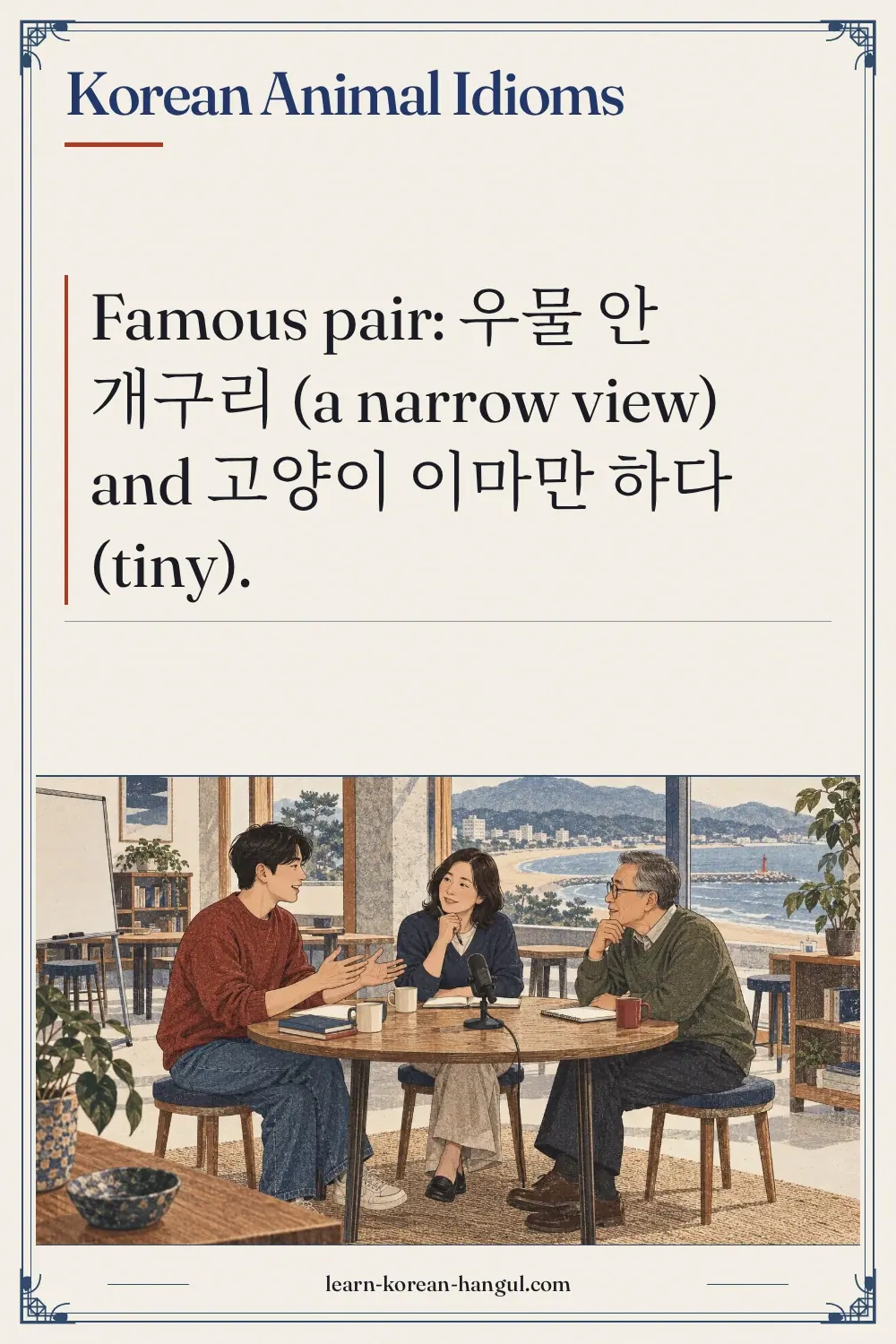
Korean Animal Idioms at a Glance
An idiom is a fixed phrase whose meaning is not the sum of its words. 우물 안 개구리 is not about a real frog in a real well, and 고양이 이마만 하다 is not about a cat's forehead. Korean has many idioms with animals, because animals were part of everyday village life. Learning them gives you a shortcut to humour, warnings and complaints that textbooks skip. This list mixes true idioms (관용구), proverbs (속담) and one four-character idiom (사자성어, 용두사미), and the page calls them all animal idioms for short.
| Group | Words | What it covers |
|---|---|---|
| Tiger and dragon idioms | 6 | Long ago, risk, strictness, empty threats, luck and anticlimax |
| Dog and cat idioms | 6 | Carefree life, mismatch, outsider, fear and small size |
| Bird and fish idioms | 6 | Narrow views, second best, helplessness, overreach, being in your element and bad influence |
| Farm animal idioms | 6 | Indifference, deaf ears, luck, wasted value, stubbornness and false kindness |
| Cultural symbolism | 6 | Foxes, puppies, rabbits, turtles, magpies and crows |
The page belongs to Korean Idioms, which teaches 40 idioms in all and explains how idioms, proverbs and four-character idioms differ. A deeper list is in Korean Body Part Idioms. For the animal names themselves, see animal names.
Which Animal Idioms Should You Learn First?
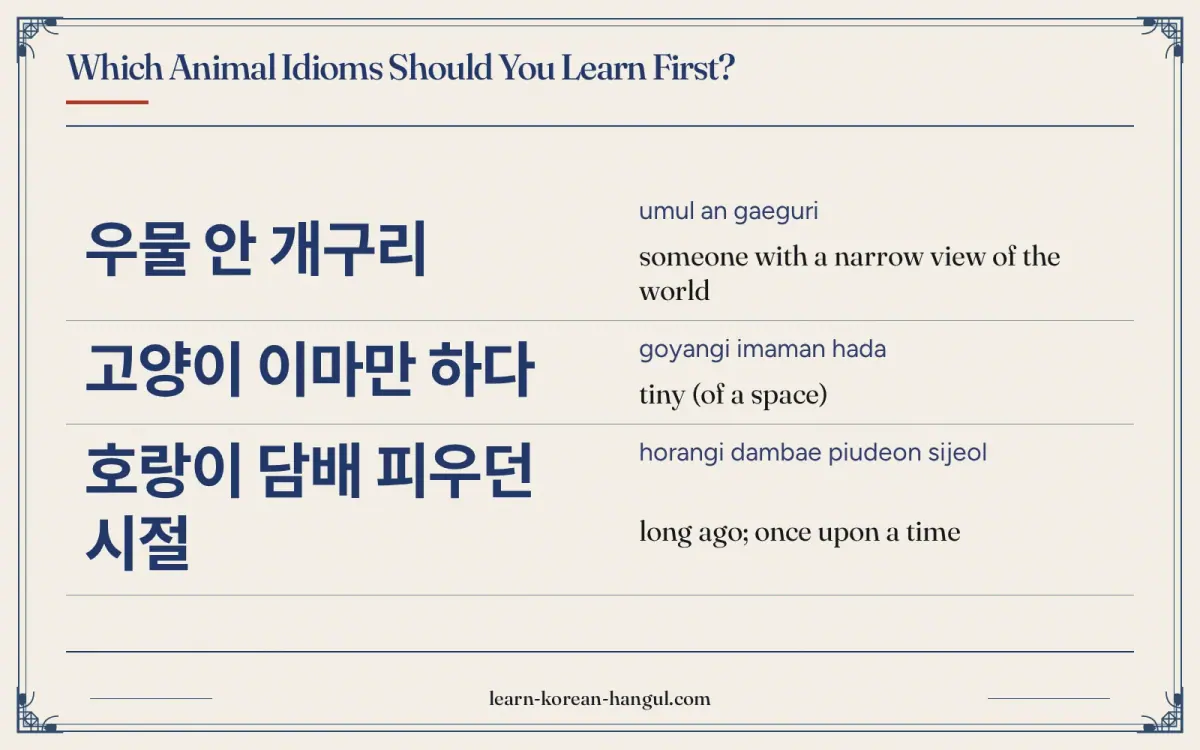
Start with the ones you will hear in drama dialogue and everyday chat, then add the full proverbs. Short phrases that end in a noun are the easiest to use, because you only add 이에요 or 예요.
- Say first. 우물 안 개구리, 꿩 대신 닭, 고양이 이마만 하다, 개밥에 도토리, 물 만난 고기, 호랑이 선생님.
- Use often. 쇠귀에 경 읽기, 소 닭 보듯, 거북이걸음, 두 마리 토끼를 잡다, 여우 같다.
- Recognise, then use with care. 돼지 목에 진주 목걸이, 양의 탈을 쓴 늑대, 하룻강아지 범 무서운 줄 모른다. They can sound rude if you aim them at a person.
The scene below is a storybook village with a well, a barn, a hill and a pond. Ten numbered objects match ten idioms. Tap a number to hear the idiom.
Word · 10
- 1
우물 안 개구리
umul an gaeguri
someone with a narrow view of the world
- 2
고양이 이마만 하다
goyangi imaman hada
tiny (of a space)
- 3
호랑이 담배 피우던 시절
horangi dambae piudeon sijeol
long ago; once upon a time
- 4
꿩 대신 닭
kkwong daesin dak
a second-best substitute
- 5
쇠귀에 경 읽기
soegwie gyeong ilgi
talking to a wall
- 6
고양이 목에 방울 달기
goyangi moge bangul dalgi
a plan that nobody dares to carry out
- 7
개밥에 도토리
gaebabe dotori
an outsider who does not fit in
- 8
물 만난 고기
mul mannan gogi
in one's element
- 9
여우 같다
yeou gatda
cunning; sly
- 10
까치가 울면 반가운 손님이 온다
kkachiga ulmyeon bangaun sonnimi onda
a magpie's call brings a welcome guest
Tiger and Dragon Idioms
The tiger is a favourite animal of Korean folk tales, and the dragon is an animal of luck. Tiger idioms are about time, courage and strictness. Dragon idioms are about luck and big beginnings. Several end in a noun (호랑이 선생님, 종이호랑이, 용두사미), so you can add 이에요 or 예요 straight onto them.
| No. | Hangul | Revised Romanization | Literally | Meaning and note | Example sentence | Audio assetId |
|---|---|---|---|---|---|---|
| 1 | 호랑이 담배 피우던 시절 | horangi dambae piudeon sijeol | the days when tigers smoked tobacco | long ago; once upon a time. Everyday, with a storytelling tone. It opens jokes and folk tales and says that something is very old. | 그건 호랑이 담배 피우던 시절 이야기예요. (That is a story from the distant past.) | au-pg-vocabulary-word-types-idioms-animals-1; example: au-pg-vocabulary-word-types-idioms-animals-31 |
| 2 | 호랑이 굴에 들어가야 호랑이를 잡는다 | horangi gure deureogaya horangireul jamneunda [호랑이 구레 드러가야 호랑이를 잠는다] | you must enter the tiger's den to catch the tiger | nothing ventured, nothing gained. A proverb, quoted whole to encourage someone to take a risk. | 호랑이 굴에 들어가야 호랑이를 잡는다고 하니까 한번 도전해 볼게요. (They say you must enter the tiger's den to catch the tiger, so I will give it a try.) | au-pg-vocabulary-word-types-idioms-animals-2; example: au-pg-vocabulary-word-types-idioms-animals-32 |
| 3 | 호랑이 선생님 | horangi seonsaengnim | tiger teacher | a very strict teacher. Everyday. Students say it with a mix of fear and respect. | 우리 담임 선생님은 호랑이 선생님이에요. (Our homeroom teacher is very strict.) | au-pg-vocabulary-word-types-idioms-animals-3; example: au-pg-vocabulary-word-types-idioms-animals-33 |
| 4 | 종이호랑이 | jongihorangi | paper tiger | someone or something that looks powerful but has no real force. Written as one word. Used for empty threats. | 그 회사는 큰소리만 치는 종이호랑이예요. (That company is a paper tiger that only talks big.) | au-pg-vocabulary-word-types-idioms-animals-4; example: au-pg-vocabulary-word-types-idioms-animals-34 |
| 5 | 용꿈을 꾸다 | yongkkumeul kkuda [용꾸믈 꾸다] | to dream a dragon dream | to dream about a dragon. Describes a dragon appearing in a dream. The expression combines the creature with the word for a dream. | 어젯밤에 용꿈을 꿨어요. (Last night I had a dragon dream.) | au-pg-vocabulary-word-types-idioms-animals-5 |
| 6 | 용두사미 | yongdusami | dragon head, snake tail | a strong start and a weak end. A four-character idiom (사자성어). Used for projects that begin with a bang and fade out. | 이번 계획도 용두사미로 끝났어요. (This plan, too, ended in anticlimax.) | au-pg-vocabulary-word-types-idioms-animals-6; example: au-pg-vocabulary-word-types-idioms-animals-36 |
Notice the spacing. 종이호랑이 (paper tiger) is one word, but 호랑이 선생님 is two words.
Example Sentences
Most of these idioms slot into a sentence as a noun phrase or as a comparison. Three patterns cover almost every row. First, a noun phrase with 이에요 or 예요: 호랑이 선생님이에요, 개 발에 편자예요. Second, a comparison with 같아요 or 처럼: 물 만난 고기 같아요, 고양이 앞에 쥐처럼 있어요. Third, a quoted proverb with 라고 하다 or 는 말이 있어요: 호랑이 굴에 들어가야 호랑이를 잡는다고 해요. Play each sentence, repeat it, then swap in a new person or place.
그건 호랑이 담배 피우던 시절 이야기예요.
geugeon horangi dambae piudeon sijeol iyagiyeyo.
That is a story from the distant past.
우리 집 마당은 고양이 이마만 해요.
uri jip madangeun goyangi imaman haeyo.
Our yard is tiny.
책도 읽고 여행도 해야 우물 안 개구리가 되지 않아요.
chaekdo ilgo yeohaengdo haeya umul an gaeguriga doeji anayo.
You have to read and travel so that you do not become a frog in a well.
How Do You Say Dog and Cat Idioms in Korean?
Dogs and cats are pets, so these idioms are casual and often funny. The dog stands for an easy life, a poor fit or a lowly place. The cat stands for power over mice and for something very small. Two of the examples use 처럼 or 같아요, which turns the idiom into a comparison.
| No. | Hangul | Revised Romanization | Literally | Meaning and note | Example sentence | Audio assetId |
|---|---|---|---|---|---|---|
| 7 | 개 팔자가 상팔자 | gae paljaga sangpalja [개 팔짜가 상팔짜] | a dog's fate is the best fate | the carefree life. Everyday and humorous. Said with a sigh at a pet that sleeps all day, or when you are tired of working. | 하루 종일 자는 강아지를 보면 개 팔자가 상팔자라는 생각이 들어요. (When I see a puppy sleeping all day, I think a dog's life is the best life.) | au-pg-vocabulary-word-types-idioms-animals-7; example: au-pg-vocabulary-word-types-idioms-animals-37 |
| 8 | 개 발에 편자 | gae bare pyeonja [개 바레 편자] | horseshoes on a dog's feet | a thing that does not suit its user; a waste. 편자 is a horseshoe, made for horses, not dogs. Used for things that are too fancy for the person. | 초보자에게 비싼 카메라는 개 발에 편자예요. (An expensive camera for a beginner is wasted on them.) | au-pg-vocabulary-word-types-idioms-animals-8; example: au-pg-vocabulary-word-types-idioms-animals-38 |
| 9 | 개밥에 도토리 | gaebabe dotori [개바베 도토리] | an acorn in dog food | an outsider who does not fit in. Everyday. A dog eats its food and leaves the acorn, so the acorn is left out. | 다들 친한데 저만 개밥에 도토리 같아요. (Everyone is close and only I feel like the odd one out.) | au-pg-vocabulary-word-types-idioms-animals-9; example: au-pg-vocabulary-word-types-idioms-animals-39 |
| 10 | 고양이 목에 방울 달기 | goyangi moge bangul dalgi [고양이 모게 방울 달기] | hanging a bell on a cat's neck | a plan that sounds good but nobody dares to carry out. It comes from a fable in which the mice agree to bell the cat and then ask who will do it. | 좋은 생각이지만 누가 하겠어요? 고양이 목에 방울 달기예요. (It is a good idea, but who would do it? It is belling the cat.) | au-pg-vocabulary-word-types-idioms-animals-10; example: au-pg-vocabulary-word-types-idioms-animals-40 |
| 11 | 고양이 앞에 쥐 | goyangi ape jwi [고양이 아페 쥐] | a mouse in front of a cat | frozen with fear before someone powerful. Everyday. Often said about a child in front of a strict parent. | 아버지 앞에서는 동생이 고양이 앞에 쥐처럼 가만히 있어요. (In front of Father, my younger sibling stays as still as a mouse before a cat.) | au-pg-vocabulary-word-types-idioms-animals-11; example: au-pg-vocabulary-word-types-idioms-animals-41 |
| 12 | 고양이 이마만 하다 | goyangi imaman hada | to be as big as a cat's forehead | tiny (of a space). Casual and humorous. Used for small rooms, yards and plots of land. | 우리 집 마당은 고양이 이마만 해요. (Our yard is tiny.) | au-pg-vocabulary-word-types-idioms-animals-12; example: au-pg-vocabulary-word-types-idioms-animals-42 |
Bird and Fish Idioms
Birds and fish give Korean its idioms about limits and places. A frog in a well has a small world, a fish in water is at home, and a parrotbill that tries to walk like a stork gets hurt. The frog counts here as a water animal. Several are full proverb sentences, so quote them whole.
| No. | Hangul | Revised Romanization | Literally | Meaning and note | Example sentence | Audio assetId |
|---|---|---|---|---|---|---|
| 13 | 우물 안 개구리 | umul an gaeguri | a frog inside a well | someone with a narrow view of the world. Everyday. The frog sees only a circle of sky and thinks that is all the sky there is. | 책도 읽고 여행도 해야 우물 안 개구리가 되지 않아요. (You have to read and travel so that you do not become a frog in a well.) | au-pg-vocabulary-word-types-idioms-animals-13; example: au-pg-vocabulary-word-types-idioms-animals-43 |
| 14 | 꿩 대신 닭 | kkwong daesin dak [꿩 대신 닥] | a chicken instead of a pheasant | a second-best substitute. Everyday. Said when the first choice is not available and you settle for something close. | 비싼 가방은 못 사서 꿩 대신 닭으로 작은 지갑을 샀어요. (I could not buy the expensive bag, so I bought a small wallet instead.) | au-pg-vocabulary-word-types-idioms-animals-14; example: au-pg-vocabulary-word-types-idioms-animals-44 |
| 15 | 닭 쫓던 개 지붕 쳐다보듯 | dak jjotdeon gae jibung chyeodabodeut [닥 쫃떤 개 지붕 처다보듣] | like a dog that was chasing a chicken, staring at the roof | left helpless after losing what you chased. The chicken flew up to the roof where the dog cannot reach. The ending -듯 means "as if". | 기차가 떠난 뒤 저는 닭 쫓던 개 지붕 쳐다보듯 서 있었어요. (After the train left, I just stood there, helpless.) | au-pg-vocabulary-word-types-idioms-animals-15; example: au-pg-vocabulary-word-types-idioms-animals-45 |
| 16 | 뱁새가 황새를 쫓아가면 가랑이가 찢어진다 | baepsaega hwangsaereul jjochagamyeon garangiga jjijeojinda [뱁쌔가 황새를 쪼차가면 가랑이가 찌저진다] | if a parrotbill follows a stork, its legs split | do not copy those who are far bigger than you. A parrotbill (뱁새) is a tiny bird and a stork has long legs. A proverb about overspending to keep up. | 뱁새가 황새를 쫓아가면 가랑이가 찢어진다고 하니까 무리하지 마세요. (They say a parrotbill that chases a stork splits its legs, so do not overdo it.) | au-pg-vocabulary-word-types-idioms-animals-16; example: au-pg-vocabulary-word-types-idioms-animals-46 |
| 17 | 물 만난 고기 | mul mannan gogi | a fish that has met water | in one's element. Everyday. Said of someone who is suddenly lively because they are doing what they love. | 노래방에 가면 동생은 물 만난 고기 같아요. (At a karaoke room, my younger sibling is like a fish in water.) | au-pg-vocabulary-word-types-idioms-animals-17; example: au-pg-vocabulary-word-types-idioms-animals-47 |
| 18 | 미꾸라지 한 마리가 온 웅덩이를 흐려 놓는다 | mikkuraji han mariga on ungdeongireul heuryeo nonneunda [미꾸라지 한 마리가 온 웅덩이를 흐려 논는다] | one loach muddies the whole pond | one bad person can spoil a whole group. A loach stirs up the mud when it swims. A proverb, often quoted about teams and classes. | 한 사람 때문에 팀 분위기가 나빠졌어요. 미꾸라지 한 마리가 온 웅덩이를 흐려 놓네요. (The team mood got worse because of one person. One loach muddies the whole pond.) | au-pg-vocabulary-word-types-idioms-animals-18; example: au-pg-vocabulary-word-types-idioms-animals-48 |
How Do You Say Farm Animal Idioms in Korean?
Cows, pigs and sheep come from village life, when most families lived near farms. A cow or bull appears in four of the six idioms. In these sayings it stands for people who do not react, who do not listen, who stumble into luck or who refuse to change their mind.
| No. | Hangul | Revised Romanization | Literally | Meaning and note | Example sentence | Audio assetId |
|---|---|---|---|---|---|---|
| 19 | 소 닭 보듯 | so dak bodeut [소 닥 보듣] | like a cow looking at a chicken | with total indifference. The two animals look at each other and feel nothing. The phrase goes before a verb, usually 하다. | 두 사람은 만나도 소 닭 보듯 해요. (Those two act as if the other is not there when they meet.) | au-pg-vocabulary-word-types-idioms-animals-19; example: au-pg-vocabulary-word-types-idioms-animals-49 |
| 20 | 쇠귀에 경 읽기 | soegwie gyeong ilgi [쇠귀에 경 일끼] | reading scripture into a cow's ear | talking to someone who will not listen. 쇠귀 means a cow's ear and 경 is a holy text. The same image as talking to a brick wall. | 아이에게 아무리 말해도 쇠귀에 경 읽기예요. (No matter how much I tell the child, it is like talking to a wall.) | au-pg-vocabulary-word-types-idioms-animals-20; example: au-pg-vocabulary-word-types-idioms-animals-50 |
| 21 | 소 뒷걸음질 치다 쥐 잡기 | so dwitgeoreumjil chida jwi japgi [소 뒫꺼름질 치다 쥐 잡끼] | a cow steps backward and catches a mouse | pure luck; success by accident. The cow did not plan to catch anything. | 이번 시험은 소 뒷걸음질 치다 쥐 잡기로 합격했어요. (I passed this exam by pure luck.) | au-pg-vocabulary-word-types-idioms-animals-21; example: au-pg-vocabulary-word-types-idioms-animals-51 |
| 22 | 돼지 목에 진주 목걸이 | dwaeji moge jinju mokgeori [돼지 모게 진주 목꺼리] | a pearl necklace on a pig's neck | a valuable thing wasted on someone who cannot value it. It is like "pearls before swine". Say it about things or yourself, not to a person's face. | 저는 와인을 잘 몰라서 비싼 와인은 돼지 목에 진주 목걸이예요. (I do not know much about wine, so expensive wine is wasted on me.) | au-pg-vocabulary-word-types-idioms-animals-22; example: au-pg-vocabulary-word-types-idioms-animals-52 |
| 23 | 황소고집 | hwangsogojip | a bull's stubbornness | a very stubborn nature. Written as one word. Often followed by 이다. | 아버지는 황소고집이라서 한번 정하면 바꾸지 않으세요. (My father is as stubborn as a bull, so once he decides, he does not change.) | au-pg-vocabulary-word-types-idioms-animals-23; example: au-pg-vocabulary-word-types-idioms-animals-53 |
| 24 | 양의 탈을 쓴 늑대 | yangui tareul sseun neukdae [양의 타를 쓴 늑때] | a wolf wearing a sheep's mask | a dangerous person who looks harmless. The same image as in English. 탈 is a mask. | 친절한 척하지만 양의 탈을 쓴 늑대일지도 몰라요. (He acts kind, but he may be a wolf in sheep's clothing.) | au-pg-vocabulary-word-types-idioms-animals-24; example: au-pg-vocabulary-word-types-idioms-animals-54 |
The wolf in 양의 탈을 쓴 늑대 is not a farm animal, but the sheep is. English uses the same image, so the idiom is easy to remember.
Cultural Symbolism
Some animals carry a fixed meaning in Korean folk belief. The fox is sly, the magpie brings good news and the crow is forgetful or unlucky. These are traditional beliefs rather than facts, but you need them to understand the idioms. Learn the animal and the feeling it stands for together.
| No. | Hangul | Revised Romanization | Literally | Meaning and note | Example sentence | Audio assetId |
|---|---|---|---|---|---|---|
| 25 | 여우 같다 | yeou gatda [여우 갇따] | to be like a fox | cunning; sly. The fox is the clever, tricky animal of Korean tales. It can tease or criticise, so context decides. | 우리 고양이는 여우 같아서 간식을 줄 때만 와요. (Our cat is sly like a fox and only comes when I give it a snack.) | au-pg-vocabulary-word-types-idioms-animals-25; example: au-pg-vocabulary-word-types-idioms-animals-55 |
| 26 | 하룻강아지 범 무서운 줄 모른다 | harutgangaji beom museoun jul moreunda [하루깡아지 범 무서운 줄 모른다] | a one-day-old puppy does not know to fear the tiger | the inexperienced are fearless because they do not know the danger. 범 is an older word for tiger. A proverb said about bold young people. | 아직 어려서 하룻강아지 범 무서운 줄 모르는 거예요. (He is still young, so he is a puppy who does not know to fear the tiger.) | au-pg-vocabulary-word-types-idioms-animals-26; example: au-pg-vocabulary-word-types-idioms-animals-56 |
| 27 | 두 마리 토끼를 잡다 | du mari tokkireul japda [두 마리 토끼를 잡따] | to catch two rabbits | to achieve two goals at once. A positive phrase. The warning version is 두 마리 토끼를 잡으려다 한 마리도 못 잡는다. | 운동도 하고 영어도 배울 수 있어서 두 마리 토끼를 잡는 거예요. (I can exercise and learn English at the same time, so I am catching two rabbits at once.) | au-pg-vocabulary-word-types-idioms-animals-27; example: au-pg-vocabulary-word-types-idioms-animals-57 |
| 28 | 거북이걸음 | geobugigeoreum [거부기거름] | a turtle's walk | a very slow pace. Written as one word. Used for traffic, queues and slow progress. | 퇴근 시간이라 차가 거북이걸음이에요. (It is rush hour, so the cars are crawling.) | au-pg-vocabulary-word-types-idioms-animals-28; example: au-pg-vocabulary-word-types-idioms-animals-58 |
| 29 | 까치가 울면 반가운 손님이 온다 | kkachiga ulmyeon bangaun sonnimi onda [까치가 울면 반가운 손니미 온다] | if a magpie cries, a welcome guest comes | a folk belief that a magpie's call means good news or a visitor. The magpie is a lucky bird in Korean tradition. | 아침에 까치가 울면 반가운 손님이 온다고 해요. (They say that if a magpie calls in the morning, a welcome guest will come.) | au-pg-vocabulary-word-types-idioms-animals-29; example: au-pg-vocabulary-word-types-idioms-animals-59 |
| 30 | 까마귀 고기를 먹었나 | kkamagwi gogireul meogeonna [까마귀 고기를 머건나] | did you eat crow meat? | said to someone who keeps forgetting. In folk belief, a person who eats crow meat becomes forgetful. Teasing, among friends. | 방금 말했는데 또 잊었어요? 까마귀 고기를 먹었나 봐요. (I just said it and you forgot already? You must have eaten crow meat.) | au-pg-vocabulary-word-types-idioms-animals-30; example: au-pg-vocabulary-word-types-idioms-animals-60 |
The magpie (까치) and the tiger (호랑이) are often paired in Korean folk painting, and both appear on this page. Treat the beliefs here as folk tradition, not as facts about the animals.
How Do You Pronounce These Words?
Animal idioms are made of ordinary words, so most of the sound is simple. The hard parts are final consonant clusters (닭, 읽), tensing after a consonant, and linking a final consonant to the next vowel. Standard pronunciation follows the National Institute of Korean Language (국립국어원) rules, and the romanization follows the Revised Romanization of Korean, which does not write tensing caused by a neighbouring sound.
| Spelling | Sounds like | What changes |
|---|---|---|
| 닭 쫓던 | [닥 쫃떤] | The cluster in 닭 is said [ㄱ] at the end of a word. In 쫓던, ㅊ is said [ㄷ] before ㄷ, and that ㄷ becomes tense. |
| 읽기 | [일끼] | The cluster ㄺ is said [ㄹ] before ㄱ, and the ㄱ becomes tense [ㄲ]. |
| 늑대 | [늑때] | After the final ㄱ, ㄷ becomes tense. |
| 용꿈을 | [용꾸믈] | The final ㅁ of 꿈 links to the vowel of 을. The tense ㄲ stays tense. |
| 팔자가 | [팔짜가] | After the final ㄹ in this Sino-Korean word, ㅈ becomes tense. |
| 뱁새가 | [뱁쌔가] | After the final ㅂ, ㅅ becomes tense. |
| 하룻강아지 | [하루깡아지] | The ㅅ in 하룻 (사이시옷) is not said as its own sound; it makes the following ㄱ tense. The form [하룯깡아지] is also accepted. |
Say the whole idiom without pausing between words. Korean links words inside a phrase, so 목에 sounds like [모게] and 앞에 sounds like [아페].
Audio and Slow Playback
Each word and sentence has its own clip. The clips below replay the five longest or trickiest idioms at a slower pace. Play one, repeat it, then play it again and compare.
What Mistakes Do Learners Make with Animal Idioms?
Five mistakes come up often.
- Translating the picture, not the meaning. 고양이 이마만 하다 is not about a cat. It means tiny. Learn the meaning with the picture.
- Swapping the animal. The animal is part of the phrase. Say 닭 쫓던 개, not 닭 쫓던 고양이, and 꿩 대신 닭, not 닭 대신 꿩.
- Aiming a rude idiom at a person. 돼지 목에 진주 목걸이, 하룻강아지 and 양의 탈을 쓴 늑대 can offend. Use them about things, about yourself or about a person who is not there.
- Keeping the dictionary ending in speech. Say 우리 방은 고양이 이마만 해요. The form 고양이 이마만 하다 sounds like written narration.
- Mixing up similar meanings. 꿩 대신 닭 is a substitute, 닭 쫓던 개 is helplessness, and 소 닭 보듯 is indifference. All three have a chicken in them.
The fourth mistake is the most common in speech. Idioms that end in -다 are real verbs and adjectives, so they take polite endings like any other.
Practice: Flashcards and Worksheet
Run the deck in recognition mode until each idiom matches its meaning, then switch to listening mode and take the quiz. The deck holds all 30 words with audio, and your progress stays in your browser. The vocabulary flashcard decks page lists the other decks.
Practice · 3
- 01그건 호랑이 담배 피우던 시절 이야기예요.
Show answer
geugeon horangi dambae piudeon sijeol iyagiyeyo.
That is a story from the distant past.
- 02우리 집 마당은 고양이 이마만 해요.
Show answer
uri jip madangeun goyangi imaman haeyo.
Our yard is tiny.
- 03책도 읽고 여행도 해야 우물 안 개구리가 되지 않아요.
Show answer
chaekdo ilgo yeohaengdo haeya umul an gaeguriga doeji anayo.
You have to read and travel so that you do not become a frog in a well.
Practice · 5
What does 우물 안 개구리 (umul an gaeguri) mean?
Show answer
someone with a narrow view of the world
우물 안 개구리 is a frog in a well: a person who knows only a small world. Example: 책도 읽고 여행도 해야 우물 안 개구리가 되지 않아요.
Which idiom means "tiny" when you talk about a room or a yard?
Show answer
고양이 이마만 하다
고양이 이마만 하다 means as big as a cat's forehead, so tiny. Example: 우리 집 마당은 고양이 이마만 해요.
A friend buys a smaller thing because the first choice was sold out. Which idiom fits?
Show answer
꿩 대신 닭
꿩 대신 닭 means a chicken instead of a pheasant: a second-best substitute.
What does 쇠귀에 경 읽기 (soegwie gyeong ilgi) describe?
Show answer
talking to someone who will not listen
쇠귀에 경 읽기 is reading scripture into a cow's ear: talking to a wall.
Which animal brings a welcome guest according to the proverb?
Show answer
까치
까치가 울면 반가운 손님이 온다: if a magpie calls, a welcome guest comes. The crow (까마귀) is the forgetful bird.
Korean Animal Idioms Worksheet (PDF)
A printable worksheet for these words (word list, matching, writing practice, fill-in-the-blank exercises and answer key) is available in A4 and US Letter from the download card on this page. For practice, draw five animals, write the Korean idiom under each and its meaning beside it.
Where to Go Next
Go up to Korean Idioms for the full idiom list, or move on to the animals' full sayings in Famous Korean Proverbs With Meanings. For idioms built on hands, feet and eyes, read Korean Body Part Idioms. Compare the animal names themselves on animal names.
Frequently Asked Questions
How Do You Say Frog in a Well in Korean?
The Korean idiom is 우물 안 개구리 (umul an gaeguri), literally 'a frog inside a well'. It describes a person who knows only a small world and thinks it is the whole world. Say 저는 우물 안 개구리였어요 to admit that you used to have a narrow view.
How Do You Pronounce 고양이 이마만 하다 (goyangi imaman hada)?
Say it in three beats: 고양이 (go-yang-i), 이마만 (i-ma-man) and 하다 (ha-da), eight syllables in all. There is no sound change, so each syllable is said as written. Link 고양이 and 이마만 smoothly. In speech it becomes 고양이 이마만 해요.
How Many Animal Idioms Should I Learn First?
Start with six: 우물 안 개구리, 꿩 대신 닭, 고양이 이마만 하다, 개밥에 도토리, 물 만난 고기 and 호랑이 선생님. They are short, common and easy to use. Add four or five new ones a week and review the older ones with the flashcard deck.
Where Can I Practise Animal Idioms with Flashcards?
The deck on this page holds all 30 words with audio. Use recognition mode first, then listening mode. More decks are on the vocabulary flashcard decks page, including the Korean idioms flashcards and the Korean proverbs flashcards.
Is the Romanization on This Page Official?
It follows the Revised Romanization of Korean, which South Korea adopted on 7 July 2000 and whose rules the National Institute of Korean Language (국립국어원) publishes. It is a learning aid and does not mark every sound change, so rely on the Hangul and the audio.
Is There a Printable Worksheet for Animal Idioms?
A printable worksheet for these words (word list, matching, writing practice, fill-in-the-blank exercises and answer key) is available in A4 and US Letter from the download card on this page. For additional practice, you can copy the group tables onto paper and cover the meaning column to test yourself.