What you'll learn
- Turn a Korean statement into a question by swapping in a question word.
- Predict where the answer will stand by looking at the question word.
- Use the special subject and object forms 누가 and 뭘.
- Spot and fix the error of moving the question word to the front.
Prerequisites: the lesson on the Korean SOV sentence pattern and the word-order idea that the verb comes last. Time: about 15 minutes.
Key facts
- A Korean question word stays in the slot where the answer would stand.
- To ask a question, replace the unknown part of a statement and keep the rest.
- Korean has no inversion and no helper verb like English "do".
- A rising tone alone can turn a statement into a yes/no question.
- The subject form of 누구 is 누가. The object form of 뭐 is 뭘 in speech.
Listen to the two model questions for this lesson.
The next section explains the idea behind the rule.
What Is Korean Question Word Position?

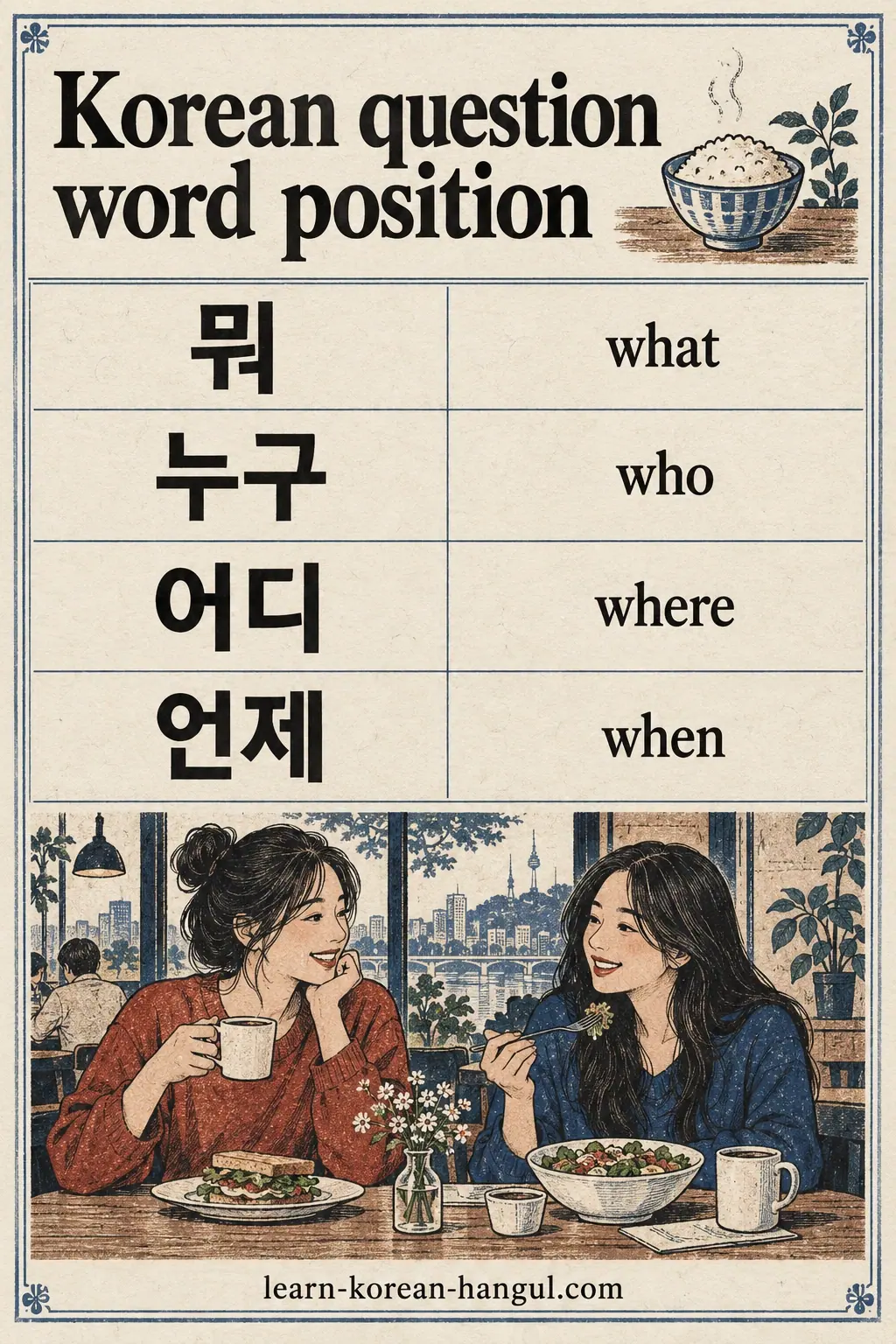
Korean question word position is the rule that a question word takes the place of the missing information and does not move. A question word is a word that asks for information, such as "what", "who" or "where". In English the question word jumps to the front of the sentence. In Korean the sentence keeps its normal shape, and the question word sits in the slot of the answer.
A useful test is to answer the question and compare the two sentences. The question 뭐 먹어요? gets the answer 비빔밥 먹어요. The word 비빔밥 stands where 뭐 stood. The rest of the sentence is the same. Linguists call this pattern wh-in-situ, which means that the question word stays "in place".
A First Example
Here are two question and answer pairs. Each answer repeats the sentence and fills the slot of the question word.
| Part | 뭐 먹어요? | 어디에서 일해요? |
|---|---|---|
| Question word | 뭐 (what) | 어디에서 (where, at what place) |
| Verb | 먹어요 (eat) | 일해요 (work) |
| Spoken | [뭐 머거요] | [어디에서 일해요] |
| RR (aid) | mwo meogeoyo | eodieseo ilhaeyo |
| English | What are you eating? | Where do you work? |
| Sample answer | 비빔밥 먹어요. | 회사에서 일해요. |
In both questions the question word comes first because the object or the place comes first in the statement. The verb is still last, as in every Korean sentence. The question words are taught in detail in 뭐 무엇 what in Korean, 누구 누가 who in Korean and 어디 where in Korean.
The next section shows how to build a question from any statement.
How Does Korean Question Word Position Work?
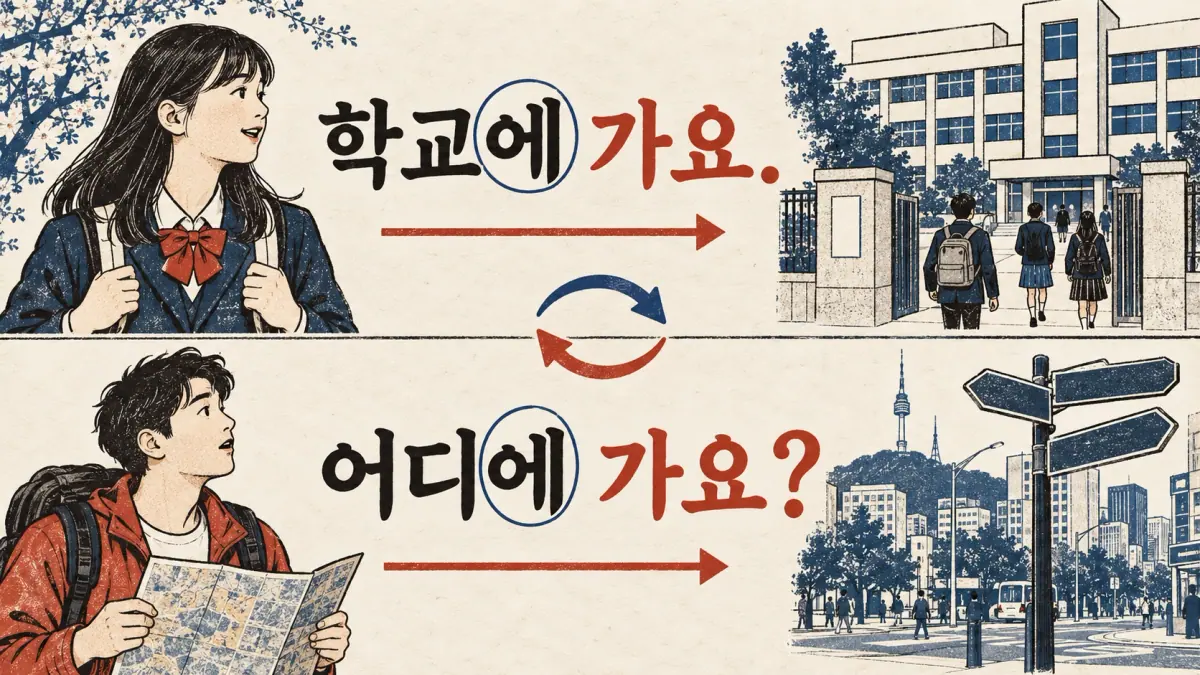
The rule has one step: replace the unknown part of a statement with the right question word, and leave everything else where it is. No other change is needed. The table below shows eight common question words, each in the slot it replaces.
| Question word | Meaning | Replaces | Statement | Question |
|---|---|---|---|---|
| 뭐 / 무엇 | what | an object | 밥을 먹어요. | 뭐 먹어요? / 뭘 먹어요? |
| 누가 / 누구 | who | a subject or an object | 민수가 왔어요. | 누가 왔어요? |
| 어디 | where | a place | 학교에 가요. | 어디에 가요? / 어디 가요? |
| 언제 | when | a time | 어제 만났어요. | 언제 만났어요? |
| 왜 | why | a reason | 피곤해서 자요. | 왜 자요? |
| 어떻게 | how | a manner | 버스로 가요. | 어떻게 가요? |
| 몇 | how many | a number | 사과를 세 개 샀어요. | 사과를 몇 개 샀어요? |
| 어느 | which | a choice | 이 책을 읽어요. | 어느 책을 읽어요? |
Three details deserve attention.
Object form of 뭐. The object particle 을/를 attaches to 뭐 as 뭐를, which shortens to 뭘 in speech: 뭘 먹어요? [뭘 머거요]. In writing and formal speech the full word 무엇 and its object form 무엇을 are used instead.
Subject form of 누구. The word 누구 changes to 누가 when it is the subject. Saying 누구가 is a mistake. For an object, use 누구를: 누구를 만났어요? ("Who did you meet?"). The matching answer fills the same slot: 민수를 만났어요.
Particles stay with the slot. When a question word replaces a noun with a particle, the particle stays: 학교에서 공부해요 becomes 어디에서 공부해요?, with 에서 kept. The particle shows what role the answer will have.
The next section builds a question from scratch.
Worked Example: Turning a Statement into 뭐 먹어요?
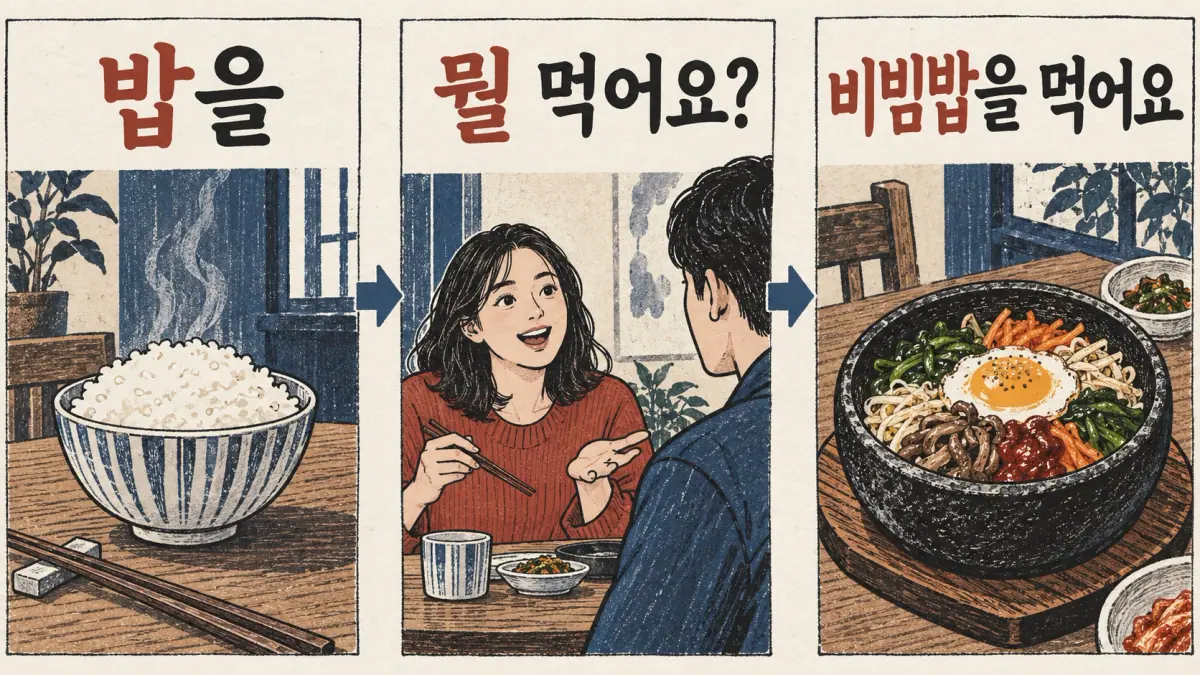
To build 뭐 먹어요?, write the statement first, find the unknown part, and swap in the question word. Five steps cover every question of this kind.
- Write the statement you expect as an answer. Start with 민수 씨는 밥을 먹어요, "Minsu eats rice."
- Decide what you want to know. You want to know the food, so the unknown part is 밥을.
- Replace the unknown with the question word. The question word for things is 뭐. Use 뭘 (or 뭐를) to keep the object particle: 민수 씨는 뭘 먹어요? ("What does Minsu eat?")
- Drop what the listener already knows. If you are asking the listener about themselves, drop the subject: a question with no subject is understood as being about "you", so 뭘 먹어요? means "What are you eating?"
- Check the verb. The verb 먹어요 is still last. The sentence is complete.
You'll know it worked when your answer can replace the question word without any other change: 비빔밥을 먹어요 fits where 뭘 먹어요 stood. Now try the place question: 회사에서 일해요 becomes 어디에서 일해요?, and the answer 회사에서 fills the slot of 어디에서.
Say each question slowly and listen to the end. In polite Korean the question has the same ending as the statement, so the intonation does part of the work: a yes/no question such as 먹어요? rises at the end. A question with a question word may rise or fall, because the question word already marks it as a question.
The next section compares this pattern with English.
Korean vs English Question Order
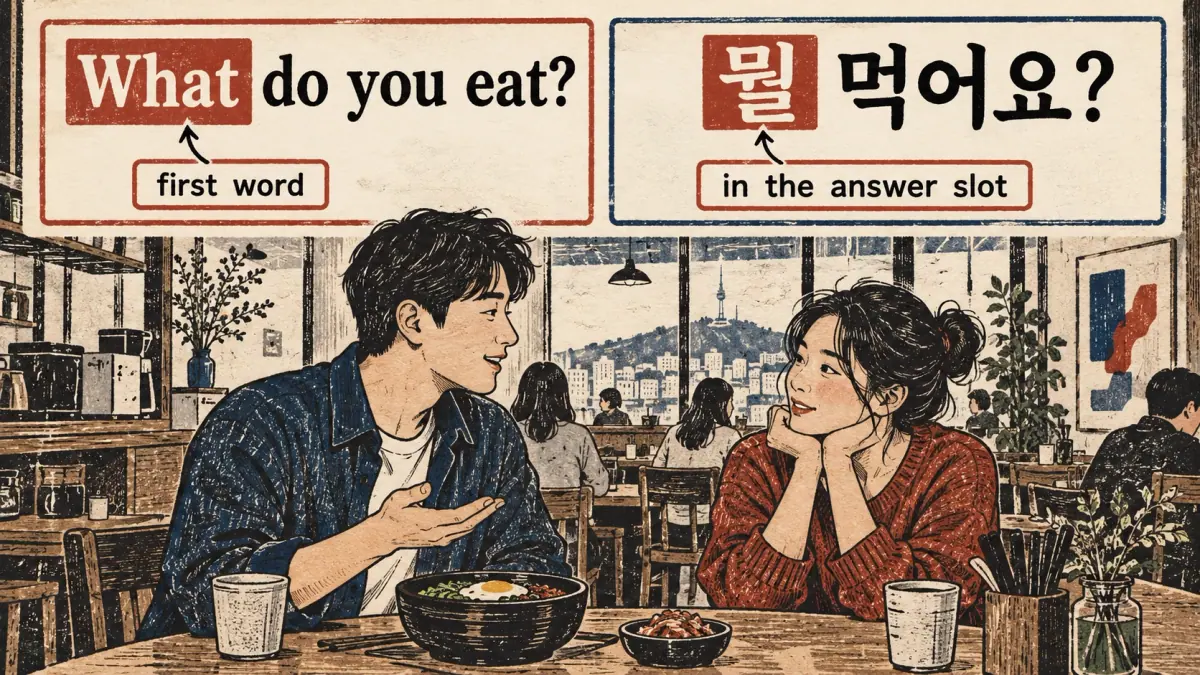
English and Korean ask questions in opposite ways. English moves the question word to the front and changes the verb order. Korean keeps the statement shape and substitutes the question word.
| Feature | English | Korean |
|---|---|---|
| Position of the question word | first word | in the answer slot |
| Verb order | changes ("do you eat") | does not change |
| Helper verb "do" | needed | does not exist |
| Statement: I eat rice | I eat rice. | 저는 밥을 먹어요. |
| Question: what | What do you eat? | 뭘 먹어요? |
| Answer position | after the verb | same slot as 뭘 |
This difference removes work for the learner. In English you must learn four steps: move the word, add "do", flip the subject and verb, then raise your voice. In Korean you only substitute a word. If you can make a statement, you can make a question.
The shared slot also helps with listening. When you hear a question, the question word tells you what type of information to give, and where it goes. If you hear 어디에서, the answer will be a place with 에서. If you hear 누가, the answer will be a person acting as subject.
The next section looks at the cases where the pattern has extra features.
Edge Cases: Yes/No Questions and Indefinite Use
The question word keeps its answer slot in ordinary questions. Three situations add detail.
1. Yes/no questions need no question word. A statement becomes a yes/no question by raising the tone at the end: 밥 먹었어요 (statement) and 밥 먹었어요? (question). Korean has no word-order change for this, and there is no helper verb. The lesson on yes/no questions in Korean covers the patterns.
2. Question words can mean "something". Korean question words also work as indefinite words, which means "some" or "any". Depending on the tone, 뭐 먹어요? can mean "What are you eating?" or "Are you eating something?" A listener uses the intonation and the situation to choose. A learner can usually rely on the situation, and should not worry about the difference at first.
3. Moving other words around the question word. Korean phrases can change places, so a question word can end up earlier or later than its default slot. In casual talk a speaker may add a word after the verb as an afterthought, as in 어디에서 일해요, 지금? ("Where do you work, now?"). The usual and safest place is still the answer slot. The idea that Korean words can move is explained in Korean flexible word order.
Time and place slots. When a question has a time or a place word, the usual order applies. 어제 어디에서 만났어요? puts "yesterday" before "where". The order is explained in Korean word order: time and place.
What this lesson does not cover. Embedded questions, such as "I do not know what he ate", use different endings. Indirect questions, tag questions and rhetorical questions belong to later lessons.
An honest limit. Intonation patterns vary by region, speaker and emotion. The rising tone described here is the textbook default, and real speech shows many variations.
The next section lists the errors that appear most often.
What Mistakes Do Learners Make with Question Words?
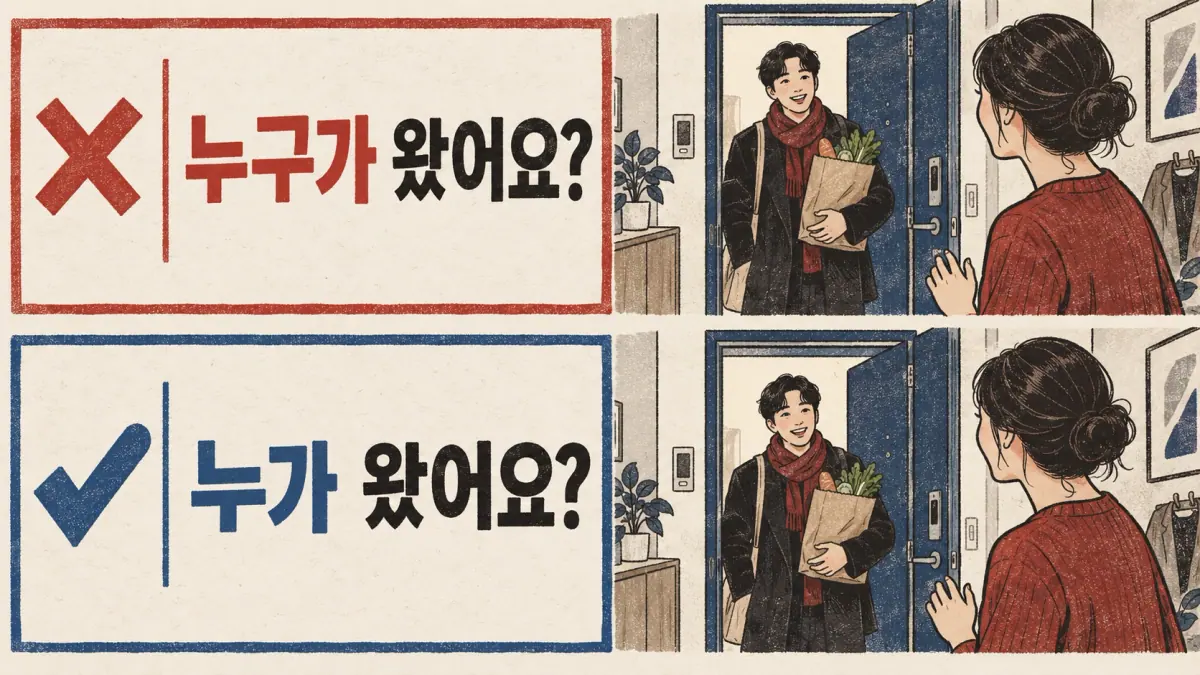
Learners make four predictable mistakes with question words. Each has a reason and a fix.
Learners often assume the question word must come first. Actually it stays in the slot of the answer. Unnatural: 뭐를 당신은 먹어요? Natural: 뭐 먹어요? or 뭘 먹어요? A fronted question word is possible in Korean for emphasis, but combined with 당신은 it sounds like a word-for-word translation. Fix: write the statement first, then replace one word.
Learners often assume 누구 takes 가 like other nouns. Actually 누구 changes to 누가. Wrong: 누구가 왔어요? Right: 누가 왔어요? Fix: memorize 누가 as the subject form, and use 누구를 for the object.
Learners often assume Korean needs a helper word. Actually it has none. Wrong: using an English-style helper to build a question, such as adding a word for "do". Right: 먹어요? with a rising tone. Fix: trust the tone and the question word.
Learners often assume the question word needs a subject. Actually the subject is usually dropped. Wrong style: 당신은 뭘 먹어요? every time. Better: 뭘 먹어요? Fix: drop "you" unless you need to contrast two people.
Practice puts these rules into your own sentences, as the next section shows.
Practice and Answers
Complete the four tasks, then compare your answers with the key.
Task 1: make the question. Replace the underlined part with the correct question word.
- 민수가 왔어요. (who)
- 학교에 가요. (where)
- 어제 만났어요. (when)
- 커피를 마셔요. (what)
Task 2: fix the error. Each sentence copies an English habit. Rewrite it as natural Korean.
- 뭘 당신은 먹어요?
- 어디에 당신은 가요?
- 누구가 왔어요?
Task 3: translate. Write in Korean: "Who is eating?" and "What do you read?"
Task 4: write your own. Write one question about where someone is going, and write the answer.
Practice · 8
Where does a Korean question word such as 뭐 or 어디 stand?
Show answer
In the slot where the answer will stand
Korean question words stay in place (wh-in-situ): replace the unknown part of the statement and keep the rest.
How do you ask "Who came?"
Show answer
누가 왔어요?
누구 changes to 누가 when it is the subject. 누구가 is a mistake.
Which is the natural way to ask "What are you eating?"
Show answer
뭘 먹어요?
Keep the statement shape, drop the subject the listener already knows, and avoid 당신. Fronting with 당신은 sounds like a word-for-word translation.
Which question word replaces 어제 in 어제 만났어요?
Show answer
언제
어제 is a time, and the question word for time is 언제: 언제 만났어요?
In speech, 뭘 is the short form of which word?
Show answer
뭐를
The object particle attaches to 뭐 as 뭐를, which shortens to 뭘 in speech.
Which form fills the blank in "___ 만났어요?" meaning "Who did you meet?"
Show answer
누구를
For an object, use 누구를. 누가 is the subject form, and 누구가 is never correct.
How do you turn the statement 밥 먹었어요 into a yes/no question?
Show answer
Raise the tone at the end
Korean has no inversion and no helper verb. A rising tone alone makes 밥 먹었어요? a question.
Besides "What are you eating?", what else can 뭐 먹어요? mean, depending on the tone?
Show answer
Are you eating something?
Question words also work as indefinite words, so 뭐 can mean "something".
Answer key
- (1) 누가 왔어요? (2) 어디에 가요? or 어디 가요? (3) 언제 만났어요? (4) 뭘 마셔요?
- (1) 뭘 먹어요? (2) 어디에 가요? (3) 누가 왔어요?
- 누가 먹어요? 뭘 읽어요?
- Sample answer: 어디에 가요? / 도서관에 가요. ("Where are you going?" / "I am going to the library.") Any question word is correct if it stands in the slot of the answer.
If you answered all of task 1 correctly, you have the substitution habit. If task 2 was hard, write the statement first and then replace one word. The next section points you to what comes after this lesson.
What Should You Learn after Korean Question Word Position?
After Korean question word position, learn the three most common question words one by one: 뭐 무엇 what in Korean, 누구 누가 who in Korean and 어디 where in Korean. Then see where adverbs sit among the slots in Korean adverb position in a sentence.
For a wider view, the parent page Korean word order lists every lesson in the set in learning order. If you want to see how much freedom the order allows, read Korean flexible word order. The basic verb-last pattern is explained in the Korean SOV sentence pattern lesson.
This lesson covers direct questions with question words only. It does not cover embedded or indirect questions. About this page. Last updated 2026-10-09. The Korean text, spoken forms and audio on this page were machine-generated and reviewed and signed off by Min-ji Park on 15 October 2026. Romanization follows the Revised Romanization of Korean and is shown only as a learning aid.
Frequently Asked Questions
What does question word position mean? Question word position means the place where a question word stands in a sentence. In Korean the question word takes the slot of the missing information and does not move. 뭐 먹어요? asks "What are you eating?" and the answer 비빔밥 먹어요 puts 비빔밥 in exactly the same slot. English moves "what" to the front instead.
How do I form a Korean question with a question word? Take the statement and replace the unknown part with the question word. Keep the other words and the verb-last order. For example, 학교에 가요 becomes 어디에 가요? when you replace 학교 with 어디. Add the polite ending, end with a falling or rise-fall tone rather than a sharp rise, and write a question mark. No other change is needed.
What is the most common mistake with question word position? The most common mistake is moving the question word to the front, English-style, as in 뭐를 당신은 먹어요? Korean speakers normally keep the question word in the slot of the answer, so the natural sentence is 뭐 먹어요? A second mistake is adding 가 to 누구, which gives the wrong form 누구가. The subject form is 누가.
How is question word position different from English? English places the question word first and then changes the verb order: "What do you eat?" Korean leaves the question word where the answer goes and keeps the verb last. Korean also needs no helper verb like "do". The sentence has the same shape as the statement, so learners can ask questions without learning a new word order.
Do I use this order in speech, writing or both? Both. Speech uses short forms such as 뭐 and 뭘, while writing and formal speech use 무엇 and 무엇을. The question word stays in the answer slot in all of them. In speech the slot can also move for emphasis, but a learner should keep the default placement until it is automatic.