How to Use the Korean Sentence Builder
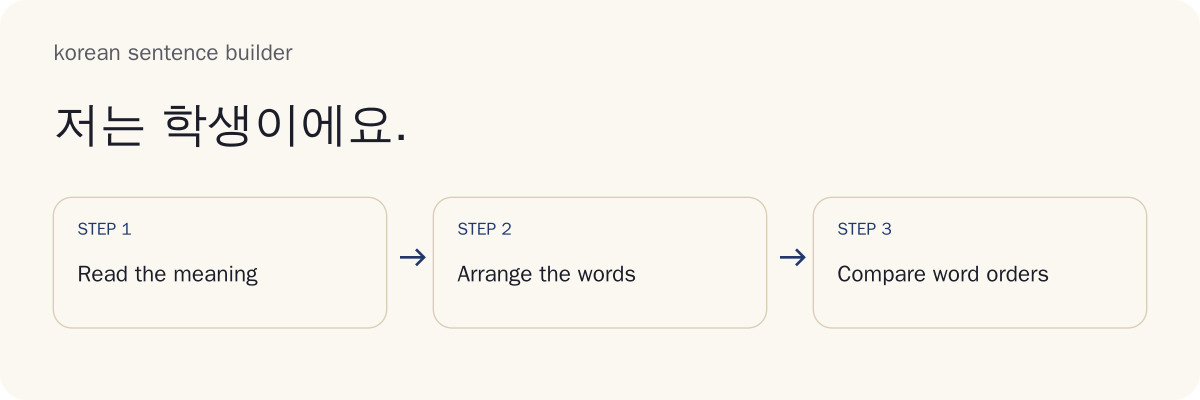
Use the builder by selecting a meaning, arranging or typing the supplied sentence, checking the outcome and trying again with less help. The goal is a sentence that fits the situation, not merely a row of familiar Korean words.
- Choose a meaning and mode. Read the whole prompt, including who is speaking, time and requested style. Build mode uses selectable chunks; Type mode accepts keyboard input or pasted text. Your checkpoint is being able to explain the intended message before answering.
- Build or type the sentence. Keep noun-and-particle chunks together. Use the controls rather than assuming dragging is necessary. In Type mode, finish Hangul composition before checking. Avoid copying a visible model while calling the attempt independent recall.
- Check and interpret the result. Distinguish an accepted answer, an incomplete attempt and an unlisted variant. A listed comparison is evidence about this task; an unknown order is not automatically bad Korean.
- Rebuild and review. Read the explanation, identify one issue and try again. Use Hint when needed, then attempt the same meaning without it later. Success means understanding why the phrase fits, not remembering where its button was.
Read the meaning again if the pieces seem impossible to arrange. A missing role or mismatched ending can be easier to identify from the intended situation than from the word bank. Sentence completeness gives you the next checkpoint.
What Makes a Korean Sentence Complete?
A complete beginner sentence needs a predicate that expresses its message, with participants supplied or understood from context. The predicate is the part that tells you an action, a quality, an identity or existence. Not every sentence needs a separately written subject and object.
The sentence-structure lessons give several patterns. Use them as different kinds of messages rather than forcing each one into “someone does something to an object.”
| Message Type | Existing Lesson Example | Meaning | Final Predicate |
|---|---|---|---|
| Action on something | 저는 사과를 먹어요. | I eat an apple. | 먹어요 |
| Identity | 저는 학생이에요. | I am a student. | 학생이에요 |
| Quality | 날씨가 좋아요. | The weather is nice. | 좋아요 |
| Absence | 시간이 없어요. | I have no time. | 없어요 |
The familiar subject-object-verb pattern is useful for the first row. It does not mean that the weather sentence needs an object or that an identity statement needs an extra action verb. Ordinary beginner clauses place their predicate at the end, but that observation alone cannot judge every possible spoken construction.
A topic identifies what the sentence is about; a subject identifies the participant associated with its predicate. An object is what an action acts on. These roles can overlap in meaning without being interchangeable labels for every chunk.
Context can make a participant clear without repeating it. The lesson's 네, 학생이에요 means “Yes, I am a student” in a context where the speaker is understood. The omitted English-style subject does not automatically make the Korean response unfinished.
A task can still require an explicit participant to practise a particular form. Distinguish that requirement from a claim that Korean always needs that participant written out. Once you understand the sentence's message and roles, the builder's checking outcomes become easier to interpret.
How Does the Builder Check an Answer?
The builder compares your attempt with listed answers and task constraints. It does not use the position of the final verb as proof that every other arrangement is correct. A finite answer key can recognise its supplied alternatives while leaving unfamiliar constructions ungraded.
Think of the process as a sequence. First, the tool checks whether there is enough material to evaluate the attempt. Next, it compares the assembled chunks or typed sentence with the supplied task information. A recognised answer receives its corresponding explanation. An unlisted answer stays outside that recognised set rather than receiving an invented grammar judgment.
Text comparison can account for supported normalisation, such as consistent character representation, without treating meaning-changing differences as cosmetic. An omitted participant, different particle or changed ending may matter to the message. Follow the specific feedback instead of assuming that every mismatch is only a typing issue.
Listed Alternatives and Task Constraints
A prompt can require a particular meaning, time or speech style. Another sentence may be usable Korean while missing that request. The fair explanation identifies what changed: the sentence describes a different event, uses a different participant or answers in another style. “Off target” and “impossible Korean” are different conclusions.
A supplied key also has limits. An unfamiliar order may need a teacher's contextual judgment. Keep the prompt with the answer when asking about it, because a bare sentence does not preserve the exercise's purpose.
Why Can Two Orders Both Fit?
The word-order lesson gives 밥을 동생이 먹어요, “My younger sibling eats the meal,” with the object first. Particle information helps retain the participant roles even when the ordinary order changes. This does not make every shuffle equally suitable in every situation.
Keep meaningful phrases together and consider what the speaker is emphasising. A word bank is an exercise representation, not permission to split any expression into arbitrary pieces. Moving a modifier away from what it describes can also change interpretation. Use a listed alternative when it fits, and keep an unknown arrangement ungraded until its context can be checked. Worked examples show how those principles support construction.
Worked Sentence-Building Examples
The four examples below reuse sentences from the site's grammar lessons. They illustrate how to read a prompt, identify roles and build a matching answer. They do not imply that every possible variation has been added to the exercise bank.
An Everyday Action
Input meaning: “I eat an apple.” Chunks: 저는 / 사과를 / 먹어요. Output: 저는 사과를 먹어요.
The opening introduces the speaker as topic, the apple chunk carries the object marking, and the predicate expresses eating. Keep the object particle attached to its noun. The sentence supplies a manageable neutral pattern before practising a more unusual order. A task asking about someone else would need a different participant, even if the arrangement were otherwise familiar.
A Place and a Reading Action
Input meaning: “Minsu reads a book at school.” Chunks: 민수가 / 학교에서 / 책을 / 읽어요. Output: 민수가 학교에서 책을 읽어요.
The particle lesson identifies Minsu as subject, school as the place of the action and the book as object. The final chunk expresses reading. Locating the action is different from saying that the school is a destination. Read the role of the whole place chunk instead of matching the school word alone.
An Identity Statement
Input meaning: “I am a student.” Chunks: 저는 / 학생이에요. Output: 저는 학생이에요.
The final identity expression completes the message without an object. Do not add an eating or going verb merely because you expect every sentence to use the first example's pattern. A contextually understood speaker can also be omitted in a suitable response, but an exercise requiring the topic chunk may ask you to keep it.
An Absence Statement
Input meaning: “I have no time.” Chunks: 시간이 / 없어요. Output: 시간이 없어요.
The predicate expresses absence. This is not the same construction as placing a negative word before the apple-eating example. Compare the intended message with the whole output, then practise identifying the predicate without looking at the role labels. The examples make particle choices more concrete.
Which Particles Belong with Each Phrase?
A particle belongs with the noun or phrase it marks. Choose its role from the message, then choose the appropriate form within a particle pair. These are separate decisions: knowing a noun's final sound does not tell you whether it should be topic, subject or object.
| Role to Identify | Common Particle Family | Existing Example Chunk |
|---|---|---|
| Topic | 은/는 | 저는 |
| Subject | 이/가 | 민수가 |
| Object | 을/를 | 책을 |
| Place of an action | 에서 | 학교에서 |
| Time or destination in a suitable construction | 에 | 학교에 |
The particle hub gives 학교에서 as “at school” and 책을 as the book marked as object. A particle attaches directly to its host without a space. Keeping these units together in Build mode helps you see their roles before moving the chunks.
Role Choice and Form Choice
Several particle families have two forms selected according to the host's ending. Learn that spelling choice after identifying the family you need. An answer can therefore choose the correct role but the wrong member of the pair, or use a well-formed pair member for the wrong role.
Avoid assigning a permanent particle to a noun. The same person or place can appear in different grammatical jobs across different messages. A school can be a destination or a place where an action happens; the word itself does not decide which message you mean.
Can a Particle Change the Meaning?
Changing particles can change who is associated with an action or how a phrase relates to it. Read the entire sentence after making a swap. A changed participant role is a meaning change, rather than a harmless alternative spelling.
Topic and subject markings also carry contextual differences. Do not assume that every first-person sentence must start with the same topic marker, or that every topic and subject version is interchangeable in the supplied situation. Use the prompt and explanation to decide what the exercise teaches. Endings then add another layer of meaning and task requirements.
Speech Levels, Questions and Negatives
Speech level, question meaning and negation are part of the requested sentence. A correct arrangement of noun chunks can still answer the wrong question or use a different style from the prompt. Check those features before treating the sentence as complete.
The sentence-structure lesson gives 저는 학생이에요 for “I am a student” and 저는 학생이 아니에요 for “I am not a student.” The negative identity statement has its own construction; it is not created by dropping an arbitrary negative word anywhere in the positive sentence. The absence example 시간이 없어요 uses another predicate pattern.
Questions also depend on the intended information. The word-order lesson gives 뭐 먹어요?, “What are you eating?” The question word occupies the place of the unknown content, rather than following an English rule that every question word moves to a special front position.
Why Can a Sentence Be off Target?
A task may ask for a polite statement about an action now. A sentence about a past event, an identity or another speech level would test a different construction. The feedback should explain that mismatch without claiming that the other construction is always invalid.
Keep punctuation consistent with the requested output, but distinguish punctuation from the sentence's full interpretation. Copying a question mark alone cannot repair the wrong words or ending. When a negative prompt is difficult, return to a matching lesson instead of rearranging familiar positive chunks at random. Once the message and construction are clear, practise producing them without the bank.
How to Practice without the Word Bank
Practise without the word bank by removing support gradually: build a familiar sentence, hide the pieces, recall its chunks and then type the whole message. Change one source of help at a time so you can identify what remains difficult.
Begin with a meaningful phrase, such as the object or place chunk, before recalling the entire sentence. Explain its role in English, then recover its Korean form from memory. This is more informative than repeatedly tapping the same button positions in a shuffled bank.
Typed practice checks whether you can produce the text when choices are absent. Pasted input can be useful for checking a supplied sentence, but it does not demonstrate the same recall. Keep those uses separate when interpreting your progress.
Hint, reveal and meaning-build audio mark an attempt assisted. Assisted attempts remain outside the unaided score. A helpful correction is still learning; separating it from independent retrieval makes the record easier to interpret.
Listening can support comparison when the source is available. Record your own version if useful, then compare by ear. Recording does not produce a pronunciation grade. When revisiting a sentence later, first try the meaning without looking at the earlier answer. Recalling a familiar arrangement once does not prove that you can use it in a new situation. Personal sets let teachers and learners organise those follow-up tasks.
Teacher Sets and Printable Worksheets
Personal sets need a context, phrase segmentation and an answer key. Import material you are permitted to study privately as text, CSV, TSV or JSON. Importing a textbook sentence does not grant permission to redistribute the book's content in shared worksheets.
Prepare a Fair Answer Key
Write the intended situation before the model answer. Identify the speaker, message and requested style. Then divide the answer into meaningful chunks, preserving attached particles and expressions that should stay together. List alternatives only when you have reason to accept them for that context.
Keep repeated chunk occurrences distinct. Two identical-looking pieces are still separate occurrences in a sentence. A stable set should retain those occurrences and its phrase boundaries so the worksheet and interactive task agree about the material being arranged.
Unknown variants should remain ungraded, including in a personal set. A supplied answer key is a comparison source, not an automatic grammar authority. Ask a qualified teacher about uncertain alternatives before assigning them as accepted answers.
Print prompts and answers separately when preparing a worksheet. Check Korean font rendering, punctuation, chunk boundaries and page breaks in the output. A seed helps reproduce an arrangement, while the set's version identifies which key and context apply. Share those details when needed for a consistent assignment.
Exports and assignment links are deliberate actions. Inspect what you selected before sharing, and keep personal recordings separate from the classroom material. A fair set records enough context to make later questions about unknown answers answerable.
Frequently Asked Questions
Can I Use the Builder before Installing a Korean Keyboard?
Yes. The Build mode uses chunk buttons. Type mode accepts pasted or keyboard input.
Does Hint Reduce My Saved Practice Score?
Hint, reveal and meaning-build audio mark an attempt assisted. Assisted attempts stay outside the unaided score.
Will the Builder Work on a Train without Internet?
After saving the tool offline, local assembly and saved progress work without a connection. Audio must be saved separately.
Can I Import Sentences from My Own Textbook?
You can import material you may privately study as text, CSV, TSV or JSON. Supply its context, segmentation and answer key; unlisted variants remain ungraded.
Where Are My Sentences and Recordings Stored?
Personal practice data stays in this browser. Exports and assignment links are deliberate actions. Private audio is cached only when you choose to save it.
What Happens If Microphone Playback Causes Echo?
Recording pauses the reference. Use headphones and compare a new take by ear; the tool does not assign a pronunciation grade.
What Should You Do When an Answer Needs Checking?
Keep the prompt, assembled or typed answer and the relevant outcome together when an unfamiliar answer needs checking. These details let a teacher compare your intention with what the sentence actually expresses. An answer shown without its situation can hide the reason it was off target.
Start by checking completeness and meaning. Did you use the required chunks? Did a particle change a participant's role? Did the ending change the time, speech style or kind of sentence? If those checks do not resolve the issue, keep the variant ungraded.
Use the local flag or evidence export deliberately if you want to preserve the comparison. Check what it contains before sharing it with another person. Personal sentences and recordings do not need to be sent automatically for every unknown result.
A model suggestion or a convincing-looking shuffle does not establish a new accepted answer. Ask a qualified Korean teacher about the full context and retain their explanation with the task. Then choose the lesson that addresses the specific uncertainty.
Continue with the Korean Sentence Builder
Use the Korean sentence builder to turn one understood meaning into a complete phrase, check its roles and try it again without the bank. Keep unfamiliar variants ungraded until their context can be checked. Progress is easier to judge when your next attempt addresses a specific earlier difficulty.
Read Korean word order lessons for the ordinary template and its variations. Compare Korean sentence patterns when a message expresses identity, quality or absence rather than an action on an object. Use the particle lessons when your noun chunks need clearer roles.
Return to one matching exercise afterwards. Explain why its predicate completes the message, why its particles fit and which information the situation leaves understood. That explanation gives your next typed attempt a purpose beyond reproducing the earlier shuffle.
A Final Practice Check
Before keeping a result as independent success, ask whether you supplied the sentence yourself, whether help was revealed and whether its meaning matches the prompt. These questions separate understanding the construction from recognising a displayed solution. Try explaining one phrase role without relying on its position in the answer bank.
A useful note records the actual difficulty: choosing the object particle, remembering an identity ending or keeping the place chunk together. A general note such as “wrong word order” can conceal those different problems. On the next attempt, change only the part that caused trouble and read the entire sentence again.
The builder covers supplied practice tasks and listed alternatives. It does not grade unrestricted Korean writing, resolve every context-dependent order or certify pronunciation from a recording. Use a full lesson or teacher discussion when your question reaches beyond the current task, then return with a clearer meaning to practise.
Keep your first unaided answer before making corrections, so a later comparison shows what you could produce without the earlier model.