Quick verdict
- Asking for a way to do something: use 어떻게 plus an action verb.
- Asking for an opinion, condition or impression: use 어때요 after the noun.
- Making a suggestion ("How about...?"): use 어때요 after the idea.
- Asking for a name or number politely: use the set phrase 어떻게 되세요.
What you'll learn
- Choose 어떻게 or 어때요 for a given English "how" question and give the reason in one sentence.
- Build both questions in a polite (해요체) sentence.
- Use 어때요 for suggestions, and 어땠어요 for the past.
- Recognise the overlap in greetings such as 어떻게 지내요? and 요즘 어때요?.
- Fix the most common mistake: 어떻게예요 for "how is it?".
Before you start: you should know the polite ending -아요/-어요 and basic sentence order. If not, read Korean sentence structure first. Audio plays only when you press a button.
What Is the Difference in 어떻게 vs 어때요?

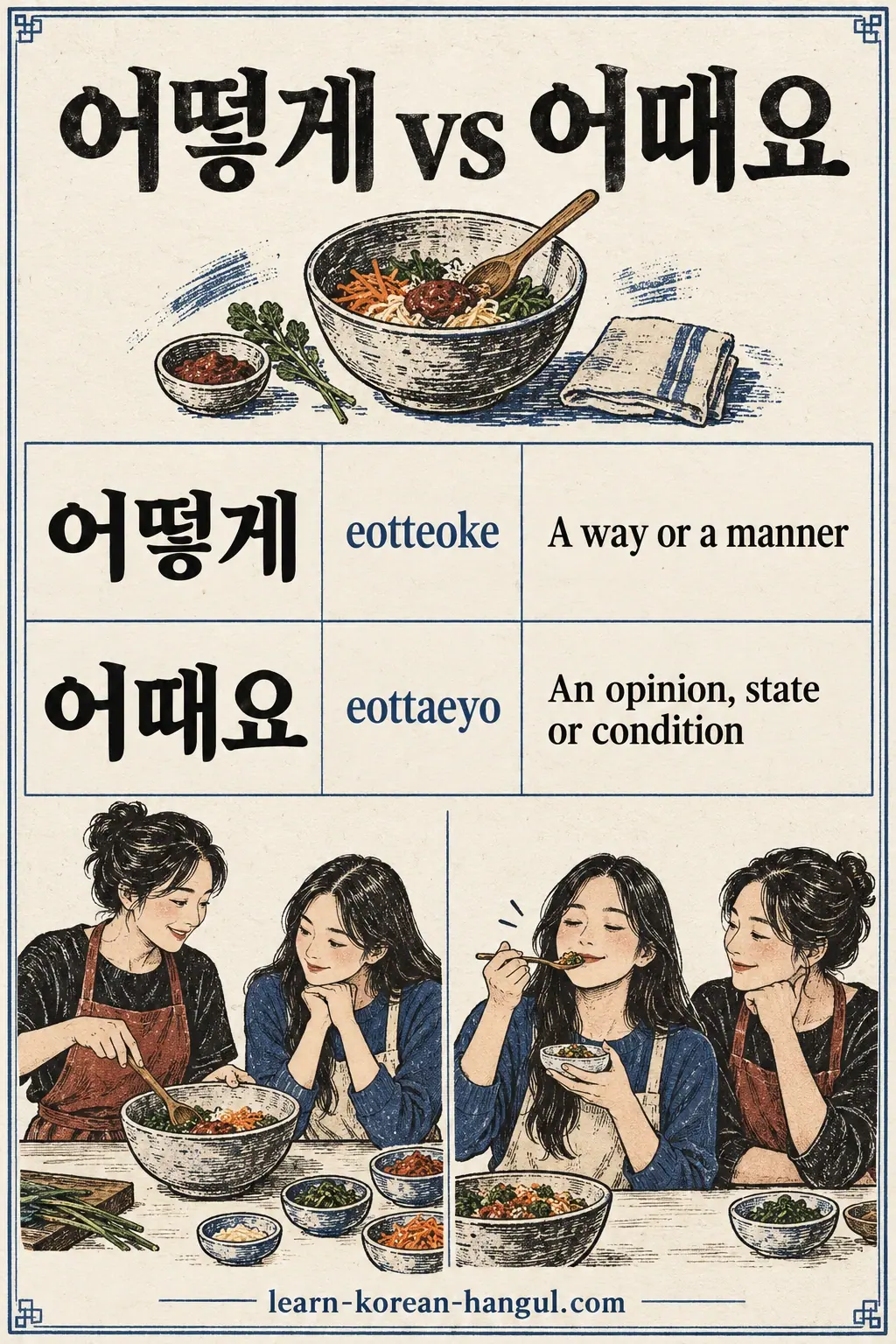
The difference in 어떻게 vs 어때요 is what the speaker wants back. 어떻게 asks for a method, and the answer is a way to act: "by bus," "like this." 어때요 asks for a judgment, and the answer is a description: "good," "too hot," "tasty." English uses the one word "how" for both, so learners need a separate habit for Korean.
Two sentences about the same topic show the contrast.
- 이 음식을 어떻게 만들어요? (i eumsigeul eotteoke mandeureoyo?) = "How do you make this food?" The reply names steps or a method.
- 이 음식 어때요? (i eumsik eottaeyo?) = "How is this food?" The reply is an opinion, such as 맛있어요 ("It's tasty").
The noun 음식 is the same, and only the question changes the answer. The next sections turn this into a rule that you can apply in a few seconds.
What Is the One-Line Rule?
Use 어떻게 when a verb follows and you want a method. Use 어때요 when a noun comes before it and you want an opinion. Ask yourself one question before you speak: "Do I want to know a way, or do I want to know what it is like?" If you want a way, say 어떻게. If you want a description, say 어때요. When in doubt about a thing you can see or taste, 어때요 is the safer word.
How Do 어떻게 and 어때요 Compare Side by Side?
The table compares the two on the points learners need most. Each row has one specific answer for each form.
| Point | 어떻게 | 어때요 |
|---|---|---|
| Core meaning | "how," by what method | "how is it," what is it like |
| What it asks | A way or a manner | An opinion, state or condition |
| Word class | Adverb | Descriptive verb (adjective) 어떻다 |
| Position | Before an action verb | After a noun, at the end |
| Typical answer | 지하철로 가요. | 좋아요. |
| Politeness forms | 어떻게 + the verb's own ending | 어때요 / 어떠세요 / 어떻습니까 |
| Past tense | The verb changes: 어떻게 갔어요? | 어땠어요? |
| Suggestion use | No | Yes: 같이 가요, 어때요? |
The table shows that 어떻게 is a modifier that needs a verb, while 어때요 is a full predicate that can end a sentence by itself. Next, one situation is built in both ways so you can see how the choice is made.
How Does 어떻게 vs 어때요 Work in a Worked Example?

어떻게 vs 어때요 works by choosing the question that matches the answer you want. Follow the steps with a trip to the market.
- Decide what you want to know. You want to reach the market. You need a method, so the word is 어떻게.
- Build the 어떻게 question. Put 어떻게 before the verb: 시장에 어떻게 가요? (sijange eotteoke gayo?) = "How do I get to the market?" A reply is 버스로 가요.
- Switch the goal. Now you have visited the market and want to hear a friend's impression. You need a description, so the word is 어때요.
- Build the 어때요 question. Put the noun first and 어때요 last: 시장 어때요? (sijang eottaeyo?) = "How is the market?" A reply is 사람이 많아요 ("There are many people").
- Check the reply. If you hear a vehicle or a path, you asked about a method. If you hear an adjective, you asked about an impression.
You will know it worked when the reply matches the question. The common slip at this step is to translate the English "how" without asking what kind of answer you need. Real conversations raise a further question: which one should you pick in a given situation?
Which Should You Choose in Each Situation?

Choose 어떻게 for methods and directions, and choose 어때요 for opinions, impressions and suggestions. The table below sorts everyday situations. Each row names the situation, the best question and a model sentence.
| Situation | Best question | Model sentence |
|---|---|---|
| Asking directions | 어떻게 | 지하철역에 어떻게 가요? |
| Asking how to read a word | 어떻게 | 이 글자를 어떻게 읽어요? |
| Asking about a new phone | 어때요 | 새 휴대폰 어때요? |
| Asking about the weather | 어때요 | 오늘 날씨가 어때요? |
| Proposing a time | 어때요 | 내일은 어때요? |
| Asking a customer's name | 어떻게 | 성함이 어떻게 되세요? |
Three kinds of speakers meet this choice most often. A traveller who asks for directions needs 어떻게 almost every time. A friend who shares photos of a trip wants 어때요, because the topic is how things were. A shop assistant who asks for a name uses 어떻게 되세요, a set phrase that has no literal "how." Two quick tests help in the moment. First, try the English word "like": if "What is it like?" fits, use 어때요. Second, try the English phrase "in what way": if "In what way do you do it?" fits, use 어떻게. Both tests work because the two Korean words come from the same verb 어떻다 ("to be like what") but point at different things: the way of an action or the quality of a thing.
The speaker's goal decides, and the mistakes below almost always come from ignoring the goal.
What Mistakes Do Learners Make with 어떻게 vs 어때요?
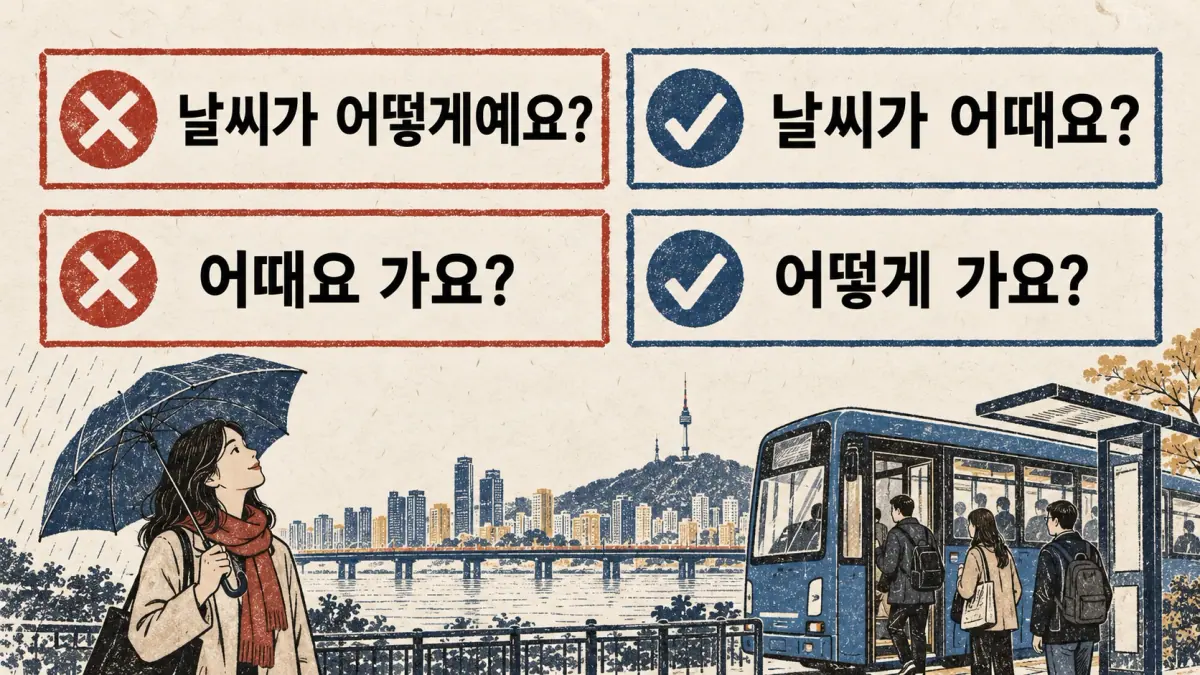
Learners most often copy the English "how is it?" into 어떻게. Four mistakes appear again and again, and each has a quick repair.
- Saying 어떻게예요. 날씨가 어떻게예요? is wrong. 어떻게 is an adverb and cannot end a sentence with 이에요. Say 날씨가 어때요?
- Putting 어때요 before a verb. 어때요 가요? is not a sentence. If you want the method, say 어떻게 가요?
- Answering an opinion question with a method. To 음식 어때요? the reply 지하철로 가요 does not fit. Reply with a description: 맛있어요.
- Forgetting the past form. To ask "How was the trip?" say 여행 어땠어요? (yeohaeng eottaesseoyo?) [여행 어때써요]. Using 어때요 for a past event sounds like a question about right now.
Use this checklist when a "how" sentence feels wrong: Does a verb follow? Do I want a method or an impression? Is the tense right? Edge cases follow from the same checklist.
When Do 어떻게 and 어때요 Work Differently?

They work differently in four cases: suggestions, greetings, set phrases and polite forms. Each case below gives the rule and one example.
- Suggestions. 어때요 can offer an idea. 같이 갈래요, 어때요? (gachi gallaeyo, eottaeyo?) = "Shall we go together? How about it?" or 내일 만나는 거 어때요? ("How about meeting tomorrow?"). 어떻게 cannot do this.
- Greetings. Both are used for "How are you?", with a small shift. 요즘 어때요? asks about your current state. 어떻게 지내요? asks how you have been getting by. In speech, native speakers often use them for the same purpose.
- Set phrase 어떻게 되세요. 성함이 어떻게 되세요? and 연세가 어떻게 되세요? (age, respectful) ask for names and ages politely. The verb 되다 means "to become" here, and the question has no method meaning.
- Formal and honorific forms. 어때요 has the honorific 어떠세요? and the formal 어떻습니까?. 어떻게 has no such set, because only the verb that follows changes: 어떻게 가세요? ("How do you go?", respectful).
An honest limit: this lesson separates two question types, but 어떻게 can also ask for an opinion when the verb after it is about opinion. 이거 어떻게 생각해요? ("What do you think of this?") uses 어떻게 with the verb 생각해요, and it asks for an opinion, not a method. Learners do not need to memorise such cases now. A related reminder: the sister word 어떤 (what kind of) works before a noun, and it is covered in 어떤 what kind of which. The long forms deserve one more look, because tests use them.
How Do 어때요, 어떠세요 and 어떻습니까 Relate?
The three forms differ in politeness only. 어때요 is the standard polite form for everyday talk. 어떠세요 adds the honorific -세요 and suits elders or customers. 어떻습니까 is formal, for news, announcements and business, and it is paired with 어떻게 + the formal verb ending, such as 어떻게 합니까?. The meaning stays the same in all three forms.
The forms confirm that 어때요 is a verb with its own politeness levels, so the practice below tests the choice directly.
Practice and Answers
Try the four items before you read the answer key. Cover the answers with your hand.
- Choose the form. You want a friend's opinion on a film. Complete: 그 영화 ___ ? (어떻게 / 어때요)
- Fix the error. A learner asks 이 책이 어떻게예요? What is wrong?
- Translate. "How do you read this word?" and "How was the food?"
- Write your own. Write one 어떻게 question and one 어때요 question about food, and reply to each.
Sentence
How is the weather?
Show answer
날씨가 어때요?
Practice · 8
You want a friend's opinion on a film. Complete: 그 영화 ___?
Show answer
어때요
An opinion question uses 어때요 after the noun.
A learner asks 이 책이 어떻게예요? What is the correct question?
Show answer
이 책이 어때요?
어떻게 is an adverb and cannot end a sentence with 이에요; use 어때요 for an impression.
Translate "How was the food?"
Show answer
음식 어땠어요?
The past of 어때요 is 어땠어요; 어때요 would ask about right now.
How do you ask directions to the subway station?
Show answer
지하철역에 어떻게 가요?
Directions are a method, so 어떻게 goes before the action verb.
Which question proposes a time ("How about tomorrow?")?
Show answer
내일은 어때요?
어때요 can offer an idea as a suggestion; 어떻게 cannot do this.
음식 어때요? Which reply fits?
Show answer
맛있어요.
An opinion question is answered with a description, not a method.
What is the honorific form of 어때요 for elders or customers?
Show answer
어떠세요?
어떠세요 adds the honorific -세요; 어때요 is standard polite and 어땠어요 is the past.
Which word class is 어때요?
Show answer
A descriptive verb from 어떻다 that can end a sentence
어때요 is a full predicate; 어떻게 is the adverb that must be followed by a verb.
Answer key
- 어때요. You want an opinion, so the sentence is 그 영화 어때요? ("How is that film?").
- 어떻게예요 cannot end a sentence. Say 이 책이 어때요? ("How is this book?") to ask for an impression.
- 이 단어를 어떻게 읽어요? (method) and 음식 어땠어요? (past opinion) [음식 어때써요].
- Answers vary. Check that the 어떻게 question has a verb after it and the 어때요 question follows a noun. Examples: 김치를 어떻게 만들어요? 배추로 만들어요. and 김치 어때요? 매워요.
Check your understanding with one more rule of thumb: if the answer is a way, use 어떻게. If the answer is an adjective, use 어때요.
What Should You Learn Next after 어떻게 vs 어때요?
After 어떻게 vs 어때요, study each question word on its own, then the amount questions. This lesson compares the two but does not teach every use of either one. Detailed rules live on their own pages.
- Start with 어떻게 how in korean, which covers the method question in depth.
- Continue with 얼마 얼마나 how much in korean for price, amount and length.
- Review the yes-or-no pattern in yes no questions in korean.
- Ask for a reason with 왜 why in korean.
- Return to Korean questions to see every lesson in the set, or compare other pairs on Korean grammar differences.
With these steps, the choice in 어떻게 vs 어때요 becomes automatic: decide whether you want a way or an impression, then match the question to it.
Frequently Asked Questions
Can I Say 어떻게예요 to Ask "How Is It"?
No. 어떻게 is an adverb and cannot end a sentence with 이에요. To ask for an opinion or a state, say 어때요, as in 날씨가 어때요? ("How is the weather?"). Use 어떻게 only when a verb follows and you want to know the method, such as 어떻게 가요?.
Why Does 어때요 Look so Different from 어떻게?
Both come from the verb 어떻다. 어떻게 adds the adverb ending -게. 어때요 adds the polite ending -어요, and because 어떻다 is an ㅎ-irregular verb, the ㅎ drops and the vowels merge into 어때요. The change hides the shared stem, so learners treat them as unrelated words, but the shared root explains why both mean "how".
How Do I Ask "How Was It?" in Korean?
Use the past form 어땠어요?, spoken [어때써요]. Add the topic: 여행 어땠어요? ("How was the trip?"). A reply is an adjective in the past, such as 좋았어요 ("It was good"). The present 어때요? would ask about how it is now, not how it was.
Is 어때요 Only for Opinions?
No. It also asks about state or condition, such as 몸이 어때요? ("How is your body?") and 날씨가 어때요?. It works as a suggestion too, as in 내일은 어때요? ("How about tomorrow?"). In all cases the answer describes something, and it is never a method.
What Is the Polite Form of 어때요?
어떠세요? is the respectful form for elders and customers, as in 기분이 어떠세요? ("How do you feel?"). 어떻습니까? is the formal form for news and business. 어때요? is standard polite speech for friends and colleagues. The meaning is the same, and only the politeness level changes.