What you'll learn
- Ask "when" with 언제 in a polite sentence and in a sentence with 이에요.
- Build 언제부터 (since when), 언제까지 (until when) and 언제쯤 (around when).
- Explain why the question has no 에 but the answer often does.
- Choose between 언제, 몇 시에 and 무슨 요일에.
- Fix the most common mistake: saying 언제에.
Before you start: you should know the polite ending -아요/-어요 and the basic order subject, object, verb. If not, read Korean sentence structure first. Audio plays only when you press a button.
What Does 언제 When in Korean Mean?

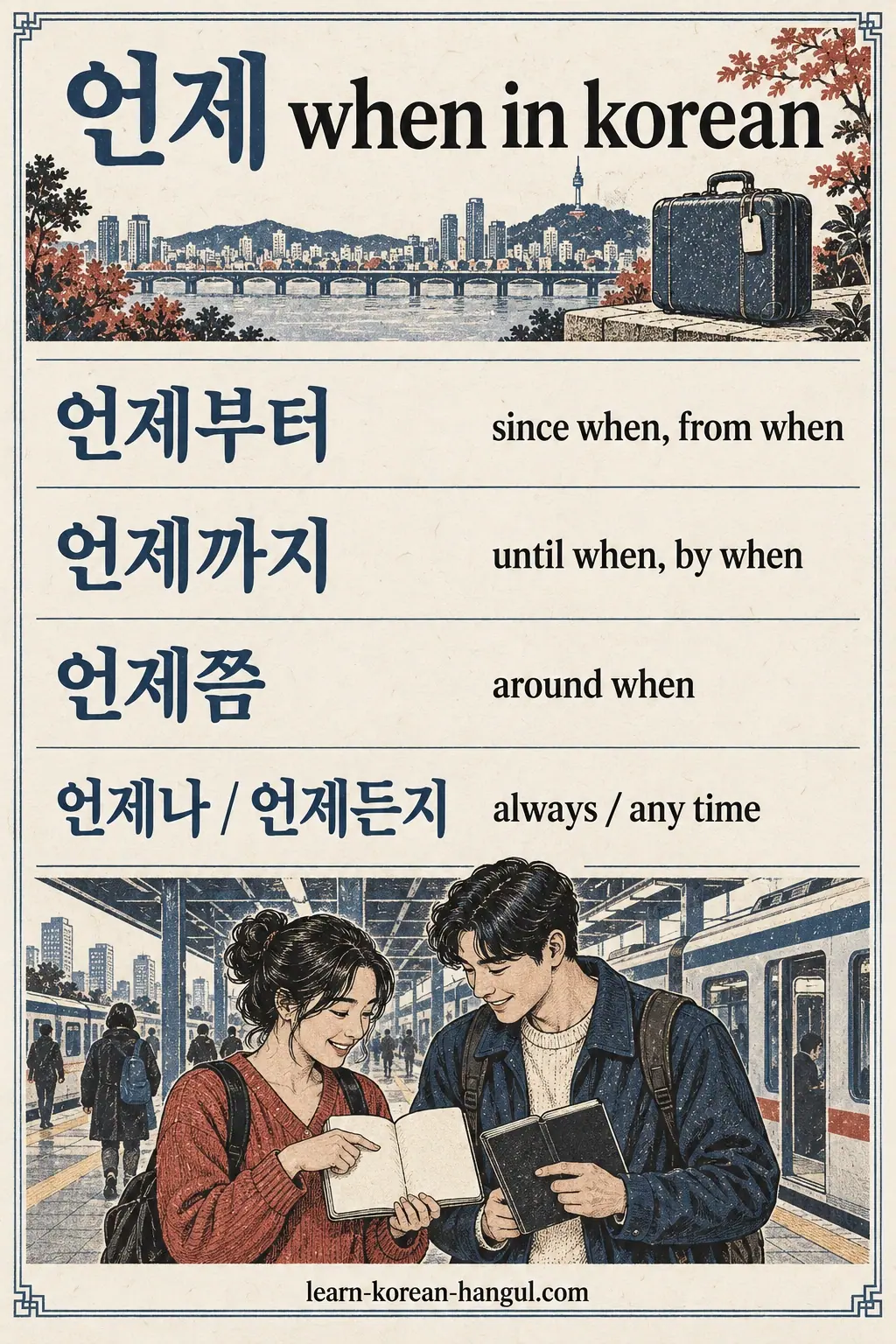
언제 is a Korean question word (의문사, uimunsa) that stands for a time. It can mean "when" for a moment, a day, a season or a date. It works as a noun-like word, so it can sit before a verb, before a particle such as 부터, or before the verb 이다 ("to be").
Korean has no separate word order for questions. Like other question words, 언제 stays in the place where the answer would stand. The answer to 언제 만나요? is 내일 만나요 ("We'll meet tomorrow"), and 내일 sits exactly where 언제 sat. The pattern is described in question word position.
A First Example
Two annotated sentences show the pattern.
- 언제 만나요? (eonje mannayo?) = "When shall we meet?" The parts are 언제 (when), 만나요 (meet, polite ending).
- 생일이 언제예요? (saengiri eonjeyeyo?) [생이리 언제예요] = "When is your birthday?" The parts are 생일이 (birthday, subject), 언제 (when), 이에요 (is), which contracts to 예요 after a vowel.
Both sentences ask for a time. The first asks for a moment to meet, and the second asks for a date. The next section states the rule that these examples share.
How Does 언제 When in Korean Work?
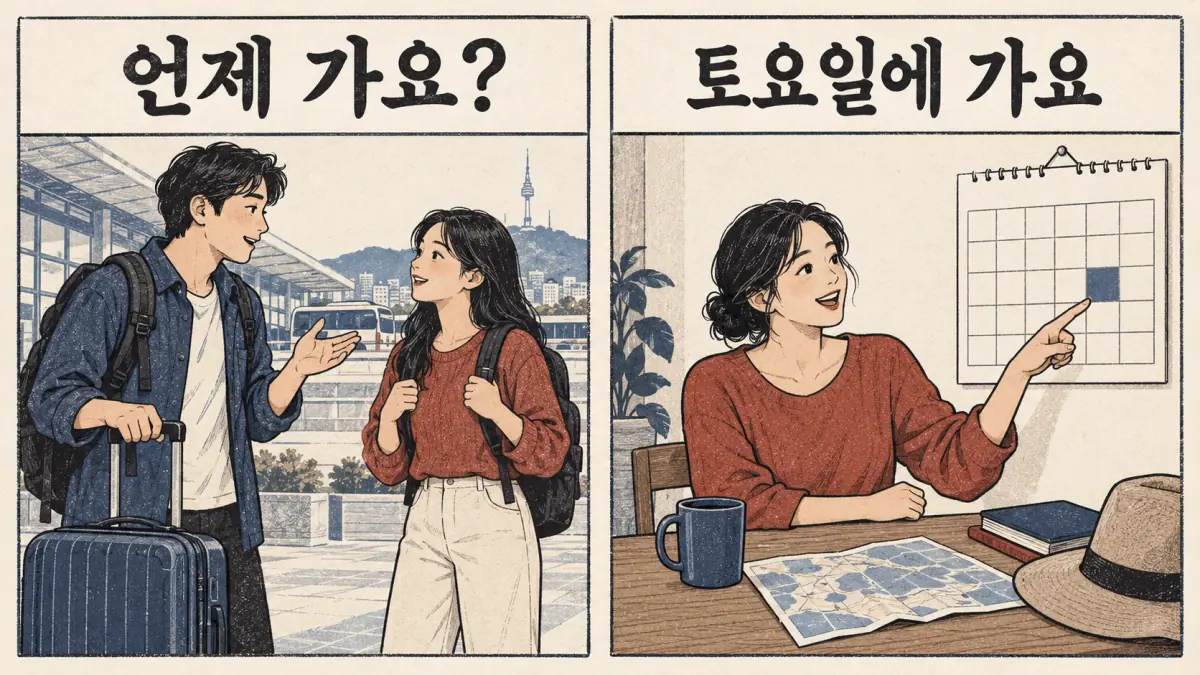
Put 언제 directly before the verb, with no 에, and use the sentence ending you would use for a statement. Add a particle such as 부터 or 까지 only when you need "since when" or "until when." The particle 에 (at, on) marks a time in the answer, but the question word 언제 already contains the idea of time, so the question does not take it.
The rule behind this is the difference between a time word and a time phrase. Words like 내일 (tomorrow), 오늘 (today) and 어제 (yesterday) take no 에 either. Specific points such as 토요일 (Saturday) or 세 시 (three o'clock) take 에. Learners often copy the answer's 에 into the question and say 언제에, which is a mistake. The time particle 에 lesson explains when 에 is needed.
Pattern Table
The table lists the forms learners use most, with meaning and a model sentence.
| Form | Meaning | Model sentence |
|---|---|---|
| 언제 + verb | when does or did it happen | 언제 가요? (When do you go?) |
| 언제 + 이에요 | when is it (a date, an event) | 시험이 언제예요? (When is the exam?) |
| 언제부터 | since when, from when | 언제부터 한국어를 공부했어요? |
| 언제까지 | until when, by when | 언제까지 해요? (Until when do you do it?) |
| 언제쯤 | around when | 언제쯤 도착해요? (Around when do you arrive?) |
| 언제나 / 언제든지 | always / any time | 언제든지 전화하세요. |
The table shows that 언제 combines with particles and endings like an ordinary noun. The 부터 from particle lesson covers the "from" word in detail. A worked example shows how to build a question from a statement.
How Do You Build a Question with 언제 Step by Step?

You build a 언제 question by replacing the time word in a statement with 언제. Follow the steps with the sentence "We meet on Saturday."
- Start with the statement. 우리는 토요일에 만나요. (urineun toyoire mannayo.) [우리는 토요이레 만나요] = "We meet on Saturday." The time phrase is 토요일에.
- Find the time phrase. 토요일에 is the part you want to ask about.
- Remove the particle with it. Take away both 토요일 and 에. The question word stands alone.
- Insert 언제. Put 언제 where the phrase stood: 우리는 언제 만나요?
- Drop the subject. Korean leaves out "we" when the context is clear: 언제 만나요? (eonje mannayo?) = "When do we meet?" Use the ordinary pitch of a wh-question; a sharp rise at the end can make it sound like the yes-no question "Shall we meet sometime?"
You will know it worked when the verb ending is unchanged and 언제 has no particle. The common slip is keeping the 에 from the statement, which gives 언제에 만나요?. Change the tense when you need to: 언제 갔어요? (eonje gasseoyo?) = "When did you go?" and 언제 갈 거예요? (eonje gal geoyeyo?) [언제 갈꺼예요] = "When will you go?" Here is a short exchange that uses the pattern with the answer carrying 에:
- A: 언제 여행 가요? (eonje yeohaeng gayo?) = "When are you going on a trip?"
- B: 다음 주에 가요. 언제 시간 있어요? (daeum jue gayo. eonje sigan isseoyo?) [다음 주에 가요. 언제 시간 이써요] = "I'm going next week. When do you have time?"
The first answer ends in 에 because 다음 주 (next week) names a point in the calendar. The second question has no 에 because 언제 already asks for that point. With the build clear, the next question is how 언제 differs from the specific time questions.
How Is 언제 Different from 몇 시에 and 무슨 요일에?

언제 asks for any time in general, while 몇 시에 asks for the hour and 무슨 요일에 asks for the day of the week. The specific questions narrow the answer to one kind of time, and they take 에 because the question word is not 언제.
| Question | Asks for | Typical answer | Takes 에? |
|---|---|---|---|
| 언제 만나요? | Any time | 내일, 토요일에, 세 시에 | No |
| 몇 시에 만나요? | The hour | 세 시에 만나요. | Yes |
| 무슨 요일에 만나요? | The day of the week | 토요일에 만나요. | Yes |
| 며칠에 만나요? | The date | 십오 일에 만나요. | Yes |
The reply to 언제 만나요? can be loose ("Soon," "Next week"), while the reply to 몇 시에 만나요? must be an hour. Use 언제 when you do not yet know what kind of time to expect. The 몇 how many in korean lesson covers 몇 시, and the 무슨 what kind of lesson covers 무슨 요일. There are also uses of 언제 that go beyond a question.
When Do You Use 언제, and When Not?

Use 언제 for time questions and for fixed phrases about time, and avoid it when you need a duration or a reason. Several uses are worth learning as whole phrases.
- "Sometime." In a suggestion, 언제 means "sometime": 언제 한번 만나요. (eonje hanbeon mannayo.) = "Let's meet sometime." The sentence is a polite wish, and no date is expected.
- Always and any time. 언제나 means "always" (언제나 고마워요, "Thank you always"), and 언제든지 means "at any time."
- Honorific questions. 언제 가세요? (eonje gaseyo?) = "When are you going?" The -세요 ending shows respect for an older person or a stranger.
- Seasons and months. 언제 also covers broad times: 언제 한국에 가요? can be answered with 봄에 (in spring) or 팔월에 (in August). The question stays the same, and the answer picks the size of the time.
- Not for length of time. To ask "how long," use 얼마나: 얼마나 걸려요? ("How long does it take?"). See 얼마 얼마나 how much in korean.
- Not for place or reason. Use 어디 where in korean for place and 왜 why in korean for reason.
An honest limit: 언제 한번 만나요 is often a social phrase and not a real plan. Korean speakers use it like "We should catch up sometime," and a fixed date may never follow. Learners who want a real appointment should ask a follow-up, such as 이번 주 어때요? ("How about this week?"). This lesson does not cover every time expression, such as 아까 (a while ago) or 나중에 (later), which belong to vocabulary lessons. The most common problems, though, come from particles, as the next section shows.
What Mistakes Do Learners Make with 언제?
Learners most often add a particle that 언제 does not take. Four mistakes appear again and again, and each has a quick repair.
- Saying 언제에. 언제에 가요? is wrong because 언제 already means "at what time." Say 언제 가요?
- Dropping 에 in the answer where it is needed. The answer to 언제 가요? can be 토요일에 가요, with 에. Without 에, 토요일 가요 is understandable but less natural. Note that 오늘, 내일 and 어제 never take 에.
- Using 언제 for the hour. 언제 시예요? is wrong. Say 몇 시예요? ("What time is it?").
- Mixing up 언제 and 어디. The two are close in sound for beginners: 언제 (eonje) is "when," and 어디 (eodi) is "where." Say them in pairs until the vowels feel different.
A useful expert habit is to answer in the same size as the question. If a friend asks 언제 만나요? and you answer 다음 달에 (next month), they will probably ask again for a day, because the answer is much wider than the plan. Give a day or an hour when you can. Use this checklist when a 언제 sentence feels wrong: Is 언제 free of 에? Is the answer's time word given the right particle? Does the question ask for a general time, not an hour? The practice below tests these three checks.
Practice and Answers
Try the four items before you read the answer key. Cover the answers with your hand.
- Choose the form. Complete: 시험이 ___ ? (언제 / 언제에)
- Fix the error. A learner asks 언제에 가요? What is the better question?
- Translate. "Since when have you lived in Seoul?"
- Write your own. Write one question with 언제 and the verb 만나요, and answer it with 에 in the answer.
Sentence
When shall we meet?
Show answer
언제 만나요?
Practice · 8
Complete "When is the exam?": 시험이 ___?
Show answer
언제예요
언제 takes no 에; with 이에요 it contracts to 언제예요 after the vowel.
A learner asks 언제에 가요? What is the better question?
Show answer
언제 가요?
Delete 에; the question word 언제 already means "at what time".
Translate "Since when have you lived in Seoul?"
Show answer
언제부터 서울에 살았어요?
언제부터 means "since when"; 언제까지 means "until when".
언제 만나요? Which answer uses the particle correctly?
Show answer
토요일에 만나요.
The answer takes 에 for a specific day, but 오늘, 내일 and 어제 never take 에.
How do you ask "What time is it?"
Show answer
몇 시예요?
언제 is not for the hour; ask the hour with 몇 시.
What does 언제 한번 만나요 usually mean?
Show answer
"Let's meet sometime" (often a social phrase)
In a suggestion, 언제 means "sometime", and no fixed date is expected.
How do you ask "How long does it take?"
Show answer
얼마나 걸려요?
언제 is not for length of time; use 얼마나.
Which question asks "When did you go?"
Show answer
언제 갔어요?
The question word stays the same, and the past ending 갔어요 shows the time.
Answer key
- 언제. The 이에요 sentence takes 언제 with no 에, giving 시험이 언제예요? ("When is the exam?").
- 언제 가요? Delete 에. The question word 언제 already means "at what time."
- 언제부터 서울에 살았어요? (eonjebuteo seoure sarasseoyo?) [언제부터 서우레 사라써요]. The question uses 언제부터 for "since when."
- Answers vary. Check that 언제 has no particle. An example: 언제 만나요? 토요일에 만나요. ("When do we meet? We meet on Saturday.").
Remember this rule of thumb: the question word has no 에, and the answer gets 에 when it names a specific day or hour.
What Should You Learn Next after 언제 When in Korean?
After 언제 when in korean, study the other question words that ask for facts about an event, then the specific time questions. This lesson covers the general "when" and does not teach the counting questions in depth. Those live on their own pages.
- Start with 어디 where in korean to ask about the place of the same event.
- Continue with 왜 why in korean to ask for the reason.
- Learn 몇 how many in korean for 몇 시 and 몇 월.
- Read time particle 에 to master where 에 belongs.
- Return to Korean questions to see every lesson in the set.
With these steps, 언제 when in korean becomes automatic: put 언제 where the answer would stand, leave out 에, and let the answer carry the particle.
Frequently Asked Questions
What Does 언제 Mean in Korean?
언제 means "when." It asks for a time, a day, a season or a date, as in 언제 만나요? ("When shall we meet?"). It can also join 부터 or 까지 for "since when" and "until when." The same word appears in 언제나 ("always") and 언제든지 ("at any time").
Why Is 언제에 Wrong?
The particle 에 marks a point in time, such as 토요일에 (on Saturday). The word 언제 already stands for that point, so adding 에 repeats the idea. Say 언제 가요?, and keep 에 for the answer, as in 토요일에 가요. Words like 오늘 and 내일 take no 에 either.
How Do I Ask "What Time" Instead of "When"?
Use 몇 시에, which asks for the hour: 몇 시에 만나요? ("At what time do we meet?"). The word 몇 needs a counter like 시, and the question takes 에. Use 언제 when any time word is acceptable, such as a day, a week or a season.
Does 언제 Change in the past or Future?
The question word stays the same, and the verb changes. 언제 갔어요? asks "When did you go?" and 언제 갈 거예요? asks "When will you go?" The present 언제 가요? can refer to a habit or a near plan, depending on context.
What Does 언제 한번 만나요 Really Mean?
언제 한번 만나요 means "let us meet sometime." Speakers use it as a friendly phrase, much like "we should catch up," and it often has no fixed date. If you want a real plan, follow it with a concrete question such as 이번 주 어때요?, which asks "How about this week?"