What you'll learn
- Attach -는지, -(으)ㄴ지, -았/었는지 and -(으)ㄹ지 to the right stems.
- Use the pattern with 알다, 모르다, 궁금하다 and 묻다.
- Build embedded questions with 뭐, 어디, 왜 and 누구.
- Tell -(으)ㄴ/는지 apart from -냐고 하다 and -나요?.
- Avoid the mistake of leaving a full question ending inside the clause.
Before you start: you should know the polite present tense and how question words work in Korean. The page on Korean questions is a good warm-up. Audio plays only when you press a button.
What Does -(으)ㄴ/는지 Grammar Mean?
-(으)ㄴ/는지 grammar means "whether," "if" or "why/what/where/who (something happens)" when the question is part of a longer sentence. Korean has no separate word for "whether." The ending 지 does the job and turns a clause into an embedded question. The main verb of the sentence then says what you do with the question: you know it, do not know it, wonder about it or ask it.
Two examples show the idea.
그 사람이 왜 안 왔는지 모르겠어요.
geu sarami wae an wanneunji moreugesseoyo.
I don't know why he didn't come.
뭘 먹고 싶은지 말해 주세요.
mwol meokgo sipeunji malhae juseyo.
Please tell me what you want to eat.
The embedded question keeps its question word, 왜 and 뭘, in the same place. You do not move it to the front as English does. The second example is said [뭘 먹꼬 시픈지 말해 주세요]. The ending also works for yes/no content, as 가는지 안 가는지 ("whether he goes or not") shows later. Next comes the formation rule.
How Do You Form -(으)ㄴ/는지?
-(으)ㄴ/는지 is formed by looking at the part of speech and the tense, and then adding one of four endings to the stem. It is closely related to the noun modifier forms: -는 for verbs and -(으)ㄴ for adjectives, followed by 지.
| Stem type | Present | Past | Future / guess |
|---|---|---|---|
| Verb | 가다 → 가는지 | 가다 → 갔는지 | 가다 → 갈지 |
| Verb with final consonant | 먹다 → 먹는지 | 먹다 → 먹었는지 | 먹다 → 먹을지 |
| Adjective, vowel stem | 예쁘다 → 예쁜지 | 예쁘다 → 예뻤는지 | 예쁘다 → 예쁠지 |
| Adjective, consonant stem | 좋다 → 좋은지 | 좋다 → 좋았는지 | 좋다 → 좋을지 |
| 있다 / 없다 | 있다 → 있는지 | 있다 → 있었는지 | 있다 → 있을지 |
| Noun + 이다 | 학생 → 학생인지 | 학생 → 학생이었는지 | 학생 → 학생일지 |
The rule is simple. Verbs and 있다/없다 take -는지. Adjectives take -ㄴ지 after a vowel and -은지 after a consonant. The past always adds -았/었 before 는지, for verbs and adjectives alike. The next parts take the stem types one at a time.
Verbs and 있다/없다
A verb takes -는지 directly on the stem, whether it ends in a vowel or a consonant: 가는지, 오는지, 먹는지, 읽는지. The words 있다 and 없다 behave like verbs, so you say 있는지 and 없는지, and 맛있다 gives 맛있는지.
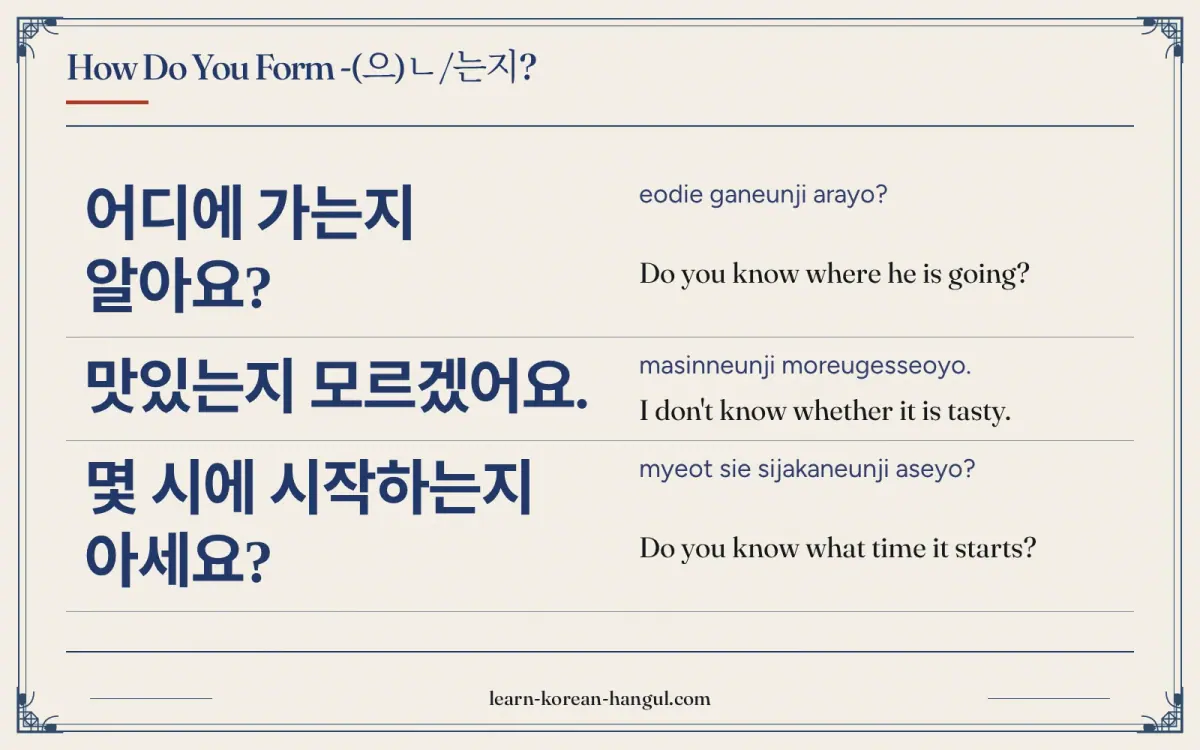
어디에 가는지 알아요?
eodie ganeunji arayo?
Do you know where he is going?
The pronunciation follows the 국립국어원 standard pronunciation rules (표준 발음법). A final consonant before ㄴ turns into a nasal sound, so 먹는지 is said [멍는지], 읽는지 is said [잉는지], and 맛있는지 is usually said [마신는지] (the standard also lists [마딘는지]). Revised Romanization shows this change: meongneunji and masinneunji. In the same way, 안 왔는지 is said [안 완는지].
Adjectives and Nouns
An adjective takes -ㄴ지 after a vowel stem and -은지 after a consonant stem: 예쁜지 ("whether it is pretty"), 좋은지 ("whether it is good") and 많은지 ("whether there is a lot"). ㄹ-adjectives drop ㄹ: 길다 becomes 긴지. ㅂ-irregular adjectives change ㅂ to 우: 춥다 becomes 추운지, and 어렵다 becomes 어려운지.
A noun takes 인지, which is the copula 이다 plus 지: 의사인지 means "whether he is a doctor." 아니다 gives 아닌지.
Although 맛있다 is translated with an adjective, it is built on 있다, so it takes -는지.
맛있는지 모르겠어요.
masinneunji moreugesseoyo.
I don't know whether it is tasty.
그 사람이 학생인지 아닌지 몰라요.
geu sarami haksaenginji aninji mollayo.
I don't know whether that person is a student or not.
Do ㄹ-Stems and Irregular Verbs Change?
ㄹ-stems drop their ㄹ before 는: 알다 becomes 아는지, 만들다 becomes 만드는지, and 살다 becomes 사는지. Other irregular verbs keep their stem in the present, because 는 starts with a consonant; they change only where a vowel follows, as in the past.
- ㄷ-irregular verbs do not change before 는지, because 는 starts with a consonant: 듣다 becomes 듣는지.
- ㅂ-irregular verbs keep ㅂ before 는지: 돕다 becomes 돕는지. In the past they change: 도왔는지.
- 하다 verbs are regular: 시작하다 becomes 시작하는지, said [시자카는지]. The ㅎ joins the ㄱ before it into the sound [ㅋ], so Revised Romanization writes sijakaneunji.
- Future and guess. -(으)ㄹ지 attaches to a vowel stem as -ㄹ지 and to a consonant stem as -을지: 갈지, 먹을지, 좋을지.
몇 시에 시작하는지 아세요?
myeot sie sijakaneunji aseyo?
Do you know what time it starts?
With the forms clear, you can build a full sentence.
Worked Example: Building a Sentence with -(으)ㄴ/는지
-(으)ㄴ/는지 grammar works the same way every time, so a five-step routine is enough. Follow it to build "Please tell me when the bus comes."
- Choose the main verb. The sentence needs a verb of telling: 알려 주세요 ("please let me know").
- Write the embedded question as a plain question. "When does the bus come?" is 버스가 언제 와요?
- Take the verb and find its stem. The verb is 오다, and the stem is 오.
- Add the right ending. A verb takes -는지, so 오 + 는지 gives 오는지. Drop the question ending 와요.
- Put it together. 버스가 언제 오는지 알려 주세요. (beoseuga eonje oneunji allyeo juseyo.) = "Please tell me when the bus comes."
Sentence
Please tell me when the bus comes.
Show answer
버스가 언제 오는지 알려 주세요
You will know it worked if the inner verb ends in -는지 or -(으)ㄴ지 and the main verb finishes the sentence. The most common slip is keeping the question ending, as in 버스가 언제 와요 알려 주세요, which is not a sentence. The next question is which tenses and sentence types can follow.
Which Tenses and Sentence Types Work with -(으)ㄴ/는지?
-(으)ㄴ/는지 works with present, past and future forms, and the sentence type is decided by the main verb. The larger sentence can be a statement, a question or a request. What is fixed is the main verb: it must deal with knowledge, doubt, asking or telling.
| Main verb | Meaning | Example |
|---|---|---|
| 알다 | to know | 어디에 가는지 알아요? (Do you know where he is going?) |
| 모르다 | not to know | 맛있는지 모르겠어요. (I don't know whether it is tasty.) |
| 궁금하다 | to be curious | 비가 오는지 궁금해요. (I wonder whether it is raining.) |
| 묻다 / 물어보다 | to ask | 어디에 가는지 물어봤어요. (I asked where he was going.) |
| 말해 주다 / 알려 주다 | to tell | 뭘 먹고 싶은지 말해 주세요. (Please tell me what you want to eat.) |
| 확인하다 | to check | 시간이 되는지 확인해 보세요. (Please check whether you have time.) |
Future doubt uses -(으)ㄹ지: 내일 날씨가 좋을지 모르겠어요 (naeil nalssiga joeulji moreugesseoyo) is said [내일 날씨가 조을찌 모르겠어요] and means "I don't know whether the weather will be good tomorrow." The tense of the inner clause shows when the event happens, and the main verb shows when you know it. The pattern for tenses is simple: choose the stem ending, then add the main verb.
How Is -(으)ㄴ/는지 Different from -냐고 하다?
-(으)ㄴ/는지 puts a question inside a sentence, and -냐고 하다 reports that someone asked a question. The first is about content you know, wonder about or tell. The second quotes a question that a person said. A third neighbour, -나요?/-(으)ㄴ가요?, asks a soft direct question at the end of a sentence.
-(으)ㄴ/는지
whether, if: an embedded question
-냐고 하다
someone asked whether or what: a reported question
-나요?/-(으)ㄴ가요?
a soft direct question
| Comparison | -(으)ㄴ/는지 | -냐고 하다 | -나요?/-(으)ㄴ가요? |
|---|---|---|---|
| Where it sits | inside a clause | before a speech verb | at the end of a sentence |
| Typical main verb | 알다, 모르다, 궁금하다 | 하다, 묻다 | none: it ends the sentence |
| Example | 어디 가는지 알아요? | 어디 가냐고 했어요. | 어디 가나요? |
| Meaning | Do you know where (he) goes? | (He) said "Where are you going?" | Where is (he) going? |
Use -(으)ㄴ/는지 to place your own question inside a sentence of knowing or wondering, -냐고 하다 to report that someone asked a question, and -나요?/-(으)ㄴ가요? to ask a soft question directly.
Reported questions are taught in -냐고 하다, and quoting in general in direct and indirect quotation. The soft direct question is taught in -나요/-(으)ㄴ가요 soft questions. Compare 친구가 어디 가냐고 물었어요 ("My friend asked where I was going") with 친구가 어디 가는지 궁금해요 ("I wonder where my friend is going"). These contrasts lead to a few variations.
Variations and Edge Cases of -(으)ㄴ/는지
-(으)ㄴ/는지 has four common variations. Each one helps you read real Korean.
- Yes/no pairs. To say "whether or not," repeat the verb with 안 or use 아닌지: 가는지 안 가는지 알려 주세요 ("Please let me know whether you are going or not"). A common fixed pair is 맞는지 아닌지 ("whether it is right or not"); 맞다 is a verb, so it takes -는지.
- "Be curious whether." 궁금하다 turns the clause into a wish to know: 비가 오는지 궁금해요.
- Exclamation with 얼마나 / 어찌나. The same ending can stand near the end of a clause in the pattern "so ... that." 어찌나 웃었는지 눈물이 났어요 (eojjina useonneunji nunmuri nasseoyo) means "I laughed so much that tears came."
- Politeness. The ending itself has no politeness level. The final verb sets it: 모르겠어요 is polite, 모르겠습니다 is formal and 몰라 is casual. For the wider picture, see Korean Speech Levels.
Think of the ending as a container. The embedded question goes in, and the main verb decides what you do with it. The exclamation type is a special case: the clause with -는지 explains a result.
What Mistakes Do Learners Make with -(으)ㄴ/는지?
Learners usually keep the question ending, choose the wrong adjective or verb form, or translate "if" with 면. Four mistakes appear again and again.
- Keeping a full question ending inside the clause. 어디에 가요 알아요? is wrong. The inner verb takes -는지: 어디에 가는지 알아요?
- Using 면 for "whether." 그 사람이 오면 알아요? means "If he comes, do you know?" For "whether," use 오는지 알아요?
- Using the verb form with an adjective. 예쁘는지 is wrong. An adjective takes -(으)ㄴ지: 예쁜지.
- Forgetting the main verb. 비가 오는지 on its own sounds unfinished in a normal statement. Add 궁금해요, 몰라요 or another verb. In casual speech a -는지 clause can stand alone as a sigh of doubt, as in 왜 이렇게 안 오는지 ("I wonder why he isn't coming"), but learners should add the main verb.
A quick check: Is the inner clause a question you know, wonder about or ask? Does its verb take -는지 and its adjective -(으)ㄴ지? Does a verb of knowing or asking finish the sentence? If all three answers are yes, the sentence is sound.
The practice set below tests these four points.
Practice and Answers
Try the four items before you read the answer key. Cover the answers with your hand.
- Choose the form. Complete: 이 음식이 ___ 모르겠어요. (맛있는지 / 맛있은지 / 맛있다지)
- Make the sentence. Use 오다: "I wonder whether he will come."
- Fix the error. A learner says 몇 시에 시작해요 아세요? Correct it.
- Use an adjective. How do you say "I don't know whether it is cold"? Use 춥다.
Practice · 7
Which sentence means "I don't know why he didn't come"?
Show answer
그 사람이 왜 안 왔는지 모르겠어요.
The embedded question takes the past form -았/었는지: 안 왔는지. The main verb 모르겠어요 completes the sentence.
Which ending goes with the adjective 좋다 in "I wonder whether it is good"?
Show answer
좋은지
Adjectives take -(으)ㄴ지 in the present. After the consonant stem 좋, the form is 좋은지.
Which is correct for 가다 in "Do you know where he is going?"
Show answer
어디에 가는지 알아요?
A verb takes -는지 in the present: 가는지. A full question ending cannot sit inside the clause.
How do you say "I don't know whether it will rain tomorrow"?
Show answer
내일 비가 올지 몰라요.
For something not yet happened, use -(으)ㄹ지: 올지. The sentence is 내일 비가 올지 몰라요.
Which form is correct for the noun 학생 in "I don't know whether he is a student"?
Show answer
학생인지 몰라요.
A noun takes 인지, the copula 이다 plus 지: 학생인지.
Which sentence means "Please tell me when the bus comes"?
Show answer
버스가 언제 오는지 알려 주세요.
The inner verb drops its question ending and takes -는지: 오는지. A full question ending cannot sit inside the clause.
Which is the correct present -는지 form of 만들다 (to make)?
Show answer
만드는지
ㄹ-stems drop ㄹ before 는: 만들다 becomes 만드는지.
Answer key
- 맛있는지. 맛있다 behaves like a verb, so it takes -는지.
- 그 사람이 올지 궁금해요. For something that has not happened, use -(으)ㄹ지.
- 몇 시에 시작하는지 아세요? The inner verb takes -는지.
- 추운지 모르겠어요. (chuunji moreugesseoyo.) The ㅂ-irregular adjective 춥다 changes ㅂ to 우, then takes -ㄴ지.
If you can complete items 1 to 3 without the key, you can build most embedded questions. The final section points to the next lessons.
What Should You Learn Next after -(으)ㄴ/는지 Grammar?
After -(으)ㄴ/는지 grammar, review direct questions, then learn how Korean reports questions and statements. This lesson teaches the embedded question and does not cover the whole quotation system.
- Compare the soft direct question in -나요/-(으)ㄴ가요 soft questions.
- Review the question words in yes/no questions and 어디 where.
- Return to the Intermediate Grammar list for the other patterns at this level.
- Continue with -냐고 하다 (reporting a question) and direct and indirect quotation.
With these steps, the choice becomes automatic: use -(으)ㄴ/는지 for questions inside your own sentences, and -냐고 하다 for questions that someone else asked.
Frequently Asked Questions
What does -(으)ㄴ/는지 mean?
-(으)ㄴ/는지 means "whether" or "if" in an embedded question, and it also carries question words such as "why" or "what." 그 사람이 왜 안 왔는지 모르겠어요 means "I don't know why he didn't come." The question sits inside a bigger sentence whose main verb is usually 알다, 모르다 or 궁금하다.
How do I attach -(으)ㄴ/는지 to a verb or adjective?
Use -는지 after a verb stem: 가는지, 먹는지. Use -(으)ㄴ지 after an adjective stem: 예쁜지 after a vowel, 좋은지 after a consonant. For the past, add -았/었는지. For the future, use -(으)ㄹ지. A noun takes 인지, as in 학생인지. ㄹ-stems drop ㄹ: 아는지, 만드는지.
Can -(으)ㄴ/는지 be used in the past tense?
Yes. Add -았/었 before 는지: 먹었는지, 갔는지, 좋았는지. 그 사람이 어제 왔는지 알아요? means "Do you know whether he came yesterday?" For something not yet happened, use -(으)ㄹ지: 내일 올지 몰라요 means "I don't know whether he will come tomorrow."
Is -(으)ㄴ/는지 used in speech or only in writing?
It is used constantly in both. The ending itself has no politeness level, because the final verb sets it: 모르겠어요 is polite, 모르겠습니다 is formal and 모르겠어 is casual. You will hear it in questions at shops, offices and schools, and read it in e-mails and reports.
What is the most common mistake with -(으)ㄴ/는지?
The most common mistake is putting a full question ending inside the clause, as in 어디에 가요 알아요?. The inner verb must take -는지: 어디에 가는지 알아요? A second mistake is using 면 for "if": 오면 아세요? means "If he comes, do you know?" and is wrong for "whether."