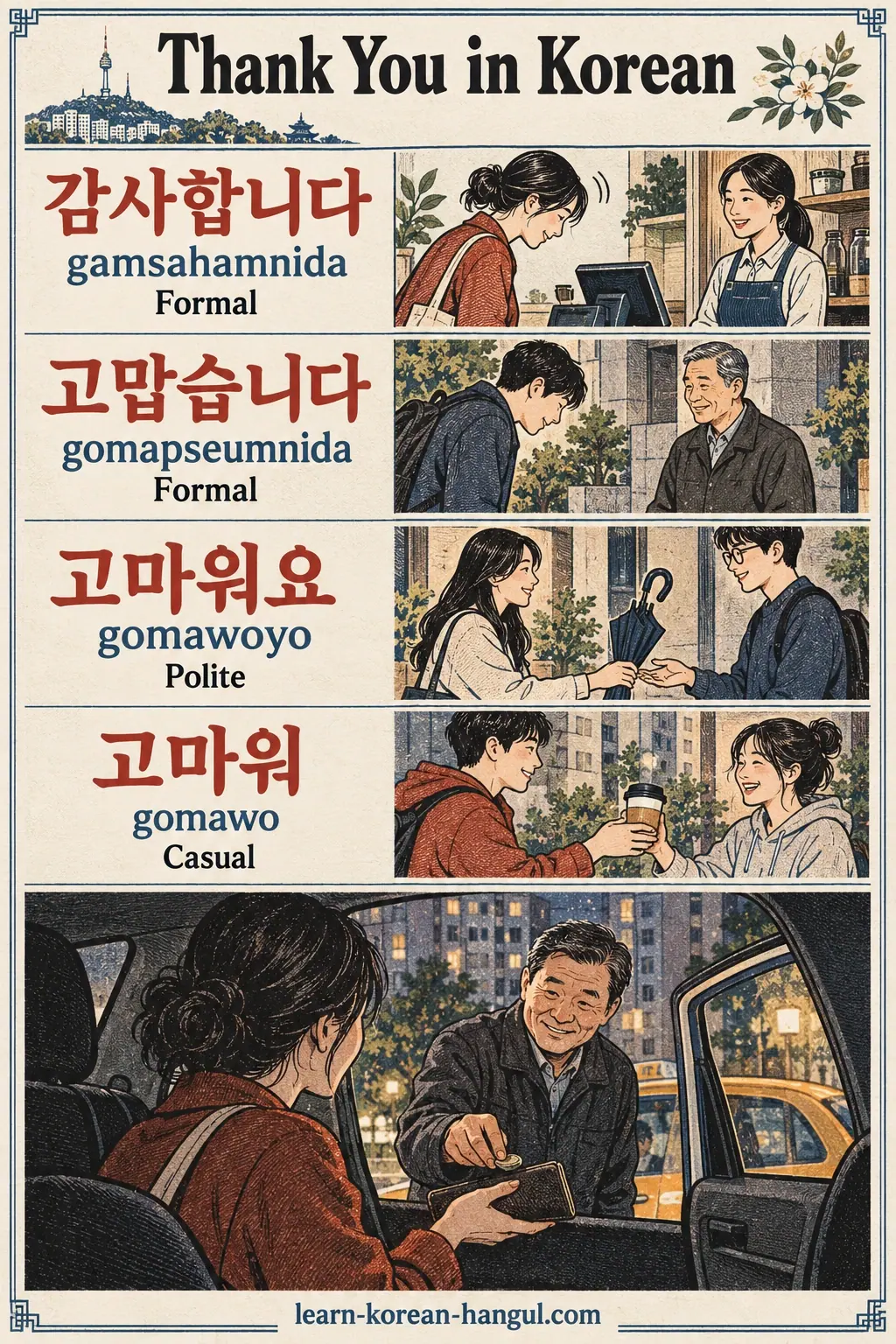
감사합니다
감사합니다
What you'll learn
- Say 감사합니다 aloud as [감사함니다], with the m sound in 합.
- Choose between 감사합니다, 고맙습니다, 고마워요 and 고마워 for a stranger, a senior and a friend.
- Explain why 감사합니다 and 고맙습니다 are equally polite.
- Thank someone for food, a gift or a favour in the way Koreans do.
Before you start: you need to read Hangul; romanization is shown as an aid and can be hidden. Time: about 12 minutes. Audio plays only when you press a button.
How Do You Say Thank You in Korean?
The safest way to say thank you in Korean is 감사합니다, because it is polite enough for anyone and never sounds rude. Korean actually has two thank-you words, and each comes in formal, polite and casual endings.
| Form | Romanization | Register | Say it to |
|---|---|---|---|
| 감사합니다 | gamsahamnida | Formal (합쇼체) | Anyone: staff, strangers, elders, bosses |
| 고맙습니다 | gomapseumnida | Formal (합쇼체) | Anyone; slightly warmer feel |
| 감사해요 | gamsahaeyo | Polite (해요체) | Acquaintances, colleagues, people you know a little |
| 고마워요 | gomawoyo | Polite (해요체) | Friends you speak politely with, younger colleagues |
| 고마워 | gomawo | Casual (반말) | Close friends, siblings, partners, children |
The two roots are 감사 (感謝), a Sino-Korean noun borrowed from Chinese characters, and 고맙다, a native Korean adjective meaning to be thankful. The next section shows each form in a sentence.
What Are the Formal, Polite and Casual Ways to Say Thank You?

Thank you follows the Korean speech levels, the endings that change with the listener's age, status and closeness, explained in the guide to Korean speech levels. The meaning stays the same while the ending shifts.
Formal: 감사합니다 (gamsahamnida)
Formal · 합쇼체감사합니다 uses the formal ending -ㅂ니다. It is the thank you you hear most in public: at the till, in a taxi, at the end of a presentation. Because it is formal, it never offends; at worst it sounds a little reserved between friends.
도와주셔서 감사합니다.
dowajusyeoseo gamsahamnida
Thank you for helping me.
The pattern "verb + -아/어 주셔서 감사합니다" means "thank you for doing ...", and it is the most useful extension of the phrase.
Formal: 고맙습니다 (gomapseumnida)
Formal · 합쇼체고맙습니다 has the same formal ending on the native root 고맙다. It is just as polite as 감사합니다, and the choice between them is mostly personal habit. Some speakers feel 고맙습니다 is warmer and more personal.
선물 정말 고맙습니다.
seonmul jeongmal gomapseumnida
Thank you so much for the gift.
Polite: 감사해요 (gamsahaeyo)
Polite · 해요체감사해요 puts 감사 into the softer polite style (해요체). It suits people you see regularly but do not know well, like a colleague in another team or a regular café worker.
늘 감사해요.
neul gamsahaeyo
Thank you, as always.
Polite: 고마워요 (gomawoyo)
Polite · 해요체고마워요 is the polite form of 고맙다. The ㅂ of 고맙 changes to 우 before a vowel ending, so 고맙 + 어요 becomes 고마워요; this is the ㅂ-irregular pattern. It sounds friendly and is common between adults who know each other.
우산 빌려줘서 고마워요.
usan billyeojwoseo gomawoyo
Thanks for lending me your umbrella.
Casual: 고마워 (gomawo)
Casual · 반말고마워 is the casual thanks, for close friends, siblings, partners and children. This is the form people search for as "thank you in Korean banmal" (반말 means casual speech).
진짜 고마워. 덕분에 살았다.
jinjja gomawo. deokbune saratda
Thanks so much. You saved me.
All five forms carry the same gratitude. Saying the main one with the right sound is the next step.
How Do You Pronounce 감사합니다?
감사합니다 is pronounced [감사함니다], gamsahamnida, in five even syllables. The written ㅂ in 합 is said as ㅁ, so the word has an m sound, not a b.
- 감 (gam): a soft g, "ah", and close the lips for m.
- 사 (sa): "sah".
- 함 (ham): written 합, said "hahm" with the lips closed.
- 니 (ni): "nee".
- 다 (da): a soft d and "ah", without dropping the pitch sharply.
Sound Changes to Listen For
Two rules from the National Institute of Korean Language Standard Pronunciation (표준 발음법) shape the formal thank-you forms:
- Nasalization in -ㅂ니다. When ㅂ meets ㄴ, it becomes ㅁ. So 감사합니다 is [감사함니다] and 고맙습니다 ends in [-씀니다]. The rule is explained in ㅂ-to-ㅁ nasalization.
- Tensing in 고맙습니다. The ㅂ at the end of 맙 makes the next ㅅ tense, so 습 becomes [씀]. The whole word is [고맙씀니다].
- Romanization follows sound, partly. Revised Romanization writes the nasal change (gamsahamnida) but not the tensing (gomapseumnida), so the romanized form is a guide, not a full transcription.
For a sound-by-sound drill with slow audio, see how to pronounce 감사합니다.
Clear pronunciation helps, but choosing the right level for the listener matters more, as the next section shows.
When Should You Use 감사합니다, and When Should You Not?

Use 감사합니다 with anyone you would address politely: strangers, staff, teachers, bosses and elders. Avoid it only with very close friends and children, where it can sound stiff, and avoid the casual forms with anyone you owe respect.
Situations Where It Fits
- Paying in a shop or getting off a taxi. A quick 감사합니다 is the norm.
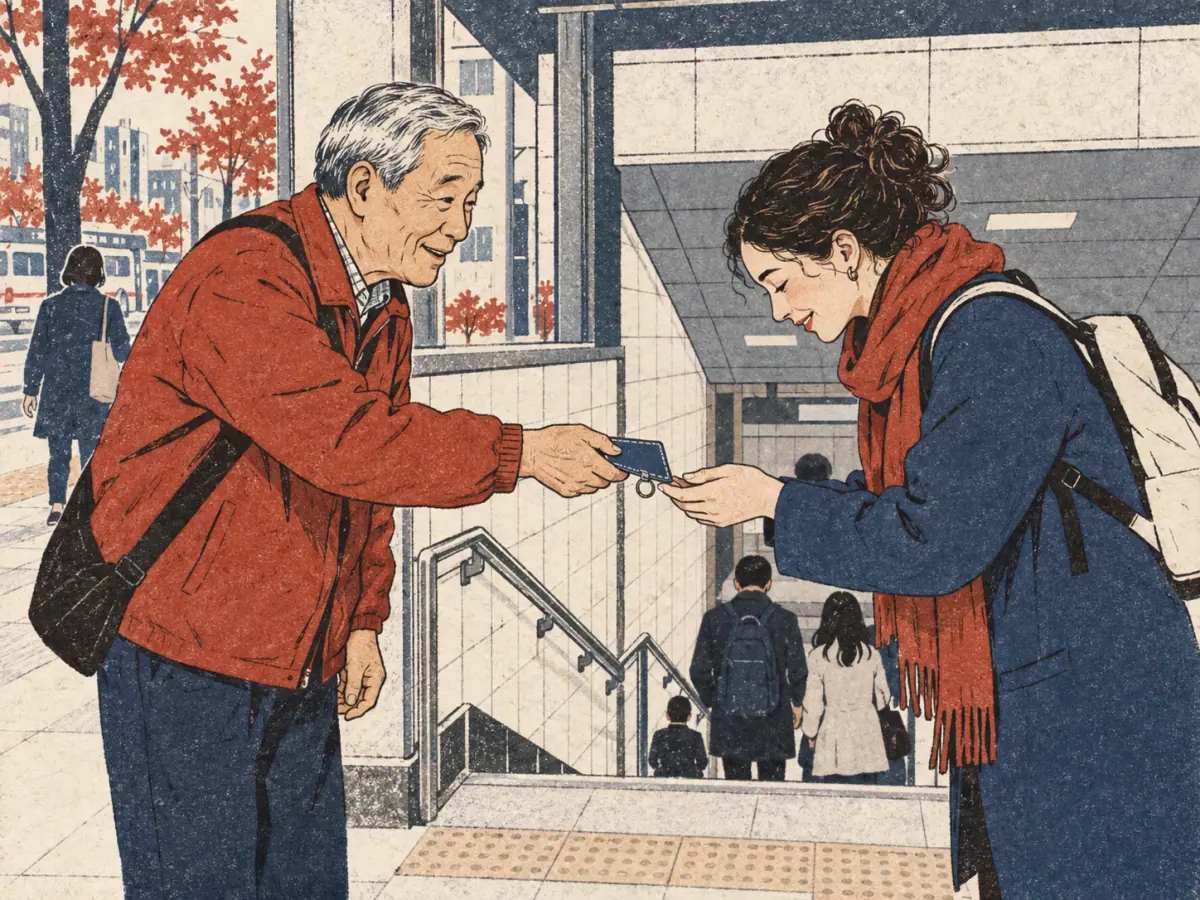
- Receiving a business card or a gift. Take it with both hands and say 감사합니다.
- After a presentation. End with 감사합니다 to the audience.
- When a stranger helps you. 감사합니다 or 정말 감사합니다 (thank you very much).
Situations to Avoid
- A close friend passing you the salt. 고마워 is natural; 감사합니다 sounds like a joke or a quarrel.
- Teachers, bosses and elders with 고마워. The casual form skips the respect they expect.
- Thanking for food at the table. Koreans say 잘 먹겠습니다 before eating and 잘 먹었습니다 after, rather than a plain thank you.
These choices are easier to feel in real exchanges, so here are three.
What Does Thank You Sound Like in a Real Conversation?

A Korean thank-you exchange is usually short, and the reply often deflects the thanks. Listen for the replies.
Paying at a Convenience Store
Clerk
영수증 드릴까요?
yeongsujeung deurilkkayo?
Would you like the receipt?
Customer
아니요, 괜찮아요. 감사합니다.
aniyo, gwaenchanayo. gamsahamnida
No, it's fine. Thank you.
Clerk
감사합니다. 안녕히 가세요.
gamsahamnida. annyeonghi gaseyo
Thank you. Goodbye.
What to notice: both sides say 감사합니다; staff thank customers for the purchase.
A Colleague Helps with a File
Sumi
자료 보내 줘서 고마워요.
jaryo bonae jwoseo gomawoyo
Thanks for sending the files.
Jun
아니에요. 필요하면 또 말해요.
anieyo. piryohamyeon tto malhaeyo
It's nothing. Tell me if you need more.
What to notice: Jun answers with 아니에요 (it's nothing), the most common reply, explained in you're welcome in Korean.
A Friend Pays for Coffee
Yuna
오늘은 내가 살게.
oneureun naega salge
I'll pay today.
Min
오, 고마워. 다음엔 내가 살게.
o, gomawo. daeumen naega salge
Oh, thanks. Next time it's on me.
What to notice: friends thank briefly and then promise to return the favour, which says as much as the words. That habit points to the culture behind thanks.
What Should You Know about the Culture behind Thank You?

Korean thanks is often shown through gesture and reciprocity, not only words. The phrase is important, but how you say it and what follows count as well.
- A slight bow or nod. Koreans often nod or bow slightly while saying 감사합니다, and the bow deepens as the other person gets older or more senior.
- Two hands. When receiving something from an elder, take it with both hands, or with the right hand supported by the left at the wrist.
- Returning the favour. Between friends, "next time it's on me" (다음엔 내가 살게) is part of thanking.
- Thanks for food. 잘 먹겠습니다 and 잘 먹었습니다 thank the cook or the person paying.
An expert insight: learners sometimes hear that 고맙습니다 is less polite than 감사합니다, or the reverse. Both are standard dictionary words, and both take the same formal ending -ㅂ니다/-습니다, so neither outranks the other. Pick one and use it consistently. The common mistakes below are about level, not word choice.
What Mistakes Do Learners Make with Thank You in Korean?
Most thank-you mistakes come from speech level or from reading the romanization literally.
| Mistake | Why it is a problem | Fix |
|---|---|---|
| Saying 고마워 to a teacher, boss or older stranger | Casual ending | Use 감사합니다 or 고맙습니다 |
| Pronouncing a b in 합: "gamsa-hab-nida" | ㅂ becomes ㅁ before ㄴ | Say [감사함니다] |
| Saying 감사합니다 to a close friend for small things | Sounds distant or sarcastic | Say 고마워 |
| Using plain thanks at a meal | Koreans use set meal phrases | Say 잘 먹겠습니다 / 잘 먹었습니다 |
| Bowing deeply to a cashier | Looks theatrical | A small nod is enough |
Learners often assume the polite -요 forms (고마워요, 감사해요) are always safer than the formal -ㅂ니다 forms. Actually, with strangers, staff and elders, 감사합니다 is the safer default, because the formal style signals respect without needing any relationship.
Is Thank You the Same as Thanks in Korean?
Partly. "Thanks" in Korean is 고마워 (casual) or 고마워요 (polite); "thank you" is closer to 감사합니다. The short answers below cover the other ways people search for this phrase.
- Thanks / thank u in Korean: 고마워 with friends; in texts, ㄱㅅ (an abbreviation of 감사) or 땡큐 among young people.
- Thank you formal in Korean: 감사합니다 or 고맙습니다.
- Thank you informal, casual or banmal: 고마워.
- Thank you polite in Korean: 감사해요 or 고마워요.
- Thank you romanized: gamsahamnida, following the Revised Romanization of Korean; romanization is an aid, not the real spelling.
- Thank you very much: 정말 감사합니다 or 대단히 감사합니다, covered in thank you very much in Korean.
Reading the forms is one thing; producing them on cue is another, so practise now.
Practice: Say It Aloud
Play the slow clip of 감사합니다, repeat it three times, then try 고맙습니다 and 고마워. Then choose a form for each situation. Answers follow.
- A taxi driver hands you your change.
- Your younger sister lends you a charger.
- Your manager praises your report.
- Why does 감사합니다 sound like it has an m in the middle?
Answers
- 감사합니다.
- 고마워.
- 감사합니다, or 고맙습니다.
- Because ㅂ in 합 becomes ㅁ before the ㄴ of 니 (nasalization), giving [감사함니다].
The phrase flashcards drill all five thank-you forms with audio.
Related Phrases to Learn Next
Thank you sits in a small family of polite phrases that learners need on day one.
- You're welcome in Korean: 아니에요 and 천만에요 for replying to thanks.
- Sorry in Korean: 죄송합니다 and 미안해요, built on the same speech levels.
- Please in Korean: 주세요, the ending that makes requests polite.
- Thank you very much in Korean: stronger thanks for real favours.
This guide belongs to the polite Korean phrases collection. What this page does not cover: written thank-you letters, wedding and funeral formulas, and the full honorific system. Pick 감사합니다 when in doubt, soften to 고마워요 as you get closer, and you can say thank you in Korean to anyone.
Frequently Asked Questions
Is 감사합니다 more polite than 고맙습니다?
No. Both use the formal ending -ㅂ니다/-습니다 and are equally polite. 감사합니다 is built on the Sino-Korean word 감사 (感謝) and is heard more in service and business, while 고맙습니다 comes from the native verb 고맙다 and can sound a little warmer. Either one is safe with elders and strangers.
How do you say thanks for the food in Korean?
Before eating, say 잘 먹겠습니다 (I will eat well); after eating, say 잘 먹었습니다 (I ate well). Both thank whoever cooked or paid, and they replace a direct thank you at the table. With friends, the polite 잘 먹을게요 and 잘 먹었어요 or casual 잘 먹을게 and 잘 먹었어 work too.
How do you reply when someone says 감사합니다?
The most common reply is 아니에요 (it's nothing), often with 괜찮아요 (it's fine). The textbook 천만에요 (you're welcome) is correct but sounds formal and a bit bookish. Shop staff and customers often simply answer 감사합니다 back, because both sides are thanking each other for the exchange.
Is it rude to thank close friends or family in Korean?
It is not rude, but heavy thanks between very close people can feel distant, as if you were strangers. Close friends say a quick 고마워 or 땡큐, borrowed from English, and family members often show thanks through actions. For a real favour, a clear 진짜 고마워 (thanks a lot) is always welcome.
How do you write thank you in Hangul?
Thank you is written 감사합니다 in Hangul: five blocks, 감, 사, 합, 니 and 다. The alternative 고맙습니다 is also five blocks: 고, 맙, 습, 니, 다. Write them without spaces. Casual thanks is 고마워, three blocks, and the polite 고마워요 adds 요 at the end.