
What you'll learn (about 20 minutes, level A0, no earlier lesson needed except the plain letter ㅂ)
- Pronounce ㅍ with a clear puff of air and tell it apart from ㅂ and ㅃ.
- Write ㅍ in 4 strokes and fit it into a syllable block.
- Read 앞 and 잎 with a final [p], and say them correctly when a vowel follows.
- Spell English words with f, such as "coffee" and "file", using ㅍ.
What Does the Korean Letter ㅍ Sound Like?
The Korean letter ㅍ sounds like the p in English "pie", "pan" or "pool" when you say the word on its own: a p followed by a noticeable burst of breath. Linguists call this burst aspiration, and the IPA symbol for the sound is [pʰ]. Revised Romanization, the official Latin spelling system, writes it simply as "p".
Here are the first words to listen to. Each one starts with ㅍ or has it in the middle.
- 파 (pa), green onion
- 포도 (podo), grapes
- 피 (pi), blood
- 표 (pyo), ticket
- 아파요 (apayo), it hurts
- 커피 (keopi), coffee
The name 피읖 follows the pattern explained on the page about Korean consonant names: the letter's own sound at the start, then 으 and the letter again at the end. Because ㅍ at the end of a syllable is read [p], the name is said [피읍].
How Is ㅍ Different from the English P?
English p is aspirated at the start of a stressed syllable ("pie") but not after s ("spy"). Korean has three separate p-type letters, and ㅍ is the one that is always aspirated. If you say English "pie" and "spy" with your hand in front of your mouth, you feel a puff for "pie" and almost none for "spy". ㅍ matches the "pie" puff in every position before a vowel.
A simple test works well at home. Hold a thin strip of paper close to your lips and say 파. The paper should flutter. Now say 바 (ba, with the plain letter ㅂ). The paper should barely move. This gives you a quick, honest check of your own pronunciation without any special equipment.
There is one limit to the English comparison. English speakers often make the puff last a little too long, so the sound turns into "p-huh". Keep the puff short and let the vowel start right after it. In Seoul speech, a syllable that begins with ㅍ typically also starts on a slightly higher pitch than one that begins with ㅂ, which gives your ear a second cue.
The three p-type letters at a glance:
| Letter | Name | Type | Airflow | Romanization | Example |
|---|---|---|---|---|---|
| ㅂ | 비읍 (bieup) | plain | light breath | b / p | 불 (fire) |
| ㅍ | 피읖 (pieup) | aspirated | strong puff | p | 풀 (grass) |
| ㅃ | 쌍비읍 (ssangbieup) | tense | no breath, tight throat | pp | 뿔 (horn) |
The next section explains why these three letters look related.
Why Does ㅍ Look Like ㅂ with an Extra Stroke?
ㅍ is part of a family of lip letters, and its shape grows from the lip letters ㅁ and ㅂ. The Hunminjeongeum Haerye (1446), the explanatory text that came with the original Hangul proclamation, describes this as the stroke-addition principle (가획, gahoek). The base letter ㅁ shows the shape of closed lips. Adding strokes gives ㅂ, and adding another stroke gives ㅍ, so each added stroke marks a stronger sound.
You can use this idea as a memory aid, not as a perfect drawing rule:
- ㅁ (mieum) is the base lip letter: a closed box.
- ㅂ (bieup) is the same lip family with one more stroke added.
- ㅍ (pieup) has more strokes again, and it carries the strongest breath.
This pattern repeats across the other aspirated letters. ㅋ adds a stroke to ㄱ, ㅌ adds a stroke to ㄷ, and ㅊ adds a stroke to ㅈ. If you already know the plain letter ㅂ, you already know where ㅍ sits in the system: same mouth position, more air.
Now that you know how the letter is built, the next section shows how to draw it.
How to Write ㅍ in 4 Strokes
ㅍ is drawn with 4 strokes in standard print, always from top to bottom and left to right.
Practise on Paper
- Draw a short horizontal bar at the top, left to right.
- Draw the left vertical line downward, starting just under the top bar.
- Draw the right vertical line downward, parallel to the left one.
- Draw a longer horizontal bar at the bottom, left to right, closing the shape.
- Draw a short horizontal bar at the top, left to right.
- Draw the left vertical line downward, starting just under the top bar.
- Draw the right vertical line downward, parallel to the left one.
- Draw a longer horizontal bar at the bottom, left to right, closing the shape.
Success check: your ㅍ looks like a small table with a top and a bottom bar and two legs between them. Both legs are the same height, and the bars are slightly longer than the gap between the legs.
Handwriting varies, and some writers draw the legs and the bottom bar in a different rhythm. The order shown here is the common teaching order. For the full set of letters side by side, see stroke order for consonants.
Inside a syllable block, ㅍ shrinks to fit. In 포, ㅍ sits on the left and ㅗ sits underneath it. In 앞, ㅍ sits at the bottom as the final consonant and becomes noticeably flatter.
Next, a look at what ㅍ does in different places inside a word.
ㅍ at the Start, Middle and End of a Word
ㅍ is aspirated at the start and in the middle of a word, and reduced to an unreleased [p] at the end of a syllable. The table summarizes all three positions.
| Position | Example | Pronounced | What happens |
|---|---|---|---|
| Start of a word | 파 (green onion) | [파] | full puff of air |
| Middle of a word | 아파요 (it hurts) | [아파요] | puff stays, usually softer |
| End of a syllable, nothing follows | 앞 (front) | [압] | lips close, no puff, no release |
| End of a syllable, a vowel follows | 앞에 (in front) | [아페] | ㅍ moves to the next syllable and keeps its puff |
A letter at the bottom of a syllable block has a name: it is called a batchim (받침, final consonant). You can read more in the glossary entry on batchim. Because ㅍ at the bottom of a block is always read [p], the same sound appears for several different letters.
ㅍ as a Final Consonant: [p]
ㅍ as a final consonant is pronounced [p]: the lips close, the sound stops, and the air is not released. This follows the final-sound rules in the 국립국어원 표준 발음법 (Standard Pronunciation Rules, National Institute of Korean Language), which reduce every final consonant to one of 7 sounds. ㅍ is reduced to [p] along with ㅂ. You can see the full list in the 7 final sounds.
- 앞 (ap), front, said [압]
- 잎 (ip), leaf, said [입]
- 숲 (sup), forest, said [숩]
Notice that the spelling keeps ㅍ, but the ear hears [p]. Learners often write 압 when they hear [압]. The correct spelling of "front" is 앞, because the word's ending is ㅍ, and you can prove it with the next section.
Linking ㅍ into the Next Syllable
When a vowel follows, the final ㅍ moves onto that vowel and is pronounced in full. This is called liaison (연음, yeoneum), and the lesson on liaison covers every case.
- 앞에 (ape), in front [아페]
- 잎이 (ipi), the leaf (as a subject) [이피]
- 숲이 (supi), the forest (as a subject) [수피]
This gives you a spelling trick. If you are not sure whether a word ends in ㅂ or ㅍ, add a vowel ending and listen. 앞에 is [아페], with a puff, so the word ends in ㅍ.
A second effect is worth a preview. When ㅂ meets ㅎ, the two merge into an aspirated [ㅍ]. For example, 입학 (school entrance) is said [이팍]. The lesson on the aspiration rule lists all of these cases.
The next section puts the pieces together in a full decoding example.
Worked Example: Reading 포도, 앞 and 커피
Reading a Korean syllable means splitting the block into its parts and joining the sounds. Here are three examples of increasing difficulty.
Example 1: 포도 (grapes).
- Split the first block: ㅍ + ㅗ.
- Say ㅍ with a puff, then add ㅗ (o): [po].
- Split the second block: ㄷ + ㅗ, giving [do] (between vowels, ㄷ is voiced, so it sounds like "d").
- Join them: [포도], romanized podo.
Example 2: 앞 (front).
- Split the block: silent ㅇ + ㅏ + ㅍ.
- The silent ㅇ at the top left only holds the place, so the first sound is the vowel ㅏ (a).
- The bottom letter ㅍ is a final consonant, so it is read [p] with the lips closed and no puff.
- Join them: [압], romanized ap.
Example 3: 커피 (coffee).
- Split the first block: ㅋ + ㅓ, giving [keo].
- Split the second block: ㅍ + ㅣ, giving [pi].
- Join them: [커피], romanized keopi.
Check yourself: if you can say all three words without looking at the romanization, you have the core skill of this lesson. Romanization is only a learning aid. It is shown in parentheses throughout this page, and the Hangul is always the main form.
Reading is easier once your ear can separate the three p-type sounds, which is the next task.
불 / 풀 / 뿔: Hearing the Difference
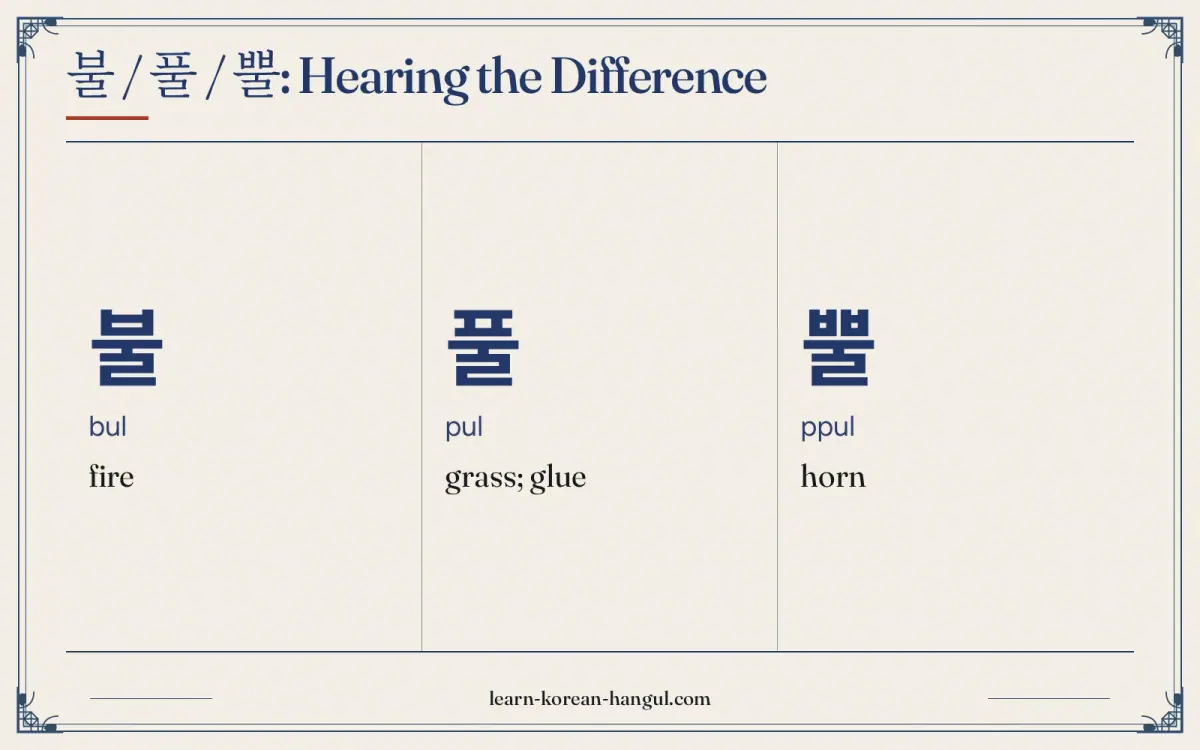
불, 풀 and 뿔 are a minimal set: three words that differ only in their first consonant. 불 (bul) means "fire" and has plain ㅂ. 풀 (pul) means "grass" and also "glue" and has aspirated ㅍ. 뿔 (ppul) means "horn" and has tense ㅃ. A learner who can hear all three has the hardest part of Korean consonants under control.
Plain: Light Breath; Aspirated: Strong Puff; Tense: No Breath and a Tight Throat
| Korean | Romanization | Meaning | Sound |
|---|---|---|---|
| 불 | bul | fire | |
| 풀 | pul | grass; glue | |
| 뿔 | ppul | horn |
| Word | Meaning | First letter | What to listen for |
|---|---|---|---|
| 불 | fire | ㅂ plain | soft start, lower pitch |
| 풀 | grass; glue | ㅍ aspirated | clear burst of air, higher pitch |
| 뿔 | horn | ㅃ tense | no air, tight, sharp start |
English speakers usually find it easy to hear the difference between ㅍ and the others after a few tries, but ㅂ and ㅃ often sound identical at first. Both lack a strong puff, so ㅃ is the one that sounds "tight". The page on the tense letter ㅃ trains that contrast in detail. For longer listening sets, see plain, tense and aspirated sounds.
Many learners mix up 풀 and 불 in their first week. English speakers hear "b" in 불, which is a fair approximation, but the Korean ㅂ at the start of a word is not voiced like English b. It sits between English "b" and "p", which is why Revised Romanization writes ㅂ as "b" before a vowel and as "p" at the end of a syllable.
Another useful pair is 비 (bi, rain) and 피 (pi, blood). The vowel is identical, so only the consonant tells them apart.
Aspiration also matters outside native words, as the next section shows.
How Korean Spells the English F with ㅍ
Korean has no f sound, so the standard loanword spelling writes English f with ㅍ. The 외래어 표기법 (Loanword Orthography rules of the National Institute of Korean Language) assigns f to ㅍ. English p and English f therefore end up with the same Korean letter.
| English word | Korean spelling | Romanized |
|---|---|---|
| coffee | 커피 | keopi |
| file | 파일 | pail |
| France | 프랑스 | peurangseu |
| Fiona (a name) | 피오나 | piona |
| pizza | 피자 | pija |
Notice 프랑스. Korean syllables need a vowel, so the cluster "Fr-" is split and the vowel ㅡ (eu) is added after ㅍ: 프 + 랑 + 스, which is read peu-rang-seu. The page on how Korean writes f, v and z shows the full mapping for names.
Expert insight: when you read 파일 aloud as a Korean word, say a clear ㅍ with a puff, not an English f. The spelling tells you which sound the word uses, and a puffed p matches it.
Common errors with ㅍ are the topic of the next section.
Which Mistakes Do Learners Make with ㅍ?
Most learners make one of three errors with ㅍ, and each has a quick fix.
- Saying "fa" for 파. The letter is a p, not an f. Press both lips together first, then release a puff. Fix: say "pa" with the paper test.
- Letting the legs cross the bars. The two vertical strokes of ㅍ should stay between the top and bottom bars. If they poke through, the letter becomes untidy and the block loses its balance. Fix: keep the legs short and the same height.
- Releasing the final ㅍ in 앞. Learners say "ap-uh" with an audible puff after the p. Fix: close your lips on the p and stop. Think of the p at the end of English "stop" when you do not release it.
A fourth, quieter mistake is believing that 입 (mouth) and 잎 (leaf) are interchangeable because both sound like [입] on their own. They are different words with different spellings, and only a following vowel (입에 [이베] versus 잎에 [이페]) shows the difference.
Learners often assume that a spelling letter always matches a single sound. Actually, ㅍ at the bottom of a block is reduced to [p], because Korean allows only 7 sounds in that position. This reduction is a rule of the language, not a mistake in the writing.
You are now ready to test what you have learned.
Practice: Read and Hear ㅍ
Complete these four exercises before you check the answers. You can also test yourself with the interactive quiz.
Practice · 5
What distinguishes ㅍ from plain ㅂ before a vowel?
Show answer
A strong puff of air
ㅍ is aspirated: it has a strong puff of air before a vowel.
How many strokes does ㅍ take in the order taught here?
Show answer
4
ㅍ is four strokes: the top bar, left leg, right leg and bottom bar.
Which word means "grass" or "glue"?
Show answer
풀
풀 with aspirated ㅍ means grass or glue; 불 means fire, and 뿔 means horn.
How does the final ㅍ in 앞 sound when the word stands alone?
Show answer
An unreleased [p] with closed lips
앞 alone is said [압], with the lips closed and no puff or release.
Which spelling means "file"?
Show answer
파일
파일 means file; 커피 means coffee, and 프랑스 means France.
- Read aloud. Say each word and write its pronunciation in brackets: 파, 포도, 표, 앞, 잎, 커피.
- Listen and choose. Play the clips for the next three words. For each one, decide whether it starts with ㅂ, ㅍ or ㅃ:
- Write. Write ㅍ four times in 4 strokes, then write the blocks 파 and 표.
- Spell. Write these English words in Hangul: pizza, file, party.
Practise on Paper
- Draw a short horizontal bar at the top, left to right.
- Draw the left vertical line downward, starting just under the top bar.
- Draw the right vertical line downward, parallel to the left one.
- Draw a longer horizontal bar at the bottom, left to right, closing the shape.
Answers to the Practice
- 파 [파], 포도 [포도], 표 [표], 앞 [압], 잎 [입], 커피 [커피]. The two blocks with final ㅍ are the only ones whose bracketed sound differs from the spelling.
- The order of the clips is 풀 (ㅍ), 불 (ㅂ), 뿔 (ㅃ). If you got two of three, replay the paper test and listen again.
- Your ㅍ should have a top bar, two legs and a bottom bar, with no leg poking through the top.
- pizza = 피자, file = 파일, party = 파티.
Review the letter with the other consonants in the Hangul flashcard decks, which play audio only when you tap. You can also test whether you can hear 불 / 풀 / 뿔 in the Hangul listening quizzes, or print the aspirated consonants worksheet. For hands-on building, try the Hangul Syllable Builder and the interactive Hangul alphabet.
What Should You Learn after ㅍ?
After ㅍ, continue to the next letter lesson on ㅊ, the fourth aspirated consonant. If you want the whole group in one view, see Korean aspirated consonants, and print the Korean consonants chart to see ㅍ beside all 19 consonants.
This lesson covers the sound, name, shape, final behavior and loanword use of ㅍ. It does not teach the full set of sound-change rules, which live in the pronunciation section, or the vowels that combine with ㅍ. Audio on this page is machine-generated and its review status is shown beside each clip; the Korean text and audio are drafts until a Korean specialist signs them off.
Questions about the Korean Letter ㅍ
Why does Korean use ㅍ for the English f? Korean has no f sound, so the official loanword rules assign the closest Korean sound, ㅍ, to English f. That is why "coffee" is 커피, "file" is 파일 and "France" is 프랑스. As a result, English p and English f both map to ㅍ, and a speaker relies on context to tell them apart.
What is the name of ㅍ? The name of ㅍ is 피읖 (pieup). It is said [피읍] because the final ㅍ in the name is reduced to [p]. The name follows the regular pattern for most consonants, in which the letter's sound is repeated at the start and the end of the name. Koreans use it when spelling a word aloud.
How many strokes does ㅍ have? ㅍ has 4 strokes in standard print: a top bar, a left leg, a right leg and a bottom bar. Draw them from top to bottom and left to right. The related plain letter ㅂ has 4 strokes as well, and the tense letter ㅃ has 8 because it doubles ㅂ. Handwriting may vary slightly between teachers.
Is ㅍ a p or an f? ㅍ is a p. It is the aspirated p, with a strong puff of air, like the p in "pie". Korean does not have an f sound, so ㅍ is also the letter that stands in for f in loanwords. When you read a Korean word with ㅍ, always start with a puffed p.
What happens to ㅍ at the end of a word? At the end of a syllable ㅍ is pronounced [p]: the lips close and the air is not released, so 앞 sounds like [압]. If a vowel follows, ㅍ moves to the next syllable and is pronounced fully, so 앞에 sounds like [아페]. This is a basic final-consonant and liaison pattern.