What you'll learn
- Say the letter name 이응 and explain the two jobs of ㅇ: empty first slot and final [ŋ].
- Write ㅇ as one circle, and write any vowel-only syllable correctly (아, not ㅏ).
- Read 아, 우유, 강 and 사랑 aloud without adding a g after final ng.
- Hear and produce the difference between final ㄴ and final ㅇ in 반 and 방.
- Prerequisites: the vowel lesson for ㅏ. Estimated time: 15 minutes.
The Korean Letter ㅇ at a Glance
The Korean letter ㅇ is the eighth consonant in South Korean dictionary order and one of the 14 basic consonants in the Hangul Orthography (한글 맞춤법, Article 4). On this site it follows ㅅ in the set of basic Korean consonants, though you have already seen it in every vowel lesson.
| Attribute | Value |
|---|---|
| Letter | ㅇ |
| Name | 이응 (ieung) |
| Revised Romanization | not written at the start; ng at the end |
| Sound at the start | none (empty slot) |
| Sound at the end | [ŋ], the back of the tongue touches the soft palate and air goes through the nose |
| Strokes | 1 |
| Contrast letter | ㄴ (final n vs final ng) |
| Keyboard key (Dubeolsik) | D |
ㅇ is the only Korean letter with two completely different jobs. Learners often assume ㅇ is the vowel "o" because of its round shape; actually it is a consonant that is silent at the start of a syllable. The vowel "o" is ㅗ, and the syllable "o" is written 오: silent ㅇ plus ㅗ.
The two jobs have a history. The 1446 commentary Hunminjeongeum Haerye (훈민정음 해례) describes ㅇ as a picture of the throat and lists a separate letter, ㆁ (옛이응, "old ieung", a circle with a small stem on top), for the ng sound. Over roughly the following century the two letters merged in writing, and modern ㅇ took over both roles. The name 이응 goes back to Choe Sejin's 1527 textbook Hunmong Jahoe (훈몽자회), which gave it to ㆁ, the letter that could also end a syllable; modern ㅇ inherited the name. It follows the regular naming pattern, explained on the page about the names of the Korean consonants. Those two jobs are the core of the next section.
What Sound Does ㅇ Make?

ㅇ makes no sound at the start of a syllable and the sound [ŋ] at the end of a syllable. [ŋ] is the "ng" in English "sing" or "long", made by raising the back of the tongue against the soft palate and letting air flow through the nose.
| Position | Example | Pronunciation | What you hear |
|---|---|---|---|
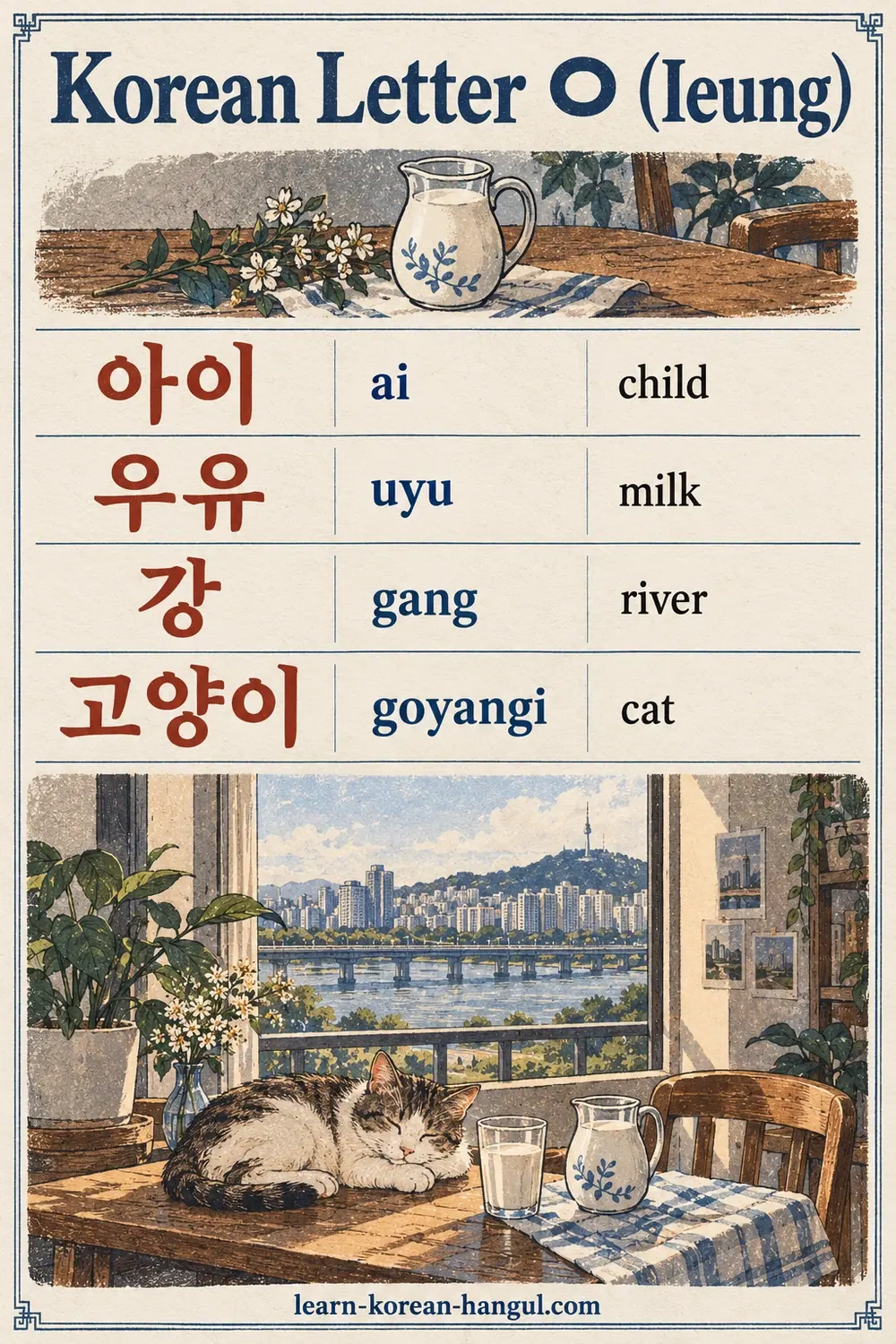
| Start of a syllable | 아이 (ai, child) | [아이] | only the vowels "a-i" |
| Start of a syllable | 우유 (uyu, milk) | [우유] | only the vowels "u-yu" |
| End of a syllable | 강 (gang, river) | [강] | ng as in "sing", no g after it |
| End, before a vowel | 고양이 (goyangi, cat) | [고양이] | ng stays in its own syllable |
To make the final sound, say "sing" slowly and freeze at the end: your tongue is up at the back and air is coming through your nose. That is a Korean final ㅇ. Finish the syllable there and do not release the tongue with a "g".
Why Does a Syllable Need a Silent ㅇ?
A syllable needs a silent ㅇ because every Korean block must start with a consonant letter. The block system has a fixed first slot (the initial), a vowel slot, and an optional final slot. When a syllable begins with a vowel sound, ㅇ fills the first slot so the block keeps its shape. That is why "a" is written 아, not ㅏ on its own.
This rule appears in every vowel-only syllable: 아, 어, 오, 우, 으, 이. It is also why the vowels are named with ㅇ: ㅏ is called 아 and ㅣ is called 이. In 아이 (child), both blocks start with a silent ㅇ, so the word is just two vowel sounds. Once you see ㅇ as a placeholder, writing it becomes simple.
How Do You Write ㅇ?
ㅇ is written in one stroke: a single circle, started at the top. The consonant stroke order lesson shows ㅇ alongside ㅎ, which ends with the same circle.
Practise on Paper
- Start at the top of the circle and draw round counter-clockwise, ending where you began.
Stroke Order: 1 Stroke
- Start at the top of the circle and draw round counter-clockwise, ending where you began.
Most Korean school materials teach the counter-clockwise direction, starting at the top. The finished circle matters more than the direction, but a consistent start point keeps your handwriting even. In handwriting, draw a plain circle with no stem. Many serif (명조, Myeongjo) fonts show a small tick at the top of ㅇ; that tick is a brush-style detail of the font, not a separate letter. The obsolete letter ㆁ, with a short vertical stem on top, appears only in historical texts.
The circle changes size with its position. As an initial in 아, it is a tall oval beside the vowel. On top of ㅗ or ㅜ, as in 오, it is round and centred. As a final in 강, it sits at the bottom, often slightly smaller and flatter. The size changes; the single closed stroke does not. With the shape in place, the next section follows ㅇ through each position in a word.
How Does ㅇ Change at the Start, Middle and End?
ㅇ is silent at the start of any syllable, including in the middle of a word, and [ŋ] at the end of any syllable. Unlike other final consonants, final ㅇ never moves into the next syllable.
| Position in the block | Example | Said | Romanized |
|---|---|---|---|
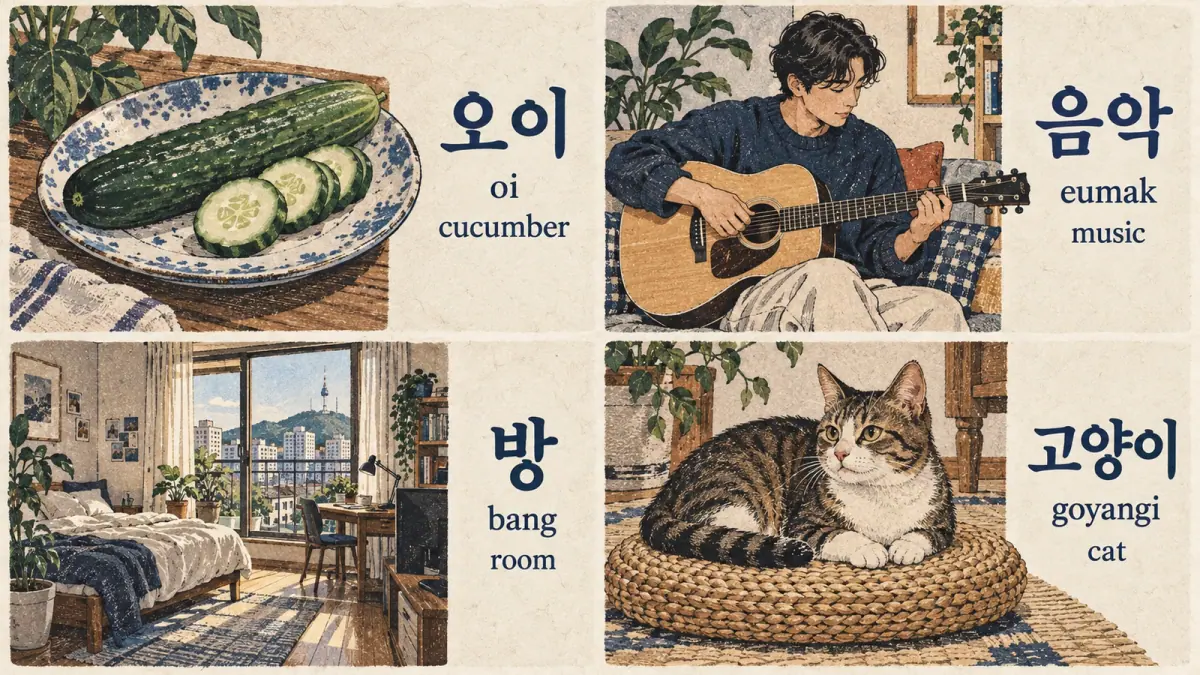
| Initial, word start | 오이 (oi, cucumber) | [오이] | oi |
| Initial, middle of a word | 음악 (eumak, music) | [으막] | eumak |
| Final (batchim) | 방 (bang, room) | [방] | bang |
| Final before a vowel | 고양이 | [고양이] | goyangi |
The second row shows the most useful fact about the silent ㅇ. Because it fills the slot without a sound, a final consonant from the previous block can slide into its place. In 음악, the ㅁ under 음 moves forward, so you hear [으막]. In 한국어 (Korean language), the ㄱ moves forward and you hear [한구거]. This is the liaison rule (final consonants move into a following ㅇ), and it works only because of the empty ㅇ slot.
ㅇ as a Final Consonant (batchim)
A consonant at the bottom of a block, like ㅇ in 강, is a batchim (받침, "support"). As a batchim, ㅇ is always [ŋ]. It is one of the seven final sounds of Korean, and only ㅇ produces it.
Final ㅇ has one special property: it stays in place before a vowel. 고양이 is said [고양이]: the ng stays in 양, and 이 still starts with silence, because modern Korean never starts a syllable with [ŋ]. Common words with final ㅇ include 사랑 (sarang, love), 방 (room) and 공 (gong, ball). The dedicated lesson on ㅇ batchim adds more practice words. The next section reads four examples step by step.
Worked Example: Reading 아, 우유, 강, 사랑
Reading a block with ㅇ takes one question: is the ㅇ at the top (or left) of the block, or at the bottom? Top or left means silent; bottom means [ŋ].
- 아. ㅇ is on the left in the first slot, so it is silent. Say only "a": [아]. Romanized a.
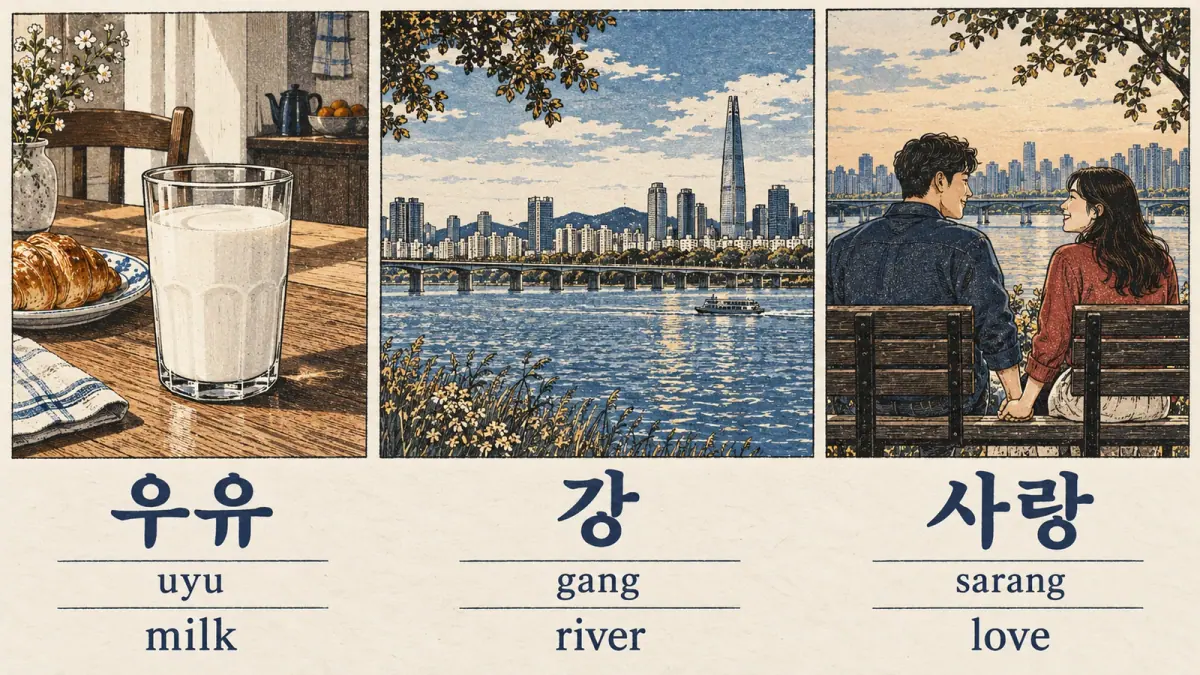
- 우유. Both blocks start with a silent ㅇ. 우 is "u", and 유 is "yu": [우유]. Romanized uyu.
- 강. ㄱ starts the block, ㅏ is the vowel, and ㅇ is at the bottom. Say "ga", then raise the back of your tongue for [ŋ] and stop: [강]. Romanized gang.
- 사랑. 사 is "sa". In 랑, ㄹ is a quick tap, then "a", then final [ŋ]: [사랑]. Romanized sarang.
The block 앙 shows both jobs at once: the first ㅇ is silent and the second is [ŋ], so 앙 is simply "ang". If your 강 ends with a hard g, stop the sound while the tongue is still raised. The nearest sound to final ㅇ is final ㄴ, which is the next comparison.
ㅇ Compared with ㄴ

Final ㅇ and final ㄴ are both nasal sounds, but ㄴ is made with the tip of the tongue and ㅇ with the back of the tongue. Pairs such as 반 (half) and 방 (room) differ only in this ending.
ㄴ: Tongue Tip up behind the Teeth; ㅇ: Tongue Tip down, Back of Tongue Up
| Korean | Romanization | Meaning | Sound |
|---|---|---|---|
| 반 | ban | half | |
| 방 | bang | room |
ㄴ: Tongue Tip up behind the Teeth; ㅇ: Tongue Tip down, Back of Tongue Up
| Korean | Romanization | Meaning | Sound |
|---|---|---|---|
| 간 | gan | liver | |
| 강 | gang | river |
ㄴ: Tongue Tip up behind the Teeth; ㅇ: Tongue Tip down, Back of Tongue Up
| Korean | Romanization | Meaning | Sound |
|---|---|---|---|
| 선 | seon | line | |
| 성 | seong | castle |
| Final ㄴ | Meaning | Final ㅇ | Meaning |
|---|---|---|---|
| 반 (ban) | half | 방 (bang) | room |
| 간 (gan) | liver | 강 (gang) | river |
| 선 (seon) | line | 성 (seong) | castle |
Use a mirror. For ㄴ, your tongue tip rises to the ridge behind your upper teeth, and you can see it. For ㅇ, your tongue tip stays down behind the lower teeth, and your mouth stays a little more open. Compare the full lesson on the letter ㄴ (Nieun). The common mistakes below often come from carrying English habits into these endings.
Common Mistakes with ㅇ
Four mistakes cause most ㅇ problems.
- Pronouncing initial ㅇ as an "o" or "ng". 아 is just "a". Fix: treat any ㅇ in the first slot as invisible.
- Writing a vowel without ㅇ. Writing ㅏ alone for "a" is not a valid syllable in normal text. Fix: always write 아, 어, 오 and so on.
- Adding a hard g after final ng. 강 said as "gang-g" adds an extra sound. Fix: hold the tongue up and let the sound fade through the nose.
- Moving final ㅇ into the next syllable. Learners who know the liaison rule sometimes apply it to ㅇ too. Fix: remember that final ㅇ always stays put, so 고양이 keeps [양].
Is ㅇ the Same as the English Letter?
No. ㅇ is not the English letter o, and it is not the English sound "ng" at the start of a syllable, because Korean never begins a syllable with ng. ㅇ is a placeholder at the start and a nasal [ŋ] at the end. The round shape is a coincidence of design, not a link to the Latin letter O.
Revised Romanization (국어의 로마자 표기법, 2000) leaves initial ㅇ out completely and writes final ㅇ as ng: 아이 is ai, 우유 is uyu, and 사랑 is sarang. If a romanized word starts with a vowel, the Hangul almost always starts with ㅇ. The exercises below test both jobs.
Practice: Four Quick Exercises
Try each exercise, then check the answers at the end of this section. The same items run as an interactive quiz.
Practice · 8
What sound does ㅇ make at the start of a syllable, as in 아?
Show answer
No sound; it fills an empty slot
Initial ㅇ is silent; it fills the first slot so a vowel-initial block keeps its shape.
What sound does ㅇ make at the end of a syllable, as in 강?
Show answer
[ŋ], the ng in "sing"
Final ㅇ is always [ŋ]; do not add a g after it.
Which word means "room"?
Show answer
방
방 ends in ㅇ and means room; 반 ends in ㄴ and means half.
How is 음악 (music) pronounced?
Show answer
[으막]
The ㅁ under 음 slides into the empty ㅇ slot of 악, so 음악 is said [으막].
How is 고양이 (cat) pronounced?
Show answer
[고양이], with the ng staying in 양
Final ㅇ never moves into the next syllable, because Korean never starts a syllable with [ŋ].
How do you write the syllable "a" in Hangul?
Show answer
아
Every block must start with a consonant letter, so "a" is written 아 with a silent ㅇ.
How many strokes does ㅇ take to write?
Show answer
1
ㅇ is a single circle drawn in one stroke, started at the top.
How is 사랑 (love) written in Revised Romanization?
Show answer
sarang
Revised Romanization writes final ㅇ as ng and leaves initial ㅇ out, so 사랑 is sarang.
- Listen and choose. Which word means "room": 반 or 방? Which means "river": 간 or 강?
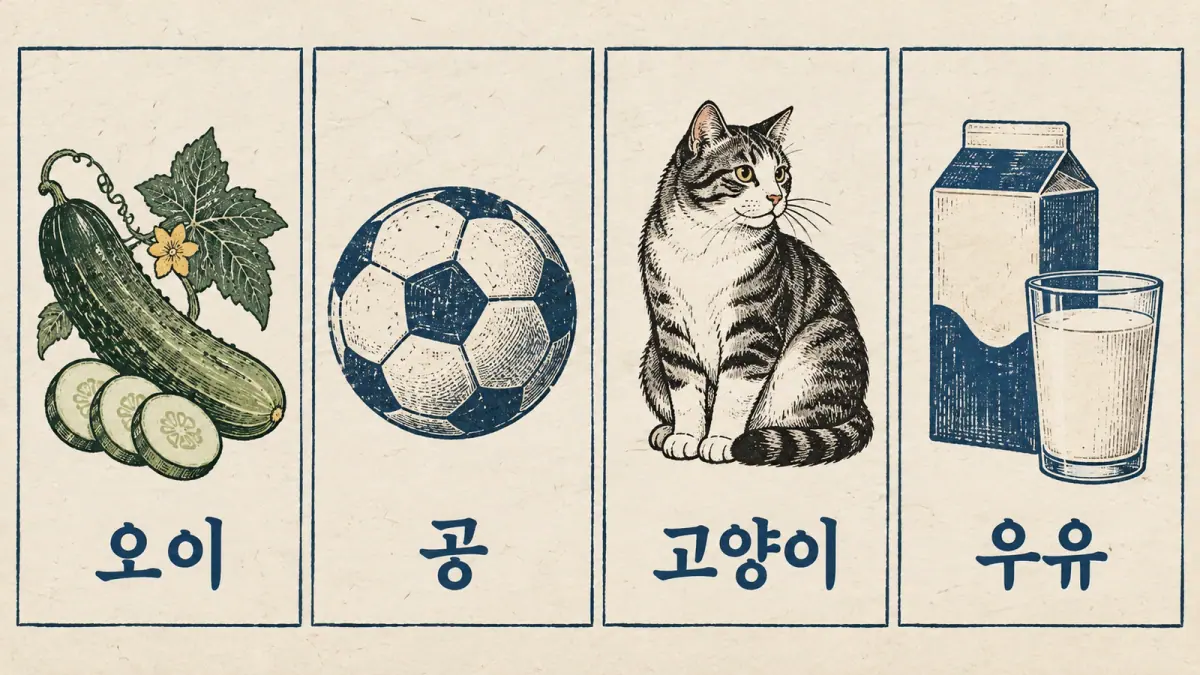
- Read aloud. Read 오이, 공 (gong, ball), 고양이 and 우유. For each ㅇ, say whether it is silent or [ŋ].
- Write the block. Write the syllables "o", "eu" and "ang" in Hangul.
- Find the final. In 음악, which consonant moves into the empty ㅇ slot, and how is the word said?
Answers
- 방 means "room" (반 is "half"). 강 means "river" (간 is "liver").
- 오이: both ㅇ silent. 공: final [ŋ]. 고양이: first ㅇ in 양 silent, final ㅇ of 양 [ŋ], ㅇ in 이 silent. 우유: both silent.
- 오, 으, 앙.
- The ㅁ of 음 moves into the empty slot of 악, so 음악 is said [으막].
If you got all four right, you understand both jobs of ㅇ.
What Should You Learn after ㅇ?
After the Korean letter ㅇ, learn The Korean Letter ㅈ (Jieut), the next basic consonant. ㅈ is built from ㅅ with one extra stroke, so it connects directly to the ㅅ lesson.
For review, use the Hangul flashcard decks for a few minutes a day, test yourself in the Hangul quizzes, and build syllables with silent and final ㅇ in the interactive Hangul alphabet. For handwriting, print the Korean consonants writing practice sheet, and see ㅇ among the 19 consonant letters on all Korean consonants.
What this lesson does not cover: the full liaison rule with double final consonants, the history of the obsolete letters ㆁ and ㆆ in detail, and nasalization, where other finals turn into [ŋ] (국물 [궁물]). Those topics live in the pronunciation and history sections, so this page stays focused on the single letter ㅇ.
Questions about the Korean Letter ㅇ
Why is ㅇ silent at the start of a syllable? Every Korean syllable block must begin with a consonant letter, even when the syllable starts with a vowel sound. ㅇ fills that slot without adding a sound, so 아 is read simply as "a". Without this rule, a vowel would float alone. The silent ㅇ also shows where a previous final consonant can move during speech.
Is final ㅇ the same as English ng? Final ㅇ is close to the ng in English "sing", made with the back of the tongue against the soft palate. Never add a g sound after it, as some English accents do in 'singer': 강 is [강], not "gang-g". When a vowel follows, as in 고양이, the [ŋ] stays where it is and does not move forward.
Can a Korean word start with ng? No. In modern Korean the [ŋ] sound appears only at the end of a syllable, never at the start of a word or syllable. An initial ㅇ is always silent. Fifteenth-century Korean had a separate letter, ㆁ, for ng, and it could appear at the start of a syllable, but that letter fell out of use centuries ago.
Why do vowel names like 아 and 오 include ㅇ? Korean vowels cannot be written alone in normal text, so each vowel is named and written with the silent ㅇ in front. The vowel ㅏ is called 아, ㅗ is called 오, and ㅣ is called 이. When you see 아 in a word, read only the vowel, because ㅇ adds no sound.
How do you type ㅇ on a Korean keyboard? On the standard Korean 2-set keyboard (Dubeolsik), ㅇ is on the key marked D. Because every vowel-initial syllable starts with ㅇ, it is one of the most-pressed keys. Typing D then K gives 아. Typing D, K, D gives 앙, because the keyboard software places the second ㅇ at the bottom automatically.