What you'll learn
- Say the letter name 지읒 and the three positional sounds of ㅈ, using 자다, 바지 and 낮.
- Write ㅈ in its printed form and recognise its handwritten ス-like form.
- Read 자, 조, 바지 and 낮 aloud, and explain why 가져요 is said [가저요].
- Tell ㅈ, ㅊ and ㅉ apart in 자다, 차다 and 짜다.
- Prerequisites: the vowel lesson for ㅏ. Estimated time: 15 minutes.
The Korean Letter ㅈ at a Glance
The Korean letter ㅈ is the ninth consonant in South Korean dictionary order and one of the 14 basic consonants in the Hangul Orthography (한글 맞춤법, Article 4). On this site it follows ㅇ in the set of basic Korean consonants.
| Attribute | Value |
|---|---|
| Letter | ㅈ |
| Name | 지읒 (jieut) |
| Revised Romanization | j before a vowel, t at the end of a syllable |
| Sound family | affricate: a stop that releases into a hiss |
| Strokes | 2 (school handwriting); 3 in some print-style charts |
| Final sound (batchim) | unreleased [t] |
| Partner letters | ㅊ (aspirated), ㅉ (tense) |
| Keyboard key (Dubeolsik) | W |
The shape of ㅈ comes from ㅅ. The 1446 commentary Hunminjeongeum Haerye (훈민정음 해례) says ㅅ pictures a tooth, and adding a stroke on top makes ㅈ, a stronger sound made in the same area. Adding one more stroke makes ㅊ. If you learned ㅅ two lessons ago, you can already see ㅅ inside ㅈ.
The name 지읒 follows the regular pattern for consonant names: 지 + 읒. In Choe Sejin's 1527 textbook Hunmong Jahoe (훈몽자회), ㅈ had only a one-syllable name, because it was not listed among the letters used at the end of a syllable. The two-syllable name 지읒 was standardised later, in the 1933 Unified Hangul Spelling System (한글 맞춤법 통일안). The page on the names of the Korean consonants covers this history. Now to the sound.
What Sound Does ㅈ Make?
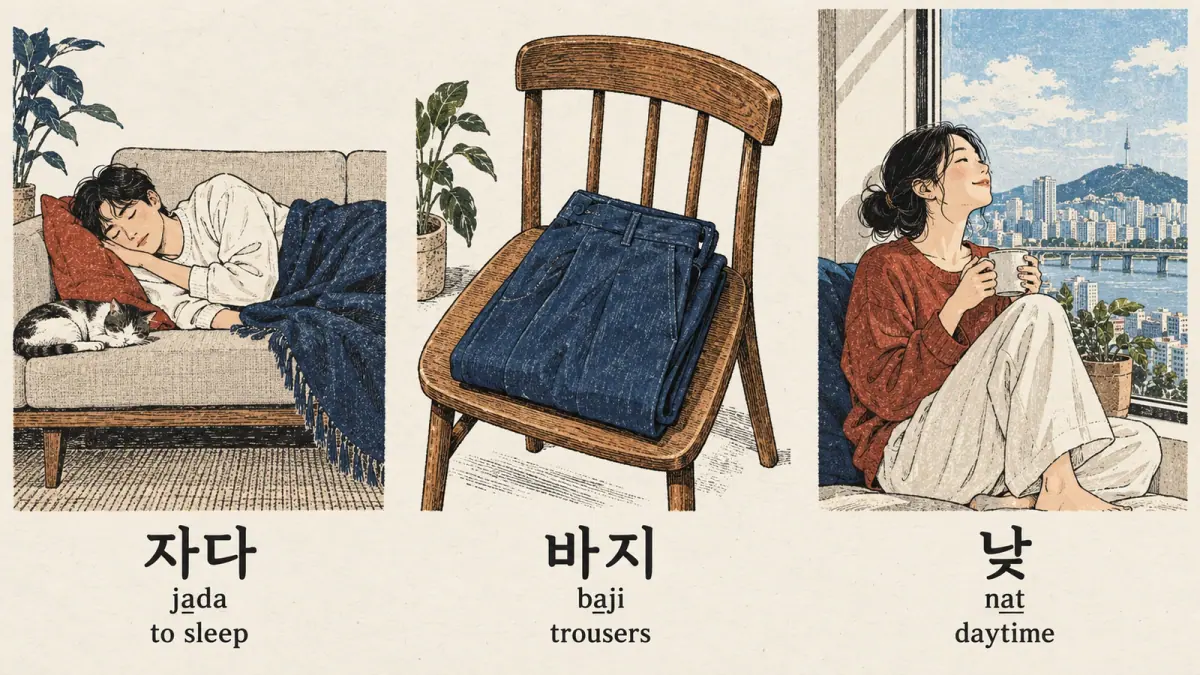
ㅈ makes one sound with three positional versions: a light ch with little breath at the start of a word, a voiced j between vowels, and an unreleased t at the end of a syllable. Linguists call this kind of sound an affricate: the tongue first blocks the air, like a t, and then releases it with a short hiss, like sh.
| Position | Example | Pronunciation | What you hear |
|---|---|---|---|
| Start of a word | 자다 (jada, to sleep) | [자다] | light ch, much less breath than English "ch" |
| Between vowels | 바지 (baji, trousers) | [바지] | soft j, as in English "magic" |
| After ㄴ, ㅁ, ㅇ or ㄹ | 반지 (banji, ring) | [반지] | soft j |
| End of a syllable | 낮 (nat, daytime) | [낟] | unreleased t |
To make the sound, place the front of your tongue just behind the gum ridge, a little further back than for ㄷ, and release it with a short, soft hiss. Keep the breath small. Learners often assume ㅈ is exactly English j; at the start of a word it is unvoiced and sounds closer to an unaspirated ch.
Why Is 져 Pronounced Like 저?
져 is pronounced like 저 because ㅈ is already made with the tongue close to the y position, so the y in the vowel ㅕ is not heard separately. The Standard Pronunciation Rules (표준 발음법, Article 5) state that 져, 쪄 and 쳐 are pronounced [저], [쩌] and [처]. The spelling with ㅕ comes from grammar: 가지다 (to have) + -어요 becomes 가져요, said [가저요].
This means you can read 져 in verb forms exactly as 저 and be correct in standard pronunciation. Revised Romanization still follows the spelling, writing gajyeoyo. With the sound in place, the next step is the shape.
How Do You Write ㅈ?
ㅈ is written in two strokes, the order taught in Korean schools: a top bar that turns down into a left-falling diagonal, then a right-falling diagonal from the middle of the first stroke. The consonant stroke order lesson shows ㅈ next to ㅅ and ㅊ so you can compare the family.
Practise on Paper
- Draw a short horizontal line from left to right across the top, then, without lifting the pen, turn and draw a diagonal down to the left. This first stroke looks like the number 7.
- Start at about the middle of the diagonal. Draw down to the right.
Stroke Order: 2 Strokes
- Draw a short horizontal line from left to right across the top, then, without lifting the pen, turn and draw a diagonal down to the left. This first stroke looks like the number 7.
- Start at about the middle of the diagonal. Draw down to the right.
Some print-style charts lift the pen after the top line and count the bar and the left diagonal as separate strokes, which gives ㅈ three strokes. Both methods produce a correct ㅈ, and both follow the same rule as all Hangul: top before bottom, left before right. This site counts two strokes, matching the consonant stroke order lesson linked above.
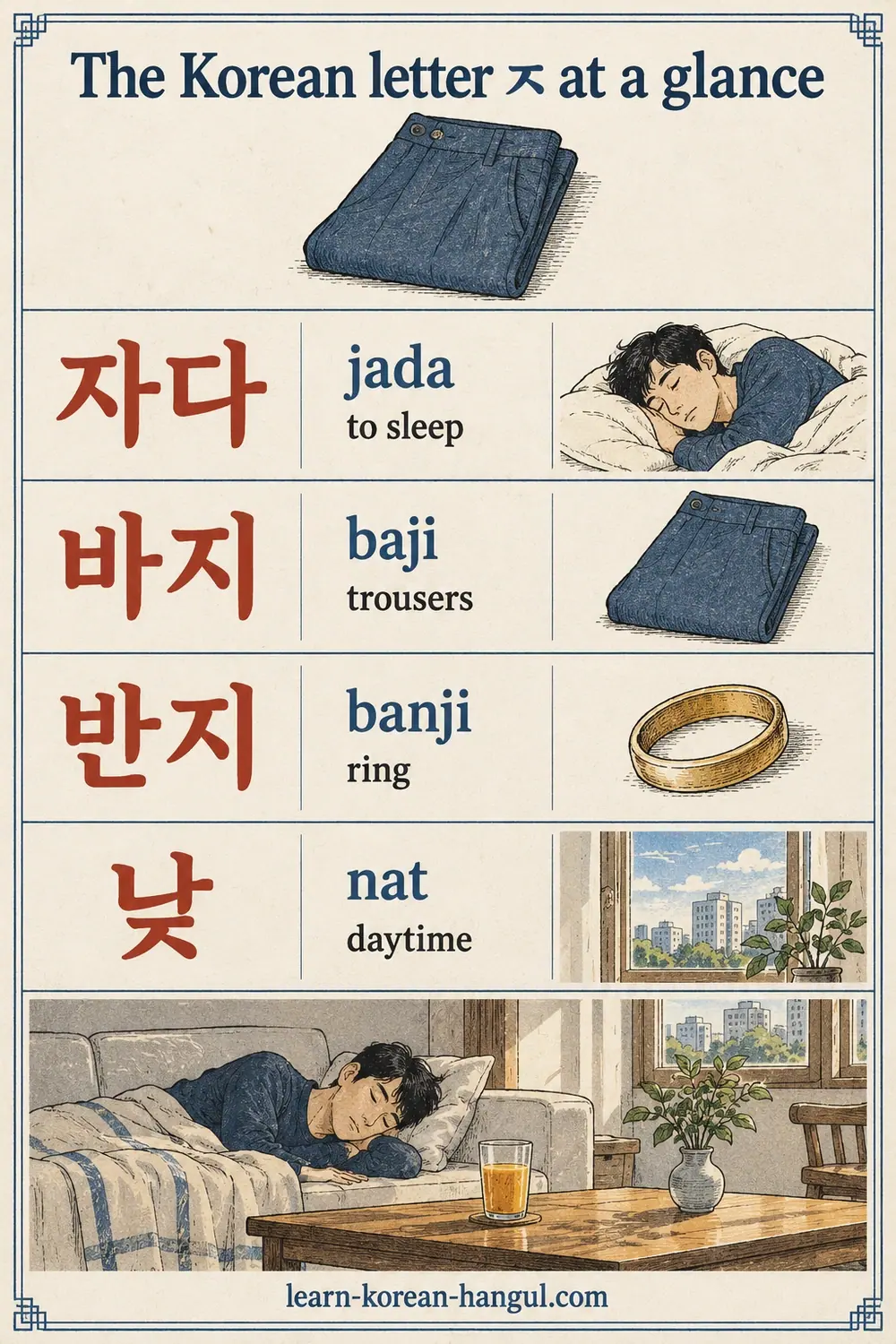
The two styles also explain why ㅈ looks different in different places. Many sans-serif (고딕, Gothic) fonts show a flat bar sitting above a ㅅ shape. Handwriting and many serif (명조, Myeongjo) fonts join the bar and the left leg into one stroke, so the letter looks like the Japanese katakana ス. Learners who only know one form often fail to recognise the other on signs and menus, so look at both in the hero image above. With the shape learned, the next section follows ㅈ through each position.
How Does ㅈ Change at the Start, Middle and End?
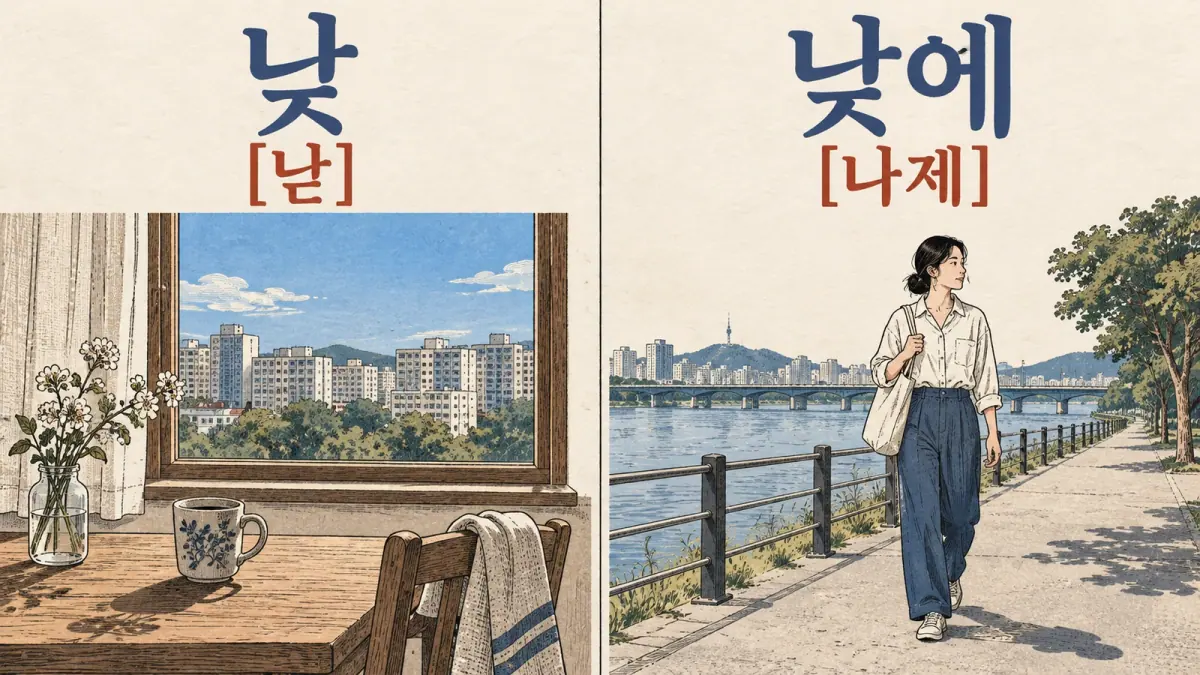
ㅈ is a light ch at the start of a word, a voiced j between vowels, and an unreleased [t] at the end of a syllable. Its final [t] turns back into ㅈ when a vowel follows.
| Position in the block | Example | Said | Romanized |
|---|---|---|---|
| Initial, word start | 지도 (jido, map) | [지도] | jido |
| Initial, between vowels | 바지 | [바지] | baji |
| Final (batchim) | 낮 | [낟] | nat |
| Final before a vowel | 낮에 (in the daytime) | [나제] | naje |
| Final before a consonant | 잊다 (itda, to forget) | [읻따] | itda |
The last two rows show ㅈ hiding and reappearing. Spoken alone, 낮 ends in [t]. Add the particle 에 and the ㅈ moves into the empty slot of the next syllable: [나제]. Before a plain consonant, final ㅈ is [t] and makes that consonant tense, so 잊다 is said [읻따].
ㅈ also appears in speech where the spelling does not show it. When ㄷ or ㅌ at the end of a syllable meets the vowel 이 of a grammatical suffix or particle, the pair is said as [지] or [치]: 같이 (together) is said [가치], and 굳이 is said [구지]. This is the palatalization rule (같이 = [가치]).
ㅈ as a Final Consonant (batchim)
A consonant at the bottom of a block, like ㅈ in 낮, is a batchim (받침, "support"). As a batchim, ㅈ is an unreleased [t]: the tongue presses against the gum ridge and stops, with no hiss.
The Standard Pronunciation Rules (표준 발음법, Article 9) place final ㅈ with ㄷ, ㅅ, ㅆ, ㅊ and ㅌ under the representative sound [t], one of the seven final sounds. That is why 낮 (daytime), 낫 (sickle) and 낯 (face) all sound like [낟] when said alone, and only the spelling, or a following vowel, tells them apart. The next section brings the positions together in real blocks.
Worked Example: Reading 자, 조, 바지, 낮
Reading a block with ㅈ takes three steps: find the consonant, find the vowel, then check whether ㅈ closes the block.
- 자. ㅈ sits left of ㅏ. Release a light ch with little breath, then "ah": [자]. Romanized ja.
- 조. ㅈ sits above ㅗ. Round your lips as you release: [조]. Romanized jo.
- 바지. 바 is ㅂ + ㅏ. In 지, ㅈ follows a vowel, so it is voiced: [바지], a soft j. Romanized baji.
- 낮. ㄴ starts the block, ㅏ is the vowel, and ㅈ is the batchim. Say "na", press the tongue up and stop: [낟]. Romanized nat.
If your 낮 ends with "j" or "ch", you released the final consonant; stop the air with the tongue instead. The amount of breath on the first ㅈ is also what separates it from its two partners.
ㅈ Compared with ㅊ and ㅉ
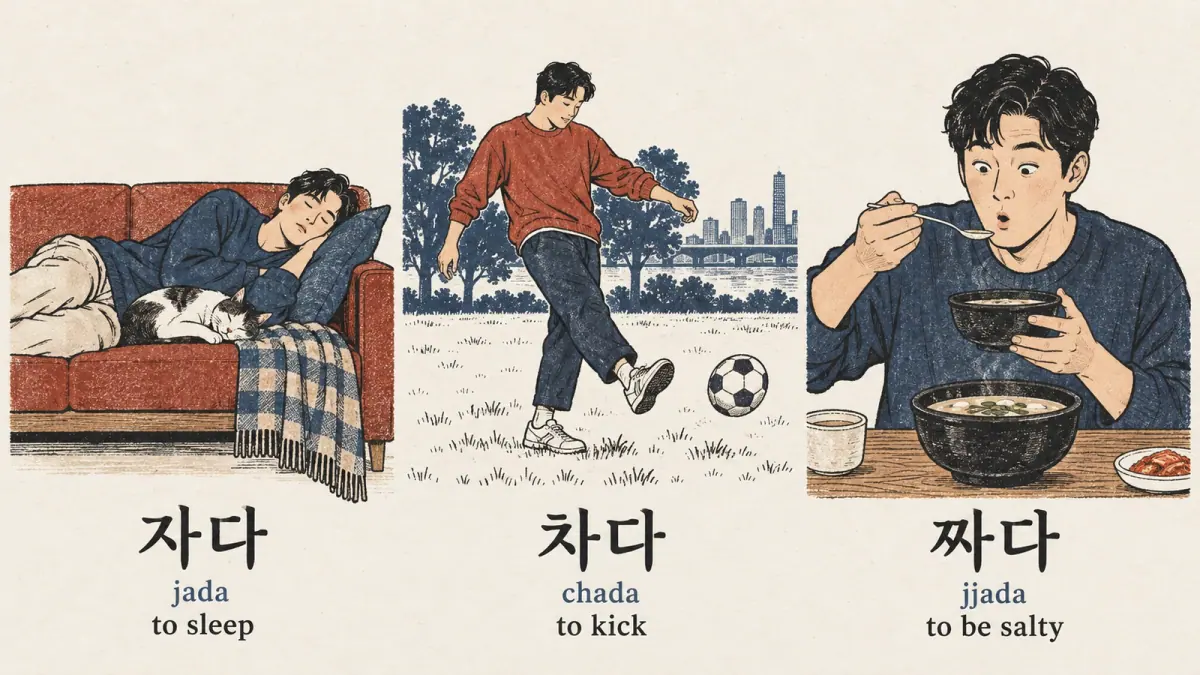
ㅈ, ㅊ and ㅉ share one tongue position and differ in breath and tension. ㅈ is plain (a small puff), ㅊ is aspirated (a strong puff), and ㅉ is tense (a tight throat and no puff). The verbs 자다 (to sleep), 차다 (to kick) and 짜다 (to be salty) show that each change makes a new word.
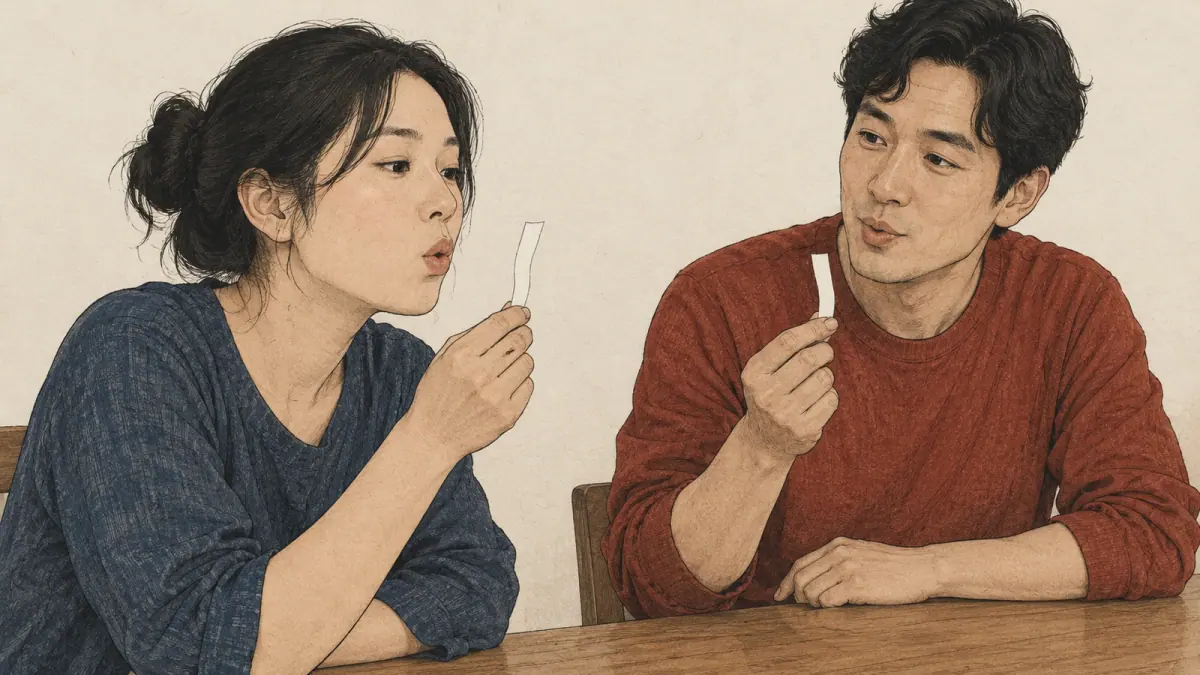
Paper Test: ㅊ Moves the Paper, ㅈ Barely, ㅉ Not at All
| Korean | Romanization | Meaning | Sound |
|---|---|---|---|
| 자다 | jada | to sleep | |
| 차다 | chada | to kick; to be cold | |
| 짜다 | jjada | to be salty |
| Letter | Type | Breath | Throat | Example word |
|---|---|---|---|---|
| ㅈ | plain (lenis) | small puff | relaxed | 자다 (jada, to sleep) |
| ㅊ | aspirated | strong puff | relaxed | 차다 (chada, to kick) |
| ㅉ | tense | no puff | tight | 짜다 (jjada, to be salty) |
Hold a strip of thin paper about 3 cm from your lips. 차다 should make it jump, 자다 should move it a little, and 짜다 should leave it still while your throat tightens. In Seoul speech, the vowel after ㅈ also starts lower in pitch than after ㅊ or ㅉ.
Study the full lessons on the letter ㅊ (Chieut) and the letter ㅉ (Ssangjieut) after the basic set. Several mistakes below come from mixing up this trio.
Common Mistakes with ㅈ
Four mistakes cause most ㅈ problems.
- Using a full English j in 자다. A strongly voiced j at the start of a word sounds foreign. Fix: start 자다 almost like "chah", with a relaxed throat and little breath.
- Aspirating 자 into 차. 자다 (to sleep) then becomes 차다 (to kick). Fix: use the paper test and aim for a small movement. The same mistake turns 지 into 치, as in 치마 (skirt).
- Reading 낮 as "naj". Final ㅈ is never j. Fix: end with an unreleased [t], [낟].
- Not recognising the handwritten ㅈ shape. The ス-like form appears on many signs, menus and handwritten notes. Fix: practise reading both forms side by side.
Is ㅈ the Same as the English Letter?
No. ㅈ is not exactly English j or English ch. English j is voiced at the start of words ("jam"), and English ch has a strong puff of air ("charm"). Korean ㅈ at the start of a word has neither feature, which is why it sits between them. Between vowels it moves toward j because the vocal cords keep vibrating, and at the end of a syllable it is a [t].
Revised Romanization (국어의 로마자 표기법, 2000) writes ㅈ as j before vowels and t at the end, as in 낮 (nat). The older McCune-Reischauer system wrote ch for word-initial ㅈ, which is why older maps and family names sometimes show "Cheju" for 제주. Read the Hangul, not the romanization. The exercises below practise exactly that.
Practice: Four Quick Exercises
Try each exercise, then check the answers at the end of this section. The same items run as an interactive quiz.
Practice · 7
Which word means "to be salty"?
Show answer
짜다
짜다 with tense ㅉ means to be salty; 자다 is to sleep and 차다 is to kick.
How is 낮 (daytime) pronounced when said alone?
Show answer
[낟]
Final ㅈ is an unreleased [t], so 낮 alone is said [낟].
How is 낮에 (in the daytime) pronounced?
Show answer
[나제]
Before a vowel the ㅈ moves into the empty slot of the next syllable, so 낮에 is said [나제].
How is 가져요 pronounced in standard pronunciation?
Show answer
[가저요]
Standard Pronunciation Rules Article 5 says 져 is pronounced [저], so 가져요 is said [가저요].
How does ㅈ sound between vowels, as in 바지?
Show answer
A soft, voiced j
Between vowels the vocal cords keep vibrating, so ㅈ becomes a soft j.
How is 같이 (together) pronounced?
Show answer
[가치]
Final ㅌ before the suffix 이 is said [치] (palatalization), so 같이 is [가치].
How is 잊다 (to forget) pronounced?
Show answer
[읻따]
Final ㅈ is [t] and makes the following plain consonant tense, so 잊다 is said [읻따].
- Listen and choose. Which word means "to be salty": 자다, 차다 or 짜다? Which means "to sleep"?
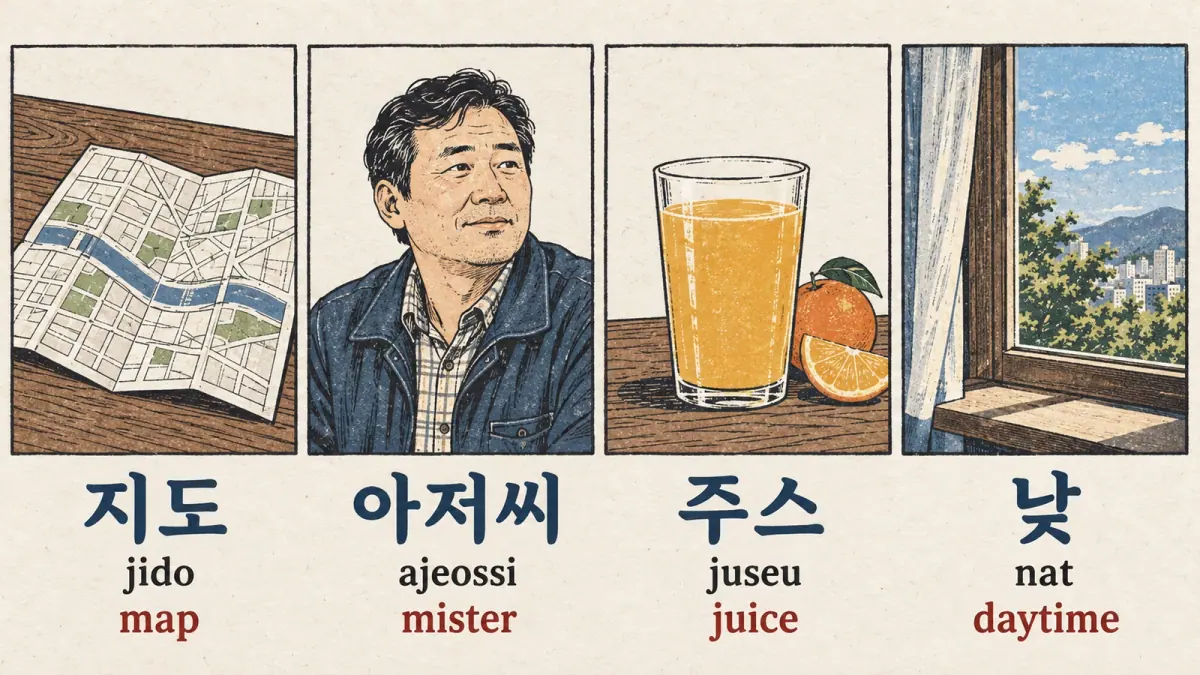
- Read aloud. Read 지도, 아저씨 (ajeossi, mister), 주스 (juseu, juice) and 낮. For each ㅈ, say whether it is ch-like, j-like or [t].
- Write the block. Build and write: ㅈ + ㅓ, ㅈ + ㅜ, ㄴ + ㅏ + ㅈ.
- Spelling vs sound. How is 가져요 pronounced, and how is 낮에 pronounced?
Answers
- 짜다 means "to be salty". 자다 means "to sleep" (차다 is "to kick").
- 지도: ch-like (light). 아저씨: j-like. 주스: ch-like (light). 낮: final [t].
- ㅈ + ㅓ = 저, ㅈ + ㅜ = 주, ㄴ + ㅏ + ㅈ = 낮.
- 가져요 is [가저요]. 낮에 is [나제].
If you got all four right, you have the main ㅈ patterns.
What Should You Learn after ㅈ?
After the Korean letter ㅈ, learn The Korean Letter ㅎ (Hieut), the last letter in the basic consonant set. ㅎ is a breathy h sound that also affects the letters around it.
For review, use the Hangul flashcard decks for a few minutes a day, test yourself in the Hangul quizzes, and listen to ㅈ, ㅊ and ㅉ in the interactive Hangul alphabet. For handwriting, print the Korean consonants writing practice sheet, and see ㅈ among the 19 consonant letters on all Korean consonants.
What this lesson does not cover: the full palatalization and tensification rules, the clusters ㄵ (as in 앉다) that include ㅈ, and the McCune-Reischauer system in detail. Those topics live in the pronunciation and romanization sections, so this page stays focused on reading and writing the single letter ㅈ.
Questions about the Korean Letter ㅈ
Is ㅈ pronounced j or ch? ㅈ is one Korean sound that English speakers hear as j or ch. At the start of a word it is a light ch with very little breath, as in 자다. Between vowels it becomes a soft j, as in 바지. At the end of a syllable it is an unreleased t, as in 낮.
Why does ㅈ look different in handwriting? ㅈ has two common shapes. Many printed fonts draw a flat bar on top with two legs below, like ㅅ under a line. Handwriting and many other fonts join the top bar and the left leg into one stroke, so ㅈ looks like the Japanese katakana ス. Both shapes are the same letter, and both are correct.
What is the difference between ㅈ, ㅊ and ㅉ? All three are made in the same place, but they differ in breath and tension. ㅈ is plain, with a small puff of air. ㅊ is aspirated, with a strong puff. ㅉ is tense, with a tight throat and no puff. The verbs 자다 (to sleep), 차다 (to kick) and 짜다 (to be salty) differ only this way.
How do you pronounce final ㅈ? Final ㅈ is pronounced as an unreleased [t]: the tongue presses the gum ridge and stops, with no j or ch sound. 낮 (daytime) is said [낟], and 잊다 (to forget) is said [읻따]. When a vowel follows, the ㅈ sound returns: 낮에 (in the daytime) is said [나제].
How do you type ㅈ on a Korean keyboard? On the standard Korean 2-set keyboard (Dubeolsik), ㅈ is on the key marked W, next to ㅂ on Q. Press Shift and W together to type the double letter ㅉ. With Korean input switched on, typing W then K gives 자, because the vowel ㅏ sits on the K key.