What you'll learn (about 15 minutes, level A0, you only need the vowel ㅏ first)
- Read and write ㅁ in the syllables 마, 모, 엄마 and 몸.
- Say the name 미음 and pronounce ㅁ correctly at the start and end of a syllable.
- Explain why 합니다 is said [함니다].
- Tell final ㅁ, ㄴ and ㅇ apart in 감, 간 and 강.
What Does the Korean Letter ㅁ Sound Like?

The Korean letter ㅁ sounds like the English m in "mom", "milk" or "swim": the lips close, the voice starts, and the air flows out through the nose. The IPA symbol is [m]. Revised Romanization, the official Latin spelling system, writes it as "m". Linguists call ㅁ a bilabial nasal, because both lips (bi-labial) make the closure and the nose carries the sound (nasal).
Unlike many Korean consonants, ㅁ hardly changes. It sounds the same at the start of a word, between vowels and at the end of a syllable. That makes it one of the easiest letters in the alphabet.
Start with these words:
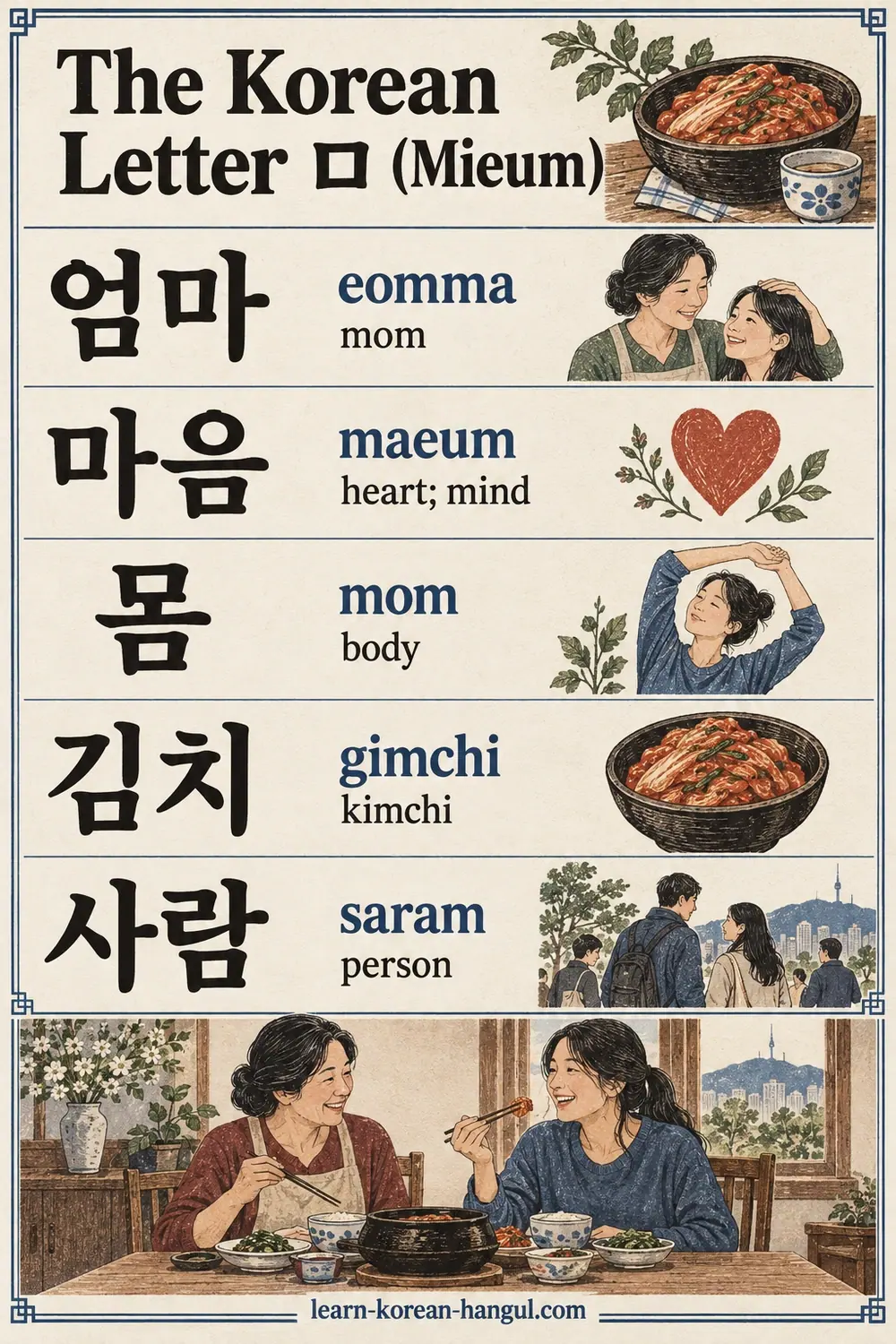
- 엄마 (eomma), mom
- 마음 (maeum), heart; mind
- 몸 (mom), body
- 김치 (gimchi), kimchi
- 사람 (saram), person
The name 미음 follows the pattern explained on the page about the names of the Korean consonants: the letter's sound at the start, then 으 and the letter again at the end. Both ends of the name are ㅁ, so the name is said [미음].
ㅁ is one of the 14 basic Korean consonants, and it is a good first letter because the English sound is almost the same.
Why Does 합니다 Sound Like Hamnida?
합니다 sounds like "ham-ni-da" because the ㅂ at the bottom of 합 becomes ㅁ when ㄴ follows. The written word 합니다 means "do" in the formal polite style, and the written ㅂ is changed in speech. The 국립국어원 표준 발음법 (Standard Pronunciation Rules, National Institute of Korean Language) calls this nasalization (비음화) in Article 18.
- 합니다 (hamnida), do, formal polite, said [함니다]
- 감사합니다 (gamsahamnida), thank you, said [감사함니다]
- 입니다 (imnida), is, formal polite, said [임니다]
This means ㅁ is both a letter you write and a sound you hear where you did not write it. The lesson on the nasalization rule (합니다 = [함니다]) covers every case. For now, remember that ㅂ followed by ㄴ or ㅁ is said as ㅁ.
Next, a look at why the letter has this shape.
Why Is ㅁ Shaped Like a Box?
ㅁ is a box because it copies the shape of the closed mouth. According to the Hunminjeongeum Haerye (1446), the text that explained the design of Hangul, the lip letters are based on the shape of the lips. The base lip letter is ㅁ. Adding a stroke gives ㅂ, and adding another gives ㅍ, so each stroke marks a stronger sound.
You can use this as a memory aid:
- ㅁ (mieum) is the base lip letter: closed lips, nose sound.
- ㅂ (bieup) adds strokes: the lips open with a soft burst.
- ㅍ (pieup) adds more strokes: the lips open with a strong puff.
This is the stroke-addition principle (가획, gahoek), also used for ㄴ, ㄷ and ㅌ. If you know ㅁ, you already know the shape family of ㅂ and ㅍ.
Now that you know the idea behind the shape, here is how to draw it.
How to Write ㅁ in 3 Strokes
ㅁ is written with 3 strokes in standard print.
Practise on Paper
- Draw the left side: a vertical line from the top down.
- Draw the top and right side together: a horizontal line to the right, then a vertical line down.
- Draw the bottom: a horizontal line from left to right, closing the box.
- Draw the left side: a vertical line from the top down.
- Draw the top and right side together: a horizontal line to the right, then a vertical line down.
- Draw the bottom: a horizontal line from left to right, closing the box.
Success check: your ㅁ is a closed box with square corners. The four sides meet without gaps, and the box is not a circle.
Some people write ㅁ in 2 strokes in quick handwriting, by joining the left side and the bottom into one stroke. The 3-stroke order is the standard teaching order. Compare it with its neighbours in consonant stroke order.
Inside a block, ㅁ is drawn a little smaller. In 마, ㅁ sits on the left and ㅏ on the right. In 모, ㅁ sits on top and ㅗ underneath. In 몸, ㅁ appears twice: once at the top and once at the bottom as a final consonant.
Next, a look at what ㅁ does in different places inside a word.
ㅁ at the Start, Middle and End of a Word

ㅁ is the same [m] at the start, in the middle and at the end of a syllable; the only change is that the lips stay closed at the end. The table shows each position.
| Position | Example | Pronounced | What happens |
|---|---|---|---|
| Start of a word | 마음 (heart) | [마음] | lips open into the vowel |
| Middle of a word | 사람 (person) | [사람] | ㅁ links the two syllables |
| End of a syllable, nothing follows | 몸 (body) | [몸] | lips stay closed, no release |
| End of a syllable, a vowel follows | 몸이 (the body) | [모미] | ㅁ moves to the next syllable |
| Written ㅂ before ㄴ | 합니다 (do) | [함니다] | ㅂ becomes ㅁ |
A letter at the bottom of a syllable block is called a batchim (받침, final consonant). The glossary entry on batchim defines the term, and a block like 몸 has ㅁ as its batchim.
ㅁ as a Final Consonant (batchim): [m]
ㅁ as a final consonant is pronounced [m]: the lips close and stay closed, and the sound ends in the nose. This is one of the 7 final sounds of Korean listed in the Standard Pronunciation Rules, and you can see all of them in the seven final sounds.
- 밤 (bam), night; chestnut
- 몸 (mom), body
- 김 (gim), seaweed; steam
- 곰 (gom), bear
English speakers sometimes open their lips slightly after a final m, especially in careful speech, which adds a small puff or vowel after "ham". In Korean the mouth stays shut until the next word starts. Close your lips and hold them for a moment after the m.
The next section puts ㅁ against two similar letters.
ㅁ Compared with ㅂ and ㄴ
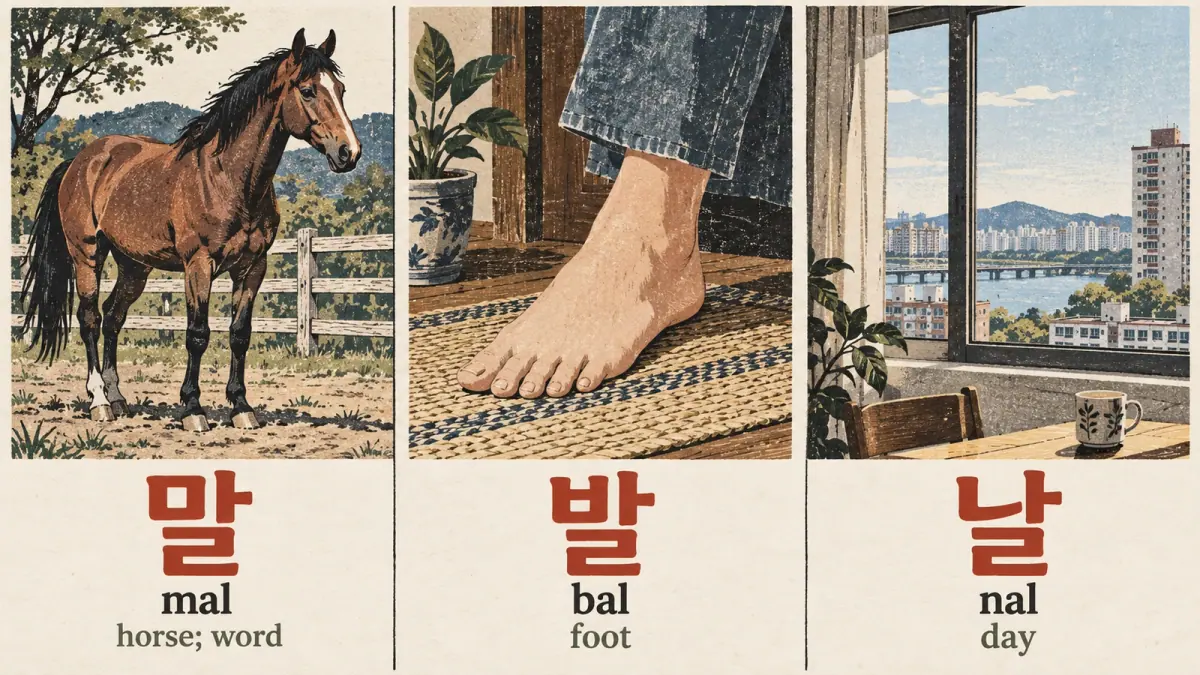
ㅁ is a nasal, ㅂ is a stop and ㄴ is a nasal made with the tongue. The set 말, 발 and 날 lets you hear all three at the start of a word. 말 (mal) means "horse" or "word", 발 (bal) means "foot", and 날 (nal) means "day".
ㅁ: Lips Closed, Sound through the Nose; ㅂ: Lips Closed, Then a Soft Burst; ㄴ: Tongue Tip on the Ridge, Sound through the Nose
| Korean | Romanization | Meaning | Sound |
|---|---|---|---|
| 말 | mal | horse; word | |
| 발 | bal | foot | |
| 날 | nal | day |
| Word | Meaning | First letter | What to listen for |
|---|---|---|---|
| 말 | horse; word | ㅁ | lips closed, humming through the nose |
| 발 | foot | ㅂ | lips closed, then a soft pop |
| 날 | day | ㄴ | tongue tip touches the ridge behind the teeth |
You can test this: pinch your nose while saying 말. The sound should change or stop, because it travels through the nose. With 발, pinching the nose changes almost nothing. For further practice, compare the letter ㅂ (Bieup) and the letter ㄴ (Nieun).
Final ㅁ, ㄴ and ㅇ: 감, 간 and 강
At the end of a syllable, ㅁ, ㄴ and ㅇ are three different sounds, and English speakers tend to merge them. 감 (gam) means "persimmon", 간 (gan) means "liver" or "saltiness", and 강 (gang) means "river".
| Word | Meaning | Final letter | Mouth |
|---|---|---|---|
| 감 | persimmon | ㅁ [m] | lips closed |
| 간 | liver; saltiness | ㄴ [n] | tongue tip on the ridge |
| 강 | river | ㅇ [ŋ] | back of the tongue raised, lips open |
The mouth position is the cue. Lips closed means ㅁ, tongue tip up means ㄴ, and open lips with the tongue back means ㅇ.
Now put the pieces together in a worked example.
Worked Example: Reading 마, 모, 엄마 and 몸
Reading a Korean syllable means splitting the block into its parts and joining the sounds. Here are four examples, from the simplest to the longest.
Example 1: 마.
- Split the block: ㅁ + ㅏ.
- Say [m] and add [a]: [ma].
Example 2: 모.
- Split the block: ㅁ + ㅗ.
- Say [m] and add [o]: [mo]. The vowel ㅗ sits under the consonant.
Example 3: 엄마 (mom).
- Split the first block: silent ㅇ + ㅓ + ㅁ, giving [eom].
- Split the second block: ㅁ + ㅏ, giving [ma].
- Join them: [엄마], romanized eomma. The ㅁ at the end of 엄 and the ㅁ at the start of 마 run together, so hold the m a little longer.
Example 4: 몸 (body).
- Split the block: ㅁ + ㅗ + ㅁ.
- Say [m], then [o], then close the lips for a final [m].
- Join them: [몸], romanized mom.
Check yourself: if you can read all four aloud without the romanization, you have the core skill. Romanization is only a learning aid shown in parentheses.
The next section collects the errors that cost learners the most.
Which Mistakes Do Learners Make with ㅁ?

Most learners make one of four errors with ㅁ, and each has a quick fix.
- Opening the lips after a final ㅁ. Learners say "mom-uh". Fix: keep the lips closed after 몸 until you start the next word.
- Reading 합니다 as hap-ni-da. The ㅂ changes to ㅁ before ㄴ. Fix: say "ham-ni-da".
- Drawing ㅁ as a circle. A looped circle can be read as ㅇ. Fix: draw four straight sides with corners.
- Mixing up ㅁ and ㅇ in fast handwriting. The two letters look similar when written quickly. Fix: always close ㅁ with corners and keep ㅇ round.
Is the ㅁ Sound in 합니다 a Spelling Error?
The ㅁ sound in 합니다 is not a spelling error. The spelling keeps ㅂ because the stem 하- plus the ending ㅂ니다 is the regular formal ending, and the pronunciation rule changes the sound. If Hangul wrote 함니다, the connection to the ending ㅂ니다 would disappear.
Learners often assume that the spelling shows exactly what is heard. Actually, Hangul spelling shows the structure of the word, and a pronunciation rule produces the sound. The same pattern appears in 입니다 [임니다] and 십만 [심만] (a hundred thousand).
You are now ready to test what you have learned.
Practice: Four Quick Exercises

Complete these exercises before you check the answers. You can also test yourself with the interactive quiz.
Practice · 5
How many strokes does ㅁ take in standard print?
Show answer
3
ㅁ is three strokes: the left side, the top and right side together, then the bottom.
Which word means "body"?
Show answer
몸
몸 means body; 마음 means heart or mind, and 사람 means person.
How do you finish the final ㅁ in 몸?
Show answer
Keep the lips closed
Final ㅁ is [m], with the lips closed and the sound flowing through the nose.
Which word means "foot"?
Show answer
발
발 with ㅂ means foot; 말 means horse or word, and 날 means day.
Which word ends with closed lips?
Show answer
감
감 ends in ㅁ with closed lips; 간 ends in ㄴ and 강 ends in ㅇ.
- Read aloud. Say each word and write its pronunciation in brackets: 마음, 엄마, 몸, 김치, 사람, 감사합니다.
- Listen and choose. Play three clips. For each one, decide whether it starts with ㅁ, ㅂ or ㄴ:
- Write. Write ㅁ three times in 3 strokes, then write the blocks 마 and 모.
- Find the final. In the pairs 감 / 간 / 강, which one ends with closed lips?
Practise on Paper
- Draw the left side: a vertical line from the top down.
- Draw the top and right side together: a horizontal line to the right, then a vertical line down.
- Draw the bottom: a horizontal line from left to right, closing the box.
Answers to the Practice
- 마음 [마음], 엄마 [엄마], 몸 [몸], 김치 [김치], 사람 [사람], 감사합니다 [감사함니다]. Only the last one differs from the spelling.
- The order of the clips is 날 (ㄴ), 말 (ㅁ), 발 (ㅂ). If you got two of three, try the nose-pinch test and listen again.
- Your ㅁ should be a closed box with four sides and square corners.
- 감 ends with closed lips (ㅁ). 간 ends with the tongue on the ridge, and 강 ends with the tongue back.
Review the letter with the other consonants in the Hangul flashcard decks. Test yourself in the Hangul quizzes. For writing practice, print the Korean consonants writing practice sheet, and try the interactive Hangul alphabet.
What Should You Learn after ㅁ?
After ㅁ, continue to the letter ㅂ (Bieup), which shares the lip shape family. To see every consonant in one place, open all Korean consonants.
This lesson covers the sound, name, shape and main behaviors of ㅁ. It does not cover every sound-change rule, which lives in the pronunciation section, or the vowels that combine with ㅁ. Audio on this page is machine-generated and its review status is shown beside each clip; the Korean text and audio are drafts until a Korean specialist signs them off.
Questions about the Korean Letter ㅁ
Is ㅁ the same as English m? Almost. ㅁ is pronounced like the English m at the start of a word, in the middle, and at the end of a syllable. The one difference is that Korean keeps the lips closed at the end of a syllable, as in 몸, while English speakers sometimes release them. Practice holding the lips shut after the m.
How many strokes does ㅁ have? ㅁ has 3 strokes in standard print: the left side, the top and right side together, and the bottom. Draw the strokes from top to bottom and left to right, and close the box with square corners. Some people write ㅁ in 2 strokes when writing quickly, but the 3-stroke order is the standard teaching order.
Why do Koreans say 함니다 when it is written 합니다? The ㅂ at the bottom of 합 changes to ㅁ before ㄴ. This is called nasalization. It happens because the nose sound of ㄴ pulls the lips sound of ㅂ into a nasal sound, ㅁ. The spelling keeps ㅂ to show the ending ㅂ니다. So 합니다 is said [함니다].
What is the difference between ㅁ and ㅂ? ㅁ and ㅂ are both made with closed lips. ㅁ sends the sound through the nose, so it hums, and ㅂ stops the air and then releases it in a soft burst. Compare 말 (horse) and 발 (foot). In Revised Romanization, ㅁ is always m, while ㅂ is b before a vowel and p at the end.
What is the name of ㅁ in Korean? The name of ㅁ is 미음 (mieum). It is said [미음]. The name follows the regular pattern for most consonants, in which the letter's sound opens and closes the name, so ㅁ is both the first and last sound. Koreans use it when spelling a word aloud or talking about the alphabet.