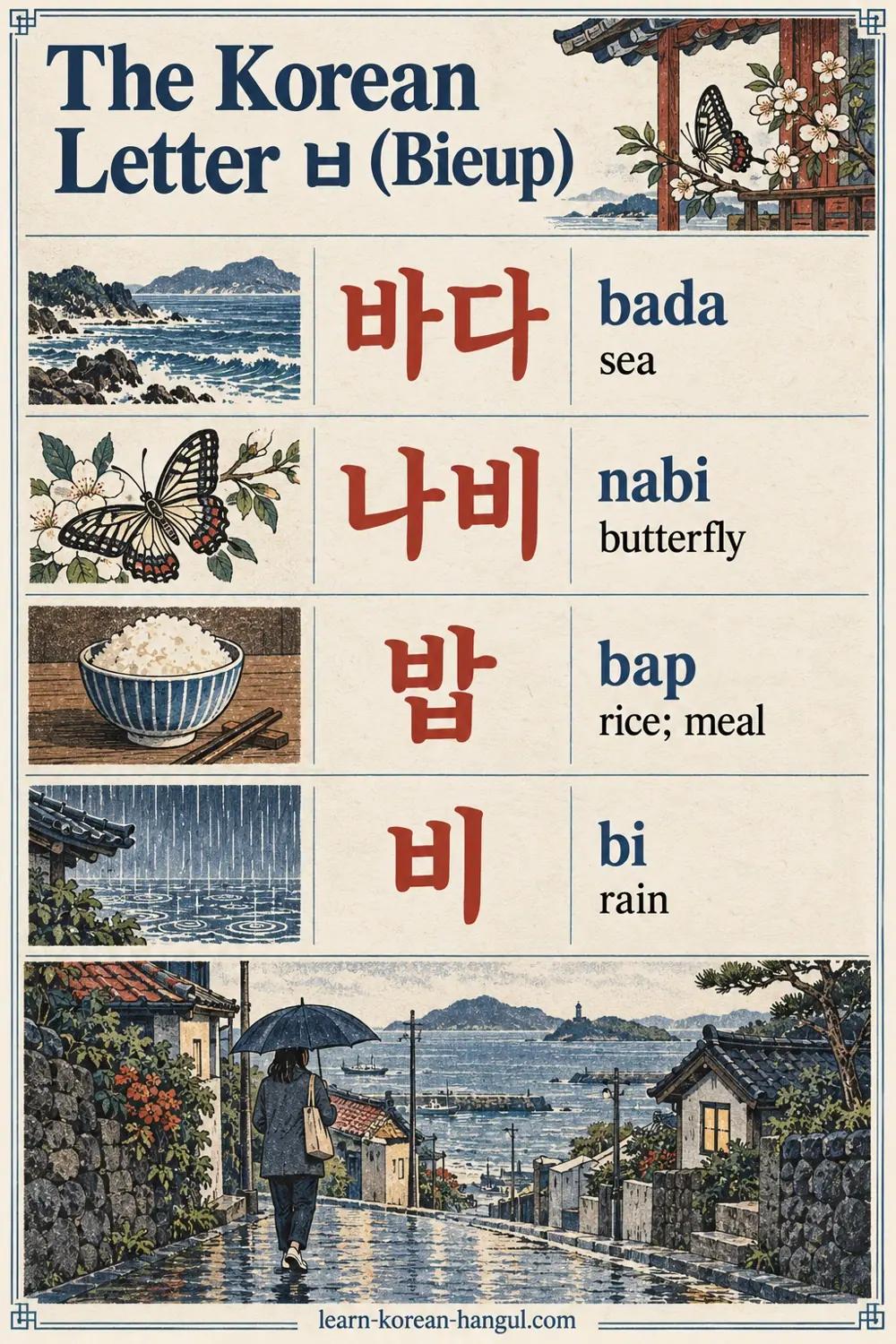
What you'll learn
- Say the letter name 비읍 and the three positional sounds of ㅂ, using 바다, 나비 and 밥.
- Write ㅂ in four strokes in the standard order.
- Read 바, 보, 나비 and 밥 aloud and keep the lips closed at the end of 밥.
- Tell ㅂ, ㅍ and ㅃ apart in 불, 풀 and 뿔.
- Prerequisites: the vowel lesson for ㅏ. Estimated time: 15 minutes.
The Korean Letter ㅂ at a Glance

The Korean letter ㅂ is the sixth consonant in South Korean dictionary order and one of the 14 basic consonants in the Hangul Orthography (한글 맞춤법, Article 4). On this site it follows ㅁ in the set of basic Korean consonants, because ㅂ is built from ㅁ.
| Attribute | Value |
|---|---|
| Letter | ㅂ |
| Name | 비읍 (bieup) |
| Revised Romanization | b before a vowel, p at the end of a syllable |
| Sound family | bilabial stop: both lips close, then open |
| Strokes | 4 |
| Final sound (batchim) | unreleased [p] |
| Partner letters | ㅍ (aspirated), ㅃ (tense) |
| Keyboard key (Dubeolsik) | Q |
The design of ㅂ shows its sound. The 1446 commentary Hunminjeongeum Haerye (훈민정음 해례) says ㅁ pictures the shape of the mouth. Adding strokes to ㅁ gives ㅂ, a lip sound with a stronger release, and adding strokes once more gives ㅍ, the breathy version. If you already know ㅁ, you already know where ㅂ is made: at the lips.
The name 비읍 follows the regular pattern for consonant names: consonant + 이, then 으 + consonant, so 비 + 읍. Only three basic consonants (ㄱ, ㄷ, ㅅ) break this pattern, as the page on the names of the Korean consonants explains. The next section turns from shape to sound.
What Sound Does ㅂ Make?
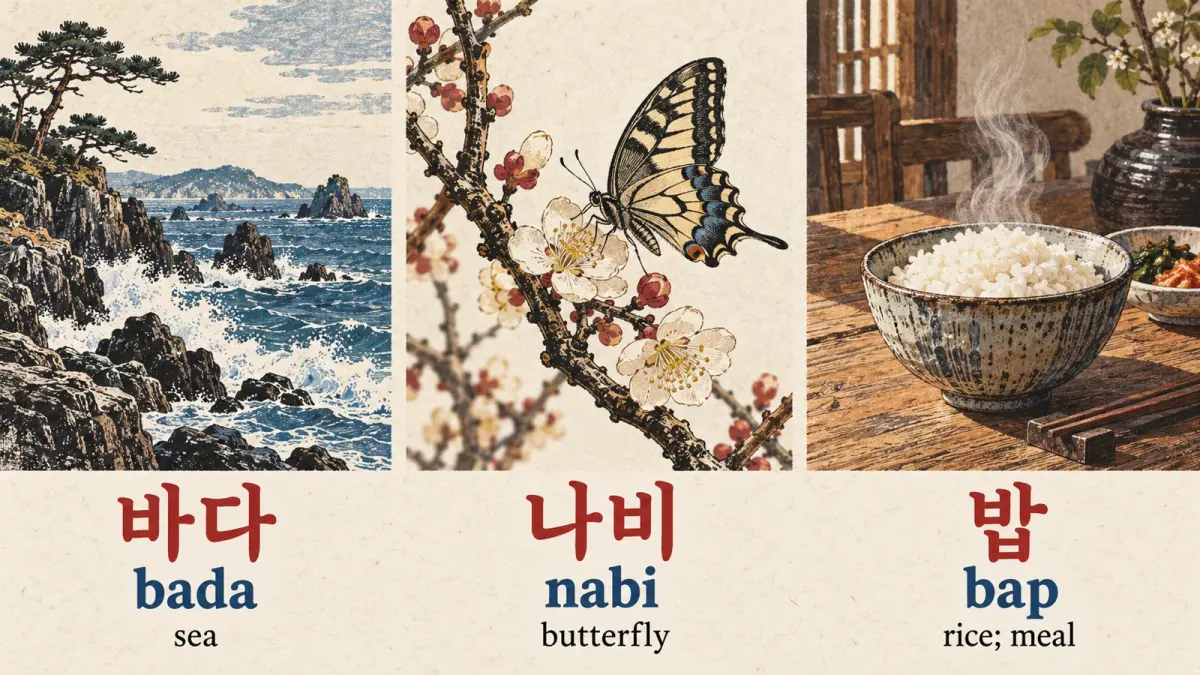
ㅂ makes one sound with three positional versions: a light p with little breath at the start of a word, a voiced b between vowels, and a p with the lips kept closed at the end of a syllable. These versions are allophones: different pronunciations of one sound that never change a word's meaning.
| Position | Example | Pronunciation | What you hear |
|---|---|---|---|
| Start of a word | 바다 (bada, sea) | [바다] | light p, much less breath than English "p" |
| Between vowels | 나비 (nabi, butterfly) | [나비] | soft b, as in English "baby" |
| After ㄴ, ㅁ, ㅇ or ㄹ | 갈비 (galbi, ribs) | [갈비] | soft b |
| End of a syllable | 밥 (bap, rice; meal) | [밥] | p with closed lips, no puff of air |
To make the sound, press your lips together, then open them gently with a small breath. Keep your throat relaxed. Learners often assume Korean has a b sound like English; ㅂ at the start of a word is closer to an unaspirated p, the p in English "spin", and it is voiced only between voiced sounds.
Why Does 밥 End with a Closed-Lip P?
밥 ends with a closed-lip p because Korean never releases a consonant at the end of a syllable. Your lips close for the final ㅂ and stay closed, so no puff of air escapes. The result is a quiet stop, which can sound to English ears as if the p is "swallowed".
Compare English "bop" said carefully, where the lips pop open at the end. In 밥 there is no pop. The two ㅂ in 밥 are the same letter, but you hear them differently: the first one opens into the vowel ㅏ, and the second one closes the syllable. Add a vowel after it and the second ㅂ opens again: 밥이 (rice + subject particle) is said [바비], with a soft b.
With the sound clear, the next step is the four strokes of the letter.
How Do You Write ㅂ?
ㅂ is written in four strokes: two vertical lines first, then two horizontal lines. The consonant stroke order lesson places ㅂ next to ㅁ and ㅍ so you can compare the three lip letters.
Practise on Paper
- Draw the left vertical line from top to bottom.
- Draw the right vertical line from top to bottom, the same height as the first.
- Draw a short horizontal line across the middle, left to right, connecting the two verticals.
- Draw the bottom horizontal line, left to right, closing the shape.
Stroke Order: 4 Strokes
- Draw the left vertical line from top to bottom.
- Draw the right vertical line from top to bottom, the same height as the first.
- Draw a short horizontal line across the middle, left to right, connecting the two verticals.
- Draw the bottom horizontal line, left to right, closing the shape.
The two verticals usually extend a little above the middle line, so ㅂ looks like an open-topped box with two posts rather than a closed square. In 바 the letter is tall and narrow. In 법 (beop, law), where ㅂ appears twice, the top ㅂ is wide and short and the bottom ㅂ is squeezed into the batchim space, so it looks flatter still. Writing the two verticals first keeps both versions balanced. Once you can write ㅂ, you can trace how it behaves in each position.
How Does ㅂ Change at the Start, Middle and End?

ㅂ changes in sound with its position: a light [p] at the start, a voiced [b] between vowels or after ㄴ, ㅁ, ㅇ and ㄹ, and an unreleased [p] at the end of a syllable. Before ㄴ or ㅁ, a final ㅂ even becomes [ㅁ].
| Position in the block | Example | Said | Romanized |
|---|---|---|---|
| Initial, word start | 비 (bi, rain) | [비] | bi |
| Initial, between vowels | 아버지 | [아버지] | abeoji |
| Final (batchim) | 입 (ip, mouth) | [입] | ip |
| Final before a vowel | 밥이 | [바비] | babi |
| Final before ㄴ | 입니다 (imnida, it is) | [임니다] | imnida |
The last row is the change you will hear most often. In polite speech, the endings -ㅂ니다 and -습니다 appear in almost every sentence, and their ㅂ is always said [ㅁ]: 입니다 is [임니다] and 합니다 (hamnida, does) is [함니다]. This is the nasalization rule (입니다 = [임니다]). Revised Romanization follows the sound here, writing imnida.
ㅂ as a Final Consonant (batchim)
A consonant written at the bottom of a block, like ㅂ in 밥, is a batchim (받침, "support"). As a batchim, ㅂ is an unreleased [p]: the lips close and stay closed.
Four spellings regularly end as [p]: ㅂ, ㅍ and the clusters ㅄ and ㄿ. The cluster ㄼ also ends as [p] in a few words, such as 밟다 (to step on, said [밥따]). The Standard Pronunciation Rules (표준 발음법, Articles 9–11) cover these spellings, as these words show:
- 입 (ip, mouth) is said [입].
- 앞 (ap, front) is spelled with ㅍ but said [압].
- 값 (gap, price) is spelled with ㅄ but said [갑].
[p] is one of the seven final sounds of Korean. The next section applies all of this to four real blocks.
Worked Example: Reading 바, 보, 나비, 밥
Reading a block with ㅂ takes three steps: find the consonant, find the vowel, then check whether ㅂ also closes the block.
- 바. ㅂ sits left of the tall vowel ㅏ. Close the lips, open them gently, and say "ah": [바]. Romanized ba.
- 보. ㅂ sits above the flat vowel ㅗ. Round your lips as you open them: [보]. Romanized bo.
- 나비. 나 is ㄴ + ㅏ. In 비, ㅂ comes after a vowel, so it is voiced: [나비], a soft b. Romanized nabi.
- 밥. ㅂ on the left, ㅏ on the right, and a second ㅂ at the bottom. Open into "ah", then close your lips and stop: [밥]. Romanized bap.
If your 밥 ends with "puh", you opened your lips after the final ㅂ. Try again and keep them shut until the sound stops. The amount of breath on the first ㅂ is what separates it from its two partners, covered next.
ㅂ Compared with ㅍ and ㅃ
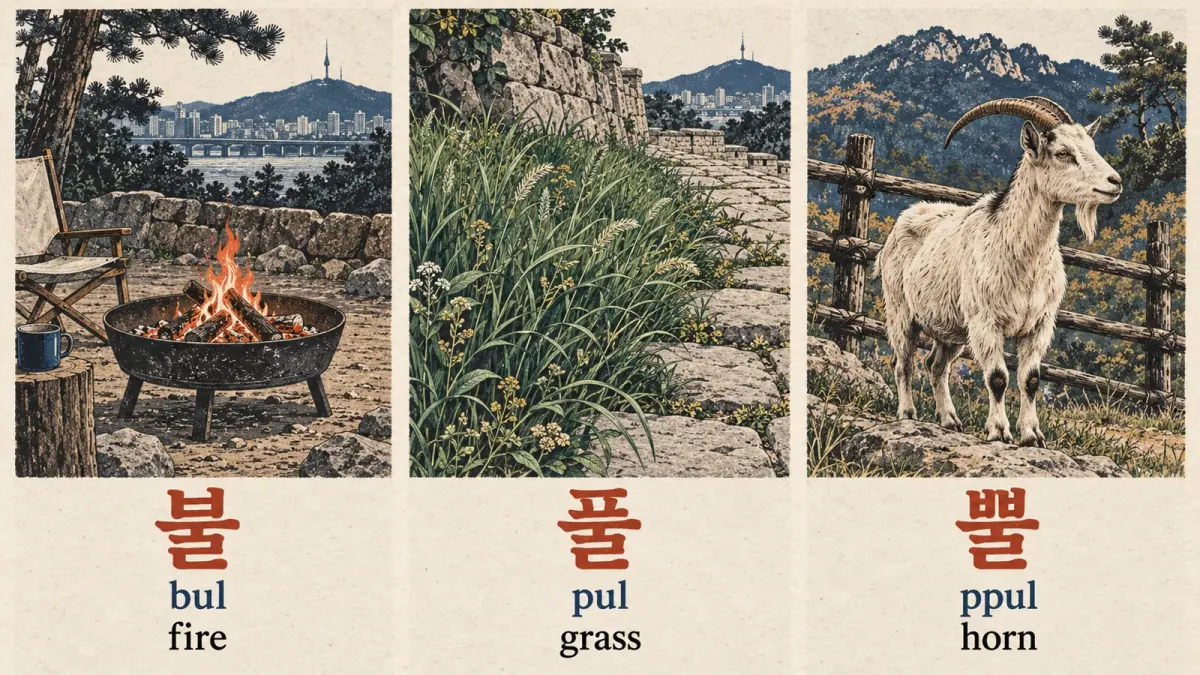
ㅂ, ㅍ and ㅃ are all made at the lips and differ only in breath and tension. ㅂ is plain (a small puff), ㅍ is aspirated (a strong puff), and ㅃ is tense (a tight throat and no puff). The three words 불 (fire), 풀 (grass) and 뿔 (horn) show that each change creates a different word.
Paper Test: ㅍ Moves the Paper, ㅂ Barely, ㅃ Not at All
| Korean | Romanization | Meaning | Sound |
|---|---|---|---|
| 불 | bul | fire | |
| 풀 | pul | grass; glue | |
| 뿔 | ppul | horn |
| Letter | Type | Breath | Throat | Example word |
|---|---|---|---|---|
| ㅂ | plain (lenis) | small puff | relaxed | 불 (bul, fire) |
| ㅍ | aspirated | strong puff | relaxed | 풀 (pul, grass) |
| ㅃ | tense | no puff | tight | 뿔 (ppul, horn) |
Lip sounds are ideal for the paper test, because the breath comes straight off your lips. Hold a strip of thin paper about 3 cm away. 풀 should make it jump, 불 should move it only slightly, and 뿔 should leave it still while your throat tightens. Seoul speakers also start the vowel lower in pitch after ㅂ than after ㅍ or ㅃ, which is a second cue to listen for.
Compare the full lessons on the letter ㅍ (Pieup) and the letter ㅃ (Ssangbieup) once you complete the basic set. Confusing these three is the source of several mistakes below.
Common Mistakes with ㅂ

Four mistakes cause most ㅂ problems.
- Using an English b at the start of 바다. A strongly voiced English b sounds foreign at the start of a Korean word. Fix: begin almost like "pah", with a relaxed throat and only a small breath.
- Aspirating 비 into 피. 비 means "rain" and 피 means "blood", so a big puff of air changes the word. Fix: use the paper test and aim for a small movement.
- Opening the lips after final ㅂ in 밥. This adds a "puh" sound. Fix: close the lips and hold them closed until the sound fades.
- Drawing the strokes in the wrong order. Starting with the horizontal lines, or drawing the right vertical first, makes the box uneven. Fix: verticals first (left, then right), then the middle line, then the bottom line.
Is ㅂ the Same as the English Letter?
No. ㅂ is not the same as English b or English p. English b is voiced at the start of words ("bat"), and English p has a strong puff of air ("pat"). Korean ㅂ at the start of a word has neither feature, so it sounds like the p in "spin", which has no puff. Between vowels it becomes a b because the vocal cords keep vibrating.
Revised Romanization (국어의 로마자 표기법, 2000) writes ㅂ as b before a vowel and p at the end, as in 밥 (bap). These letters help with names and signs but are not a pronunciation key; 부산 is written Busan, yet its first sound is closer to a light p. The exercises below train the real sounds.
Practice: Four Quick Exercises
Try each exercise, then check the answers at the end of this section. The same items run as an interactive quiz.
Practice · 8
What is the name of the letter ㅂ?
Show answer
비읍
ㅂ is named 비읍, following the regular pattern consonant + 이, then 으 + consonant.
How many strokes does ㅂ take to write?
Show answer
4
ㅂ is four strokes: left vertical, right vertical, middle horizontal, then bottom horizontal.
Which word means "grass"?
Show answer
풀
풀 with aspirated ㅍ means grass; 불 is fire and 뿔 is horn.
How is 입니다 pronounced?
Show answer
[임니다]
A final ㅂ before ㄴ becomes the nasal [ㅁ], so 입니다 is said [임니다].
How does the final ㅂ in 밥 sound?
Show answer
A p with the lips kept closed, no puff
Korean never releases a final consonant, so the lips close for final ㅂ and stay closed.
How is 밥이 (rice + subject particle) pronounced?
Show answer
[바비]
When a vowel follows, the final ㅂ opens into the next syllable as a soft b: [바비].
How is 앞 (front) pronounced when said alone?
Show answer
[압]
Final ㅍ ends as the same unreleased [p] as ㅂ, so 앞 is said [압].
Which word means "rain"?
Show answer
비
비 with plain ㅂ means rain; aspirating it gives 피, blood.
- Listen and choose. Which word means "grass": 불, 풀 or 뿔? Which means "rain": 비 or 피?
- Read aloud. Read 아버지, 비누 (binu, soap), 입 and 밥. For each ㅂ, say whether you hear a p-like, b-like or closed-lip sound.
- Write the block. Build and write: ㅂ + ㅓ, ㅂ + ㅜ, ㅂ + ㅏ + ㅂ.
- Find the final. How is the ㅂ in 입니다 pronounced, and why?
Answers
- 풀 means "grass" (불 is "fire", 뿔 is "horn"). 비 means "rain" (피 is "blood").
- 아버지: b-like. 비누: p-like. 입: closed-lip final [p]. 밥: p-like at the start, closed-lip [p] at the end.
- ㅂ + ㅓ = 버, ㅂ + ㅜ = 부, ㅂ + ㅏ + ㅂ = 밥.
- It is pronounced [ㅁ], giving [임니다], because a final ㅂ before ㄴ becomes nasal.
If you got all four right, you are ready for the next letter.
What Should You Learn after ㅂ?
After the Korean letter ㅂ, learn The Korean Letter ㅅ (Siot), the next basic consonant. ㅅ is the first hissing sound in the course, and it behaves differently before ㅣ.
For review, use the Hangul flashcard decks for a few minutes a day, test yourself in the Hangul quizzes, and listen to all the lip sounds in the interactive Hangul alphabet. For handwriting, print the Korean consonants writing practice sheet, and see ㅂ among the 19 consonant letters on all Korean consonants.
What this lesson does not cover: the full nasalization rule, tensification after final ㅂ (as in 입고 [입꼬]), and the exceptions for the cluster ㄼ. Those rules live in the pronunciation and batchim sections, so this page stays focused on reading and writing the single letter ㅂ.
Questions about the Korean Letter ㅂ
Is ㅂ a b or a p? ㅂ is one Korean sound that English speakers hear as b or p depending on position. At the start of a word it is a light p with little breath, as in 바다. Between vowels it softens to b, as in 나비. At the end of a syllable it is a p with the lips kept closed, as in 밥.
What is the difference between ㅂ, ㅍ and ㅃ? All three are made by closing and opening the lips, but they differ in breath and tension. ㅂ is plain, with a small puff of air. ㅍ is aspirated, with a strong puff. ㅃ is tense, with a tight throat and no puff. The words 불 (fire), 풀 (grass) and 뿔 (horn) differ only in this way.
Why is 입니다 pronounced 임니다? 입니다 is said [임니다] because a final ㅂ before ㄴ or ㅁ turns into the nasal sound [ㅁ]. Your lips are already closed for ㅂ, and the coming ㄴ lets air into the nose, so the two sounds blend. This rule, called nasalization, also gives 합니다 [함니다] in polite speech. The spelling never changes.
How do you write ㅂ in the right stroke order? Write ㅂ in four strokes. First draw the left vertical line from top to bottom. Second, draw the right vertical line, also top to bottom. Third, draw the short horizontal line across the middle, left to right. Fourth, draw the bottom horizontal line, left to right, to close the shape. The verticals usually rise slightly above the middle line.
How do you type ㅂ on a Korean keyboard? On the standard Korean 2-set keyboard (Dubeolsik), ㅂ is on the key marked Q, the first letter key in the top row. Press Shift and Q together to type the double letter ㅃ. With Korean input switched on, typing Q then K gives 바, because the vowel ㅏ sits on the K key.