What you'll learn
- Say the letter name 리을 and choose the right ㄹ sound (tap, l or long l) for any position.
- Write ㄹ in three strokes with even spacing.
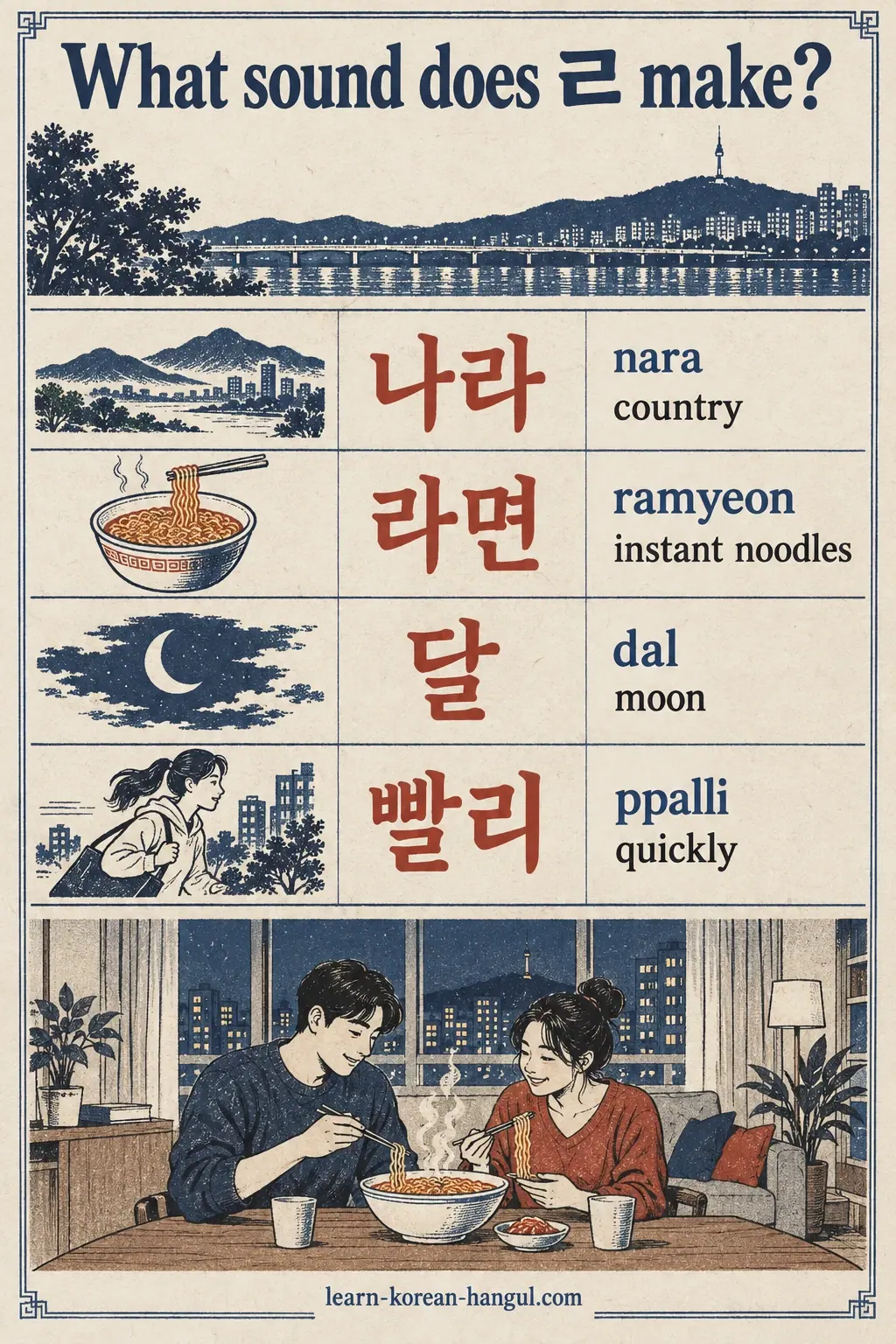
- Read 라, 나라, 달 and 빨리 aloud, and explain their romanization (ra, nara, dal, ppalli).
- Tell final ㄹ apart from final ㄴ in pairs like 물 and 문.
- Prerequisites: the vowel lesson for ㅏ. Estimated time: 15 minutes.
The Korean Letter ㄹ at a Glance
The Korean letter ㄹ is the fourth consonant in South Korean dictionary order and one of the 14 basic consonants in the Hangul Orthography (한글 맞춤법, Article 4). On this site it is the fourth of the basic Korean consonants.
| Attribute | Value |
|---|---|
| Letter | ㄹ |
| Name | 리을 (rieul) |
| Revised Romanization | r before a vowel, l at the end of a syllable, ll for ㄹㄹ |
| Sound family | liquid: the tongue tip taps or rests on the gum ridge |
| Strokes | 3 |
| Final sound (batchim) | clear [l] |
| Neighbour letter | ㄴ (same tongue area; they change each other) |
| Keyboard key (Dubeolsik) | F |
ㄹ is the only Korean consonant that English speakers hear as both r and l. English treats r and l as separate sounds that change meaning ("right" vs "light"), while Korean uses one sound unit, written ㄹ, whose pronunciation depends on its position. Learners often assume Korean has separate r and l sounds; it does not.
The name 리을 follows the regular pattern for consonant names: consonant + 이, then 으 + consonant, so 리 + 을. Unlike 기역, 디귿 and 시옷, it has no irregular history; the page on the names of the Korean consonants shows the full set. The 1446 commentary Hunminjeongeum Haerye (훈민정음 해례) did not build ㄹ by adding a stroke to another letter. It treated ㄹ as a separately shaped letter related to the tongue-tip sounds ㄴ, ㄷ and ㅌ. Those positional sounds are the heart of this lesson.
What Sound Does ㄹ Make?

ㄹ makes a quick tap [ɾ] before a vowel and a clear lateral [l] at the end of a syllable. When two ㄹ meet across a syllable boundary, they form a long [ll]. A tap is a single fast touch of the tongue tip on the ridge behind the upper teeth; a lateral is a sound where the tongue stays on the ridge and air flows past its sides.
| Position | Example | Pronunciation | What you hear |
|---|---|---|---|
| Between vowels | 나라 (nara, country) | [나라] | quick tap, like the tt in American "butter" |
| Start of a word (loanwords) | 라면 (ramyeon, instant noodles) | [라면] | light tap or soft l |
| End of a syllable | 달 (dal, moon) | [달] | clear l, tongue stays up |
| Doubled ㄹㄹ | 빨리 (ppalli, quickly) | [빨리] | long l, no tap |
The closest English model is the middle of "butter", "water" or "ladder" in American English, where the tongue flicks once against the ridge. Say "butter" quickly and notice that the tongue touches only once. That same flick in 나라 gives you a Korean ㄹ. Do not round your lips or curl your tongue back as in English "red"; that sound does not exist in Korean.
Why Does ㄹ Sound Like Both R and L?
ㄹ sounds like both r and l because the tongue does two different things depending on what follows. Before a vowel the tongue has to move on to that vowel quickly, so it only taps the ridge, which English ears hear as r. At the end of a syllable nothing follows, so the tongue rests on the ridge and air flows around it, which English ears hear as l.
You can hear the switch inside one word. 서울 (Seoul) ends in a clear [l]. Add the particle 에 (in) and the ㄹ moves to the start of the next syllable: 서울에 is said [서우레], with a tap. The letter is identical; only its position changed.
Once you know which sound to make, the next step is writing the letter.
How Do You Write ㄹ?
ㄹ is written in three strokes: a ㄱ-shape at the top, a short horizontal line in the middle, and an ㄴ-shape at the bottom. The consonant stroke order lesson shows these strokes next to ㄱ and ㄴ, which ㄹ visibly contains.
Practise on Paper
- Draw a horizontal line left to right, then turn down at the right end (the shape of ㄱ).
- Draw a short horizontal line left to right across the middle, joining the bottom of the first stroke.
- Start at the left end of the middle line, draw down, turn the corner and draw right (the shape of ㄴ).
Stroke Order: 3 Strokes
- Draw a horizontal line left to right, then turn down at the right end (the shape of ㄱ).
- Draw a short horizontal line left to right across the middle, joining the bottom of the first stroke.
- Start at the left end of the middle line, draw down, turn the corner and draw right (the shape of ㄴ).
Keep the three horizontal lines evenly spaced, with the bottom line slightly longer. In 라 the letter is narrow and tall; in 달 it sits at the bottom of the block and is flattened, with tight spacing. A common handwriting mistake is writing ㄹ as one continuous zigzag like the number 2 or a "Z". In fast handwriting the strokes do run together, but beginners should lift the pen so each line stays clear. With the shape learned, you can follow ㄹ through each position in a word.
How Does ㄹ Change at the Start, Middle and End?

ㄹ is a tap before a vowel, a clear l at the end of a syllable, a long l when doubled, and in some combinations with ㄴ, ㅁ or ㅇ it changes sound completely. The spelling never changes.
| Position in the block | Example | Said | Romanized |
|---|---|---|---|
| Initial, between vowels | 나라 | [나라] | nara |
| Final (batchim) | 물 (mul, water) | [물] | mul |
| Final + initial ㄹ | 빨리 | [빨리] | ppalli |
| Final before a vowel | 서울에 | [서우레] | Seoure |
| ㄴ next to ㄹ | 연락 (yeollak, contact) | [열락] | yeollak |
| ㄹ after ㅁ or ㅇ | 심리 (simni, psychology) | [심니] | simni |
The last two rows are previews. When ㄴ and ㄹ meet, the ㄴ usually becomes [ㄹ], so 연락 is said [열락]. This is the liquidization rule (연락 = [열락]). When ㄹ follows ㅁ or ㅇ, the ㄹ becomes [ㄴ], so 심리 is said [심니] and 종로 (a Seoul district) is said [종노]. Revised Romanization follows these sounds, which is why 종로 is written Jongno.
ㄹ as a Final Consonant (batchim)
A consonant at the bottom of a block, like ㄹ in 달, is a batchim (받침, "support"). As a batchim, ㄹ is a clear [l]: the tongue tip rests on the gum ridge behind the upper teeth, and the back of the tongue stays low. English speakers often use a "dark" l at the end of words like "full", with the back of the tongue raised. Korean final ㄹ is lighter, closer to the l in "leaf".
[l] is one of the seven final sounds of Korean, and ㄹ is the only letter that produces it on its own. Some two-letter clusters also start with ㄹ (ㄺ, ㄻ, ㄼ, ㄽ, ㄾ, ㄿ, ㅀ), as in 닭 (chicken, said [닥]); those are taught in the batchim section. Putting the positions together is easiest with a few real blocks.
Worked Example: Reading 라, 나라, 달, 빨리

Reading ㄹ correctly comes down to one question: is a vowel coming next? If yes, tap. If no, hold an l.
- 라. ㄹ sits left of ㅏ, and a vowel follows, so tap: [라]. Romanized ra.
- 나라. 나 is ㄴ + ㅏ. In 라 the ㄹ comes between two vowels, so it is a quick tap: [나라]. Romanized nara.
- 달. ㄷ + ㅏ, with ㄹ as the batchim. Nothing follows, so the tongue rests on the ridge: [달]. Romanized dal.
- 빨리. 빨 ends with ㄹ, and 리 starts with ㄹ. The two combine into one long l with no tap: [빨리]. Romanized ppalli.
Check yourself with the audio. If your 나라 sounds like English "Nara" with a curled r, relax your tongue and flick it once. If your 빨리 sounds like "pal-ri", keep the tongue on the ridge through the middle. ㄹ's closest neighbour in the mouth, ㄴ, is the source of the next contrast.
ㄹ Compared with ㄴ

ㄹ and ㄴ are both made with the tongue tip on the gum ridge, but ㄴ sends air through the nose and ㄹ does not. At the end of a syllable this difference separates many common words, such as 물 (water) and 문 (door).
Pinch Your Nose: ㄴ Stops, ㄹ Continues
| Korean | Romanization | Meaning | Sound |
|---|---|---|---|
| 물 | mul | water | |
| 문 | mun | door |
Pinch Your Nose: ㄴ Stops, ㄹ Continues
| Korean | Romanization | Meaning | Sound |
|---|---|---|---|
| 살 | sal | flesh; years of age | |
| 산 | san | mountain |
Pinch Your Nose: ㄴ Stops, ㄹ Continues
| Korean | Romanization | Meaning | Sound |
|---|---|---|---|
| 발 | bal | foot | |
| 반 | ban | half |
| Final ㄹ | Meaning | Final ㄴ | Meaning |
|---|---|---|---|
| 물 (mul) | water | 문 (mun) | door |
| 살 (sal) | flesh; years of age | 산 (san) | mountain |
| 발 (bal) | foot | 반 (ban) | half; class |
Try the nose test. Say a long ㄴ ("nnn") and pinch your nose: the sound stops. Say a long ㄹ ("lll") and pinch: the sound continues, because air leaves through the mouth around the tongue. Compare the full lesson on the letter ㄴ (Nieun). Many of the errors below come from treating ㄹ like an English letter instead.
Common Mistakes with ㄹ
Four mistakes cause most ㄹ problems.
- Pronouncing 나라 with an English r. Rounded lips and a curled tongue sound strongly foreign. Fix: use the single flick from American "butter".
- Using a dark English l in 물. Raising the back of the tongue makes 물 sound like "mool" with an English accent. Fix: keep the tongue tip forward and the back low, as in "leaf".
- Romanizing 서울 as "Seour". Final ㄹ is l in Revised Romanization. Fix: write r only before a vowel (나라 nara) and l elsewhere (서울 Seoul, 달 dal).
- Writing ㄹ in one continuous zigzag. The result looks like a 2 or a Z. Fix: lift the pen for each of the three strokes.
Is ㄹ the Same as the English Letter?
No. ㄹ matches neither English r nor English l exactly. Before vowels it is a tap, which English has only inside words like "butter" (in American speech). At the end of a syllable it is a light l, without the dark quality English l often has at the end of words.
Spelling rules add one more twist. South Korea follows the initial sound rule (두음법칙, Hangul Orthography Articles 10–12): in Sino-Korean words, which come from Chinese, a ㄹ at the very start of a word changes. 리 becomes 이, so "reason" is 이유, not 리유. 로 becomes 노, so "old person" is 노인. North Korea does not apply this rule and writes 리유 and 로인. Loanwords such as 라면 and 라디오 (radio) keep their ㄹ in both Koreas. The exercises below practise each position.
Practice: Four Quick Exercises

Try each exercise, then check the answers at the end of this section. The same items are available as an interactive quiz.
Practice · 8
How is ㄹ pronounced between two vowels, as in 나라?
Show answer
A quick tap, like the tt in American "butter"
Before a vowel the tongue only taps the gum ridge once, so 나라 has a quick tap.
How is ㄹ pronounced at the end of a syllable, as in 달?
Show answer
A clear l with the tongue resting on the ridge
As a batchim, ㄹ is a clear [l]: nothing follows, so the tongue rests on the ridge.
Which word means "water"?
Show answer
물
물 ends in ㄹ and means water; 문 ends in ㄴ and means door, and 산 means mountain.
What is the Revised Romanization of 빨리?
Show answer
ppalli
ㄹㄹ is a long l and is romanized ll, giving ppalli.
How is 서울에 (in Seoul) pronounced?
Show answer
[서우레], with a tap
Before a vowel the final ㄹ moves to the next syllable and becomes a tap, so 서울에 is said [서우레].
How many strokes does ㄹ take to write?
Show answer
3
ㄹ is written in three strokes: a ㄱ-shape, a short middle line, and an ㄴ-shape.
In the nose test, what happens when you pinch your nose while holding a long ㄹ?
Show answer
The sound continues, because air leaves through the mouth
ㄹ sends air around the tongue through the mouth, so pinching the nose does not stop it; ㄴ stops.
How is 연락 (contact) pronounced?
Show answer
[열락]
When ㄴ and ㄹ meet, the ㄴ usually becomes [ㄹ], so 연락 is said [열락].
- Listen and choose. Which word means "water": 물 or 문? Which means "mountain": 살 or 산?
- Read aloud. Read 다리 (dari, leg), 길 (gil, road), 라면 and 빨리. For each ㄹ, say whether it is a tap, an l, or a long l.
- Write the block. Build and write: ㄹ + ㅗ, ㄹ + ㅣ, ㅁ + ㅜ + ㄹ.
- Romanize. Write 나라, 달 and 빨리 in Revised Romanization.
Answers
- 물 means "water" (문 is "door"). 산 means "mountain" (살 is "flesh" or "years of age").
- 다리: tap. 길: final l. 라면: initial tap or soft l. 빨리: long l.
- ㄹ + ㅗ = 로, ㄹ + ㅣ = 리, ㅁ + ㅜ + ㄹ = 물.
- nara, dal, ppalli.
If you answered all four correctly, you can handle ㄹ in any position.
What Should You Learn after ㄹ?
After the Korean letter ㄹ, learn The Korean Letter ㅁ (Mieum), the next basic consonant. ㅁ is a lip sound, and its square shape is the base for ㅂ and ㅍ.
For review, use the Hangul flashcard decks for a few minutes a day, test yourself in the Hangul quizzes, and listen to ㄹ in every position in the interactive Hangul alphabet. For handwriting, print the Korean consonants writing practice sheet, and see ㄹ among the 19 consonant letters on all Korean consonants.
What this lesson does not cover: the full liquidization and ㄹ-nasalization rules, the complete initial sound rule word list, and clusters starting with ㄹ such as ㄺ and ㄼ. Those are taught in the pronunciation and batchim sections, so this page stays focused on reading and writing the single letter ㄹ.
Questions about the Korean Letter ㄹ
Is ㄹ an r or an l? ㄹ is one Korean letter that sounds like r in some positions and l in others. Before a vowel it is a quick tongue tap, close to the tt in American "butter", as in 나라. At the end of a syllable it is a clear l, as in 달. Doubled as ㄹㄹ it is a long l, as in 빨리.
How do you pronounce ㄹㄹ in 빨리? ㄹㄹ is a long, clear l. The first ㄹ closes the syllable 빨 as [l], and the second ㄹ starts 리 while the tongue stays on the gum ridge, so you hear one l held about twice as long. Do not tap the second ㄹ. Revised Romanization writes this as ll, giving ppalli.
Why is it Seoul and not Seour? 서울 ends with ㄹ, and ㄹ at the end of a syllable is pronounced [l], so the city is said [서울] with a final l. Revised Romanization writes final ㄹ as l, which gives Seoul. The r spelling is used only when ㄹ comes before a vowel, as in 나라 (nara) or 서울에 (Seoure, in Seoul).
Why do some Korean words starting with ㄹ change to ㅇ or ㄴ? South Korean spelling follows the initial sound rule (두음법칙): many Sino-Korean syllables that begin with ㄹ change at the start of a word. 리 becomes 이 (이유, reason) and 로 becomes 노 (노인, old person). North Korea keeps the ㄹ (리유, 로인). Loanwords such as 라면 and 라디오 keep ㄹ in both.
How do you type ㄹ on a Korean keyboard? On the standard Korean 2-set keyboard (Dubeolsik), ㄹ is on the key marked F. With Korean input switched on, typing F then K produces 라, because the vowel ㅏ sits on the K key. ㄹ has no Shift version, since Korean has no double ㄹ letter; 빨리 is typed with two separate ㄹ keys.