
At a glance
- Name: 쌍시옷 (ssangsiot), "double siot".
- Sound: tense [s͈] before a vowel; a stopped [t] at the end of a syllable.
- Romanization: "ss" before a vowel (싸다 ssada), "t" at the end (있다 itda).
- Strokes: 4.
- Family: one of five double (tense) consonants: ㄲ ㄸ ㅃ ㅆ ㅉ.
What Does the Korean Letter ㅆ Sound Like?
The Korean letter ㅆ sounds like a tense s: the throat tightens, the tongue presses firmly behind the upper teeth, and the sound comes out short, sharp and slightly higher in pitch than plain ㅅ. Phoneticians write it [s͈], where the small mark below means "tense".
Try it with the block 싸 (ssa). Say the English word "sa" as in "salsa", then say it again while tightening your throat as if you were about to lift something heavy. Keep the air quiet. That tight, clean hiss is ㅆ.
A tense consonant is a consonant made with extra muscle tension in the throat and mouth and almost no puff of breath after it. Korean has five of them, all written as doubled letters. You can read about the whole group in Korean double consonants.
How Is ㅆ Different from the English S?
The English s in "sea" sits between the two Korean sounds. English s is relaxed like ㅅ, but it has no breathy quality and no throat tension, so English speakers often hear ㅅ and ㅆ as "the same s". The difference lives in three places:
| Feature | ㅅ (plain) | ㅆ (tense) | English s in "sea" |
|---|---|---|---|
| Throat | relaxed | tight | relaxed |
| Breath after the s | a little breathy | none | none |
| Pitch of the next vowel | lower | higher | not used for meaning |
| Strength of the hiss | soft, weak | strong, sharp | medium |
The pitch row is the most useful clue for listeners. In Seoul Korean, a vowel after a tense consonant tends to start at a higher pitch than a vowel after a plain consonant. If 싸 sounds "higher and tighter" than 사, you are hearing the contrast correctly.
Now that you know the sound, the next question is why the letter looks like two copies of ㅅ.
Why Does ㅆ Look Like ㅅ Written Twice?
ㅆ looks like ㅅ written twice because Hangul builds tense sounds by doubling the plain letter. The Hunminjeongeum of 1446 described writing two identical letters side by side, called 각자병서 (gakjabyeongseo, "same-letter side-by-side writing"), for this kind of strengthened sound.
The pattern is the same for all five tense consonants:
- ㄱ → ㄲ
- ㄷ → ㄸ
- ㅂ → ㅃ
- ㅅ → ㅆ
- ㅈ → ㅉ
The name follows the same logic. 쌍 (ssang) means "pair" or "double", so 쌍시옷 is "double 시옷". The naming pattern for all consonants is explained in Korean consonant names. Start from the plain letter ㅅ if you have not learned it yet, because ㅆ is built from its shape and changes only the airflow.
In dictionaries ㅆ comes directly after ㅅ, so 싸다 is listed after every word that starts with ㅅ. With the design clear, you can write the letter.
How to Write ㅆ in 4 Strokes
ㅆ is written in 4 strokes: the first ㅅ in two strokes, then the second ㅅ in two strokes, always left to right.
- Draw the left slanting stroke of the first ㅅ, from top centre down to the lower left.
- Add the short right stroke of the first ㅅ, starting at the middle of stroke 1 and running down to the right.
- Draw the left slanting stroke of the second ㅅ.
- Add the right stroke of the second ㅅ.
Practise on Paper
- ㅅ, then a second ㅅ to its right
Inside a syllable block, both halves shrink so the pair takes the same space as one ordinary consonant. In 싸 the pair sits on the left of the vowel ㅏ; in 쓰 it sits above ㅡ and becomes wide and flat; in 있 it sits at the bottom as a final consonant. The first ㅅ is often written slightly narrower, with its right stroke shortened, so the second ㅅ fits beside it. Compare the strokes of ㅆ with its neighbours in the stroke order for double letters lesson.
Writing is only half the job: ㅆ behaves differently depending on where it sits in a word.
ㅆ at the Start, Middle and End of a Word
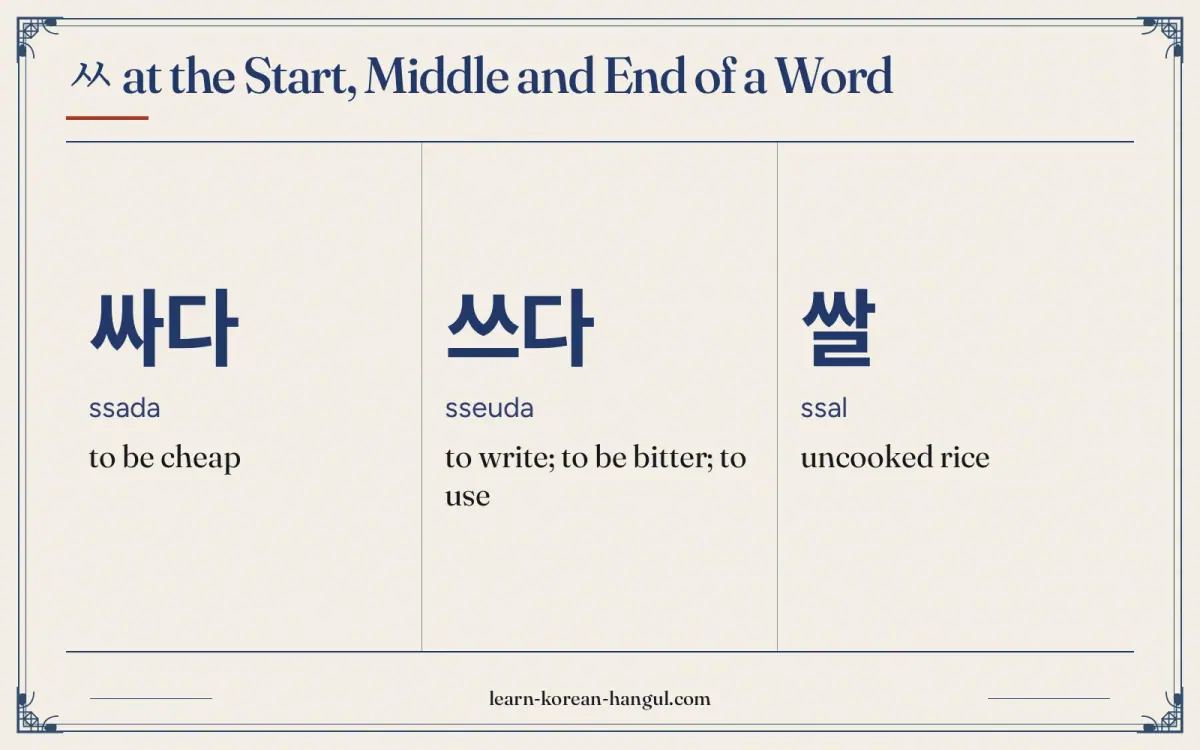
ㅆ keeps its tense hiss at the start of a syllable and turns into a stopped [t] at the end of a syllable. That gives three practical positions:
| Position | What you hear | Example | Pronounced | Meaning |
|---|---|---|---|---|
| Start of a word | tense [s͈] | 싸다 (ssada) | [싸다] | to be cheap |
| Middle, start of a syllable | tense [s͈] | 비싸요 (bissayo) | [비싸요] | it's expensive |
| End of a syllable, before a consonant | stopped [t] | 있다 (itda) | [읻따] | to exist, to have |
| End of a syllable, before a vowel | moves forward, tense [s͈] | 있어요 (isseoyo) | [이써요] | there is, I have |
Here are common words that start with ㅆ. Tap each one and repeat it twice.
| Korean | Romanization | Meaning | Audio |
|---|---|---|---|
| 싸다 | ssada | to be cheap | |
| 쓰다 | sseuda | to write; to be bitter; to use | |
| 쌀 | ssal | uncooked rice | |
| 씨 | ssi | seed; title after a name | |
| 쌍둥이 | ssangdungi | twins | |
| 비싸요 | bissayo | it's expensive | |
| 아저씨 | ajeossi | middle-aged man; "sir" |
ㅆ as a Final Consonant: [t]
A final ㅆ is pronounced [t] because Korean allows only seven sounds at the end of a syllable, and every s-type and t-type letter (ㅅ ㅆ ㅈ ㅊ ㅌ ㄷ ㅎ) collapses into the same stopped [t]. This is rule 9 of the 국립국어원 Standard Pronunciation Rules (표준 발음법). The full system is covered in the 7 final sounds.
To make a stopped [t], put your tongue where you would say "t", then stop the air without releasing it. Examples:
- 있다 → [읻따] (itda), "to exist, to have".
- 했다 → [핻따] (haetda), "did".
- 갔다 → [갇따] (gatda), "went".
- 있습니다 → [읻씀니다] (itseumnida), "there is" (formal).
Notice the second change in each example: the consonant after the stopped [t] becomes tense, so 다 is said [따] and 습 is said [씀]. This is called post-obstruent tensification (Standard Pronunciation Rules, rule 23): a plain ㄱ ㄷ ㅂ ㅅ ㅈ after a stopped final sound turns into its tense partner.
Linking ㅆ into the Next Syllable
When the next syllable starts with the silent ㅇ, a final ㅆ moves forward and is pronounced as a full tense [s͈] at the start of that syllable. This movement is called liaison (연음, yeoneum), and it is rule 13 of the Standard Pronunciation Rules.
- 있어요 → [이써요] (isseoyo), "there is; I have".
- 갔어요 → [가써요] (gasseoyo), "went".
This position matters for everyday speech because final ㅆ appears in almost every polite form of the Korean past tense: 했어요 "did", 먹었어요 "ate", 봤어요 "saw". In typical beginner conversation, ㅆ is one of the double consonants you meet most often at the bottom of a block, mainly because of these past-tense endings and the verb 있다.
Positions explained, the next step is to decode real words one letter at a time.
Worked Example: Reading 싸다, 있어요, 아저씨
This worked example reads three words from left to right, block by block, so you can see exactly where ㅆ changes.
Word 1: 싸다 (ssada), "to be cheap"
- 싸 = ㅆ + ㅏ. ㅆ starts the block, so say a tense [s͈], then "a": [s͈a].
- 다 = ㄷ + ㅏ. Plain ㄷ between vowels sounds close to a soft "d": [da].
- Together: [싸다], ssada.
Word 2: 있어요 (isseoyo), "there is"
- 있 = ㅇ + ㅣ + ㅆ. The first ㅇ is silent; ㅣ is "ee"; ㅆ is final.
- The next block 어 starts with silent ㅇ, so liaison applies: ㅆ moves forward.
- Read it as 이 + 써 + 요: [이써요], isseoyo. Do not stop on a [t] here.
Word 3: 아저씨 (ajeossi), "middle-aged man"
- 아 = silent ㅇ + ㅏ: [a].
- 저 = ㅈ + ㅓ: [jeo], with a soft "j".
- 씨 = ㅆ + ㅣ: a tense s before "ee", which sounds close to a sharp "ssh": [s͈i], often heard as [ɕ͈i].
- Together: [아저씨], ajeossi.
Practise building these blocks yourself with the Hangul syllable builder, which plays each block you create. Once you can read the words, the hardest skill remains: hearing ㅅ and ㅆ apart.
사다 / 싸다: Hearing the Difference
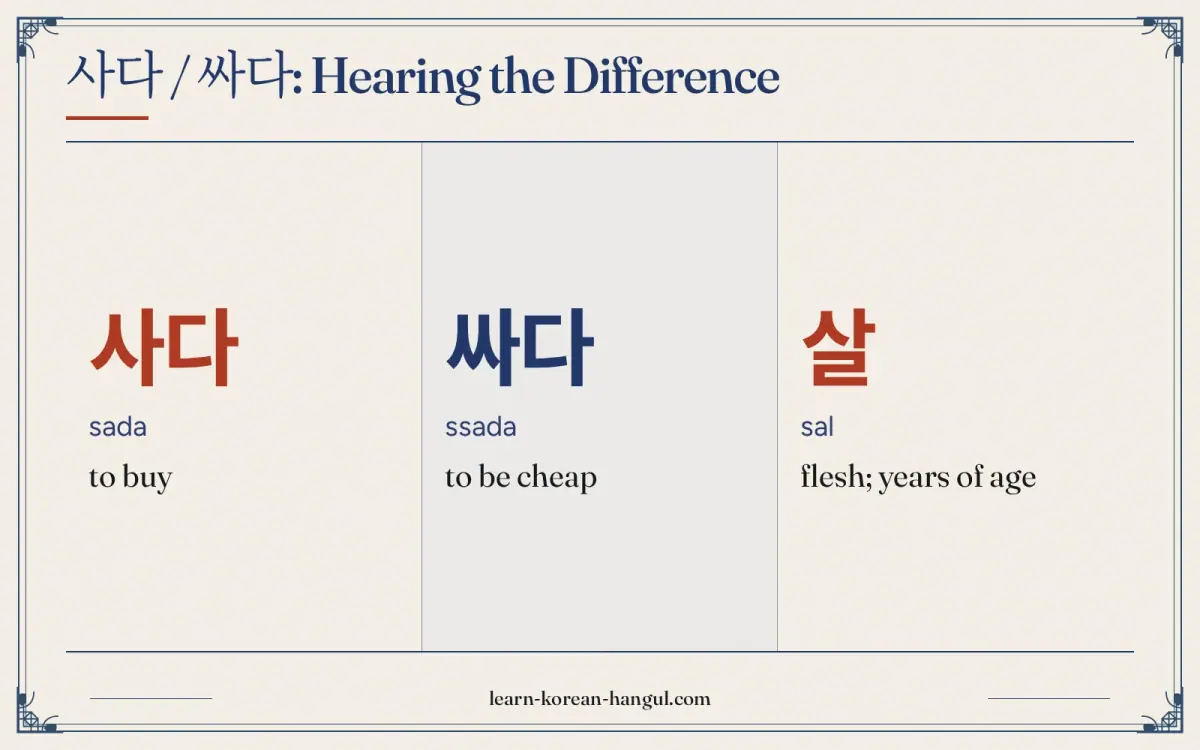
사다 means "to buy" and 싸다 means "to be cheap"; the only difference is plain ㅅ versus tense ㅆ. Pairs like this, which differ in a single sound, are called minimal pairs, and they are the fastest way to train your ear.
ㅆ: Tight Throat, No Breath, Higher Pitch
| Korean | Romanization | Meaning | Sound |
|---|---|---|---|
| 사다 | sada | to buy | |
| 싸다 | ssada | to be cheap |
Same Vowel, Different Tension
| Korean | Romanization | Meaning | Sound |
|---|---|---|---|
| 살 | sal | flesh; years of age | |
| 쌀 | ssal | uncooked rice |
Both Sound Sh-Like before ㅣ
| Korean | Romanization | Meaning | Sound |
|---|---|---|---|
| 시 | si | o'clock; poem | |
| 씨 | ssi | seed; title after a name |
| Pair | Plain ㅅ | Tense ㅆ |
|---|---|---|
| 1 | 사다 (sada), to buy | 싸다 (ssada), to be cheap |
| 2 | 살 (sal), flesh; years of age | 쌀 (ssal), uncooked rice |
| 3 | 시 (si), o'clock; poem | 씨 (ssi), seed; Mr./Ms. |
| 4 | 서요 (seoyo), I stand | 써요 (sseoyo), I write; it's bitter |
ㅅ and ㅆ form a two-way contrast, not a three-way one. Most Korean consonants come in sets of three: plain ㄱ, aspirated ㅋ and tense ㄲ, for example. The s-sound has no aspirated member, so Hangul has no "ㅅ with an extra stroke". This gap is why you only need to listen for one difference here: relaxed and slightly breathy (ㅅ) versus tight and clean (ㅆ). The full three-way system is drilled with longer listening sets in plain, tense and aspirated sounds.
Before ㅣ, both letters change colour. 시 and 씨 are both pronounced with the tongue further back, close to the "sh" in "she" (phonetically [ɕi] and [ɕ͈i]). The tension difference stays, so 씨 is a short, tight "sshi", not the soft English "she".
Listening tip: focus on the vowel after the consonant, not the hiss itself. The vowel after ㅆ typically starts higher and sounds "pressed". Test whether you can hear 사다 / 싸다 in the Hangul listening quizzes. Knowing the contrast also explains the most common mistakes, covered next.
Which Mistakes Do Learners Make with ㅆ?
Learners make three predictable mistakes with ㅆ: they merge it with ㅅ, they pronounce a final ㅆ as a hissing s, and they use the title 씨 in the wrong situation.
Mistake 1: saying 싸요 and 사요 the same way at a market. Learners often assume that a "stronger s" is enough; actually the tension must come from the throat, because a louder English s still sounds like ㅅ to Korean ears. 싸요 means "it's cheap" and 사요 means "I'll buy it", so mixing them confuses a shop conversation. Fix: tighten your throat before the hiss and keep the air quiet.
Mistake 2: reading final ㅆ in 있다 as [s]. Learners often read 있다 as "iss-da"; actually it is [읻따], because a final ㅆ before a consonant is always the stopped [t]. Fix: stop the air with your tongue tip and let the next ㄷ become tense.
Mistake 3: using 씨 with someone of higher status. Learners often treat 씨 as a universal "Mr./Ms."; actually it is used between equals or towards juniors, such as colleagues at a similar level (민수 씨). For a teacher use 선생님, for a manager use their job title, and never put 씨 after your own name. A family name with 씨 alone (for example 김 씨) can sound distant or rude in direct address.
A fourth point about romanization: loanwords and foreign names rarely use ㅆ. The standard loanword spelling writes an English s as plain ㅅ (버스 "bus", 서비스 "service", 샘 "Sam"), even though many speakers pronounce these with a tense sound. If you write your own name in Hangul, use ㅅ unless you are copying an established spelling.
With the mistakes in mind, test yourself.
Practice: Read and Hear ㅆ
Do these four exercises without looking at the answers. Use audio only when the exercise asks for it.
- Read aloud. Read these words and decide whether each ㅆ is [s͈] or [t]: 쓰다, 있다, 갔어요, 씻다, 쌀.
- Listen and choose. Play the clip and choose the word you hear: 서요 or 써요?
- Write. Write the Hangul for: ssal (rice), bissayo (it's expensive), ajeossi (middle-aged man).
- Spell a name. The English name Sam is written in Hangul with which letter, ㅅ or ㅆ?
Practice · 8
Which word means "to be cheap"?
Show answer
싸다
싸다 has tense ㅆ and means to be cheap; 사다 with plain ㅅ means to buy.
How is 있다 pronounced?
Show answer
[읻따]
Final ㅆ before a consonant is a stopped [t], and the following ㄷ becomes tense: [읻따].
How is 있어요 pronounced?
Show answer
[이써요]
Before a syllable starting with silent ㅇ, the final ㅆ moves forward as a full tense s: [이써요].
How many strokes does ㅆ take to write?
Show answer
4
ㅆ is two ㅅ shapes, each written in two strokes, left to right: four strokes in total.
Which letter is the aspirated partner of ㅅ?
Show answer
There is none; ㅅ and ㅆ form a two-way contrast
The s-sound has only plain ㅅ and tense ㅆ; Hangul has no aspirated s.
The English name Sam is written in Hangul with which letter?
Show answer
ㅅ (샘)
Standard loanword spelling writes an English s as plain ㅅ, so Sam is 샘.
Who should you NOT address with the title 씨?
Show answer
Your teacher
씨 is used between equals or toward juniors; for a teacher use 선생님.
How is 갔어요 (went) pronounced?
Show answer
[가써요]
Liaison moves the final ㅆ into the next syllable as a tense s: [가써요].
Answers to the Practice
- 쓰다 [s͈], 있다 [t] → [읻따], 갔어요 [s͈] through liaison → [가써요], 씻다: the first ㅆ is [s͈] and the final ㅅ is [t] → [씯따], 쌀 [s͈].
- The clip is 써요 (sseoyo), "I write" or "it's bitter". You should hear a tight, higher-pitched start. Compare it with 서요:
- 쌀, 비싸요, 아저씨.
- ㅅ: 샘. Standard loanword spelling uses plain ㅅ for an English s.
If you missed exercise 2, replay the minimal pairs above five times each before moving on. You can also review ㅆ with the other letters in the Hangul flashcard decks, which play audio only when you tap, or print the double consonants worksheet for handwriting practice.
What Should You Learn after ㅆ?
After ㅆ, learn ㅉ (ssangjieut), the last of the five double consonants; it works exactly like ㅆ but is built from ㅈ. When you can hear 사다 / 싸다, continue to the next letter lesson.
Useful next steps:
- Korean double consonants: the overview of ㄲ ㄸ ㅃ ㅆ ㅉ and how tense sounds work as a group.
- Korean consonants chart: a printable chart showing ㅆ beside all 19 consonants.
- Interactive Hangul alphabet: tap any letter to hear it and see its strokes.
What this lesson does not cover: the full sound-change rules for final consonants (see the 7 final sounds), how to form the past tense (see the Korean past tense), and the general politeness system behind 씨. The Korean letter ㅆ appears in every one of those topics, so the sound skills from this page carry straight into them.
Frequently Asked Questions
What is the difference between ㅅ and ㅆ?
ㅅ is the plain s, said with a relaxed throat and a small breath of air. ㅆ is the tense s, said with a tight throat, more muscle in the tongue and almost no extra breath. The difference changes meaning: 사다 means "to buy" and 싸다 means "to be cheap". Listen for a sharper, slightly higher hiss in ㅆ.
Why is 있다 pronounced 읻따?
Two rules apply. First, a final ㅆ is pronounced like a stopped [t], one of the seven final sounds in Korean. Second, after that stopped final sound, the next plain consonant becomes tense, so ㄷ in 다 is said as ㄸ. The result is [읻따], romanized itda. Before a vowel, as in 있어요, ㅆ keeps its hiss: [이써요].
Is there an aspirated version of ㅅ?
No. Most Korean consonants come in sets of three, such as ㄱ, ㅋ and ㄲ. The s-sound has only two members: plain ㅅ and tense ㅆ. Hangul has no letter for an aspirated s. Some phoneticians describe plain ㅅ itself as slightly breathy, which is one reason the ㅅ and ㅆ contrast sounds unusual to English speakers.
How do you use 씨 after a name?
씨 is a polite title placed after a person's name, similar to "Mr." or "Ms.", as in 민수 씨. Use it with colleagues or people of about equal or lower status. Do not use it for teachers, bosses or older people; use titles such as 선생님 instead. Never attach 씨 to your own name.
Why does 씨 sound like "she"?
Before the vowel ㅣ, both ㅅ and ㅆ are pronounced further back on the tongue, close to the "sh" in "she". So 시 and 씨 both have a "sh"-like colour. 씨 is still tense: the throat is tight and the sound is short and sharp, not the soft, breathy "she" of English.