
What you'll learn (about 20 minutes, level A0, you only need the plain letter ㄷ first)
- Pronounce ㄸ with a tight throat and no puff of air.
- Write ㄸ as two ㄷ shapes in 4 strokes.
- Tell 달, 탈 and 딸 apart by ear.
- State that ㄸ is never written as a final consonant (batchim).
What Does the Korean Letter ㄸ Sound Like?
The Korean letter ㄸ sounds like the t in English "stop" or "star" with the s removed: a firm t made with a tight throat and no puff of air. Linguists call this a tense (or fortis) consonant, and the IPA symbol is [t͈], where the small mark under the t shows the tension. Revised Romanization, the official Latin spelling system, writes it as "tt".
Start with these words:
- 딸 (ttal), daughter
- 땀 (ttam), sweat
- 떡 (tteok), rice cake, said [떡]
- 또 (tto), again; also
- 뛰다 (ttwida), to run; to jump
- 이따가 (ittaga), later
The name 쌍디귿 adds 쌍 (ssang, "pair" or "twin") in front of the name of the plain letter. It follows the pattern explained on the page about Korean consonant names. The letter ㄸ is one of the five double consonants, and the page on Korean double consonants shows how the group works together.
How Is ㄸ Different from the English T?
English does not have a separate tense t, but you already make the sound in "stop". The t in "stop" is not aspirated, because the s before it removes the puff. Put your hand in front of your mouth and say "top" and then "stop". You feel a puff for "top" and almost none for "stop". ㄸ matches the "stop" t, and the aspirated ㅌ matches the "top" t.
ㄸ is also not the English d. English d is voiced: the vocal cords vibrate during the closure. ㄸ is voiceless, with a tight throat, so it sounds closer to a t than a d to English ears. This is why learners who say "dal" for 딸 sound like they said 달.
A home test works well. Hold a thin strip of paper close to your lips and say 따. The paper should stay still. Now say 타 (ta, with the aspirated letter ㅌ). The paper should flutter. A second cue is in the throat: for ㄸ, the throat feels tight, as if you were holding your breath just before the sound.
The English comparison has limits. In "stop", the t follows an s, while ㄸ can start a word on its own, and the Korean tension is stronger. In Seoul speech, a syllable that begins with ㄸ also typically starts on a higher pitch than one that begins with ㄷ. Do not say it as a long double t. It is one sound.
The three t-type letters at a glance:
| Letter | Name | Type | Airflow | Romanization | Example |
|---|---|---|---|---|---|
| ㄷ | 디귿 (digeut) | plain | light breath | d / t | 달 (moon) |
| ㅌ | 티읕 (tieut) | aspirated | strong puff | t | 탈 (mask) |
| ㄸ | 쌍디귿 (ssangdigeut) | tense | no breath, tight throat | tt | 딸 (daughter) |
The next section explains why ㄸ looks like two ㄷ.
Why Does ㄸ Look Like ㄷ Written Twice?
ㄸ is ㄷ written twice because Hangul builds tense sounds by doubling the plain letter. In the Hunminjeongeum Haerye (1446), the text that explained the design of Hangul, this is described as writing the same letter side by side (각자병서, gakjabyeongseo). The doubled shape tells the reader that the sound is tighter and stronger.
The same idea gives ㄲ from ㄱ, ㅃ from ㅂ, ㅆ from ㅅ and ㅉ from ㅈ. These five letters are called 쌍자음 (ssangjaeum, "twin consonants"), and their sounds are called 된소리 (doenssori, "hard sounds"). The letter name describes how the letter is written, and the sound name describes how it feels, but they refer to the same five letters.
Now that you know how the shape works, here is how to write it.
How to Write ㄸ in 4 Strokes
ㄸ is written with 4 strokes in standard print: one ㄷ, then a second ㄷ right next to it. Each ㄷ takes 2 strokes.
Practise on Paper
- Draw the top bar of the first ㄷ, left to right.
- Draw the body of the first ㄷ: a vertical line down on the left, then a horizontal line along the bottom.
- Draw the top bar of the second ㄷ, starting at the same height.
- Draw the body of the second ㄷ in the same way.
- Draw the top bar of the first ㄷ, left to right.
- Draw the body of the first ㄷ: a vertical line down on the left, then a horizontal line along the bottom.
- Draw the top bar of the second ㄷ, starting at the same height.
- Draw the body of the second ㄷ in the same way.
Success check: your ㄸ has two identical ㄷ shapes at the same height, each narrow, with a small gap between them. The open sides of both ㄷ face right.
Inside a block, both ㄷ shapes become narrow so that the pair fits into the width of one letter. In 딸, ㄸ sits on the left and ㅏ on the right, with ㄹ underneath. The most common problem in handwriting is making the second ㄷ larger than the first, so keep them the same size. You can compare ㄸ with its neighbours in stroke order for double letters.
Next, a look at what ㄸ does in different places inside a word.
ㄸ at the Start, Middle and End of a Word
ㄸ is tense at the start and in the middle of a word, and it is never written at the end of a syllable. The table shows each position.
| Position | Example | Pronounced | What happens |
|---|---|---|---|
| Start of a word | 딸 (daughter) | [딸] | tight t, no puff |
| Middle of a word | 이따가 (later) | [이따가] | tight t stays tight |
| Start of a second block after a stop | 받다 (to receive) | [받따] | written ㄷ is heard as ㄸ |
| End of a syllable | none | none | ㄸ is not written there |
Why Is ㄸ Never a Final Consonant?
ㄸ is never a final consonant because Korean spelling does not allow ㄸ, ㅃ or ㅉ at the bottom of a block. A letter at the bottom of a syllable block is called a batchim (받침, final consonant), and the glossary entry on batchim defines the term. Sixteen consonant letters and some two-letter clusters can appear there, and among the double letters only ㄲ and ㅆ are allowed.
This is a spelling fact. It also means that you will only ever meet ㄸ at the start of a syllable block, which makes the letter simpler to learn than ㄲ. At the bottom of a block, the final-sound rules of the 국립국어원 표준 발음법 (Standard Pronunciation Rules, National Institute of Korean Language) reduce every letter to one of 7 sounds. See the seven final sounds for the full list.
Where Do You Hear ㄸ without Seeing It?
You hear a tense [t͈] in places where the spelling shows a plain ㄷ, because Korean tenses certain consonants after a final stop. This is called tensification (경음화), described in Articles 23 to 28 of the Standard Pronunciation Rules.
- 받다 (batda), to receive, said [받따]
- 식당 (sikdang), restaurant, said [식땅]
- 옆도 (yeopdo), beside, too, said [엽또]
In each word, a final stop sound ([k], [t] or [p]) comes right before ㄷ, and the ㄷ becomes tense. Learners hear a "tt" there even though the spelling has a single ㄷ. The lesson on tensification lists the contexts. For now, expect a tense sound after any final pronounced [k], [t] or [p], including the ㅍ of 옆.
Now put the pieces together in a worked example.
Worked Example: Reading 딸, 떡 and 이따가
Reading a Korean syllable means splitting the block into its parts and joining the sounds. Here are three examples.
Example 1: 딸 (daughter).
- Split the block: ㄸ + ㅏ + ㄹ.
- Say a tight t, then [a], then a final [l] with the tongue tip on the ridge.
- Join them: [딸], romanized ttal.
Example 2: 떡 (rice cake).
- Split the block: ㄸ + ㅓ + ㄱ.
- Say a tight t, then [eo], then a final [k] with no release.
- Join them: [떡], romanized tteok.
Example 3: 이따가 (later).
- Split the blocks: silent ㅇ + ㅣ, then ㄸ + ㅏ, then ㄱ + ㅏ.
- Say [i], then a tight [tta], then [ga].
- Join them: [이따가], romanized ittaga.
A bonus word contains two tense letters. 떡볶이 (tteokbokki, spicy rice cakes) is written with ㄸ and ㄲ. It is said [떡뽀끼]. The ㄸ starts the word, and the 볶 block ends in ㄲ, which moves onto 이 as a tense [kki]. The ㅂ after a final ㄱ is also heard as tense, a case of the tensification rule above.
Check yourself: if you can read all three aloud without the romanization, you have the core skill. Romanization is only a learning aid shown in parentheses.
Reading is easier once your ear can separate the three t-type sounds.
달 / 탈 / 딸: Hearing the Difference
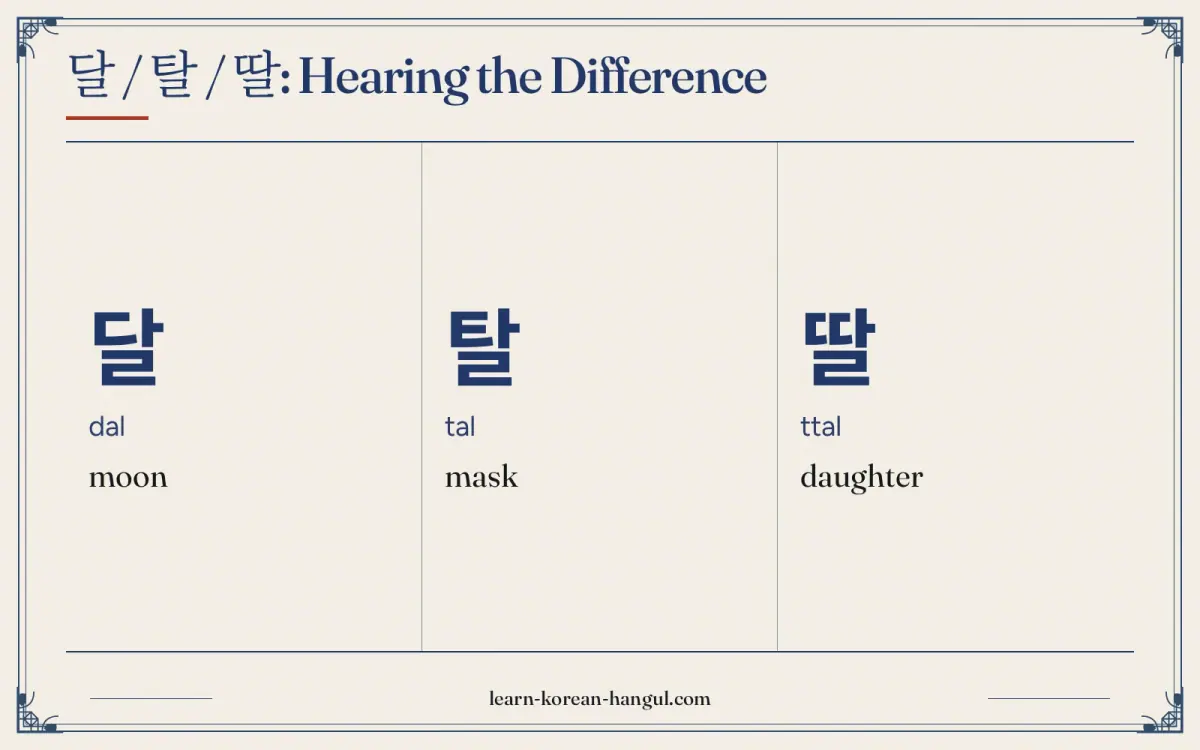
달, 탈 and 딸 form a minimal set: three words that differ only in their first consonant. 달 (dal) means "moon" (and also "month") and has plain ㄷ. 탈 (tal) means "mask" and has aspirated ㅌ. 딸 (ttal) means "daughter" and has tense ㄸ.
Plain: Light Breath; Aspirated: Strong Puff; Tense: No Breath and a Tight Throat
| Korean | Romanization | Meaning | Sound |
|---|---|---|---|
| 달 | dal | moon | |
| 탈 | tal | mask | |
| 딸 | ttal | daughter |
| Word | Meaning | First letter | What to listen for |
|---|---|---|---|
| 달 | moon | ㄷ plain | soft start, lower pitch |
| 탈 | mask | ㅌ aspirated | clear burst of air, higher pitch |
| 딸 | daughter | ㄸ tense | no air, tight, sharp start |
Romanization hides this contrast. A beginner who sees "dal", "tal" and "ttal" may think the difference is small, but a Korean listener hears three clearly different words. Most English speakers find ㅌ easy to hear, because of the puff, and then find ㄷ and ㄸ hard to separate, since neither has a puff. ㄸ is the tight one. Compare with the aspirated letter ㅌ. For longer listening sets, see plain, tense and aspirated sounds.
The next section collects the errors that cost learners the most.
Which Mistakes Do Learners Make with ㄸ?
Most learners make one of three errors with ㄸ, and each has a quick fix.
- Saying ㄸ as English d. English d is voiced and soft. Fix: say the t in "stop" with a tight throat, with no voice buzz.
- Making it breathy like ㅌ. Fix: use the paper test. The paper should stay still.
- Assuming 딸 and 달 sound the same. Both look close in romanization ("dal" and "ttal"). Fix: listen to the minimal set above, and keep the tight throat for 딸.
Learners often assume that a doubled letter means a doubled length. Actually, the doubled shape marks tension, not length. A second wrong belief is that ㄸ can end a syllable like ㄲ. It cannot. If you see a doubled sound at the end of a block, it is ㄲ or ㅆ.
You are now ready to test what you have learned.
Practice: Read and Hear ㄸ
Complete these exercises before you check the answers.
- Read aloud. Say each word and write its pronunciation in brackets: 딸, 땀, 떡, 또, 뛰다, 이따가.
- Listen and choose. Play the clips for the next three words. For each one, decide whether it starts with ㄷ, ㅌ or ㄸ:
- Write. Write ㄸ three times in 4 strokes, then write the blocks 따 and 떡.
- Predict. How are 받다 and 식당 pronounced? Which doubled letters can end a syllable?
Practise on Paper
- Draw the top bar of the first ㄷ, left to right.
- Draw the body of the first ㄷ: a vertical line down on the left, then a horizontal line along the bottom.
- Draw the top bar of the second ㄷ, starting at the same height.
- Draw the body of the second ㄷ in the same way.
Answers to the Practice
- 딸 [딸], 땀 [땀], 떡 [떡], 또 [또], 뛰다 [뛰다], 이따가 [이따가]. They are read as spelled, and the final ㄱ in 떡 is an unreleased [k].
- The order of the clips is 탈 (ㅌ), 딸 (ㄸ), 달 (ㄷ). If you got two of three, repeat the paper test and listen again.
- Your ㄸ should have two matching ㄷ shapes at the same height.
- 받다 is [받따] and 식당 is [식땅]. Only ㄲ and ㅆ can end a syllable.
Review the letter with the other consonants in the Hangul flashcard decks, which play audio only when you tap. Test whether you can hear 달 / 탈 / 딸 in the Hangul listening quizzes, or print the double consonants worksheet. For hands-on building, try the Hangul Syllable Builder and the interactive Hangul alphabet.
What Should You Learn after ㄸ?
After ㄸ, continue to the next letter lesson on ㅃ. To see the whole group, read about Korean double consonants and print the Korean consonants chart to see ㄸ beside all 19 consonants.
This lesson covers the sound, name, shape and early sound changes of ㄸ. It does not cover every sound-change rule, which lives in the pronunciation section, or the vowels that combine with ㄸ. Audio on this page is machine-generated and its review status is shown beside each clip; the Korean text and audio are drafts until a Korean specialist signs them off.
Questions about the Korean Letter ㄸ
Can ㄸ be at the end of a syllable? No. ㄸ is never written as a final consonant, so you will only see it at the start of a syllable block. Among the double letters, only ㄲ and ㅆ can appear at the bottom of a block. If you hear a tense t after another consonant, as in 식당 [식땅], the spelling has a plain ㄷ.
What is the difference between ㄷ, ㅌ and ㄸ? All three are made with the tongue tip on the ridge behind the upper teeth. ㄷ is plain, with a light breath. ㅌ is aspirated, with a strong puff of air. ㄸ is tense, with a tight throat and no puff. Compare 달 (moon), 탈 (mask) and 딸 (daughter). The first letter is the only difference.
How do you write ㄸ? Write ㄸ as two ㄷ shapes side by side, in 4 strokes. Draw the top bar and body of the first ㄷ, then the top bar and body of the second ㄷ. Keep both the same height and size, and narrow enough to fit in one letter space. Handwriting may vary slightly between teachers.
Is ㄸ like the English d? No. ㄸ is closer to the t in English "stop" than to d. English d is voiced and soft, while ㄸ is voiceless and tight, with no puff of air. A learner who says "dal" for 딸 will be heard as saying 달 (moon). Use the paper test to check that you do not add a breath.
Why is 식당 pronounced 식땅? In 식당, the final ㄱ of 식 makes the ㄷ of 당 tense. This is called tensification (경음화). The spelling shows a plain ㄷ, but the ear hears a tense ㄸ, so the word is [식땅]. The same thing happens in 받다 [받따] and 옆도 [엽또], and the lesson on tensification lists the contexts.