
Key facts
- ㅉ is pronounced [t͡ɕ͈]: a tight j/ch sound with no puff of air.
What you'll learn
- Pronounce ㅉ without a puff of air and without voicing it like an English "j".
- Write ㅉ as two matching ㅈ shapes inside a syllable block.
- Distinguish 자다, 차다 and 짜다 by ear and by spelling.
- Read 진짜, 가짜, 찌개, 짝 and 쪽 aloud.
- Explain why ㅉ never appears at the bottom of a block.
Before you start: you should be able to read the plain letter ㅈ and a few vowels such as ㅏ and ㅣ. This lesson takes about 20 minutes. Audio plays only when you press a button.
What Does the Korean Letter ㅉ Sound Like?
ㅉ sounds like a tight, short "jj" made with no breath. The tongue touches the roof of the mouth in the same place as for ㅈ, but the throat is tense and almost no air leaves the mouth when you release the sound. Linguists describe it as a tense (fortis) affricate and write it [t͡ɕ͈] in the International Phonetic Alphabet.
An affricate is a sound that starts as a stop and ends as a hiss. English has two of them: the "ch" in "church" and the "j" in "judge". Korean ㅉ sits in that same family, which is why "between j in jam and ch in itchy" is a useful guide. It is not the same as either English sound, though. A beginner can place it by following three steps:
- Say the English word "itchy" slowly and stop right after the "ch" sound.
- Hold your throat tight, as if you are about to lift something heavy.
- Release the sound with no puff of air and let a vowel follow at once.
Hear it in 짜다 (jjada, "to be salty"):
Many speakers also start the vowel after a tense consonant on a slightly higher pitch than after a plain one. You do not need to copy that on day one. Getting the missing breath right is the first goal, and the pitch usually follows.
ㅉ Compared with the English J
ㅉ is different from the English "j" in two ways: it has no voicing and no breath. English "j" in "jam" is voiced, which means your vocal cords buzz during the sound. Korean ㅉ is voiceless and tight. English "ch" in "church" is also voiceless, but it comes with a strong burst of air. Korean ㅉ keeps the voiceless quality and removes the burst.
| Feature | English "j" (jam) | English "ch" (church) | Korean ㅉ |
|---|---|---|---|
| Vocal cords buzz | Yes | No | No |
| Burst of air after release | Light | Strong | None |
| Throat | Relaxed | Relaxed | Tight |
This is why a learner who says 진짜 as "jin-jah" with an English "j" is understood, but sounds noticeably less natural. The sound is close enough for communication and far enough for a Korean listener to notice. Next, the shape of the letter explains where this sound comes from.
Why Does ㅉ Look Like ㅈ Written Twice?
ㅉ looks like ㅈ written twice because it is a doubled letter, and Hangul doubles a letter to show a tense version of the same sound. Hangul was created under King Sejong in 1443, and the scholars who wrote the Hunminjeongeum Haerye (훈민정음 해례, 1446) described this method. They wrote the same letter twice, side by side, and called the method 각자병서 (gakjabyeongseo, "writing identical letters side by side").
The five double consonants follow one pattern. Each one is a plain consonant written two times.
| Plain letter | Double letter | Name of double letter | Example |
|---|---|---|---|
| ㄱ | ㄲ | 쌍기역 | 까치 (magpie) |
| ㄷ | ㄸ | 쌍디귿 | 딸 (daughter) |
| ㅂ | ㅃ | 쌍비읍 | 빵 (bread) |
| ㅅ | ㅆ | 쌍시옷 | 싸다 (to be cheap) |
| ㅈ | ㅉ | 쌍지읒 | 짜다 (to be salty) |
The word 쌍 (ssang) means "a pair" or "twin". So 쌍지읒 literally means "twin jieut", where 지읒 is the name of ㅈ. That naming pattern is explained on the Korean consonant names page, and the whole group is covered in Korean double consonants.
One caution: doubling a letter on paper does not mean the sound lasts twice as long. The doubled shape marks tension, not length. Now that the logic is clear, the next section shows how to draw the letter.
Writing ㅉ as Two ㅈ Shapes
You write ㅉ by drawing one ㅈ on the left and a second ㅈ of the same size on the right. Draw the left shape first, then the right, moving from left to right as with all Hangul. Each ㅈ starts with a short horizontal line at the top that turns, without lifting the pen, into a diagonal to the lower left; a second diagonal then runs from its middle to the lower right.
Practise on Paper
- ㅈ, then a second ㅈ to its right
Stroke counts vary between sources. This site follows the Korean school handwriting count of two strokes for each ㅈ, which gives four for ㅉ. Some print charts count each ㅈ as three strokes (one horizontal line plus two diagonals), which gives six. Both describe the same shape, so learn the order of the two halves first. The stroke order for double letters lesson shows all five double letters in the same style so you can compare them.
Inside a syllable block, ㅉ takes the same space as one wide consonant. Both halves must be narrower than a single ㅈ so that the pair fits in the same top-left slot. The usual mistakes are:
- Drawing two full-width ㅈ shapes, so the block becomes too wide.
- Letting the two halves touch, which can make the letter look like a different shape.
- Making one half bigger than the other.
Try writing 짜 three times, then 찌 three times, keeping the top row of each block level. Practising whole blocks matters more than practising the bare letter, because Hangul is read one block at a time.
Where Does ㅉ Appear in a Word?
ㅉ appears at the start of a syllable, either at the start of a word or in the middle of a word after another syllable. It never appears in the final position of a block. A learner sees the letter in three situations: word-initial, word-medial, and in spoken sounds that are not written as ㅉ.
| Position | Example | Reading | Meaning |
|---|---|---|---|
| Word start | 짝 | jjak | pair, partner |
| Word start | 쪽 | jjok | side; page (counter for pages) |
| Word middle | 진짜 | jinjja | really, real |
| Word middle | 가짜 | gajja | fake |
Why Is ㅉ Never a Final Consonant?
ㅉ is never a final consonant because Korean spelling allows only some letters at the bottom of a block, and ㅉ is not among them. The final consonant slot is called 받침 (batchim). Of the double consonants only ㄲ and ㅆ can sit there, as in 밖 (outside) and 있다 (to exist). ㄸ, ㅃ and ㅉ never do.
There is also a sound reason. At the end of a syllable Korean reduces every consonant to one of seven sounds (ㄱ ㄴ ㄷ ㄹ ㅁ ㅂ ㅇ), and no tense affricate is among them. So a Korean writer has no reason to put ㅉ at the bottom of a block. If you see ㅉ in a block, look at the top-left or the middle of a word, never the bottom. You can read how final consonants work in final consonants (batchim).
Hearing ㅉ without Seeing It
You hear ㅉ without seeing it when a plain ㅈ follows certain final consonants, because of a rule called tensification (된소리되기). After a final ㄱ, ㄷ or ㅂ sound, a following ㅈ is pronounced tense. The spelling stays ㅈ; only the sound changes. The tensification lesson covers the rule in full. Two examples:
| Written | Spoken | Meaning |
|---|---|---|
| 닭장 | [닥짱] | chicken coop |
| 낮잠 | [낟짬] | nap |
Brackets show how a word is actually pronounced, and the part before them shows the spelling. A similar change happens in 짧다 (to be short), which is pronounced [짤따]. There the written cluster ㄼ is reduced to a single ㄹ sound and the ㄷ after it becomes tense. That word is a preview of cluster finals, which come later in the course.
Spelling and sound are two different layers, and both matter. The next section applies them to real words.
Worked Example: Reading 진짜, 찌개 and 짝
You read each word by splitting it into blocks, naming the letters in each block, and then joining the sounds. This is the same routine used for any Hangul word. Here is a worked example for each of three common words.
Worked example 1: 진짜
- Split the word into two blocks: 진 and 짜.
- Block 진 is ㅈ (initial) + ㅣ (vowel) + ㄴ (final). It sounds like "jin".
- Block 짜 is ㅉ (initial) + ㅏ (vowel). It sounds like tense "jja".
- Join them: 진짜 is read [진짜], "jinjja". Revised Romanization writes jinjja.
You will hear this word constantly. It means "real" or "really", and its opposite is 가짜 (gajja, "fake").
Worked example 2: 찌개
- Split into 찌 and 개.
- Block 찌 is ㅉ + ㅣ and sounds like tense "jji".
- Block 개 is ㄱ + ㅐ and sounds like "gae".
- Join them: 찌개 is [찌개], "jjigae".
A 찌개 is a Korean stew served bubbling in a small pot, so you will see the word on menus. Two common ones are 김치찌개 (kimchi stew) and 된장찌개 (soybean paste stew).
Worked example 3: 짝
- Only one block: 짝.
- It is ㅉ + ㅏ + ㄱ. The final ㄱ is pronounced as a short, unreleased "k".
- Read it as [짝], "jjak".
The word means "pair" or "partner", as in a matching shoe or a study partner. Note that ㄱ is the final consonant here, not ㅉ.
More words to read with ㅉ:
| Word | Reading | Meaning |
|---|---|---|
| 쪽 | jjok | side; page |
| 짜증 | jjajeung | annoyance, irritation |
| 짜장면 | jjajangmyeon | black bean noodles |
| 김치찌개 | gimchijjigae | kimchi stew |
| 된장찌개 | doenjangjjigae | soybean paste stew |
Most ㅉ words are native Korean words; Sino-Korean words (words built from Chinese characters) almost never start a syllable with ㅉ, and 짜장면 is a borrowed dish name. Loanwords from English almost never contain ㅉ, because the official loanword spelling rules avoid tense consonants for foreign stops and affricates. So 피자 (pizza) uses plain ㅈ, not ㅉ. For the full set of loanword rules see Korean loanword orthography. With these words ready, the key skill is hearing the difference between three similar sounds.
How Do You Hear the Difference between 자다, 차다 and 짜다?
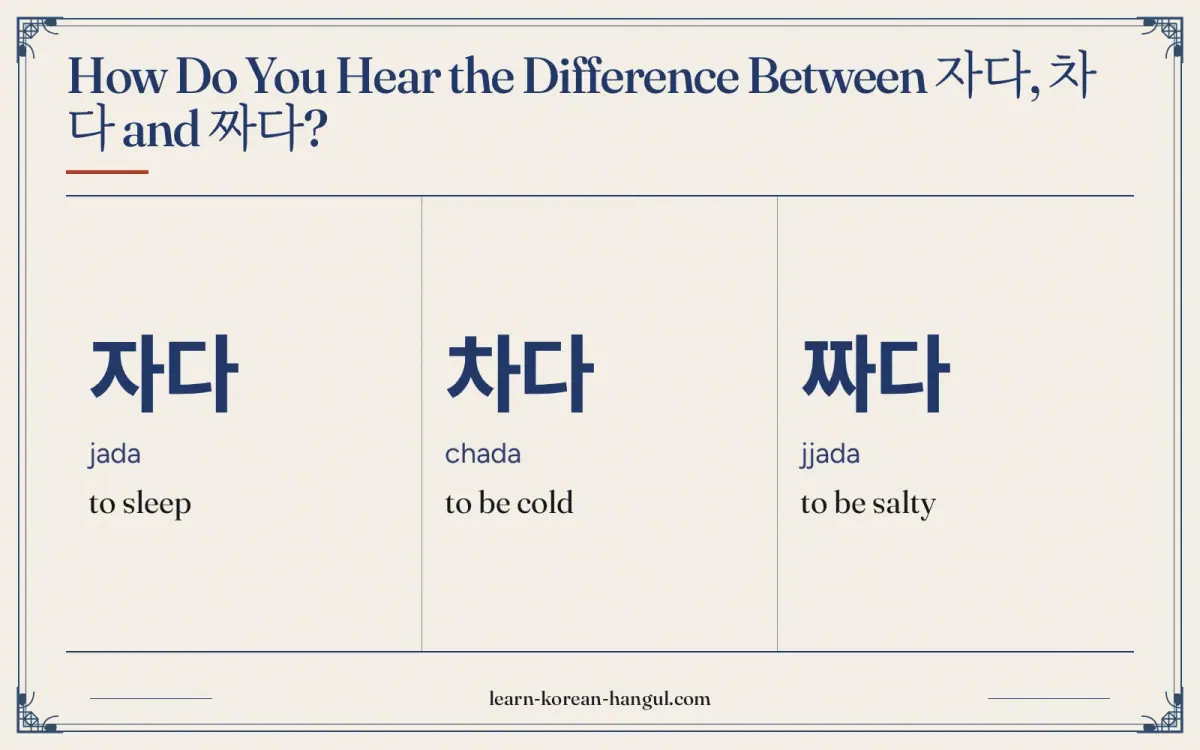
You hear the difference by listening for breath. 자다 (jada, "to sleep") begins with a plain ㅈ and a light breath. 차다 (chada, "to be cold") begins with an aspirated ㅊ and a strong puff. 짜다 (jjada, "to be salty") begins with a tense ㅉ and no puff at all. These three words differ only in their first consonant, so linguists call them a minimal set.
| Word | First letter | Type | Breath | Meaning |
|---|---|---|---|---|
| 자다 | ㅈ | plain | light | to sleep |
| 차다 | ㅊ | aspirated | strong puff | to be cold |
| 짜다 | ㅉ | tense | none, tight throat | to be salty |
Plain: Light Breath; Aspirated: Strong Puff; Tense: No Breath and a Tight Throat
| Korean | Romanization | Meaning | Sound |
|---|---|---|---|
| 자다 | jada | to sleep | |
| 차다 | chada | to be cold | |
| 짜다 | jjada | to be salty |
A paper test makes the difference visible. Hold a thin strip of paper or a tissue near your lips. Say 차다 and the paper moves a lot. Say 자다 and it moves a little. Say 짜다 and it should barely move. If your 짜다 moves the paper, you are adding breath.
One more detail: a plain ㅈ between two vowels is usually voiced, as in 어제 (eoje, yesterday), so it can sound close to an English j. Do not let that voicing leak into ㅉ. Tense consonants stay voiceless and tight everywhere. For longer listening sets with ㄱ ㄲ ㅋ and other trios, use the plain, tense and aspirated sounds lesson, and read about the aspirated partner in the aspirated letter ㅊ. The next section covers what usually goes wrong.
Common Mistakes with ㅉ
Learners make three main mistakes with ㅉ, and each one has a simple fix.
| Mistake | What it sounds like | Fix |
|---|---|---|
| Saying ㅉ like English "j" | A buzzing, voiced "j" | Keep your voice off during the consonant and tighten the throat |
| Adding breath, so 짜다 sounds like 차다 | A "ch" with a puff | Do the paper test; the paper should not move |
| Writing two ㅈ shapes that touch or differ in size | A smudged or unbalanced block | Draw both halves narrower, with a clear gap |
Here is an expert tip. The tension is in the throat and tongue, not in the lips or the jaw. Learners who clench the jaw often produce an English-style "ch" with extra force instead of a tense Korean ㅉ. Keep the face relaxed and make the effort inside the throat.
A second tip: do not translate the "double" in the name into "say it longer". Length is not the cue. A tense consonant has a slightly longer closure in careful speech, but the real difference is the lack of a puff and the tight throat.
Limits of This Lesson
This lesson covers the letter ㅉ at the beginner level. It does not teach every sound change that makes a plain ㅈ sound tense, and it does not cover the cluster finals (such as ㄼ in 짧다) in detail. Pronunciation of tense consonants also varies slightly between speakers and regions, and written descriptions such as "tight throat" can only approximate what you hear. Use the audio on this page as your main guide, and let the writing support it.
For the wider picture on all three types of consonant, see the plain, tense and aspirated sounds lesson. For the five double letters printed together, see the Korean consonants chart. The next step is to practise what you have learned.
Practice: Read and Hear ㅉ
Try the four exercises, then check the answers below.
Exercise 1: Read aloud. Say each word, then write what it means.
- 짜다
- 진짜
- 가짜
- 찌개
- 짝
- 쪽
Exercise 2: Listen and choose. Which word has no puff of air at the start: 자다, 차다 or 짜다? Then play the three clips and say them in a row.
Practice · 7
Which word starts with no puff of air and a tight throat?
Show answer
짜다
짜다 starts with tense ㅉ: no puff and a tight throat. 자다 has a light breath and 차다 a strong puff.
What does 짜다 mean?
Show answer
to be salty
짜다 (tense ㅉ) means to be salty; 자다 is to sleep and 차다 is to be cold.
Can ㅉ be written as a final consonant (batchim)?
Show answer
No, it only starts syllables
Of the double consonants only ㄲ and ㅆ can be a batchim; ㅉ appears only at the start of a syllable.
How does Revised Romanization write 진짜?
Show answer
jinjja
Revised Romanization writes ㅉ as jj before a vowel, so 진짜 is jinjja.
What is the opposite of 진짜 (real)?
Show answer
가짜
가짜 means fake, the opposite of 진짜; 찌개 is stew and 짝 is pair or partner.
How is 낮잠 (nap) pronounced?
Show answer
[낟짬]
After a final [t] sound, a following ㅈ is pronounced tense, so 낮잠 is said [낟짬].
What does doubling ㅈ into ㅉ show?
Show answer
A tense sound
The doubled shape marks tension, not length; the puff belongs to aspirated ㅊ.
Exercise 3: Write. Write each of these blocks three times, keeping both halves of ㅉ narrow and equal: 짜, 찌, 짝, 쪽.
Exercise 4: Spell a word. The dish 짜장면 is black bean noodles. Write the three blocks, then say the word. Hint: the first block is ㅉ + ㅏ, and the second block ends in ㅇ.
Answers to the Practice
- Exercise 1: 짜다 = to be salty; 진짜 = real, really; 가짜 = fake; 찌개 = stew; 짝 = pair, partner; 쪽 = side, page.
- Exercise 2: 짜다 is the word with no puff. Play 자다, 차다 and 짜다 in a row and notice that 차다 is the only one that clearly moves a strip of paper.
- Exercise 3: your blocks should show two ㅈ shapes of the same height, with a clear gap between them.
- Exercise 4: 짜장면 is 짜 + 장 + 면. Block 짜 is ㅉ + ㅏ, block 장 is ㅈ + ㅏ + ㅇ (plain ㅈ, sounds like "jang"), and block 면 is ㅁ + ㅕ + ㄴ.
Practice · 16
- 01쌍지읒
Show answer
letter name
- 02짜다
Show answer
to be salty; tense ㅉ in the contrast set
- 03자다
Show answer
to sleep; plain ㅈ in the contrast set
- 04차다
Show answer
to be cold; aspirated ㅊ in the contrast set
- 05진짜
Show answer
really; real
- 06가짜
Show answer
fake
- 07찌개
Show answer
stew
- 08김치찌개
Show answer
kimchi stew
- 09된장찌개
Show answer
soybean paste stew
- 10짝
Show answer
pair; partner
- 11쪽
Show answer
side; page
- 12짜증
Show answer
annoyance
- 13닭장
Show answer
chicken coop; pronounced [닥짱] by tensification
- 14낮잠
Show answer
nap; pronounced [낟짬] by tensification
- 15짧다
Show answer
to be short; pronounced [짤따]
- 16짜장면
Show answer
black bean noodles
You can also review ㅉ with the other letters in the Hangul flashcard decks, which play audio only when you tap, and test your ears in the Hangul listening quizzes. The Hangul Syllable Builder lets you assemble 짜, 찌 and 쪽 yourself, and the Interactive Hangul Alphabet plays every letter name. For paper practice, print the double consonants worksheet.
What Should You Learn after ㅉ?
After ㅉ, finish the double consonants if any are left, then move on to the next lesson in the Hangul course, which starts the Y-vowels with ㅑ. The path is: plain letter ㅈ, aspirated ㅊ, tense ㅉ, then the next lesson. When you can hear 자다, 차다 and 짜다 as three different words, continue to the next Hangul lesson.
Scope note: this lesson teaches the Korean letter ㅉ only. The sound-change rules that produce tense sounds in the middle of words belong to the pronunciation section, and the full rules for stroke order belong to the writing section. If you can name the letter as 쌍지읒, say it without a puff, and read 진짜 and 찌개, you have met the goal of the lesson.
Frequently Asked Questions
What Does 진짜 Mean?
진짜 (jinjja) means real, genuine or, used as an adverb, really. It is the opposite of 가짜 (gajja, fake). In conversation 진짜? works like English "really?" and 진짜 맛있어요 means "it is really tasty". It is one of the most common words that contains ㅉ.
Can ㅉ Be a Final Consonant?
No. ㅉ is never written as a final consonant (batchim). Of the five double consonants only ㄲ and ㅆ can sit at the bottom of a block, as in 밖 and 있다. ㄸ, ㅃ and ㅉ appear only at the start of a syllable, so you will never need to read ㅉ at the bottom of a block.
What Is the Difference between ㅈ, ㅊ and ㅉ?
All three are made in the same place, with the tongue against the roof of the mouth. ㅈ is plain with a light breath, ㅊ is aspirated with a strong puff of air, and ㅉ is tense with no puff and a tight throat. Compare 자다 (to sleep), 차다 (to be cold) and 짜다 (to be salty).
How Do You Romanize ㅉ?
Revised Romanization writes ㅉ as jj before a vowel: 짜다 is jjada, 진짜 is jinjja and 찌개 is jjigae. Romanization is only a rough aid. English readers tend to say jj as a plain j, which loses the tight, breathless quality that separates 짜다 from 자다.
How Many Strokes Does ㅉ Have?
ㅉ is written as two ㅈ shapes side by side, left one first. This site counts 4 strokes: Korean schools teach each ㅈ in two strokes (the top bar turning into the left leg, then the right leg). Some print-style charts count each ㅈ as three strokes, giving six. Learn the two-shape order and keep both halves the same size.