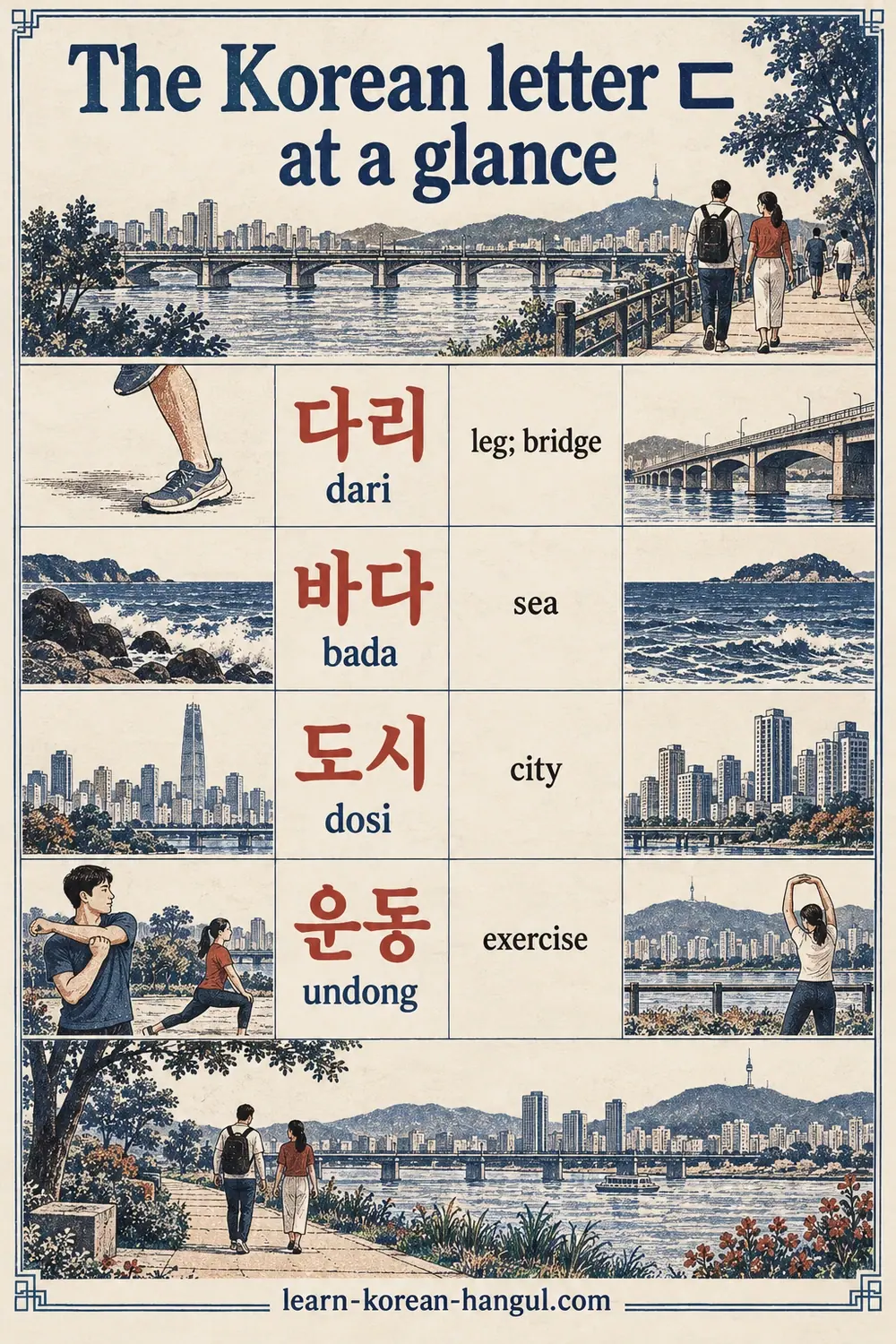
What you'll learn
- Say the letter name 디귿 and the three positional sounds of ㄷ, using 다리, 바다 and 곧.
- Write ㄷ in two strokes and keep its proportions in 다 and 듣.
- Read the blocks 다, 도, 디 and 곧 aloud without adding an extra vowel.
- Hear and produce the difference between ㄷ, ㅌ and ㄸ.
- Prerequisites: the vowel lesson for ㅏ. Estimated time: 15 minutes.
The Korean Letter ㄷ at a Glance
The Korean letter ㄷ is the third consonant in South Korean dictionary order and one of the 14 basic consonants in the Hangul Orthography (한글 맞춤법, Article 4). On this site it is the third of the basic Korean consonants, taught right after ㄴ because the two letters share a shape.
| Attribute | Value |
|---|---|
| Letter | ㄷ |
| Name | 디귿 (digeut) |
| Revised Romanization | d before a vowel, t at the end of a syllable |
| Sound family | alveolar stop: the tongue tip touches the ridge behind the upper teeth |
| Strokes | 2 |
| Final sound (batchim) | unreleased [t] |
| Partner letters | ㅌ (aspirated), ㄸ (tense) |
| Keyboard key (Dubeolsik) | E |
The shape of ㄷ comes from ㄴ. The 1446 commentary Hunminjeongeum Haerye (훈민정음 해례) says ㄴ pictures the tongue tip touching the upper gum. Adding a stroke on top gives ㄷ, a stronger sound made in the same place, and adding one more gives ㅌ, the breathy version. This "add a stroke for a stronger sound" design means that once you know ㄴ, you already know where to put your tongue for ㄷ.
The name 디귿 is irregular. The usual pattern (consonant + 이, consonant + 으 + consonant) would give 디읃. The name comes from Choe Sejin's 1527 textbook Hunmong Jahoe (훈몽자회), which wrote letter names with Chinese characters and used a character meaning "end", read 귿 at the time, because no character was read 읃. North Korea uses 디읃. The page on the names of the Korean consonants covers the three irregular names together. Next, the sound itself.
What Sound Does ㄷ Make?

ㄷ makes one sound with three positional versions: a light t with little breath at the start of a word, a voiced d between vowels, and an unreleased t at the end of a syllable. These versions are allophones, meaning different pronunciations of one sound that never change a word's meaning.
| Position | Example | Pronunciation | What you hear |
|---|---|---|---|
| Start of a word | 다리 (dari, leg; bridge) | [다리] | light t, much less breath than English "t" |
| Between vowels | 바다 (bada, sea) | [바다] | soft d, as in English "ladder" said slowly |
| After ㄴ, ㅁ, ㅇ or ㄹ | 운동 (undong, exercise) | [운동] | soft d |
| End of a syllable | 곧 (got, soon) | [곧] | t with the tongue held, no puff of air |
To make the sound, press the tip of your tongue against the ridge just behind your upper front teeth, then release it gently with very little air. A useful trick: say 운동 slowly. Because ㄷ follows the voiced sound ㄴ, you can feel how the soft d version forms, with your vocal cords buzzing all the way through.
Why Does 굳이 Sound Like Guji?
굳이 (guji, "insistently") sounds like [구지] because ㄷ turns into ㅈ when it is followed by the vowel 이 of a grammatical suffix or particle. This change is called palatalization: the tongue moves toward the hard palate to prepare for 이, and the t-sound becomes a j-sound. The spelling keeps ㄷ because the word is built from 굳- (firm) plus -이.
The same change happens in 해돋이 (haedoji, sunrise), said [해도지]. You will study it properly in the palatalization rule (굳이 = [구지]). For now, the key point is that ㄷ before 이 in these words is not said as "di".
With the sound in place, you can learn to write the letter.
How Do You Write ㄷ?
ㄷ is written in two strokes: first a horizontal line across the top, then an L-shaped stroke that goes down and turns right. The consonant stroke order lesson shows how this two-stroke pattern compares with ㄴ (one stroke) and ㅌ (three strokes).
Practise on Paper
- Draw a horizontal line from left to right across the top.
- Start just under the left end of that line. Draw down, turn the corner, and draw right along the bottom. This second stroke is the shape of ㄴ.
Stroke Order: 2 Strokes
- Draw a horizontal line from left to right across the top.
- Start just under the left end of that line. Draw down, turn the corner, and draw right along the bottom. This second stroke is the shape of ㄴ.
The bottom line is usually a little longer than the top line, so the letter looks stable. Inside a block the proportions change. In 다 the letter is tall and narrow because it shares width with ㅏ. In 듣 (the first syllable of 듣다, to listen) it is flat and wide on top and squeezed into a short space at the bottom, where it sits as a final consonant. Practise both sizes so your handwriting stays readable.
A common mistake is drawing ㄷ in three separate strokes, with the bottom line lifted off as its own stroke. The result often leaves a gap at the corner. Keep the down-and-right movement in one motion. Next comes the way ㄷ changes position by position.
How Does ㄷ Change at the Start, Middle and End?

ㄷ changes only in sound, never in spelling: it is a light [t] at the start, a voiced [d] between vowels or after ㄴ, ㅁ, ㅇ and ㄹ, and an unreleased [t] when it closes a syllable.
| Position in the block | Example | Written | Said | Romanized |
|---|---|---|---|---|
| Initial, word start | 도시 (dosi, city) | 도 | [to] | do |
| Initial, between vowels | 바다 | 다 | [da] | da |
| Final (batchim) | 곧 | 곧 | [kot̚] | got |
| Final, before a consonant | 듣다 (deutda, to listen) | 듣 | [듣따] | deut |
The last row shows a second effect of a final ㄷ. When it is followed by another plain consonant, that consonant becomes tense, so 듣다 is said [듣따]. Revised Romanization ignores this and writes deutda, following the spelling.
ㄷ as a Final Consonant (batchim)
A consonant at the bottom of a block, like ㄷ in 곧, is a batchim (받침, "support"). As a batchim, ㄷ is pronounced [t] with the tongue tip held against the gum ridge and no release.
The final [t] sound is far more common than the letter ㄷ suggests: seven letters are pronounced [t] at the end of a syllable: ㄷ, ㅅ, ㅆ, ㅈ, ㅊ, ㅌ and usually ㅎ. The Standard Pronunciation Rules (표준 발음법, Article 9) group the first six under the representative sound ㄷ; final ㅎ has its own article (Article 12). A clear demonstration is this set of four different words that sound identical when said alone:
| Word | Meaning | Said |
|---|---|---|
| 낟 | grain | [낟] |
| 낫 | sickle | [낟] |
| 낮 | daytime | [낟] |
| 낯 | face | [낟] |
The difference comes back as soon as a vowel follows. 낮에 (in the daytime) is said [나제], and 낯이 is said [나치]. This is why Korean keeps the different spellings: they show the sound you will hear before a vowel. The full system is explained in the seven final sounds. The next section puts the initial and final positions together in real blocks.
Worked Example: Reading 다, 도, 디, 곧
Reading a block with ㄷ takes three steps: find the consonant, find the vowel, then check whether a consonant closes the block.
- 다. ㄷ sits left of the tall vowel ㅏ. Touch the tongue tip to the gum ridge, release lightly, and say "ah": [다]. Romanized da.
- 도. ㄷ sits above the flat vowel ㅗ. Round your lips first, then release ㄷ into ㅗ: [도]. Romanized do.
- 디. ㄷ sits left of ㅣ. Say a light t, then "ee": [디]. Keep it light; a strong puff makes 티. Note that 디 at the start of a word is mostly found in loanwords such as 디자인 (design).
- 곧. ㄱ sits on top, ㅗ under it, and ㄷ at the bottom as the batchim. Say 고, then press the tongue tip up and stop: [곧]. Romanized got.
If your 곧 sounds like "go-tuh", you released the final ㄷ; hold the tongue in place until the sound ends. The release, or lack of it, is also what separates ㄷ from its partner letters.
ㄷ Compared with ㅌ and ㄸ
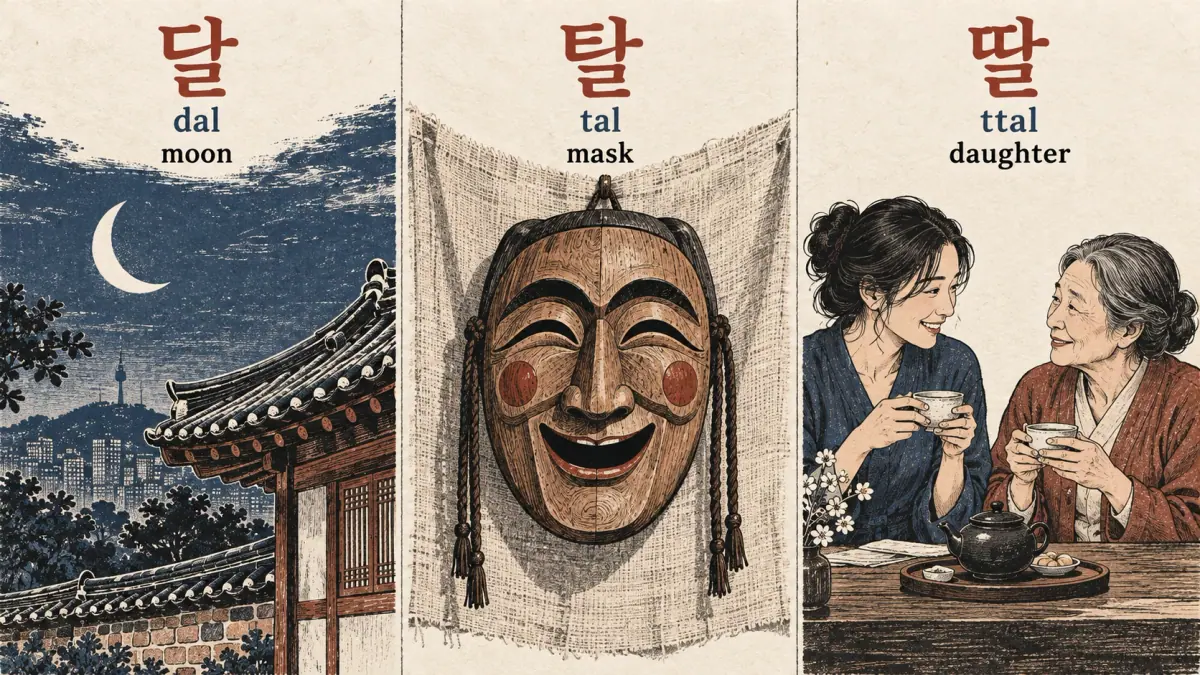
ㄷ, ㅌ and ㄸ share one tongue position and differ in breath and tension. ㄷ is plain (a small puff), ㅌ is aspirated (a strong puff), and ㄸ is tense (a tight throat, no puff). The set 달 (moon), 탈 (mask) and 딸 (daughter) shows that the three letters make different words.
Paper Test: ㅌ Moves the Paper, ㄷ Barely, ㄸ Not at All
| Korean | Romanization | Meaning | Sound |
|---|---|---|---|
| 달 | dal | moon | |
| 탈 | tal | mask | |
| 딸 | ttal | daughter |
| Letter | Type | Breath | Throat | Example word |
|---|---|---|---|---|
| ㄷ | plain (lenis) | small puff | relaxed | 달 (dal, moon) |
| ㅌ | aspirated | strong puff | relaxed | 탈 (tal, mask) |
| ㄸ | tense | no puff | tight | 딸 (ttal, daughter) |
Try the breath test with a strip of paper about 3 cm from your lips. 탈 should make the paper jump, 달 should move it a little, and 딸 should leave it still while your throat tightens. In Seoul speech the vowel after ㄷ also tends to start lower in pitch than after ㅌ or ㄸ, which gives you a second cue to listen for.
Study the full lessons on the letter ㅌ (Tieut) and the letter ㄸ (Ssangdigeut) after the basic set. Mixing these three up is also behind several of the common mistakes below.
Common Mistakes with ㄷ

Four mistakes account for most ㄷ errors, and each has a direct fix.
- Using a strong English d at the start of 다리. A fully voiced English d sounds foreign at the start of a Korean word. Fix: start 다리 almost like "tah", with a relaxed throat.
- Aspirating 디 into 티. A big puff of air changes the letter to ㅌ. Fix: use the paper test and aim for a small movement.
- Writing ㄷ in three strokes with a separate bottom bar. This leaves gaps and uneven corners. Fix: draw the L-shaped second stroke in one movement.
- Reading 굳이 as "gud-i". The spelling shows ㄷ, but the word is said [구지]. Fix: remember that final ㄷ + the suffix or particle 이 becomes [지].
Is ㄷ the Same as the English Letter?
No. ㄷ is not the same as English d or English t. ㄷ is one plain (lenis) sound, /t/, that neighbouring sounds push toward t or d. English d is voiced at the start of a word ("day"), and English t has a strong puff of air ("tie"). Korean ㄷ at the start of a word has neither feature, so it sits between them.
Revised Romanization (국어의 로마자 표기법, 2000) writes ㄷ as d before a vowel and t at the end, as in 곧 (got). Treat these letters as a spelling aid for names and signs, not as a pronunciation key. The exercises below train you to read the Hangul directly.
Practice: Four Quick Exercises

Try each exercise, then check the answers at the end of this section. The same items run as an interactive quiz.
Practice · 7
What is the South Korean name of the letter ㄷ?
Show answer
디귿
South Korea uses the irregular name 디귿 from the 1527 Hunmong Jahoe; 디읃 is the North Korean name.
How many strokes does ㄷ take to write?
Show answer
2
ㄷ is two strokes: a top horizontal line, then one L-shaped stroke that goes down and turns right.
Which word means "daughter"?
Show answer
딸
딸 with tense ㄸ means daughter; 달 is moon and 탈 is mask.
How is 굳이 pronounced?
Show answer
[구지]
Final ㄷ followed by the suffix 이 becomes [지] (palatalization), so 굳이 is said [구지].
Which of these words is NOT said [낟] when spoken alone?
Show answer
나
낫, 낮 and 낯 all end in a final [t] and are said [낟]; 나 has no final consonant.
How does ㄷ sound between vowels, as in 바다?
Show answer
A soft, voiced d
Between vowels ㄷ is voiced, so you hear a soft d in 바다.
How is 듣다 (to listen) said?
Show answer
[듣따]
A final ㄷ makes the following plain consonant tense, so 듣다 is said [듣따].
- Listen and choose. Which word means "daughter": 달, 탈 or 딸? Which means "mask"?
- Read aloud. Read 바다, 도시, 어디 (eodi, where) and 곧. For each ㄷ, say whether you hear a t-like or d-like sound.
- Write the block. Build and write: ㄷ + ㅓ, ㄷ + ㅜ, ㄱ + ㅗ + ㄷ.
- Find the final. Which of these words are all said [낟] when spoken alone: 낫, 낮, 나, 낯?
Answers
- 딸 means "daughter". 탈 means "mask" (달 is "moon").
- 바다: d-like. 도시: t-like. 어디: d-like. 곧: the final ㄷ is an unreleased [t].
- ㄷ + ㅓ = 더, ㄷ + ㅜ = 두, ㄱ + ㅗ + ㄷ = 곧.
- 낫, 낮 and 낯 are all said [낟]. 나 has no final consonant.
If you got these right, the letter ㄷ is in place.
What Should You Learn after ㄷ?
After the Korean letter ㄷ, learn The Korean Letter ㄹ (Rieul), the next basic consonant. ㄹ is the letter learners ask about most, because it sounds like r in some positions and l in others.
To review ㄷ, spend a few minutes a day with the Hangul flashcard decks, check yourself in the Hangul quizzes, and listen to every consonant in the interactive Hangul alphabet. For handwriting, print the Korean consonants writing practice sheet. To see ㄷ next to the other consonant letters, open all Korean consonants.
What this lesson does not cover: the full palatalization rule (굳이, 같이), tensification after final consonants (듣다 [듣따]), and how ㅎ behaves as a batchim. Those topics live in the pronunciation section, so this page stays focused on reading and writing the single letter ㄷ.
Questions about the Korean Letter ㄷ
Is ㄷ a d or a t? ㄷ is one Korean sound that English speakers hear as d or t depending on position. At the start of a word it is a light t with little breath, as in 다리. Between vowels it becomes a soft d, as in 바다. At the end of a syllable it is a held, unreleased t, as in 곧.
Why do so many letters sound like t at the end? Korean does not release consonants at the end of a syllable, so letters made at or just behind the gum ridge lose their differences. ㄷ, ㅅ, ㅆ, ㅈ, ㅊ and ㅌ all end as [t], and ㅎ usually does too. The Standard Pronunciation Rules (Article 9) group the first six under the representative sound ㄷ.
What is the difference between ㄷ and ㅌ? ㄷ and ㅌ use the same tongue position but differ in breath. ㄷ is plain, with a small puff of air, while ㅌ is aspirated, with a strong puff. The words 달 (moon) and 탈 (mask) differ only in this breath. A strip of paper in front of your lips moves clearly for ㅌ and only slightly for ㄷ.
Why is ㄷ named 디귿? The regular naming pattern would give 디읃, but the name 디귿 comes from the 1527 textbook Hunmong Jahoe, which wrote letter names in Chinese characters. It used a character meaning "end", read 귿 in the Korean of that time, because no character was read 읃. North Korea uses the regular name 디읃.
How do you type ㄷ on a Korean keyboard? On the standard Korean 2-set keyboard (Dubeolsik), ㄷ is on the key marked E. Press Shift and E together for the double letter ㄸ. With Korean input switched on, typing E then K produces 다, because the vowel ㅏ sits on the K key. Phone keyboards set to the 2-set layout use the same keys.