Korean horizontal vowels are the five vowels with a long horizontal stroke (ㅗ ㅛ ㅜ ㅠ ㅡ), and in a syllable block they sit under the consonant, as in 고. Once you know this second placement rule, you can write and read every block that has a flat vowel.
What you'll learn
- Name the five horizontal vowels and say where the consonant goes.
- Build 15 to 20 syllables such as 고, 누, 그, 요 and 뷰.
- Tell ㅗ from ㅜ at a glance and explain why 가 and 고 look different.
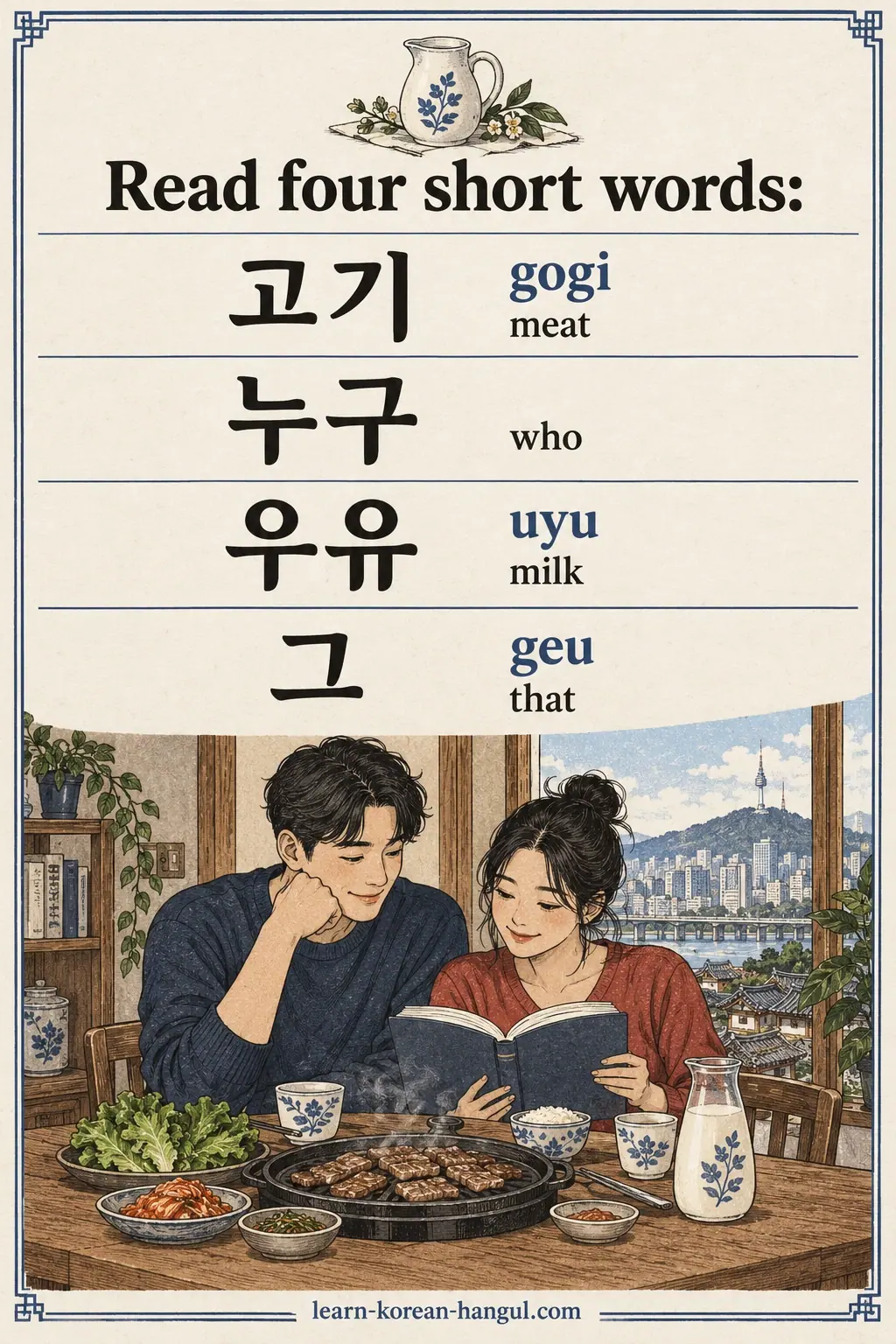
- Read four short words: 고기, 누구, 우유 and 그.
Honest limit: printed fonts and handwriting differ, so the corner of ㄱ and the thickness of the flat stroke will look slightly different in every typeface. The placement rule never changes.
Prerequisites: vertical-vowel blocks, so the contrast is clear. Estimated time: 20 minutes.
This layout is one of the six block shapes. It is the mirror of the vertical layout, so the next section starts with the rule itself.
What Are Korean Horizontal Vowels?
Korean horizontal vowels are vowels whose main stroke is a flat line that runs left to right. Hangul places the first consonant according to the direction of that stroke. If the stroke is flat, the consonant goes on top and the vowel goes underneath, so the block is read from top to bottom. If the stroke is tall, the consonant goes on the left, which is the vertical layout.
The test is the same one you used before: find the vowel's longest stroke. In ㅗ the long stroke lies flat, so the consonant stands above it. In ㅏ the long stroke stands upright, so the consonant stands beside it.
Which Vowels Are Horizontal?
Five vowels are horizontal. Three are simple and two add a "y" glide:
| Vowel | Revised Romanization | Sounds like | Example block |
|---|---|---|---|
| ㅗ | o | "o" in "more", with rounded lips and no glide | 고 (go) |
| ㅛ | yo | "yo" in "yore" | 요 (yo) |
| ㅜ | u | "oo" in "moon", with rounded lips | 누 (nu) |
| ㅠ | yu | "you" | 뷰 (byu) |
| ㅡ | eu | "oo" in "moon" said with flat, spread lips | 그 (geu) |
The short strokes carry meaning. In ㅗ the short stroke points up, and in ㅜ it points down. Two short strokes, as in ㅛ and ㅠ, add a "y" glide. The vowel ㅡ has no short stroke at all; with ㅣ, it is one of the two plainest letters in the alphabet. Because there is no equivalent English vowel, many learners find the vowel ㅡ the hardest sound in this group. Try ㅜ first, then spread your lips without moving your tongue.
With the five vowels named, you can now assemble a block.
How to Build a Horizontal-Vowel Block in 3 Steps

You build a horizontal-vowel block by choosing a consonant, choosing a flat vowel, and stacking the consonant above the vowel inside one square. The recipe below uses 고 as the model.
- Pick the first consonant. For 고, take ㄱ. If the syllable has no starting sound, take silent ㅇ. Checkpoint: one consonant in hand.
- Pick a horizontal vowel and place it below. For 고, take ㅗ and set it under ㄱ. Checkpoint: the vowel's long stroke runs along the full width of the block.
- Flatten both into one square. Make the consonant short and wide so that both letters fill the block with no gap. Checkpoint: the finished block is about as wide as it is tall, and it reads from top to bottom as "go".
Write the consonant first, then the vowel, as with every block. The order of each stroke inside the block is covered in writing whole syllable blocks.
Common mistake: putting the consonant to the left of a flat vowel, which gives something like ㄱㅗ spread out sideways. In Hangul, a flat vowel always goes under the consonant.
How Do You Tell ㅗ from ㅜ at a Glance?
You tell ㅗ from ㅜ by the direction of the short stroke. In ㅗ the short stroke points up and sits above the long line. In ㅜ the short stroke points down and hangs below it. A simple picture helps: ㅗ is a plant growing up out of the ground, and ㅜ is a root growing down.
The same cue applies to the y-versions. ㅛ has two short strokes pointing up, and ㅠ has two pointing down. The pair 오 and 우 is the commonest source of misreading, so practise them side by side with the audio: 오 (o), 우 (u).
Next, compare these blocks with the vertical ones you already know.
Why Do 가 and 고 Look so Different?
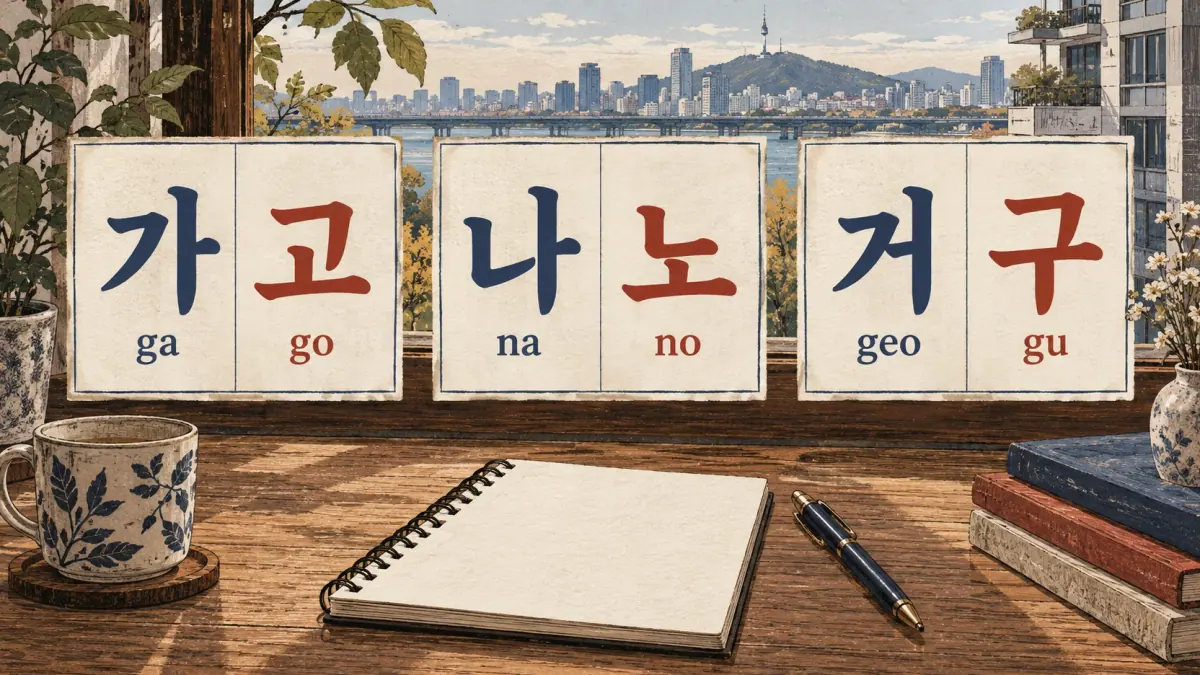
가 and 고 look different because the vowel changes the shape of the space the consonant lives in. With a vertical vowel, the consonant gets a tall, narrow slot on the left. With a horizontal vowel, it gets a short, wide slot on top. The letter ㄱ adapts: in 가 its downstroke slants, but in 고 it flattens and keeps a right-angle corner.
Seeing the pairs side by side makes the rule easier to feel than any description:
| Vertical block | Horizontal block | What changes |
|---|---|---|
| 가 (ga) | 고 (go) | ㄱ slants in 가, and has a right-angle corner in 고 |
| 나 (na) | 노 (no) | ㄴ is tall in 나, and short and wide in 노 |
| 거 (geo) | 구 (gu) | the vowel moves from the right side to the bottom |
Both blocks fill a square of the same size. That is why a line of Korean text looks regular, even though some blocks contain a tall vowel and others a flat one. Typefaces and handwriting differ in the exact shape, so use the picture as a guide, not as a ruler.
Seeing the shapes is one thing, and assembling them is another, so the worked example comes next.
Worked Example: Building Syllables Step by Step
Example 1: build 고 (go).
- Start with ㄱ, the sound "g".
- Place ㅗ, the vowel "o", under it.
- Flatten ㄱ into a short corner. Result: 고, read "go".
Example 2: build 누 (nu).
- Start with ㄴ, the sound "n".
- Place ㅜ under it. The short stroke points down.
- Result: 누, read "nu". The block 누 is also the first half of the word 누구 (who).
Example 3: build 그 (geu).
- Start with ㄱ.
- Place ㅡ under it. ㅡ is a plain flat line, so the block is a corner on top of a bar.
- Result: 그, read "geu". This is also a real word, meaning "that".
More blocks to scan. Read these 18 syllables from top to bottom, consonant first:
| Vowel | Blocks |
|---|---|
| ㅗ (o) | 고 (go), 노 (no), 도 (do), 모 (mo), 소 (so) |
| ㅜ (u) | 구 (gu), 두 (du), 부 (bu), 수 (su), 주 (ju) |
| ㅡ (eu) | 그 (geu), 드 (deu), 므 (meu), 스 (seu) |
| ㅛ, ㅠ | 요 (yo), 교 (gyo), 뷰 (byu), 유 (yu) |
Practice
You can practise this step with the hangul syllable builder, which gives instant feedback. After this, there is one extension to preview.
How Do Horizontal and Vertical Blocks Compare?

Horizontal and vertical blocks differ in four ways: where the consonant sits, how the block is read, how many vowels belong to the group, and how the consonant is drawn. The table puts the two layouts side by side.
| Feature | Vertical-vowel block | Horizontal-vowel block |
|---|---|---|
| Consonant position | left | top |
| Reading direction inside the block | left to right | top to bottom |
| Vowels in the group | 9 (ㅏ ㅐ ㅑ ㅒ ㅓ ㅔ ㅕ ㅖ ㅣ) | 5 (ㅗ ㅛ ㅜ ㅠ ㅡ) |
| Shape of the consonant | tall and narrow | short and wide |
| Example | 가 (ga) | 고 (go) |
Real words mix both layouts, and decoding them is a good test. Take 고기 (gogi, "meat"). The first block 고 has a flat vowel, so ㄱ is on top and ㅗ is below. The second block 기 has an upright vowel, so ㄱ is on the left and ㅣ is on the right. You read the two blocks left to right as one word, then read each block by its own layout. The word 우유 (uyu, "milk") works the same way, except that both blocks are horizontal: silent ㅇ on top of ㅜ, then silent ㅇ on top of ㅠ.
Adding a Final Consonant to This Layout

A horizontal-vowel block can also carry a final consonant, and then it has three rows. For example, 고 plus ㅁ makes 곰 (gom, "bear"): the first consonant on top, the vowel in the middle, and the final consonant at the bottom. The letters keep their order from top to bottom. This three-row stack is why the consonant and vowel must be flat and short.
The bottom letter is called 받침 (batchim). The next lessons cover it in depth, and you can jump ahead to the batchim lesson once you know all the vowel layouts.
Before practising, look at the mistakes that cost beginners the most time.
What Mistakes Do Beginners Make?
Beginners make five predictable mistakes with horizontal-vowel blocks.
- Mixing up ㅗ and ㅜ. Check the short stroke: up is ㅗ (o), down is ㅜ (u).
- Reading ㅡ as a dash. ㅡ looks like a hyphen, but it is a vowel. Alone it is not a syllable; with silent ㅇ it forms 으.
- Placing the vowel beside the consonant. A flat vowel never goes on the right. Put it underneath.
- Writing the vowel too thick or too long. The flat stroke should span the block but stay thin. If it is heavy, it crowds the consonant above it, and the block looks like a solid bar. Keep a clear gap of about one stroke width between the two letters.
- Forgetting that the vowel keeps its sound. The layout changes the position, not the sound. 고 is "go" and 가 is "ga" because the vowels differ, not because the layout differs.
Remember: learners often assume that a horizontal vowel makes the consonant sound different. It does not. The consonant ㄱ is the same letter in 가 and 고. Only its drawn shape changes.
Now put the rule into practice.
Practice: Build and Read 12 Syllables

Do these on paper first, then check the answers at the end.
A. Build the block. Combine each pair into one syllable.
- ㄴ + ㅗ
- ㅁ + ㅜ
- ㅅ + ㅡ
- ㅇ + ㅛ
- ㅂ + ㅠ
- ㅈ + ㅗ
B. Read the block. Say each one aloud and write its Revised Romanization.
- 오
- 우
- 으
- 보
- 두
- 유
C. Read the words. Each word uses at least one horizontal-vowel block.
- 고기 (meat)
- 누구 (who)
- 우유 (milk)
- 그 (that)
Practice · 8
Which group contains only horizontal vowels?
Show answer
ㅗ ㅛ ㅜ ㅠ ㅡ
The five horizontal vowels are ㅗ ㅛ ㅜ ㅠ ㅡ; their long stroke lies flat.
With a horizontal vowel, where does the first consonant go?
Show answer
On top of the vowel
A flat vowel goes under the consonant, so the consonant sits on top and the block is read top to bottom.
Which block do you get from ㄴ + ㅗ?
Show answer
노
ㄴ goes on top and ㅗ (short stroke pointing up) goes below, giving 노 (no).
How do you tell ㅗ from ㅜ?
Show answer
In ㅗ the short stroke points up; in ㅜ it points down
Up is ㅗ (o) and down is ㅜ (u); two short strokes would be ㅛ or ㅠ.
How is the block 으 built?
Show answer
Silent ㅇ on top of ㅡ
A vowel-initial syllable uses silent ㅇ, and with a horizontal vowel the ㅇ goes on top.
What is the Revised Romanization of 두?
Show answer
du
두 is ㄷ on top of ㅜ, and ㅜ is romanized u.
In the word 고기, how is each block laid out?
Show answer
고 has ㄱ on top of ㅗ; 기 has ㄱ to the left of ㅣ
Each block follows its own vowel: flat ㅗ goes under the consonant, upright ㅣ goes beside it.
Does a horizontal vowel change how the consonant ㄱ sounds in 고 compared with 가?
Show answer
No, only its drawn shape changes
The layout changes position, not sound; ㄱ is the same letter in 가 and 고, only flattened.
Answers. 1. 노 (no). 2. 무 (mu). 3. 스 (seu). 4. 요 (yo). 5. 뷰 (byu). 6. 조 (jo). 7. o. 8. u. 9. eu. 10. bo. 11. du. 12. yu.
If you missed more than three, return to the table of five vowels and say each one aloud. You can review these syllables later with the Hangul flashcard decks.
What to Learn Next
Learn the mixed-vowel blocks next. Mixed-vowel blocks combine a horizontal and a vertical part, so the vowel wraps under and to the right of the consonant. With two layouts known, move on to the Korean aspirated consonants, starting with the aspirated consonant ㅋ.
This lesson does not cover how final consonants sound, the sound-change rules between blocks, or the compound vowels that mix both directions. Those are taught in their own lessons.
To summarise, Korean horizontal vowels follow one rule: a flat vowel goes under the consonant, and the block is read from top to bottom.
Frequently Asked Questions
Is ㅡ a horizontal vowel? Yes. ㅡ is the plainest horizontal vowel: a single flat line with no short stroke. The consonant sits on top of it, as in 그 (geu) and 스 (seu). Because it has no stroke pointing up or down, learners sometimes forget it is a vowel, so always pair it with a consonant or silent ㅇ, as in 으.
Why does 고 look flatter than 가? A horizontal vowel stretches across the block, so the consonant on top gets a wide, short space. The ㄱ in 고 is flattened with a right-angle corner, while in 가 it is tall and narrow. Both blocks still fill the same square, which keeps lines of Korean text evenly spaced.
How do I avoid mixing up 오 and 우? Look at the short stroke. In ㅗ it points up, like the top of a hill, and in ㅜ it points down, like a root. Then listen: 오 is "o" with rounded lips, and 우 is "oo" with rounded lips. Say each one against the audio three times; the sound difference sticks faster than the shape.
Is 그 a word? Yes. 그 is a complete word meaning "that" or "the" when it points to something already mentioned, for example 그 사람 (that person). It is built from ㄱ on top and ㅡ below. It is also the pronoun "he" in written Korean, so context matters.
Do horizontal vowels change pronunciation? No. A vowel keeps its sound whatever layout it sits in; the layout only decides where the letters go. ㅗ is always roughly "o", and ㅜ always roughly "u". Sounds can still change from neighbouring letters inside a word, but those sound-change rules are taught in the pronunciation lessons, not by the block shape.