
Korean vertical vowels are the nine vowels with a long vertical stroke (ㅏ ㅐ ㅑ ㅒ ㅓ ㅔ ㅕ ㅖ ㅣ), and in a syllable block they sit to the right of the consonant, as in 가. Learn this one placement rule and you can already write and read every syllable in the first row of the Korean syllable chart.
What you'll learn
- Name the nine vertical vowels and say which side of the consonant each one sits on.
- Build 20 syllables such as 가, 너, 디, 애 and 예 from a consonant plus a vertical vowel.
- Explain why a consonant like ㄱ changes shape inside a block.
- Read the 가나다 row aloud, and read four short words made from it.
Prerequisites: you know the shape of a few consonants (start with the letter ㄱ) and the vowel ㅣ. Estimated time: 20 minutes.
This layout is one of the six block shapes, and it is the one to learn first. The next section names the vowels that belong to it.
What Are Korean Vertical Vowels?
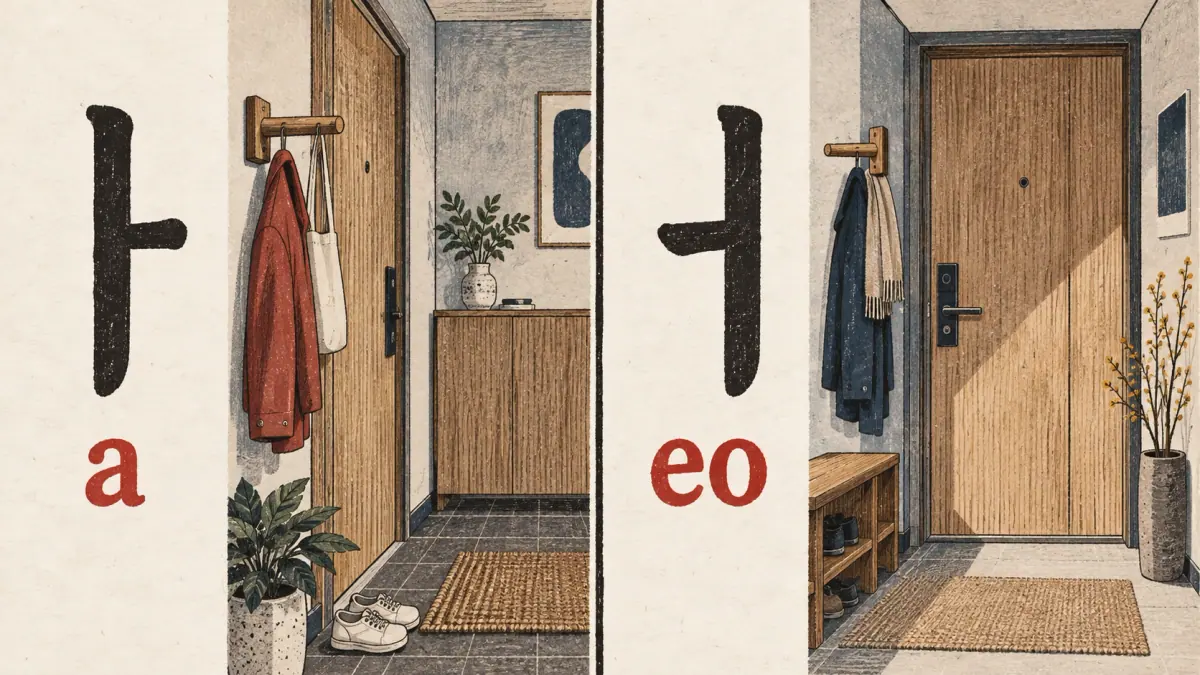
Korean vertical vowels are vowels whose main stroke is a tall line that runs up and down. Hangul writes each syllable as a small square block, and the direction of the vowel's main stroke decides where the first consonant goes. If the stroke is vertical, the consonant stands on the left and the vowel stands on the right. Linguists call the first consonant the "onset" and the vowel the "nucleus" of the syllable; Hangul simply gives each a fixed position.
A quick test works every time: look at the vowel's longest stroke. If it points up and down, like the line in ㅏ, the consonant goes left. If it lies flat, like the line in ㅗ, the consonant goes on top, which is covered in the lesson on horizontal-vowel blocks.
Which Vowels Are Vertical?
Nine vowels are vertical. Five of them are basic vowels (ㅏ ㅑ ㅓ ㅕ ㅣ), and four are built by adding ㅣ (ㅐ ㅒ ㅔ ㅖ):
| Vowel | Revised Romanization | Sounds like | Example block |
|---|---|---|---|
| ㅏ | a | "a" in "father" | 가 (ga) |
| ㅐ | ae | "e" in "bed" (open) | 애 (ae) |
| ㅑ | ya | "ya" in "yacht" | 야 (ya) |
| ㅒ | yae | "ye" in "yes" (open) | 얘 (yae) |
| ㅓ | eo | "u" in "bus", with relaxed, unrounded lips and the jaw a little open | 너 (neo) |
| ㅔ | e | "e" in "bed" | 에 (e) |
| ㅕ | yeo | "yo" in "young" | 여 (yeo) |
| ㅖ | ye | "ye" in "yes" | 예 (ye) |
| ㅣ | i | "ee" in "see" | 기 (gi) |
Each vowel has one long vertical line plus short strokes. The short stroke points right in ㅏ and left in ㅓ. Two short strokes, as in ㅑ and ㅕ, add a "y" glide. The letters ㅐ and ㅔ are formed by adding a second vertical line, ㅣ. In everyday speech most Seoul speakers pronounce ㅐ and ㅔ almost the same, so do not worry about telling them apart by ear at this stage. Spell them by memory, and let the pronunciation lessons refine the sound later.
Now that you can spot the nine vowels, the next step is to put one next to a consonant.
How to Build a Vertical-Vowel Block in 3 Steps
You build a vertical-vowel block by choosing a consonant, choosing a vowel, and placing the consonant on the left of the vowel inside one square. The recipe below uses 가 as the model.
- Pick the first consonant. For 가, take ㄱ. If the syllable has no starting sound, take the silent ㅇ instead (more on that below). Checkpoint: you have one consonant in your hand.
- Pick a vertical vowel and place it on the right. For 가, take ㅏ and set it to the right of ㄱ. Checkpoint: the vowel's long stroke is as tall as the whole block.
- Squeeze both into one square. Narrow the consonant slightly so that the two letters fill the square without a gap. Checkpoint: the finished block is about as wide as it is tall, and it reads left to right as "ga".
Write the consonant first, then the vowel. This stroke order is the standard one taught in Korean schools, and it keeps your handwriting consistent. The full stroke-by-stroke order is covered in writing whole syllable blocks.
Common mistake: writing the two letters at full size next to each other, which makes the block twice as wide as its neighbours. Korean blocks are meant to be equal in width, so shrink both letters a little.
Why Does the Consonant Change Shape?
The consonant changes shape because it has less room. Inside a block the consonant is squeezed into the left half, so wide letters become narrower. The clearest example is ㄱ. Standing alone it has a sharp corner, but in 가 the horizontal bar is shorter and the downstroke leans slightly to the left. Compare it with 고, where ㄱ has a right-angle corner because the space above a horizontal vowel is wide, not narrow.
Other consonants adapt in the same way. In 사 the letter ㅅ has two legs that spread less than they do in ㅅ alone. In 마 the box ㅁ is a narrow rectangle. Typefaces and handwriting differ in the exact slant, so treat the shape as a guide, not a rule to measure. The common point is that the consonant always shrinks, and the vertical vowel keeps its full height.
Once you know the placement and the shape change, you can read a whole row of blocks at once.
How Do You Read the 가나다 Row?
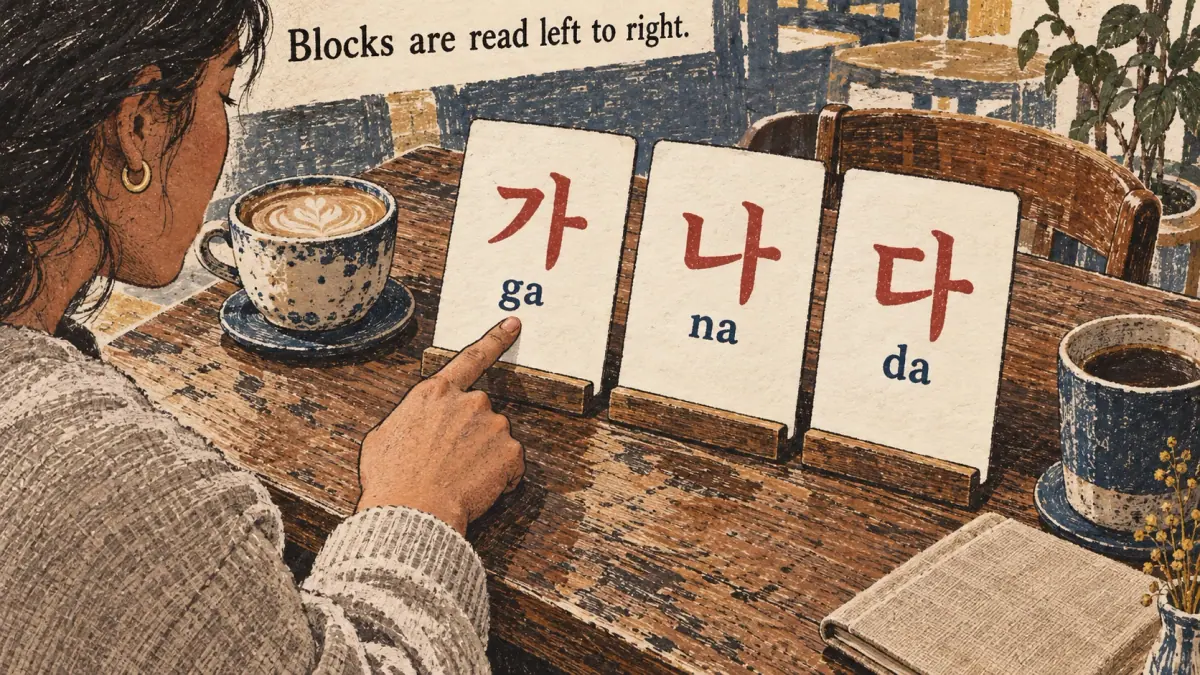
You read the 가나다 row from left to right, saying each block as the consonant sound plus the vowel sound. The row pairs the traditional order of consonants with the vowel ㅏ:
| Block | Consonant | Reads as |
|---|---|---|
| 가 | ㄱ | ga |
| 나 | ㄴ | na |
| 다 | ㄷ | da |
| 라 | ㄹ | ra (or la) |
| 마 | ㅁ | ma |
| 바 | ㅂ | ba |
| 사 | ㅅ | sa |
| 아 | ㅇ (silent) | a |
Say the row slowly, then at normal speed, using the audio below. The pattern holds for every vowel: swap ㅏ for ㅓ and the row becomes 거 너 더 러 머 버 서 어.
Notice the block 아. It has no starting sound, yet Hangul still needs something in the consonant slot, so it uses ㅇ. At the start of a syllable, ㅇ is silent. It is a placeholder, and it keeps every block built from the same two-part pattern. The same trick gives 애 (ae), 이 (i) and 예 (ye).
The last step before practising is to see the whole process on two examples.
Worked Example: Building Syllables Step by Step

The two worked examples below show the three steps with different vowels.
Example 1: build 가 (ga).
- Start with ㄱ, the sound "g".
- Add ㅏ, the vowel "a", on the right.
- Shrink ㄱ so the block is square. Result: 가, read "ga".
Example 2: build 너 (neo).
- Start with ㄴ, the sound "n".
- Add ㅓ on the right. ㅓ has its short stroke pointing left, which is the mirror image of ㅏ.
- Squeeze into one square. Result: 너, read "neo". The Korean word 너 also means "you" in casual speech.
Example 3: build 기 (gi).
- Start with ㄱ.
- Add ㅣ on the right. Because ㅣ has only one stroke, it is the easiest vertical vowel to write.
- Result: 기, read "gi". You can see here that the vowel is a plain vertical line and the consonant sits beside it.
Practice
More blocks to scan. Read these 20 syllables left to right, consonant first. Each one follows the same pattern as the three examples above:
| Vowel | Blocks |
|---|---|
| ㅏ (a) | 가 (ga), 나 (na), 마 (ma), 사 (sa), 하 (ha) |
| ㅓ (eo) | 거 (geo), 더 (deo), 버 (beo), 서 (seo), 저 (jeo) |
| ㅣ (i) | 디 (di), 미 (mi), 비 (bi), 지 (ji), 리 (ri) |
| ㅐ, ㅔ, ㅖ | 애 (ae), 배 (bae), 세 (se), 예 (ye), 계 (gye) |
Expert tip: do not try to memorise all 20 as separate pictures. Memorise the nine vowels and the 14 basic consonants, then treat each block as a small sum. Learners who read by sum, not by picture, can decode new blocks they have never seen.
You can practise this step with the hangul syllable builder, which gives instant feedback. Once the three-part recipe feels automatic, there is one extension worth previewing.
Adding a Final Consonant to This Layout
A vertical-vowel block can also carry a final consonant at the bottom, and the consonant and vowel then share the upper part of the block. For example, 가 plus ㄴ makes 간 (gan). The first consonant and the vowel keep their left-right order. The new letter, called 받침 (batchim), slides in underneath.
In a block with a final consonant, the vowel's long stroke is shortened so that it stops above the bottom letter. This is the only time a vertical vowel loses height. The full lesson is in the batchim lesson, which comes after you have met all three vowel layouts.
Before you practise, check the mistakes that trip most beginners.
What Mistakes Do Beginners Make?
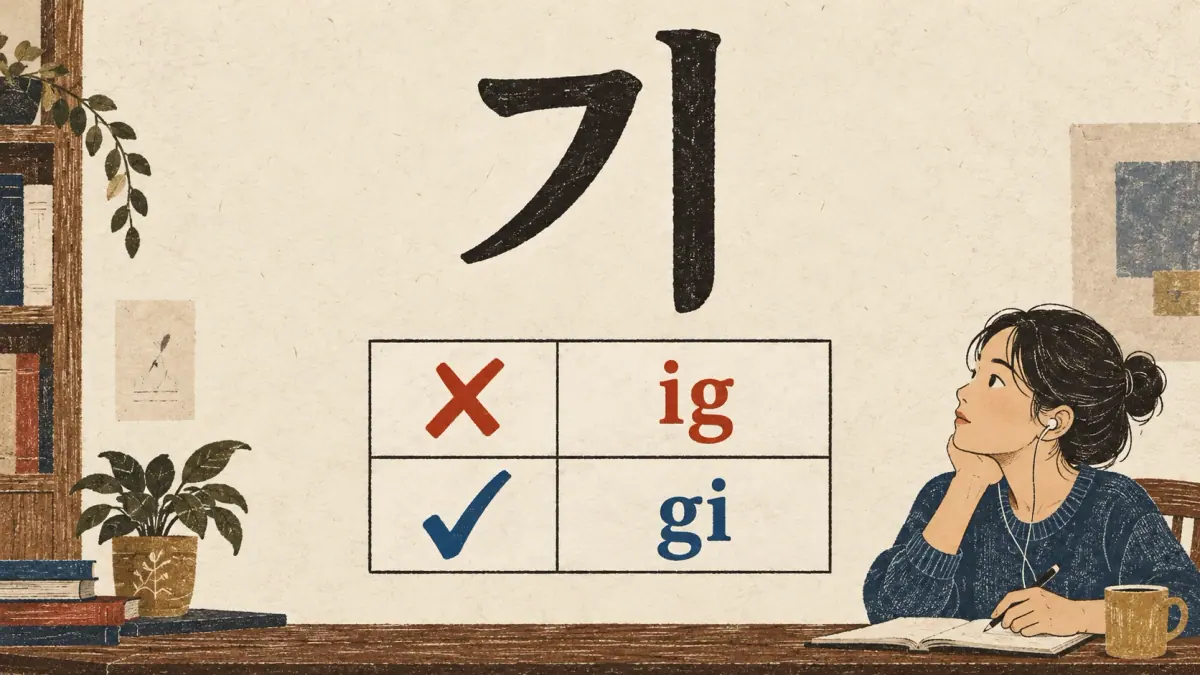
Beginners make four predictable mistakes with vertical-vowel blocks. Each one has a simple fix.
- Reading right to left. Learners sometimes read 기 as "ig". The consonant is on the left, so the sound comes first: "gi".
- Confusing ㅏ and ㅓ. The short stroke points right in ㅏ (a) and left in ㅓ (eo). A memory aid: say "a" for the stroke on the right and "eo" for the stroke on the left, and check each block against the audio.
- Skipping the silent ㅇ. Writing ㅏ alone is not a syllable. A block that begins with a vowel needs ㅇ on the left: 아, not ㅏ.
- Writing a short vowel. If ㅏ stops halfway down the block, the block looks like two stacked pieces. Draw the vertical stroke all the way from top to bottom.
Remember: learners often assume ㅇ is "the letter that makes the ng sound". That is true only at the end of a syllable. At the beginning, as in 아, it makes no sound at all.
You are ready to try the drills yourself.
Practice: Build and Read 12 Syllables
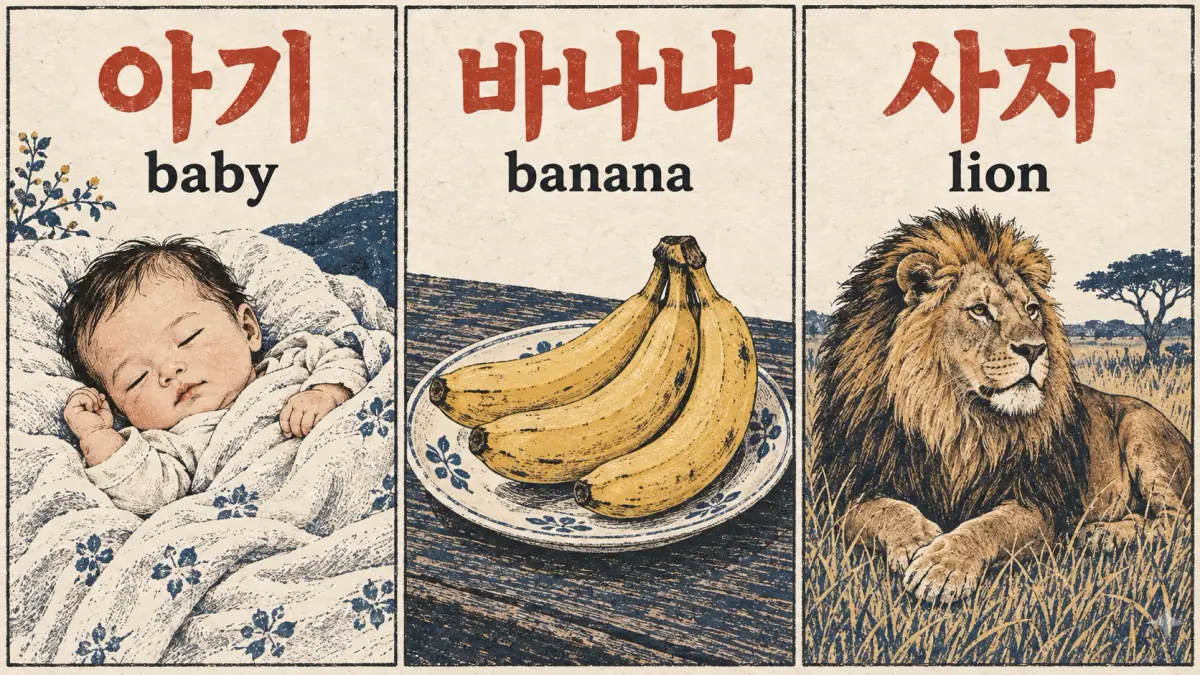
Do these exercises on paper first, then check your answers below.
A. Build the block. Combine each pair into one syllable.
- ㄴ + ㅓ
- ㅁ + ㅣ
- ㅂ + ㅐ
- ㅇ + ㅖ
- ㅅ + ㅔ
- ㄷ + ㅣ
B. Read the block. Say each one aloud, then write its Revised Romanization.
- 마
- 기
- 라
- 여
- 바
- 애
C. Read the words. Each word uses only vertical-vowel blocks.
- 아기 (baby)
- 나라 (country)
- 바나나 (banana)
- 사자 (lion)
Practice · 8
With a vertical vowel, where does the first consonant go?
Show answer
On the left
If the vowel's long stroke runs up and down, the consonant stands on the left and the vowel on the right.
Which of these vowels is NOT vertical?
Show answer
ㅗ
ㅗ has a flat main stroke, so the consonant goes on top; ㅐ, ㅕ and ㅣ are vertical.
Which block is ㄴ + ㅓ?
Show answer
너
ㅓ is vertical, so ㄴ goes on the left: 너 (neo).
How do you write a syllable that is just the vowel ㅏ?
Show answer
아
A vowel-initial syllable uses silent ㅇ in the consonant slot: 아, not ㅏ alone.
How do you read the block 기?
Show answer
gi
Blocks are read left to right, consonant first: ㄱ + ㅣ = gi.
What happens to ㄱ inside the block 가?
Show answer
It gets narrower and its downstroke slants slightly left
The consonant is squeezed into the left half, so ㄱ shrinks and slants while ㅏ keeps its full height.
Which block is ㅇ + ㅖ?
Show answer
예
Silent ㅇ on the left plus ㅖ on the right gives 예 (ye).
When does a vertical vowel lose height?
Show answer
When a final consonant sits underneath
With a batchim, the vowel's long stroke stops above the final consonant; that is the only time it is shortened.
Answers. 1. 너 (neo). 2. 미 (mi). 3. 배 (bae). 4. 예 (ye). 5. 세 (se). 6. 디 (di). 7. ma. 8. gi. 9. ra (or la). 10. yeo. 11. ba. 12. ae.
If you missed more than three, return to the vowel table and say each vowel aloud before building the block again.
Review these syllables later with the Hangul flashcard decks, and for the complete grid see the Korean syllable chart.
What to Learn Next
Learn horizontal-vowel blocks next. They use the other placement rule, where the vowel goes below the consonant, so that you can sort any block into the right shape. After that comes the mixed-vowel layout, which wraps the vowel below and to the right.
This lesson does not cover final consonants in detail, the sound rules that change how a block is read inside a word, or the exact stroke order for each letter. Those topics have their own lessons: start with horizontal-vowel blocks, then return to the six block shapes for the full overview.
In short, Korean vertical vowels follow one rule. If the vowel's long stroke runs up and down, the consonant goes on the left and the vowel on the right, and the block is read left to right.
Frequently Asked Questions
Is ㅐ a vertical vowel? Yes. ㅐ is a vertical vowel made from ㅏ plus ㅣ, so it sits to the right of the consonant, as in 애 (ae) and 배 (bae). All nine vowels whose long stroke runs up and down follow the same left-to-right rule: ㅏ ㅐ ㅑ ㅒ ㅓ ㅔ ㅕ ㅖ ㅣ.
Why is 가 not written like ㄱ + ㅏ side by side with gaps? Every Hangul block fills one square space of equal size. The consonant and vowel are resized to share that space, so the ㄱ in 가 is narrower and slants slightly. This is why Korean text looks evenly spaced, and why typing ㄱ then ㅏ produces a single joined block.
What does 가나다 mean? 가나다 is not an everyday word. It is the first three syllables of the traditional consonant row, much like ABC in English. Korean also uses 가, 나, 다 as list labels, the way English uses a, b, c. Reciting the row is a common first reading exercise.
Can I write the vowel smaller? Keep a vertical vowel as tall as the whole block. The long vertical stroke is the signal that tells a reader to look to the left for the consonant. If you shrink it, the block becomes harder to read, and in the 3-part layouts it can collide with the final consonant at the bottom.
Is 이 a word? Yes. 이 is a full syllable and also a word with several meanings, including "tooth", "two" in Sino-Korean numbers, and "this". It is built from silent ㅇ on the left and ㅣ on the right, so it is read [i]. Context decides which meaning is intended.